Summary: Purchasing a flat from a non-resident seller with a home loan creates a significant tax deduction at source (TDS) challenge because the buyer remains responsible for deducting tax even when the bank directly disburses most of the sale consideration to the seller. Unlike purchases from resident sellers, which generally attract 1% TDS above the prescribed threshold, purchases from non-residents fall under Section 393(2) of the Income-tax Act, 2025, with deductions based on the applicable rates for the seller’s taxable income. Where no lower or nil deduction certificate is available, withholding on the gross consideration can create a substantial cash-flow burden. A ₹1.20 crore purchase financed by a ₹90 lakh home loan illustrates how a 14.95% illustrative TDS rate produces a deduction of ₹17.94 lakh, including ₹13.455 lakh attributable to the bank-funded portion. From 1 October 2026, Notification No. 121/2026 introduced Schedule E in Form 141, allowing specified resident individual and HUF buyers to complete the relevant TDS compliance without obtaining a TAN. However, this procedural simplification does not eliminate the buyer’s withholding obligation. The article explains how to establish the seller’s residential status, obtain a lower or nil deduction certificate through Form 128, incorporate TDS provisions into the sale agreement, coordinate net disbursement with the lender, deposit tax, file Form 141 and issue Form 132. It also addresses the seller’s refund and remittance requirements.
- Buying a Flat from an NRI with a Home Loan: TDS, Bank Disbursement and Form 141 Schedule E
- Why the Bank Disbursement Is the Buyer's Problem
- How Large the TDS Deduction Is
- Resident Seller Versus Non-Resident Seller
- Taxable Capital Gain and Gross Sale Consideration
- Surcharge, Cess and Higher Deduction Rates
- A Worked Example: ₹1.20 Crore Flat Purchased with a ₹90 Lakh Home Loan
- Lower or Nil TDS Certificate Under Section 395
- Planning the Home Loan Disbursement
- 1. Confirm the Seller's Residential Status Before Signing
- 2. Ask About a Lower or Nil Deduction Certificate
- 3. Include the TDS Arrangement in the Sale Agreement
- 4. Give the Bank the Net Disbursement Calculation
- 5. Deposit and Report TDS Through Form 141 Schedule E
- 6. Issue the TDS Certificate in Form 132
- Transactions Spanning 1 October 2026
- The Non-Resident Seller's Side: Return, Refund and Remittance
- Conclusion
Buying a Flat from an NRI with a Home Loan: TDS, Bank Disbursement and Form 141 Schedule E
A buyer who purchases a flat from a resident seller with a home loan rarely thinks about TDS beyond the familiar 1 percent. The bank disburses the loan, the buyer deducts 1 percent of each payment, and the arithmetic is small enough to absorb. When the seller is a non-resident, the same home-loan transaction can go wrong in a way that is expensive to undo: the TDS can exceed 14 percent of the sale value, it applies to the money the bank pays as much as to the buyer’s own contribution, and once the bank has released the full disbursement to the seller, the buyer has nothing left in hand to deduct from.
The procedure changed on 1 October 2026, when Schedule E was added to Form 141 and a resident individual or HUF buying from a non-resident no longer needs a TAN. That change simplifies the filing. It does not change the size of the deduction or the buyer’s responsibility for it. This article looks at the practical problem the procedural articles do not address: how to plan the deduction when most of the price is paid by a lender.
Why the Bank Disbursement Is the Buyer’s Problem
TDS is the buyer’s obligation, not the bank’s. Where the seller is a non-resident, the buyer deducts tax under section 393(2) of the Income-tax Act, 2025 (Table, Sl. No. 17), not under section 393(1), which carries the 1 percent rule for resident sellers. The deduction is made on every payment to the seller, including the token advance, each instalment and the amount the bank disburses from the buyer’s loan account. A home loan is a loan to the buyer; when the bank pays the seller, it is paying on the buyer’s behalf.
Banks generally disburse against the sale agreement and the sanction letter, often by a demand draft or transfer in the seller’s favour. A bank’s internal checklist is built mainly around resident sellers, and the disbursement request is usually prepared before anyone has calculated the TDS. If the bank releases the full amount to the seller, the buyer is left to pay the tax from their own funds and recover it from a seller who may already have left India.
How Large the TDS Deduction Is
Resident Seller Versus Non-Resident Seller
For a resident seller the buyer deducts 1 percent of the higher of the consideration and the stamp duty value, once that value is Rs 50 lakh or more. For a non-resident seller there is no Rs 50 lakh threshold and no 1 percent rate. The buyer deducts at the rate applicable to the seller’s income, which for a property held long enough to give a long-term capital gain is 12.5 percent for transfers on or after 23 July 2024, increased by the applicable surcharge and health and education cess.
Taxable Capital Gain and Gross Sale Consideration
The law charges TDS on the income chargeable to tax, which for a sale is the capital gain. The buyer, however, does not know the seller’s cost of acquisition or improvement and is responsible if too little is deducted. In practice, unless the seller produces a lower or nil deduction certificate, buyers and banks apply the rate to the full sale consideration.
Surcharge, Cess and Higher Deduction Rates
With surcharge at 10 percent or 15 percent depending on the amount, and cess at 4 percent, the effective rate on a long-term gain commonly works out to about 13.0, 14.3 or 14.95 percent. The surcharge depends on the actual figures, so the rate should be worked out for each transaction rather than taken from a table. Where the seller’s PAN is not available or is inoperative, and the seller has not furnished the details the law allows in its place, a higher rate applies.
A Worked Example: ₹1.20 Crore Flat Purchased with a ₹90 Lakh Home Loan
A buyer agrees to purchase a flat in Chennai for Rs 1.20 crore from a seller who lives abroad and is a non-resident for tax. The bank has sanctioned a loan of Rs 90 lakh. The buyer’s own contribution is Rs 30 lakh, of which Rs 10 lakh is paid as advance on signing the agreement and Rs 20 lakh at registration, along with the bank’s disbursement.
If no certificate is produced and TDS is deducted on the full consideration at an effective 14.95 percent, the total deduction is about Rs 17.94 lakh. The buyer’s own Rs 30 lakh is enough to cover it only if the deduction is planned against every payment from the start:
| Payment | Amount (Rs) | TDS at 14.95% (Rs) | Net to Seller (Rs) |
|---|---|---|---|
| Advance on agreement | 10,00,000 | 1,49,500 | 8,50,500 |
| Buyer’s balance at registration | 20,00,000 | 2,99,000 | 17,01,000 |
| Bank disbursement | 90,00,000 | 13,45,500 | 76,54,500 |
| Total | 1,20,00,000 | 17,94,000 | 1,02,06,000 |
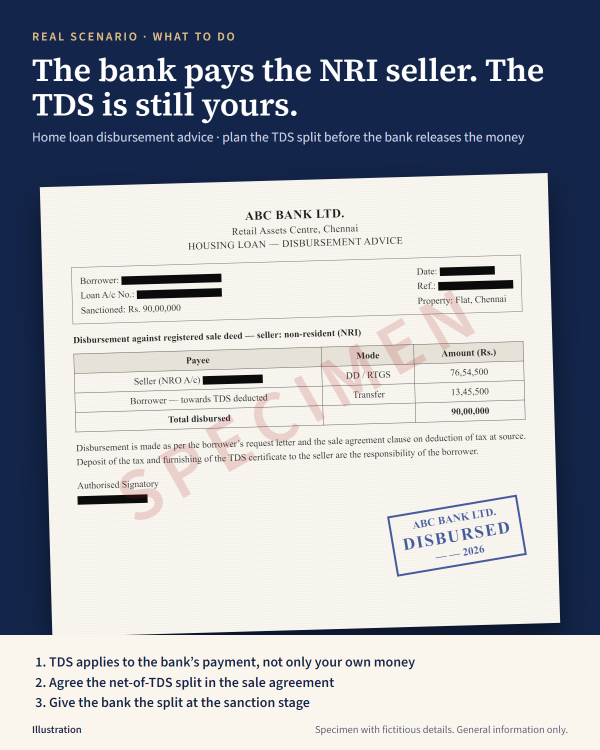
Illustration (attached image): a specimen home loan disbursement advice with fictitious details, showing the bank paying the seller net of TDS and the TDS portion routed to the buyer.
The figures are illustrative. The point is the last line before the total: Rs 13.46 lakh (Rs 13,45,500) of the deduction relates to money that never passes through the buyer’s hands. If the bank pays Rs 90 lakh to the seller, the buyer has to find about Rs 13.46 lakh from elsewhere on the day of registration.
Lower or Nil TDS Certificate Under Section 395
If the seller obtains a certificate fixing a lower rate based on the real gain, the deduction falls accordingly. The seller applies to the Assessing Officer; under the Income-tax Act, 1961 this was the application in Form 13 under section 197, and under the 2025 Act the Department’s guidance places it in Form 128, with the certificate issued under section 395. A certificate covers only payments made after it is issued and within its limits, so it has to be in hand before the first payment it is meant to cover.
Planning the Home Loan Disbursement
The following sequence avoids the problem in most transactions:
1. Confirm the Seller’s Residential Status Before Signing
Confirm the seller’s residential status in writing before the agreement. An Indian passport does not make a person resident for tax; residence depends on the days of stay in India. A written statement from the seller, kept with the file, is the buyer’s first protection.
2. Ask About a Lower or Nil Deduction Certificate
Ask early whether the seller will apply for a lower or nil deduction certificate. The application takes time to process. If the seller intends to apply, fix the agreement timeline so that the advance is small and the main payments fall after the certificate is likely to be issued.
3. Include the TDS Arrangement in the Sale Agreement
Write the TDS into the sale agreement. State that the price is subject to deduction of tax at source, that the seller will receive the price net of the deduction, and how the deduction will be apportioned between the advance, the buyer’s balance and the bank’s disbursement.
4. Give the Bank the Net Disbursement Calculation
Give the bank the split before it prepares the disbursement. Provide the bank with the agreement clause, the calculation and, if available, the certificate, and request that the disbursement in the seller’s favour be for the net amount, with the TDS portion routed so that the buyer can deposit it. Banks differ in how they handle this, so raise it at the sanction stage rather than on the day of registration.
5. Deposit and Report TDS Through Form 141 Schedule E
Deposit and report under Schedule E. From 1 October 2026, a resident individual or HUF buyer deposits and reports the tax through Form 141, Schedule E, on the e-filing portal using the buyer’s own PAN, and a TAN is no longer mandatory for these transactions. Other buyers, such as companies and firms, should check the TAN requirement on the portal. Resident and non-resident sellers cannot be combined in one Form 141: Schedule B is used for a resident seller and Schedule E for a non-resident one. Check the due date on the portal for the month in which each deduction is made.
6. Issue the TDS Certificate in Form 132
Issue the TDS certificate to the seller. The buyer furnishes the TDS certificate in Form 132 so that the seller can claim credit in the return for the year of sale.
Transactions Spanning 1 October 2026
Payments made before 1 October 2026 followed the earlier route, with a TAN and a quarterly statement. Where an agreement straddles that date, the date of each deduction decides which procedure applies to it.
The Non-Resident Seller’s Side: Return, Refund and Remittance
The seller has to file an income tax return in India for the year of sale, report the capital gain and claim credit for the tax deducted. If the deduction on the full consideration exceeds the tax on the actual gain, the difference comes back only as a refund after the return is processed, which is why a lower deduction certificate is usually worth applying for on a large sale. When the seller moves the proceeds abroad, the remittance is supported by Form 145 (earlier Form 15CA) and, where required, a Chartered Accountant’s certificate in Form 146 (earlier Form 15CB); limits on remittance are governed by the Reserve Bank of India’s directions. Payment is normally received in the seller’s NRO account.
Conclusion
Schedule E has removed the TAN, which was the main procedural obstacle for an individual buying from an NRI. The arithmetic remains what it was. In a home-loan purchase, most of the price is paid by the bank, and most of the TDS therefore relates to money the buyer does not control. The buyer who settles the seller’s status, the possibility of a certificate, the agreement clause and the bank’s disbursement split before registration avoids having to fund a six-figure or seven-figure deduction from their own funds.
******
General information only. Rates, forms and due dates should be checked on the Income Tax Department’s website for the date of each payment.
About the author: CA S. A. Abdul Rahim is a Chartered Accountant in practice in Adyar, Chennai, since 1985.