Shriram Finance Company Ltd Vs Karthik Travels Pvt Ltd (NCLT Chennai)
Summary: The National Company Law Tribunal, Division Bench-I, Chennai, admitted the insolvency petition filed by Shriram Finance Limited against Karthik Travels Private Limited under Section 7 of the Insolvency and Bankruptcy Code, 2016. The creditor had provided 39 vehicle loans and two business term loans, supported by loan documents, vehicle hypothecation, personal guarantees and mortgages over guarantors’ properties. The petition, filed on 14 August 2023, disclosed financial debt of ₹9,26,14,822 and an amount claimed in default of ₹23,54,74,793 as on 19 May 2023. The creditor relied on account statements, a NeSL certificate and loan recall notices issued in January 2023. The Tribunal recorded that the account had been classified as NPA on 16 March 2020.
The corporate debtor disputed maintainability principally under Section 10A, contending that the alleged defaults fell within the protected COVID period. It also relied on RBI’s COVID regulatory package and the moratorium for instalments falling due between 1 March and 31 August 2020 to challenge the NPA classification. It cited Ramesh Kymal on the statutory suspension and Vidarbha Industries on the discretion associated with Section 7(5)(a). Additionally, it relied on NOCs for 19 vehicles, closure of several loan accounts, repayments including ₹2 crore towards one facility, and its calculation that only ₹40,86,890 remained due on a particular facility as on 19 November 2022, below the ₹1 crore threshold. These were the debtor’s submissions, rather than findings accepted by the Tribunal.
The financial creditor answered that defaults existed before the COVID suspension and continued afterwards. It explained that NOCs for cancellation of vehicle hypothecation were issued subject to undertakings preserving repayment liability. It asserted that, after giving credit for payments, the remaining default still exceeded the statutory threshold. The order also records that the parties had filed a joint compromise memo on 6 August 2024, following which the petition was disposed of as settled. Upon breach of the agreed payment schedule, the creditor secured restoration through IA/1168/2025. During the hearing on 17 September 2025, the debtor submitted a further payment schedule acknowledging ₹5,08,64,569 payable between September 2025 and 31 March 2026, referring to a proposed property sale.
The Tribunal held that Section 10A did not protect defaults committed before 25 March 2020. It found that the defaults preceded that date, continued beyond the pandemic restrictions and exceeded ₹1 crore even after accounting for repayments. The issue of NOCs and settlement of individual vehicle loans did not discharge the remaining liability. Referring to Ramesh Kymal, it noted the purposive approach to Section 10A, but concluded that the present defaults fell outside the protection claimed. It also relied on Power Trust Vs Bhuvan Madan and the clarification in Suresh Kumar Reddy that Vidarbha’s observations were confined to its facts. The Tribunal stated that the Section 7 enquiry concerns debt and default, subject to the threshold and limitation requirements, and found admission warranted.
Accordingly, CIRP was initiated against Karthik Travels and Mathur Sabhapathy Viswanathan was appointed Interim Resolution Professional. He was directed to take the statutory steps under Sections 15, 17 and 18 and file a report within 20 days. The board’s powers stood superseded, and the creditor was directed to advance ₹3 lakh towards the IRP’s expenses. A moratorium under Section 14 commenced from the order date, with the order reproducing its restrictions, protections for essential and critical supplies, exceptions and duration. The Registry was directed to communicate the order to the parties, IBBI, the IRP and the Registrar of Companies.
Cases Discussed
- Power Trust Vs Bhuvan Madan — (2026) ibclaw.in 87 SC (Supreme Court). Relied upon for the limited scope of the financial creditor’s insolvency admission enquiry and the objective of prompt insolvency resolution.
- Suresh Kumar Reddy & Ors. Vs Canara Bank & Ors. — (2023) ibclaw.in 67 SC (Supreme Court). Cited through Power Trust for the clarification that the relevant observations in Vidarbha were confined to that case’s facts.
- Vidarbha Industries Power Limited Vs Axis Bank Limited — Civil Appeal No. 4633 of 2021 (Supreme Court, 2022). Invoked by the corporate debtor on discretion under Section 7(5)(a); the Tribunal referred to the subsequent clarification limiting its application.
- Ramesh Kymal Vs Siemens Gamesa Renewable Power Pvt Ltd — Civil Appeal No. 4050 of 2020 (Supreme Court, 2021). Cited by the debtor and considered by the Tribunal regarding Section 10A’s protective purpose; the present petition was admitted on findings of defaults before the protected period.
FULL TEXT OF THE ORDER OF NCLT CHENNAI
1. This petition CP(IB)/157(CHE)/ 2023 under Section 7 of the Insolvency and Bankruptcy Code, 2016 (IBC) r/w Rule 4 of the Insolvency and Bankruptcy (Application to Adjudicating Authority) Rules, 2016 has been filed by the Financial Creditor / Petitioner Shriram Finance Limited against the Corporate Debtor / Respondent Karthik Travels Private Limited for initiating Corporate Insolvency Resolution Process (CIRP).
2. Part – I of the petition provides the particulars of the Financial Creditor i.e. Shriram Finance Limited formerly known as Shriram Transport Finance Company Limited. It was incorporated on 30.06.1979 having its registered office at 14A, South Phase, Industrial Estate, Guindy, Chennai – 600 032. Part – II of the petition provides the particulars of the Corporate Debtor i.e. Karthik Travels Private Limited. It was incorporated on 20.01.2016 with authorized capital and paid up capital of Rs. 2,00,00,000/-. Its registered office is at 18/43, Corporation Shopping Complex, III Cross Street, Chennai – 600 028 within the jurisdiction of this Tribunal. In Part – III of the petition, the Petitioner has proposed the name of Insolvency Professional being Mr. Mathur Sabhapathy Viswanathan having IBBI Registration No: IBBI/IPA- 001/IP-P00674/2017-2018/11148, Email ID: [email protected]. In Part – IV of the petition, Petitioner has disclosed the particulars of financial debt being Rs. 9,26,14,822/- as on 19.05.2023, amount claimed to be in default being Rs. 23,54,74,793/- as on 19.05.2023. This petition has been filed on 14.08.2023. Part – V of the petition provides the details of the documents, records and evidence of default.
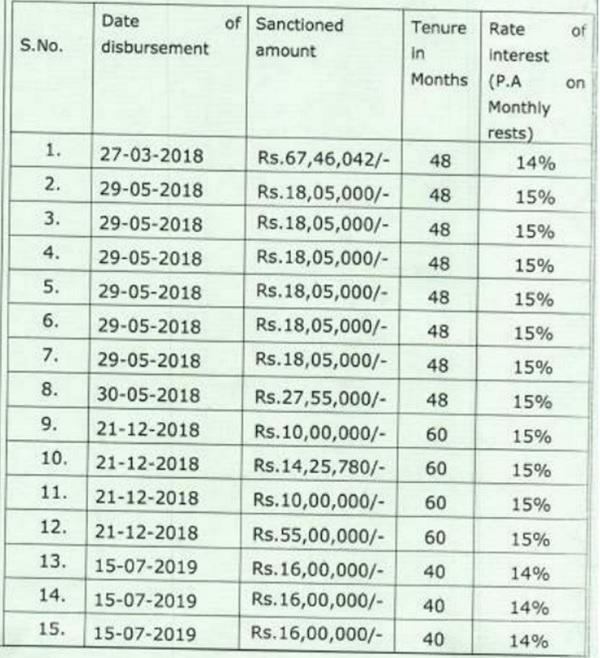
3. The case of the Petitioner is that the Petitioner, a NBFC incorporated under the Companies Act, 1956, on the request made by the Corporate Debtor for seeking financial assistance for its business, in the year 2018, sanctioned financial facilities in the form of 39 vehicle loans and two term loans being business loans. In consideration thereof and to secure the facilities, the Corporate Debtor executed the loan documents. M. Eshwar and M. Mohan, Directors of the Corporate Debtor stood as the Guarantors in their individual capacity for the 39 vehicle loans availed by the Corporate Debtor. Rajasekaran also stood as Guarantor for the vehicle loans availed by the Corporate Debtor. In respect of two term loans, i.e. business loans availed, the Corporate Debtor executed the loan documents. Mrs. R. Poonam Madan, M. Ramesh Madan and N. Vijayan stood as the Guarantors for the term loans and executed the letter of guarantee. Apart from standing as Guarantors, they created mortgage over their immovable properties by executing two memorandum of title deeds. Against the sanctioned loan, the Financial Creditor disbursed the facilities from 27.03.2018 to 19.07.2019 as tabulated below.
–
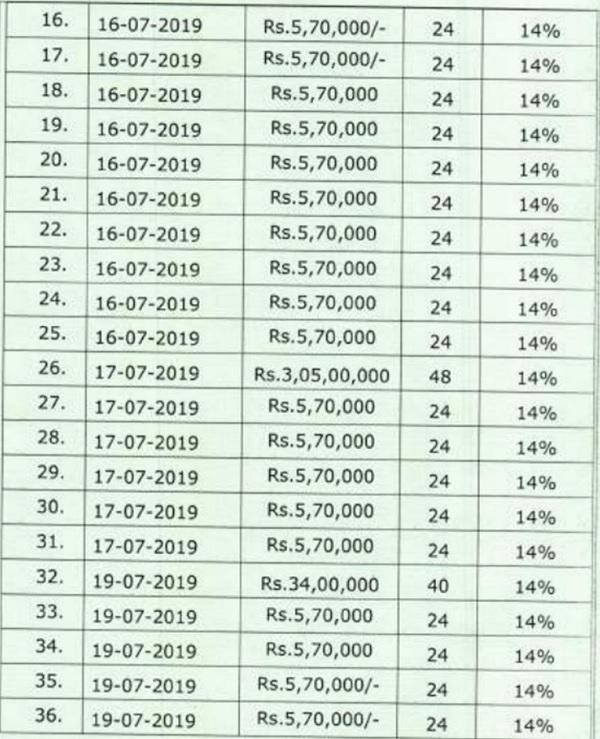
4. The loan was payable in 48 / 60 / 24 / 40 monthly installments carrying rate of interest (per annum on monthly rests) @ 14% to 15%. The term loans were disbursed on 27.02.2018 and 04.03.2020 for Rs. 90,00,000/- and Rs. 48,28,000/- respectively, carrying an interest rate @ 15% and 20% per annum on monthly rests repayable in 60 monthly installments. The Corporate Debtor / Guarantors executed various documents including demand promissory note, term loan agreement, letter of guarantee, hypothecation cum loan agreement, letter of guarantee as detailed in para 5 of Part – III of the petition. To secure the above facilities, the Corporate Debtor also hypothecated the vehicles purchased from and out of the said facilities as per details as under:
5. A condition was stipulated in the loan documents that in case of default, additional interest shall be charged and the interest would be 20% per annum compounded monthly for the period of default.
6. It is alleged that after availing the vehicle loans, the Corporate Debtor did not come forward to repay the loans as agreed upon and the account of the Corporate Debtor with the Financial Creditor became NPA on 16.03.2020. The Financial Creditor sent loan recall legal notices dated 06.01.2023, 11.01.2023, 12.01.2023 and 13.01.2023, but despite that the Corporate Debtor did not make the payment which made the Petitioner file the petition. The Petitioner has placed copy of the above documents including NeSL certificate, statement of accounts, master data of the Corporate Debtor and stated that the petition is within limitation.
7. On getting notice of the petition, the Corporate Debtor filed the reply wherein it denied the averments made in the petition and alleged that the petition suffers from the vices of suppression veri and suggestio falsi. It however admitted that it had approached the Petitioner for purchase / refinance of motor vehicles, machinery and other assets and entered into multiple loan agreements with the Petitioner. It is stated that despite the loan account becoming NPA on 16.03.2020, the Petitioner sanctioned and disbursed a term loan of Rs. 48,28,000/- under the loan agreement dated 04.03.2020. It is stated that Respondent had received ‘No Objection Certificates’ for 19 of the hypothecation cum loan agreements and the Respondent was permitted to remove the hypothecated vehicles from the premises. It is stated that the NOCs were given much prior to the filing of the petition, during the year 2020-2023.
8. It is stated that the default of dues amounting to Rs. 9,26,14,822/- occurred between March 2020 to March 2021 i.e. the 10A period (Covid 19 pandemic period from 25.03.2020 to 24.03.2021).
9. It is stated that the Respondent had taken all bonafide steps to close the loans by paying the amounts due under the loan agreements. Even after filing of the petition, two loan agreements were settled and closed for which loan closure letters were issued by the Petitioner. In addition, it settled two more loan agreements for which the Petitioner had promised to provide NOCs as Annexure B. It is stated that Respondent also paid Rs. 2,00,00,000/- in respect of the loan agreement No. MVELIT907160011 against which the Petitioner issued the acknowledgment letter (Annexure C).
10. It is stated that during the subsistence of Covid 19 pandemic, RBI issued various directions and circulars for the rescue of the borrowers indicating the moratorium period from 01.03.2020 to 31.08.2020. Considering the same, accounts classified as standard as on 29.02.2020, even if the amounts were overdue, moratorium would operate for the payments that fell due in the said period. Therefore classification of the account of the Respondent as NPA is not valid. Reference is made of the case Ramesh Kymal Vs. Siemens Gamesa Renewable Power Pvt Ltd, Civil Appeal No. 4050 of 2020 where Hon’ble Supreme Court held that the amendment in the form of Section 10A was brought in place keeping in mind the catastrophic effects of the said provision. It was held that no application shall ever be filed for the initiation of CIRP for the default said to have occurred for the period after 25.03.2020 for a period of six months extendable upto one year. In the present case, the default occurred between the period 2020-2021. One loan facility, out of 39 loan facilities and two term loans, fell in the year 2020 as evident from the record of default filed by the Petitioner. Even for the said loan agreement, the Respondent had made a payment of Rs. 2.0 Crore on 27.10.2021. So, by virtue of RBI circulars and Section 10A of the Code, Respondent has not committed any default. Reference is made of the case Vidarbha Industries Power Limited Vs. Axis Bank Limited, Civil Appeal No. 4633 of 2021, to submit that the term ‘may’ used in Section 7(5)(a) of IBC must be construed in accordance with the intent of the legislature. It is stated that the Respondent is not a defaulter and is in a condition to make good any other dues that may arise.
11. With the reply, the Respondent has placed copy of the loan closure letter dated 04.11.2023, letter dated 07.11.2023, acknowledgment letter dated 27.10.2021 and letter dated 16.10.2023 issued by the Petitioner as well as the RBI circulars issued by RBI on Covid – 19 Regulatory Package.
12. The Respondent filed an additional counter vide Sr. No. 1075 dated 13.03.2026 alleging that as the majority of alleged defaults fell within the period for which initiation of CIRP is expressly barred by Section 10A of IBC, the petition is legally untenable. With respect of loans under entries 1, 2 and 3 as per tabulation below, defaults occurred on 16.03.2020 and 21.03.2020, so the classification of accounts as NPA is legally invalid and in violation of the directives issued by RBI i.e. RBI/2019-20/220 dated 17.04.2020 and RBI/2019-20/244 dated 23.05.2020. It is stated that the Respondent had made the payments of Rs. 10,01,724/-, Rs. 1,65,300/- and Rs. 1,72,900/- towards these loans.
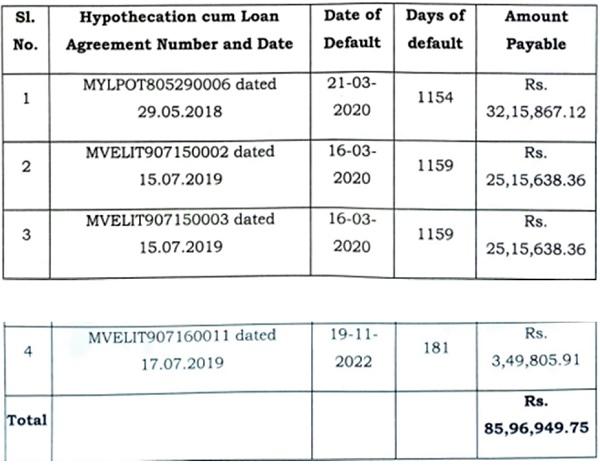
13. With respect to the loan under entry 4 in the table above, on 31.10.2020, the Petitioner had received Rs. 2.0 Crores from the Respondent towards servicing of loans. It is stated that as per the terms of the agreement, Respondent was to pay monthly installment of Rs. 6,99,655/- till 20.07.2023 and Rs. 99,58,875/- on 20.08.2023. Hence, as on 19.11.2022, the hypothecation amount payable with respect to entry 4 amounted to Rs. 2,65,86,890/- out of which the Respondent has paid Rs. 2,25,00,000/-. Therefore, on the actual date of default i.e. on 19.11.2022, only Rs. 40,86,890/- were due which are below the threshold of Rs. 1.0 Crore.
14. The Respondent has placed a document dated 28.09.2023 i.e. Request permission to sell vehicles vide Sr. No. 2093 dated 26.04.2024 stating that as they were unable to clear the arrears / outstanding amount or settle the loan accounts, they decided to sell the vehicles and deposit the sale proceeds in the account of the Petitioner. The Respondent has also filed a memo vide Sr. No. 2097 dated 29.04.2024 stating that out of 39 vehicle loan facilities, the Respondent has made the payments and closed the 11 vehicle loan facilities.
15. The Petitioner filed the Rejoinder vide Sr. No. 243. dated 11.01.2024 wherein it denied the averments made in the reply / counter. It is stated that the Respondent had approached the Petitioner in 2018 for a floating loan which the Petitioner sanctioned to the tune of Rs. 50,00,000/- on 21.03.2018. After availing the same, the Respondent did not maintain the repayment and requested to renew the loan which the Petitioner did adding the accrued interest on 12.03.2019. Even after the renewal, it did not repay the loan before the maturity date and once again requested the Petitioner by letter dated 20.03.2020 to convert the floating loan into a term loan which request was acceded to. Thereafter the Respondent executed the various documents. It is stated that permission in respect of 19 vehicles was given for cancellation of hypothecation and endorsement / entry in the registration certificate of the vehicles based on the request of the Respondent who had given an undertaking that though the NOC has been given but it shall not absolve the Respondent from its liability and it will settle the account in accordance with the terms and conditions of the loan agreement. It is alleged that the Respondent failed to settle the loans.
16. It is stated that the Respondent has misinterpreted Section 10A of IBC. The defaults committed by the Respondent were well prior to Covid 19 and continued after Covid 19 period. The Respondent has yet to close / settle the remaining loan agreements. It is stated that after deposit of the sale proceeds / amount, cancellation of hypothecation endorsement letters dated 06.10.2021 and 28.09.2023 were given. It is stated that the default amount is more than the threshold limit even prior to Covid 19 which continued even after the pandemic restrictions as per tabulation placed below.
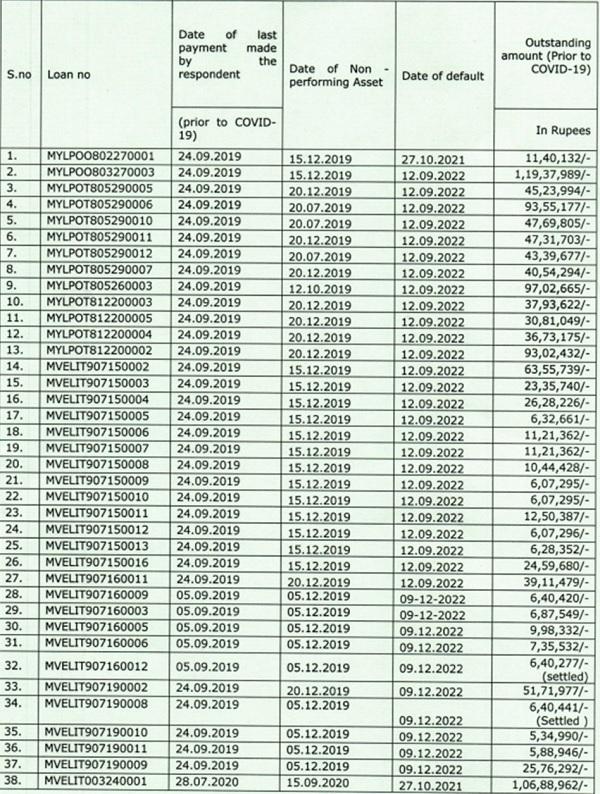
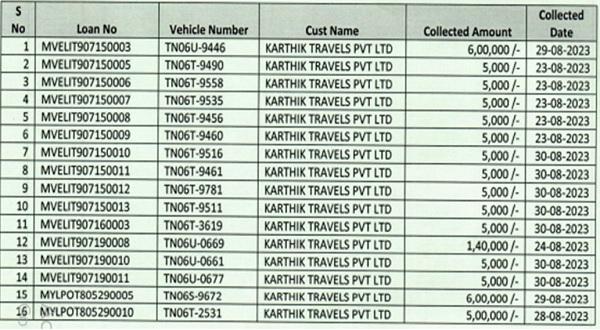
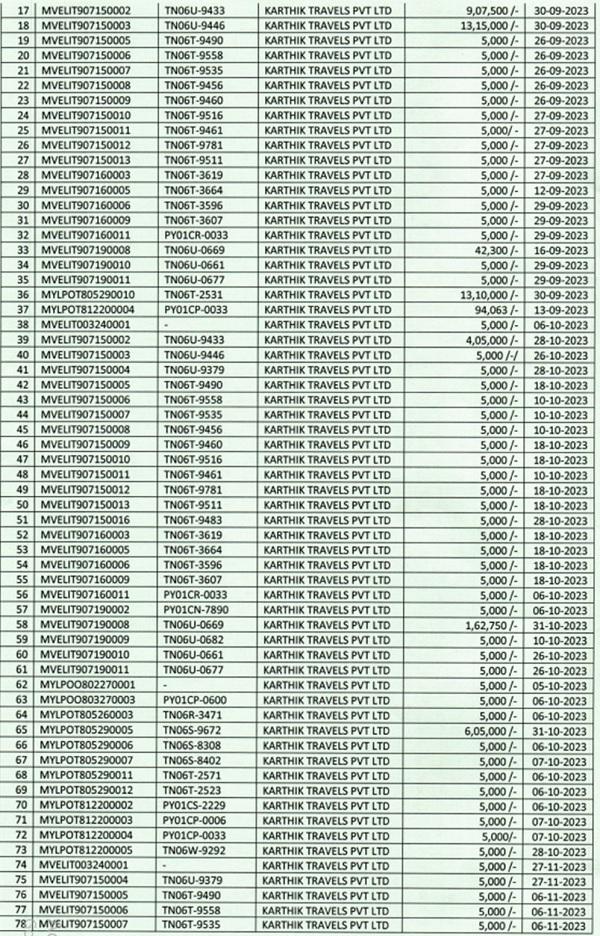
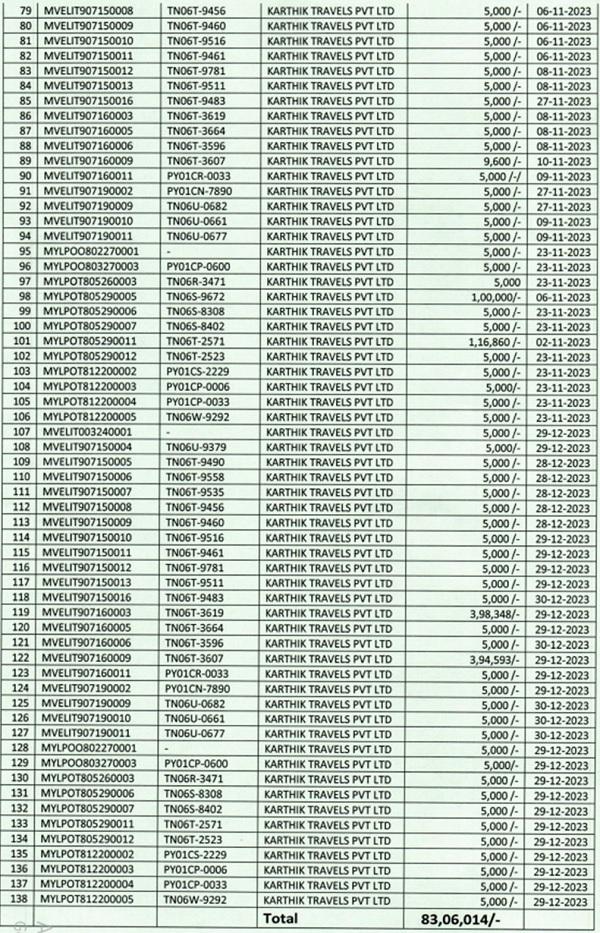
It is stated that after giving credit to the payments made in the loan accounts, there was an outstanding liability which remained unpaid. The cases referred by the Respondent in reply are not applicable to the present case. The letters sent by the Respondent prior to filing of the petition would disprove the contention raised by the Respondent. It is stated that after filing of the petition, the Respondent made a payment of Rs. 83,06,014/- as against the outstanding liability of Rs. 23,54,74,793/- from 23.08.2023 to 31.12.2023 as per the details placed at page 6 to 8 of the Rejoinder, which is reproduced as under.
–
–
17. We have heard Ld. Counsels for the parties and perused the written submissions filed by the Respondent.
18. In the instant case, the Respondent had sent a proposal to settle the dues of the Petitioner. The parties filed the joint memo of compromise on 06.08.2024 stating that one time settlement has taken place. They also filed the schedule of payment. It was undertaken by the Respondent that there shall be no default in the repayment schedule and in case of default, OTS would stand withdrawn. The petition was disposed of as settled. When the Corporate Debtor defaulted in the repayment, the Petitioner filed an application IA/1168/2025 for restoration of the petition alleging that the Respondent did not honor the OTS and committed default. After hearing the parties, this Tribunal allowed the application and revived the petition. It is to note that during the hearing on 17.09.2025, the Respondent had placed a memo enclosing a schedule of payment for a sum of Rs. 5,08,64,569/- payable from September, 2025 to 31.03.2026 stating that they are selling a property at Medavakkam.
19. A perusal of record shows that the Petitioner had advanced loans to the Corporate Debtor for purchase of 39 vehicles during the period from 27.03.2018 to 19.07.2019 i.e. prior to Covid 19. It also advanced two term loan for Rs. 90,00,000/- and Rs. 48,28,000/- on 27.02.2018 and 04.03.2020 respectively i.e. prior to Covid 19. The loans were repayable in installments carrying interest. The Corporate Debtor had executed the loan documents. Repayments were guaranteed by the Guarantors. The Corporate Debtor also hypothecated the vehicles which were purchased from and out of the above facilities. The Guarantor also mortgaged their immovable properties.
20. The record shows that the Corporate Debtor defaulted in repayment of loan and the account of the Corporate Debtor with the Petitioner was declared NPA on 16.03.2020.
21. Section 10A of IBC provides that no application for initiation of CIRP of a Corporate Debtor shall be filed for any default arising on or after 25.03.2020 for a period of six months. It was extended to one year by notification. It was provided that this provision shall not apply to any default committed before 25.03.2020.
22. In the present case, the default was committed prior to 25.03.2020. Due to non-payment of installment, the account of the Corporate Debtor was declared NPA on 16.03.2020. The loans were recalled on 06 / 11 / 12 .01.2023 by issuing the legal notices. The tabulation placed by the Petitioner shows that the defaults occurred prior to 10A period. The recall notices / legal notices were issued in January 2023 i.e. after the expiry of Covid 19 period. The amount claimed to be in default is Rs. 23,54,74,793/- inclusive of interest upto 19.05.2023.
23. It may be true that the Petitioner had issued NOCs for 19 hypothecated vehicles, prior to filing of petition but the same would not absolve the liability of the Respondent / Corporate Debtor to make payments for the remaining amount. It may also be true that four of the vehicle loan agreements were settled after the filing of the petition and the Corporate Debtor paid an amount of Rs. 2.0 Crore in respect of another loan 160011 but still the Corporate Debtor owes liability to the Petitioner for an amount exceeding the threshold of Rs. 1.0 Crore.
24. In the instant cae, after declaring the loan account NPA, it waited for the Corporate Debtor to repay the loan but when installments were not paid, it issued the recall notices only in 2023 and not during the Covid 19 period. In this case, the Corporate Debtor defaulted prior and after the Covid 19 period which is evident from the statement filed by the Petitioner. The Respondent in its reply vide Sr. No. 1075 dated 13.03.2026 has also admitted the defaults which were prior and after the 10A period. The Petitioner has given a tabulation in the Rejoinder at page 5 which shows that the default amount is more than the threshold limit prior to Covid 19 which continued even after the pandemic restrictions. After giving credit to the payments made in the loan account, still there is an outstanding liability exceeding the threshold.
25. In the case of Ramesh Kymal supra, Hon’ble Supreme Court has held that Section 10A does not contain any requirement that the Adjudicating Authority must launch an inquiry into whether or if so to what extent, the financial health of the Corporate Debtor was affected by the onset of Covid 19 pandemic. The Parliament has stepped in legislatively because of the wide spread distress caused by an unheralded public health crisis. Hence, embargo contained in Section 10A must receive a purposive construction which will advance the object which was sought to be achieved by enacting the provision.
26. The proceedings of the case would show that Respondent had offered to settle and entered into a settlement. The parties filed a joint memo of compromise giving the schedule of payments. On that basis, the petition was disposed of as settled. The Respondent thereafter committed default and did not adhere to the payment schedule which made the Petitioner revive the petition. The Respondent had admitted its liability giving a schedule of payment starting from September 2025 till 31.03.2026 for a sum of Rs. 5,08,64,569/- which amount exceeds the threshold of Rs. 1.0 Crore.
27. It is well settled law that for the petition under Section 7 of IBC, the Tribunal has to see the debt and default. If the debt exceeds the threshold of Rs. 1.0 Crore and there is a default within the limitation as provided under Article 137 of Schedule 1 to the Limitation Act, the petition is liable to be admitted. In the case of Power Trust Vs. Bhuvan Madan, (2026) ibclaw.in 87 SC, Hon’ble Supreme Court has held that the objective of enactment of IBC was to create a complete Code for easy, prompt and seamless resolution of the insolvency process. The Tribunal is not required to go into the inability of the Corporate Debtor to pay its debt. The Code restricts the scope of enquiry for an admission of insolvency process by a Financial Creditor merely to the existence of a debt due and payable and nothing more. It was held that this Court has already clarified in the case of Suresh Kumar Reddy & Ors. Vs. Canara Bank & Ors., (2023) ibclaw.in 67 SC., that the observations made in Para 90 are restricted to the facts of Vidarbha case supra.
28. For the aforesaid reasons, we admit the petition CP(IB)/157(CHE)/2023 and initiate Corporate Insolvency Resolution Process against the Corporate Debtor Karthik Travels Private Limited.
29. The Petitioner has proposed the name of Mr. Mathur Sabhapathy Viswanathan (Email ID: [email protected]) as IRP. We therefore appoint Mr. Mathur Sabhapathy Viswanathan with Registration No: IBBI/IPA-001/IP-P00674/2017-2018/11148 (Email ID: [email protected]) having AFA valid till 30.06.2027 as the Interim Resolution Professional. The IRP, who is appointed shall take forward the process of Corporate Insolvency Resolution of the Corporate Debtor. The IRP appointed shall take in this regard such other and further steps as are required under the Statute, more specifically in terms of Section 15,17,18 of the Code and file his report within 20 days before this Bench. The powers of the Board of Directors of the Corporate Debtor shall stand superseded as a consequence of the initiation of the CIRP in relation to the Corporate Debtor in terms of the provisions of IBC, 2016.
30. The Financial Creditor is directed to pay a sum of Rs. 3,00,000/- (Rupees Three Lakhs Only) to the Interim Resolution Professional to meet out the expenses and to perform the functions assigned to him in accordance to Regulation 6 of Insolvency and Bankruptcy Board of India (Insolvency Resolution Process for Corporate Persons) Regulations, 2016.
31. As a consequence of the petition being admitted in terms of Section 7 of the Code, the moratorium as envisaged under the provisions of Section 14(1) and as extracted hereunder shall follow in relation to the Corporate Debtor:
a. The institution of suits or continuation of pending suits or proceedings against the respondent including execution of any judgment, decree or order in any court of law, tribunal, arbitration panel or other authority;
b. Transferring, encumbering, alienating or disposing of by the respondent any of its assets or any legal right or beneficial interest therein;
c. Any action to foreclose, recover or enforce any security interest created by the respondent in respect of its property including any action under the Securitization and Reconstruction of Financial Assets and Enforcement of Security Interest Act, 2002;
d. The recovery of any property by an owner or lessor where such property is occupied by or in the possession of the respondent.
Explanation.-For the purposes of this sub-section, it is hereby clarified that notwithstanding anything contained in any other law for the time being in force, a licence, permit, registration, quota, concession, clearance or a similar grant or right given by the Central Government, State Government, local authority, sectoral regulator or any other authority constituted under any other law for the time being in force, shall not be suspended or terminated on the grounds of insolvency, subject to the condition that there is no default in payment of current dues arising for the use or continuation of the license or a similar grant or right during moratorium period;
32. However, during the pendency of the moratorium period in terms of Section 14(2) (2A) and 14(3) as extracted hereunder:
(2) The supply of essential goods or services to the Corporate Debtor as may be specified shall not be terminated or suspended or interrupted during moratorium period.
(2A) Where the interim resolution professional or resolution professional, as the case may be, considers the supply of goods or services critical to protect and preserve the value of the Corporate Debtor and manage the operations of such Corporate Debtor as a going concern, then the supply of such goods or services shall not be terminated, suspended or interrupted during the period of moratorium, except where such Corporate Debtor has not paid dues arising from such supply during the moratorium period or in such circumstances as may be specified.
(3) The provisions of sub-section (1) shall not apply to
(a) such transactions, agreements or other arrangement as may be notified by the Central Government in consultation with any financial sector regulator or any other authority;
(b) a surety in a contract of guarantee to a corporate debtor.
33. The duration of the period of moratorium shall be as provided in Section 14(4) of the Code and for ready reference reproduced as follows:
(4) The order of moratorium shall have effect from the date of such order till the completion of the Corporate Insolvency Resolution Process:
Provided that where at any time during the Corporate Insolvency Resolution Process period, if the Adjudicating Authority approves the Resolution Plan under sub-Section (1) of Section 31 or passes an order for liquidation of Corporate Debtor under Section 33, the moratorium shall cease to have effect from the date of such approval or Liquidation Order, as the case may be.
34. Based on the above terms, CP(IB)/157(CHE)/2023 stands admitted in terms of Section 7 of IBC, 2016 and the moratorium shall come into effect as of this date. A copy of the Order shall be communicated to the Financial Creditor as well as to the Corporate Debtor above named by the Registry. In addition, a copy of the Order shall also be forwarded to IBBI for its records. Further, the Interim Resolution Professional above named who is figuring in the list of Resolution Professionals forwarded by IBBI be also furnished with copy of this Order forthwith by the Registry, who will also communicate the initiation of the CIRP in relation to the Corporate Debtor to the Registrar of Companies concerned.