
Praveen Kumar HUF Vs DCIT (ITAT Agra)
ITAT Upholds Section 263 Revision Only for Section 145A Violation, Rejects Other Grounds
Introduction
The Agra Bench of the Income Tax Appellate Tribunal (ITAT), in Praveen Kumar HUF vs. DCIT, partly allowed the assessee’s appeal against revision under Section 263. The Tribunal rejected the revision concerning cash deposits, working capital, property investment and trading results, but sustained it on non-compliance with Section 145A(ii).
The decision distinguishes between revision based on unsupported objections and revision supported by an identified statutory violation. The Tribunal held that the assessee’s consistent accounting practice could not justify failure to make the tax-inclusive adjustments required under Section 145A(ii).
Facts of the Case
The assessee declared total income of ₹31,32,810, comprising business income and income from other sources. The case was selected for scrutiny concerning large cash deposits in bank accounts.
During assessment, the Assessing Officer called for bank statements, the cash book, cash-flow information and evidence explaining the deposits. After considering the submissions, the returned income was accepted.
The Principal Commissioner subsequently invoked Section 263, alleging that the Assessing Officer had not conducted proper enquiries on several matters. These included cash deposits, an alleged deposit mismatch, inadequate liquidity, investment with Omaxe Group, increased turnover, declining net profit and valuation under Section 145A.
Cash Deposits of ₹40 Lakh Already Examined
The Principal Commissioner questioned deposits of ₹15 lakh and ₹25 lakh, alleging that sufficient cash was unavailable in the cash book.
The Tribunal found that the Assessing Officer had specifically examined the source of deposits and sought reconciliation with cash sales. The assessee had furnished its full-year cash book, bank statements, deposit details and sales information.
The Tribunal also identified an incorrect date in the revisional notice: the ₹25 lakh deposit was made on 23 March 2022, rather than 24 March 2022.
As the deposits were supported by cash-book entries and no specific deficiency in the sales details was identified, revision on this issue was held unjustified.
Alleged Deposit Difference Was Unsupported
Another objection concerned an alleged difference of ₹58,37,679 between cumulative cash deposits of ₹38,61,94,000 and a lower figure adopted by the Principal Commissioner.
The assessee specifically requested the basis of the lower figure, but it was not supplied. The Tribunal observed that the necessary bank and cash-book records had already been furnished during assessment.
The onus was on the Principal Commissioner to explain the basis of the alleged discrepancy. In its absence, setting aside the assessment on this issue was not justified.
Working Capital and Omaxe Investment
The Principal Commissioner questioned how the assessee could conduct substantial business with limited liquid funds. The assessee explained that it dealt in fast-selling goods, collecting sale proceeds before making payments to suppliers.
The Tribunal found no adverse finding rebutting this business explanation. It also noted that the identified property investments and advances largely represented opening balances, with no fresh investment during the year in those items.
Regarding Omaxe Group, the assessee stated that payments had been made through banking channels between 2004 and 2008. The Principal Commissioner neither contradicted this with material nor established how the search information concerning Omaxe affected assessment year 2022-23. Revision on these grounds was therefore rejected.
Decline in Net Profit Explained
The Principal Commissioner also questioned increased turnover and a decline in the net-profit ratio from 0.74% to 0.41%.
The assessee explained that GST and penalty expenditure of ₹18,98,570 had reduced the accounting profit. However, that expenditure had already been added back in the income computation, and taxes were paid accordingly.
Excluding that amount, the net-profit ratio was 1.03%. The Tribunal accepted the explanation and also considered the increase in turnover following the COVID-affected period reasonable. Revision concerning the trading results was consequently set aside.
Section 145A Violation Sustained Revision
The Tribunal reached a different conclusion on accounting treatment. The assessee accounted for CGST, SGST and cess separately, while sales were recorded exclusive of GST.
Examining Section 145A(ii), the Tribunal held that purchases, sales and inventory required adjustment to include applicable tax, duty, cess or fee actually paid or incurred within the statutory terms.
The assessee’s submissions and accounting notes showed that the required adjustment had not been made. The Tribunal therefore held the assessment erroneous and prejudicial to the Revenue on this issue.
Conclusion
The ITAT partly allowed the appeal, sustaining revision only on Section 145A(ii) compliance. Revision on all other challenged grounds was quashed. The ruling confirms that an established statutory accounting violation can sustain revision even where the remaining objections fail.
Cases Discussed
1. Malabar Industries Ltd. vs. CIT; (2000) 243 ITR 83 (SC). Cited by the assessee for the conditions governing revision under Section 263. The Tribunal distinguished the assessee’s authorities on the established Section 145A(ii) violation.
2. M.L. Chains vs. PCIT; (2024) 461 ITR 457 (Allahabad High Court). Cited by the assessee in support of its challenge to the revisional order. An exact TaxGuru judgment URL was not verified.
3. Deniel Merchants (P.) Ltd. vs. ITO; [2018] 95 taxmann.com 366 (SC). Relied on by the Revenue to support revision where necessary assessment enquiries were not made.
FULL TEXT OF THE ORDER OF ITAT AGRA
This appeal is directed against the impugned order dated 11.03.2026 in Revision No PCIT, Agra/Revision 263/100000790785/2025 passed by the Principal Commissioner of Income-tax, Agra-1 (hereinafter referred to as the “PCIT”), u/s. 263 of the Income Tax Act, 1961 (hereinafter referred to as the “Act”) for the A.Y. 2022-23, wherein ld. PCIT has cancelled the assessment order dated 16.02.2024 passed u/s. 143(3) r.w.s. 144B of the Act with directions to pass fresh order.
2. The assessee had filed its return of income (ITR-3) for the Assessment Year 2022-23 under section 139(1) of the Income Tax Act, 1961 and subsequently filed under section 139(5) of the Income Tax Act, 1961 on 25.11.2022 by declaring business income of Rs.30,06,134/-, income of Rs. 1,26,673/- from other sources thereby declared total income of Rs.31,32,810/-.
2.1 Subsequently, the case was selected for scrutiny under CASS (Computer Aided Scrutiny Selection) on the following issue.
“Large cash deposit in bank account (s)”
2.2. The AO noted that in order to verify the issues, notices, letters were issued to assessee. The details of opportunities given and the compliances by the assessee as noted by the AO are reproduced as under:
2. Details of opportunities given:
| Type of notice/commu nication | Date of notice/comm unication | Date of notice/com pliance given |
Responses of the assesse e received/ not received | Date of response received | Response type Full/Part/Adjourn ment | Remarks if any |
| 143(2) | 01/06/2023 | 16/06/2023 | Received | 14/06/2023 | Partly received | – |
| 142(1) | 09/08/2023 | 23/08/2023 | Received | 19/08/2023 & 23/08/2023 | Partly received | – |
| 142(1) | 14/12/2023 | 21/12/2023 | Received | 15/12/2023 | Sought for adjournment | – |
| Issued letter | 20.12.2023 | 02/01/2024 | – | – | Adjourned to | |
| 02/01/2024 | ||||||
| – | Received | 01/01/2024 | Fully received |
2.3 The AO noted that during the course of assessment proceedings, notices from time to time were issued and on perusal of the information furnished by the assessee company, no adverse view could be drawn. Accordingly, the AO accepted the returned income.
3. Thereafter, the learned PCIT initiated proceedings u/s. 263 of the Act by issuing a show cause notice dated 20.01.2026. The assessee submitted its reply point wise to the queries issued by the Ld. PCIT. However, the Ld. PCIT was not satisfied with the reply filed by the assessee and set aside the assessment order dated 16.10.2024 passed u/s 143(3) r.w.s. 144B of the Act.
3.1 The Ld. PCIT initiated the proceedings u/s 263 of the Act on the ground that the AO did not conduct proper enquires in respect of the following items.
i. Cash deposit of Rs. 15,00,000/- and Rs. 25,00,000/- in the bank account of the assessee.
ii. Cash deposit of Rs. 58,37,679/- in the bank account of the assessee.
iii. Inadequate liquidity of fund of around Rs. 7,00,000/- for conducting a business having turnover of Rs. 58,00,00,000/- (inclusive of GST) and peak balance of Rs. 65,88,538/- on 16.04.2020 in the bank account of the assessee being highly improbable.
iv. No enquiry made by the AO in respect of cash payment received by the Omaxe group in view of search action conducted in Omaxe group.
v. Increase in gross receipts to Rs. 30,30,33,059/- during the year compared to gross receipts of Rs. 19,72,33,082/- which translated in to year-on-year increase of 53.65% for which no query was made by the FAO.
vi. NP/Turnover ratio decline to 0.41% compared to 0.74% being a sharp decrease despite no change in business but no query made by the FAO.
vii. Valuation of purchase/sale/ inventory being done without including the tax/duty/cess/fee paid in violation of section 145A(ii) of the Act.
3.2 The main focus of the Ld. PCIT for invoking the provisions of section 263 of the Act was that in terms of Explanation 2, clause (a) of section 263 of the Act, the impugned order passed by the AO was erroneous as well as prejudicial to the interests of revenue, as it was passed without making enquiries or verification, which should have been made/conducted by the AO. The ld. PCIT accordingly issued a show cause notice dated 20.01.2026 to the assessee calling for the explanation of the assessee.
3.3 In reply, the assessee submitted that the cash deposit of Rs.15,00,000/- and Rs.25,00,000/- on 24.03.2022 in the bank account No. 2812120040000126 in the Ujjivan Small Finance Bank Ltd., Hathras was out of cash balance, as available as per cash book.
3.4 Regarding the query of the learned PCIT in the show cause notice
with respect to the cash deposit of Rs. 58,37,679/- in the bank account of the assessee, the assessee requested that the basis for bank deposit of Rs.38,03,56,381/-as per the cash book as noted by the Ld. PCIT in his show cause notice may be provided to the assessee for due and proper explanation by the assessee.
3.5 Regarding the query of the Ld PCIT about the reasons for high turnover with the thin capital of the assessee, it was explained that the main reason of high turnover, with his thin capital investment was on a/c of the fact that assessee dealt in fast selling items and made payments to suppliers later on, from realization of sale proceeds and therefore, he was able to carry-on business with less investments as compared to turnover. Further, regarding the issue of the investment and cash payment received by the Omaxe group in view of search action conducted in Omaxe group the assessee submitted that the property from Omaxe group was purchased in 2004 and the property has not been transferred and the matter is pending and denied any cash payment.
3.6 Regarding the query with respect to the increase in gross receipts to Rs. 30,30,33,059/- during the year compared to gross receipts of Rs. 19,72,33,082/- which translated in to year-on-year increase of 53.65% and the NP/Turnover ratio decline to 0.41% compare to 0.74% being a sharp decrease despite no change in business the assessee filed a statement of the comparative trading results since assessment year 2018-19 to 2025-26 and submitted that the G.P. rate and N.P. rate is progressive in the all-preceding years and later years. It was further submitted that in the year under consideration, as per Audit copy P/L a/c filed, G.S.T. amount & penalty Rs. 18,98,570/- was debited in P/L a/c which reduced the N.P. rate to 0.41% but the assessee considering the said expenditure as not allowable from revenue point disallowed the same and added back in the computation of income and paid the taxes thereon. The assessee filed a copy of computation of income which showed that the N.P. was 1.03% during the year which is quite reasonable and very much high and acceptable. It was further submitted that the F.A.O. had also made an enquiry on this issue and vide our reply dated 28.12.23 the fact was explained and evidenced and on account of this reason, the F.A.O. neither disturbed the Trading results nor drawn any adverse inference.
3.7 Regarding the query on the valuation of stock as per the provisions of section 145A (ii) of the Act, it was submitted by the assessee that it was the regular system of valuation as per past practice and the assessee had not deviated from the past valuation system. It was submitted that the assessee had followed the correct accounting system calls for no otherwise inference. Further it stated that if this cess/levy duty will not have taken in to a/c while valuing closing stock inventory, the trading results would have disclosed ‘loss’ Therefore, it further submitted that this presumption is not based as per record and requested that valuation may kindly be accepted.
3.8 The Learned PCIT after taking note of the reply noted that the assessee submits that the FAO after deep enquiry and investigation had completed the assessment after study of whole year cash book filed before him and accepted the returned income after taking into account comparative trading results, keeping in view the nature and pattern of the business of the assessee. However, the learned PCIT did not accept the above explanation of the assessee and noted that the assessee had filed only two pages of cash book but did not submit any documentary evidence regarding the source of cash deposit of Rs. 15,00,000/- and Rs. 25,00,000/-. Regarding the source it was noted by the Ld. PCIT that the assessee only submitted that the cash related to assessee’s sale proceeds.
3.9 On the issue of cash deposit amounting to Rs.58,37,679/-, the learned PCIT noted that the was unable to access the figure of Rs.38,03,56,381/- and observed that the assessee had not submitted any reply on that issue8 | P a g e
3.10 Regarding the observation of the Ld. PCIT about the inadequate liquidity, after considering the reply of the assessee, the Ld. PCIT noted that the assessee was dealing in fast selling items and makes payments to Suppliers later on from realization of sale proceeds but did not make any adverse comments or findings thereon.
3.11 Learned PCIT also noted that the assessee had not submitted any documentary evidence regarding the addition to fixed assets and only submitted a chart, which was not verifiable in absence of any documentary evidence.
3.12 Regarding the contention of the assessee in respect of Omaxe property, that this property was purchased in F.Y. 2004 and the assessee had started payment by a/c payee D.D. 1st payment on 28.10.04 for Rs2,14,614/- and all payments thereafter upto 2008, were made by a/c payee Cheques/Bank transfer only total paid Rs. 29,45,684/- upto 2008, the learned PCIT noted that the assessee had not submitted any documentary evidence to prove his contention. Learned PCIT also noted that on perusal of record, it was observed that the AO had neither made any enquiry nor obtained any details with regard to this issue i.e. the cash receipt by the assessee by the Omaxe group regarding the sale or the said property.
3.13 Regarding GP/NP issue, learned PCIT noted that the AO had not made any enquiry regarding the issue valuation.
3.14 On the issue mentioned in para no. G of the show cause notice regarding variation of closing stock and as to whether there was any variation, the learned PCIT noted that the assessee remained silent on the issue of section 145A(ii) of the Act.
3.15 Accordingly, in terms of Explanation 2 clause (a) of section 263 of the Act, the ld. PCIT observed that the impugned order passed by the AO was erroneous as well as prejudicial to the interests of revenue, as it was passed without making enquiries or verification, which should have been made/conducted by the AO.
4. Aggrieved with the said order, the assessee is in appeal before us on the following grounds of appeal:
“1. That the order passed by Ld. PCIT, Agra 1 u/s 263 of the I. T. Act is wrong, arbitrary, bad in law and against the facts of the case.
20. That the Order passed u/s 263 is also wrong, unwarranted and bad in law as the issues discussed by Ld. PCIT in the impugned order were duly considered at the assessment stage by making queries and the submissions filed. Thus, it cannot be said that the order passed by the Assessing Officer is either erroneous or prejudicial to the interest of Revenue.
3. That the Ld. PCIT while passing the impugned order u/s 263 has wrongly relied upon Explanation 2 Clause (a) of section 263. In the present case, proper enquiry and verification has been done by the Assessing Officer. Hence, the Order passed u/s 263 deserves to be cancelled.
4. That the Order passed u/s 263 is also wrong and bad in law as the Ld. PCIT in the impugned order has not arrived at any categorical finding on the merits. The observation / finding of the Ld. PCIT is not in accordance with the provision as laid down in section 263 of the I. T. Act, 1961 and appears that the Ld. PCIT by Order u/s 263 has authorized AO for making roving & fishing enquiries which is not permissible in law.
5. That the Order passed u/s 263 is also wrong and bad in law as the proper written compliance was made in response to notice issued u/s 263 and the Ld. PCIT has arbitrary rejected the same without specifically pointing out any specific discrepancy on the end of assesse.
6. That on the merits of the case also the order passed u/s 263 by Ld. CIT is wrong and bad in law as: –
-
- Deposit in Bank Account is duly covered by the cashbook and verified by the AO.
- No discrepancy pointed out by Ld. CIT on the issue of working capital having progressive business results as explained.
- Payment to M/s Omaxe Group made in the year 2008.
Thus, on these issues it cannot be said that the Order passed by the Assessing Officer is without enquiry or verification and is erroneous in so far as prejudicial to the interest of Revenue.
7. That under the facts and circumstances of the case and the legal position, the Order passed u/s 263 of the I. T. Act, 1961 deserves to be cancelled.
8. That the assesse craves leave to add, alter, amend or delete any of the grounds of appeal before or at the time of hearing of appeal.”
5. At the time of hearing, learned AR submitted that the order of the ld. PCIT was bad in law as the ld. PCIT in his order has not given a single instance wherein the ld. PCIT arrived at any categorical finding on merits that there is an error in the assessment order, which had caused prejudice to the interest of revenue. In this regard, the assessee placed reliance upon the consolidated order dated 21.02.2025 of this Bench, which according to the assessee had referred and relied upon the judgment of the Hon’ble Apex Court in the case of Malabar Industries Ltd. vs. CIT (2000_ 243 ITR 83 (SC) and the Hon’ble Allahabad High Court in the case of M.L. Chains vs. PCIT (2024) 461 ITR 457 (All.) and had quashed the respective orders u/s 263 of the Act. The assessee also filed a written synopsis and paper book (page no. 1-56). The relevant extract of the written submission filed by the assessee in its synopsis (page no. 1-5 of the paper book) are reproduced and discussed later in this order issues wise.
6. On the other hand, the Ld. CIT DR supported the order of the Ld. PCIT and stated that the ld. PCIT was correct in setting aside the impugned order passed by the AO wherein for the reasons stated by the Ld. PCIT and directing the AO to carry out for a detailed enquiry was as per the provision of section 263 of the Act. In this regard, the Ld. CIT DR relied upon the decision of the Hon’ble Apex Court in the case of Deniel Merchants (P). Ltd. vs. ITO, [2018] 95 taxmann. com 366 (SC).
7. We have heard both the parties and perused the material on record. In this regard, the relevant extract of the show cause notice, the reply of the assessee to the said show cause notice of the Ld. PCIT and the findings of the Ld. PCIT issue wise are reproduced as under along with the submissions of the Ld. AR and our findings are discussed as below:
Issue raised in the SCN:
It is observed that you had deposited cash amounting to Rs. 15,00,000/- and Rs. 25,00,000/- on 24.03.2022 in bank account no. 2812120040000126 maintained with Ujjivan Small Finance Bank Ltd, but the same were not matching with Cash Book furnished by you. Since, you had deposited the said cash of Rs. 40,00,000/- which was not available in cash book, it should have been treated as unexplained cash credit u/s 68 of the Act and taxed accordingly. However, the same was not done in the assessment order.
| Reply filed by the assessee to the SCN:
A) The Cash deposit of Rs. 15,00,000/- and Rs.25,00,000/- on 24.03.2022 in the bank a/c No. 2812120040000126 in the Ujjivan Small Finance Bank Ltd., Hathras was out of cash balance, as available as per cash book-copy a/c from 1.03.2022 to 24.03.2022, produced before your honour for per usual & for your ready reference. As per copy Cash Book dated 24.03.2022 your honour will verify that there is no cash introduction and old Bal. only sale proceeds have amounted to cash balance, which was deposited in the Bank above. There was sufficient cash balance which was used to deposit in bank and, therefore, not any cash credit so as to enable your honour for consideration U/s 68 of the I/Tax Act’61 as proposed. On a/c. of this fact the F.A.O., after specific enquiry of cash deposit in bank, after verification of the Cash Book an evidence filed, was kind enough to consider the above bank deposits as proved & not for any otherwise treatment and, therefore, request your honour to please accept the fact and oblige not to proceed as proposed. |
Finding of the Ld. PCIT:
I have carefully considered the reply and documents filed by the assessee vis-à-vis material available on record. It is observed that the assessee has submitted that the cash amounting to Rs. 40,00,000/- deposited in Ujjivan Small Bank Itd., Hathras was out of cash balance, as available as per cash book, however, assessee has only submitted copy of only 02 pages of cash book maintained by him. Assessee has also not submitted any documentary evidence regarding source of cash, he has only submitted that cash was related to his sale proceeds.
| Assessee’s submission before this Tribunal:
(i) First reason Page 2 Para 3 A of Order u/s 263 (Re: – Cash Deposit) Submission before Ld. PCIT (Page 4 Para A of Order u/s. 263)
|
7.1 Our findings: In this regard, we note that the AO vide notice dated 09.08.2023 u/s. 142(1) of the Act (placed at page No. 15 to 17 of the paper book) asked the assessee to submit following:
“1. Detailed computation of income for AY under consideration.
2. Please furnish details of all the bank account(s) held during the year as under:
a) Name of the Bank
b) Address of Bank
c) Account holder(s) name
d) Bank account number
e) MICR Code
f) Type of bank accountName of the Bank
3. Copies of bank statement of all the bank accounts held during the year under consideration.
4. Source of cash deposits made during the year along with documentary evidence.
5. Cash flow statement for the year under consideration.
6. Copy of cash book for the year under consideration.”
7.2 The assessee submitted the cash book for the period 01.04.2021 to 31.03.2022 by letter dated 23.08.2023 placed at page No. 21 of the paper book) and other details including the copies of bank statements were file for the period 01.04.2021 vide letter dated 20.08.2023 (placed at page no. 18-19 of the paper book). In this regard, the relevant extract of the said letter explaining the source of cash deposit is reproduced as under:
“4. The source of cash deposit in the above banks a/c are exclusively of Cash Sales only as also proved and supported by the copy of Cash Book being sent separately, as required by your horour Cash Sales are to ‘Khokhawala ‘Pattriwala’, Cycle/Scooter Halker and petty shop keepers sitting in Gali and Mohallas of Hathras or nearby areas selling in item as in Pan Masala, Tambcoo, Detergent Cake, Toilet shop washing powder, Namkeen etc.”
7.3 Further, the AO vide notice u/s. 142(1) of the Act dated 14.12.2023 at Sl. No. 3 & 4 had called for the following details:
“2. It is requested to furnish the complete cash deposits made during the financial year under consideration in the following format.
| S.No. | Amount deposited | Date of deposit | Account Number | Name of the account holder |
Name & address of the bank |
4. Vide reply furnished on 19.08.2023 you have stated that the total sources for total cash deposits are exclusively of cash sales. In this regard, you are requested to furnish the complete details of sales and reconcile the same with cash deposits in the following manner.
| Name & Address of the purchaser | GSTIN | Date of sale | Amount | Name account & address of the bank where the sale amount was deposited | Date of deposit | Bank account number |
7.4 In reply the assessee submitted the following details vide letter dated 28.12.2023 (placed at page no. 26-27 of the paper book) :
“3. Complete chart for the cash deposit in the required performa is filed duly verifiable from the cash book, copy already sent to your honour on 23.08.2023 and if required may kindly be verified.
4. The sales details in the performa as asked for, for day to day sales is enclosed. The cash deposit in bank are out of cash sale.
7.5 Further, the assessee has also placed the two pages of the cash book (at page 34 & 35 of the paper book) apparently placed before the ld. PCIT and a summary of the cash book (English Translation at page No. 36 of the paper book) to explain that the source of the cash deposit was out of cash balance as per the cash book maintained by the assessee. On perusal of the chart for the cash deposit in the required proforma placed at page no. 28-33, we notice on page 33 of the paper book that the amount of Rs. 15,00,000/- and Rs. 25,00,000/- in cash has been deposited in bank account no. 2812120040000126 maintained with Ujjivan Small Finance Bank Ltd. on 24.03.2022 and 23.03.2022 respectively which is supported by respectively the necessary entries in the cash book (placed at page no. 34 and 35 of the paper book). Further, the assessee submits that vide letter dated 28.12.2023 (placed at page no. 26-27 of the paper book) it submitted the necessary details regarding the sales made by the assessee as per proforma requisitioned by the AO at serial no. 4 of the notice u/s 142 of the Act dated 14.12.2023 (placed at page no. 22-25 of the paper book) and the relevant query at Sr. No. 4 of the notice u/s 142(1) of the Act. reproduced as above. The ld. PCIT has not denied the submission of the above document as claimed by the assessee and has also not given and specific finding that the cash sales claimed by the assessee and the details furnished in the proforma lacked any accuracy or any deficiency. Thus, the observation of the Ld. PCIT that it had only submitted the cash book but the assessee had not submitted any documentary evidences regarding the source of cash is not acceptable. Further, we also notice that the AO had examined the source of cash deposit during the course of assessment proceedings and all the details called for were filed by the assessee. However, we notice that the Ld. PCIT in his show cause notice dated that the assessee had noted that the assessee had deposited a sum of Rs. 25,00,000/- on 24.03.2022 in bank account no. 2812120040000126 maintained with Ujjivan Small Finance Bank Ltd whereas per the chart of the cash deposit on page no. 33 of the paper book, we notice that the cash deposit of Rs. 25,00,000/- has been made on 23.03.2022. In this regard, we notice that the Ld. PCIT has wrongly noted the date of deposit of Rs. 25,00,000/- on 24.03.2022 because as per the cash book placed at page no. 35 of the paper book the said deposit is being reflected on 23.03.2022. This is evident from the relevant extract of the chart giving the details of cash deposit by the assessee during F.Y. 2021-22 which is reproduced as under:
| Master Jagannath Prasad Sadabad Gate, Hathras 1-Apr-21 to 31-Mar-22 | ||||||
| S. No. | Amount Deposited | Particulars | Date of Deposit | Account Number | Name of the assessee | Name & Address of the Bank |
| 252 | 25,00,000/- | Cash | 23- Mar-22 | 2312120040000126 | Master Jagannath Prasad Prop. Praveen Kumar HUF |
Ujjivan Bank Agra-Aligarh Road, Hathras |
| 253 | 5,00,000/- | Cash | 24- Mar-22 | 0246214000016 | Master Jagannath Prasad Prop. Praveen Kumar HUF |
Canara Bank, Main Branch, Hathras |
| 254 | 15,00,000/- | Cash | 24- Mar-22 | 2312120040000126 | Master Jagannath Prasad Prop. Praveen Kumar HUF |
Ujjivan Bank Agra-Aligarh Road, Hathras |
7.6 Further, the said dates of deposits are also supported by the relevant extract of the cash book (placed at page no 34-35 of the paper book) which is reproduced as under:
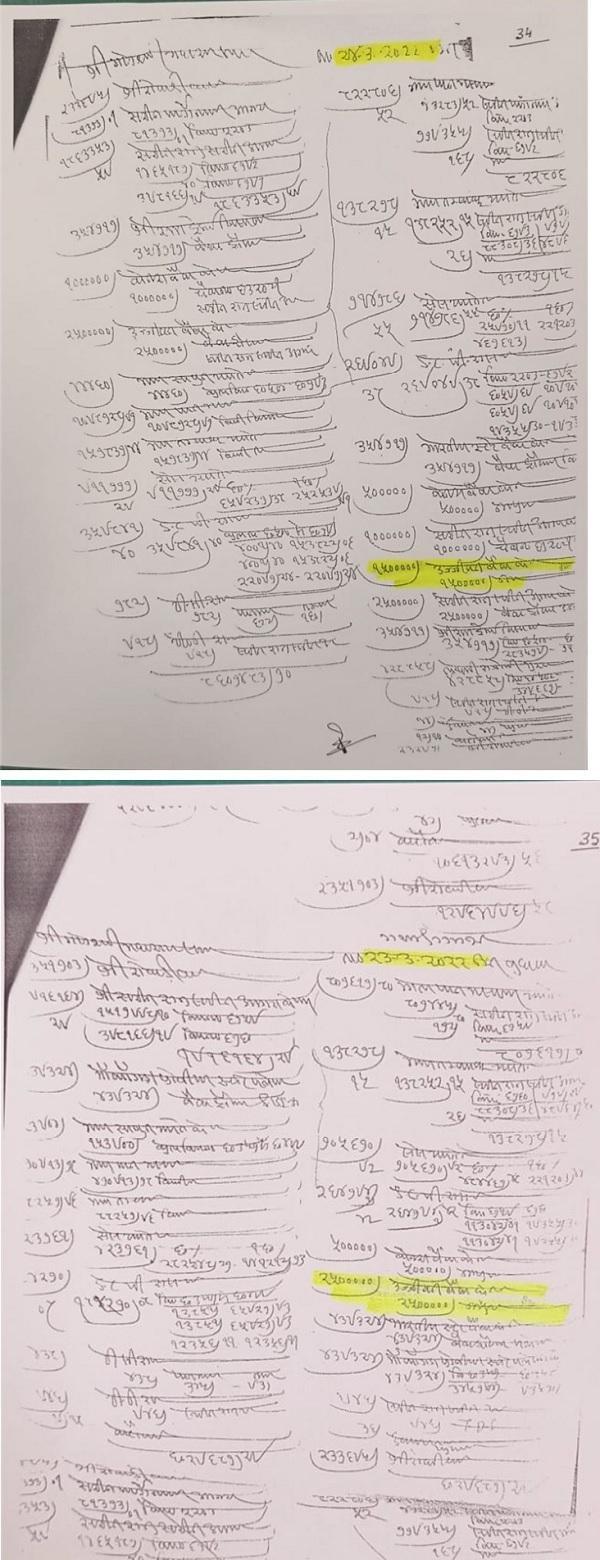
7.7 Regarding, the observation of the Ld. PCIT that only two pages of the cash book i.e. on page no. 34-35 of the paper book were placed before the Ld. PCIT, we are satisfied with the explanation of the assessee that the relevant two pages to explain that the deposit of Rs. 15,00,000/- and Rs. 25,00,000/- on 23.03.2022 and 24.03.2022 as per the show cause notice of the Ld. PCIT were produced before him and the cash book for the entire financial year 2021-22 was placed before the AO which has not been denied by the Ld. PCIT. Therefore, the action of the Ld. PCIT for setting aside this issue to the file of the AO is not justified.
7.8 Cash deposit of Rs. 58,37,679/-:
Issue raised in the SCN:
B. It is observed that as per Cash Book, you had deposited cash of Rs. 38,03,56,321/- only during the year under consideration. However, as per cumulative cash deposit details compiled by yourself, you deposited Rs. 38,61,94,000/- in cash during the year under consideration. Thus, there is no explanation on records with regards to the remaining cash deposit of Rs.58,37,679/- (38,61,94,000-38,03,56,321)
Reply filed by the assessee to the SCN:
B) As per Cash Book sums as under were deposited in cash in the year in question.
| 1. State Bank of India (Main), Hathras | 35,68,08,000/- |
| 2. Canara Bank (Main), Hathras | 1,57,36,000/- |
| 3. Ujjivan Small Finance Bank Ltd., Hathras | 1,36,50,000/- |
| Total Deposited | 38,61,94,000/- |
Your honour have mentioned in year notice bank deposit for Rs.38,03,56,321/-and have sought reply for difference Rs. 58,37,679/-. In this connection it is requested that basis for bank deposit of Rs. 38,03,56,381/- as mentioned in your notice in reply may kindly be provided so that due and proper explanation for the same may be submitted. The assessee on it part have not been able to access this figure of Rs. 38,03,56,321/- and, therefore, requested your honour to intimate the source of this figure for due & acceptable reply and explanation.
Since the assessee is maintaining daily banks Cash Book, therefore, there cannot be any difference in bank deposits and, therefore, again requests your honour to provide to us the base of figure of Rs. 38,03,56,321/- for due & clear clarification and explanation.
(emphasis supplied by us)
Finding of the Ld. PCIT:
On the issue of difference of Rs. 58,37,679/- as cash deposited, assessee has submitted that he was unable to access the figure of Rs. 38,03,56,381/-, therefore, he has not submitted any reply on that issue.
| Assessee’s submission before this Tribunal:
(ii) Second reason Page 2 Para 3B of Order u/s 263 (Re: – Difference in cash deposit)
|
7.9 Our findings: Regarding the issue of cash deposit of Rs.38,03,56,381/-, the assessee submits that the basis of the said figure was not provided by the ld. PCIT despite specifically being asked. It was further submitted that since the assessee was maintaining daily banks Cash Book and therefore, there cannot be any difference in bank deposits. Further, the ld. AR submits that as per the cash book, the cash deposited is more whereas the amount stated by the ld. PCIT indicates that the cash deposited was less. Therefore, it is not a case of the department that the assessee had deposited more cash and the assessee has filed the details of less cash deposited.
7.10 In this regard, we note that the assessee during the course of assessment proceedings in reply to query to submit the details of bank account and the copy of the bank account and to explain the source of cash deposit along with documentary evidences, along with cash follow statements for the year under consideration and the copy of cash book vide notice u/s 142 (1) of the Act dated 09.08.2023 placed at page no. 17 of the paper book filed the same vide letter dated 20.08.2023 placed at page no. 18-19 of paper book which is reproduced as under:
“3. The copy of Bank Statement for the period 1.4.21 to 31.3.22 of the following banks are sent.
a) Canara Bank, Hathras (Current a/c)
b) State Bank of India, Hathras (Current a/c)
c) Ujjivan Bank, Hathras (Current a/c)
d) Canara Basnk, Hathras (Saving Bank a/c)
4. The source of cash deposit in the above banks a/c are exclusively of Cash Sales only as also proved and supported by the copy of Cash Book being sent separately, as required by your horour Cash Sales are to ‘Khokhawala ‘Pattriwala’, Cycle/Scooter Halker and petty shop keepers sitting in Gali and Mohallas of Hathras or nearby areas selling in item as in Pan Masala, Tambcoo, Detergent Cake, Toilet shop washing powder, Namkeen etc.
5. The Cash flow statement for the year under consideration is by itself fully proved and supported from copy of the Cash Book and Bank statement as being sent separately.
6. The copy of the Cash Book maintained on Computer is sent on Computer system as required, for your kind verification.”
(emphasis supplied by us)
7.11 Thus, we notice that the assessee had filed all the necessary details including the cash book for F.Y. 2021-22 as asked by the AO which must have been examined by the Ld. PCIT while initiating the proceedings u/s 263 of the Act. Therefore, the onus was on the Ld. PCIT to furnish the basis of the cash deposit of Rs.38,03,56,381/-, as per his observations that as per Cash Book, the assessee had deposited cash of Rs. 38,03,56,321/- only during the year under consideration whereas as per cumulative cash deposit details compiled by the assessee, the assessee had deposited Rs. 38,61,94,000/- in cash during the year under consideration and thus, there is no explanation on records with regards to the remaining cash deposit of Rs.58,37,679/- (38,61,94,000- 38,03,56,321) when the assessee specifically being asked for it. The same was not provided by the Ld. PCIT to the assessee and therefore the explanation of the assessee that since the assessee was maintaining daily banks Cash Book and therefore, there cannot be any difference in bank deposits as per the cash book cannot be rejected. Therefore, the action of the Ld. PCIT for setting aside this issue to the file of the AO is not justified.
7.12 Issue regarding availability of inadequate liquidity:
Issue raised in the SCN:
C. It is observed that you had total capital of Rs. 1,90,80,476/- as on 31.03.2022. However, out of the above Rs. 29,76,869/- is blocked towards Fixed Assets, Rs. 70,29,717/- is blocked towards Supertech Pavillion Flat, Rs. 29,45,684/ is blocked towards Advance against Omaxe Shop, Rs. 26,70,000/- is blocked towards Advance to M/s Ankur Traders, Rs. 27, 10,000/-is blocked towards Advance to Dauji Trading Company. This leaves liquidity of around Rs. 7,00,000/- only with you from which you have conducted a business having Turnover of Rs. 58,00,00,000/-(inclusive of GST) which is prima facie not possible. Furthermore, you have always had bank balance of 30-40L which peaked to Rs. 65,88,538/- on 16.04.2021. Considering the fact that you had liquidity available with you were only around Rs. 7,00,000/-, regular bank balance of 30-40L and peak balance of Rs. 65,88,538/on 16.04.2021 becomes highly improbable. However, no enquiry has been made by the FAO in this regard.
Reply filed by the assessee to the SCN:
(C) The Investments as on 31.3.22, as pointed out, in different fixed assets as under:
| 1. Fixed assets | 2976869/- |
| 2. Super Tech Pavillion Flat | 7029717/- |
| 3. Omexa Shop | 2945684/- |
| Ankur Traders | 2670000/- |
| Dauji Trading Co. | 2710000/- |
In response, it is submitted that these investments are coming from past years before 2018-19 as per statement enclosed herewith (A). From this statement your honour will verify that all the pointed assets (investments) are not new one, but old one, made in past years. The main reason of high turnover, with his thin capital investment, is on a/c of the fact that assesseee deals in fast selling items and make payments to Suppliers later on, from realization of sale proceeds, therefore, he was able to carry-on business with less investments as compared to turnover. Since turnover is high, therefore, assessee is not in any trading loss and is carrying on the business successfully. The bank balance as pointed out is duly supported with the daily a/c books (Cash Book) & record maintained, credits of sale proceeds in bank & then used bank balance in remittance to suppliers, in routine course of business. The bank deposits are duly supported with regular a/c books maintained, produced before your honour for your kind verification. The Ld. F.A.O. also after verification of this issue from the full year’s Cash Book with him, was well satisfied and accepted a/c books in his asstt. order dated 16.2.24.
Hope your honour will appreciate the trade policy and will oblige by accepting realty without drawing any adverse inference on this issue when the assessee is progressive and paying due income tax regularly. Since it was not considered a vital issue for consideration, therefore, the F.A.O. did not prefer to mention this issue in the Asstt. Order and not warranted also, where no adverse inference is possible, in the facts and circumstances of the case and, therefore, requested that the fact may kindly be accepted and oblige.
Finding of the Ld. PCIT:
With regard to issue mentioned at para 3C in the notice dated 20.01.2026. The assessee has submitted that he has dealing in fast selling items and makes payments to Suppliers later on from realization of sale proceeds. Assessee has not submitted any documentary evidences regarding this issue only submitted a chart reflecting statement of fixed assets, which was also not verifiable in absence of documentary evidences.
| Assessee’s submission before this Tribunal:
(iii) Third reason Page 2 Para 3 C of Order u/s. 263. (Re: – Fixed Investment)
|
7.13 Our findings: Regarding the inadequate liquidity of availability of cash of Rs. 7,00,000/- for carrying out the turnover of Rs. 58,00,00,000/-inclusive of GST on the explanation filed by the assessee, the Ld. PCIT observed the submission of the assessee that he has dealing in fast selling items and makes payments to suppliers later on from realization of sale proceeds but did not make any adverse observation or finding on this issue. Regarding the fixed investment, it is stated that all the investments are old and filed the details of the same at page 5 of the paper book. In this regard, the assessee filed a chart giving the statement of fixed investment on page No. 37 of the paper book. On its perusal, it is seen that the investment in Super Tech flat, Omaxe shop, Ankur Traders and Dauji Trading Co. was as per the opening balance and there is no fresh investment in respect of these investments during the year. Regarding the fixed assets, there is increase in the fixed asset on account of addition of car amounting to Rs.16 lakh. The accounts of the assessee are audited and the Ld. PCIT has not given any adverse findings in this regard. Therefore, the action of the Ld. PCIT for setting aside this issue to the file of the AO is not justified on this issue.
7.14 Omaxe Group:
| Issue raised in the SCN:
D. It is observed that a Search action had been conducted in the Omaxe Goup wherein comprehensive details of Cash payments received by the Omaxe Group towards various projects had been compiled by the Department. No attempt has been made by the FAO to obtain the details with regards to cash payments made by you, if any, to Omaxe Group towards purchase of the above mentioned shop |
| Reply filed by the assessee to the SCN:
D)The assessee purchased property from Omaxe Group in the F.Y.2004 and started payment by a/c payee D.D. Ist. Payment on 28.10.04 for Rs2,14,614/- & all payments thereafter upto 2008, were made by a/c payee Cheques/Bank transfer only total paid Rs. 29,45,684/- upto 2008. The property have not so far been transferred and the matter is pending. The investment is old one and not made in the year in question. It is also confirmed that between 2004 to 2008, all payments by Bank & no cash was paid. |
| Finding of the Ld. PCIT:
With regard to issue mentioned in para 3D of the notice dated 20.01.2026, assessee has submitted that he had purchased property from Omaxe Group in the F.Y. 2004 and started payment by account payee D.D. upto 2008. The property was not transferred till date and the matter is pending. However, assessee has not submitted any documentary evidence to prove his contention. Further, on perusal of records, it is observed that AO has not made any enquiry nor obtained any details with regard to this issue. |
| Assessee’s submission before this Tribunal:
(iv) Fourth Reason Page 2 Para D of Order u/s 263. |
(Re: – Investment in purchase of Property from Omaxe Ltd.)
On this reason also it cannot be said that there is any loss to the Revenue. |
7.15 Our findings: The observation of the Ld. PCIT are general in nature without mentioning the date of search in the Omaxe group and how the seized documents in the Omaxe group will be relevant for the assessment in the case of the assessee for A.Y. 2022-23 when the assessee submits that payment to Omaxe group was made between 28.10.2004 and thereafter up to 2008 which has not been contradicted by any findings for any material by the Ld. PCIT. Therefore, the action of the Ld. PCIT for setting aside this issue to the file of the AO is not justified on this issue.
7.16 Increase of turnover and decline in NP/Turnover Ratio:
Issue raised in the SCN:
E. It is observed that you have gross receipt of Rs. 30,30,33,059/- during the year under consideration compared to gross receipt of Rs. 19,72,33,082/ in the preceding previous year. This translates into year-on-year increase of 53.65% in gross receipts. However, no query has been made by the FAO regarding this.
F. It is observed that you have declared NP/ Turnover Ratio of 0.41% during the year under consideration compared to declared NP/Turnover ratio of 0.74% in the preceding previous year. Thus, there has been a sharp decrease in declared NP /Turnover ratio from 0.74% to 0.41% despite no change in business. However, no query has been made by the FAO regarding this.
| Reply filed by the assessee to the SCN:
E & F) The assessee is filing a statement of the comparative trading results(B) since asstt. year 2018-19 to 2025-26. From this statement your honour will verify that the G.P. rate and N.P. rate is progressive in the all preceding years and later years. In the year under consideration, as per Audit copy P/L a/c filed, your honour will verfy that G.S.T. amount & penalty Rs. 18,98,570/- was debited in P/L a/c which reduced N.P. rate to 0.41% but the assessee considering the said exp. as not allowable from Revenue point therefore disallowed the same and added back in the computation of income and paid I/Tax thereon.. Copy Computation of Income enclosed, (C) which proves that the N.P. 1.03% which is quite reasonable and very much high and acceptable and calls for any otherwise inference so as to disturb the trading results. The F.A.O. had also made an enquiry on this issue and vide our reply dated 28.12.23 the fact was explained and evidenced and on a/c of this reason, the F.A.O. neither disturbed the Trading results nor drawn any adverse inference. Further submitted that the trading results have been accepted in the past also in asstt. U/s 143 (3) in the asstt. in asstt. U/s 143 (3) in the asstt. year 2010-11. Copy of notice u/s. 142(1) dt. 14.12.2023 from FAO and reply dated 21.12.2023 enclosed for ready reference. The assessee is filing a statement ‘D’ of Comparative P/L a/c expenses, where in your honour will find that P/L a/c exp. are very nominal with all economical back ground and very necessary and inevitable incidental expenses to carry on business have been incurred and, therefore, in the interest of justice and equity it is prayed that the trading results may kindly be accepted, as as accepted in past considering this aspect of the matter in F.A.O. did not disturbed the trading results and accepted the same. In this connection it will not be out of place to mention that the preceding year (F.Y.2020-21) asstt. year 21-22 was ‘Corona’ period and the sale were low in that year, the ‘Corona ‘was over in (F.Y. 2021-22) and sells increased as reflected per statement. The increased G.P. & N.P. is direct effect of progressive business and, therefore, requested that the trading results calls for no deviation.. |
Finding of the Ld. PCIT:
Furthermore, on the issues mentioned in para 3E & 3F of the notice dated 20.01.2026, the assessee has submitted that the G.P. rate and N.P. rate is progressive in all the preceeding years and later years. It is further submitted by the assessee that the FAO vide notice u/s 142(1) dated 14.12.2023 enquired the issue. However, on perusal of records, it is observed that FAO has not make any enquiry regarding these issues.
Assessee’s submission before this Tribunal:
(v) Fifth and Sixth Reason Page 3 Para E and F of Order u/s 263
(Re: – G.P and N.P rate)
-
- Submission before Ld. PCIT (Page 6 Para E and F).
- In the year under consideration both G.P and N.P rate is better.
- On this reason also it cannot be said that there is any loss to the Revenue.
7.17 Our findings: Regarding the GP and NP rates, the assessee submitted that in the year under consideration, both GP and NP rate was better and therefore, there cannot be any loss to the Revenue. In this regard, the assessee filed a chart of GP and NP at page No. 38 of the paper book, which is reproduced as under:
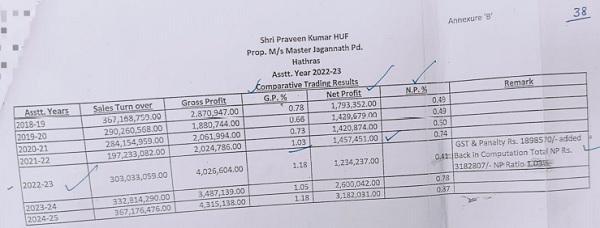
7.18 In this regard, the explanation of the assessee that as per Audit copy P/L a/c filed, G.S.T. amount & penalty Rs. 18,98,570/- was debited in P/L account which reduced N.P. rate to 0.41% but the assessee considering the said exp. as not allowable from Revenue point therefore disallowed the same and added back in the computation of income and paid taxes thereon. It is further submitted that by excluding the same the N.P. amounts to 1.03% which is quite reasonable and very much high and acceptable and calls for any otherwise inference so as to disturb the trading results is acceptable. Further, the assessee filed a statement ‘D’ of Comparative P/L a/c expenses, where in it was stated that P/L a/c exp. are very nominal with all economical back ground and very necessary and inevitable incidental expenses to carry on business have not been adversely commented by the Ld. PCIT. Moreover, the explanation of the assessee that the increase in the turnover due to the present year being post covid year also cannot be rejected. Therefore, the action of the Ld. PCIT for setting aside this issue to the file of the AO is not justified on this issue.
7.19 Method of accounting:
| Issue raised in the SCN:
G. It is observed that the accounting method employed by you that the valuations of purchase/sale/inventory are being done without including the tax/duty/cess/fee paid. However, section 145A(ii) of the Act clearly provides that valuation of purchase/sale/ inventory shall be adjusted to include the amount of any tax/duty/cess/fee paid or incurred by the Assessee to bring the goods or services to the place of its location and condition as on the date of valuation. Reply filed by the assessee to the SCN: G) The valuation of the closing stock have been valued as per regular system of valuation as per past practice and have not deviated from the past valuation system. Thus the assessee have followed correct accounting system calls for no otherwise inference. Further stated that if this cess/levy duty will not have taken in to a/c while valuing closing stock inventory, the trading results would have disclosed ‘loss’ Therefore, this presumption is not based as per record and requested that valuation may kindly be accepted. |
Finding of the Ld. PCIT:
On the issue mentioned in para 3G of the notice dated 20.01.2026, assessee submitted that the valuation of the closing stock have been valued as per regular system of valuation as past practice and have not deviated from the past valuation system. However, assessee remains silent on the issue of invoking of section 145A(ii) of the Act.
| Assessee’s submission before this Tribunal:
(vi) Seventh reason Page 3 Para G of Order u/s 263 Submission before Ld. PCIT (Page 6 Para G)
The purchase amount of the goods is accounted for in the stock and the respective CGST, SGST, CESS is accounted for separately and debited in the respective accounts. Similarly, in case of sales, sale amount is deducted from stock and the respective CGST, SGST, CESS is accounted for separately and credited in the respective account. |
7.20 Our findings: The Ld. PCIT noted that on the issue mentioned in para 3G of the notice dated 20.01.2026, assessee submitted that the valuation of the closing stock has been valued as per regular system of valuation as past practice and have not deviated from the past valuation system. The Ld. PCIT, however, noted that the assessee remained silent on the issue of invoking of section 145A(ii) of the Act. Further, it was also submitted by the assessee that the purchase amount of the goods is accounted for in the stock and the respective CGST, SGST, CESS is accounted for separately and debited in the respective accounts. Similarly, in case of sales, sale amount is deducted from stock and the respective CGST, SGST, CESS is accounted for separately and credited in the respective account.
7.21 In this regard, the Ld. AR also referred to the “Significant Accounting Policies and Notes on Accounts” (placed on page no. 39 of the paper book) and the relevant extract of the same is reproduced as under:
“SCHEDULE- ‘D’
SCHEDULES FORMING PART OF ACCOUNTS FOR YEAR EENDING MARCH 31, 20;
SIGNIFICANT ACCOUNTING POLICIES AND NOTES ON ACCOUNTS
The financial statements have been prepared in accordance with applicable Income Computation Disclosure Standard issued by CBDT of India and the relevant significant accounting policies applied in preparing and presenting these financial statements are set out below:
A) ACCOUNTING CONVENTION
The financial statements are prepared under historical cost convention on accrual basis of accounting, industry specific practices, in accordance with ICDS and going concern. basis., Accounting Policies are followed consistently. Necessary changes in accounting policies in compliance of ICDS have been made.
B) INVENTORIES
Stock in trade is as per verified & certified by the Karta and calculated at the lower of cost or realizable value.
C) REVENUE REGOGNITION
(i) Revenue from Sale of Goods is accounted for at the time of billing which is generally at the time of Delivery of Goods or Loading of Goods in Transport. No Goods has been given to client without raising a Sales Bill. Sales is Exclusive of GST Thereon.
(ii) Interest is recognized on accrual basis but Interest on refund or cess is recognized on receipt basis
(iii) The amount of Sale of Goods not recognized during the financial year due to lack of reasonable certainty of ultimate collection was Rs. NIL.”
(emphasis supplied by us)
7.22 Thus, as per the above submission of the assessee and the note of the auditor, we notice that the purchase amount of the goods is accounted for in the stock and the respective CGST, SGST, CESS is accounted for separately and debited in the respective accounts and similarly, in case of sales, sale amount is deducted from stock and the respective CGST, SGST, CESS is accounted for separately and credited in the respective account. In this regard, the relevant provisions of section 145A of the Act relevant to A.Y. 2022-23 is reproduced as under:
“145A. [ Method of accounting in certain cases. [Substituted by Finance Act, 2018 (Act No. 13 of 2018), dated 29.3.2018.]
For the purpose of determining the income chargeable under the head “Profits and gains of business or profession”,
(i)the valuation of inventory shall be made at lower of actual cost or net realisable value computed in accordance with the income computation and disclosure standards notified under sub-section (2) of section 145;
(ii) the valuation of purchase and sale of goods or services and of inventory shall be adjusted to include the amount of any tax, duty, cess or fee (by whatever name called) actually paid or incurred by the assessee to bring the goods or services to the place of its location and condition as on the date of valuation;
(iii)the inventory being securities not listed on a recognised stock exchange, or listed but not quoted on a recognised stock exchange with regularity from time to time, shall be valued at actual cost initially recognised in accordance with the income computation and disclosure standards notified under sub-section (2) of section 145;
(iv) the inventory being securities other than those referred to in clause (iii), shall be valued at lower of actual cost or net realisable value in accordance with the income computation and disclosure standards notified under sub-section (2) of section 145:”
(emphasis supplied by us)
7.23 Therefore, as per the provisions of section 145A (ii) of the Act the valuation of purchase and sale of goods or services and of inventory shall be adjusted to include the amount of any tax, duty, cess or fee (by whatever name called) actually paid or incurred by the assessee to bring the goods or services to the place of its location and condition as on the date of valuation, which as per the above submission of the assessee as well as the Auditor’s note has not been done by the assessee. Therefore, the accounts prepared by the assessee are in violation of the provision of section 145A (ii) of the Act which makes the assessment order on this issue both erroneous as well as prejudicial to the interest of the revenue. The assessee carries on business and declares its income from “profit and gains and business” and therefore, it was bound to follow the provision of section 145A (ii) of the Act which has not been done by the assessee in this case.
7.24 Therefore, in view of our findings, we uphold the order of the Ld. PCIT in setting aside the order of the AO on this issue only i.e. in respect of para no. G of the show cause notice dated 20.01.2026 issued by the Ld. PCIT. In respect of the other issues raised by the Ld. PCIT in Para nos. A, B, C, D, E and F of the show cause notice dated 20.01.2026 issued by the Ld. PCIT, in view of our discussion in respect of each such issues earlier in this order we have held that the findings of the Ld. PCIT do not justify his findings that the order passed by the AO in respect of these issue are either erroneous or prejudicial to the interest of revenue. Therefore, the action of the Ld. PCIT in setting aside the assessment order in respect of the other issues raised by the Ld. PCIT in Para nos. A, B, C, D, E and F of the show cause notice dated 20.01.2026 issued by the Ld. PCIT is not sustainable and the same is set aside and quashed.
7.25 Further, we have also considered the case laws relied upon by the Ld. PCIT and the Ld. AR in support of their findings/contentions respectively. On careful consideration, we are of the considered view that in view of our discussion in respect of each such issues as mentioned in Para nos. A, B, C, D, E and F of the show cause notice dated 20.01.2026 issued by the Ld. PCIT earlier in this order we have held that the findings of the Ld. PCIT do not justify his findings that the order passed by the AO in respect of these issues are either erroneous or prejudicial to the interest of revenue and therefore the case laws relied upon by the Ld. PCIT do not support his findings. Similarly, in view of our finding earlier in this order, that the accounts prepared by the assessee are in violation of the provision of section 145A (ii) of the Act which makes the assessment order on this issue both erroneous as well as prejudicial to the interest of the revenue, the case laws relied upon by the assessee are distinguishable on the facts of the present case of the assessee and therefore, does not support the submission of the assessee.
8. In the result, the appeal of the assessee is partly allowed in term of our above observations.
Order pronounced in the open court on 29/10/2026.




