Renault Nissan Automotive India Pvt. Ltd. Vs Commissioner of GST & Central Excise (CESTAT Chennai)
Summary: The Customs, Excise and Service Tax Appellate Tribunal, Chennai, in Renault Nissan Automotive India Pvt. Ltd. Vs Commissioner of GST & Central Excise, Service Tax Appeal No. 41736 of 2019, Final Order No. 40436/2023 dated 15 June 2023, examined the service tax consequences of expatriate employees seconded by Nissan Motor Company Ltd., Japan, to the Indian appellant. The principal dispute concerned whether salaries, allowances, bonuses and other benefits paid to the secondees formed part of the taxable value of manpower recruitment or supply agency services under Section 67 of the Finance Act, 1994.
The Department discovered a proposed secondment agreement during compliance verification conducted between February and December 2013. It considered the arrangement to constitute an import of manpower recruitment or supply agency services and proposed service tax liability under the reverse charge mechanism. The proceedings included Show Cause Notice No. 58/2014 and subsequent demands covering periods from October 2008 to June 2017. The initial notice proposed service tax of ₹47,76,04,295 and separately questioned CENVAT credit of ₹56,74,30,342. The adjudicating authority confirmed service tax demands relating to the secondment arrangement but allowed the disputed input service credit, against which the Revenue did not appeal.
The appellant argued that the secondees were employed in India under separate employment contracts, that salaries were subject to tax deduction at source, and that the employees worked under its direction and supervision. According to the appellant, the amounts paid directly to expatriates were employment expenses rather than consideration paid to Nissan Motor Company for providing manpower. It further submitted that only certain social security costs were reimbursed to the overseas company and that service tax had already been discharged on the relevant reimbursement under reverse charge.
On the substantive taxability issue, the Tribunal considered the Supreme Court judgments in Commissioner of Customs, Central Excise & Service Tax Vs Northern Operating Systems Pvt. Ltd. and International Merchandising Company, LLC Vs Commissioner of Service Tax. It found that the definition of manpower recruitment or supply agency was sufficiently broad to encompass the secondment arrangement. The Tribunal observed that the Indian company made payments directly to expatriates and that the contractual provisions governing salaries, bonuses and allowances had to be examined when determining taxable consideration. It concluded that the appellant could not escape reverse charge liability merely because the expatriates worked under its operational supervision.
The appellant also challenged the inclusion of salary and reimbursement components in the assessable value, relying on Union of India Vs Intercontinental Consultants and Technocrats Pvt. Ltd., and argued that the reimbursement provisions had changed with effect from 14 May 2015. In addition, it disputed invocation of the extended period of limitation, pointing to repeated departmental audits and disclosure of relevant accounting records. It claimed that any service tax payable would generate corresponding CENVAT credit, making the transaction revenue-neutral.
The dispute thus required consideration of the distinction between an employer-employee arrangement and taxable manpower supply, the treatment of expatriate remuneration under the valuation provisions, and the separate questions of limitation, interest and penalties. The Tribunal’s analysis of the secondment arrangement was guided substantially by the Supreme Court’s ruling in Northern Operating Systems, while the remaining statutory and factual issues required independent examination.
Cases Discussed
- Commissioner of Customs, Central Excise & Service Tax Vs Northern Operating Systems Pvt. Ltd. — 2022 (61) G.S.T.L. 129 (S.C.); applied to the nature of secondment and manpower supply.
- International Merchandising Company, LLC Vs Commissioner of Service Tax, New Delhi — 2022 (67) G.S.T.L. 129 (S.C.); considered on the statutory definition of manpower recruitment or supply agency.
- Union of India Vs Intercontinental Consultants and Technocrats Pvt. Ltd. — 2018 (10) G.S.T.L. 401 (S.C.); relied upon by the appellant concerning reimbursable expenditure and valuation.
- Commissioner of Service Tax Vs Bhayana Builders (P) Ltd. — 2018 (10) G.S.T.L. 118 (S.C.); cited on the meaning of gross amount charged.
- Commissioner of Income Tax Vs Eli Lilly and Co. (India) Pvt. Ltd. — 2009 (312) ITR 225 (S.C.); cited regarding expatriate employment and income-tax treatment.
- British Airways Vs Commissioner of Central Excise — 2014-TIOL-979-CESTAT-DEL; relied upon by the appellant.
- Paul Merchants Ltd. Vs Commissioner of Central Excise — 2012-TIOL-1877-CESTAT-DEL; relied upon by the appellant.
- Commissioner of Central Excise, Bangalore Vs Pragathi Concrete Products (P) Ltd. — 2015 (8) TMI 1053 (S.C.); cited on limitation.
- Nirlon Ltd. Vs Commissioner of Central Excise, Mumbai — 2015 (320) E.L.T. 22 (S.C.); cited on revenue neutrality.
- Commissioner of Central Excise & Customs Vs Narmada Chematur Pharmaceuticals Ltd. — 2005 (179) E.L.T. 276 (S.C.); cited on revenue neutrality.
- Punjab Tractors Ltd. Vs Commissioner of Central Excise — 2005 (181) E.L.T. 380 (S.C.); cited on revenue neutrality.
- Commissioner of Customs & Central Excise Vs Textile Corporation Marathwada Ltd. — 2008 (231) E.L.T. 195 (S.C.); cited on revenue neutrality.
- Goa Industrial Products Vs Commissioner of Central Excise, Goa — 2005 (181) E.L.T. 222 (Tri.-Mumbai); cited on revenue neutrality.
- Ashirwad Foundaries Pvt. Ltd. Vs Commissioner of CGST & Central Excise — 2020 (3) TMI 847 (CESTAT Kolkata); cited on revenue neutrality.
- Commissioner of CGST & Central Excise Vs Edelweiss Financial Services Ltd. — Diary No. 5258/2023; cited regarding consideration.
FULL TEXT OF THE CESTAT CHENNAI ORDER
Brief undisputed facts, as could be gathered from the Show Cause Notice and impugned order, are that the appellant is inter alia engaged in providing Business Auxiliary Service, etc.
2.1 It is the specific case of the Department that during the course of compliance verification of the appellant’s records from February 2013 to December 2013, they appear to have come across a draft agreement which the appellant was proposing to sign, termed as Secondment Agreement (SA) with M/s Nissan Motor Company Ltd., Japan (hereinafter referred to as ‘NMC’) for obtaining employees, i.e., secondees of M/s. NMC. It appeared to them that the appellant had entered into separate employment contract with foreign expatriates, and from the above, it appeared to the Department that the same would fall within the definition of “manpower recruitment or supply agency” service under Section 65(68) of the Finance Act, 1994 since providing supply of manpower service temporarily or otherwise would be covered under the above definition.
2.2 Drawing reference to C.B.E.C. Circular F. No. 137/35/2011-S.T. dated 13.07.2011 vis-à-vis Secondment Agreement, it appeared to the Department that deputation of foreign employees/expatriates by M/s. NMC to the appellant would be covered under import of service under the definition of manpower recruitment or supply agency service and hence, the appellant was liable to pay Service Tax under reverse charge mechanism as per erstwhile Section 66/66A and Section 68 ibid. read with the Place of Provision of Services Rules, 2012 issued under Notification No. 28/2012-Service Tax dated 20.06.2012 and Notification No. 30/2012-Service Tax dated 20.06.2012.
3.1 As a sequel, a Show Cause Notice No. 58/2014 dated 21.04.2014 came to issued, wherein the features of the Secondment Agreement have been highlighted at paragraph 4. It is recorded at paragraph 6 the liability of the appellant to pay Service Tax; reference is made to erstwhile Section 66 and Section 67 ibid., and at paragraph 6.2, reference is made to Rule 5 of the Service Tax (Determination of Value) Rules, 2006; paragraph 6.3 refers to the Place of Provision of Services Rules, 2012 and at paragraph 6.4, it is observed that the Service Tax was not paid on the salaries, bonus and allowances paid and that other benefits reimbursed in local currency have not been included in the value for the purposes of payment of Service Tax.
3.2 Further reference is made to the Secondment Agreement vide paragraphs 6.5 and 6.6, and at 6.7, it is assumed that the entire amount i.e. salaries, allowances, bonus and other expenses paid directly to the secondee would together constitute the consideration for deputation / manpower supply service, on which the Service Tax was liable to be paid in terms of Section 67 and other provisions of the Service Tax (Determination of Value) Rules, 2006; and also that the manpower services rendered by M/s. NMC to the appellant were covered under the Place of Provision of Services Rules, 2012 read with Notification No. 30/2012-Service Tax dated 20.06.2012, the Service Tax thus came to be quantified at Rs.47,76,04,295/-, as detailed in Annexure-I to the Show Cause Notice.
3.3 At paragraph 10, it is observed that the appellant had wrongly availed Input Service Tax Credit under ISD invoices, which was considered as having been irregularly availed without determining the admissibility of CENVAT Credit by the appellant, which was to be disallowed.
3.4 On the basis of the above, it was proposed, after invoking proviso to Section 73(1) ibid., to demand Service Tax for the period 2008-09 to 2013-14 towards manpower recruitment or supply agency service, further proposed to disallow and recover Rs.56,74,30,342/- under Rule 14 of the CENVAT Credit Rules, 2004 being the ineligible credit availed by the appellant, for the period from April 2010 to March 2011, apart from appropriate interest under Section 75 ibid. and penalty under Section 78 ibid.
3.5 It appears that four Statements of Demand (SODs) came to issued on similar lines proposing tax demands for various tax-periods.
4.1 It appears that the appellant filed a detailed reply denying any liability to Service Tax. They also appear to have pleaded that the appellant had treated the secondee as its own employees, TDS was made on the salary paid to them, had also accounted for expenditure in its financial statements as personnel expenses; appellant has been issuing TDS certificate in Form 16 under the Income Tax Act; and that the secondee was to carry out the work under the guidance, direction and the supervision of the appellant and such secondee should comply with the appellant’s internal rules regarding working hours and working days.
4.2 The appellant further appears to have submitted with regard to employment contract that the same would provide the job title, contract period, department, effective date of their appointment, annual salary in INR along with perks and that the same was governed by the laws as applicable in India.
4.3 It has also been pleaded in their reply that such secondees are on Employment Visa, being the employees of an Indian company by virtue of the employment contract with the appellant; the fact that the appellant had disclosed the amounts paid to the secondees as salary under the head “salaries, wages and bonus” and hence, there was no service provider-service recipient relationship between the appellant and M/s. NMC. It was also pleaded that just because M/s. NMC disbursed social security contribution of secondees during the subsistence of the Secondment Agreement, that ipso-facto would not amount to the provision of any service, much less manpower recruitment or supply agency service; and also that no consideration whatsoever was charged by M/s. NMC nor was anything paid as consideration by the appellant towards the alleged manpower recruitment or supply agency service.
4.4 It also appears to have also relied upon a decision of the Hon’ble Supreme Court in the case of Commissioner of Income Tax v. Eli Lilly and Co., (India) Private Limited [2009 (312) ITR 225 (Supreme Court)], the order of the Larger Bench of the CESTAT in the case of M/s. British Airways v. Commissioner of Central Excise [2014-TIOL-979-CESTAT-DEL] and the majority order in the case of M/s. Paul Merchants Ltd. v. Commissioner of Central Excise [2012-TIOL-1877-CESTAT-DEL].
5.1 The Commissioner, after considering the arguments advanced by the appellant, has chosen to pass the common impugned Order-in-Original Nos. 13-17/2019 dated 29.07.2019 wherein, he has held that the appellant was liable to pay Service Tax on the supply of manpower services for the period from 2008-09 (October 2008) to 2013-14 (up to January 2014), along with applicable interest and penalty, as proposed in the Show Cause Notice, however has allowed the CENVAT Credit alleged to have been wrongly availed, since the facts and demands were identical.
5.2 The Adjudicating Authority has further confirmed the demand of Service Tax for the period from February 2014 to March 2015 under Sections 73(1) and 73(2) ibid., along with applicable interest and penalty, as demanded.
5.3 The Commissioner has ordered the amount paid towards salary and perks of the expats for the period from October 2014 to March 2015 to be considered as part of the consideration for supply of manpower service, includable in the assessable value, and has further confirmed the demand of Rs.3,28,19,590/- being the Service Tax payable for the period October 2014 to March 2015 under Sections 73(1) and 73(2) ibid., along with applicable interest and penalty as proposed.
5.4 He has further confirmed Service Tax demand of Rs.7,65,48,338/- as tax payable for the period from April 2015 to March 2016 under Sections 73(1) and 73(2) ibid., along with applicable interest and penalty.
5.5 He has also confirmed the demand of Rs.10,43,50,716/- as Service Tax payable for the period from April 2016 to June 2017 under Sections 73(1) and 73(2) ibid., along with applicable interest and penalty.
6.1 The learned Adjudicating Authority has given the following findings, to confirm the demands proposed in the Show Cause Notice/Statements of Demand: –
- During the secondment period, the expats would remain as employees of M/s. NMC, which means that they were under the control of M/s. NMC.
- Expats are supplied to the appellant on certain terms and conditions, for a specific period and to perform specified tasks.
- From the Secondment Agreement it is clear that a part of compensation is granted by M/s. NMC on behalf of the appellant, which was reported to the appellant for onward reimbursements.
- M/s. NMC have the right to replace the secondee or change the secondment period after issuing notice to the appellant.
- Individual contract with expats were purely based on the Secondment Agreement, to give effect to certain provisions of the agreement.
- Conditions of employment of expats are determined by the Secondment Agreement between the appellant and M/s. NMC and not that with the expats.
- Appellant cannot independently employ an expat other than in terms of the conditions determined by M/s. NMC as per Secondment Agreement.
- Salary paid on split formula, i.e., a part is paid by M/s. NMC and other part is paid by the appellant; that paid by M/s. NMC shall be reimbursed by the appellant in Yen.
- M/s. NMC discharges its obligations as an employer by subscribing to social security and employees’ retirement benefit plans.
- Reference is drawn to C.B.E.C. Circular F. No. 137/35/2011-Service Tax dated 13.07.2011.
- Coming to India under Employment Visa does not mean that there exists an employer-employee relationship between the appellant and expats.
- The word ‘employee’ is used in the Secondment Agreement only in the context of M/s. NMC, but not the appellant, and no letter of appointment was issued to the expat by the appellant.
- In any case, presence or absence of relationship would not decide the applicability of Service Tax here.
- Provident Fund is a mandatory obligation to be fulfilled for a foreign national during work in India and also, according to the Income Tax Act, 1961, when a person stays in India for more than 182 days between 1st April and 31st March of any financial year, the person is considered as a Resident Indian and as per Section 9(1)(ii) of the Income Tax Act, income which falls under the head ‘salary’, if it is earned in India, shall be deemed to accrue or arise in India.
- There is no dispute that the personnel of M/s. NMC who were seconded to the appellant had stayed for more than 182 days in India and also that the appellant had only deployed them in accordance with the terms and conditions determined by M/s. NMC; thus, as per the provisions of the Income Tax Act, the salary of such personnel which has accrued or arisen in India was liable to Income Tax and such taxpayers shall file Income Tax return as compliance, but however, these provisions do not come in the way of determining applicability of Service Tax.
- In terms of the Secondment Agreement, the secondee shall carry out the work as set out as per instructions of M/s. NMC under the guidance, direction and supervision of the appellant.
- Appellant does not have the power to select the employees, which lies with M/s. NMC.
- The service contract, called Secondment Agreement here, based on which employees have been deputed, did not bring any employer-employee relationship between the appellant and the expats.
- The Secondment Agreement rather enables the assigning of employees of M/s. NMC to work for a specified period for the appellant.
- There was cash flow to M/s. NMC for maintenance of the expats on record of the original employer, which was to be construed as ‘service’ under Section 67 of the Finance Act, 1994, and hence there was consideration for the service.
- Thus the tax obligation on the amount paid in foreign currency to the expats was on the appellant, which is also the consideration.
- Salaries paid to the expats are a consideration includible in the gross amount in terms of Section 67; since the transaction is between the related parties, the value adopted did not represent true transactional value, which therefore has to include salary,
- In view of changes from 01.07.2012 (Negative List), a service is taxable if it conforms with the definition of ‘service’ under Section 65B(44) or figuring in Section 66E, but not listed under Section 66D ibid.
- Payment made by the appellant to M/s. NMC is for import of service; the same is the consideration for service, which is not listed in the Negative List and that the recipient is in the taxable territory.
- Thus the appellant is liable to pay Service Tax in terms of the provisions of Section 66A of the Finance Act read with Rule 2(1)(d)(iv) of the Service Tax Rules, 1994 and Rule 3(iii) of the Taxation of Services (Provided from Outside India and Received in India) Rules, 2006 (pre 01.07.2012) / Section 66B of the Finance Act read with Rule 2(1)(d)(i)(G) of the Service Tax Rules and Rule 3 of the Place of Provision of Services Rules, 2012 (post 01.07.2012) and that the appellant is liable to pay Service Tax on reverse charge.
- Case law relied by appellant are factually distinguishable.
- Section 73(1) was rightly invoked since nature and arrangement of deployment of personnel was never disclosed.
- By not bringing the contract to the Department’s knowledge, exact nature of relationship between the appellant and the expats was not revealed to the Department.
- Thus the Show Cause Notice No. 58/2014 dated 21.04.2014 was right in invoking the extended period of limitation.
6.2 With regard to the other issue of alleged wrong availment of CENVAT Credit, the learned lower authority, after considering the merits of arguments and case law, holds that the appellant is entitled to the credit availed on the basis of ISD invoice. Consequently, the proposed demand in the Show Cause Notice came to dropped on this issue.
6.3 It is against the first part/first issue, that was held against, that the appellant-assessee has preferred the present appeal before this forum.
7.0 Heard Shri S. Muthu Venkataraman, Learned Advocate appearing for the appellant and Shri M. Ambe, Learned Deputy Commissioner representing the respondent.
7.1 Both the counsel confirm that the Revenue has not filed any appeal against the other part of the order of the Adjudicating Authority, which was decided in favour of the assessee.
8. After hearing both sides, we find that the only issue to be decided by us is: whether the salary and other benefits provided to the secondees by the appellant are includible as part of the assessable value within the meaning of Section 67 of the Finance Act, 1994?
9.1 Learned Advocate for the appellant submitted at the outset that the impugned demand has been proposed under Section 67 of the Finance Act, 1994 read with Rule 5 of the Service Tax (Determination of Value) Rules, 2006; “consideration” came to be amended only with effect from 14.05.2015 to include reimbursable expenditure; it has been held in the Show Cause Notice that salary paid to the expats are nothing but reimbursement of expenses and the proposed demand was based on Rule 5 ibid. (at paragraphs 6.7 and 12(i) of the Show Cause Notice dated 21.04.2014 as well as paragraph 6(2) of the Show Cause Notice dated 23.03.2017).
9.2 It is contended that the above proposal is thus directly contrary to the ruling in the case of Union of India & Anr. v. M/s. Intercontinental Consultants and Technocrats Pvt. Ltd. [2018 (10) G.S.T.L. 401 (S.C.)] and therefore, any demand here for the period from October 2008 to May 2015 does not survive.
9.3.1 Without prejudice to the above, the Learned Advocate would submit that the demand has been proposed and confirmed by invoking the extended period of limitation under Section 73 (1) of the Act and the only contention of the Revenue is that the nature / deployment of personnel was not disclosed.
9.3.2 It is his further case that the appellant was subjected to various audits / scrutiny by the Department officials from time to time and all the information along with documents were provided to the audit party. Thus, the appellant’s Books of Account, balance-sheet, P&L Account, etc., were frequently audited by the authority and as such, the Department was very much aware of the facts and therefore, there was no suppression of any facts, much less, with an intention to evade tax.
9.3.3 The Learned Advocate further submitted that the audit team visited the appellant’s premises right from December 2011 and conducted frequent audits, during which time they did not raise any issue on the alleged manpower supply services and therefore, invoking the larger period of limitation, that too, for the reason of suppression of facts, was not justified.
9.3.4 Our attention was invited to the table at page 4 of the written submissions filed, wherein references are made to SCN/SODs and periods covered. The same, along with the amount of Service Tax confirmed, is extracted below:-
| Sl. No. | Date of SCN/SOD | SCN/SOD No. | Period Covered | Amount of Service Tax confirmed in the OIO |
|---|---|---|---|---|
| 1. | 21.09.2014 | SCN No. 58 of 2014 | Oct 2008 – Jan 2014 | Rs.47,76,04,295/- |
| 2. | 08.10.2015 | SOD No. 60 of 2015 | Feb 2014 – Mar 2015 | Rs.8,42,26,083/- |
| 3. | 23.03.2017 | SCN No. 18 of 2017 | Oct 2014 – Mar 2015 | Rs.3,28,19,590/- |
| 4. | 25.05.2017 | SOD No. 30 of 2017 | Apr 2015 – Mar 2016 | Rs.7,65,48,338/- |
| 5. | 01.03.2019 | SOD No. 03 of 2019 | Apr 2016 – Jun 2017 | Rs.10,43,50,716/- |
9.3.5 Learned Advocate further invited our attention to page number 275 of the Appeal Memorandum wherein the details of visits of the audit party, including the period covered, number of days, etc., are reflected, which is reproduced below for the sake of convenience: –
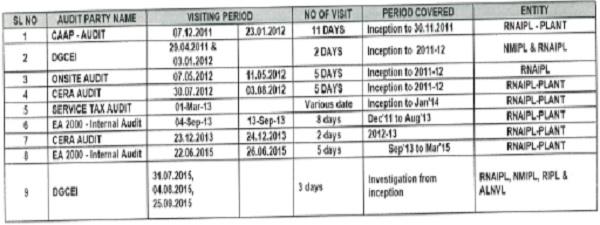
9.3.6 He would thus summarize that there have been visits by various audit teams right from December 2011, but the first Show Cause Notice for the period from October 2008 to January 2014 came to be issued only on 21.09.2014 and therefore, the entire activities including the alleged manpower supply service being very much within the knowledge of the Department Officials, there was no question of suppression of any facts, to justify invoking the extended period of limitation. He placed reliance on the following case-law in support: –
-
- M/s. International Merchandising Company, LLC v. Commissioner of Service Tax, New Delhi [2022 (67) G.S.T.L. 129 (S.C.)]
- Commissioner of Central Excise, Bangalore v. M/s. Pragathi Concrete Products (P) Ltd. [2015 (8) TMI 1053 – Supreme Court]
9.4 Without prejudice to the above, he would make the following submissions on merits, which are summarized as under: –
(i) The appellant had furnished documents like Employment Visa, TDS Certificates, PF Registration, etc., which proved that the expats were on the rolls of the appellant.
(ii) What was paid by the appellant was nothing but the salary and not reimbursements as concluded by the Adjudicating Authority.
(iii) The appellant and M/s. NMC have agreed to the split payment, that is to say, the salary part to be paid by the appellant and the social security of the expats was to be met by M/s. NMC, which alone was to be reimbursed by the appellant.
(iv) Other than the reimbursement of social security, the appellant does not pay any other amount to M/s. NMC.
(v) The terms of the contract, when read in full, would make it clear that the expats should carry out the assigned work as per the instructions of M/s. NMC but under the guidance, direction and supervision of the appellant.
(vi) After entering into separate employment contracts with the expats, the appellant had discharged all the obligations in the capacity of an employer such as TDS on the salary paid and the statutory deductions like contribution to PF, etc.
(vii) Though pre-secondment events such as selection, negotiation of emoluments, etc., may not be within the scope of the appellant, but however, during the entire period of secondment, the secondees were under the complete control of the appellant.
(viii) Even if the portion of the Adjudicating Authority’s order was to be accepted that M/s. NMC had retained control over the secondees, the arrangement with the appellant would only result in dual employment, meaning thereby that both the appellant and M/s. NMC would become joint employers for the expats, in which event the cost of such employees would be shared by the joint employers and hence, there would be no service provider-recipient relationship between the appellant and M/s. NMC.
(ix) Hence, there is no question of any service, much less that of manpower supply service.
9.5 With regard to quantification by treating the salary paid as consideration, the Learned Advocate would submit that Service Tax has been demanded per Order-in-Original even on the amounts paid as salary (net of TDS) to the expats employed in India by the appellant. He would refer to the provisions of Section 67(1)(i) of the Finance Act, 1994 to contend that for the purposes of levy of Service Tax, there should be some consideration flowing from the service receiver to the service provider. He would thus contend that here, in the case on hand, the appellant would not pay any amount to M/s. NMC other than specifically towards the reimbursement of social security, which cannot be considered as “consideration” within the meaning of the Explanation to Section 67(1)(i) ibid.
9.6 He would thus conclude that even on merits, the appellant’s case deserves to be allowed.
9.7.1 The next ground urged on behalf of the appellant is that even if the Service Tax is required to be paid on the salary paid to the secondees, that entitles the appellant to avail CENVAT Credit. Thus, it is his case that the CENVAT Credit that could be availed, would be claimed as refund. It is thus pleaded that the entire issue is revenue neutral, for which reason the demand of tax on the salary paid to the secondees and the interest charged thereon cannot survive.
9.7.2 In this regard, he placed reliance on the following case-law: –
-
- Nirlon Ltd. v. Commissioner of Central Excise, Mumbai [2015 (320) E.L.T. 22 (S.C.)]
- Commissioner of C.Ex. & Cus., Vadodara v. Narmada Chematur Pharmaceuticals Ltd. [2005 (179) E.L.T. 276 (S.C.)]
- Punjab Tractors Ltd. v. Commissioner of C.Ex., Chandigarh [2005 (181) E.L.T. 380 (S.C.)]
- Commissioner of Cus. & C.Ex. v. Textile Corpn. Marathwada Ltd. [2008 (231) E.L.T. 195 (S.C.)]
- Goa Industrial Products v. Commissioner of Central Excise, Goa [2005 (181) E.L.T. 222 (Tri. -Mumbai)]
- Ashirwad Foundaries Pvt. Ltd. v. Commissioner of CGST & Central Excise, Kolkata North Commissionerate [2020 (3) TMI 847 – CESTAT, Kolkata]
9.8 It is further contended on behalf of the appellant that as per the understanding of the appellant, the payments made towards the expats were clearly in the nature of salary, on which TDS was also made in good faith. It is only the Revenue which having treated such payment as not salary, has proposed the present demand under dispute, which involves interpretation of taxing statute and also classification, and hence, the larger period cannot be invoked, nor could there be any penalty in this regard.
9.9 The Learned Advocate also placed reliance on the following decisions: –
(a) Rule 5 of the Service Tax (Determination of Value) Rules, 2006 ultra vires:
-
- Union of India & Anr. v. M/s. Intercontinental Consultants and Technocrats Pvt. Ltd. [2018 (10) G.S.T.L. 401 (S.C.)]
(b) Gross amount charged cannot be used as an instrument to ignore the actual value of contract:
-
- Commissioner of Service Tax v. M/s. Bhayana Builders (P) Ltd. & ors. [2018 (10) G.S.T.L. 118 (S.C.)]
(c) When there is no flow of consideration there can be no levy of Service Tax:
-
- Commissioner of C.G.S.T. & Central Excise v. M/s. Edelweiss Financial Services Ltd. [Diary No. 5258/2023 – TS-136-SC-2023-ST]
10. Per contra, the Learned Deputy Commissioner relied on the findings of the lower authority. On merits, he placed reliance on the decision of the Hon’ble Apex Court in the case of Commissioner of Customs, Central Excise & Service Tax, Bangalore (Adjudication) v. M/s. Northern Operating Systems Pvt. Ltd. [2022 (61) G.S.T.L. 129 (S.C.)] and M/s. International Merchandising Company, LLC v. Commissioner of Service Tax, New Delhi [2022 (67) G.S.T.L. 129 (S.C.)].
11.1 In reply, the Learned Advocate would submit that, on facts, the decisions of the Hon’ble Apex Court which are relied upon by the Revenue (supra) are distinguishable. He would submit that in the case on hand, there is a clear finding that the secondees were on the rolls of both the appellant and M/s. NMC whereas the same fact is not available in the decisions of the Hon’ble Supreme Court (supra).
11.2 He would also submit that the principle laid down in the case of M/s. Northern Operating Systems Pvt. Ltd. (supra) has been complied with by the appellant by discharging the Service Tax on the reimbursement of social security charges paid, under reverse charge mechanism, and therefore, the ratio of the said judgement is in favour of the appellant.
12. We have heard the rival contentions and we have perused the documents placed on record including the Secondment Agreement entered into between the appellant and M/s. NMC and the employment agreement entered into between the appellant and the expats. We have also gone through the decisions relied upon by both the sides.
Issue on merits:
13.1 From the facts of the case and the documents placed on record, we find that the appellant made payments directly to the expats like salary and other allowances, which are not reimbursement of any expenditure.
13.2 Further, we find that there is no dispute as to the provision of manpower recruitment or supply agency service, for which Service Tax is paid by the appellant, though under reverse charge mechanism.
13.3 The relevant portion of Section 67 of the Finance Act, 1994 reads as under: –
SECTION 67. Valuation of taxable services for charging service tax. — (1) Subject to the provisions of this Chapter, where service tax is chargeable on any taxable service with reference to its value, then such value shall, —
(i) in a case where the provision of service is for a consideration in money, be the gross amount charged by the service provider for such service provided or to be provided by him;
(ii) in a case where the provision of service is for a consideration not wholly or partly consisting of money, be such amount in money as, with the addition of service tax charged, is equivalent to the consideration;
(iii) in a case where the provision of service is for a consideration which is not ascertainable, be the amount as may be determined in the prescribed manner.
.
.
.
Explanation. — For the purposes of this section, —
(a) [“consideration” includes —
(i) any amount that is payable for the taxable services provided or to be provided;
(ii) any reimbursable expenditure or cost incurred by the service provider and charged, in the course of providing or agreeing to provide a taxable service, except in such circumstances, and subject to such conditions, as may be prescribed;
(iii) any amount retained by the lottery distributor or selling agent from gross sale amount of lottery ticket in addition to the fee or commission, if any, or, as the case may be, the discount received, that is to say, the difference in the face value of lottery ticket and the price at which the distributor or selling agent gets such ticket.”
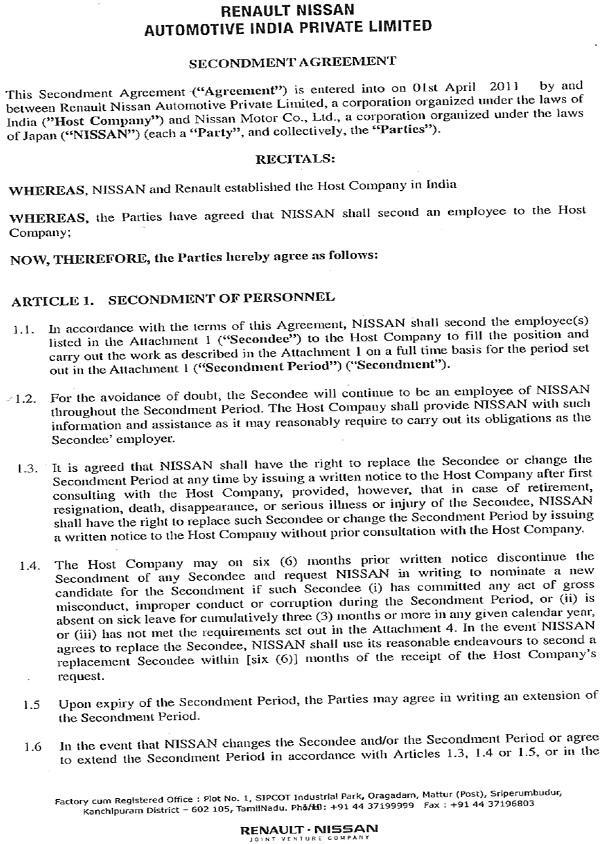
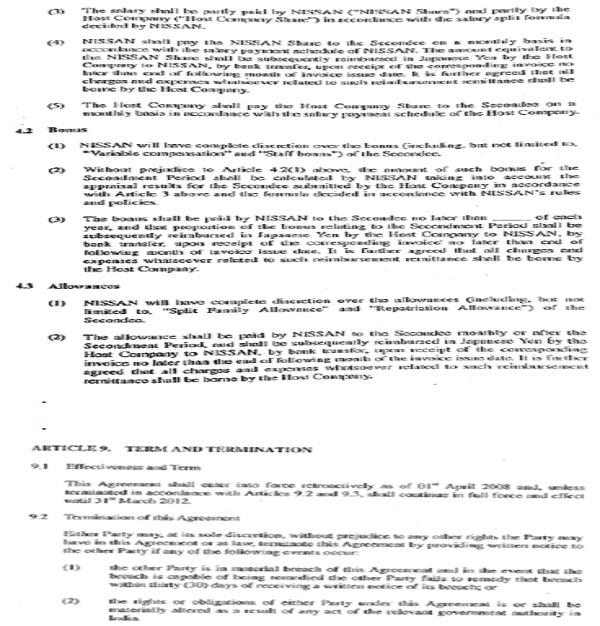
13.4.1 The relevant clauses of the Secondment Agreement dated 01.04.2011 (‘SA’ for short) between the appellant and M/s. NMC, placed on record / paper book, are reproduced below: –
–
–
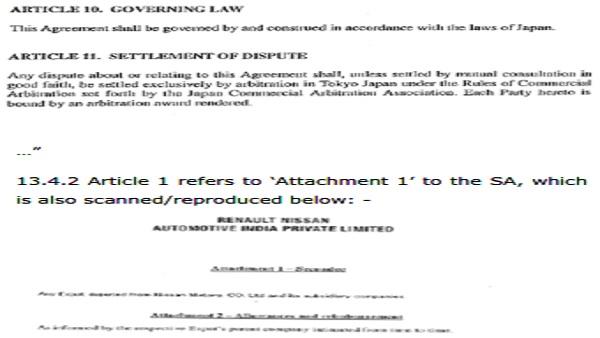
13.5.1 We have seen that in terms of the agreement between the parties, specifically Article 4, where ‘salary, bonus and others’ have been provided for, it is clear that it is for the appellant to pay the salary, bonus, perks, etc., to the secondees working for it in India, and there is also no dispute that the above clauses of the agreement are binding on both the parties.
13.5.2 It is thus clear that what is paid is towards the cost incurred for making available the service which the appellant has received. Further, in terms of the definition under Section 67 ibid., ‘consideration’ would include any amount that is payable for the taxable services provided or to be provided and thus, in view of our discussions in the above paragraphs, there is no doubt in our mind that what is provided by M/s. NMC is nothing but manpower recruitment service.
13.6.1 At this juncture, we deem it appropriate to refer to the decisions of the Hon’ble Apex Court in the cases of M/s. International Merchandising Company, LLC (supra) and M/s. Northern Operating Systems Pvt. Ltd. (supra).
13.6.2 In the decision in the case of M/s. International Merchandising Company, LLC (supra), the Hon’ble Apex Court has observed as under: –
“8. The Commissioner ruled that the consideration paid to FSE for appearance of VA for a sports tournament is taxable under the definition of “manpower recruitment or supply agency”. The Commissioner observed that the source of supply of skilled manpower is outside India and has been received by the appellant in India. The Commissioner further ruled that any programme made by a programme producer and then offered for sale to different TV channels or broadcasters for relay is a taxable activity. The Commissioner concluded that the transaction made by the appellant with Zee Telefilms includes element of service and is taxable.
9. Aggrieved by the order of the Commissioner, the appellant lodged appeals before the Tribunal. The Tribunal by its judgment dated 29 May, 2020 held against the appellant. It observed that the services provided by FSE were in the nature of supplying, recruiting, and providing players for sport events organized by the appellant. It held that such services will be covered under the definition of “manpower recruitment or supply agency” under Section 65(105)(k) read with Section 65(68) of the Finance Act, 1994. The Tribunal further relied upon the decision in Board of Control for Cricket in India v. Commissioner [2015 (37) S.T.R. 785 (Tri. – Mum.)] to uphold the order of the Commissioner imposing the demand of service tax under the category of programme producer services during the relevant period. The Tribunal did not accept the argument of the appellant that the Commissioner could not have invoked the extended period of limitation as the issues involved interpretation of legal provisions. On the issue of imposition of penalty on the appellant, the Tribunal directed the Commissioner to redetermine the amount of penalty in remand proceedings.”
13.6.3 After hearing both sides, the Hon’ble Apex Court has observed as under: –
“14. While analysing the rival submissions, it would be necessary to set out the essential ingredients of the definition contained in Section 65(68). The provision defines a “manpower recruitment or supply agency” to mean (i) any person engaged in providing any service; (ii) directly or indirectly; (iii) in any manner; (iv) for recruitment or supply of manpower; (v) temporarily or otherwise; and (vi) to any other person. In other words, the definition encompasses a situation where a person is engaged in providing a service for the recruitment or supply of manpower to any other person. The definition incorporates a recruitment as well as a supply of manpower. The expression ‘supply’ is of a wider connotation than recruitment. Moreover, the width of the provision is abundantly clear by the use of the expressions “directly or indirectly”, “in any manner” and “temporarily or otherwise”.
15. In the present case, there can be no manner of doubt that FSE, which is admittedly a company with a distinct legal identity, had an agreement with the appellant in terms of which the services of VA were to be provided. There was undoubtedly nothing on the record to indicate that VA was an employee of FSE. The issue however is as to whether the definition which has been extracted earlier of “manpower recruitment or supply agency” must be constrained by a further requirement of the existence of an employer-employee relationship between the manpower supply agency and the person whose services are provided. Plainly, the definition does not incorporate such a requirement or condition.
……
……
17. ……
…….. But it does not postulate that such a relationship must exist for the statutory definition to be attracted. Hence, the fact that there may be no relationship of employment between VA and FSE would not be dispositive for the purposes of the statutory definition in Section 65(68). For the above reasons, we are of the view that the decision of the Tribunal on this aspect of the matter cannot be faulted with.”
13.6.4 In the decision in the case of M/s. Northern Operating Systems Pvt. Ltd. (supra), which is decided by the Three-Judge Bench of the Hon’ble Supreme Court, the relevant observations of the Hon’ble Court are as under: –
“11. The CESTAT then, on an examination of the agreements, interpretation of documents on record (including the agreements entered by the respondent with its group company), held that the subject matter of the contract was not supply of manpower. The group companies were not engaged in supply of manpower. The CESTAT held that those seconded to the assessee working in the capacity of employees and receiving salaries by group companies were only for disbursement purposes. The employee-employer relationship existed and that the activity, therefore, could not be termed as “manpower recruitment and supply agency.” It was held that the assessee obtained from its group companies directly or by transfer, service of expatriate employees who were paid salaries by the assessee in India, for which tax was deducted and paid to statutory benefits – such as provident fund. The assessee also remitted contributions to be paid toward social security and other benefits on account of the employees, under the laws applicable to the group companies abroad. In these circumstances, it was held that the overseas group companies which had contracted with the assessee were not in the business of supply of manpower and that the assessee was not a service recipient. On the strength of this reasoning, the assessee’s appeals were allowed and the revenue’s appeals were rejected.”
13.6.5 After hearing both sides and after going through the relevant documents, it has been observed by the Hon’ble Supreme Court, as under: –
“42. The assessee’s contention before the CESTAT, inter alia, was that apart from it having control over the nature of work of the seconded employees, no consideration was charged by the foreign entities from it for providing the supply of manpower as the revenue alleged.
…
44. The question is what are the services provided to the assessee, and by whom? Do they include the provision of services, through employees, by its overseas group companies or affiliates? After 1-7-2012, the definition of “service” underwent a change. Except listed categories of activities excluded from, or kept out of the fold of the definition, every activity virtually is “service”. Now, by Section 65(44), “service” means
(a) any activity
(b) carried out by a person for another
(c) for consideration, and
(d) includes a declared service (the term “declared service” is defined in Section 66E).
……
48. The task of this Court, therefore is to, upon an overall reading of the materials presented by the parties, discern the true nature of the relationship between the seconded employees and the assessee, and the nature of the service provided – in that context – by the overseas group company to the assessee.
…
50. The above features show that the assessee had operational or functional control over the seconded employees; it was potentially liable for the performance of the tasks assigned to them. That it paid (through reimbursement) the amounts equivalent to the salaries of the seconded employees – because of the obligation of the overseas employer to maintain them on its payroll, has two consequences : one, that the seconded employees continued on the rolls of the overseas employer; two, since they were not performing jobs in relation to that employer’s business, but that of the assessee, the latter had to ultimately bear the burden. There is nothing unusual in this arrangement, given that the seconded employees were performing the tasks relating to the assessee’s activities and not in relation to the overseas employer. ……..
……
……
53. Facially, or to put it differently, for all appearances, the seconded employee, for the duration of her or his secondment, is under the control of the assessee, and works under its direction. Yet, the fact remains that they are on the pay rolls of their overseas employer. What is left unsaid – and perhaps crucial, is that this is a legal requirement, since they are entitled to social security benefits in the country of their origin. It is doubtful whether without the comfort of this assurance, they would agree to the secondment…..
……
……
57. Taking a cue from the above observations, while the control (over performance of the seconded employees’ work) and the right to ask them to return, if their functioning is not as is desired, is with the assessee, the fact remains that their overseas employer in relation to its business, deploys them to the assessee, on secondment. Secondly, the overseas employer – for whatever reason, pays them their salaries. Their terms of employment – even during the secondment – are in accord with the policy of the overseas company, who is their employer. Upon the end of the period of secondment, they return to their original places, to await deployment or extension of secondment.
……
……
59. As regards the question of revenue neutrality is concerned, the assessee’s principal contention was that assuming it is liable, on reverse charge basis, nevertheless, it would be entitled to refund; it is noticeable that the two orders relied on by it (in SRF and Coca Cola) by this Court, merely affirmed the rulings of the CESTAT, without any independent reasoning. Their precedential value is of a limited nature. This Court has been, in the present case, called upon to adjudicate about the nature of the transaction, and whether the incidence of service tax arises by virtue of provision of secondment services. That a particular rate of tax – or no tax, is payable, or that if and when liability arises, the assessee, can through a certain existing arrangement, claim the whole or part of the duty as refund, is an irrelevant detail. The incidence of taxation, is entirely removed from whether, when and to what extent, Parliament chooses to recover the amount.
…
61. In view of the above discussion, it is held that the assessee was, for the relevant period, service recipient of the overseas group company concerned, which can be said to have provided manpower supply service, or a taxable service, for the two different periods in question (in relation to which show cause notices were issued).”
(Emphasis supplied by us, in bold)
13.7 We find from the clauses of the SA in the case on hand, which are extracted elsewhere in this order, that the terms and conditions and scope of the SA is more or less identical to that of the assessee before the Hon’ble Apex Court in the case of M/s. Northern Operating Systems Pvt. Ltd. (supra).
13.8 The above decisions of the Hon’ble Apex Court, according to us, clearly hold that the definition of manpower recruitment or supply agency is wide enough to include ‘recruitment’ as well as ‘supply’ of manpower. The expression ‘supply’ is of a wider connotation than recruitment. We are therefore of the view that the ratio of the above rulings squarely apply to this case and thus, there is no escape for the appellant before us from Service Tax liability in respect of manpower recruitment or supply agency service under reverse charge mechanism.
13.9 As such, we hold that the appellant is required to pay applicable Service Tax for the normal period along with interest. However, we agree with the contention of the appellant there is no suppression of facts involved and that being the case, the penalties imposed are set aside.
Decision on the point of limitation:
14. We will now consider the case of the appellant on limitation.
14.1 We have perused the table indicating the dates of SCN/SODs and periods covered vis-à-vis the other table wherein the visit by the officers of the Revenue on various dates is depicted. From the above, even if it were to be assumed that the appellant had received manpower supply services, the fact remains that the whole of the activities were within the knowledge of the Revenue / officials of the Department and hence, there is no scope whatsoever to allege suppression of any facts.
14.2 In this context, it was submitted that what was paid by the appellant to the expats was nothing but salary which is not amenable to Service Tax and the Revenue only sought to interpret the same differently to fasten the tax liability. The issue, therefore, involved classification and interpretation of taxing statute, for which reason also suppression of facts could not be alleged.
14.3 The Hon’ble Apex Court in the case of M/s. Northern Operating Systems Pvt. Ltd. (supra) has also examined the issue of limitation and in this regard, the Hon’ble Court has referred to: –
(i) Cosmic Dye Chemical v. Collector of Central Excise [(1995) 6 SCC 117]
(ii) Uniworth Textiles v. Commissioner of Central Excise [2013 (9) SCC 753]
and thereafter, has proceeded to hold as under: –
“64. The fact that the CESTAT in the present case, relied upon two of its previous orders, which were pressed into service, and also that in the present case itself, the revenue discharged the later two show cause notices, evidences that the view held by the assessee about its liability was neither untenable, nor mala fide. This is sufficient to turn down the revenue’s contention about the existence of “wilful suppression” of facts, or deliberate misstatement. For these reasons, the revenue was not justified in invoking the extended period of limitation to fasten liability on the assessee.
.
.
66. In light of the above, the revenue’s appeals succeed in part; the assessee is liable to pay service tax for the periods spelt out in the SCNs. However, the invocation of the extended period of limitation, in this Court’s opinion, was unjustified and unreasonable. Resultantly, the assessee is held liable to discharge its service tax liability for the normal period or periods, covered by the four SCNs issued to it. The consequential demands therefore, shall be recovered from the assessee.”
Revenue neutrality:
15.1 It has been canvassed before us that even if the payment of salary to the secondees is to be considered as consideration for quantification of the Service Tax liability, there is no doubt that the same would entitle the appellant to avail CENVAT Credit of the same and thus, the appellant could always seek refund. This, according to the Learned Advocate, establishes the fact that the issue is revenue neutral insofar as the demand of Service Tax on salary paid to the expats is concerned.
15.2 In the case of M/s. Northern Operating Systems Pvt. Ltd. (supra), the Hon’ble Court did not go into the issue for the reasons given at paragraph 59 of the said order. To repeat the same, it has been held:
“59. ….
….. it is noticeable that the two orders relied on by it (in SRF and Coca Cola) by this Court, merely affirmed the rulings of the CESTAT, without any independent reasoning. Their precedential value is of a limited nature. This Court has been, in the present case, called upon to adjudicate about the nature of the transaction, and whether the incidence of service tax arises by virtue of provision of secondment services….”
15.3 In the case of M/s. Nirlon Ltd. (supra) relied upon by the appellant, the Hon’ble Apex Court has categorically held as under: –
“9. We have ourselves indicated that the two types of goods were different in nature. The question is about the intention, namely, whether it was done with bona fide belief or there was some mala fide intentions in doing so. It is here we agree with the contention of the learned Senior Counsel for the appellant, in the circumstances which are explained by him and recorded above. It is stated at the cost of repetition that when the entire exercise was revenue neutral, the appellant could not have achieved any purpose to evade the duty.”
15.4 In the case of M/s. Narmada Chematur Pharmaceuticals Ltd. (supra), the Hon’ble Apex Court has held as under: –
“In C.A. Nos. 5485-86/2003 :
4. The Modvat credits which according to the appellant had been wrongly availed of by the assessee was Rs. 9,63,607/-. It is stated by learned counsel that the excise duty paid by not availing of the exemption was the exact amount and that therefore the action of the assesse was revenue neutral. The appeals are accordingly dismissed. If upon verification the submission of the respondent is found to be incorrect, liberty is granted to the appellant to mention this matter before this Court.”
15.5 Further, the Hon’ble Apex Court in the case of M/s. Textile Corpn. Marathwada Ltd. (supra) has held as under: –
“3. Admittedly, against the decision of the Tribunal in Indian Rayon and Industries Ltd. (supra), Revenue did not file any appeal and accepted the decision and in our view rightly so. Admittedly, assessee has paid duty at the final stage. If assessee has to pay the excise duty at each and every stage of manufacturing, it would be entitled to Modvat credit and the whole exercise would be revenue neutral.”
16. From the facts before us, we do not see any difference from the facts involved in the case of M/s. Northern Operating Systems Pvt. Ltd. (supra). The said decision in M/s. Northern Operating Systems Pvt. Ltd. (supra) is also exhaustive, which has even dealt with from both revenue neutral situation as well as limitation perspectives which, according to us, squarely applies to the present case.
17. In addition to the above, we also have the guidance of the ratio laid down by the Hon’ble Apex Court in the case of M/s. Pragathi Concrete Products (P) Ltd. (supra) wherein it has been held that when a unit of the taxpayer therein was audited several times during the period and there were also physical inspections by the Department as well, there could not be any case of suppression.
18. In view of the above guiding principles laid down by the Hon’ble Apex Court, we do not have any doubt that it is the case of a revenue neutral situation and that by suppressing the same, the appellant / assessee could not have achieved any benefit.
19. In view of the discussion in the above paragraphs, we are of the view that on merits, the appellant has to fail, but however, the appellant’s claim as to this case being revenue neutral, deserves merit, for which reason the extended period of limitation cannot be invoked. Further, even on the issue of limitation, following the decision in the case of M/s. Northern Operating Systems Pvt. Ltd. (supra), specifically paragraphs 64 and 66 which are extracted by us elsewhere in this order, we hold that the demand, if any, would survive only for the normal period.
20. In the result, the appeal is partly allowed, as indicated above, but however, partly dismissed, sustaining the demand, if any, for the normal period.
(Order pronounced in the open court on 15.06.2023)