Sansco Technologies (Kerala) Private Limited Vs Commissioner of State Tax (GSTAT Ernakulam)
Summary: The Goods and Services Tax Appellate Tribunal, Ernakulam Bench, allowed the appeal of Sansco Technologies (Kerala) Private Limited against an order confirming an excess input tax credit demand for F.Y. 2017-18. The appellant, a super distributor of Oppo mobile products in Kerala, had received a notice under Section 73(1) alleging excess ITC of Rs.13,97,613 on comparison of GSTR-2A with GSTR-3B. The demand was confirmed by the adjudicating authority and upheld in first appeal. Before the Tribunal, the appellant challenged the figures adopted by the authorities, their failure to consider the latest GSTR-2A and GSTR-9 data, and the omission of Rs.56,31,242 of IGST paid on imported goods.
The comprehensive reconciliation produced by the appellant showed total eligible credit of Rs.45,24,29,934.57 against credit availed of Rs.44,78,81,069.87, leaving an overall difference of Rs.45,48,864.70 in its favour. The reconciliation disclosed unavailed IGST credit of Rs.48,22,559.51, while CGST and SGST credit availed exceeded the corresponding available amounts by Rs.1,37,242.10 and Rs.1,36,452.71 respectively. The appellant argued that the surplus IGST credit absorbed these differences. It also relied on Circular No. 192/04/2023-GST dated 17 July 2023 and judicial decisions concerning credit reported under incorrect tax heads. Separately, it submitted that the matching and reversal mechanism had not been operational during the relevant period, that GSTR-2A discrepancies alone could not justify denial of genuine credit, and that recovery should first be pursued against defaulting suppliers.
The Revenue argued that actual payment of tax to the Government under Section 16(2)(c) was mandatory, that the claimant bore the burden of proof under Section 155, and that separate tax heads could not be netted merely because aggregate credit was sufficient. It relied on State of Karnataka v. Ecom Gill Coffee Trading Private Limited. The Tribunal, however, recorded that the appellant’s factual reconciliation and the omission of import IGST credit had not been disputed or rebutted. Applying Section 49(5)(a) as it stood during the relevant period, it held that surplus IGST credit could be used to discharge a shortfall in CGST or SGST. Following Rejimon Padickapparambil Alex v. Union of India and the jurisdictional High Court decisions identified in the order, it concluded that no short payment warranting Section 73 proceedings had been established.
The Tribunal independently found that the original authority had neither afforded a personal hearing nor discussed the appellant’s contentions, rendering the adjudication order null and void for violation of natural justice. It also held that the first appellate authority had mechanically confirmed the demand without analysing the submissions and evidence, resulting in a non-speaking order. The Revenue’s arguments concerning Sections 16(2)(c) and 155 were held irrelevant to the dispute because the show cause notice contained no specific allegation on those grounds. The appeal was allowed, the impugned appellate order was set aside, and consequential relief was granted.
Cases Discussed
- M/s. Lucknow Test House v. Additional Commissioner Grade-II, State Tax, Lucknow & Ors., 2026 (9) TMI 151 (GSTAT Lucknow). Cited by the appellant in support of determining excess credit with reference to aggregate eligible ITC.
- M/s. Win Auto Sales v. Union of India, W.P.(C) No. 12913 of 2025; 21/10/2025 (Kerala High Court). Identified by the Tribunal as following the Rejimon decision.
- M/s. Kaniamparambil Steels v. State Tax Officer, W.P.(C) No. 5975 of 2025; 23/06/2025 (Kerala High Court). Identified as following the principle concerning credit allocated under incorrect tax heads.
- Golden Traders v. Assistant State Tax Officer, W.P.(C) No. 14998 of 2025; 05/06/2025 (Kerala High Court). Listed by the Tribunal among decisions following Rejimon.
- M/s. S&D Sales & Marketing vs Golden Traders vs Asst State Tax Officer, W.P.(C) No. 8729 of 2025; 25/03/2025 (Kerala High Court). Listed in this form in paragraph 6.9(b) of the supplied order as following Rejimon.
- TRM Associates v. State Tax Officer, W.P.(C) No. 2694 of 2025; 28/01/2025 (Kerala High Court). Listed as following the same credit-allocation principle.
- M/s. K.V. Koshy & C.K. Paul v. Assistant Commissioner, Central Tax and Central Excise, 2025-VIL-1211-KER (Kerala High Court). Cited by the appellant regarding recovery from a recipient without first proceeding against the defaulting supplier; the decision date is not stated in the source.
- Rejimon Padickapparambil Alex v. Union of India & Ors., 2024 KHC OnLine 7215; 2024-TIOL-2024-HC-KERALA-GST (Kerala High Court). Followed by the Tribunal in holding that the surplus IGST credit could cover the CGST and SGST shortfall and that Section 73 proceedings were unwarranted on the facts.
- Unity Ooh Media Solutions Pvt. Ltd. v. Deputy State Tax Officer, 2024 (1) TMI 377; W.P.(C) No. 42429 of 2023; 21/12/2023 (Kerala High Court). Cited by the appellant concerning denial of credit based on supplier reporting discrepancies; the Revenue sought to distinguish it.
- Raju Joseph v. State Tax Officer, 2023 (11) TMI 1012 (Kerala High Court). Cited by the appellant regarding genuine ITC claims affected by GSTR-2A discrepancies.
- Geetha Agencies v. Deputy Commissioner of State Tax, 2023 (11) TMI 137 (Kerala High Court). Cited by the appellant in support of examining the underlying entitlement to credit.
- Praveen Bhaskaran v. Union of India, 2023 (10) TMI 1204 (Kerala High Court). Cited by the appellant among decisions concerning ITC and GSTR-2A discrepancies.
- Mina Bazar v. State Tax Officer, 2023 (10) TMI 926; W.P.(C) No. 30670 of 2023; 19/09/2023 (Kerala High Court). Cited by the appellant regarding the need to consider evidence supporting the ITC claim.
- M/s. Henna Medicals v. State Tax Officers, 2023 (10) TMI 98; W.P.(C) No. 30660 of 2023; 19/09/2023 (Kerala High Court). Cited by the appellant; the Revenue contended that the decision was distinguishable.
- Diya Agencies v. State Tax Officer, W.P.(C) No. 29769 of 2023; 12/09/2023 (Kerala High Court). Referred to in the Revenue’s submission distinguishing the appellant’s authorities on ITC discrepancies.
- State of Karnataka v. M/s. Ecom Gill Coffee Trading Pvt. Ltd., 2023 SCC OnLine SC 248; Civil Appeal No. 230 of 2023; 13/03/2023 (Supreme Court). Relied upon by the Revenue on the burden of proving an ITC claim under analogous VAT provisions; the Tribunal held that the specific supplier-payment allegations advanced by the Revenue were outside the show cause notice.
- Union of India v. Bharti Airtel Ltd., arising out of SLP(C) No. 8654 of 2020; 28/10/2021 (Supreme Court). Cited by the appellant for the role of books, invoices and other records in self-assessment and the portal’s facilitative character.
- St. Joseph Tea Company v. State Tax Officer, W.P. No. 17235/2020; 17/06/2021 (Kerala High Court). Cited by the appellant in its submissions concerning credit not reflected in GSTR-2A.
- M/s. D.Y. Beathel Enterprises v. State Tax Officer (Data Cell), [2021] 127 taxmann.com 80; 24/02/2021 (Madras High Court). Cited by the appellant regarding recovery action against a defaulting seller; the Revenue sought to distinguish it.
- Saji S. v. Commissioner of State GST, 2018 (19) GSTL 385 (Ker); 2018-TIOL-2902-HC-KERALA-GST (Kerala High Court). Appears in the findings reproduced through Rejimon regarding adjustment of amounts between GST heads.
- State of M.P. v. Narmada Bachao Andolan, (2011) 7 SCC 639 (Supreme Court). Cited by the appellant in support of its impossibility argument concerning the non-operational matching and reversal mechanism.
FULL TEXT OF THE ORIGINAL GSTAT JUDGMENT/ORDER
1.0 The present Appeal (APL/26/ERN/2026) has been preferred by M/s Sansco Technologies (Kerala) Pvt Ltd (‘Appellant’) against Order-in-Appeal No. OIA/JCEKM/2024/GSTA500 dated 6/6/2025 passed by the Joint Commissioner (Appeals), SGST Department, Ernakulam. (Appellate Authority)
2.0 Brief Facts of the Case :
2.1 The Appellant, M/s. Sansco Technologies (Kerala) Pvt. Ltd ( GSTIN 32AACCO1981D2ZS) is the Super Distributor of M/s. Oppo Mobile India Pvt. Ltd. for the State of Kerala and is engaged in the distribution of mobile telephones and allied electronic products.
2.2 The Appellant was issued a Show Cause Notice dated 22/07/2023 under Section 73(1) of the CGST/KSGST Act, 2017, alleging that they had availed excess ITC of Rs.13,97,613/- on a comparison of GSTR-2A with GSTR-3B.
2.3 The proper officer, proceeded to pass Order No. ZD321223013976L dated 14.12.2023, confirming the demand.
2.4 The appeal filed before the Appellate Authority was dismissed vide the impugned order in appeal.
2.5 Aggrieved by the impugned order of the Appellate Authority, the Appellant has filed this appeal before the Tribunal.
3.0 Grounds of Appeal / Submissions of the Appellant:
3.1 Demand Actually Incorrect- Overall GSTR2A shows no excess ITC availed.
a.The adjudicating authority determined the alleged excess ITC on a line-by-line comparison of IGST, CGST, and SGST components between GSTR-2A and GSTR-3B, without examining the consolidated overall position. When the overall ITC figures are compared correctly, the ITC eligible as per GSTR-2A is higher than the ITC claimed in GSTR-3B.The demand is therefore factually unsustainable at its foundation.
b. A selective component-wise comparison that ignores the net overall position produces a distorted and legally untenable result. The screenshots of the GSTR-3B and GSTR-2A data as appearing in the GST portal, demonstrating the correct overall position, are reproduced.
c. The figures in the show cause notice and the order also do not match the ITC data reflected in the GSTR-9 annual return filed by the Appellant for F.Y. 2017- 18. The authorities below ought to have examined the GSTR-9 data before confirming the demand. The GSTR-2A is a dynamic return and the authorities were obligated to examine the latest GSTR-2A data at the time of adjudication.
3.2 Non-consideration of the Integrated Tax paid on the import of goods;
a. The report does not capture the IGST credit available to the Appellant on account of import of goods, which is separately reflected in GSTR-2A (under the head ‘Import of Goods’) on the strength of Bills of Entry filed with ICE. The above credits appear under the sheet named “IMPG” when the GSTR 2A is downloaded. The sheet is part of GSTR 2A file and contains the Bill of Entry Number, Bill of Entry Date and the corresponding reference/assessment date on ICEGATE.
b. IGST credit of Rs.56,31,242/- on account of import of goods has not been considered either in the Order-in-Original dated 14.12.2023 or in the impugned Order-in-Appeal dated 06.06.2025. The ‘Input tax credit claimed and due (Other than import of goods)’ available under the ‘ITC Comparison Report’ generated on the Portal, by its very design, excludes import-related credit and confines itself to domestic B2B transactions reported through GSTR-1/GSTR-2A. Appellant has availed the IGST correctly. It is submitted that since the IGST is paid the said tax paid ought to be considered by the proper officer.
3.3 Latest GSTR-2A figures not considered by the proper officer
a.The proper officer has adopted different figures as per GSTR-2A. The following table shows the comparative figures
| ITC availed as per GSTR2A | ITC Availed | ||||
|---|---|---|---|---|---|
| 1 | 2 | 3 | 4 | 5 | 6 |
| As per order | As per TABLE 8A Of GSTR 9 | Latest GSTR 2A (after reducing credit notes) | As per Order | As per Table 6A of GSTR-9 | |
| CGST | 3,85,92,656 | 3,98,08,551 | 3,87,48,582 | 3,88,83,291 | 3,88,85,824 |
| SGST | 3,85,93,457 | 3,98,09,340 | 3,87,49,371 | 3,88,83,291 | 3,88,85,824 |
| IGST | 36,92,92,289 | 36,92,83,750 | 36,93,00,738 | 37,01,09,421 | 37,01,09,421 |
b. From the above it is clear that the proper officer has erred in considering the ITC available as per GSTR 2A. Even if the values as per GSTR 2A as auto populated in TABLE 8A of GSTR 9 would have been considered (column 3 above), still there would have been no excess availment. The proper officer has considered different figures, which is totally incorrect. GSTR-2A is a dynamic document. It is a settled position of law that, while completing the assessment, the latest GSTR-2A available on the GST Portal must be adopted for the purpose of assessment. Appellate proceedings are a continuation of the assessment proceedings. Hence, the latest GSTR-2A ought to have been considered in the appellate proceedings as well.
c.The latest GSTR 2A of the appellant as available in GST portal is extracted below
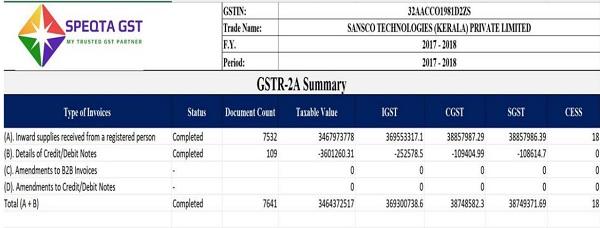
d. If the above values are considered together with the IGST paid on import of goods as reflected in GSTR-2A, the resultant reconciliation is as follows
| Particulars | IGST (Rs.) | CGST (Rs.) | SGST (Rs.) | Total (Rs.) |
|---|---|---|---|---|
| B2B credit as per GSTR-2A | 36,95,53,317.08 | 3,88,57,987.29 | 3,88,57,986.39 | 44,72,69,290.76 |
| Less: Credit Notes as per GSTR-2A | (2,52,578.50) | (1,09,404.99) | (1,08,614.70) | (4,70,598.19) |
| Add: IGST on import of goods as per GSTR-2A | 56,31,242.00 – – | 56,31,242.00 | ||
| Total ITC available as per GSTR-2A | 37,49,31,980.58 | 3,87,48,582.30 | 3,87,49,371.69 | 45,24,29,934.57 |
| ITC availed in GSTR-3B (Table 4(A) | 37,01,09,421.07 | 3,88,85,824.40 | 3,88,85,824.40 | 44,78,81,069.87 |
| Difference [Eligible ITC less ITC availed] | 48,22,559.51 | (1,37,242.10) | (1,36,452.71) | 45,48,864.70 |
e. It is well settled that IGST paid on import of goods is a legitimate component of ITC available to a registered person under Section 16 of the CGST Act, 2017 read with Section 20 of the IGST Act, 2017, and there is no statutory basis to exclude the same while comparing the overall eligibility of ITC of the Appellant merely because the GST Portal’s ‘ITC Comparison Report’ does not display it.
f. Exclusion of import-related credit from the said report is a limitation of the Portal’s reporting tool and cannot be a ground to deny the Appellant the benefit of credit that is otherwise legitimately available and duly evidenced by Bills of Entry filed with ICEGATE.
g. In view of the above, the allegation that the Appellant has availed ITC in excess of what is available as per GSTR-2A is factually incorrect, and stands demonstrated to be so on a complete and correct reconciliation of GSTR-2A (including import credit) with GSTR-3B. The demand, being based on an incomplete comparison, is unsustainable and is liable to be set aside in its entirety
3.4 EXCESS AVAILMENT OF ITC TO BE DETERMINED ON AN AGGREGATE BASIS
a. The question whether any excess Input Tax Credit has been availed must be determined by considering the credit under IGST, CGST and SGST as a whole, and not head-wise in isolation. As per Section 49(5) of the CGST Act, 2017 read with Rule 88A of the CGST Rules, 2017, IGST credit is required to be utilized first towards payment of IGST and thereafter towards payment of CGST and SGST. The credit under the three heads thus constitutes a common pool available for discharge of the output tax liability of the Appellant
b. This position has been recognized by the Central Board of Indirect Taxes and Customs itself. In Circular No. 192/04/2023-GST dated 17.07.2023, the Board clarified that, for determining whether wrongly availed credit has been utilized and for computation of interest under Rule 88B of the CGST Rules, 2017, the balance in the electronic credit ledger under the heads of IGST, CGST and SGST taken together is to be considered.
c. The Hon’ble High Court of Kerala, in Rejimon Padickapparambil Alex v. Union of India & Ors. [2024 KHC OnLine 7215], has held that the electronic credit ledger operates as a unified pool with separate compartments for IGST, CGST and SGST, that mere allocation of credit under an incorrect head causes no loss of revenue, and set aside the proceedings initiated under Section 73 on that basis.
d. The Hon’ble Goods and Services Tax Appellate Tribunal, Lucknow Bench, in M/s. Lucknow Test House v. Additional Commissioner Grade-II, State Tax, Lucknow & Ors. 2026 (9) TMI 151 – GSTAT LUCKNOW held that a demand for excess Input Tax Credit cannot be sustained merely on account of the allocation of credit between IGST, CGST and SGST, where the Department has not established that the aggregate eligible credit of the taxpayer has been exceeded. In the present case, the reconciliation above demonstrates that the aggregate Input Tax Credit available as per GSTR-2A (Rs.45,24,29,934.57) exceeds the aggregate credit availed in GSTR-3B (Rs.44,78,81,069.87) by Rs.45,48,864.70.
e. The apparent head-wise excess of Rs.1,37,242.10 under CGST and Rs.1,36,452.71 under SGST stands wholly absorbed by the IGST credit of Rs.48,22,559.51 available to the Appellant but not availed. When the credit is considered as a whole, there is no excess availment of Input Tax Credit, and no loss of revenue has been caused to the exchequer. The demand is, therefore, liable to be set aside on this ground as well.
3.5 Order in original passed exparte without hearing / without considering the reply to ASMT-09 _ Fundamental breach of natural justice.
a. The proper officer ought to have considered the submissions made by the Appellant in Form GST ASMT-11 in reply to the notice in Form GST ASMT-10. The notice in Form GST ASMT-10 forms part of the assessment proceedings, and the reply thereto equally forms part of the assessment records. The assessing authority was therefore bound to consider it. The Appellant had categorically submitted in the said reply that the figures adopted in the ASMT-10 were not correct. Appellant had also submitted that credit availed in GSTR 3B is lesser than the credit available in GSTR 2A. 11. The assessing authority ought to have considered this important submission before completing the proceedings. The non-consideration of the said reply constitutes a clear violation of the principles of natural justice.
b. The adjudicating authority passed the demand order without affording the Appellant a personal hearing. The passing of the order without any hearing is a fundamental breach of the mandatory procedure under Section 73 and of the principles of natural justice. The First Appellate Authority upheld the order without addressing this specific violation of natural justice. The denial of hearing at the original adjudication stage cannot be cured merely by the availability of appellate proceedings — it is a jurisdictional infirmity in the original order.
3.6 No mechanism in place during 2017-18 – GSTR 2A not mandatory criterion for ITC
a. During F.Y. 2017-18 — the initial year of GST implementation — the matching and reversal mechanism prescribed under Sections 41 and 42 of the CGST Act read with Rules 69, 70, and 71 of the CGST Rules was never operationalized. Forms GSTR-2, GSTR-3, GST MIS-1, and GST MIS-2 were never put into operation. The Government itself kept the filing of Forms GSTR-2 and GSTR-3 in abeyance vide Circular No. 26/26/2017-GST dated 29.12.2017. Sub-rule (4) of Rule 36 of the CGST Rules, 2017 — which made the comparison of ITC with GSTR-2A mandatory — was inserted only with effect from 09.10.2019 by Notification No. 49/2019-CT. This provision has prospective effect. It does not apply to, and cannot be used to deny ITC for, F.Y. 2017-18.
b. During July 2017 to September 2019, taxpayers lawfully availed ITC on the basis of: (a) possession of valid tax invoice from a registered supplier; (b) receipt of goods or services; and (c) the goods not being covered under Section 17(5) blocked credit. GSTR-2A was, during this period, a facility for reconciliation — not a mandatory prerequisite for ITC.
3.7 All conditions of section 16(2) fulfilled – ITC validly availed
a. The Appellant purchased goods from registered suppliers under valid tax invoices (Section 16(2)(a)), received the goods (Section 16(2)(b)), and filed its returns (Section 16(2)(d)). All four conditions for eligibility of ITC were satisfied. The denial of ITC was not on the ground of non-fulfilment of any of these conditions by the Appellant.
b. The Supreme Court of India in Union of India v. Bharti Airtel Ltd. (Civil Appeal SLP(C) No. 8654 of 2020, decided on 28.10.2021) held that the GST common portal is only a facilitator and need not be the primary source for self- assessment; the primary source is in the form of agreements, invoices, receipts, and books of accounts maintained by the registered person. The Court held that the obligation to self-assess OTL and ITC is primarily book-based and not wholly dependent on the auto-generated information in the common portal.
c. The Hon’ble Kerala High Court, in a series of decisions — including Unity Ooh Media Solutions Pvt. Ltd. v. Deputy State Tax Officer (2024 (1) TMI 377), Raju Joseph v. State Tax Office (2023 (11) TMI 1012), Geetha Agencies v. Deputy Commissioner (2023(11) TMI137), Praveen Bhaskaran v. Union of India (2023 (10) TMI 1204), Mina Bazar v. State Tax Officer (2023 (10) TMI 926), M/s. Henna Medicals vs .State Tax Officers (2023 (10) TMI 98), and St. Joseph Tea Company v. State Tax Officer (W.P. 17235/2020 dated 17.06.2021) — has consistently upheld the position that bona fide taxpayers cannot be denied their eligible ITC on the ground that supplier invoices are not reflecting in GSTR-2A.
3.8 Reversal mechanism not operationalized- Failure to reverse cannot be attributed to appellant.
a. Section 16(2)(c) of the CGST Act conditions ITC on actual payment of tax by the supplier, but this condition is expressly made ‘subject to the provisions of Section 41.’ Section 41(2) provides for reversal of ITC in ‘such manner as may be prescribed.’ The prescribed mechanism — Section 42, Rules 69-71, Forms GSTR-2, GSTR-3, and GST MIS-2 — was never operationalized. The department cannot use the non-operationalization of its own prescribed mechanism as a ground to demand tax from the recipient through a Section 73 proceeding.
b. Under Section 42 read with Rule 71, the discrepancy in ITC is required to be communicated to the recipient in Form GST MIS-2 before any reversal can be required. No such communication was ever issued to the Appellant. In the absence of the communication and the mechanism, there is no ‘failure’ on the part of the Appellant to reverse ITC — and therefore no violation that can give rise to a demand under Section 73 or penalty under Section 73(9).
c. The legal maxim lex non cogit ad impossibilia — the law does not compel the doing of impossible things — is directly applicable. The Appellant could not have verified whether its suppliers paid output tax to the government, and could not have reversed ITC in the prescribed manner when neither the Forms nor the mechanism were in operation. As held by the Supreme Court in State of M.P. v. Narmada Bachao Andolan (2011 (7) SCC 639), compliance with a statutory requirement cannot be insisted upon where the mechanism for such compliance has not been made available.
3.9 Recovery from recipient without proceeding against defaulting supplier – contrary to law
a. The Madras High Court in M/s. D.Y. Beathel Enterprises v. The State Tax Officer (Data Cell) (2021 127 Taxmann.com 80 (Madras)) held that recovery action must first be initiated against the defaulting seller before proceeding against the buyer. No action appears to have been initiated against any of the Appellant’s suppliers in the present case.
b. The Hon’ble Kerala High Court in M/s. K.V. Koshy & C.K. Paul v. Assistant Commissioner, Central Tax and Central Excise (2025-VIL-1211-KER) held that proceeding against the recipient for non-payment of tax by the supplier — without first proceeding against the supplier or establishing collusion, closure, or absence of assets — is arbitrary and unsustainable. The same principle is directly applicable to the present matter.
Shri K.Ramaswamy, CA, appeared on behalf of the appellant and made a forceful argument reiterating the above contentions.
4.0 Submissions of the Respondent / Revenue
4.1 Section 16(2)( c) is a mandatory prerequisite- Invoice possession alone is insufficient.
a. Entitlement to Input Tax Credit is not an absolute or inherent right, but a statutory concession subject to strict compliance with all conditions prescribed under Section 16(2) of the CGST Act, 2017. While Section 16(2)(a) and (b) require possession of a tax invoice and receipt of goods, Section 16(2)(c) lays down a mandatory non-negotiable condition:
‘the tax charged in respect of such supply has been actually paid to the Government, either in cash or through utilization of input tax credit admissible in respect of the said supply.’
b. Form GSTR-2A reflects details of outward supplies declared by suppliers in Form GSTR-1. Where an invoice does not appear in GSTR-2A, there is a primary legal inference that the supplier has failed to declare the supply and consequently failed to pay the corresponding tax into the Government Treasury. The Appellant’s reliance on invoice possession and bank payment records satisfies only commercial receipt, but does not prove payment of tax to the Government Exchequer under Section 16(2)(c).
c. Statutory burden of proof lies entirely on the assessee under section 155.
Under Section 155 of the CGST/KSGST Act, 2017, where any registered person claims entitlement to ITC, the burden of proving such claim lies directly upon that person. The Revenue is not required to perform impossible audits of un-cooperative third-party suppliers when the primary claimant fails to produce basic corroborative evidence.
d. The Hon’ble Supreme Court of India in State of Karnataka v. M/s. Ecom Gill Coffee Trading Pvt. Ltd. (2023 SCC OnLine SC 248) authoritatively settled this proposition under analogous value-added tax provisions.
e. Before the First Appellate Authority, as recorded in Order-in-Appeal (Page7), the Appellant adduced zero documentary evidence—such as supplier tax certificates, GSTR-3B filings of suppliers, or dynamic reconciliation ledgers—to establish that tax was deposited for the disputed IGST differential of ₹8,17,132/-. Consequently, the Appellate Authority correctly confirmed the disallowance.
4.2 Component wise matching is mandatory – cross head netting is impermissible.
a. The Appellant contends that overall ITC available in GSTR-2A (₹44,89,01,641.74) exceeds total ITC claimed in GSTR-3B (₹44,78,81,069.87), and therefore no demand lies. This argument fundamentally misconstrues the statutory architecture of the GST law.
b. CGST, SGST, and IGST are separate statutory taxes governed by distinct legislative enactments (CGST Act, KSGST Act, and IGST Act). Under Section 49 read with Rule 88A, set-off rules govern the utilization of available credit towards tax liability, but they do NOT permit a taxpayer to claim excess credit under one specific tax head (IGST) merely because credit under other distinct tax heads (CGST/SGST) was under-claimed. Scrutiny under Section 61 and determination under Section 73 are conducted head-by-head. An excess claim of ₹8,17,132/- under IGST is an unauthorized availment in law that cannot be sanitized by netting off across unrelated statutory heads.
4.3 Distinction of Appellant’s case laws
The Appellant relies on several judgments of the Hon’ble Kerala High Court (e.g., Diya Agencies v. State Tax Officer [2023], Unity Ooh Media, Henna Medicals) and the Madras High Court in D.Y. Beathel Enterprises (2021). However, those decisions are readily distinguishable on facts.
Shri Anil Gopinath, AR appeared for the revenue and reiterated the above submissions.
5.0 Discussion and findings.
5.1 We find that the appellant has contended that:
a. The figures in the show cause notice and the order do not match the ITC data reflected in the GSTR-9 annual return filed by the Appellant for F.Y. 2017- 18
b. GSTR-2A is a dynamic return and the authorities were obliged to examine the latest GSTR-2A data at the time of adjudication.
c. If the values as per GSTR 2A as auto populated in TABLE 8A of GSTR 9 had been considered still there would have been no excess availment.
d. It is a settled position of law that, while completing the assessment, the latest GSTR-2A available on the GST Portal must be adopted for the purpose of assessment.
5.3 We find that the contentions of the appellant on facts are not disputed / refuted by the revenue. We also find that contentions with regard to non-accounting of IGST on imported goods which were pressed vigorously by the appellant during the hearing were not disputed / rebutted by the learned AR.
5.4 On the basis of the comprehensive reconciliation statement produced by the appellant (refer para 3.3 d above) which takes into account the latest GSTR 9 figures and the IGST credit on account of imports, the appellant has contended that
- the allegation that the Appellant has availed ITC in excess of what is available as per GSTR-2A is factually incorrect, and stands demonstrated to be so on a complete and correct reconciliation of GSTR-2A (including import credit) with GSTR-3B.
- the demand, being based on an incomplete comparison, is unsustainable and is liable to be set aside in its entirety
6.1 We find that on the basis of the said reconciliation statement (which is not disputed or rebutted) it is clearly seen that while the overall credit was in excess by Rs 45,48,864.70, CGST and SGST credit were short to the extent of Rs 1,37,242.10 and Rs 136452.71 respectively.
6.2 The next question which arises for consideration whether the excess availment of ITC can be determined on an aggregate basis, as contended by the appellant
6.3 The learned AR, while not disputing the facts and figures as presented by the appellant as above, has contended that:
a. CGST, SGST, and IGST are separate statutory taxes governed by distinct legislative enactments (CGST Act, KSGST Act, and IGST Act).
b. Under Section 49 read with Rule 88A, set-off rules govern the utilization of available credit towards tax liability, but they do NOT permit a taxpayer to claim excess credit under one specific tax head (IGST) merely because credit under other distinct tax heads (CGST/SGST) was under-claimed. Scrutiny under Section 61 and determination under Section 73 are conducted head-by-head.
6.4 We find that the said contentions are not sustainable for the following reasons:
a. Section 49(5)(a) of the CGST / KGST Act as it stood during the period in question read as follows:
The amount of input tax credit available in the electronic credit ledger of the registered person on account of––
(a) integrated tax shall first be utilised towards payment of integrated tax and the amount remaining, if any, may be utilised towards the payment of central tax and State tax, or as the case may be, Union territory tax, in that order; …………
6.5 We find that in view of the clear and unambiguous wording of the section as above, it is the vested right of the tax payer to use any surplus credit of IGST (after using it to discharge IGST due ) to discharge short fall , if any of CGST /SGST. The contentions of the revenue, to the contrary, are against the statutory provisions.
6.6 We also find that the appellant has sought to rely on the judgement of the Honourable High Court of Kerala in the case of Rejimon Padickaparamabil Alex vs Union of India 2024-TIOL-2024-HC-KERALA-GST in support of their case.
6.7 We find that in that case the honourable High Court has appreciated and approved the following principles with respect to the fungibility of credit between CGST/SGST and IGST as recorded in an order dated 14.12.2023 passed by Assistant Commissioner of Central Tax, East Division-6, Bengaluru:
a. Kerala High Court decision in the case of Saji S. Vs.Commissioner of State GST 2018 (19) GSTL 385 (KER) = 2018-TIOL-2902-HC-KERALA-GST has allowed transfer and adjustment of amount from “SGST” to “IGST” and also held that it is inequitable for authorities to let the assessee suffer on account of any delay in transfer. Therefore, relying on the decision of Kerala High Court (Supra) tax paid wrongly under CGST and SGST should rightly be adjusted and no further recovery under IGST is legally sustainable.
b. CBIC vide Circular No.192/04/2023-GST dated 17th July 2023 had given clarification on charging of interest under section 50(3) of the CGST Act, 2017, in cases of wrong availment of IGST credit and reversal thereof.
c. The essence of the above clarification is that the input tax credit (ITC) available in the electronic credit ledger should be considered as a pool of funds designated for different types of taxes, such IGST, CGST and SGST. These accounts represent a wallet with compartments for IGST, CGST, and SGST funds. Therefore, while determining interest under rule 88B of the CGST Rules, the entire wallet has to be taken into consideration, not just individual compartments. If the total balance (combining IGST, CGST, and SGST) falls below the amount of the wrongly availed IGST credit, there is interest liability. If, however, the total wallet balance never dips below this specific amount during the relevant period, there’s no interest liability. Similarly, for utilizing the IGST liability, the clarification emphasizes that the eligibility of funds for this payment is based on the total balance in the entire wallet, not just the IGST compartment. In short, the analogy of the above circular is that the GST system treats the electronic credit ledger as a unified resource, and interest is incurred if, collectively, the available funds fall below the amount of wrongly availed credit during the specified period.
6.8 The Court went on to add:
“8. We have deemed it appropriate to extract the above findings from the order of the Assistant Commissioner since we find that it not only represents the correct view of the procedural law in this regard, but more importantly, demonstrates that revenue officials, even at the level of Assistant Commissioner, who are often the first point of contact between an assessee and the revenue department, are capable of rendering timely and effective justice in our country which is known for its huge backlog of cases. At a time when the justice dispensation system is looking for ways and means to reduce litigation generally, and especially in the field of taxation where delays can affect the nation’s economy, orders such as the one extracted above come as a welcome breath of fresh air, and are to be duly appreciated and encouraged. It needs no gainsaying that an expeditious disposal of cases, especially those involving procedural aspects of taxation, is the need of the hour so as to ensure fairness and certainty in tax administration.
9.We find that on the facts in the instant case, the notice issued to the appellant, and the demand confirmed against him, were in proceedings initiated under Section 73 of the GST Act. The said provisions are attracted only when it appears to a proper officer that any tax has not been paid or short paid or erroneously refunded, or where input tax has been wrongly availed or utilised for any reason. The case before us clearly reveals that there has been no wrong availment of credit, and that the only mistake committed by the appellant was an inadvertent and technical one, where he had omitted to mention the IGST figures separately in Form GSTR 3B. The mistake was also insignificant because it is not in dispute that there was no outward supply attracting IGST that was effected by him.” wrongly availed or utilised for any reason. The case before us clearly reveals that there has been no wrong availment of credit, and that the only mistake committed by the appellant was an inadvertent and technical one, where he had omitted to mention the IGST figures separately in Form GSTR 3B. The mistake was also insignificant because it is not in dispute that there was no outward supply attracting IGST that was effected by him.”
6.9 We also find that the ratio of the above decision has been followed in the cases listed below:
a. Order dated 28/01/2025 of Kerala High Court in the case of TRM Associates vs State Tax Officer WP( C) NO 2694 of 2025
b. Order dated 25/03/2025 of Kerala High Court in the case of M/s S&D Sales & Marketing vs Golden Traders vs Asst State Tax Officer WP( C) NO 8729 of 2025
c. Order dated 05/06/2025 of Kerala High Court in the case of Golden Traders vs Asst State Tax Officer WP( C) NO 14998 of 2025
d. Order dated 23/06/2025 of Kerala High Court in the case of M/s Kaniamparambil Steels vs State Tax Officer WP( C) NO 5975 of 2025
e. Order dated 21/10/2025 of Kerala High Court in the case of M/s Win Auto Sales vs UOI- WP( C) NO 12913 of 2025
6.10 We find that the law as laid down by the honorable jurisdictional High Court is applicable mutatis mutandis to the present case and in keeping with the tenets of judicial discipline, we are duty bound to follow the same. We find that the excess credit available in the IGST account of the appellant is eligible to be set off against the shortfall in CGST /SGST credit. We find that if the overall credit were considered, even after setting off the shortfall in CGST to the tune of Rs 137242.10 and shortfall in SGST to the tune of RS 136452.71, the overall ITC credit would still be Rs 45,48,64.70 (due to the surplus credit of ITC of Rs 48,22,559.51)
6.11 In view of the facts of the case and the legal principle as enunciated by the Kerala High Court in the Rejimon case supra we find that there no case is made out for any short payment of tax, warranting invocation of section 73 of the KGST /CGST Act.
7.1 We also find that the appellant has raised a contention that the adjudicating authority passed the demand order without affording the Appellant a personal hearing. The passing of the order without any hearing is a fundamental breach of the mandatory procedure under Section 73 and of the principles of natural justice. The First Appellate Authority upheld the order without addressing this specific violation of natural justice. The denial of hearing at the original adjudication stage cannot be cured merely by the availability of appellate proceedings — it is a jurisdictional infirmity in the original order.
7.2 On perusal of the original adjudication order, we find that it is a matter of record that the original adjudicating authority did not afford a hearing to the appellant, nor discussed the contentions of the appellant in the adjudication order. We find that the adjudication order is a unilateral litany of charges against the appellant and nothing more. On this ground alone we find that the adjudication order is null and void as it has been passed against all principles of natural justice.
7.3 We also find that the Appellate Authority after recording various contentions of the appellant, (including those on facts which are not disputed / rebutted by the learned AR) has not thought fit to discuss/ analyse any of these contentions/evidences and has mechanically confirmed the order in original , passing a non-speaking order, displaying total non-application of mind , in gross violation of the principles of natural justice, for which reason also the order in appeal is liable to be set aside in its entirety.
7.4 We also find that other than noticing (alleged) difference between the ITC credit available in GSTR 2A and actual ITC used as per GSTR 3B, and calling forth the appellant to pay up the same along with interest and penalty, the show cause does not disclose any cause of action against the assessee and therefore once the issue of alleged excess credit is dealt with, nothing else survives in this case. Though the learned AR has made various contentions with regard to section 16(2)(c) and section 155, we find that there is no specific allegation against the appellant in the SCN with regard to any of the above, and therefore these contentions are not relevant to the issue under consideration.
8. In view of the findings as above, the following order is passed:
The appeal is allowed and the impugned order in appeal is set aside, with consequential relief.
(Order pronounced in open court)