Smt. Rano Singh & Others Vs Gurbax Singh (D) Through LRs & Others (Supreme Court of India)
Agreement to Sell Does Not Confer Ownership; Possession Claim Fails Where Contract Was Abandoned and Registered Sale Remained Unchallenged
Issue involved
Whether the heirs of an original allottee could recover possession of a property based on an agreement to sell when the allottee had requested its transfer to another person, that person subsequently obtained a registered sale deed, and the plaintiffs neither sought appropriate substantive relief nor instituted proceedings within limitation. The Court also examined estoppel, acquiescence and part-performance under section 53A of the Transfer of Property Act, 1882.
Background of the case
The dispute concerned Plot No. 8, Friends Colony, New Delhi, measuring approximately 4,132 square yards, together with the construction thereon.
Sohan Singh obtained allotment through an agreement to sell dated 14 January 1952, after paying ₹11,824 and other charges. The agreement required him to construct a house within three years. Failure to comply would result in loss of the right to obtain a sale of the plot.
By a letter dated 4 October 1954, Sohan Singh expressed his inability to undertake construction and requested the housing society to transfer the plot to Gurbax Singh, whom he described as his nephew.
The society acted on that request. Gurbax Singh took possession, paid outstanding dues and constructed a house, completed by 1959. The society executed a registered sale deed in his favour on 3 December 1960.
Sohan Singh’s heirs subsequently alleged that the transfer was fraudulent and that Sobha Singh, Gurbax Singh’s father, had merely been entrusted with managing construction on Sohan Singh’s behalf.
They instituted a suit for possession and mesne profits in 1975. The Trial Court dismissed it, and the Delhi High Court affirmed that dismissal.
Plaintiffs’ contentions
The plaintiffs relied on the original allotment, payment of consideration and the agreement to sell. They claimed that the property belonged to Sohan Singh and that the subsequent sale deed resulted from fraud and collusion.
They also invoked section 53A, contending that rights arose through part-performance.
Gurbax Singh relied on Sohan Singh’s transfer request, his own expenditure on construction, continuous possession and the registered sale deed. Limitation, estoppel and adverse possession were also pleaded.
Supreme Court’s findings on limitation
The Court held that the claim was hopelessly barred by limitation.
Although specific performance had not been sought, the Court examined that possible remedy under Article 54 of the Limitation Act. Even taking the plaintiffs’ asserted knowledge of the competing sale in 1963, the three-year period would have expired in 1966.
Likewise, a challenge seeking cancellation or setting aside of the sale deed under Article 59 was out of time, even on the plaintiffs’ version of when they acquired knowledge.
Regarding possession under Article 64, the Court noted that Sohan Singh had voluntarily requested transfer and had not established dispossession against his will. Even on alternative calculations considered by the Court, the 1975 suit fell outside the twelve-year period.
Agreement to sell and appropriate relief
The Court reiterated that an agreement to sell does not itself convey ownership or create an interest or charge in immovable property.
Relying on Rambhau Namdeo Gajre v. Narayan Bapuji Dhotra and Suraj Lamp & Industries Pvt. Ltd. v. State of Haryana, it distinguished a contractual entitlement from title conveyed through a registered sale deed.
Here, no registered conveyance had been executed in Sohan Singh’s favour. Once the defendant asserted ownership through a registered deed, the plaintiffs could not succeed merely by seeking possession without appropriately challenging that deed or seeking specific performance and the necessary declaratory relief.
Estoppel, acquiescence and section 53A
The Court held that Sohan Singh’s letter induced the society and Gurbax Singh to act. Construction followed, and a registered conveyance was executed.
Neither Sohan Singh nor persons claiming through him could subsequently deny the position he had consciously represented. His failure to revoke the letter and abandonment of the construction obligation also constituted acquiescence.
The section 53A argument failed because the plaintiffs were out of possession and Sohan Singh had abandoned performance of a mandatory contractual condition. Payment of consideration did not establish the remaining essentials.
No cogent evidence established fraud in execution of the sale deed.
Decision
The Supreme Court dismissed the appeal, upheld dismissal of the possession suit and made no order as to costs.
Author’s comments
The judgment demonstrates the importance of matching the relief claimed to the right actually held. A contractual purchaser cannot simply present himself as an owner and seek possession while leaving a competing registered conveyance unchallenged.
Equally, section 53A does not cure abandonment of contractual obligations. Its requirements concerning possession and performance or willingness must be established.
The estoppel finding also rested on affirmative conduct, rather than silence alone: Sohan Singh expressly requested the transfer, and others materially acted upon it.
Finally, the limitation discussion must be read with the character of the suit. The Court examined Article 64 concerning prior possession, alongside possible contractual and cancellation remedies. The judgment should not be reduced to a proposition that every property possession suit necessarily carries the same starting point for limitation.
List of Cases Discussed
- State of Kerala v. V.R. Kalliyanikutty, (1999) 3 SCC 657 – Relied upon for the public policy behind limitation and rejection of stale claims.
- Ahmadsahab Abdul Mulla (2) v. Bibijan, (2009) 5 SCC 462 – Explained the two alternative starting points for Article 54 limitation.
- Rambhau Namdeo Gajre v. Narayan Bapuji Dhotra, (2004) 8 SCC 614 – Applied for the rule that an agreement to sell does not create title and Section 53A operates defensively.
- Suraj Lamp & Industries (P) Ltd. (2) v. State of Haryana, (2012) 1 SCC 656 – Applied for the requirement of a registered conveyance to transfer immovable property ownership.
- State of U.P. v. District Judge, (1997) 1 SCC 496 – Quoted within Rambhau on the limited defensive operation of Section 53A.
- Anathula Sudhakar v. P. Buchi Reddy, (2008) 4 SCC 594 – Applied for the requirement of declaratory relief where a serious cloud is raised over title.
- Kurella Naga Druva Vudaya Bhaskara Rao v. Galla Jani Kamma, (2008) 15 SCC 150 – Distinguished mere denial or adverse possession from a serious cloud on established title.
- Poona Ram v. Moti Ram, (2019) 11 SCC 309 – Cited in the plaintiffs’ submissions.
- Narasamma v. A. Krishnappa, (2020) 15 SCC 218 – Cited in the plaintiffs’ submissions.
- Umadevi Nambiar v. Thamarasseri Roman Catholic Diocese, (2022) 7 SCC 90 – Cited in the plaintiffs’ submissions.
- Ningawwa v. Byrappa Shiddappa Hireknrabar, 1968 SCC OnLine SC 206 – Cited in the defendant’s submissions.
- Hussain Ahmed Choudhury v. Habibur Rahman, 2025 SCC OnLine SC 892 – Cited in the defendant’s submissions.
- Nikhila Divyang Mehta v. Hitesh P. Sanghvi, 2025 SCC OnLine SC 779 – Cited in the defendant’s submissions.
- Prem Singh v. Birbal, (2006) 5 SCC 353 – Cited in the defendant’s submissions.
- Dhurandhar Prasad Singh v. Jai Prakash University, (2001) 6 SCC 534 – Cited in the defendant’s submissions.
FULL TEXT OF THE ORIGINAL SUPREME COURT JUDGMENT
1. Heard.
2. The instant appeal is filed by the Plaintiffs who are the legal heirs of late Shri. Sohan Singh, challenging the Judgment and order of the High Court of Delhi1 passed in RFA No.377/2010dated 02.02.2012 whereunder the Judgment and decree passed by Additional District Judge, Tis Hazari, Delhi2 dated 14.01.2010 in Case No. M-27/2009 (old Suit No.475/1975) dismissing the suit for possession came to be affirmed.
3. For the sake of convenience, the parties herein shall be referred in terms of their nomenclature, rank and status before the Trial Court, i.e., Appellants as legal heirs of Sohan Singh or Plaintiffs and the Respondent No. 1 as Defendant No. 1. As Respondents No. 2 to 10 are also the legal heirs of Sohan Singh and they are seeking identical relief to that of the Plaintiffs, hence, their claims are not discussed separately.
4. Before we proceed to formulate the question of law for adjudication of facts, we deem it necessary to first set out the inter se relationship between the parties to the suit and their respective legal heirs for better understanding. Accordingly, genealogical chart depicting the relationship between the parties to this lis and their rank as per the Trial Court and before this Court is set out hereinbelow –
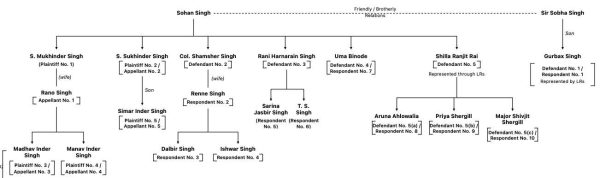
5. The dispute between the parties relate to Plot No.8, Friends Colony, New Delhi admeasuring approximately 4,132 sq.yds., together with the super-structure constructed thereon, which, for the ease of reference shall be referred to as “plot” or “suit property” hereinafter.
CASE AND ARGUMENTS ADVANCED BY THE PLAINTIFFS
6. Sohan Singh is the father of Plaintiffs, S. Mukhinder Singh and S. Sukhinder Singh. He became the member of Nathu Ram 3 Friends Colony Co-operative Housing Building Society Ltd. on 16.01.1950 and was allotted the suit property by way of an Agreement to Sell dated 14.01.1952, with an express condition that he has to raise construction over the plot within a stipulated time-period of three years. In accordance with the said written agreement, Sohan Singh paid the sale consideration of Rs. 11,824/- along with other charges.
7. Sohan Singh had close friendly/brotherly relations with Sobha Singh and they also shared a commercial relationship as partners in a firm. Thus, Sohan Singh entrusted all matters relating to the suit property to Sobha Singh, who was acting as his agent in respect thereof. Since Sohan Singh was at Shimla, the construction of the house was assigned to Sobha Singh, who carried out the same. After the completion of the construction, Sohan Singh wrote a letter to the Society evidencing the completion of construction and contends that 3 Hereinafter referred to as the “Society” the ownership of Sohan Singh was duly recorded in Resolution No. 6 dated 30.08.1959.
8. The dispute, according to the Plaintiffs arose when the Society decided to transfer the plot to Defendant No. 1 vide meeting held on 13.12.1959, despite duly recording that Sohan Singh is the owner of the plot. Although the sale consideration was paid by Sohan Singh, the Society vide Sale Deed dated 03.12.1960 transferred the plot to Defendant No. 1, by way of a sham and voidable document. The Plaintiffs further contended that the plot exclusively belonged to Sohan Singh and that, aggrieved by the execution of the Sale Deed in favour of Defendant No. 1, Sohan Singh approached the Society on 14.05.1963 seeking execution of the Sale Deed in his favour upon completion of the construction. However, by letter dated 23.05.1963, the Society informed him that the plot originally allotted to him had already been transferred in favour of Defendant No. 1 and that the Sale Deed had been executed on 03.12.1960.
9. The Plaintiffs, alleging that the Society, in collusion with Defendant No. 1, fraudulently transferred the plot in favour of Defendant No. 1, approached the Registrar of Co-operative Society for redressal of his grievance, through arbitration proceedings. However, the Society thereafter approached the Registrar of Co-operative Societies, which permitted the Society to institute a civil suit before the Competent Court. The Society filed Suit No. 235 of 1966 seeking declaration that the Sale Deed dated 03.12.1960 executed in favour of Defendant No. 1 as valid and also sought perpetual injunction against the Plaintiffs. Subsequently, the Plaintiffs instituted the Suit No. 475 of 1975 (subject suit) seeking of possession of the plot along with mesne profits. In support of the contentions raised Appellants have relied upon the following judgments.
i. Poona Ram vs. Moti Ram (Dead) Through Legal Representatives and Others; (2019) 11 SCC 309.
ii. Narasamma and Others vs. A. Krishnappa (Dead) Through Legal Representatives; (2020) 15 SCC 218.
iii. Umadevi Nambiar vs. Thamarasseri Roman Catholic Doicese; (2022) 7 SCC 90.
CASE AND ARGUMENTS ADVANCED BY THE DEFENDANT NO. 1
10. The Defendant No. 1, Gurbax Singh, son of Sobha Singh, contended that the suit be dismissed on the following amongst other contentions –
11. Notwithstanding the initial allotment of the plot in favor of Sohan Singh, the Defendant No. 1 categorically submitted that Sohan Singh failed to satisfy an essential covenant of the Agreement, which obligated him to raise construction on the suit property within a stipulated timeframe. He asserted that Sohan Singh lacked the financial means to undertake such construction and, consequently, by way of a letter dated 04.10.1954, requested the Society to transfer the plot to Defendant No. 1, whom he described therein as his “nephew”.
12. Acting upon the letter of Sohan Singh recommending the transfer of the suit property in favour of Defendant No. 1, the Society, by resolution dated 13.10.1954, resolved to transfer the plot to Defendant No. 1. Thereafter, by letter dated 16.10.1954, the Society informed Defendant No. 1 of the recommendation made by Sohan Singh and directed him to clear all outstanding dues. Subsequently, by letter dated 22.11.1954, the Society informed Sohan Singh that the plot had been allotted to Defendant No. 1.
13. Pursuant thereto, Defendant No. 1 took possession of the plot in 1954, discharged all outstanding dues payable to the Society entirely and, from his own funds, constructed a two-storeyed residential house thereon, which was completed by 1959. Since then, Defendant No. 1 has remained in continuous and uninterrupted possession and occupation of the suit property, asserting and exercising rights of absolute ownership over the property. They also denied the contention of the Plaintiffs that Sobha Singh was acting as an agent of Sohan Singh.
14. In response to the submissions advanced by the Plaintiffs, Defendant No. 1 contended that Sohan Singh had forfeited all rights that he previously held in respect of the suit property. On 14.08.1959, Defendant No. 1 informed the Society that the construction had been completed without any financial assistance or contribution from Sohan Singh or the Plaintiffs.
15. Alternatively, the Defendant No. 1 also took the contention of adverse possession on the ground that he has been in continuous possession of the plot since 1954. In support of their contentions, they have relied upon following judgments.
i. Ningawwa vs. Byrappa Shiddappa Hireknrabar and Others; (1968) SCC OnLine SC 206.
ii. Hussain Ahmed Choudhury and Others vs. Habibur Rahman (Dead) through Lrs. And Others; (2025) SCC OnLine SC 892.
iii. Anathula Sudhakar vs. P. Buchi Reddy (Dead) by Lrs. And Others; (2008) 4 SCC 594.
iv. Nikhila Divyang Mehta and Another vs. Hitesh P. Sanghvi and Others; (2025) SCC OnLine SC 779. . Prem Singh and Others vs. Birbal and Others; (2006) 5 SCC 353.
vi. Dhurandhar Prasad Singh vs. Jai Prakash University and Others; (2001) 6 SCC 534.
CASE AND ARGUMENTS ADVANCED BY DEFENDANTS NO. 2 TO 5 (RESPONDENT NOS. 2 TO 10) IN THIS APPEAL
16. The Respondent Nos. 2 to 10 in the present appeal had filed their written statements before the Trial Court supporting the plaintiffs and in the present appeal they have reiterated their stand and sought for the appeal being allowed.
TRIAL COURT AND ITS DECISION
17. Owing to the commonality of issues involved, the suit instituted by the Society and the suit filed by the Plaintiffs were consolidated to be tried together and disposed of jointly and the evidence recorded in the suit preferred by the Society was ordered to be treated as evidence in the subject suit. However, the suit of the Society came to be dismissed for default, but the evidence recorded was preserved for the adjudication of the Plaintiffs suit.
18. The Court initially framed fourteen issues inter alia, question of limitation, estoppel and on ownership and possession of the suit property. Further, three additional issues were framed with regard to the amount involved in construction and payment of the sale consideration by Sohan Singh. Since we are dealing with the most significant questions of law, we confine ourselves to those questions specifically challenged before us.
19. Defendant No. 1 argued that the suit is not maintainable as the Plaintiffs have sought for possession without seeking any relief of specific performance or cancellation of the Sale Deed dated 03.12.1960. On evaluation, the Trial Court observed that the issue of the validity of the Sale Deed was already framed as an issue and since damages were not claimed by the Plaintiffs, the only relief left was of possession. Thus, on the said score, Trial Court admitted the suit.
20. The Trial Court, on the aspect of limitation, held in favour of the Plaintiffs. It came to be held that dispute arose in 1963 when the Plaintiffs came to know of the alleged sale deed executed in favour of Defendant No. 1. The Plaintiffs raised the dissonance before the Society and the matter was referred to Arbitration. The Learned Arbitrator was of the opinion that issue “involved a complicated question of law and fact” and relegated the parties to approach the Civil Court for proper adjudication. As a result, the Society filed Civil Suit No. 235/1966 wherein Sohan Singh and the Defendant No. 1 were arrayed as parties. Realising that the Society had transferred the plot to the Defendant No. 1, the Plaintiffs filed Civil Suit No. 475/1975 renumbered as Suit No. M-27 of 2009 seeking possession. Thus, the Trial Court concluded that for the purpose of limitation, the facts right from 1963 till the filing of the suit in 1975 are to be considered as the dispute was raised before other forums before the suit was finally filed in 1975.
21. Nonetheless, on merits, the Trial Court recognised that the Plaintiffs were estopped from contending that transfer of the plot to the Defendant No.1 was without consent. This was for the reason that firstly, Sohan Singh had never given any letter to Sobha Singh or to Defendant No. 1 derecognising their rights over the plot, which resultantly, gave Sobha Singh and Defendant No.1 permissible possession of the suit property. Secondly, the Society has transferred the plot to the Defendant No. 1 on the strength of the letter dated 04.10.1954 by Sohan Singh and no efforts were made to raise any objection to the possession of the Defendant No. 1 over the property till 1975. Sohan Singh or anyone claiming through him has not financially contributed for raising the construction or complied with the conditions stipulated under the agreement dated 14.01.1952 by which the Suit Schedule property was allotted to Sohan Singh.
HIGH COURT – THE REGULAR FIRST APPEAL AND ITS JUDGMENT
22. Before the High Court, the parties made submissions on four issues as enumerated under the impugned order –
a. Application of Section 53A of the Transfer of Property Act, 1882 to ascertain whether Sohan Singh had become the owner of the suit property by virtue of part performance?
b. Whether the sale deed dated 03.12.1960 executed in favour of the Defendant No. 1 is on account of fraud and collusion and its effect thereto?
c. Whether the suit filed by the Plaintiffs is barred by limitation by the operation of Article 59 of the Limitation Act, 1963?
d. Whether the Defendant No. 1 was the owner of the suit property by virtue of estoppel or by adverse possession?
23. The first aspect dealt with by the High Court was the argument raised by the Plaintiffs under Section 53A of the Transfer of Property Act, to the effect that the buyer, and in the instant case, Sohan Singh, acquired rights over the suit property pursuant to an agreement entered into between Sohan Singh and the Society, upon payment of the agreed sale consideration. The High Court rejected this argument on the premise that the written agreement dated 14.01.1952, under which the property was agreed to be sold to Sohan Singh, contained an express clause obligating him to raise construction on the said plot within a specified time. To establish readiness and willingness under Section 53A, Sohan Singh was required to demonstrate performance of this condition. Instead, being unable to carry out the construction, Sohan Singh had addressed a letter dated 04.10.1954 to the Society requesting the transfer of the plot in favor of Sobha Singh.
24. In furtherance, the Court pointed out another critical observation – Sohan Singh had voluntarily abjured his rights under the agreement dated 14.01.1952 vide letter dated 04.10.1954. Once a person willingly puts an end to the performance of continuous obligations set out in the agreement, he cannot thereafter raise a claim under Section 53A of Transfer of Property Act. Thus, the undisputed factual position as discerned by the High Court was that there was no transaction between Sohan Singh and Sobha Singh or with anybody else for the purpose of construction over the said plot/suit property.
25. The Original purchaser or allottee from the Society of the suit property was Sohan Singh. The suit was filed by the legal heirs of Sohan Singh. The Court noticed that during his life time, Sohan Singh neither revoked his letter nor questioned the sale deed. In addition to the above, the Court further noted that there was an intention to transfer the plot and the membership to the Defendant No. 1 and this intention overrides the nature of relationship shared between Sohan Singh and Sobha Singh.
26. Discussing the Rules of the Society, the High Court relied on the Resolution dated 28.11.1954, passed much prior to the sale deed dated 03.12.1960, which provided that transfer can take place not only to a close blood relation but also to a friend of the member of the society. The Court clarified that Sobha Singh was a close friend of Sohan Singh, but vide letter dated 04.10.1954, Sohan Singh refers to Defendant No. 1 as “nephew” evidencing their close bond and by operation of the resolution expanding the transfer to non-blood relatives, the sale in favour of Sobha Singh was validly executed.
27. On limitation, the High Court held that Plaintiffs and their predecessor in interest, Sohan Singh, had knowledge of the Sale Deed since 1960 itself which forms an actual and factual knowledge. This was corroborated by the admission of Plaintiff No. 1 who specifically admitted that they came to know of the fraud of execution of the Sale Deed in the year 1960. In any event, registration of the sale deed constituted deemed notice under Section 3 of the Transfer of Property Act. Ergo, the Plaintiffs are said to have notice of the sale deed once it was duly registered. As per Article 59 of the Limitation Act, 1963, a suit to cancel or set aside an instrument has to be filed within three years from the date when the facts entitling the plaintiff to have the instrument cancelled or set aside becomes known to him. The High Court therefore was of the view that even if the limitation is computed from the date as stated by the Plaintiffs, i.e., 1963, the suit is patently barred by limitation as the challenge to the sale deed ends in the year 1966 and the suit was filed in the year 1975, without challenge to the sale deed dated 03.12.1960.
28. On the issue of estoppel and the ownership of the Defendant No. 1, the reasoning of the High Court was based on the law laid down under Section 115 of the Indian Evidence Act, which estops an owner from asserting title after intentionally inducing another to believe and act upon the representation of ownership. Applying this principle, the Court observed that Defendant No. 1 acted as the owner of the suit property as per the letter dated 04.10.1954 by Sohan Singh to the Society as the Society transferred the plot and the membership to Defendant No.1. High Court further observed that no amount was paid or contributed by the Plaintiffs in lieu of the construction undertaken by the Defendant No. 1.
29. Based on the said reasonings, the High Court while upholding the Judgement of the Trial Court dismissed the First Appeal of the Plaintiffs, prompting them to approach this Court by way of the present Appeal.
30. We have had the opportunity to go through all the documents placed on record and have given our anxious consideration to the rival contentions raised by the Learned Counsels appearing for the parties. In our considered opinion, the following point would arise for our consideration:
“Whether the Judgment of the High Court, which confirmed the dismissal of the suit for possession passed by the Trial Court requires interference?”
ANALYSIS, DISCUSSION AND CONCLUSION
In Re: On Limitation
31. Undisputed facts –
| Date of Agreement to Sell in favour of the Plaintiff executed by Society | 14.01.1952 |
| Time period given to complete construction and for execution of Sale Deed (3 years) | 14.01.1955 |
| Date of Letter submitted by Sohan Singh to the Society to transfer the Suit Schedule property in favour of Gurbax Singh | 04.10.1954 |
| Date of Sale Deed registered & executed in favour of Defendant No.1 by the Society | 03.12.1960 (construction was completed in 1959) |
| Date of institution of the suit | 1975 |
32. On the issue of limitation, the High Court and the Trial Court have taken divergent views, while the Trial Court observed that the suit is maintainable, the High Court rules that the suit is barred by limitation. The stand of the parties and the Courts being completely divergent would compel us to discuss each of their stands independently.
33. The Plaintiffs advanced arguments to the effect that suit had been instituted within the prescribed period of limitation. Their specific case was that the Sale Deed dated 03.12.1960 was executed by playing fraud, pursuant to which the Plaintiffs raised claims by letter dated 25.04.1964 against the Society by raising a dispute before the Registrar of Co-operative Societies resulting in Arbitral Proceedings. However, upon an application made by the Society, the Registrar, vide order dated 22.01.1966, directed the Society to institute a civil suit before the competent Court within a period of six months. Hence, the Society filed a Civil Suit No. 235/1966 against Sohan Singh seeking declaration that the sale deed registered in favour of Gurbax Singh was valid along with a prayer for perpetual injunction. In the said suit, Gurbax Singh was also impleaded as a party and he filed the Written statement on 21.08.1971 claiming title by virtue of sale deed executed by the Society in his favour on 03.12.1960. Thereafter, the Plaintiffs filed Civil Suit No.475/1975 for possession on 22.05.1975. Both Suits were consolidated and ordered that evidence recorded in Civil Suit No.235/1966 be treated as evidence in Civil Suit No.475/1975.
34. Defendant No. 1 contended that Plaintiffs had full knowledge of execution of the Sale Deed dated 03.12.1960 since the very year of its execution. As recorded by the High Court, Plaintiff No. 1 too, in his deposition before the Trial Court categorically admitted that he became aware of the fraud played upon him in 1960. Hence, 1st Defendant advanced submissions to the effect that suit filed by the Plaintiffs is barred by limitation, inter alia, all reliefs that have been sought or could be sought by the Plaintiffs are hopelessly barred by limitation. It is in this background Trial Court framed Issue No.7 to the following effect: “7. Whether the Suit is within Limitation”
35. Three limbs of arguments were presented by the Defendant No.1 to non-suit the Plaintiffs on the issue of Limitation –
a. Article 54 of the Limitation Act, 1963: Although the Plaintiffs have not sought specific performance, arguendo, even if such a relief were to have been sought, the suit would be barred by limitation. Under Article 54, a suit for specific performance must be instituted within three years from the date fixed for performance or, where no such date is fixed, from the date when the Plaintiff has notice of the refusal to perform. In the present case, the limitation period expired in 1963.
b. Article 59 of the Limitation Act, 1963: If the Plaintiffs intended to seek a declaration for cancellation of the Sale Deed dated 03.12.1960, such a suit ought to have been instituted within three years from the date of execution of the Sale Deed, as prescribed under Article 59 of the Limitation Act. However, it was not done so.
c. Article 64 of the Limitation Act, 1963: The Plaintiffs have sought the relief of possession which must be instituted within twelve years from the date of dispossession. In the present case, the period of limitation expired in 1972, whereas the suit was instituted only in 1975 and was thus barred by limitation.
We deem it apt and appropriate to extract aforesaid Articles of Limitation Act, 1963 for analysis of the arguments advanced on this aspect and same is extracted hereinbelow.
| Description of Suit | Period of Limitation | Time from which period begins to run |
|---|---|---|
| Article 54
For specific performance of a contract |
Three years | The date fixed for the performance, or, if no such date is fixed, when the plaintiff has notice that the performance is refused. |
| Article 59
To cancel or set aside an instrument or decree or for the rescission of a contract |
Three years | When the facts entitling the plaintiff to have the instrument or decree cancelled or set aside or the contract rescinded first become known to him. |
| Article 64
For possession of immovable property based on previous possession and not on title, when the plaintiff while in possession of the property has been dispossessed |
Twelve years | The date of dispossession. |
36. Before we embark upon our discussion and reasoning, we deem it appropriate to analyse the law on limitation application to the instant case.
37. The law of limitation, as a procedural law, finds its roots in the maxims “interest reipublicae ut sit finis litium” which means that it is in the interest of the State that there should be a limit to litigation and “vigilantibus non dormientibus jura subveniunt” – the law assists the vigilant and not those who sleep over their rights. It specifies that a litigant ought to be diligent, careful and proactive in enforcing and protecting his rights for a purpose that the litigation ought to be raised before the cause expires and also to prevent the litigation from being dragged for a prolonged period of time. It cannot be construed that the period of limitation bars the court from enforcing substantive justice. As the scope of the Act specifies, it is to make sure that the parties knock the doors of the court within a time bound manner so as to not render their cause otiose. A substantial cause seeking justice has a lifespan and once the cause dies, it cannot be revived by dilatory tactics by clinging to another cause. Thus, the period of limitation cannot be extended by any party to make it naturally convenient to bring the cause within the period of limitation.
38. In State of Kerala and Others v. V.R. Kalliyanikutty and Another, referring to Halsbury’s Laws of England, 4th Edn., this Court has supported the existence of statutes of limitation holding that a dormant claim can be more cruel than bring justice; the Defendant might not have or would have lost the requisite evidence needed to prove the case; and a good cause should be perused with reasonable diligence. What needs to be seen is that an existing cause is redressed and not the resurrection of a stale one. Keeping these legal principles in mind, we shall now advance to the adjudication of the rival claims. We clarify that the suit filed by the Plaintiffs is one for possession. However, we also deem it appropriate to discuss other points for the specific contentions raised by the Defendant No. 1 and to lay to rest all contentions in that regard.
39. The claim of the Plaintiffs being barred under Article 54 of the Limitation Act, 1963 –
a. Article 54 primarily provides the limitation period to file a suit for specific performance. The Plaintiffs, in the present matter have not sought for specific performance, but even assuming they had, the suit would be barred by limitation. As per the Article, a suit for specific performance has to be filed within a period of three years from the “date fixed for performance or if no such date is fixed, when the plaintiff has notice that the performance is refused”. For clear understanding we refer to the case of Ahmadsahab Abdul Mulla (2) Dead by proposed LRs 5 v. Bibijan & Others, which clarified that, when there is a date for performance of the contract, there is a definite date for doing that particular act. The second date runs from the time the plaintiff notices the refusal. Thus, both dates are definitive and refers to a date from the calendar.
b. First instance – date fixed for performance: The Agreement to Sell dated 14.01.1952 stipulated a period of three years within which Sohan Singh was required to raise construction on the plot. Accordingly, the date fixed for performance fell due on 14.01.1955. Under Article 54 of the Limitation Act, the period of limitation would commence from the date so fixed and expire three years thereafter, i.e., on 14.01.1958. Any suit for specific performance instituted thereafter would be barred by limitation.
c. Second instance – date of notice of refusal: The period of limitation would begin from the date on which the Plaintiffs had notice of refusal to perform. The execution of the Sale Deed dated 03.12.1960, at the very least, constituted such refusal. The Plaintiffs contended before the High Court that they came to know of the Sale Deed only on 14.05.1963, when they approached the Society for execution of a Sale Deed in their favour. The Society, vide letter dated 23.05.1963, informed Sohan Singh that a Sale Deed had already been executed in favour of Defendant No. 1. Even reckoning limitation from the date of such knowledge, the period of three years would have expired in 1966. The present suit, having been instituted only in 1975, is ex facie barred by limitation.
40. The claim of the Plaintiffs being barred under Article 59 of the Limitation Act-
a. Article 59 of the Limitation Act applies to all suits seeking to cancel or set aside an instrument or decree, or to rescind a contract. For present purposes, we are concerned with the cancellation or setting aside of an instrument. An instrument is a written document, which may include a contract, agreement or deed, etc., which is not void ab initio. The limitation under this Article begins three years from “when the fact entitling the plaintiff to have the instrument or decree cancelled or set aside or the contract rescinded first become known to him”.
b. A suit for cancellation of a Sale Deed is to be filed within 3 years from the date of sale or from when the party comes to know of it. Accordingly, a suit seeking cancellation or setting aside of the Sale Deed dated 03.12.1960 ought to have been instituted by Sohan Singh within three years from the date on which the Plaintiffs acquired knowledge of the facts entitling them to seek such relief. Even assuming that the Plaintiffs acquired knowledge of the Sale Deed only on 23.05.1963, when the Society informed them that the Sale Deed had already been executed in favour of Defendant No. 1, the period of limitation would expire in 1966. On the other hand, if limitation is calculated from the date of execution of the Sale Deed, the period would have expired in 1963. In either event, the suit was instituted only in 1975 and was barred by limitation.
41. The claim of the Plaintiff being barred under Section 27 read with Article 64 of the Limitation Act –
a. Section 27 of the Limitation Act provides for extinguishment of the right on the lapse of the period of limitation fixed to institute a suit for possession of any property. In essence, the right of a person to institute a suit extinguishes if it is not brought within the prescribed time period. The right to sue that accrues in a person has to be enforced within the time prescribed under law.
b. When possession is the moot question, Article 64 also comes into play. Possession is not based on title and anyone who claims lawful possession can invoke this Article within twelve years from the date of dispossession. It is founded on the principle of prior possession and subsequent dispossession. The possession of the Plaintiff can be of any form and dispossession for the purpose of this Article means taking possession without the consent of the person who was already in lawful possession. It involves some active element in the mind of the person dispossessing a person against his will with the intention of taking absolute and exclusive control over the property.
c. Absence of Dispossession – To maintain a suit under Article 64, the Plaintiffs were required to prove previous possession which was demonstrated by the Agreement to Sell under which handed over possession of the plot to Sohan Singh to raise construction. The second covenant of dispossession is not established by the Plaintiffs. Pertinently, Sohan Singh was not dispossessed by any act attributable to either the Society or Defendant No. 1. The words “I am requesting the Society through you to kindly sanction the transfer of the plot to my nephew Col. Gurbax Singh” used in the letter dated 04.10.1954, shows the intention of Sohan Singh to part with possession of the plot to Defendant No. 1, pursuant to which Defendant No. 1 was legally put in possession by the Society acting upon the communication dated 04.10.1954, the working committee of the society in its meeting held on 13.10.1953 by Resolution No. 3 (c) resolved to transfer the suit schedule plot to the name of the Col. Gurbax Singh. This Resolution as well as accepting his prayer made in the letter dated 04.10.1954 was communicated to Sohan Singh by the Society, by communication dated 16.10.1954 and Sohan Singh was also called upon to clear the arrears of Rs.1180/- against development charges. This amount was paid by Gurbax Singh on 20.10.1954. Therefore, in the instant case, there is no element of dispossession.
d. Suit filed after the expiry of 12 years – Article 64 can be invoked before the expiry of 12 years from the date of dispossession. From the facts borne from the records, Defendant No. 1 was put in possession of the plot in 1954 and completed construction by 1959. Thus, for all purposes, the Plaintiffs had lost possession over the plot in the year 1954 and the period of twelve years would extinguish in 1966.
e. Alternative plea of adverse possession – Defendant No. 1 also raised a plea of adverse possession, contending that even if it were assumed that he had dispossessed the Plaintiffs, their claim for recovery of possession was required to be instituted within twelve years of such dispossession. The execution of the Sale Deed dated 03.12.1960, at the latest, marked the point from which the Plaintiffs claim to possession stood excluded. Accordingly, the period of twelve years would expire in 1972, rendering the suit instituted in 1975 barred by limitation.
42. Though the Plaintiffs are liable to be non-suited on the ground of limitation alone, we deem it appropriate to examine the matter on merits as well.
In Re: Nature of Agreement dated 14.01.1952 and Letter dated 04.10.1954
43. The Plaintiffs place substantial reliance upon Agreement dated 14.01.1952, by which the plot was transferred in favour of Sohan Singh. This Agreement is in the nature of an Agreement to Sell and also bears the same title. Pertinently, Clause 7 of the said Agreement stipulated that the buyer/Vendee, i.e., Sohan Singh, has to complete construction of the house within three years. Clause 7 expressly provided that in the event of failure to complete construction within the stipulated timeframe, the vendee shall “loose the right to obtain a sale of the plot agreed to be sold”. We are of the opinion that this was a mandatory condition to be fulfilled by the vendee. While Sohan Singh had time until January 1955 to raise the superstructure, he addressed a communication dated 04.10.1954, much prior to the expiry of the three-year period, expressing his inability to build. Stating that he had no other option, Sohan Singh requested the Society to transfer the plot to Defendant No. 1, Col. Gurbax Singh, whom he described as his ‘nephew’.
44. It is trite law that an Agreement to Sell does not transfer title or create any right over the property intended to be sold therein. Section 54 of the Transfer of Property Act, squarely provides that a Contract for Sale is only a document which provides that Sale shall take place as per the terms and conditions agreed by the parties. It is further explicitly mentioned that a Contract of Sale does not itself, create any interest or charge on such property. These principles have been time and again laid down and enunciated by this Court. We have, in the case of Rambhau Namdeo Gajre v. Narayan Bapuji Dhotra (Dead) through LRs. & Anr6, subsequently affirmed in the case of Suraj Lamp and Industries Private Limited(2) through Director v. State of Haryana and Another7, categorically observed that only a valid, registered Sale Deed is capable of conveying the property. Mere existence of an Agreement to Sell does not, in any manner confer title or ownership rights over the property in the absence of a registered Sale Deed.
45. In Rambhau Namdeo Gajre v. Narayan Bapuji Dhotra (Dead) through LRs. & Anr (supra), this Court stated:
“ 13. The agreement to sell does not create an interest of the proposed vendee in the suit property. As per Section 54 of the Act, the title in immovable property valued at more than Rs 100 can be conveyed only by executing a registered sale deed. Section 54 specifically provides that a contract for sale of immovable property is a contract evidencing the fact that the sale of such property shall take place on the terms settled between the parties, but does not, of itself, create any interest in or charge on such property. It is not disputed before us that the suit land sought to be conveyed is of the value of more than Rs 100. Therefore, unless there was a registered document of sale in favour of Pishorrilal (the proposed transferee) the title of the suit land continued to vest in Narayan Bapuji Dhotra (original plaintiff) and remain in his ownership. This point was examined in detail by this Court in State of U.P. v. District Judge [(1997) 1 SCC 496] and it was held thus: (SCC pp. 499-500, para 7)
“7. Having given our anxious consideration to the rival contentions we find that the High Court with respect had patently erred in taking the view that because of Section 53- A of the Transfer of Property Act the proposed transferees of the land had acquired an interest in the lands which would result in exclusion of these lands from the computation of the holding of the tenure-holder transferor on the appointed day. It is obvious that an agreement to sell creates no interest in land. As per Section 54 of the Transfer of Property Act, the property in the land gets conveyed only by registered sale deed. It is not in dispute that the lands sought to be covered were having value of more than Rs 100. Therefore, unless there was a registered document of sale in favour of the proposed transferee agreement- holders, the title of the lands would not get divested from the vendor and would remain in his ownership. There is no dispute on this aspect. However, strong reliance was placed by learned counsel for Respondent 3 on Section 53-A of the Transfer of Property Act. We fail to appreciate how that section can at all be relevant against the third party like the appellant State. That section provides for a shield of protection to the proposed transferee to remain in possession against the original owner who has agreed to sell these lands to the transferee if the proposed transferee satisfies other conditions of Section 53-A. That protection is available as a shield only against the transferor, the proposed vendor, and would disentitle him from disturbing the possession of the proposed transferees who are put in possession pursuant to such an agreement. But that has nothing to do with the ownership of the proposed transferor who remains full owner of the said lands till they are legally conveyed by sale deed to the proposed transferees. Such a right to protect possession against the proposed vendor cannot be pressed in service against a third party like the appellant State when it seeks to enforce the provisions of the Act against the tenure-holder, proposed transferor of these lands.”
(emphasis supplied)
There was no agreement between the appellant and the respondent in connection with the suit land. The doctrine of part-performance could have been availed of by Pishorrilal against his proposed vendor subject, of course, to the fulfilment of the conditions mentioned above. It could not be availed of by the appellant against the respondent with whom he has no privity of contract. The appellant has been put in possession of the suit land on the basis of an agreement of sale not by the respondent but by Pishorrilal, therefore, the privity of contract is between Pishorrilal and the appellant and not between the appellant and the respondent. The doctrine of part-performance as contemplated in Section 53-A can be availed of by the proposed transferee against his transferor or any person claiming under him and not against a third person with whom he does not have a privity of contract.”
46. Apropos to the citations discussed, ownership rights in respect of the suit plot could crystallize in favor of Sohan Singh, or his legal heirs, only upon due fulfillment of the condition precedent stipulated under the Agreement which would have obligated the Society to execute a Sale Deed in favour of Sohan Singh. Admittedly, Sohan Singh was unable to fulfil the condition and as a result, he was never conferred with the title of ownership. The Plaintiffs also directed our attention to Resolution of the Society dated 30.08.1959 which they contend, recognises their ownership since the construction of the house was complete. The right of ownership cannot be acquired merely by way of a recital or statement in the Resolution of the Society. It is pertinent to note that no Sale Deed was executed or registered in favour of Sohan Singh legally conveying ownership of the suit plot and as such, the Plaintiffs cannot derive their rights from an Agreement to Sell which was never completed by their predecessor-in-interest, Sohan Singh.
47. The Society merely acted upon Sohan Singh’s letter dated 04.10.1954, wherein he unequivocally expressed his inability to comply with the mandatory construction covenant, thereby consciously abandoning his rights under the Agreement to Sell, which admittedly never culminated in a registered Sale Deed. We are therefore of the considered view that neither Sohan Singh nor anyone claiming through or under him retained any subsisting right, title, or interest in the suit plot, as no title ever came to vest in Sohan Singh. No right could possibly survive or accrue in his favor after he expressly admitted his inability to fulfill the fundamental condition stipulated under the Agreement to Sell. We cannot lose sight of the categorical submission of Defendant No. 1 that he had been in possession of the suit property since 1954, when he took over the plot for the purpose of raising construction thereon. This assertion is further borne out by the fact that, during the period from 1960 to 1964, the suit property was let out to officers of the New Zealand High Commission, and the rent of Rs. 1,500 arising therefrom was collected by Defendant No. 1. There is clinching evidence in favour of the Defendant No. 1 and against the Plaintiff to sufficiently establish that Defendant No. 1 had acquired ownership over the plot and the Agreement to Sell dated 14.01.1952 was rendered redundant.
In Re: Nature and Reliefs sought for in the Suit filed by the Plaintiffs
48. We are unable to subscribe to the reasoning of the Trial Court ruling that the Plaintiffs’ suit for possession was maintainable. In our opinion, a suit for possession simpliciter is not maintainable where there is serious, concrete dispute casting a cloud over the plaintiff’s title, necessitating a substantive prayer for declaration.
49. We may note with benefit the principles enunciated in the case of Anathula Sudhakar v. P Buchi Reddy (Dead) by LRs. and 8 Others wherein this Court examined various circumstances and the maintainability of suits and held as follows:
“14. We may however clarify that a prayer for declaration will be necessary only if the denial of title by the defendant or challenge to plaintiff’s title raises a cloud on the title of plaintiff to the property. A cloud is said to raise over a person’s title, when some apparent defect in his title to a property, or when some prima facie right of a third party over it, is made out or shown.
An action for declaration, is the remedy to remove the cloud on the title to the property. On the other hand, where the plaintiff has clear title supported by documents, if a trespasser without any claim to title or an interloper without any apparent title, merely denies the plaintiff’s title, it does not amount to raising a cloud over the title of the plaintiff and it will not be necessary for the plaintiff to sue for declaration…..”
(emphasis supplied)
50. This Court has delineated that under normal circumstances, it is not necessary for the Plaintiff, deeming to be the owner, to seek declaration, and mere prayer for possession is permissible if the Plaintiff has clear title and ownership over the property. The hitch, however, arises when the Defendant or any other third party raises a plea of ownership which is substantiated by cognizant defect in the title of the Plaintiff. An exemplification of one such illustration is demonstrated in the case of Kurella Naga Druva Vudaya Bhaskara Rao v. Galla Jani Kamma 9 Alias Nacharamma wherein the Court, while relying upon the the case of Anathula Sudhakara, remarked:
“16. The plaintiff had purchased the suit land under registered sale deed dated 10.4.1957. Defendant did not claim title with reference to any document but claimed to have perfected title by adverse possession. A mere claim by the defendant that he had perfected his title by adverse possession, does not mean that a cloud is raised over plaintiff’s title and that the plaintiff who is the owner, should file a suit for declaration of title. Unless the defendant raises a serious cloud over the title of the plaintiff, there is no need to file a suit for declaration. The plaintiff had title and she only wanted possession and therefore a suit for possession was maintainable. We are fortified in this view by the following observations of this Court in Anathula Sudhakar v. P. Buchi Reddy (2008) 4 SCC 594…”
(emphasis supplied)
51. The aforesaid precedents lays down that if the title of the Plaintiff is not under risk, a prayer for possession is sufficient. But if the title of the Plaintiff is rebutted by the Defendant by cogent evidence, a mere prayer seeking possession of the property would not suffice. This is for the simple reason that a person, whose title is disputed, cannot lay a challenge to the true owners’ right title and ownership as the same becomes a disputed question of fact for the Court to adjudicate upon.
52. Reverting to the case on hand, it is the specific contention of the Defendant No. 1 that he acquired title and ownership rights over the plot upon construction of the house which stood completed in 1959, and conclusively, when the Sale Deed dated 03.12.1960 was executed by the Society in his favour. The Plaintiffs, on the other hand, asserted that since the payment of consideration was complete and the Agreement to Sell dated 14.01.1952 was executed in favour of Sohan Singh, they were the true owners of the plot being legal heirs of the original allottees. Thus, this is a case whether there was clearly a cloud over the title of the Plaintiffs due to the execution of the Sale Deed dated 03.12.1960 in favour of Defendant No. 1. Therefore, the proper relief that ought to have been sought by the Plaintiffs is the relief of declaration for cancellation of the Sale Deed dated 03.12.1960, inter alia, specific performance and a relief of declaration of ownership.
53. After Defendant No. 1 asserted his title on the strength of a registered Sale Deed, it was incumbent on the Plaintiffs to institute a suit for declaration for cancellation of the Sale Deed or in the alternative, the plaintiffs ought to have filed a suit for specific performance of the Agreement to Sell which stood in their favour. The Trial Court, although dismissed the suit, overlooked that a proper prayer ought to have been sought by the Plaintiffs when their title was challenged by compelling evidence. A basic prayer for possession cannot survive when the Defendant No.1 has a registered Sale Deed in his name nullifying the title of the Plaintiffs.
In Re: Doctrine of Estoppel and Acquiscence
54. As far as Estoppel is concerned, as discussed hereinabove, the High Court was of the view that the Plaintiffs were estopped from filing the suit as Sohan Singh ceased to act upon the Agreement to Sell, he lost title over the plot.
55. We also deem it appropriate to analyse the point of estoppel enshrined under S. 115 of the Evidence Act which provision is extracted hereinbelow for immediate reference-
“115. Estoppel.––When one person has, by his declaration, act or omission, intentionally caused or permitted another person to believe a thing to be true and to act upon such belief, neither he nor his representative shall be allowed, in any suit or proceeding between himself and such person or his representative, to deny the truth of that thing.
Illustration
A intentionally and falsely leads B to believe that certain land belongs to A, and thereby induces B to buy and pay for it. The land afterwards becomes the property of A, and A seeks to set aside the sale on the ground that, at the time of the sale, he had no title. He must not be allowed to prove his want of title.”
56. This Court, in catena of judgments has expounded the meaning of estoppel. We refer to the case of Pratima Chowdhury v. Kalpana Mukherjee and Another10, wherein this Court observed:
“ 29.2. …. This is against the doctrine of fairness. Lord Denning in his book, The Discipline of Law, 7th Reprint, p. 223, observed:
‘It is a principle of justice and of equality. It comes to this, when a man by his words or conduct has led another to believe that he may safely act on the faith of them—and the other does act on when it would be unjust or inequitable for him to do so.’
In the words of Dixon, J.:
‘The principle upon which estoppel in pais is founded is that the law should not permit an unjust departure by a party from an assumption of fact which he has caused another party to adopt or accept for the purpose of their legal relations.’
The said principle was further stretched to the following extent:
‘At any rate, it applies to an assumption of ownership or absence of ownership. This gives rise to what may be called proprietary estoppel. There are many cases where he is not the owner, or, at any rate, is not claiming an interest therein, or that there is no objection to what the other is doing. In such cases, it has been held repeatedly that the owner is not to be allowed to go back on what he has led the other to believe. So much so that his own title to the property, be it land or goods, has been held to be limited or extinguished, and new rights and interest have been created therein. And this operates by reason of his conduct what he has led the other to believe even though he never intended it.’ It may be said that even in absence of actual promise, if a person by his words or conduct, so behaves as to lead another to believe that he will not insist on his strict legal rights, knowing or intending that the other will act on that belief and he does so act, that again will raise an equity in favour of the other, and it is for a court of equity to say in what way the equity may be satisfied. An equity does not necessarily depend on agreement but on words or conduct. The Privy Council in Plimmer v. Wellington Corpn.[(1884) LR 9 AC 699: (1881-85) All ER Rep Ext 1320 (PC)] observed that the Court must look at the circumstances in each case to decide in what way the equity can be satisfied.”
57. Further, the four postulates of Section 115 were further explicated which reads thus:
“35.…..
It needs to be understood that the rule of estoppel is a doctrine based on fairness. It postulates the exclusion of the truth of the matter. All for the sake of fairness. A perusal of the above provision reveals four salient preconditions before invoking the rule of estoppel.
(i) Firstly, one party should make a factual representation to the other party.
(ii) Secondly, the other party should accept and rely upon the aforesaid factual representation.
(iii) Thirdly, having relied on the aforesaid factual representation, the second party should alter his position.
(iv) Fourthly, the instant altering of position, should be such, that it would be iniquitous to require him to revert back to the original position.
Therefore, the doctrine of estoppel would apply only when, based on a representation by the first party, the second party alters his position, in such manner, that it would be unfair to restore the initial position.”
58. The flow of events in the instant case, rightly fulfil all the preconditions stipulated. While an Agreement to Sell was executed in favour Sohan Singh, the first condition of making factual representation, is Sohan Singh’s letter dated 04.10.1954 to the Society wherein he expressed his inability to construct his house and requested the Society to transfer the plot to Defendant No. 1. The second condition was fulfilled when the Society, acting on the said representation/letter dated 04.10.1954, allowed Defendant No. 1 to construct a house on the plot and executed the Sale Deed dated 03.12.1960 which consequently altered the position of the Defendant No. 1 as the owner of the plot, thus fulfilling the third condition. Lastly, the fourth condition also stood satisfied, once the Sale Deed was executed in favour of the Defendant No. 1. Hence, it was impossible for the Plaintiffs to contend that they were the owners of the plot since they failed to raise any construction thereon and also failed to initiate judicial proceedings well within the period of limitation.
59. Needless to state, once Sohan Singh, by his letter dated 04.10.1954, intentionally caused the Society as well as the Defendant No. 1 to believe that he could not raise any construction, neither he, nor the Plaintiffs shall be allowed to deny the contents of the letter.
60. The matter can also be looked in the lens of Doctrine of Acquiescence which is a form of estoppel. It is clarified that the invocation of acquiescence is independent of delay or limitation as it is founded on one’s conduct of knowledge of a fact or legal rights. There are two kinds of estoppel, direct and indirect. Direct acquiescence constitutes a direct act of a person done with full knowledge with the express acceptance or approbation of the consequences of the act. It is propounded in the case of Chairman, State Bank of India and Another v. 11 M.J. James and an excerpt from the case is extracted below –
“39. Before proceeding further, it is important to clarify distinction between “acquiescence” and “delay and laches”. Doctrine of acquiescence is an equitable doctrine which applies when a party having a right stands by and sees another dealing in a manner inconsistent with that right, while the act is in progress and after violation is completed, which conduct reflects his assent or accord. He cannot afterwards complain. In literal sense, the term acquiescence means silent assent, tacit consent, concurrence, or acceptance, which denotes conduct that is evidence of an intention of a party to abandon an equitable right and also to denote conduct from which another party will be justified in inferring such an intention. Acquiescence can be either direct with full knowledge and express approbation, or indirect where a person having the right to set aside the action stands by and sees another dealing in a manner inconsistent with that right and in spite of the infringement takes no action mirroring acceptance. However, acquiescence will not apply if lapse of time is of no importance or consequence.”
61. The question that arises for consideration is whether Sohan Singh, by his conduct, acquiesced or relinquished or forfeited the mandatory obligations cast upon him under the Agreement to Sell, so as to constitute direct acquiescence. A party who, of his own volition, foregoes performance of a binding contractual obligation cannot thereafter be permitted to resile from such conduct and assert claims inconsistent to his actions.
62. Sohan Singh admittedly submitted the letter dated 04.10.1954, expressly stating his inability to raise construction on the plot which violated the obligation contained in Clause 7 of the Agreement to Sell. Significantly, he neither revoked nor challenged the contents of the said letter, nor sought to rescind or resile from the position expressed therein, during his lifetime. His conduct is, therefore, a conscious and unequivocal abandonment of his obligation to raise construction and an acceptance of the consequent transfer of the plot in favour of Defendant No. 1.
63. In these circumstances, we are of the view that the suit falls flat, as Sohan Singh, by his conduct and by issuance of the letter dated 04.10.1954, had unequivocally acquiesced and relinquished the compulsory obligation to raise construction under the Agreement to Sell. The said letter constituted a clear and direct act of acquiescence, which precludes the Plaintiffs from subsequently asserting a claim founded upon an obligation which Sohan Singh himself had consciously abandoned. We are not inclined to deal with the issue of fraud as no cogent evidence was brought before the Courts below to establish fraud in the execution of the Sale Deed dated 03.12.1960. Thus, we answer this point against the Plaintiffs.
In Re: Invocation of Section 53A of the TP Act by the Plaintiffs
64. The Plaintiffs rely on Section 53A of the Transfer of Property Act to contend that they had performed the contract in part. The provision of Part-Performance is traceable to Section 53-A of Transfer of Property Act and it reads:
“53-A. Part performance. —Where any person contracts to transfer for consideration any immovable property by writing signed by him or on his behalf from which the terms necessary to constitute the transfer can be ascertained with reasonable certainty: and the transferee has, in part performance of the contract, taken possession of the property or any part thereof, or the transferee being already in possession, continues in possession in part performance of the contract and has done some act in furtherance of the contract, and the transferee has performed or is willing to perform his part of the contract,
then, notwithstanding that, where there is an instrument of transfer, that the transfer has not been completed in the manner prescribed therefor by the law for the time being in force, the transferor or any person claiming under him shall be debarred from enforcing against the transferee and persons claiming under him any right in respect of the property of which the transferee has taken or continued in possession, other than a right expressly provided by the terms of the contract: Provided that nothing in this section shall affect the rights of a transferee for consideration who has no notice of the contract or of the part performance thereof.”
65. The essentials of part-performance has been expounded by this Court in the case of Nathulal v. Phoolchand, Shrimant Shamrao Suryavanshi and Another v. Prahlad Bhairoba 13 Suryavanshi (dead) by LRs and Others, and most recently reiterated in the case of Giriyappa and Another v. 14 Kamalamma and Others which spells –
“11. From the aforesaid, it is evident that the protection of a prospective purchaser/transferee of his possession of the property involved, is available subject to the following prerequisites:
(a) There is a contract in writing by the transferor for transfer for consideration of any immovable property signed by him or on his behalf, from which the terms necessary to constitute the transfer can be ascertained with reasonable certainty;
(b) The transferee has, in part-performance of the contract, taken possession of the property or any part thereof, or the transferee, being already in possession, continues in possession in part- performance of the contract;
(c) The transferee has done some act in furtherance of the contract and has performed or is willing to perform his part of the contract.”
66. Juxtaposing legal principles with the factual position before us, we find that the most important essentials are not met for the reason that –
a. A fundamental requirement of the doctrine of part- performance is that the transferee must take possession of the property, or a part thereof, and continue in possession. In the present case, while Sohan Singh was initially granted possession of the plot to construct a house, he later unequivocally requested that the plot be transferred to Defendant No. 1. Defendant No. 1 who subsequently built the house and has remained in continuous possession since then till date. Admittedly, the Plaintiffs were out of possession at the time of filing the suit, a fact clearly established by their prayer seeking a decree for possession.
b. Another requirement to be fulfilled is that the transferee is required to do some act in furtherance of the contract and has performed or is willing to perform his part of the contract. As candidly noticed by the High Court, Sohan Singh was not ready and willing to perform his part of the contract, i.e., carry out the imperative condition of construction of the house within three years, as he had voluntarily tendered a letter dated 04.10.1954, giving up his rights, thereby abandoning the Agreement to Sell. Therefore, the Plaintiffs cannot take shelter of part- performance when Sohan Singh, virtually quit from performance of mandatory obligations.
67. Therefore, we settle this argument in the negative to hold that the Plaintiffs have not made a case of part-performance.
CONCLUSION
68. Succinctly put, we are not convinced with the case of the Plaintiffs as –
a. The suit for possession is hopelessly barred by limitation.
b. Agreement to Sell, without the execution of a registered Sale Deed does not confer any right title or ownership over the plot. Sohan Singh had an Agreement to Sell only in his name but no registered Sale Deed was ever executed. Therefore, he cannot seek possession without any prayer for declaration for cancellation the Sale Deed dated 03.12.1960 or seek specific performance of the Agreement to Sell.
c. Sohan Singh, or any person claiming through or under him, is estopped from asserting any right, title or ownership over the plot, in view of his acquiescence in the non-fulfilment of the obligatory condition stipulated in the Agreement to Sell and the subsequent transfer of the plot in favour of Defendant No. 1.
d. The Plaintiffs have not fulfilled any of the essentials of Section 53-A of Transfer of Property Act to demonstrate part-performance.
69. In answer to the points formulated by us, we are of the considered view that the judgment of the High Court affirming the judgment and decree of the Trial Court dismissing the suit warrants no interference and same is upheld.
70. For the foregoing reasons, the Appeal is dismissed. Pending applications, if any, shall stand consigned to records. No order as to costs.
Notes:
1 Hereinafter referred to as the “High Court”
2 Hereinafter referred to as the “Trial Court”
3 Hereinafter referred to as the “Society”
4 (1999) 3 SCC 657
5 (2009) 5 SCC 462
6 (2004) 8 SCC 614
7 (2012) 1 SCC 656
8 (2008) 4 SCC 594
9 (2008) 15 SCC 150
10 (2014) 4 SCC 196
11 (2022) 2 SCC 301
12 (1969) 3 SCC 120
13 (2002) 3 SCC 676
14 2024 SCC OnLine SC 3849