Bal Kishan Soni Vs Commissioner of Customs (Preventive) (CESTAT Kolkata)
Summary: CESTAT Kolkata allowed three connected appeals against confiscation of 664.02 grams of gold and penalties imposed on Bal Kishan Soni, Prakash Chand Soni and Kanheya Lal. Railway police intercepted Kanheya Lal at Guwahati Railway Station on 26 May 2024 and recovered four gold biscuits, which were subsequently handed over to Customs. The gold was valued at ₹48,98,808. Bal Kishan Soni claimed ownership and produced nine auction purchase invoices for gold ornaments, explaining that the ornaments had been melted into gold biscuits and entrusted to Kanheya Lal for delivery. The adjudicating authority nevertheless ordered absolute confiscation under sections 111(b) and 111(d) of the Customs Act, 1962, and imposed penalties totalling ₹4 lakh under sections 112(a) and 112(b). Commissioner (Appeals) upheld that order.
The Tribunal examined whether the seizure satisfied the requirement of reasonable belief under section 110(1) of the Customs Act, 1962. Following its earlier decision in R. Rajesh Naykar and Others, it found that the railway police seizure list did not indicate foreign markings. The Customs inventory disclosed only a “W” marking on one item, which did not establish foreign origin. Customs had accepted the police recovery without independently forming a reasonable belief, based on credible material, that the gold was smuggled. The Tribunal held that this absence of independent application of mind rendered the seizure legally unsustainable.
The Tribunal also accepted the purchase invoices, bank statement and income-tax returns produced by Bal Kishan Soni, noting that the Revenue had not discarded those documents. It held that the appellants had discharged the burden under section 123, whereas the Revenue had failed to establish that the gold was smuggled. Consequently, the gold was held not liable to confiscation and directed to be released. The Tribunal also cancelled the penalties under section 112, set aside the impugned order and allowed the appeals with consequential relief, if any.
Cases Discussed
- R. Rajesh Naykar and Others, Customs Appeal Nos. C/75055,75056/2020, Final Order Nos. 77299-77300/2025 dated 20 August 2025 (CESTAT Kolkata) — Followed in examining whether Customs independently formed a reasonable belief before seizing gold recovered by another agency.
- Om Prakash Shah, Director of M/s Quilon Trade Commerce Pvt. Ltd. Vs Commissioner of Customs (Preventive), Kolkata, and connected appeals of Prakash Kumar Shah, Santosh Kumar Shah and Prahlad Kumar Das, 2025 (5) TMI 1623 (CESTAT Kolkata) — Cited by the appellants in support of their challenge to confiscation and penalties.
- Vikram Kumar Kabra Vs Principal Commissioner of Customs Hyderabad – Customs, 2025 (5) TMI 587 (CESTAT Hyderabad) — Cited by the appellants concerning the evidentiary basis for treating seized gold as smuggled.
- M/s. Geetanshu Aggarwala, M/s. Dharmender Kumar Jha and M/s. Tirlok Singh Vs Commissioner of Customs (Preventive), Kolkata, 2025 (2) TMI 1291 (CESTAT Kolkata) — Relied upon by the appellants in support of release of the seized gold and cancellation of penalties.
- Commissioner of Customs (Preventive), Patna Vs Lalit Krishna Agarwal, Final Order No. 77506 of 2023 dated 8 November 2023, Customs Appeal No. 75499 of 2022 (CESTAT Kolkata) — Discussed within the quoted R. Rajesh Naykar decision for the requirement of evidence supporting a reasonable belief that the seized goods were of foreign origin.
- Om Sai Trading, 2022 (382) E.L.T. 9 (Supreme Court) — Referred to by the appellants as the Supreme Court decision upholding the Patna High Court decision reported at 2020 (372) E.L.T. 542.
- Union of India Vs Mohammed Nawaz Khan, (2021) 10 SCC 100 (Supreme Court) — The quoted precedent and the present order refer to this decision when discussing subjective satisfaction based on objective material.
- Om Sai Trading, 2020 (372) E.L.T. 542 (Patna High Court) — Cited by the appellants on the requirement that reasonable belief must exist when seizure takes place.
- Madhukar Sonaba Bhagat Vs Commissioner of Customs (Preventive), West Bengal, 2019 (368) E.L.T. 990 (CESTAT Kolkata) — Cited by the appellants in support of their challenge to confiscation.
- Umrao Lal Vs Commissioner of Customs, 2016 (331) E.L.T. 216 (CESTAT Delhi) — Discussed in the quoted precedent concerning absence of markings or material evidence establishing foreign origin.
- V.K. Jain & Sons Vs Commissioner of Customs, 2003 (160) E.L.T. 910 (Tribunal) — Cited by the appellants in support of their submissions.
- Sri Samir Kumar Roy & Others Vs Commissioner of Customs (Preventive), West Bengal, 2001 (135) E.L.T. 1036 (Tribunal) — Cited by the appellants against confiscation and penal action.
- Union of India Vs Mahesh Raj, 1990 SCC (3) 115 (Supreme Court), as cited in the source — Referred to in the quoted precedent concerning the evidentiary foundation for invoking section 123.
- D. Bhoormull, AIR 1974 SC 859 (Supreme Court) — Referred to in the quoted precedent in its discussion of suspicion and evidence.
- Gian Chand Vs State of Punjab, AIR 1962 SC 496 (Supreme Court) — Relied upon in the quoted precedent and the present order while examining the legal basis for seizure.
FULL TEXT OF THE CESTAT KOLKATA ORDER
All the three appeals are arising out of the same impugned order, accordingly, all are disposed of by a common order.
2. The facts of the case are that on 26.05.2024 Officers of GRPS (Govt. Railway Police Service), Guwahati intercepted Shri Kanheya Lal while he was going to travel by 12423 Down Rajdhani Express in Coach No B9 stationed at Platform No 01 of Guwahati Railway Station at around 06:53 am on the basis of an information that a person will travel the said train with smuggled gold.
2.1 On search of the person of Shri Kanheya Lal, it was found that four numbers of gold biscuits are kept in a poach made of cloth under his waist. On enquiry, Shri Kanheya Lal could not produce any document related to the said gold biscuits. The recovered gold was seized by GRPF Guwahati and apprehended Shri Kanheya Lal.
2.2 On 26.05.2024 Shri Kanheya Lal was produced before the Hon’ble Court of Judicial Magistrate First Class, Kamrup(M), Assam. Thereafter, on 26.05.2024 at around 6:30 pm the gold biscuits along with apprehended person Shri Kanheya Lal was handed over to the officers of Anti-Smuggling Unit of Customs division, Guwahati.
2.3 On 26.05.2024, the Customs Officers certified the seized goods with the government approved valuer, Shri Suresh Kumar Soni of KK Jewellers, He recorded his observations that marking “W” was found on Sl. No. 01 Gold biscuits whereas, Sl. No 02 to 04 Gold biscuits have no marking and all the gold biscuits were having purity 99.50% collectively valued at Rs.48,98,808/- (Rupees Forty-Eight Lakhs Ninety-Eight Thousand Eight Hundred Eight Only). Subsequently, a seizure list under the provisions of section 110 of Customs Act 1962 is prepared on 26.05.2024.
2.4 Subsequently, the samples were sent to New Guwahati Hallmark Centre, Guwahati and as per their test report all gold biscuits are of 23.89k(99.57%), 23.84k(99.35%) 23.84k(99.35%) and 23.85k(99.40%). None of the sample were sent to Customs Revenue Control Laboratory (CRCL) for testing.
2.5 Kanheya Lal on 26.05.2024 stated that the four gold biscuits were given to him by shri Prakash Chand Soni for Carrying the same from Dimapur to New Delhi. The contact no of Shri Prakash Chand Soni was given to him by Shri Bal Kishan Soni of Rajasthan. Shri Bal Kishan is a friend of Shri Kanheya Lal. He also stated that he was instructed to hand over the said gold to Shri Bal Kishan Soni.
2.6 During subsequent investigation, the statement was recorded from Shri Bal Kishan Sonion 21.08.2024 wherein, he claimed the ownership of seized gold biscuits. Shri Bal Kishan Soni presented 09 nos of tax invoices bearing nos. from AS2624OCT0000054 to AS2324OCT0000062 dated 06.10.2023 & 07.10.2023 issued by Asirvad Microfinance Limited (GSTIN 18AAGCA5275J1ZD). BeltolaTiniali, Jyoti Complex, 1st Floor, Near Nakshatra. Hotel, Bashishtha Road, Kamrup, Guwahati – 781028, issued to Balkishan, Merta, Nagaur, Rajasthan – 341510. From the said tax invoices, it has been observed that Gold Ornaments having combined gross weight of 821.12 grams & net weight 809.96 grams have been sold by M/s Asirvad Microfinance Limited to Balkishan. He also stated that he gave the said ornaments to his relatives Shri Prakash Chand Soni to melt and convert the same to gold biscuits and subsequently to give to Kanheya Lal to deliver back to him (Shri Bal Kishan Soni).
2.7 He also stated that on his instruction Shri Prakash Soni handed over the seized gold biscuits to shri Kanheya Lal so that the same can be delivered by him. He further submitted that by way of melting process, the weight of 681.580grams of ornament reduced to some extent, thereafter 17.560 grams of gold were kept in custody of Shri Prakash Chand Soni and rest 664.02grams (that is seized four gold biscuits) were delivered to Shri Kanheya Lal.
2.8 However, without disputing the authenticity of the said 9 tax invoices, the SCN was issued on 20.11.2024. In reply, the appellant defended their case with the documentary evidence. However, after due process the adjudicating authority absolutely confiscated seized gold biscuits weighing 664.02 grams u/s 111(b) and 111(d) of the Customs Act 1962 and imposed penalty Rs.50,000 on shri Kanheya Lal, Rs.2,00,000/- on Shri Bal Kishan Soni, Rs.1,50,000/- on Shri Prakash Chand Soni, u/s 112(a) and (b) of the Customs Act 1962.
2.9 Being aggrieved with said order, the appellants filed appeals before the Commissioner of Customs (Appeals)and Commissioner of Customs (Appeals) vide impugned order rejected the appeals filed by the appellants.
Being aggrieved with the said order, the appellants are before me.
3. The ld.Counsel for the appellants submits that the appellants have produced the necessary documents including Purchase invoice for the seized gold. He further submits that mere failure to produce the bills immediately during train interception does not alter their genuineness. It is his further contention that appellants discharged the statutory burden under Section 123 of the Customs Act, 1962. He has further contended that the legal burden shifted entirely to the Revenue department to prove that the gold bars were smuggled. He further submits that a detailed inquiry by authorities with the specified seller, revealed absolutely nothing incriminating. He further contends that the seized gold lacks any physical inscriptions, stamps, or marks indicating foreign production. Further, he submits that no testing was done in Customs Revenue Control Laboratory (CRCL). Initial report shows 24K purity, subsequent report shows 23.8K purity. He further points out that the foreign-marked gold typically features a higher purity level of 99.9%, negating the initial “reason to believe”, it was smuggled. Again, he submits that under Section 110, “reasonable belief” must exist at the exact moment of seizure, not established retrospectively. In support of his contention, he relies on the following decisions :
(i) Om Sai Trading reported in [2020 (372) E.L.T. 542 (Pat.)] (Upheld in Supreme Court [2022 (382) E L T 9 (SC)]) ;
(ii) Madhukar Sonaba Bhagat reported in [2019(368) E.L.T. 990 (Tri.- Kolkata ;
(iii) V.K. Jain & Sons vs. Commr. Of Customs –[2003(160) E.LT. 910 (T)] ;
(iv) Sri Samir Kumar Roy & Others v. CC (Prev.) West Bengal –[2001 (135) E.L.T. 1036 (T)] ;
(v) M/s. Geetanshu Aggarwala M/s. Dharmender Kumar Jha, M/s. Tirlok Singh Versus Commissioner of Customs (Preventive), Kolkata [2025 (2) TMI 1291 – CESTAT KOLKATA] ;
(vi) Vikram Kumar Kabra Versus Principal Commissioner of Customs Hyderabad – Customs [2025 (5) TMI 587 – CESTAT HYDERABAD] ;
(vii) Om Prakash Shah, Director of M/s Quilon Trade Commerce Pvt. Ltd. Versus Commissioner of Customs (Preventive), Kolkata And Prakash Kumar Shah, Santosh Kumar Shah, Prahlad Kumar Das Versus Commissioner of Customs (Preventive), Kolkata [2025 (5) TMI 1623 – CESTAT KOLKATA] ;
He, therefore, submits that the above cited case laws are squarely applicable in the present cases.
3.1 Finally, he prays that the seized gold is to be released without any penal action on the appellants under the provisions of Section 112 of the Customs Act, 1962 by setting aside the impugned order.
4. The ld.A.R. for the Revenue has reiterated the findings of the impugned order.
5. Heard both the parties and considered the submissions.
6. I find that in this case, the gold has been seized by the Government Railway Police Service on 26.05.2024. In that circumstances, it is to be seen whether the seizure of the gold was based on a “reasonable belief” as required under Section 110(1) of the Customs Act, 1962 or not ?
7. I find that the similar issue has been dealt by this Tribunal in the case of Shri R.Rajesh Naykar & Others in Customs Appeal Nos.C/75055,75056/2020 vide Final Order Nos.77299-77300/2025 dated 20.08.2025, wherein this Tribunal has observed as under :
“12. We find that in the instant case, gold weighing 3325.49 grams was seized by the 24th Assam Rifles on 24.07.2015 at Imphal-Moreh Road from the possession of the driver Shri S. Subash Singh, appellant no. 2 and subsequently, the same had been handed over to the Customs Officers, Moreh, Manipur.
12.1. From the report submitted by the Assam Rifles while handing over of the gold to Customs Officers at Moreh, we observe that the report does not indicate the presence of any foreign markings on the seized gold. For the sake of ready reference, the “Handing/Taking Over Certificate” evidencing handing over of the said goods to the Customs authorities is reproduced below: –
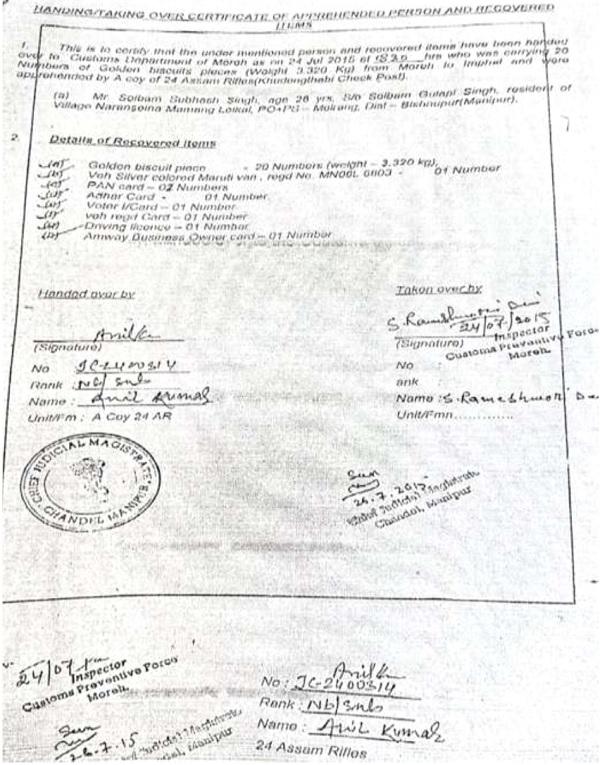
12.2. From the above report, we find that the gold in question has been mentioned in the report as ‘Golden biscuit piece-20 numbers’. The report has not indicated the presence of any foreign markings on the gold recovered by them.
12.3. We have also perused the Seizure inventory prepared by the Customs officers under Section 110 of the Customs Act, 1962. For ready reference a scanned copy of the seizure list id reproduced below:
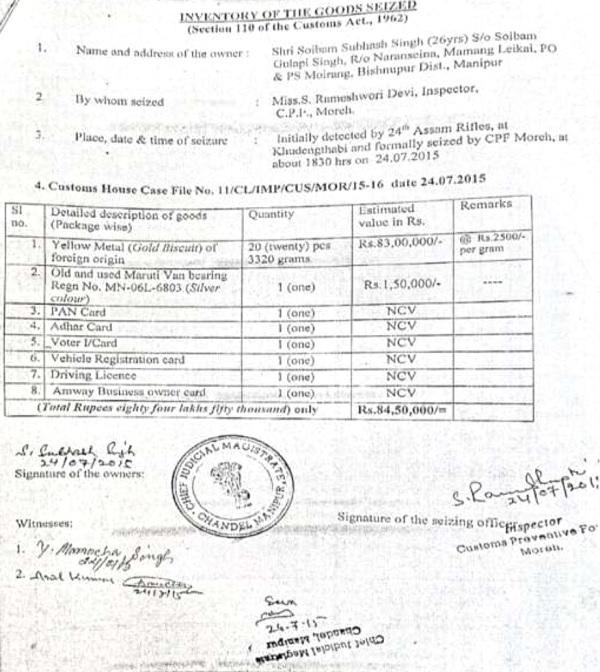
12.4. A perusal of the seizure Inventory also reveals that there were no foreign markings available on the gold. We observe that seizure in this case centers around the exercise of authority by the Custom Officials under section 110 (1) of the Customs Act, which reads as under: –
“Section 110 (1) : Seizure of goods, documents and things: If the proper officer has reason to believe that any goods are liable to confiscation under this Act, he may seize such goods.”
12.5. In the present case, we observe that the gold was seized by the personnel of Assam Rifles and later handed over to Customs, meaning that the Customs officer did not act on his independent belief but merely accepted the seizure done by another agency. The Hon’ble Supreme Court in Union of India v. Mohammed Nawaz Khan, (2021) 10 SCC 100, held that the authority effecting the seizure must demonstrate a subjective satisfaction based on objective material, failing which the seizure is invalid.
12.6. We observe that even after accepting the gold from personnel of the Assam Rifles, the Customs officers did not derive any subjective satisfaction that the gold was of foreign origin and smuggled. The seizure inventory fails to disclose any material evidence justifying a ‘reasonable belief’ for seizure of the gold. In this regard, we observe that the mere finding of gold does not render it liable for seizure unless there is cogent and positive evidence proving its foreign origin as the first condition, as precursor to seizure. The Hon’ble Supreme Court, in Gian Chand v. State of Punjab (1962 AIR 496), has categorically held that mere suspicion is not sufficient to justify seizure, and the prosecution must provide substantive evidence of foreign origin.
12.7. Further, we observe that in Union of India v. Mahesh Raj (1990 SCC (3) 115), the Hon’ble Supreme Court ruled that the burden under Section 123 arises only if there is prima facie evidence indicating foreign origin, which is entirely absent in this case.
12.8. Also, in D. Bhoormull (1974 AIR 859), the Hon’ble Supreme Court emphasized that suspicion alone is not a substitute for evidence. In Umrao Lal v. Commissioner of Customs (2016 (331) E.L.T. 216 (Tri.-Del.), it was held that in the absence of markings or material evidence proving foreign origin, confiscation is not sustainable.
12.9. In the instant case, we observe that Assam Rifles recovered gold from the procession of appellant no. 2 solely on suspicion that it was smuggled and later handed it over to Customs. However, instead of conducting an independent verification or forming their own reasonable belief based on credible evidence, the Customs officers proceeded with the seizure under the Customs Act without exercising due diligence. They failed to assess whether a reasonable belief of smuggling genuinely existed, as required by law, and merely acted on the presumption created by Assam Rifles. This lack of independent application of mind renders the seizure arbitrary and legally unsustainable.
12.10. In this regard, we find that a similar view has been expressed by the Tribunal, Kolkata in Customs Commissioner of Cus (Prev.), Patna v. Lalit Krishna Agarwal [Final Order No. 77506 of 2023 dated 08.11.2023 in Customs Appeal No. 75499 of 2022 – CESTAT, Kolkata], wherein it was observed as under:-
“6. In fact, during the course of investigation, it is a fact on record that boondi silver and silver jewellary were recovered from the shop of the respondent. So, the question arises that in the absence of any seizure of Port or Airport or not having any foreign markings on the goods seized from the respondent, how the officers came to the conclusion that the goods are third country origin goods. Therefore, first, onus on the Revenue is to make a reasonable belief that the goods are of third country. Admittedly, no such evidence has been produced by the Revenue to allege that to make a reasonable belief, the goods are of third country origin. In the absence of that, the goods in question cannot be confiscated.”
12.11. In view of the above discussions, we hold that there was no ‘reasonable belief’ in this case for seizure of the gold in question in terms of Section 110(1) of the Customs Act, 1962. Thus, the issue no. (i) framed at paragraph 11 of this Order is answered in the negative.
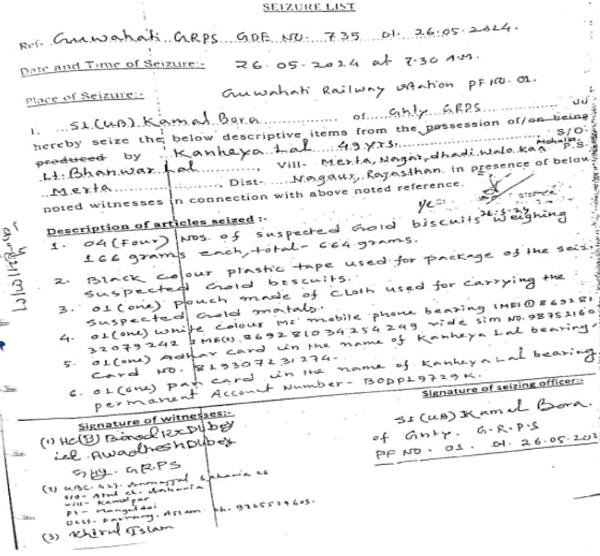
8. Admittedly, in this case, I find that the seizure list made by the GRPS, does not indicate any presence of any foreign marking on the seized gold. For better appreciation of facts, the seizure memo is extracted herein below :
9. I also take note of the fact that the Seizure Inventory was prepared by the Customs Officer under the provisions of Section 110 of the Customs Act, 1962. The same is also extracted herein below :
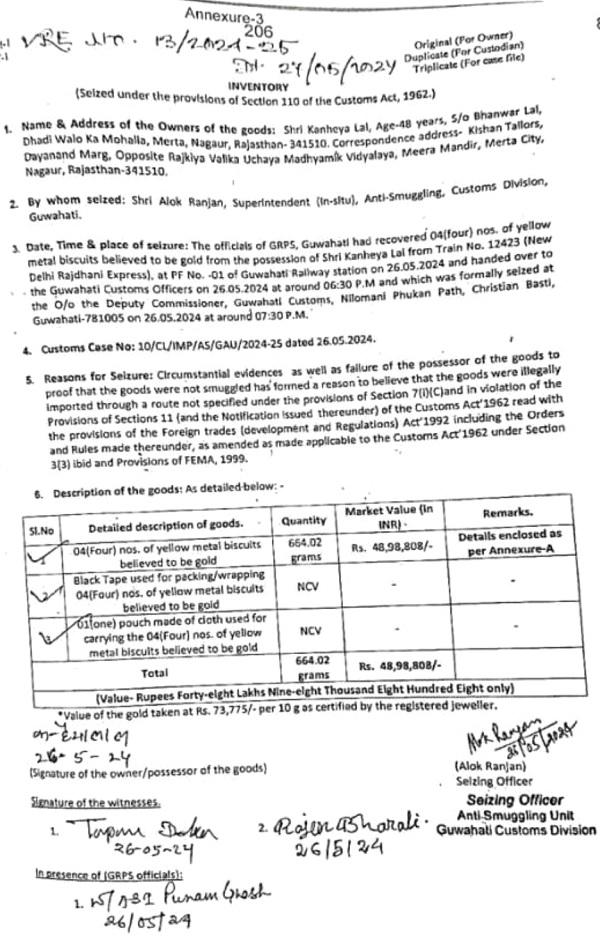
10. On perusal of the said seizure inventory, there is no foreign marking on the gold and only one item at Sl.No.1, there is a marking as “W”, which does not indicate that the gold in question is of foreign origin.
11. Therefore, I hold that the gold was seized by the personnel of GRPS and later handed over to Customs, which resulting that the Customs officer did not act on his independent belief but merely accepted the seizure done by another agency. Admittedly, the Hon’ble Supreme Court in Union of India v. Mohammed Nawaz Khan (supra) held that the authority effecting the seizure must demonstrate a subjective satisfaction based on objective material, failing which the seizure is invalid.
12. Therefore, I observe that even after accepting the gold from personnel of the GRPS, the Customs officers did not derive any subjective satisfaction that the gold was of foreign origin and smuggled. The seizure inventory fails to disclose any material evidence justifying a ‘reasonable belief’ for seizure of the gold. In this regard, I observe that the mere finding of gold does not render it liable for seizure unless there is cogent and positive evidence proving its foreign origin as the first condition, as precursor to seizure as held by the Hon’ble Supreme Court, in Gian Chand v. State of Punjab (supra), wherein the Hon’ble Apex Court has categorically held that mere suspicion is not sufficient to justify seizure, and the prosecution must provide substantive evidence of foreign origin.
13. Therefore, I observe that the GRPS recovered gold from the procession of Appellant No.(3) solely on suspicion that it was smuggled and later handed it over to Customs. However, instead of conducting an independent verification or forming their own reasonable belief based on credible evidence, the Customs officers proceeded with the seizure under the Customs Act without exercising due diligence. They failed to assess whether a reasonable belief of smuggling genuinely existed, as required by law, and merely acted on the presumption created by GRPS. This lack of independent application of mind renders the seizure arbitrary and legally unsustainable.
14. In view of this, I hold that there was no “reasonable belief” in this case for seizure of gold in question in terms of Section 110(1) of the Customs Act, 1962.
15. Therefore, the gold cannot be held liable for confiscation.
16. I further take note of the fact that the Appellant No.(1), Shri Bal Kishan Soni has produced the purchase invoices for procurement of the said gold jewellery , which was converted and melted into gold. The said facts have been accepted by Shri Bal Kishan Soni in his statement recorded on 21.08.2024 wherein he stated that the said gold seized belongs to his Firm, i.e. M/s Aditya Jewellers. He further added that he bought ornamental gold in October, 2023 from a Micro Finance Company by auction and by way of melting the ornamental gold made gold pieces, which was seized by the Department. He also submitted purchase auction invoices of gold and copy of bank account statement, ITR for the Financial Year 2022-23 and 2023-24. As the documents produced by the Appellant, Shri Bal Kishan Soni, have not been discarded by the Revenue , in that circumstances, the said documents are admissible as an evidence. As the Appellant has discharged the burden cast on them under Section 123 of the Customs Act, 1962 and now onus is on the Revenue to prove that the gold in question is smuggled one, which the Revenue has failed to do so.
17. In that circumstances, I hold that the gold in question is not liable for confiscation.
18. In view of the above discussions, I hold that as the gold in question is not liable for confiscation, therefore, the same is to be released to the appellant and no penalties are imposable on the appellants.
19. Accordingly, the impugned order is set aside and the appeals are allowed with consequential relief, if any.
(Pronounced in the open Court 30.09.2026)