Gorakhpur Kasia Tollways Pvt. Ltd. Vs PCIT (ITAT Indore)
Summary: ITAT Indore allowed the appeal of Gorakhpur Kasia Tollways Pvt. Ltd. and quashed the revisionary order passed under Section 263 for AY 2020-21. The dispute concerned computation of book profit under Section 115JB in respect of a notional loss of Rs.20,90,15,065 on initial recognition of investments in preference shares and unwinding interest of Rs.5,03,04,427 on provision for overlay. The PCIT treated the assessment as erroneous and prejudicial to Revenue on the ground that the Assessing Officer had failed to properly examine these adjustments.
The Tribunal, however, found from the assessment record that the AO had repeatedly raised queries regarding the Ind AS adjustments, obtained detailed replies and computations, conducted a video-conference hearing and specifically examined the Section 115JB computation before accepting the assessee’s position. Therefore, this was not a case of lack of enquiry permitting revision under Explanation 2 to Section 263. The Tribunal further held on merits that the notional loss arising on initial recognition of preference-share investments did not require adjustment while computing MAT, having regard to the specific framework applicable to Ind AS companies and CBDT’s clarification regarding MTM losses on FVTPL financial instruments.
As regards unwinding interest on the overlay provision, the assessee had a contractual road-renewal obligation under its NHAI concession agreement. The liability satisfied the tests governing an ascertained obligation and consequently did not warrant an addition to book profit. The Tribunal accordingly quashed the Section 263 order and restored the assessment order.
Cases Discussed
- Malabar Industrial Co. Ltd. v. CIT (2000) 243 ITR 83 (SC) — The Supreme Court principle that Section 263 requires the assessment order to be both erroneous and prejudicial to Revenue was applied. Where the AO adopts a legally permissible view, revision cannot be invoked merely because another view is possible
- CIT v. Max India Ltd. (2007) 295 ITR 282 (SC) — Relied upon for the proposition that where two views are possible and the AO adopts one permissible view, disagreement of the Commissioner does not make the assessment erroneous and prejudicial to Revenue.
- CIT v. Associated Food Products (P) Ltd. (2006) 280 ITR 377 (MP) — The jurisdictional High Court’s principle requiring both error and prejudice as conditions precedent for exercise of Section 263 jurisdiction was noticed.
- CIT v. Nirav Modi [2016] 71 taxmann.com 272 (Bombay) — Referred to for distinguishing absence of enquiry from inadequate enquiry; Section 263 cannot ordinarily be used merely to direct a fuller enquiry where the AO has already examined the matter.
- CIT v. Anil Kumar (2011) 335 ITR 83 (Delhi) — Referred to on the principle that where application of mind by the AO is discernible from the record, Section 263 cannot be invoked merely because the Commissioner holds a different opinion.
- CIT v. Vikas Polymers (2012) 341 ITR 537 (Delhi) — The Tribunal reproduced the principle that an assessment cannot be revised merely because the AO’s query and the assessee’s response are not elaborately recorded in the assessment order.
- Mrs. Khatiza S. Oomerbhoy v. ITO, 101 TTJ 1095 (ITAT Mumbai) — Relied upon for broader principles governing Section 263, including that an AO’s conclusion after enquiry and consideration of the assessee’s written explanation cannot be treated as erroneous merely because the assessment order does not contain an elaborate discussion.
- ITO v. D.G. Housing Projects Ltd. [2012] 343 ITR 329 (Delhi) — Applied for the distinction between absence of enquiry and an allegedly erroneous conclusion after enquiry; in the latter situation, the Commissioner must himself examine the issue on merits rather than merely direct further enquiry.
- Principal CIT, Surat-2 v. Shreeji Prints (P) Ltd. [2021] 130 taxmann.com 294 (SC) — Cited by the assessee in support of its challenge to revision under Section 263.
- Principal CIT-2, Meerut v. Canara Bank Securities Ltd. [2020] 114 taxmann.com 545 (SC) — Cited by the assessee in support of its contention against exercise of Section 263 jurisdiction.
- Jitendrasinh Zala v. PCIT, ITA No. 871/RJT/2024, order dated 18.11.2025 (ITAT Rajkot) — Relied upon by the assessee in connection with the treatment of unwinding interest on provision for overlay under Ind AS 37.
- Rotork Controls India (P.) Ltd. v. CIT [2009] 180 Taxman 422 (SC) — The test requiring a present obligation arising from a past event, probable outflow of resources and a reliable estimate of the obligation was considered in determining whether the overlay provision represented an ascertained liability.
- Mahaveer Trader v. CIT (1996) 220 ITR 167 (MP) — Relied upon by Revenue to contend that a favourable conclusion cannot stand where the relevant material had not actually been examined by the AO.
Assessee was Represented by:- Ms. Shreya Jain
FULL TEXT OF THE ORDER OF ITAT INDORE
This appeal of Assessee pertaining to A.Y. 2020-21 is directed against the order of First Appellate Authority dated 19.03.2025 passed u/s.263 of the Act emanating out of the Assessment order passed u/s.143(3) r.w.s.144B of the Income Tax Act 1961 (hereinafter called as the ‘Act’) framed by ACIT-1(1), Indore on 23.09.2022.
2. Assessee has raised following grounds of appeal:
“1. That on the facts and in the circumstances of the case and in law the Ld. Pr. CIT erred in initiating revision proceedings under section 263 of the Act by ignoring the fact that during the assessment proceedings the Ld. AO made the specific query regarding the deduction of Rs. 50,57,27,576/- claimed in return of Income which included the Notional Profit/(Loss) in initial recognition Investment of Rs. 20,90,15,065/- and the Notional unwinding interest on preference shares of Rs. 5,03,04,427/- and after satisfying with the reply and evidence filed by the company accepted our contention in the assessment year in question, thus according to explanation – 2 of section 263 the PCIT can’t invoke section 263.
2. That on the facts and in the circumstances of the case and in law the Ld. Pr. CIT erred in treating the order dated 23.09.2022 passed under section 143(3) r. w. s. 144B of the Act by the National Faceless Assessment Centre, Delhi for AY 2020-21 as erroneous and prejudicial to the interest of the revenue.
3. That on the facts and in the circumstances of the case and in law the Ld. Pr. CIT erred in concluding that the learned AO has neither made any inquiry nor the assesse company filed any reply and evidence regarding the Notional Profit/(Loss) in initial recognition Investment in preference shares of Rs. 20,90,15,065/- and the Notional unwinding interest on provision for overlay of Rs. 5,03,04,427/- during the course of assessment proceedings.
4. That on the facts and in the circumstances of the case and in law the Ld. Pr. CIT for failed to appreciate the facts that assessee company is under obligation to prepare its accounts as per IND-AS therefore no addition / subtraction could be made from book profit.
5. That on the facts and in the circumstances of the case and in law the Ld. Pr. CIT erred in not relying on the decision of Hon’ble Apex Court, various High Courts and Tribunals including jurisdictional tribunal wherein it was held that as per explanation 2 section 263 order cannot be revised where the order is passed by the Ld. AO after making proper enquiry and verification.”
3. Brief facts of the case are that the assessee is a Private Limited company incorporated as a Special Purpose Vehicle (SPV) for Toll collection of Gorakhpur-Kasia section of National Highway No.28. Income of Rs.4,31,530/- declared in the return for A.Y. 2020-21 e filed on 13.01.2021 and book profit u/s.115JB of the Act shown at Rs.22,17,67,412/-. Case selected for Complete Scrutiny under CASS for verification of the following six issues:
(i). Default in TDS & Disallowance for such default
(ii). Large refund claim out of advance tax
(iii). Substantial investment by an unlisted company in non- business assets
(iv). Large deduction claimed under section 80I/80IA/ 80IB/80IC as compared to Turnover
(v). Low income in comparison to very high investments
(vi). Claim of Large Value Refund
4. After validly serving statutory notices u/s.143(2) and 142(1) of the Act various submissions were filed by the assessee replying the questionnaire issued by the ld. Assessing Officer and further notices issued from time to time. Ld. Assessing Officer after examining all the details, books of account, replies to various questions raised in the questionnaire finally completed the assessment making various additions on account of interest at Rs.22,29,741/-; disallowance of Health and Education expenses at Rs.41,33,077/-; disallowance of interest on TDS at Rs.2,18,969/- and assessed the income at Rs.70,13,317/-. After the completion of the assessment on 23.09.2022 u/s.143(3) rw.s.144B of the Act, ld. Principal Commissioner of Income Tax (PCIT) called the assessment records for examination within the powers provided u/s.263 of the Act and issued following show cause notice dated 21.01.2025 u/s.263 of the Act:
“NOTICE FOR THE HEARING
M/s/Mr/Ms
Subject: Notice for Hearing in respect of Revision proceedings u/s 263 of the THE INCOME TAX ACT, 1961-Assessment Year 2020-21.
In this regard, a hearing in the matter is fixed on 03/02/2025 at 12:11 PM. You are requested to attend in person or through an authorized representative to submit your representation, if any alongwith supporting documents/information in support of the issues involved (as mentioned below). If you wish that the Revision proceeding be concluded on the basis of your written submissions/representations filed in this office, on or before the said due date, then your personal attendance is not required. You also have the option to file your submission from the e-filing portal using the link:
Subject: Show cause notice u/s 263 of the Income Tax Act, 1961, for the A.Y. 2020-21-reg.
Please refer to the above.
2. On perusal of the records, it has been observed that the assessee had filed its Income Tax Return for A.Y. 2020-21 on 13/01/2021 declaring total income of Rs. 4,31,530/- and book profit u/s 115JB of Rs. 22,17,67,412/-. Further, the case was selected for scrutiny through CASS on the following issues:
(i) Default in TDS & Disallowance for such default.
(ii) Large refund claim out of advance tax.
(iii) Substantial investment by an unlisted company in non-business assets.
(iv) Large deduction claimed under section 801/801A/801B/80IC as compared to turnover.
(٨) Low income in comparison to very high investments.
(vi) Claim of large value refund.
Accordingly, assessment order u/s 143(3) r.w.s. 144B of the Income Tax Act 1961 (hereinafter referred as “Act”) was passed on 23/09/2022 assessing the total income at Rs. 70,13,317/- and book profit u/s 115JB at Rs. 22,17,67,412/-. Further, rectification order u/s 154 was passed on 12/01/2024 at book profit u/s 115JB at Rs. 22,58,80,489/-.
3. As per facts of the case, the case was selected for scrutiny through CASS and subsequently, notice u/s 143(2) was issued on 29/06/2021 fixing the date for compliance on 14/07/2021. Further notices u/s 142(1) were issued on 23/11/2021 and 12/09/2022. In response to the said notices, the assessee submitted its replies alongwith the documents/evidences requisite for. Considering the of facts of the case as well as the replies submitted by the assessee, the assessment order u/s 143(3) r.w.s. 144B of the Act was passed on 23/09/2022 assessing the total income at Rs. 70,13,317/- and book profit u/s 115JB at Rs. 22,17,67,412/-.
4. On perusal of the case records, the following issues emerged:
(i) The assessee company had debited an amount of Rs.5,03,04,427/- as “Unwinding Interest on provision for Overlay” under the head Finance Cost in Note 23 of the profit and loss statement and the same was added back for computation of income but was not added back for computing book profit. Since, “Unwinding Interest on provision for Overlay” is the amount set aside to provisions made for meeting liabilities, other than ascertained liabilities, the same was liable to be added back for computing book profit which was not done while completing scrutiny assessment proceedings.
(ii) The assessee company had credited an amount of Rs. (-) 20,90,15,065/ as Profit/(loss) on initial Recognition of investments” under the head Other Income in Note 19 of the profit and loss statement. As per the reply of the assessee company, it was nothing but the notional loss on fair valuation of investments at the discounted rate i.e. it was expected credit loss and actually the loss had not been occurred. Thus, it was the amount set aside to provisions made for meeting liabilities, other than ascertained liabilities and was required to be added back for computing the book profit which was not done while completing scrutiny assessment proceedings.
5. During the course of assessment proceedings, you have neither furnished any details nor explained the issues involved with relevant documentary evidence with regard to issues narrated above. Hence, the issue involved in this case remained to be verified. The Assessing Officer has not at all verified these issues and relevant facts involved therein while completing the assessment without any application of mind, without conducting proper inquiries and due verification. As such, the assessment is erroneous in the sense that it is prejudicial to the interest of revenue. You are therefore, required to show cause why provisions of section 263 be not invoked in your case for the reasons mentioned above as the order of NFAC dated 23/09/2022 for A.Y 2020-21, is erroneous in so far as it is prejudicial to the interest of revenue.
6. You are hereby given an opportunity of being heard to explain as to why the proposed revision should not be carried out. For this purpose, your reply should be received on or before 03/02/2025. On the scheduled date, you may either appear in person or get yourself represented by a representative duly authorized by you as per section 288 of the Act. You may also make your written submissions in lieu of personal appearance. If such written submissions are received on or before the scheduled date, the same shall be duly considered for the purpose of the proceedings u/s 263 of the Act.
7. Please note that you may also file your reply through mail [email protected] along with all relevant records and documents. It is not necessary to attend the office for this purpose. In case of non-compliance, the matter will be decided on merits of the case and information available on record.”
5. In response, the assessee submitted reply on 16.02.2025 through which it is stated that ld. Assessing Officer specifically asked the assessee to explain that the deduction claimed u/s.80IA(4) is Rs.5,05,72,757/- whereas the profit from eligible business for claiming the deduction u/s.80IA(4) is Rs.27,88,49,033/-. Assessee in its reply submitted that there were various adjustments made on account of Indian Accounting Standards Rules, (in short ‘IND AS’) which included the Notional profit/loss for the initial recognition of investments in relation to the preference shares of unlisted companies which are redeemable at par after certain period of time and also certain instruments are considered as compound financial instructions as per IND-AS system of accounting and they are to be recognized at discounted value and for this reason notional loss on initial recognition for investment has been shown in the profit and loss account. Similarly, there is notional unwinding interest on provision for overlay at Rs.5,03,04,427/- and this is a part of operation, maintenance and transfer of Road Project and that the project is spread across many years but due to application of IND-AS as against the estimated project cost of Rs.148.32 crore, estimation of 130.48 crore was required to be valued at discounted present value in the initial year of project. The present value based on 10% discount was arrived at RS.99.27 crore. The difference of Rs.31.21 crore in the estimated expenditure on road renewal and present value is to be achieved by way of providing unwinding interest on provision for overlay out of which Rs.17.73 crore have been applied in the earlier financial year and Rs.5.03 crore is debited during the financial year under consideration and balance of Rs.8,.43 crore shall be incurred in the coming financial years and the same being notional expenditure is disallowed in the computation of income. Similarly, interest of Rs.1,10,89,538/- shown on preference shares in the profit and loss prepared as per IND-AS 109 is nothing but notional interest because as per the provisions of Income Tax Act only real income can be assessed to tax as the notional loss is calculated/worked out on hypothetical basis by adopting the method of accounting by IND-AS.
6. The assessee further made submissions before ld. PCIT that on the issues raised in the show cause notice u/s.263 of the Act, a detailed enquiry has already been conducted by ld. Assessing Officer and submissions have been filed on more than one occasion and ld. Assessing Officer after examining the submissions have found merit in the contentions of the assessee and therefore after adequate and detailed enquiry the submissions of the assessee have been accepted. It was further submitted that even on merits of the case also the issues referred in the show cause notice, no addition deserves to be made because they are only part of notional expenses which are shown as per the IND-AS guidelines issued by the Govt. of India for certain categories of companies which have to prepare their financial statements adopting the IND-AS which mainly ascertains the present value of the items of the profit and loss account and balance sheet and also take into consideration the present value of the future commitments/transactions of the company so as to depict the correct and fair picture of the financials. However, ld. PCIT was not satisfied with these submissions of the assesee and after recording the following finding came to the conclusion that there is under assessment of book profit u/s.115JB of the Act to the extent of Rs. 25,93,19,492/:
“The assessee Company filed the return of income for AY 2020-21 on 13.01.2021 declaring total income at Rs (-) 4,31,530/- and at Rs.22,17,67,412/-under section 115JB. The case was selected for complete scrutiny under CASS. The regular assessment was completed on 23.09.2022 u/s 143(3) r.w.s. 144B at Rs. 70,13,317/- and at Rs. 22,17,67,412/- under section 115JB. Further, rectification order u/s 154 was passed on 06.04.2023 at Rs. 22,58 80,489/- u/s 115JB.
Further, on perusal of case records, it has been observed that the assessee company had debited an amount of Rs. 5,03,04,427/- as “Unwinding Interest on provision for Overlay” under the head Finance Cost in Note 23 of the profit and loss statement. The same was added back for computation of income but was not added back for computing book profit. Since. “Unwinding Interest on provision for Overlay” is the amount set aside to provisions made for meeting liabilities, other than ascertained liabilities, the same was required to be added back for computing book profit, however, the same was not done during the assessment proceedings.
Similarly, the assessee company had credited an amount of Rs. (- )20,90,15,065/-as- Profit/(loss) on initial Recognition of investments” under the head Other Income in Note 19 of the profit and loss statement. As per the reply of the assessee company, it was nothing but the notional loss on fair valuation of investments at the discounted rate i.e. it was expected credit loss and actually the loss had not been occurred. Thus, it was the amount set aside to provisions made for meeting liabilities, other than ascertained liabilities and was required to be added back for computing book profit, however, the same was not done during the assessment proceedings These above omissions resulted in under assessment of book profit u/s 115JB to the extent of Rs. Rs. 25,93,19,492/- (Rs. 5,03,04,427/- + Rs. 20,90,15,065/-) involving short levy of Minimum Alternative Tax (MAT) of Rs. 4,53,08,302/-
5.5 The above issues were confronted to the assessee company vide notice dated 22/01/2025. In compliance to the same, the assessee company submitted its reply firstly opposing the action of the department regarding invoking of section 263 of the Act, after relying upon some judgements. The same has already been discussed and rejected in the preceding para Secondly, the assessee company contended that the amount of Rs. 5,03,04,427/- debited in P&L A/c under the head ‘Unwinding interest on provision for overlay represents the time related changes in the carrying value of provision that were recognized in the previous periods for long-term obligations. It further submitted that this amount has to be borne by the assessee company in future and if the company is not able to carry out entire or some portion in any scheduled year, it is required to be done in next year, thus it is an ‘Ascertained Obligation’
5.6 The submission of the assessee company on the above issue has properly gone through. On careful examination of the submission of the assessee, it can be seen that the assessee company itself is not certain that what amount will be expensed in the coming year. It submitted the tentative expenses details which certainty is based on the various circumstances. Hence, it can’t be said that the claimed expenses are in the nature of Ascertained Obligation. The provision of section 115JB clearly says that to determine the ‘book profit’, the profit as shown in the statement of profit and loss for the relevant previous year prepared under sub-section (2), as increased by the amount or amounts set aside to provisions made for meeting liabilities, other that the ascertained liabilities. Hence, in the case of the assessee, the amount of Rs. 5,03,04,427/- debited in P&L A/c under the head Unwinding interest on provision for overlay’ being uncertained liabilities should be taken for determining the book profit but during the assessment proceedings, the AO didn’t consider this fact and without doing verification, passed the assessment order which is prejudicial to the interest of the revenue.
5.7 Simultaneously, on the issue of crediting the amount of Rs. (-) 20,90,15,065/-in P&L A/c as Profit/(Loss) on initial recognition of investments, the assessee company contended that it is a fair valuation adjustment which is mandatory adjustment on required under Ind AS 109. Since, it is an investment made by the company in preference shares which is discounted at fair value due to financial requirements, thus can’t be categorized as liability.
5.8 The submission/contention of the assessee company on this issue has also been properly gone through but not found tenable as on perusal of the audit report and P&L A/c, it can be seen that the assessee company has revalued the value of its investment and accordingly. Rs. 20,90,15,065/- is nothing but notional loss on fair value of investments at the discounted rate le it was expected credit loss and actually, the loss had not been occurred. Thus, it was the amount set aside to provisions made for meeting liabilities, other than ascertained liabilities. As per section 115JB, this amount should also be taken for calculating book profit. However, the assessee company didn’t do the same and during the assessment proceedings, the AO also failed to appreciate the fact and didn’t verify the issue properly, which led the assessment order erroneous in so far as it is prejudicial to the interest of the revenue.”
7. Ld. PCIT thereafter referring to certain judicial precedents concluded the order observing that the Assessing Officer during the course of proceedings did not make any enquiry about the correct calculation of book profit in accordance with the provisions of section 115JB of the Act as a result of which the value of book profit or loss valued at Rs. 25,93,19,492/- involving short levy of Minimum
Alternative Tax and therefore the assessment order dated 23.09.2022 is erroneous in so far as it is prejudicial to the interest of the Revenue and was hit by clause (a) of Explanation 2 to section 263 which provides that the order is passed without making enquiries or verification should have been made and accordingly set aside the order dated 23.09.2022 to the file of ld. Assessing Officer to re- examine the issue and to make denovo assessment.
8. Aggrieved assessee is now in appeal before this Tribunal.
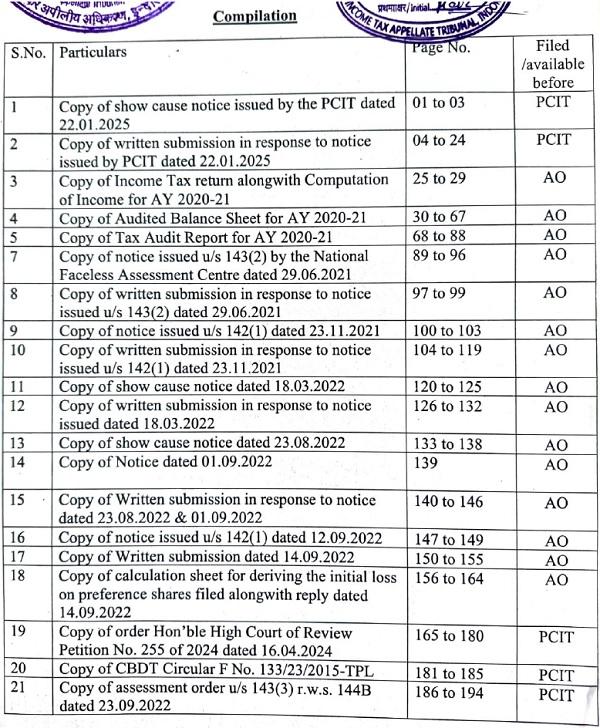
9. Ld. Counsel for the assessee firstly referred to the various documents placed in the paper book running into 194 pages which are as under:
10. Thereafter, ld. Counsel for the assessee referred to the submissions filed before the Assessing Officer in response to notice u/s.142(1) of the Act dated 23.11.2021 where detailed submissions were made with regard to the notional profit/loss in the initial recognition of investment in preference shares and notional unwinding interest on provision or overlay. Thereafter, at the time of personal hearing through video conference, assessee again explained the matter and IND-AS adjustments were examined by ld. Assessing Officer; secondly ld. Assessing Officer again issued questionnaire dated 12.09.2022 relating to calculation of book profit u/s.115JB of the Act. She submitted that the assessee company also submitted written submissions on 15.09.2022 providing detailed calculation sheet for setting out 10% discounting factor and the methodolody adopted for discounting the investments made in preference shares in accordance with IND-AS 109 and in the assessment order ld. Assessing Officer records that “the details submitted by the assessee and material available on record has been perused and accepted.” It is submitted that ld. Assessing Officer raised detailed enquiries regarding the aforesaid issued during the assessment proceedings to which comprehensive replies were filed along with supporting evidences and therefore the assessment order cannot be deemed to be erroneous on the ground of not making any enquiry as the ld. Assessing Officer adopted legally plausible and factually supported view after conducting thorough investigation. Reliance placed on the following decisions:
1. CIT Vs. Max Industries Ltd. (2007) 295 ITR 282 (SC)
2. The Hon’ble Jurisdictional Bench in the case of Shri Kamal Kishore Mukati Vs. PCIT-1, Indore – ITA No.870/Ind/2019 order dated 28.06.2021
3. CIT Vs. Sunbeam Auto 332 ITR 167 (Del.)
4. Gabriel India Ltd. [1993] 203 ITR 108 (Bom)
5. Principal CIT, Surat-2 Vs. Shreeji Prints (P) Ltd. [2021] 130 taxmann.com 294 (SC)
6. Principal CIT Vs. Shree Gayatri Associates [2019] 106 taxmann.com 31 (SC)
7. Principal CIT-2, Meerut Vs. Canara Bank Securities Ltd. [2020] 114 taxmann.com 545 (SC)
8. Principal CIT-8, Mumbai Vs. Sumatich and Tolamal Gouti [2019] 111 taxmann.com 287 (SC)
11. Ld. Counsel for the assessee further made reference that the assessee company is mandatorily required to prepare financial statements in accordance with IND-AS as notified under the Companies Act, 2013. Further, sub-section 2(a), 2(b) and 2(c) inserted u/s.115JB by the Finance Act, 2017 constitute self contained and specific framework for computing the book profit for the companies operative from A.Y. 2017-18. Besides above amendment in Minimum Alternative Tax by the Finance Act, 2017, CBDT Circular dated 25.07.2017 also issued clarification in the form of Frequently Asked Questions and it is stated that where marked to market gains/losses on account of and market gains recognize profit or loss on financial instruments are included in book profits for MAT computation, it is clarified that MTM losses on such instruments recognized through profit or loss shall not require any adjustments as provided under clause (i) of Explanation 1 to section 115JB(2) of the Act. Thus, it was made clear that notional loss on investments in preference shares under FVTPL does not require any adjustment while computing MAT.
12. Similarly, as regards the unwinding interest on provision for overlay at Rs.5,03,04,427/- it was submitted that the said provision has been made only to comply to the IND-AS 37 so as to meet the three criteria namely; (a) an enterprise has a present obligation as a result of past event; (b) it is probable that an outflow of resources will be required to settle the obligation; and (c) a reliable estimate can be made of the amount of the obligation. Reliance also placed on the decision of Coordinate Bench, Rajkot in the case of Jitendrasinh Zala Vs. PCIT – ITA No.871/RJT/2024 dated 18.11.2025
13. On the other hand, ld. DR vehemently argued referring to the following written submissions:
“MAY IT PLEASE YOUR HONOURS,
The Revenue places on record its written submission in support of the order dated 19.03.2025 passed by the Ld. Pr. CIT, Indore-1 under section 263 of the Income-tax Act, 1961 (“the Act”), whereby the assessment order dated 23.09.2022 passed under section 143(3) r.w.s. 144B of the Act was set aside and the matter restored to the file of the Ld. AO for de-novo examination. The assessee-company. aggrieved by the said order, has preferred the present appeal, which deserves to be dismissed for the reasons set out hereunder.
Brief Facts of the Case
1. The assessee filed its return of income for A.Y. 2020-21 on 13.01.2021 declaring total income of Rs. 4,31,530/- and book profit under section 115JB of the Act at Rs. 22,17,67,412/-.
2. The case was selected for complete scrutiny through CASS, inter alia, on the issue of large deduction claimed under section 80-IA as compared to turnover and substantial investment made by the assessee, an unlisted company, in non-business assets. Notice under section 143(2) was issued on 29.06.2021, followed by notices under section 142(1) dated 23.11.2021 and 12.09.2022.
3. The assessment was completed on 23.09.2022 under section 143(3) r.w.s. 144B of the Act. accepting the book profit under section 115JB at Rs.22,17,67,412/- without making any addition on account of (i) “Unwinding Interest on Provision for Overlay” of Rs.5,03,04,427/-debited to Finance Cost (Note 23 of the P&L), and (ii) “Profit/(Loss) on Initial Recognition of Investments” of Rs. (-)20,90,15,065/- credited under Other Income (Note 19 of the P&L), both of which had been added back/deducted only for computation of normal income and not for computation of book profit under section 115JB.
4. On examination of the assessment records, the Ld. Pr. CIT found that the aforesaid two items represented amounts set aside to provisions made for meeting liabilities other than ascertained liabilities within the meaning of clause (c) of Explanation 1 to section 115JB(2) of the Act, and were consequently required to be added back while computing book profit an exercise which the L.d. AO never undertook. This resulted in under- assessment of book profit to the extent of Rs. 25,93,19,492/- and short levy of MAT of Rs. 4,53,08,302/-.
5. Show cause notice dated 22.01.2025 under section 263 was accordingly issued, and after affording repeated opportunities (including a final opportunity dated 04.02.2025), the assessee’s reply dated 16.02.2025 was considered and rejected, culminating in the impugned order dated 19.03.2025 setting aside the assessment for fresh examination.
Preliminary Submission: Scope of Enquiry Actually Conducted by the AO
6. At the outset, it is fairly conceded, as is also borne out from the assessee’s own written synopsis (paras 1.1 to 1.6), that the Ld. AO did raise certain queries during the course of assessment proceedings touching upon the Ind- AS adjustments made by the assessee while computing the deduction under section 80-IA, and that the assessee filed replies dated 08.12.2021, and 14.09.2022/15.09.2022 in response to notices under section 142(1) dated 23.11.2021 and 12.09.2022 respectively. To that limited extent, it cannot be said that the issue of Ind-AS adjustments was entirely outside the AO’s contemplation.
7. However, a bare perusal of the assessee’s own synopsis makes it evident that the enquiry so conducted, and the material so furnished, was confined exclusively to the “calculation sheet for deriving the initial loss on preference shares of Rs. 20,90,15,065/- and interest income of Rs. 1,10,89,358/- on preference shares as per IND-AS 109″ (Para 1.5a of the synopsis) and the “detailed calculation sheet for setting out 10% discounting factor methodology adopted for discounting the investment made in preference shares” (Para 1.5b of the synopsis).
8. It is submitted that nowhere in the assessee’s own synopsis, nor in the assessment record as placed before this Hon’ble Tribunal, is there any reference to a calculation sheet, working, or methodology showing how the estimated capital outlay of Rs. 130.48 Crores earmarked for road renewal/major maintenance works was discounted to its present value of Rs.99.27 Crores, so as to justify the debit of Rs.5,03,04,427/- as “Unwinding Interest on Provision for Overlay” for the year under consideration. The AO never called for such working, and the assessee never furnished it during the course of assessment proceedings.
9. It is submitted that the calculation sheet furnished for preference shares (an investment, i.e., an asset side item) cannot be equated with, or treated as a substitute for, the working of discounting of the capital outlay on road renewal (a liability/provision side item), which is the specific item under challenge in the impugned 263 proceedings. The two are distinct financial instruments/provisions governed by different Ind-AS standards (Ind-AS 109 for preference shares; Ind-AS 37 for the overlay provision), each requiring independent verification of the discounting methodology, discount rate, and the resultant unwinding computation.
10. In the absence of any such working having been called for by the AO or furnished by the assessee, it is submitted that the AO could not possibly have formed any considered or informed view as to whether the sum of Rs.5,03,04,427/- represented an ascertained liability, entitled to exclusion from the rigours of clause (c) of Explanation 1 to section 115JB(2), or an unascertained liability liable to be added back. The acceptance of the assessee’s claim, without verifying the very working on which the quantification of the liability rests, is not “enquiry” in the eyes of law, it is, at best, a mechanical acceptance of an unverified claim.
Order is Erroneous and Prejudicial for Want of Enquiry
11. It is well settled that non-enquiry, as distinguished from inadequate enquiry, squarely attracts the revisionary jurisdiction under section 263. Reliance is placed on Explanation 2(a) to section 263 of the Act, which deems an order to be erroneous and prejudicial to the interest of Revenue where “the order is passed without making inquiries or verification which should have been made.”
12. Reliance is also placed on the decisions submitted with our case law compilation index filed during the course of hearing held on 06.07.2026.
13. It is submitted that where the very foundation of a claim, here, the discounting methodology by which the capital outlay of Rs. 130.48 Crores was reduced to its present value is neither called for by the AO nor placed on record by the assessee, the resultant acceptance of the claim cannot be regarded as a “possible view” taken after due application of mind. A view can only be said to be taken where the material necessary to form that view has first been examined. In the absence of examination, there is no view, only, as has been judicially observed, “a chance result.”
The Ascertained/Unascertained Liability Argument as Taken by the Ld. Pr. CIT
14. Without prejudice to the above, and independently of the question of enquiry, it is submitted that the very submission of the assessee before the Ld. Pr. CIT establishes that the sum of Rs.5,03,04,427/- was not an ascertained liability within the meaning of clause (c) of Explanation 1 to section 115JB(2) of the Act.
15. As recorded by the Ld. Pr. CIT at para 5.6 of the impugned order, the assessee’s own submission conceded that the assessee company was “not certain” of the exact amount that would be expensed in the coming years, and that the details furnished were merely “tentative expenses details” dependent on “various circumstances.” It is submitted that a liability, to qualify as “ascertained,” must be measurable and quantified with a reasonable degree of certainty and not merely estimated on a tentative basis subject to future variation.
16. The assessee’s own synopsis (Para 5.6 as recorded in the 263 order) itself defines an unascertained liability as one which “is not yet determined in exact amount but is expected to arise in the future” and which is “contingent or dependent on certain events that have not yet occurred.” It is submitted that this very test stands satisfied against the assessee, and not in its favour, once it is seen that:
(a) The discounting working for the capital outlay of Rs. 130.48 Crores was never placed before the AO or verified by him;
(b) The assessee’s own figures for future years’ expenditure on road renewal were admittedly tentative and subject to revision, as evident from the year- wise revision of the estimate from Rs. 114.41 Crores to Rs. 130.48 Crores; and
(c) In the absence of a verified, reliable working demonstrating how the present value of Rs. 99.27 Crores was arrived at, the amount of Rs. 5,03,04,427/- claimed as unwinding interest for the year cannot be said to rest on a “reliable estimate” as required by the three-fold test laid down by the Hon’ble Supreme Court in Rotork Controls India (P.) Lid. v. CIT [2009] 180 Taxman 422 (SC), namely (i) a present obligation as a result of a past event, (ii) probability of an outflow of resources, and (iii) a reliable estimate of the amount of the obligation.
17. It is submitted that the third limb of the Rotork test i.e. a reliable estimate of the amount of obligation, is not a matter of assertion, it must be demonstrable from a verifiable working. Where such a working itself was never called for by the AO nor furnished by the assessee, the necessary inference that follows is that the liability remains unquantified and, therefore, unascertained on the record as it stood before the AO. The assessee cannot be permitted to assert reliability of estimate on the one hand while simultaneously withholding, and never producing before the AO, the very calculation by which that estimate was arrived at.
18. It is further submitted that the Ld. Pr. CIT has correctly appreciated this aspect at para 5.6 of the impugned order, holding that since the assessee itself was uncertain of the future expenditure, the claimed expenses could not be treated as an “Ascertained Obligation,” and that clause (c) of Explanation 1 to section 115JB(2) was squarely attracted. The same reasoning applies with equal force to the notional loss of Rs.20,90,15,065/- on initial recognition of investments, which the Ld. Pr. CIT has similarly held, at para 5.8 of the impugned order, to be in the nature of a provision for diminution in value requiring add-back, a finding never tested by the AO during the original assessment.
Explanation 2 to Section 263 Not Attracted in Assessee’s Favour
19. The assessee’s reliance on the principle that where the AO has taken a “possible view” after due enquiry, the Pr. CIT cannot substitute his own opinion under section 263 (CIT v. Max India Ltd. (2007) 295 ITR 282 (SC); Kamal Kishore Mukati v. PCIT, ITA No. 870/Ind/2019), is misplaced. That principle presupposes that the AO did in fact examine the claim on the basis of complete material. It cannot avail an assessee who never furnished the very working which formed the basis of the claim, and consequently deprived the AO of the material necessary to form any view, possible or otherwise. Reliance in this regard is also placed on the Jurisdictional High Court’s decision in Mahaveer Trader v. CIT (1996) 220 ITR 167 (MP), where it was held that a finding recorded by the Tribunal in favour of the assessee, without the material having actually been examined by the AO, cannot be sustained.
20. It is accordingly submitted that Ground Nos. 1 and 3 of the assessee’s appeal, premised on the plea of due enquiry under Explanation 2 to section 263, deserve to be rejected, and Ground Nos. 2 and 4, premised on the plea that the impugned amounts represent ascertained liabilities not requiring add-back under section 115JB, equally deserve to be rejected, for the reasons set out above. Ground No. 5, being consequential to the above grounds, does not survive independently.
Praver
In view of the foregoing, it is most humbly prayed that the order dated 19.03.2025 passed by the Ld. Pr. CIT, Indore-1 under section 263 of the Act be upheld, and the present appeal of the assessee be dismissed.”
14. We have heard the rival submissions and perused the record placed before us. The assessee has challenged the impugned order on two counts firstly contending that ld.PCIT erred to assume jurisdiction u/s.263 of the Act regarding the issues which have already been adequately enquired by the Assessing Officer and a permissible view has been taken and secondly on merits it is stated that the correct calculation of book profit u/s.115JB of the Act has been made in view of sub-section (2A), (2B) and 2(C) inserted in section 115JB of the Act by the Finance Act, 2017 for computation of book profit for INDA-AS Companies effective from A.Y. 2017-18. We will first take up the issue as to whether ld.PCIT erred in assuming jurisdiction u/s.263 of the Act and directing the Assessing Officer to recompute the book profit u/s.115JB of the Act by adding unwinding interest on provision for overlay at Rs.5,03,04,427/- and loss on initial recognition on investment at Rs.20.90 crore for the investment made in preference shares of unlisted company.
15. Before proceeding to examine the issues stated above, we find that the provision of Section 263 of the Act has direct bearing on the issue raised before us, therefore, it is pertinent to take note of this section which reads as under:
“Revision of orders prejudicial to revenue. 263. (1) The Principal Chief Commissioner or Chief Commissioner or Principal Commissioner or Commissioner may call for and examine the record of any proceeding under this Act, and if he considers that any order passed therein by the Assessing Officer or the Transfer Pricing Officer, as the case may be, is erroneous in so far as it is prejudicial to the interests of the revenue, he may, after giving the assessee an opportunity of being heard and after making or causing to be made such inquiry as he deems necessary, pass such order thereon as the circumstances of the case justify, including,—
(i) an order enhancing or modifying the assessment or cancelling the assessment and directing a fresh assessment; or
(ii) an order modifying the order under section 92CA; or
(iii) an order cancelling the order under section 92CA and directing a fresh order under the said section. Explanation 1.—For the removal of doubts, it is hereby declared that, for the purposes of this sub-section,—
(a) an order passed on or before or after the 1st day of June, 1988 by the Assessing Officer or the Transfer Pricing Officer, as the case may be, shall include—
(i) an order of assessment made by the Assistant Commissioner or Deputy Commissioner or the Income-tax Officer on the basis of the directions issued by the Joint Commissioner under section 144A;
(ii) an order made by the Joint Commissioner in exercise of the powers or in the performance of the functions of an Assessing Officer or the Transfer Pricing Officer, as the case may be, conferred on, or assigned to, him under the orders or directions issued by the Board or by the Principal Chief Commissioner or Chief Commissioner or Principal Director General or Director General or Principal Commissioner or Commissioner authorised by the Board in this behalf under section 120;
(iii) an order under section 92CA by the Transfer Pricing Officer;
(b) “record” shall include and shall be deemed always to have included all records relating to any proceeding under this Act available at the time of examination by the Principal Chief Commissioner or Chief Commissioner or Principal Commissioner or Commissioner;
(c) where any order referred to in this sub-section and passed by the Assessing Officer or the Transfer Pricing Officer, as the case may be, had been the subject matter of any appeal filed on or before or after the 1st day of June, 1988, the powers of the Principal Commissioner or Commissioner under this sub-section shall extend and shall be deemed always to have extended] to such matters as had not been considered and decided in such appeal.
Explanation 2.—For the purposes of this section, it is hereby declared that an order passed by the Assessing Officer or the Transfer Pricing Officer, as the case may be, shall be deemed to be erroneous in so far as it is prejudicial to the interests of the revenue, if, in the opinion of the Principal Chief Commissioner or Chief Commissioner or Principal Commissioner or Commissioner,—
(a) the order is passed without making inquiries or verification which should have been made;
(b) the order is passed allowing any relief without inquiring into the claim;
(c) the order has not been made in accordance with any order, direction or instruction issued by the Board under section 119; or
(d) the order has not been passed in accordance with any decision which is prejudicial to the assessee, rendered by the jurisdictional High Court or Supreme Court in the case of the assessee or any other person.
Explanation 3.—For the purposes of this section, “Transfer Pricing Officer” shall have the same meaning as assigned to it in the Explanation to section 92CA.
(2) No order shall be made under sub-section (1) after the expiry of two years from the end of the financial year in which the order sought to be revised was passed.
(3) Notwithstanding anything contained in sub-section (2), an order in revision under this section may be passed at any time in the case of an order which has been passed in consequence of, or to give effect to, any finding or direction contained in an order of the Appellate Tribunal, the High Court or the Supreme Court.
Explanation.—In computing the period of limitation for the purposes of sub- section (2), the time taken in giving an opportunity to the assessee to be reheard under the proviso to section 129 and the period commencing on the date on which stay on any proceeding under this section was granted by an order or injunction of any court and ending on the date on which certified copy of the order vacating the stay was received by the jurisdictional Principal Commissioner or Commissioner shall be excluded.”
15.1. On a bare perusal of the sub section-1 would reveal that powers of revision granted by section 263 to the learned Commissioner have four compartments. In the first place, the learned Commissioner may call for and examine the records of any proceedings under this Act. For calling of the record and examination, the learned Commissioner was not required to show any reason. It is a part of his administrative control to call for the records and examine them. The second feature would come when he will judge an order passed by an Assessing Officer on culmination of any proceedings or during the pendency of those proceedings. On an analysis of the record and of the order passed by the Assessing Officer, he formed an opinion that such an order is erroneous in so far as it is prejudicial to the interests of the Revenue. By this stage the learned Commissioner was not required the assistance of the assessee. Thereafter the third stage would come. The learned Commissioner would issue a show cause notice pointing out the reasons for the formation of his belief that action u/s 263 is required on a particular order of the Assessing Officer. At this stage the opportunity to the assessee would be given. The learned Commissioner has to conduct an inquiry as he may deem fit. After hearing the assessee, he will pass the order. This is the 4th compartment of this section. The learned Commissioner may annul the order of the Assessing Officer. He may enhance the assessed income by modifying the order. He may set aside the order and direct the Assessing Officer to pass a fresh order. At this stage, before considering the multi-fold contentions of the ld. Representatives, we deem it pertinent to take note of the fundamental tests propounded in various judgments relevant for judging the action of the ld. Pr. CIT taken u/s 263.
15.2. Hon’ble Supreme Court in the case of Malabar Industrial Co. Ltd. vs. CIT (2000) 243 ITR 83 (SC) has laid down following ratio with regard to provisions of section 263 of the Act:
“There can be no doubt that the provision cannot be invoked to correct each and every type of mistake or error committed by the Assessing Officer; it is only when an order is erroneous that the section will be attracted. An incorrect assumption of facts or an incorrect application of law will satisfy the requirement of the order being erroneous. In the same category fall orders passed without applying the principles of natural justice or without application of mind. The phrase ‘prejudicial to the interests of the revenue’ has to be read in conjunction with an erroneous order passed by the Assessing Officer. Every loss of revenue as a consequence of an order of the Assessing Officer cannot be treated as prejudicial to the interests of the revenue, for example, when an ITO adopted one of the courses permissible in law and it has resulted in loss of revenue; or where two views are possible and the ITO has taken one view with which the Commissioner does not agree, it cannot be treated as an erroneous order prejudicial to the interests of the revenue unless the view taken by the ITO is unsustainable in law. It has been held by this Court that where a sum not earned by a person is assessed as income in his hands on his so offering, the order passed by the Assessing Officer accepting the same as such will be erroneous and prejudicial to the interests of the revenue – Rampyari Devi Saraogi v. CIT [1968] 67 ITR 84 (SC) and in Smt. Tara Devi Aggarwal v. CIT [1973] 88 ITR 323 (SC)”. [Emphasis Supplied]
15.3. Hon’ble Apex Court in the case of CIT vs. Max India Limited as reported in 295 ITR 0282 has held that:
“2. At this stage we may clarify that under para 10 of the judgment in the case of Malabar Industrial Co. Ltd. (supra) this Court has taken the view that the phrase “prejudicial to the interest of the Revenue” under s. 263 has to be read in conjunction with the expression “erroneous” order passed by the AO. Every loss of revenue as a consequence of an order of the AO cannot be treated as prejudicial to the interest of the Revenue. For example, when the ITO adopted one of the courses permissible in law and it has resulted in loss of revenue; or where two views are possible and the ITO has taken one view with which the CIT does not agree, it cannot be treated as an erroneous order prejudicial to the interest of the Revenue, unless the view taken by the ITO is unsustainable in law.”
15.4. Hon’ble Madhya Pradesh High court in the case of CIT vs. Associated Food Products (P) Ltd as reported in 280 ITR 0377 has held that:
“10. In view of the aforesaid pronouncement of law and taking into consideration the language employed under s. 263 of the Act, it is clear as crystal that before exercise of powers two requisites are imperative to be present. In the absence of such foundation exercise of a suomoto power is impermissible. It should not be presumed that initiation of power under suomoto revision is merely an administrative act. It is an act of a quasi-judicial authority and based on formation of an opinion with regard to existence of adequate material to satisfy that the decision taken by the AO is erroneous as well as prejudicial to the interests of the Revenue. The concept of “prejudicial to the interests of the Revenue” has to be correctly and soundly understood. It precisely means an order which has not been passed in consonance with the principles of law which has in ultimate eventuate affected realization of lawful revenue either by the State has not been realized or it has gone beyond realization. These two basic ingredients have to be satisfied as sine qua non for exercise of such power. On a perusal of the material brought on record and the order passed by the CIT it is perceptible that the said authority has not kept in view the requirement of s. 263 of the Act inasmuch as the order does not reflect any kind of satisfaction. As is manifest the said authority has been governed by a singular factor that the order of the AO is wrong. That may be so but that is not enough. What was the sequitur or consequence of such order qua prejudicial to the interest of the Revenue should have been focused upon. That having not been done, in our considered opinion, exercise of jurisdiction under s. 263 of the Act is totally erroneous and cannot withstand scrutiny. Hence, the Tribunal has correctly unsettled and dislodged the order of the CIT. [Emphasis supplied]”
15.5. In the light of the provisions of section 263 of the Act and a settled position of law, powers u/s 263 of the Act can be exercised by the Pr. Commissioner/Commissioner on satisfaction of twin conditions, i.e., the assessment order should be erroneous and also prejudicial to the interest of the Revenue. By ‘erroneous’ is meant contrary to law. Thus, this power cannot be exercised unless the Commissioner is able to establish that the order of the Assessing Officer is erroneous and prejudicial to the interest of the Revenue. Thus, where there are two possible views and the Assessing Officer has taken one of the possible views, no action to exercise powers of revision can arise, nor can revisional power be exercised for directing a fuller enquiry to find out if the view taken is erroneous. This power of revision can be exercised only where no enquiry, as required under the law, is done. It is not open to enquire in case of inadequate inquiry. Our view is fortified by the judgment of Hon’ble High Court of Bombay in the case of CIT vs. Nirav Modi, [2016] 71 taxmann.com 272 (Bombay).
15.6. This view is further supported by the decision of the Hon’ble Gujarat High Court in the case of Shri Prakash Bhagchand Khatri in Tax Appeal No. 177 with Tax Appeal No.178 of 2016, wherein the Hon’ble Gujarat High Court was seized with the following substantial question of law:
“Whether the Tribunal is right in law and on facts in upholding the order passed by the CIT under section 263 of the Act on merits and still storing the issue of allowability of deduction under section 54 of the Act to the file of Assessing Officer even though the working of allowability of deduction under section 54F is available in the order under section 263 which is not disputed by the assessee before ITAT.”
15.7. We find that the Hon’ble Delhi High Court in the case of CIT vs. Anil Kumar reported in 335 ITR 83 has held that where it was discernible from record that the A.O has applied his mind to the issue in question, the ld. CIT cannot invoke section 263 of the Act merely because he has different opinion. Relevant observation of the High Court reads as under:
“63. We find the Hon’ble Delhi High Court in the case of Vikas Polymer reported in 341 ITR 537 has held as under:
“We are thus of the opinion that the provisions of s. 263 of the Act, when read as a composite whole make it incumbent upon the CIT before exercising revisional powers to: (i) call for and examine the record, and
(ii) give the assessee an opportunity of being heard and thereafter to make or cause to be made such enquiry as he deems necessary. It is only on fulfilment of these twin conditions that the CIT may pass an order exercising his power of revision. Minutely examined, the provisions of the section envisage that the CIT may call for the records and if he prima facie considers that any order passed therein by the AO is erroneous insofar as it is prejudicial to the interest of the Revenue, he may after giving the assessee an opportunity of being heard and after making or causing to be made such enquiry as he deems necessary, pass such order thereon as the circumstances of the case justify. The twin requirements of the section are manifestly for a purpose. Merely because the CIT considers on examination of the record that the order has been erroneously passed so as to prejudice the interest of the Revenue will not suffice. The assessee must be called, his explanation sought for and examined by the CIT and thereafter if the CIT still feels that the order is erroneous and prejudicial to the interest of the Revenue, the CIT may pass revisional orders. If, on the other hand, the CIT is satisfied, after hearing the assessee, that the orders are not erroneous and prejudicial to the interest of the Revenue, he may choose not to exercise his power of revision. This is for the reason that if a query is raised during the course of scrutiny by the AO, which was answered to the satisfaction of the AO, but neither the query nor the answer were reflected in the assessment order, this would not by itself lead to the conclusion that the order of the AO called for interference and revision. In the instant case, for example, the CIT has observed in the order passed by him that the assessee has not filed certain documents on the record at the time of assessment. Assuming it to be so, in our opinion, this does not justify the conclusion arrived at by the CIT that the AO had shirked his responsibility of examining and investigating the case. More so, in view of the fact that the assessee explained that the capital investment made by the partners, which had been called into question by the CIT was duly reflected in the respective assessments of the partners who were I.T. assessees and the unsecured loan taken from M/s Stutee Chit & Finance (P) Ltd. was duly reflected in the assessment order of the said chit fund which was also an assessee.”
64. Since in the instant case the A.O. after considering the various submissions made by the assessee from time to time and has taken a possible view, therefore, merely because the DIT does not agree with the opinion of the A.O., he cannot invoke the provisions of section 263 to substitute his own opinion. It has further been held in several decisions that when the A.O. has made enquiry to his satisfaction and it is not a case of no enquiry and the DIT/CIT wants that the case could have been investigated/ probed in a particular manner, he cannot assume jurisdiction u/s 263 of the Act. In view of the above discussion, we hold that the assumption of jurisdiction by the DIT u/s 263 of the Act is not in accordance with law. We, therefore, quash the same and grounds raised by the assessee are allowed.”
15.8. The ITAT in the case of Mrs. Khatiza S. Oomerbhoy vs. ITO, Mumbai, 101 TTJ 1095, analyzed in detail various authoritative pronouncements including the decision of Hon’ble Supreme Court in the case of Malabar Industries 243 ITR 83 and has propounded the following broader principle to judge the action of CIT taken under section 263:
“(i) The CIT must record satisfaction that the order of the AO is erroneous and prejudicial to the interest of the Revenue. Both the conditions must be fulfilled.
(ii) Sec. 263 cannot be invoked to correct each and every type of mistake or error committed by the AO and it was only when an order is erroneous that the section will be attracted.
(iii) An incorrect assumption of facts or an incorrect application of law will suffice the requirement of order being erroneous.
(iv) If the order is passed without application of mind, such order will fall under the category of erroneous order.
(v) Every loss of revenue cannot be treated as prejudicial to the interests of the Revenue and if the AO has adopted one of the courses permissible under law or where two views are possible and the AO has taken one view with which the CIT does not agree. If cannot be treated as an erroneous order, unless the view taken by the AO is unsustainable under law
(vi) If while making the assessment, the AO examines the accounts, makes enquiries, applies his mind to the facts and circumstances of the case and determine the income, the CIT, while exercising his power under s 263 is not permitted to substitute his estimate of income in place of the income estimated by the AO.
(vii) The AO exercises quasi-judicial power vested in his and if he exercises such power in accordance with law and arrive at a conclusion, such conclusion cannot be termed to be erroneous simply because the CIT does not fee stratified with the conclusion.
(viii) The CIT, before exercising his jurisdiction under s. 263 must have material on record to arrive at a satisfaction.
(ix) If the AO has made enquiries during the course of assessment proceedings on the relevant issues and the assessee has given detailed explanation by a letter in writing and the AO allows the claim on being satisfied with the explanation of the assessee, the decision of the AO cannot be held to be erroneous simply because in his order he does not make an elaborate discussion in that regard.”
15.9. Apart from above stated broader principles, one more principle needs to be added in view of the judgment of Hon’ble Delhi High Court in the case of ITO vs. D.G. Housing Projects Ltd. [2012] 343 ITR 329 (Delhi) that the ld. CIT has to examine and verify the issue himself and give a finding on merits and form an opinion on merits that the order passed by the AO is erroneous and prejudicial to the interest of the Revenue. Relevant extract is reproduced below:
“In the present case, the findings recorded by the Tribunal are correct as the CIT has not gone into and has not given any reason for observing that the order passed by the Assessing Officer was erroneous. The finding recorded by the CIT is that “order passed by the Assessing Officer may be erroneous”. The CIT had doubts about the valuation and sale consideration received but the CIT should have examined the said aspect himself and given a finding that the order passed by the Assessing Officer was erroneous. He came to the conclusion and finding that the Assessing Officer had examined the said aspect and accepted the respondent’s computation figures but he had reservations. The CIT in the order has recorded that the consideration receivable was examined by the Assessing Officer but was not properly examined and therefore the assessment order is “erroneous”. The said finding will be correct, if the CIT had examined and verified the said transaction himself and given a finding on merits. As held above, a distinction must be drawn in the cases where the Assessing Officer does not conduct an enquiry; as lack of enquiry by itself renders the order being erroneous and prejudicial to the interest of the Revenue and cases where the Assessing Officer conducts enquiry but finding recorded is erroneous and which is also prejudicial to the interest of the Revenue. In latter cases, the CIT has to examine the order of the Assessing Officer on merits or the decision taken by the Assessing Officer on merits and then hold and form an opinion on merits that the order passed by the Assessing Officer is erroneous and prejudicial to the interest of the Revenue. In the second set of cases, CIT cannot direct the Assessing Officer to conduct further enquiry to verify and find out whether the order passed is erroneous or not.”
16. In light of the settled judicial precedents, we now move on to examine the fact that whether the issues referred in the show cause notice u/s.263 of the Act has been adequately and extensively enquired by the Assessing Officer.
17. We proceed to reproduce various notices issues by the Ld. Assing Officer and the replies given by the assessee herein below: “Notice dated 23.11.2021
5. it is observed that during the year under consideration you have claimed huge deduction u/s 80-IA (4)(i), in this connection you are requested to submit following-
a Please provide copy of audit report, profit and Loss account, balance sheet, if any maintained separately (project wise) along with form 10CCB as in your submission you have shown three Road were taken/tendered on OMT basis by NHAI.
b. Please also explain how the income from other sources are eligible for deduction u/s 801A(4) of the Act.
c. Please furnish the details of amortization and claimed during the year under consideration with supporting documents.
d. Whether any subsidy received from the Govt
e. Further on perusal of form 10CCB probably for one project, it seen that total profit from the eligible business for claiming deduction u/s 80-1A94(i) of Rs. 278849033/-whereas deduction claimed of Rs. 505727576/- please the same.
Reply filed by the assessee on 08.12.2021
5.e) The assessee company is an associate of Agroh Infrastructure Developers Private Limited who is required to follow Indian Accounting Standard (IND-AS) due to the conditions laid down in Companies (Indian Accounting Standards (IND AS) Rules 2015, with effect from AY 2020-21. Under the said accounting standard some of the Income and Expenses recognized in Profit and Loss Account of the Company which being notional are not allowable / deductible as per the provisions of Income Tax Act and hence added back while computing Taxable Income in the Income Tax Return which is evident from enclosed computation of income. (Pg no. 104 to 107)
The major reasons for claiming deductions of Rs. 50,27,576/-u/s 801A(4)(i) is due to the Ind-AS adjustments (Refer computation of Income on page no. 3 of our previous submission dated 12.07.2021 however we are again enclosing herewith the computation of Income for your perusal. Refer page no. 104to107). The details of major adjustments are as under:
| Sr. No. | Particulars | Amount(Rs.) |
|---|---|---|
| A | Notional Profit/(Loss) in initial recognition of Investment (Added) | 20,90,15,065/- |
| B | Notional Unwinding Interest on provision on Overlay (Added) | 5,03,04,427/- |
| C | Notional Interest on preference Shares (Deducted) | 1,10,89,359/- |
A) Notional Profit/(Loss) in initial recognition of Investment
The assessee company has invested Rs. 27,48,00,000/- in the preference share of unlisted companies which are redeemable at par after certain period of time. All such instruments are considered as compound financial instruments as per IND-AS system of accounting. The amount receivable from such instruments is recognized at discounted value and the present value of future cash receivable are recognized as fair value of the investment on the date of making investment and balance amount is recognized as a notional Profit /Loss in the Profit and Loss Statement. In the financial year 2019-20 i.e. A. Y. 2020-21 such loss of Rs. 20,90,15,065/- was recognized as loss on initial recognition which is a NOTIONAL LOSS. The same is disallowed and added while computing the taxable income as per Income Tax Act. Therefore eligible income u/s 801A(4)(i) is increased by Rs. 20,90,15,065/-.
B)Notional Unwinding interest on provisions for overlay at Rs. 5.03,04,427/- The Company is engaged in Operation, Maintenance and transfer of Road Project where by apart from routine operation and maintenance, it is required to carry out the Major Capital expenses in form of Project Facilities and road renewals during the Concession period. The Total estimated project cost on these activities by the company is estimated at Rs. 148.32 Crores. Out of which estimation for Rs. 17.84 crores was made for project facilities and Rs. 130.48 crores was made for road renewals in earlier financial years. In continuation the company has incurred entire expenses of Rs. 17.84 crores related to project facilities.
However due to application of IND-AS the estimation of Rs. 130.48 crores as mentioned above was required to be valued at the discounted present value in the initial year of project and the present value based on 10% discount was arrived at Rs. 99.27 Crores by the company.
However, the difference of Rs. 31.21 crores in the estimated expenditure on road renewal and present value is to be achieved by way of providing Unwinding interest on Provision for Over lav. Out of the difference amount of Rs. 31.21 crores the company has applied Rs. 17.73 crores in earlier financial years and Rs. 5,03,04,327/- is debited during the financial year under consideration and balance Rs. 8.43 crores shall be incurred in coming financial years i.e. during the remaining period of project. The same being the NOTIONAL expenditure is disallowed in the computation of income in the income tax return. Therefore, deduction eligible for deduction u/s 801A(4)(i) is increased by Rs. 5,03,04,327/-.
C Details of Unwinding Interest income which is one of such notional incomes is as under:
After initial recognition of preference shares as explained in Para (A) above, as per IND-AS the company has to recognize interest income every year at the rate which is used for arriving at present value of the investment and such amount is credited to Profit and Loss as Unwinding interest Income as per Ind-AS. Such amount was calculated at Rs. 1,10,89,359/- which is nothing but a NOTIONAL INCOME and not a real income. Please refer Note No. 19 of the Audited Financial Statements where the above amount was credited to the profit and loss account at Rs. 1,10,89,359/- Since this notional income was included in the P&L account, therefore it is deducted while computing the taxable income as per Income Tax Act. Thereby eligible profit for deduction w/s 801A(4)(i) is reduced by Rs. 1,10,89,359/-.
18. Another notice u/s 142(1) dated 18.02.2022 asking the assessee to furnish more information relating to unbinding interest of provision for outlay at Rs.5,03,04,427/- to which reply was filed by the assessee on 19.03.2022 and the relevant part of the reply relating to the issue is as under:
iv) As to the interest of Rs. 5,03,04,427/- being Unwinding interest on provision for overlay, it is submitted that same is notional interest and worked out as per the requirement of IND-AS accounting policy applicability. The same is disallowed in the computation of income so the same do not have any effect on the income of the company. Copy of computation of income duly highlighting of disallowance of Rs. 5,03,04,427/- is enclosed herewith.
19. Another reply by the assessee was filed on 07.09.2022 to the Assessing Officer’s notice dated 01.09.2022 and along with other issues, the information has been supplied regarding the issue under consideration raised in the show cause notice u/s 263 of the Act and the same reads as under:
“4) Variation 4: Interest on Preference shares (Rs. 1,10,89,359/-)
It is submitted that company has not received any interest on the preference shares nor receivable on the same as per the terms of issue of preference shares. On preference shares dividend is receivable if the subscribing company is having sufficient profit and distribute the dividend its shareholders in that case priority shall be given to the preference shareholders. The subscriber companies have not distributed any dividend hence the question of receipt of dividend does not arises. Moreover the dividend is accounted for on cash basis and not on mercantile basis hence same will be offered in the year of receipt. It is settled law that under the Income Tax Act no notional income can be assessed or taxed.
The interest calculated by the Chartered Accountant who has prepared the accounts as per IND-AS has included notional interest on preference shares and therefore same could not be taxed. Moreover if interest portion shall be taken on notional basis in that case loss of Rs. 20,90,15,065/- worked out on notional basis on investment in preference shares by adopting the IND- AS method of accounting be set off against the notional interest income of Rs. 1,10,89,359/-.
We also retreat our submission that the assessee company is an associate of Agroh Infrastructure Developers Private Limited who is required to follow Indian Accounting Standard (IND-AS) due to the conditions laid down in Companies (Indian Accounting Standards (IND AS)) Rules 2015, with effect from AY 2020-21. Under the said accounting standard some of the Income and Expenses recognized in Profit and Loss Account of the Company which being notional are not allowable / deductible as per the provisions of Income Tax Act and hence reversed while computing Taxable Income in the Income Tax Return. Details of Unwinding Interest income which is one of such notional incomes is as under:
The assessee company has invested in the preference share of unlisted companies which are redeemable at par after certain period of time. All such instruments are considered as compound financial instruments as per IND- AS system of accounting. The amount receivable from such instruments is recognized at discounted value and the present value of future cash receivable are recognized as fair value of the investment on the date of making investment and balance amount is recognized as a notional Profit /Loss in the Profit and Loss Statement. In the financial year 2019-20 i.e., A. Y. 2020-21 such loss of Rs. 20,90,15,065/- was recognized as loss on initial recognition which is a NOTIONAL LOSS. The same is disallowed while computing the total taxable income as per Income Tax Act.
After initial recognition every year interest income is recognized at the rate which is used for arriving at present value of the investment and such amount is credited to Profit and Loss as Unwinding interest Income as per Ind-AS. Such amount was calculated at Rs. 1,10,89,359/- which is nothing but a NOTIONAL INCOME and not a real income. Please refer Note No. 19 of the Audited Financial Statements where the above amount was credited to the profit and loss account at Rs. 1,10,89,359/- Since this notional income was included in the P&L account, therefore it is deducted while computing the taxable income as per Income Tax Act.
Relaince is placed on the decision of Hon’ble Gauhati High Court rendered in the case of Highway Construction Co. Pvt. Ltd., Vs. CIT 199 ITR 702, The relevant para of the decision is reproduced herein under:
“The finding of the Income tax Officer is that the assessee ought to have collected interest. In other words, the view of the Income-tax Officer, which has been accepted by the Tribunal was that the assessee, as a good business concern, should not have granted interest-free loan, or should have insisted on payment of interest. If the assessee had not bargained for interest, or had not collected interest, we fall to see how the income-tax authorities can fix a notional interest as due, or collected by the assessee. Our attention has not been invited to any provision of the Income-tax Act empowering the income-tax authorities to include in the income interest which was not due or not collected. In this view, we answer question No. (ii) in the negative, that is, in favour of the assessee and against the Revenue.”
7. From the above para reproduced form the judgment of Hon’ble Gauhati High Court, It comes out that in a case where the income is not actually received by the assessee and it has not accrued to the assessee, then under no provisions of Income ITA No. 2541/Bang/2019 ITA No. 37/Bang/2020 S. P. Nos. 29 and 59/Bang/2020 Page 7 of 18 Tax Act, the income tax authorities are authorized to include such Income which was neither due nor collected. In the present case also, this is not the case of the AO that higher amount of lease rental was received by the assessee or it has accrued to the assessee and therefore, in our considered opinion, this judgment of Hon’ble Gauhati High Court is squarely applicable in the present case. No contrary decision of Hon’ble Karnataka High Court or of Hon’ble Apex Court has been cited before us by learned DR of the Revenue and learned DR of the Revenue also could not show that in the facts of the present case, this judgment of Hon’ble Gauhati High Court is not applicable. We respectfully follow this judgment of Hon’ble Gauhati High Court and decide this issue in favour of the assessee. Accordingly, ground No.2 of the assessee’s appeal is allowed
5) Without prejudice to the above, it is submitted on the disallowances/ addition proposed in show cause notice kindly allow an opportunity to submit and explain our case by video-conferencing as per provision of Section 144B of the IT Act, for which we are authorizing to our C.A. Prakash Jain and C.A. Shreya. The power of attorney executed in their favour is enclosed herewith. Their phone no. +91 9425062152, +919827433113 and e-mail id is: [email protected] and [email protected] respectively.
20. Further the Ld. Assing Officer issued another notice u/s 142(1) and the assessee filed following submission during the hearing by following video conferencing submission dated 14.09.2022:
21. From the above replies, we note that during the course of assessment proceedings, a notice u/s.142(1) of the Act dated 23.11.2021 was issued by the Assessing Officer asking for the deduction claimed u/s.80IA(4) of the Act to which the assessee has replied that it is an Associate of Agro Infrastructure Developer Pvt. Ltd. which is required to follow Indian Accounting Standards (IND- AS) due to the conditions laid down in Companies (Indian Accounting Standards) (IND-AS) Rules, 2015 effective for the assessee company during A.Y. 2020-21. In the said Indian Accounting Standards, some of the income and expenses recognized in the profit and loss account of the company which being notional or not allowable/deductible as per the provisions of Income Tax Act and hence added back while computing the taxable income. Thereafter, a note was also given about the notional profit/loss in initial recognition of investment and notional unwinding interest on provision for overlay pertaining to operation, maintenance and transfer of road projects awarded by National Highways Authority of India. Assessee explained in detail about both the notional loss/notional expenditure which have been booked in the profit and loss account based on the application of IND-AS and the calculation of the present value of the future outflow/future gain/loss. We further find that even in the show cause notice dated 23.08.2022 ld. Assessing Officer has explicitly applied his mind to the specific submission of the assessee and evaluated and accepted the assessee’s contention that unwinding interest on provision for overlay is a mere notional IND-AS adjustment already added back to the computation of income. Subsequently at the time of personal hearing through video conferencing assessee again explained IND-AS adjustment matter to the ld. Assessing Officer in detail based on which another notice dated 12.09.2022 was issued to the assessee wherein ld. Assessing Officer has asked the question about the tax payable u/s.115JB of the Act and assessee was asked to explain in the video conferencing scheduled on 14.09.2022. Reply dated 14.09.2022 was submitted online on 15.09.2022 and calculation sheet for deriving notional loss on investment in preference shares at Rs.20.90 approx was submitted along with IND-AS 109 financial instrument guidelines with details showing classification, recognition, de-recognition and measurement requirement for all the financial assets and liabilities. This IND-AS 109 provides guidelines for Accounting and Reporting of financial instruments which will enable the stakeholders to assess the timing and uncertainty for cash flow in the future. It was also explained that as per IND-AS requirement, the company has discounted all the investments in preference shares made in F.Y. 2019-20 to its present value and recognized the loss on initial recognition of preference shares in the profit and loss statement. Assessee company also submitted written submissions dated 15.09.2022 with detailed calculation sheet for setting out 10% discounting factor methodology.
22. We find that based on all these details and submissions by the assessee, adequate enquiry being conducted by the ld. Assessing Officer from time to time based on the replies filed by the assessee and the final observation of the Assessing Officer in the assessment order has observed that “The details submitted by the assessee and material available on record has been perused and accepted” clearly establishes that a detailed and adequate enquiry has been conducted by the Assessing Officer for the issues referred in the show cause notice u/s.263 of the Act and therefore the assessment order cannot be treated as erroneous on the ground of lack of enquiry and also not prejudicial to the interest of Revenue is a legally permissible and factually supported view has been taken after thorough investigation. Facts indicate that ld.PCIT has set aside the assessment order merely for the purpose of conducting further verification/investigation inspite of the fact that a detailed and adequate enquiry has already been conducted by the Assessing Officer which has been duly demonstrated by the multiple queries raised by ld. Assessing Officer to which submissions filed during the course of assessment proceedings. It is a settled principle of law that where the Assessing Officer has conducted enquiries and applied his mind to the issue under consideration, then the revisionary jurisdiction u/s.263 cannot be invoked merely because ld. PCIT is of the view that further or more elaborate enquiries ought to have been carried out. It is not a case of inadequate enquiry because whatever possible questions which could have been asked to examine the issues referred in the show cause notice u/s.263 of the Act has already been inquired by the Assessing Officer and duly explained by the assessee to the satisfaction of the Assessing Officer. Though we have already referred to the settled judicial precedents, we would like to take note of the recent decision of Coordinate Bench, Rajkot in the case of Jitendrasinh Zala Vs. PCIT – ITA No.871/RJT/2024 dated 18.11.2025. Relevant finding of the Tribunal is reproduced below:
“15. Therefore, we find that the during the assessment proceeding, the assessing officer issued notice u/s. 142(1) of the Act and has raised questions. In response to the said notices u/s.142(1) of the Act, the assessee submitted its reply before the Assessing Officer. The assessing officer, having examined the details and documents and after application of mind, framed the assessment order, therefore, such assessment order was not erroneous and prejudicial to the interest of revenue. In this context, we note that there is difference between ‘Lack of enquiry’ and ‘inadequate enquiry’. It is for the assessing officer to decide the extent of enquiry to be made as it is his satisfaction as what is required under law. Reliance is placed on the decision of CIT v. Sunbeam Auto Ltd. [(2010) 332 ITR 167], wherein Hon’ble Delhi High Court has held that if there was any inquiry, even inadequate, that would not by itself, give occasion to the Commissioner to pass order u/s 263 of the Act, merely because the Commissioner has a different opinion in the matter and that only in cases where there is no enquiry, the power u/s 263 of the Act can be exercised. The ld. PCIT cannot pass the order u/s 263 of the Act on the ground that further/thorough enquiry should have been made by assessing officer.
16. Let us take the guidance of judicial precedents laid down by the Hon’ble Apex Court in Malabar Industries Ltd. vs. CIT [2000] 243 ITR 83(SC) wherein their Lordship have held that twin conditions needs to be satisfied before exercising revisional jurisdiction u/s 263 of the Act by the CIT. The twin conditions are that the order of the Assessing Officer must be erroneous and so far as prejudicial to the interest of the Revenue. In the following circumstances, the order of the assessing officer can be held to be erroneous order, that is (i) if the Assessing Officer’s order was passed on incorrect assumption of fact; or (ii) incorrect application of law; or (iii)Assessing Officer’s order is in violation of the principle of natural justice; or (iv) if the order is passed by the Assessing Officer without application of mind; (v) if the assessing officer has not investigated the issue before him; then the order passed by the Assessing Officer can be termed as erroneous order. Coming next to the second limb, which is required to be examined as to whether the actions of the assessing officer can be termed as prejudicial to the interest of Revenue. When this aspect is examined one has to understand what is prejudicial to the interest of the revenue. The Hon’ble Supreme Court in the case of Malabar Industries (supra) held that this phrase i.e. “prejudicial to the interest of the revenue’’ has to be read in conjunction with an erroneous order passed by the Assessing Officer. Their Lordship held that it has to be remembered that every loss of revenue as a consequence of an order of Assessing Officer cannot be treated as prejudicial to the interest of the revenue. When the Assessing Officer adopted one of the courses permissible in law and it has resulted in loss to the revenue, or where two views are possible and the Assessing Officer has taken one view with which the CIT does not agree, it cannot be treated as an erroneous order prejudicial to the interest of the revenue “unless the view taken by the Assessing Officer is unsustainable in law”.
17. Taking note of the aforesaid dictum of law laid down by the Hon’ble Apex Court, we find that in assessee`s case under consideration, there is no failure on the part of the assessing officer to conduct adequate enquiry. It is pertinent to mention here that there was as such no allegation of ‘no enquiry’ or ‘lack of enquiry’ or verification, because the Ld. Pr. C.I.T. himself found all the details/evidences in the assessment record, i.e. well within the A.O.’s possession and what he alleged was about the plausible view taken by the A.O. as against his perception and understanding on the same set of facts and documents. The main allegation of ld PCIT in his order under section 263, was that assessing officer has not made further inquiry. It means inquiry has been made by the assessing officer. The ld Counsel at this juncture submitted before the Bench that there is no end of further inquiry, the assessing officer whenever needed made further inquiry also. It is the domain of the assessing officer to decide, whether further inquiry is needed or not. After getting the documents and information from the assessee, during the assessment proceedings, the assessing officer has examined the documents and evidences and applied his mind, and he made further inquiry also whenever he thinks fit that further inquiry is necessary and then framed the assessment under section 143(3) of the Act. Therefore, the impugned order of the PCIT has to be quashed for the reason that order of the assessing officer sought to be revised in the impugned order was neither erroneous nor prejudicial to the interest of the revenue for the reason of any lack of inquiry that the assessing officer ought to have made in the given facts and circumstances of the case. We accordingly quash the order u/s 263 of the Act and allow the appeal of the assessee.
18. In the result, the appeal filed by the assessee, is allowed.”
23. In the above referred decision, the Coordinate Bench has dealt with other settled judicial precedents which we have already referred in the preceding paras including the decision of Hon’ble Apex Court in the case of Malabar Industries Limited Vs. CIT (supra) and the decision in the case of Sunbeam Auto Ltd. (supra) and respectfully following the same and considering the facts of the instant case, we are of the considered view that ld. PCIT erred to assume jurisdiction u/s.263 of the act for the issues which already stood adequately enquired by the Assessing Officer leaving no room to hold that the assessment order is erroneous in so far as it is prejudicial to the interest of Revenue. Accordingly, Grounds of appeal No.1, 2 and 5 raised by the assessee are allowed and the impugned order u/s.263 of the Act is quashed.
24. Now we take up the merits of the case as challenged by the assesee in Ground Nos. 3 and 4 regarding the computation of book profit u/s.115JB of the Act by not adding back the notional profit/loss in initial recognition of investment in preference shares and notional unwinding interest on provision for overlay. Before proceeding further, we would like to take note of the fact that the assessee is mandatorily required to prepare its financial statements in accordance with IND-AS as notified under the Companies Act, 2013. Further, through Finance Act, 2017 sub-section (2A), (2B) and 2(C) have been inserted in section 115JB of the Act stating self contained and specific framework for computation of book profit for IND-AS compliant companies and the same reads as under:
[(2A) For a company whose financial statements are drawn up in compliance to the Indian Accounting Standards specified in Annexure to the Companies (Indian Accounting Standards) Rules, 2015, the book profit as computed in accordance with Explanation 1 to sub-section (2) shall be further-
(a) increased by all amounts credited to other comprehensive income in the statement of profit and loss under the head “Items that will not be re- classified to profit or loss”;
b) decreased by all amounts debited to other comprehensive income in the statement of profit and loss under the head “Items that will not be re- classified to profit or loss”;
(c) increased by amounts or aggregate of the amounts debited to the statement of profit and loss on distribution of non-cash assets to shareholders in a demerger in accordance with Appendix A of the Indian Accounting Standards 10;
(d) decreased by all amounts or aggregate of the amounts credited to the statement of profit and loss on distribution of non-cash assets to shareholders in a demerger in accordance with Appendix A of the Indian Accounting Standards 10:
Provided that nothing contained in clause (a) or clause (b) shall apply to the amount credited or debited toother comprehensive income under the head “Items that will not be re-classified to profit or loss” in respect of
(i) revaluation surplus for assets in accordance with the Indian Accounting Standards 16 and Indian Accounting Standards 38; or
(ii) gains or losses from investments in equity instruments designated at fair value through other comprehensive income in accordance with the Indian Accounting Standards 109:
Provided further that the book profit of the previous year in which the asset or investment referred to in the first proviso is retired, disposed, realised or otherwise transferred shall be increased or decreased, as the case may be, by the amount or the aggregate of the amounts referred to in the first proviso for the previous year or any of the preceding previous years and relatable to such asset or investment.
(2C) For a company referred to in sub-section (2A), the book profit of the year of convergence and each of the following four previous years, shall be further increased or decreased, as the case may be, by one-fifth of the transition amount:
Provided that the book profit of the previous year in which the asset or investment referred to in sub-clauses (B) to (E) of clause (iii) of the Explanation is retired, disposed, realised or otherwise transferred, shall be increased or decreased, as the case may be, by the amount or the aggregate of the amounts referred to in the said sub-clauses relatable to such asset or investment:
Provided further that the book profit of the previous year in which the foreign operation referred to in sub- clause (F) of clause (iii) of the Explanation is disposed or otherwise transferred, shall be increased or decreased, as the case may be, by the amount or the aggregate of the amounts referred to in the said sub-clause relatable to such foreign operations.
Explanation. For the purposes of this sub-section, the expression-
(i) “year of convergence” means the previous year within which the convergence date falls;
(ii) “convergence date” means the first day of the first Indian Accounting Standards reporting period as defined in the Indian Accounting Standards 101;
(iii) “transition amount” means the amount or the aggregate of the amounts adjusted in the other equity (excluding capital reserve and securities premium reserve) on the convergence date but not including the following:-
(A) amount or aggregate of the amounts adjusted in the other comprehensive income on the convergence date which shall be subsequently re-classified to the profit or loss;
(B) revaluation surplus for assets in accordance with the Indian Accounting Standards 16 and Indian Accounting Standards 38 adjusted on the convergence date;
(C) gains or losses from investments in equity instruments designated at fair value through other comprehensive income in accordance with the Indian Accounting Standards 109 adjusted on the convergence date;
(D) adjustments relating to items of property, plant and equipment and intangible assets recorded at fair value as deemed cost in accordance with paragraphs D5 and D7 of the Indian Accounting Standards 101 on the convergence date;
(E) adjustments relating to investments in subsidiaries, joint ventures and associates recorded at fair value as deemed cost in accordance with paragraph D15 of the Indian Accounting Standards 101 on the convergence date; and
(F) adjustments relating to cumulative translation differences of a foreign operation in accordance with paragraph D13 of the Indian Accounting Standards 101 on the convergence date.]”
25. Besides the above amendment brought in subsequent for IND- AS companies, CBDT vide circular dated 25.07.2017 issued clarification in the form of Frequently Asked Questions on the issues relating to levy of Minimum Alternative Tax (MAT) for IND-AS companies and FAQ Question No.1 reads that the profit for the period may include Marked to market (MTM) gains/losses on account of fair value adjustments on various financial instruments recognized through profit or loss (FVTPL). A situation may arise where the losses on account of fair value adjustments could be added back in view of clause (i) of Explanation 1 to section 115JB(2) of the Act. Whether the losses on such instruments require any adjustment for computing book profits for the purpose of MAT? And the answer given by CBDT to this FAQ reads as under:
“Answer: Since MTM gains recognised through profit or loss on FVTPL classified financial instruments are included in book profits for MAT computation, it is clarified that MTM losses on such instruments recognised through profit or loss shall not require any adjustments as provided under clause (i) of Explanation 1 to section 115JB(2) of the Act. However, in case of provision for diminution/impairment in value of assets other than FVTPL financial instruments, the existing adjustment of clause (i) of Explanation 1 to section 115JB (2) of the Act shall apply. It is further clarified that for financial instruments where gains and losses are recognised through Other Comprehensive income (OCI), the amended provisions of MAT shall continue to apply.”
26. From the above FAQ and reply of the CBDT there remains no confusion that the Marked to Market (MTM) loss on the instruments recognized through profit and loss account shall not require any adjustment as provided under clause (i) of Explanation 1 to section 115JB(2) of the Act and therefore the assessee has rightly computed the book profit by not adding back the notional loss on initial recognition of investment in preference shares of unlisted companies which are redeemable at par after certain period of time and the notional loss has been calculated recognizing the amount receivable from such instrument at discounted value and the present value of future cash receivable are recognized as fair value of the investment on the date of making investment, therefore, the view taken by the Assessing Officer accepting the assessee’s contention is in accordance with law.
27. As regards the second issue of unwinding interest on provision for overlay of Rs.5,03,04,427/-, ld. PCIT has observed that said provision is not for ascertained liability and therefore is required to be added back for computing the book profit. However, the assessee has contended that this provision is for ascertained liability and therefore not required to be added back. To examine this contention, we note that the assessee is obligated under the National Highways Authority of India Agreement dated 22.05.2015 to carry out the periodic road renewal at specified intervals. Schedule B clause 1.2 of this Agreement mandatorily specifies the year wise obligation for 40mm thick Bitumen concrete overlay and the expenditure is quantified by NHAI at Rs.130.48 crore. Under IND-AS 37 provision of Rs.130.48 crore was discounted to its present value of Rs.99.27 croe (10% discount) and the difference of Rs.31.21 crore is required to be built up over the concession period through unwinding of interest on provision for overlay. We note that unwinding of interest refers to the process of recognizing interest expenditure over time on a financial liability that is initially measured on its present value. This concept is commonly used in accounting, specially under International financial reporting standards (IFRS) when dealing with this provision, lease liabilities or decommissioning obligations. In India, IFRS has not been implemented as in its original shape but after certain modifications, IND-AS has been implemented in India for certain categories of listed and unlisted companies by the Finance Act, 2017 onwards. Unwinding interest works in a fashion when a company recognizes liability that is to be settled in future, it discounts the future outflow to present value using a discount rate. Each year as the settlement date approaches the present value of the liability increases because the time to make payment decreases. This increase in the liability due to passage of time is called unwinding of the discount or unwinding interest. Such unwinding interest is to be recognized as a finance cost in the income statement. In the instant case difference of Rs.31.21 crore as referred (supra) is required to be built up over the concession period through unwinding of interest on provision for overlay and the time value accretion of a known certain and contractually mandated future obligation as each accounting year passes. Therefore, the unwinding of interest on provision for overlay is purely for ascertained liability and the said liability is also in accordance with the test laid down by the Hon’ble Apec Court in the case of Rotork Controls India Ltd. Vs. CIT (2018) 180 Taxmann 422 which provides that (a) an Enterprise has a present obligation as a result of past event; (b) it is probable that an outflow of resources will be required to settle the obligation: (c) a reliable estimate can be made of the amount of the obligation. We find that the assessee is obligated under NHAI concession Agreement dated 22.05.2015 so there is present obligation as a result of past event. Secondly, the assessee is required to meet the obligation of major maintenance and thus an outflow of resources will be required to settle the obligation and thirdly reliable estimate has been made based on the estimated cost of major maintenance work prescribed in Schedule B clause 1.2 which is also backed by independent Engineer Certificate. In this manner, all the three categories laid down by the Hon’ble Apex Court in the case of Rotork Controls India Ltd. Vs. CIT (supra) are fulfilled and that the amount set aside to provision under the head unwinding of interest on provision for overlay and for the ascertained liability is not required to be adjusted under clause (i) of Explanation 1 to section 115JB(2) of the Act which only comes into operation when the provision is made for meeting liability other than ascertained liabilities. Since the alleged provision for unwinding of interest is for ascertained liability, the assessee has rightly not included it for the purpose of calculation of book profit.
28. We also take note that when there is specific provisions for IND- AS compliant companies the same has to be applied because it is settled law that where statute contains both a general provision as well as specific provision, the later must prevail. i.e. when a general law and a special law dealing with some aspect dealt with by the general law are in question, the rule adopted and applied is one of harmonious construction whereby the general law, to the extent dealt with by the special law, is impliedly repealed. Since the section 115 JB explicitly inserted the adjustment for IND-AS vide clause 2A to 2C of Explanation 1, the unwinding interest on provision for overlay of 5,03,04,427/- cannot be treated as per clause 3 of Explanation 1 and that ld. Assessing Officer has rightly accepted the assessee’s contention and treated the unwinding interest as ascertained liability which requires no adjustment in MAT.
29. Therefore, on merits also we find that the assessee has made correct calculation of book profit by not including the notional profit/loss on initial recognition of investment and notional unwinding interest on provision for overlay. To conclude, the impugned order u/s.263 is hereby quashed and assessment order for A.Y. 2020-21 dated 23.09.2022 passed u/s.147 r.w.s.144B is hereby restored. Grounds of appeal No.2 and 3 raised by the assessee are allowed.
30. In the result, the appeal of the assessee is allowed.
Order pronounced in the open court on 23rd September, 2026.