Balu Kashinath Pawar Vs ITO (ITAT Pune)
No Signature, No Appeal: ITAT Rejects Two Unsigned Challenges
Appeals failed before the merits could be examined
In Balu Kashinath Pawar v. Income Tax Officer, ITA Nos. 1079 and 1083/PUN/2026, concerning Assessment Years 2017-18 and 2018-19, the Pune Bench of the Income Tax Appellate Tribunal dismissed both appeals as non-maintainable because neither Form No. 36 nor the grounds of appeal bore the appellant’s signature.
The defects remained uncorrected despite a defect memo issued by the Registry. The Tribunal also noted an improper appeal fee and the absence of a valid authority document for the representative appearing virtually.
The order, pronounced on 5 October 2026, was passed by Dr. Dipak P. Ripote, Accountant Member, and Shri Vinay Bhamore, Judicial Member. Its central concern was whether the appeals could be authenticated as having actually been filed by the taxpayer.
Survey revealed allegedly bogus deduction claims
The proceedings originated from a survey under section 133A conducted in the case of tax practitioner Mr. Kishor Patil.
According to the order, the survey team found that the practitioner had claimed bogus deductions under Chapter VI-A in returns filed for some employees of Bosch Ltd., CEAT Ltd. and other concerns. The assessee was identified as one of the taxpayers concerned.
For Assessment Year 2017-18, a notice under section 148 was issued. The order records that the assessee had claimed deductions of ₹3,01,793 without evidence to substantiate them.
The Assessing Officer determined income at ₹11,20,661, against returned income of ₹6,67,080, making an addition of ₹4,53,581. The deduction figure and the total addition are separately recorded in the order; the Tribunal did not examine their component-wise merits.
The CIT(A) confirmed the assessment, following which the assessee approached the Tribunal. The connected appeal for Assessment Year 2018-19 involved identical procedural defects.
Form No. 36 must be properly signed and verified
The Tribunal referred to section 253(6), which requires an appeal to be filed in the prescribed form and verified in the prescribed manner.
Under Rule 47 of the Income-tax Rules, 1962, the prescribed appeal form is Form No. 36. Where an appeal is filed by an assessee, the form, grounds of appeal and verification must be signed by the person specified in Rule 45(3).
Applying these requirements to the appeals before it, the Bench found that the appellant had not signed either Form No. 36 or the grounds of appeal.
The Tribunal treated these omissions as fundamental to the validity of the filings. A set of unsigned appeal documents did not establish that the taxpayer had adopted the grounds, verified the appeal or authorised the challenge.
Defect memo remained unanswered
The Registry had issued a defect memo, providing an opportunity to address the deficiencies. However, the assessee failed to comply.
The Bench also observed that the email address stated in Form No. 36 belonged to a tax practitioner, rather than the appellant. In addition, the proper appeal fee had not been paid.
A Chartered Accountant appeared virtually, but the Tribunal recorded that she did so without a valid Power of Attorney or Vakalatnama, and that the original authority document had not been filed.
These circumstances reinforced the concern about authentication. The dismissal, however, expressly rested on the absence of signatures on Form No. 36 and the grounds of appeal, together with the unresolved filing defects.
The Tribunal could not verify the taxpayer’s participation
The background of allegedly fraudulent deduction claims assumed significance when the Bench considered the unsigned filings.
The Tribunal observed that, with no appellant’s signature and a practitioner’s email address appearing in the appeal form, there was no evidence establishing that Balu Kashinath Pawar had actually filed the appeal.
It accordingly dismissed the appeal for Assessment Year 2017-18 as non-maintainable. Since the appeal for Assessment Year 2018-19 contained the same omissions, the finding was applied to that appeal as well.
The Bench cited Akar Auto Industries Limited v. ACIT, Shivjyoti Sahakari Patpedhi Maryadit v. ITO, and Maruthi Constructions v. ITO in support of its conclusion.
Both appeals were therefore dismissed as non-maintainable. Although the order noted a five-day filing delay and an affidavit explaining it, the operative decision concerned maintainability arising from the unsigned documents.
Author’s Comments
The decision highlights a basic distinction between preparing an appeal and validly instituting it. Grounds drafted by a professional must still be properly adopted and verified by the person authorised to sign. Representation at the hearing cannot, by itself, establish the authenticity of unsigned appeal papers.
The unanswered defect memo is particularly relevant. The Tribunal was dealing with deficiencies that remained unresolved after the Registry had drawn attention to them. In a case involving allegedly bogus claims made through a practitioner, uncertainty about the taxpayer’s participation carried added weight.
The outcome should also be described accurately. The Tribunal did not adjudicate the deduction claims on merits or independently determine the correctness of the assessment additions.
For practitioners, the lesson is practical: signature, verification, authority documents, appeal fee and compliance with Registry notices deserve the same attention as substantive grounds. An unsigned appeal can leave even a carefully drafted challenge unheard.
Cases Discussed:
- Akar Auto Industries Limited Vs. ACIT, ITA Nos. 1056 & 1057/MUM/2025, order dated 08.08.2025 — relied upon in support of dismissal of the unsigned appeal as non-maintainable.
- Shivjyoti Sahakari Patpedhi Maryadit Vs. ITO, ITA No. 6930/MUM/2014, order dated 08.10.2015 — relied upon by the Tribunal.
- Maruthi Constructions Vs. ITO, ITA No. 91/Hyd/2025, order dated 09.04.2025 — relied upon by the Tribunal.
FULL TEXT OF THE ORDER OF ITAT PUNE
These two appeals filed by the assessee against the order of the Learned Commissioner of Income Tax (Appeals), NFAC, Delhi [Ld.CIT(A)], passed u/s. 250 of the Income Tax Act, 1961 (‘the Act’) for Assessment Years (AYs) 2017-18 and 2018-19 on 10.12.2025, emanating from the Assessment Order u/s 147 r.w.s. 144B of the Act, dated 26.09.2021.
2. Since, the issue involved is same, for the sake of convenience, these two appeals were heard together and are disposed of by this common order.
3. There was a delay of 05 days in filing of both the appeals before this Tribunal. The assessee filed an affidavit explaining the reasons for delay.
4. First, we shall take up the appeal in ITA No. 1079/PUN/2026 for AY 2017-18.
Findings and Analysis :
5. We have heard both the parties and perused the records. Abhilasha Sanjay Pawar, CA appeared virtually without valid Power of Attorney or Vakalatnama. She had not filed original copy of POA/Vakalatnama.
5.1 In this case, a survey u/s 133A of the Act was conducted in the case of Tax Practitioner, Mr. Kishor Patil. It was noted by the survey team that Mr. Kishor Patil had claimed bogus deduction under Chapter VIA in the case of some of the employees of Bosch Ltd., CEAT Ltd. etc. The assessee is one of them. Accordingly, notice u/s 148 was issued to the assessee for AY 2017-18. It was noted that the assessee had claimed bogus deduction of Rs.3,01,793/- under Chapter VIA of the Act. The assessee was not having any evidence to prove the same. The Assessing Officer assessed the income at Rs.11,20,661/- by making addition of Rs.4,53,581/- to the returned income of Rs.6,67,080/-. Aggrieved by the same, the assessee filed an appeal before the Ld. CIT(A), who confirmed the assessment order. Aggrieved by the order of the Ld. CIT(A), the assessee filed an appeal before this Tribunal.
6. As per section 253(6) of the Act, an appeal to the Appellate Tribunal shall be in the prescribed form and shall be verified in the prescribed manner. The prescribed form as per Rule 47 of the Income Tax Rules is Form No. 36. The Rule 47 is reproduced here as under :
“Form of appeal and memorandum of cross-objections to Appellate Tribunal.
47. (1) An appeal under sub-section (1) or sub-section (2) of section 253 to the Appellate Tribunal shall be made in Form No. 36 and where the appeal is made by the assessee, the form of appeal, the grounds of appeal and the form of verification appended thereto shall be signed by the person specified in [sub-rule (3)] of rule 45].
(2) A memorandum of cross-objections under sub-section (4) of section 253 to the Appellate Tribunal shall be made in Form No. 36A and where the memorandum of cross- objections is made by the assessee, the form of memorandum of cross- objections, the grounds of cross-objections and the form of verification appended thereto shall be signed by the person specified in [sub-rule (3)] of rule 45].”
7. Thus, as per section 253(6) r.w. Rule 47 of the Income Tax Rules, an assessee who wish to file an appeal before the Tribunal shall file the said appeal in Form No. 36 duly verified in the prescribed manner.
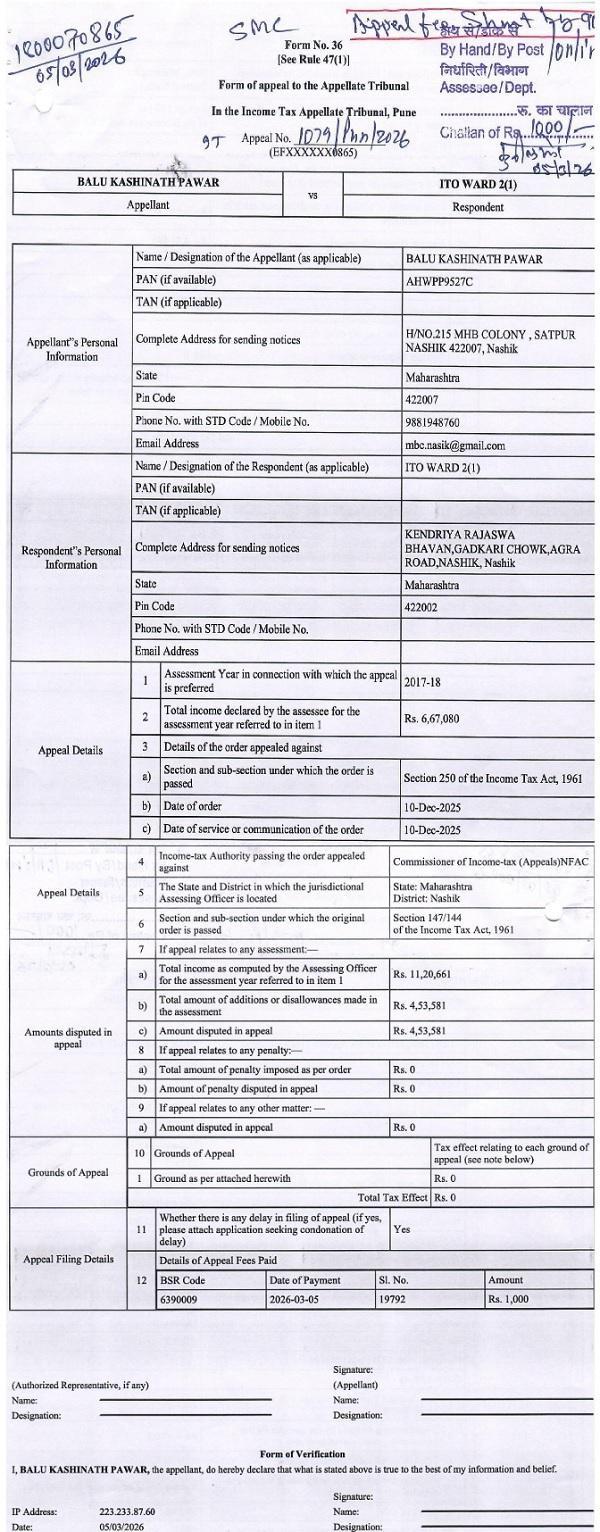
8. The Form No. 36 and Grounds of appeal filed by the assessee are scanned and reproduced here as under :
GROUNDS OF APPEAL
1. The learned Commissioner of Income Tax is not justified in levying demand u/s 156 of Rs. 1,94,215/- on the AO was disallowed the deductions and added back in total income without appreciating that the said levy of demand was not justified in law.
2. The learned Commissioner of Income Tax failed to appreciate that before the Commissioner of Income Tax, the assessee had duly explained that under reporting of income in his case was attributable to wrong action of tax consultant and all the material facts relating thereto along with substantiating evidences in form of complaint filed against Tax Consultant before Economic Wing of Police Department etc. were also furnished by the assessee and therefore, the levy of demand u/s 156 without rebutting the explanation offered by the assessee was not justified in view of provisions of the said Act.
3. The learned Commissioner of Income Tax ought to have appreciated that the bona fides of the explanation offered by assessee were established from the fact that the assessee, being salaried employee from technical background, was totally dependent upon the tax consultant for filing income tax return and therefore, the levy of demand u/s 156 was not justified in view of the explanation offered by the assessee.
9. Thus, it can be observed that Form No. 36 does not contain any signature of the appellant. The email id mentioned in Form No. 36 is of some Tax Practitioner i.e. [email protected]. The grounds of appeal are also unsigned. The Registry of ITAT, Pune had issued defect memo to the assessee but the assessee failed to comply the same. The assessee had not paid the proper appeal fee. It is mandatory to file Form No. 36 duly verified. The signature of the appellant on Form No. 36 is mandatory. Similarly, the signature of the appellant on grounds of appeal is mandatory. In this case, neither Form No. 36 nor grounds of appeal contained signature of the appellant. We have already mentioned that email id on Form No. 36 is of the Tax Practitioner. In these facts, there is no means to verify that Mr. Balu Kashinath Pawar has actually filed this appeal.
We have already produced the background that there have been fraudulent claims and the Tax Practitioner Mr. Patil was involved. Therefore, there is no evidence on record to establish that this particular appeal has been actually filed by Mr. Balu Kashinath Pawar. Not signing Form No. 36 and grounds of appeal makes appeal non-maintainable.
Accordingly, appeal in ITA No. 1079/PUN/2026 for AY 2017-18 is dismissed as non-maintainable. We find support from the following decisions:
i. Akar Auto Industries Limited Vs. ACIT, ITA Nos. 1056 & 1057/MUM/2025, order dated 08.08.2025;
ii. Shivjyoti Sahakari Patpedhi Maryadit Vs. ITO, ITA No. 6930/MUM/2014, order dated 08.10.2015 and
iii. Maruthi Constructions Vs. ITO, ITA No. 91/Hyd/2025, order dated 09.04.2025.
10. Similarly, in ITA No. 1083/PUN/2026 for AY 2018-19 also there is no signature in Form No. 36 and grounds of appeal. The same are scanned and reproduced here as under :
GROUNDS OF APPEAL
1. The learned Commissioner of Income Tax is not justified in levying demand u/s 156 of Rs. 1,94,215/- on the AO was disallowed the deductions and added back in total income without appreciating that the said levy of demand was not justified in law.
2. The learned Commissioner of Income Tax failed to appreciate that before the Commissioner of Income Tax, the assessee had duly explained that under reporting of income in his case was attributable to wrong action of tax consultant and all the material facts relating thereto along with substantiating evidences in form of complaint filed against Tax Consultant before Economic Wing of Police Department etc. were also furnished by the assessee and therefore, the levy of demand u/s 156 without rebutting the explanation offered by the assessee was not justified in view of provisions of the said Act.
3. The learned Commissioner of Income Tax ought to have appreciated that the bona fides of the explanation offered by assessee were established from the fact that the assessee, being salaried employee from technical background, was totally dependent upon the tax consultant for filing income tax return and therefore, the levy of demand u/s 156 was not justified in view of the explanation offered by the assessee.
11. Thus, in view of the fact that the issue raised in the appeal in ITA No. 1083/PUN/2026 is identical and are arising from same set of facts, the finding given by us while adjudicating the appeal in ITA No.1079/PUN/2026 would mutatis mutandis apply to the appeal in ITA No. 1083/PUN/2026 as well. Accordingly, appeal in ITA No. 1083/PUN/2026 is dismissed as non-maintainable in the same terms.
12. To sum up, both the appeals of the assessee are dismissed as non-maintainable.
Order pronounced in the open Court on 05th October, 2026