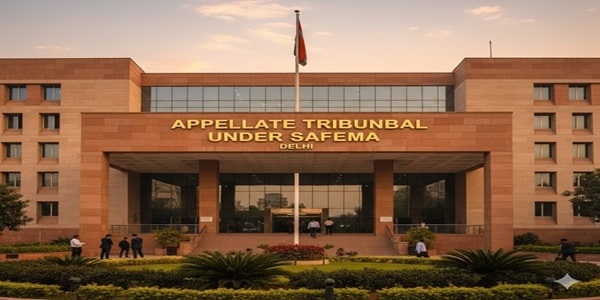
Initiating Officer Vs DCS Infotech Pvt. Ltd. (Appellate Tribunal under SAFEMA, New Delhi)
Interest-Free Loans Are Not Per Se Benami, but Layering of Funds Through a Controlled Company to Acquire Promoters’ Shares Constitutes Benami Transaction: SAFEMA Tribunal
Summary: The Appellate Tribunal under SAFEMA has held that interest-free loans by themselves do not constitute a benami transaction. However, where the alleged borrowing company is controlled by the persons providing the funds, its directors and shareholders are merely name-lenders, and the funds are layered through group concerns to acquire shares for the benefit of those controlling persons, the arrangement would fall within the definition of a benami transaction under Sections 2(9)(A) and 2(9)(C) of the Prohibition of Benami Property Transactions Act, 1988.
The Tribunal set aside the order of the Adjudicating Authority and confirmed the provisional attachment of the shares and other assets. It also granted liberty to the Department to refer the matter to SEBI for investigation into the possible aspect of insider trading.
Facts of the case
The Income-tax Investigation Wing conducted a survey in the case of Deepak Nitrite Ltd. and its associated concerns. During the survey, the books of account and other important documents belonging to M/s DCS Infotech Pvt. Ltd. were found at the business premises of the Deepak Group.
The investigation revealed that DCS Infotech had purchased 46,48,720 shares of Deepak Nitrite Ltd. between FY 2004-05 and FY 2009-10 at a cost of approximately ₹5.47 crore. The market value of those shares had subsequently increased to approximately ₹119.54 crore.
The Initiating Officer alleged that DCS Infotech was not carrying on any substantial independent business and was primarily engaged in holding shares of Deepak Nitrite and routing funds among the entities belonging to the Deepak Group.
The majority shareholder of DCS Infotech, Shri Rohit P. Shah, stated that he was merely a name-lender and had signed documents at the instructions of Shri Chimanlal Mehta and Shri Deepak Mehta. He claimed to have no knowledge of the investments, bank transactions, assets or liabilities of the company.
The directors also stated that the investment decisions were taken on the instructions of Shri Chimanlal Mehta and Shri Deepak Mehta. They were employees of the group concerns and allegedly acted only as nominal directors.
Based on these facts, the Initiating Officer treated DCS Infotech as the benamidar and Shri Chimanlal Mehta and Shri Deepak Mehta as the beneficial owners.
Adjudicating Authority refused to confirm attachment
The Adjudicating Authority held that DCS Infotech had earlier carried on software and allied businesses and had also invested in shares of companies unrelated to the Deepak Group.
It accepted the company’s explanation that the Deepak Nitrite shares were acquired partly from its own profits and partly from genuine loans, which were subsequently repaid. It also observed that the dividends and sale proceeds remained with DCS Infotech and were not directly transferred to the alleged beneficial owners.
Consequently, it held that Sections 2(9)(A) and 2(9)(C) were not applicable and refused to confirm the attachment.
The Initiating Officer challenged this finding before the Tribunal.
Interest-free loan alone does not make a transaction benami
The Tribunal accepted the principle that the mere grant of an interest-free loan or financial assistance cannot automatically make the subsequent acquisition a benami transaction.
A genuine loan retains the character of a borrowing even if it is interest-free or provided by a relative or associated concern. If every acquisition made from borrowed funds were regarded as benami, ordinary commercial and family transactions would also fall within the Act.
However, the Tribunal held that the present case could not be examined merely as an isolated instance of interest-free lending. The entire chain of transactions, control over the company, source and movement of funds, possession of records and the ultimate benefit had to be considered together.
Layering and circular movement of funds established the arrangement
DCS Infotech initially received substantial loans from ETCO Telecom Ltd. Instead of utilising the amount for its own business, it advanced the money interest-free to concerns belonging to the Deepak Group.
Those group concerns subsequently returned the funds to DCS Infotech in different tranches whenever funds were required to acquire shares of Deepak Nitrite. By 2010-11, DCS Infotech had invested approximately ₹5.91 crore in Deepak Nitrite shares and had obtained loans of approximately ₹5.65 crore from Deepak Group companies.
The Tribunal held that the arrangement had to be examined as a continuous chain rather than as separate loan and investment transactions.
The expression used in Section 2(9)(A) is that consideration must be “provided or paid” by another person. “Provided” is wider than direct payment and includes an indirect allocation or arrangement of financial resources enabling the property to be acquired.
Therefore, routing the money through several group entities did not alter the real source of the funds.
Dummy shareholders and effective control
The Tribunal attached considerable importance to the statements of the shareholders and directors.
The majority shareholder holding about 94.91% of the shares admitted that he had no knowledge of the company’s investments, bank entries or assets and that he signed documents at the instructions of the promoters of the Deepak Group.
The directors were employees of the group companies and stated that decisions relating to DCS Infotech were taken by Shri Chimanlal Mehta and Shri Deepak Mehta.
The books of DCS Infotech and even its original share certificates were found at the premises from which the Deepak Group operated. The registered shareholders and directors had not derived any meaningful benefit from the investment, despite the shares appreciating to a value of nearly ₹120 crore.
These circumstances established that the ostensible shareholders had no real control over the company or its assets.
Sections 2(9)(A) and 2(9)(C) both applicable
The Tribunal held that Section 2(9)(A) applied because the consideration for acquiring the shares was provided, directly or indirectly, by the alleged beneficial owners and their group concerns, while the property was held for their immediate or future benefit.
Section 2(9)(C) was also attracted because the ostensible shareholder and directors were unaware of the company’s ownership, investments and assets and acted merely as name-lenders.
The Tribunal therefore set aside the order of the Adjudicating Authority and confirmed the provisional attachment.
2016 machinery provisions can apply retrospectively
The disputed share acquisitions took place before the 2016 amendment to the Benami Act. Relying upon the Supreme Court’s decision in Manjula and Others v. D.A. Srinivas, the Tribunal held that the declaratory, procedural, curative and machinery provisions introduced in 2016 could operate retrospectively or retroactively.
Accordingly, the machinery relating to attachment, adjudication and confiscation could be applied even to earlier transactions. The Tribunal also held that there was no prescribed limitation period preventing initiation of proceedings after ten years.
However, it clarified that penal provisions creating new offences or enhancing punishment cannot be applied retrospectively. Thus, confiscation proceedings could continue, but retrospective criminal punishment under Chapter VII was impermissible.
Author’s comments
The ruling does not lay down that every loan from a related party results in a benami acquisition. What converted the transaction into a benami arrangement was the combination of fund layering, circular movement of money, complete control by the alleged beneficial owners, dummy shareholders, absence of independent decision-making and denial of knowledge by the ostensible owners.
The decision also substantially changes the defence available in cases involving transactions prior to 01.11.2016. After Manjula, the argument that the amended Benami Act is wholly inapplicable to pre-2016 transactions may no longer protect the property from attachment and confiscation. Nevertheless, the constitutional protection against retrospective penal consequences continues.
The practical principle emerging from the ruling is that the form of a loan will not prevail where the surrounding evidence establishes that the lender actually provided the resources, controlled the holder and remained the real beneficiary of the property.
Cases Discussed
- Manjula and Others v. D.A. Srinivas — 2026, Supreme Court — retrospective/retroactive operation of declaratory, procedural, curative and machinery provisions of the 2016 amendment; penal provisions prospective.
- Union of India v. M/s Ganpati Dealcom Pvt. Ltd. — 2022 Supreme Court decision discussed as having been recalled on review.
- Bengal Immunity Company Limited v. State of Bihar and others — 1955, Supreme Court — mischief rule of statutory construction.
- Shyam Sunder and others v. Ram Kumar and another — 2001, Supreme Court — declaratory legislation and retrospective operation.
- Zile Singh v. State of Haryana and others — 2004, Supreme Court — declaratory/clarificatory amendments and retrospectivity.
- National Agricultural Coop. Mktg. Federation of India Ltd. v. Union of India — 2003, Supreme Court — touchstones for legislative retrospectivity.
- Commissioner of Income Tax I, Ahmedabad v. Gold Coin Health Food Private Limited — 2008, Supreme Court — true nature of an amendment and retrospectivity.
- Commissioner of Income Tax (Central)-I, New Delhi v. Vatika Township Private Limited — 2015, Supreme Court — declaratory or clarificatory statutes may operate retrospectively.
- Indian Performing Rights Society Limited v. Sanjay Dalia and another — 2015, Supreme Court — mischief rule and purposive construction.
- State Bank of India v. V. Ramakrishnan and another — 2018, Supreme Court — clarificatory amendment may operate retrospectively.
- Ghanashyam Mishra and Sons Private Limited v. Edelweiss Asset Reconstruction Company Limited and others — 2021, Supreme Court — amendment supplying an omission or explaining a former statute may relate back.
- Pawan Kumar v. Babulal — 2019, Supreme Court — fiduciary relationship in context of father and children.
- Marcel Martins v. M. Printer — 2012, Supreme Court — scope of fiduciary capacity under the unamended Benami law.
- CBSE v. Aditya Bandopadhyay — 2011, Supreme Court — meaning and characteristics of fiduciary relationship.
- Nexus Feeds Ltd. v. The Assistant Commissioner of Income Tax — Telangana High Court — cited on retrospective application of the amended Benami provisions.
- Niharika Jain w/o Shri Andesh Jain v. Union of India — Rajasthan High Court — cited on retrospective application of the amended Benami provisions.
FULL TEXT OF THE JUDGMENT/ORDER OF APPELLATE TRIBUNAL UNDER SAFEMA, NEW DELHI
Present Appeal u/s 46(1) of Prohibition of Benami Property Transactions Act, 1988 (PBPTA) is filed against the impugned order u/s 26(3) dated 18.03.2020 passed by the Adjudicating Authority in Reference No. 1171/2019, wherein the Ld. Adjudicating Authority has not confirmed the attachment. The details of the properties attached by appellant in Reference No. 1171/2019 are as under:
I. Details of assets of M/s DCS Infotech Pvt. Ltd. attached u/s 24(4)(a)(i) of the PBPTA
| Account ID/ Account Number | Particular of financial institution |
|---|---|
| DP ID: IN 301330 Client ID: 18489633 | Stock Holding Corporation of India Ltd., Vile Parle (East), Mumbai |
| Current A/c No. 11037319354 | SBI, Churchgate Branch, Mumbai (IFSC: SBIN0001821) |
| A/c No.: 11099449438 | SBI, Pune Branch (IFSC: SBIN0000454) |
II. Details of assets of M/s DCS Infotech Pvt. Ltd. attached u/s 24(4)(a)(i) of the PBPTA
| Account ID/ Account Number | Particular of financial institution |
|---|---|
| Scheduled Land including all easements and appurtenances* of land admeasuring 8 Kanal in Kila No. 40/10 and 8 Kanal in Kila No. 39/06 aggregating to 16 Kanal i.e. 2 Acres vide int No. 865 & 867 situated in Village – Bairampur, Sub-Tehsil Sohna, Dist.- Gurugram, Haryana as detailed vide Registration Documents No. 2477/94 | Sub-Registrar, HUDA market Rd., Block B, Sector 56, Gurugram, Haryana 122011 |
| Fixed Deposit with SBI | State Bank of India, Mumbai |
| Share of Yerrowada Investments Limited | Yerrowad Investments Limited 10-B, Bakhtwar, Nariman Point, Mumbai – 400021. |
| A/c No.: 1109944499 | SBI, Pune Branch (IFSC: SBIN0000454), PB No. 6, Collector Office Compound, Pune – 411001. |
Facts of the Case:
2. As per the facts of the case, the Initiating Officer/Deputy Commissioner of Income Tax, BPU-1, Mumbai, received an information from Deputy Director of Income Tax (DDIT) (Investigation) – Unit 3(4), Mumbai dated 22.11.2018 related to benami transactions of M/s. DCS Infotech Pvt. Ltd. (M/s DIPL) (PAN: AABCD0536C) for purchasing 46,48,720 shares of M/s Deepak Nitrite, during the Financial Years from 2004-05 to 2009-10 at initial cost of Rs.5,46,92,058/- and the current market value of these shares is Rs.119,54,18,348/- (as on date of order u/s 24(4) dated 20.02.2019). The Respondent No.1 has not done any other business except focusing on acquisition of shares of the listed entity.
3. During the course of survey u/s 133A of the Income Tax Act, 1961, on 15.11.2018, in the case of M/s Deepak Nitrite Limited, M/s Lalaki Works Private Limited and others at 702 & 703, Terminal Building, Nehru Road, Near Vile Parle Police Station, Vile Parle (E), Mumbai 400099, by the ADIT (Inv.), Unit 3(3), Mumbai, the following confidential and important documents pertaining to M/s DIPL was found at the Vile Parle premises. The books of accounts and other relevant records of M/s DIPL were also maintained at the aforesaid address. Share certificates of M/s DIPL in the name of Sh. Rohit P. Shah, Sh. Digant K Mehta and Sh. Ketan Kapasi was also found at the aforesaid address.
4. On further enquiry, it was found that the company M/s DCS Infotech Private Limited is registered on the residential address of Shri Digant K. Mehta i.e. at Flat no. B-601, Anamika Avenue CHS Ltd., Mahavir Nagar, Dahanukar Wadi, Kandivali (West), Mumbai, who is one of the director and shareholder of the company, whereas the books of account were maintained at 702 & 703, Terminal Building, Nehru Road, Near Vile Parle Police Station, Vile Parle (E), Mumbai 400099.
5. M/s DIPL is a closely held private limited company. The company was incorporated on 31.03.1989 and presently registered at Flat no. B- 601, Anamika Avenue CHS Ltd. Mahavir Nagar, Dahanukar Wadi, Kandivali (West), Mumbai. The shareholders of M/s DIPL are as under:
| i. Shri Rohit P Shah | 94.91% |
| ii. Shri Digant Kantilal Mehta | 4.99%
|
| iii. Shri Ketan D Kapasi | 0.10% |
The Directors of the company are as under:
i. Shri Digant Kantilal Mehta
ii. Shri Dharmendra Jaswantray Mehta
6. On further enquiry, it was found that M/s DIPL had purchased total No. of 46,48,720 shares of M/s Deepak Nitrite Limited from FY 2004-2005 to 2009-10 at the investment cost was Rs. 5,46,92,058/-. During the course of survey action, it emanated that M/s. DIPL is managed and controlled by his associate concerns and Deepak Nitrite Ltd. Shareholders of M/s DIPL were not having any knowledge of the investment made by the company in Deepak Nitrite Ltd. and one of the shareholder Shri Rohit P Shah is a relative of Shri Chimanlal Khimchand Mehta & Shri Deepak C. Mehta and the other shareholder Shri Digant K Mehta are employees of Deepak Group of Companies.
7. The salient points which emerged from the Income Tax Returns (ITR) profiling of M/s DIPL are as under:
a. The contact e-mail ID i.e. [email protected] of the benamidar M/s DIPL is same as that of various companies of Deepak Group.
b. The address of M/s DIPL as provided in its ITRs is Flat No. B- 601, Anamika Avenue CHS Ltd. Mahavir Nagar, Dhanukar Wadi, Kandiwali (West), Mumbai which is the residential address of Shri Digant Mehta, who is a serving employee of Deepak Group.
c. The company does not have any running business except investing in Shares, mainly of Deepak Nitrite Ltd. It appears that the company has been in existence exclusively to hold the shares of Deepak Nitrite Ltd. The only source of income for the company is dividend income of shareholdings, mainly of Deepak Nitrite Ltd., and interest income from Bank deposits. The same are not being passed on to the shareholders.
8. Shri Rohit P Shah in his sworn statement recorded under oath u/s 131 of IT Act, 1961 on 16.11.2018 has submitted as under:
a. He is a 60-year-old person. He is an equity investor and is presently the Director of M/s Robust Marketing Services Private Limited and M/s Mahadhan Investments & Finance Pvt. Ltd.
b. Though his name is mentioned as a 94.91% shareholder of M/s DIPL, he is only a name lender, who signs the documents pertaining to M/s DIPL. Other than signing the documents, he is not aware of any activity as well as transactions pertaining to M/s DIPL.
c. Shri Digant Mehta and Shri Dharamendra Mehta are employees of Deepak Group of Companies and he has not appointed them as director of M/s DIPL.
d. He is not aware of any business activity of M/s DIPL and he is also not aware where the books of account are maintained and also does not know anything about the assets and liabilities of M/s DIPL.
e. Shri C.K. Mehta is his maternal uncle and Shri Deepak C. Mehta is his cousin brother and that all the papers pertaining to M/s DIPL were signed by him at their instance.
f. M/s DIPL has made investment in 46,48,720 shares of Deepak Nitrite amounting to Rs. 5,46,92,058/-. However, he has no knowledge about the investment made and he has been signing the papers at the instance of Shri Deepak C. Mehta without knowing the fact or purposes pertaining to the investment made.
g. He is not aware of the credit entries in the bank account of M/s DIPL in account no. 11037319354 of SBI Churchgate Branch wherein there is a credit entry of Rs. 1,49,66,045/- on 21st March, 2017 and credit of Rs. 2,34,45,009/- on 22nd March 2017.
h. He is not a beneficiary of the sale proceeds received from the sale of shares of Deepak Nitrite on 21st March 2017 and 22nd March 2017, as he has not paid anything for the purchase of these shares.
i. He did not get any benefit from M/s DIPL and that all the affairs of the company were controlled and managed by Deepak Group of Companies.
j. All the events right from the beginning of becoming a shareholder in M/s DIPL, all business activities and decisions are carried out on the basis of direction given by Shri Deepak C. Mehta. He has no role in buying shares, selling shares, making investments out of capital, appointing directors, etc. The purchase of Deepak Nitrite shares were done from the funds arranged by Shri Deepak Mehta. Further, he also revealed that he did not benefit from the sale proceeds received from the sale of shares of Deepak Nitrite.
9. Shri Digant K. Mehta in his sworn statement recorded on oath u/s 131 of IT Act, 1961 on 16.11.2018 has submitted as under:
a. He is the shareholder (4.99%) and Director of M/s DIPL.
b. He is Manager – Accounts of M/s Storewell Credits and Capital Pvt. Ltd. and M/s Sofotel Infra Pvt. Ltd. and he is also looking after the overall accounting and legal obligations of the
companies controlled by Shri Chimanlal Khimchand Mehta & Shri Deepak C. Mehta and their family members.
c. M/s DIPL is having its registered address at Flat No. B601, Anamika Avenue CHS Ltd. Mahavir Nagar, Dahanukar Wadi, Kandivali (West), Mumbai – 400 067, which is also his residence.
d. 702 & 703, Terminal Building, Nehru Road, Near Vile Parle Police Station, Vile Parle (E), Mumbai 400 099 is the address from where the concerns of Shri Chimanlal Khimchand Mehta & Shri Deepak C. Mehta and their family members are operating. The list of companies operating out of this premise are as under:
-
- M/s Stiffen Credits & Capital Pvt. Ltd.
- M/s Stigma Credits & Capital Pvt. Ltd.
- M/s Stepup Credits & Capital Pvt. Ltd.
- M/s Checkpoint Credits & Capital Pvt. Ltd.
- M/s HardikLeafin Pvt. Ltd.
- M/s PranawaLeafin Pvt. Ltd.
- M/s ForexLeafin Pvt. Ltd.
- M/s SkyroseFinvest Pvt. Ltd.
- M/s Sundown Finvest Pvt. Ltd.
- M/s Voidcoin Softwar Pvt. Ltd.
- M/s Storewell Credits & Capital Pvt. Ltd.
- Kanwant Development Corporation
- Deepak Medical Foundation
- M/s The Lakaki Works Pvt. Ltd.
e. All the records of M/s DIPL are maintained at 702 & 703, Terminal Building, Nehru Road, Near Vile Parle Police Station, Vile Parle (E), Mumbai 400 099, from where the concerns of Shri Chimanlal Khimchand Mehta, Shri Deepak C. Mehta and their group companies are also operating, and not at the registered address of M/s DIPL i.e. at Kandivili (West), Mumbai.
f. The Directors (Dharmendra Mehta and himself) of the M/s DIPL take decision regarding investment done by the company only on the directions of Shri Chimanlal Khimchand Mehta & Shri Deepak C. Mehta.
g. The main investment made by M/s DIPL were in respect of 46,48,720 shares of M/s Deepak Nitrite Limited purchased from FY 2004-05 to 2009-10 at an initial cost of Rs. 5,46,92,058/- and the current market value of these shares is Rs. 119,54,18,348/-.
h. He is not aware that M/s DIPL had sold 3,50,000 shares for Rs. 4,10,31,453/- from 16.03.2017 to 21.03.2017.
10. Shri Dharmendra Mehta in his sworn statement recorded in his oath u/s 131 of IT Act, 1961 on 1611.2018 has submitted as under:
a. He is working as a Senior Account Executive in M/s Sofotel Infra Pvt. Ltd., an entity controlled by Shri Chimanlal Khimchand Mehta and Shri Deepak C. Mehta, as well as maintaining accounts of some of the Group companies of Shri Deepak C. Mehta.
b. He is a Director in M/s DIPL and M/s Whitehall Commercial Co. Pvt. Ltd. (an entity controlled by Shri Chimanlal Khimchand Mehta and Shri Deepak C. Mehta).
c. He is not receiving any director sitting fee/salary/any financial benefit for acting as Director of M/s DIPL.
d. All the decision with respect to M/s DIPL are taken by Shri Chimanlal Khimchand Mehta & Shri Deepak C. Mehta.
e. He is signing on the papers on the directions of Shri Chimanlal Khimchand Mehta & Shri Deepak C. Mehta.
11. On the basis of above deposition and facts, it was concluded by IO that the above scheme of transactions was designed by Shri Chimanlal Khimchand Mehta, Shri Deepak C. Mehta who were/are the alter ego of M/s DIPL in view of the following:
a. The funds for the investment in purchase of shares of M/s Deepak Nitrite Ltd. were channelized in the form of loans from Deepak Group of Companies i.e. M/s HardikLeafin Pvt. Ltd., M/s Sundown Finvest Pvt. Ltd. and M/s Sofotel Infra Pvt. Ltd. The newly formed company had no other source of funds.
b. M/s DIPL is managed & controlled by Shri Chimanlal Khimchand Mehta, Shri Deepak C. Mehta and his associate concerns.
c. Shri Digant Mehta and Shri Dharmendra Mehta are namesake Directors of M/s DIPL and were getting instruction from Shri Chimanlal Khimchand Mehta & Shri Deepak C. Mehta.
d. Shri Digant Mehta and Shri Dharmendra Mehta were working for the Group companies of Shri Deepak C. Mehta and they were receiving income in the form of salaries.
e. Shri Rohit Shah, Shri Digant Mehta and Shri Dharmendra Mehta who are the 100% shareholders of M/s DIPL were not aware of the purchase/sale of shares of M/s Deepak Nitrite Ltd.
f. Shri Rohit Shah, Shri Digant Mehta and Shri Dharmendra Mehta never received the proceeds/benefit from the sale of shares of Deepak Nitrite Ltd.
g. Shri Rohit Shah, Shri Digant Mehta and Shri Dharmendra Mehta are mere dummy persons signing the papers on the instructions of Shri Chimanlal Khimchand Mehta & Shri Deepak C. Mehta.
12. In view of the above, the transaction of investment in 46,48,720 shares of Deepak Nitrite Ltd. by M/s DIPL from FY 2004-05 to 2009-10 as discussed above, was satisfying the conditions of being a Benami Transaction as per section 2(9)(A) and 2(9)(C) of the PBPTA, 1988. In view of the above discussion, the Initiating Officer had reason to believe that a clear case of Benami Transaction was made out against M/s DIPL being the benamidar and Shri Chimanlal Khimchand Mehta, Shri Deepak C. Mehta and Deepak Nitrite Ltd. being the beneficiaries with regard to investment of 46,48,720 shares of M/s Deepak Nitrite Ltd. and its proceeds thereof. Therefore, Show Cause Notice (SCN) u/s 24(1) of the PBPTA, 1988 dated 28.11.2018 was issued to the benamidar and the Beneficial Owners and was duly served upon them. Thereafter, Provisional Attachment Order u/s 24(3) of PBPTA was passed on 29.11.2018 by the Initiating Officer.
13. During the proceedings u/s 24(4) of the PBPTA, 1988, the SCN and the PAO was duly served on the Benamidar and the Beneficial Owners. Since, no reply was filed by the Benamidar, vide letter dated 18.01.2019, the Benamidar was given a final opportunity to reply to the SCN by 25.01.2019. Further, along with the letter, the Benamidar was provided with the copies of the statements of Shri Digant K. Mehta, Shri Dharmendra Mehta and Shri Rohit P Shah, which were recorded u/s 131 of the Income Tax Act, during the course of search and seizure action in the case of Deepak Nitrite Ltd. In response to the said letter, the Benamidar filed a letter dated 29.01.2019 requesting further time to reply to the SCN.
14. During the proceedings u/s 24(4) of the PBPTA, 1988, summons u/s 19(1) of the PBPTA, 1988 dated 04.02.2019 were issued to various individuals/shareholders/Partners of the benamidar entities by IO, seeking their personal attendance. In response to the said summons, they sought adjournment. Vide letter dated 05.02.2019, a detailed questionnaire seeking various details/information was issued to the Benamidar calling for information u/s 24(1) of the PBPTA, 1988. Further, vide letter dated 07.02.2019, one more opportunity was given to the Benamidar to file its reply in response to the SCN. Vide letter dated 11.02.2019, the Benamidar filed its reply to the SCN dated 28.11.2018, raising various points.
15. Based on the submissions of the benamidar and the beneficial owners, then I.O. passed a detailed speaking order in the form of Provisional Attachment Order u/s 24(4)(a)(i) of the PBPTA, 1988 dated 20.02.2019, after taking the prior approval of the Approving Authority, till the passing of the order by the Adjudicating Authority u/s 26(3) of the PBPTA, 1988. Thereafter, reference was sent to the Adjudicating Authority vide no. R- 1171/2019 for confirmation of PAO.
16. The Adjudicating Authority, vide impugned order u/s 26(3) of the PBPTA, held as under:
a. The Defendants have shown that it has undertaken business of computer software/hardware, data processing/distribution and marketing of readymade software packages in the field of personnel, inventory and accounts during year 1990-91 to 2000-01.
b. Defendant is investing in shares and having received dividends and profits on sale of shares from the FY 2004-05 to 2017-2018. The profit on sale of shares for the year 2004-05 is indicated as Rs.1,00,80,290 and for the year 2016-17 at Rs.3,66,00,880/-. Defendant has thus made investment in shares of other companies as well and earned considerable profits therefrom, which companies are not related to Deepak Group.
c. In May and August of 2004, Defendant invested in the shares of HOEC worth Rs.78,86,185 and in February 2015 sold the shares at the value of Rs.1,79,66,375. Thus, earning profit on sale of shares at Rs.1,00,80,290.
d. The Defendants have demonstrated that the consideration for purchase of shares of Deepak Nitrite is funded by its own profits and partly from the loans from third party, which loans were repaid. The said details of acquisition from its own funds and from the sourced loan were duly disclosed to the IO, are duly supported by the bank records and the audited balance sheet/returns of income by M/s DIPL from the year 31.04.2004 to 31.03.2011.
| Source | Consideration |
|---|---|
| Total dividend received in DCS from DNL during the period 2004-05 to 2017-18 | 3,83,17,474 |
| Sale of shares of DNL | 3,66,00,880 |
| Total | 7,49,18,354 |
| Cost of acquisition of the DNL share by | 5 ,91,83,138 DCS |
e. It needs to be appreciated that there are and there cannot be any prohibitions or the barring of the loan transaction absolutely. The character of the loans indicated by DCS, besides the utilization of its own funds, cannot be equated to be loans which are not repayable. In fact, the loans are repaid. The contentions of the Defendants that the funds for purchase of shares have not been provided or paid by D-2 and D-3 deserves an acceptance.
f. Shri Digant K. Mehta in his statement had also emphasized that the investment made by DCS is by Company itself and is an old investment.
g. One of the circumstances pointed by the Defendant is pertaining to the earning and utilization from the shares so invested.
I.O. has not adduced any evidence which indicates that the benefits arising therefrom have been transferred or passed on to the beneficial owners.
h. The applicability by the I.O. of the provisions of 2(9)(c) is also improper, unsubstantiated and not acceptable, which declares a transaction or arrangement in respect of the property is not aware of or, denies knowledge of, such ownership. D-1 has been receiving and utilizing the benefits arising from such an investment from share and hence it cannot be accepted that it was not aware of or had denied knowledge of such ownership.
i. The Defendants have elaborately dealt with the contentions and findings of the I.O. in order u/s 24(4) of PBPTA. We have gone through the said submissions and find the same to have dealt with all the contentions, material, observation and findings of the I.O. The said submissions deserve an acceptance.
j. Accordingly, it was held that the provisions of Section 2(9)(A) and Section 2(9)(C) of the PBPTA are not applicable. Aggrieved by the said order, Appellant DCIT filed the present appeal.
17. During the final arguments, Ld. counsel for the appellant DCIT, BPU, Mumbai, reiterated the submissions, as mentioned in the grounds of appeal and respondents reiterated the submissions as mentioned in their respective replies, which will be highlighted during our discussion in the following paras. After hearing the rival submissions, the following issues emerge for decision:-
i) Whether application for impleadment of LRs of Sh. Chimanlal Khimchand Mehta needs to be dismissed on the ground that they do not claim any shares in M/s Deepak Nitrite Ltd. or any other assets held by M/s DCS Infotech and also that they were not bequeathed by their father with any such shares?
ii) Whether the Amended provisions of PBPT Act cannot be applied retrospectively?
iii) Whether the present proceedings are without jurisdiction as there is a delay of more than 10 years in the proceedings initiated by the IO?
iv) Whether the taking of interest free loans by DCS Infotech to other group entities of Sh. Chimanlal Khimchand Mehta and Sh. Deepak C. Mehta giving rise to apprehension of benami transaction reducing the role of M/s DCS infotech to that of a mere proxy?
v) Whether there exists a benami transaction? if yes, whether it falls under Section 2(9) A or under Section 2(9)C of the PBPT Act? Now, we will decide the above issues in the following paras.
Issue-wise Findings
i) Whether application for impleadment of LRs of Sh. Chimanlal Khimchand Mehta needs to be dismissed on the ground that they do not claim any shares in M/s Deepak Nitrite Ltd. or any other assets held by M/s DCS Infotech and also that they were not bequeathed by their father with any such shares?
18. Ld. counsel for proposed respondents Sailesh C. Mehta and Ajay C. Mehta (the legal heirs of respondent no.2, Shri Chimanlal C. Mehta) submitted that they had already objected the application for impleading/ substituting them as legal heirs of their father late Shri Chimanlal K. Mehta vide letter filed before this Tribunal on 13.01.2025, wherein they have explained that the present proceedings are in respect of shares of Deepak Nitrite Ltd. held by M/s DCS Infotech Pvt. Ltd. and that they have nothing to do with the shares of Deepak Nitrite Ltd. or any other assets held by M/s DCS Infotech and that they were also not bequeathed by his father with any such shares of Deepak Nitrite Ltd. or any assets of M/s DCS Infotech Pvt. Ltd., and thus they have objected to impleading their name in the present proceedings and the application was also allowed by the Tribunal vide order dated 17.01.2025. The counsel has further argued that they tend to rely upon and refer to the submissions filed by their brother Shri Deepak C. Mehta and their father Shri Chimanlal K. Mehta.
19. However, the fact that LRs of Sh. Chimanlal Khimchand Mehta are not claiming any shares in M/s Deepak Nitrite Ltd. or any other assets held by M/s DCS Infotech and/or they were not bequeathed by their late father with any such shares, is no ground to dismiss the application for their impleadment as LRs., as the issue regarding benami transaction will be decided on its own merit irrespective of application for their impleadment as LRs. The filing of this application filed by appellant DCIT does not give rise to any inference regarding their involvement in the alleged benami transaction. Hence, this application for impleadment is hereby allowed without any prejudice on the merits of the case.
ii) Whether the Amended provisions of PBPT Act cannot be applied retrospectively?
20. On this issue, the Ld. counsel for appellant submitted that the issue regarding retrospective application is still pending before the Hon’ble Supreme Court of India, in UOI v. M/s Ganpati Dealcom Pvt Ltd. as previous judgment dated 23.08.2022, passed in in Civil Appeal No 5783 of 2022, is already recalled vide Order dated 18.10.2024, in Review Petition (Civil) No 359 of 2023. Prayer is accordingly made that this issue may be kept open till final decision in the aforesaid case.
21. On the other hand, the Ld. counsel for the respondents submitted that this issue is already decided by the Hon’ble Supreme Court of India and various High Courts, wherein it is specifically held that the amended provisions of PBPT Act cannot be applied retrospectively. Ld. counsel for the Respondents contended that the PAO has been passed by applying the amended provisions retrospectively, as the provisions of the sections of the PBPT Act have been brought into effect from 01.11.2016, which have penal and criminal consequences, which is against the principles laid down in Article 20(1) of the Constitution of India. The IO has thus erred in using this amended definition to a transaction that took place much before 2016. Further, the property in question was acquired much prior to the Notification dated 25.10.2016 to make amendment in the Act of 1988 and in view of the same, the present case is covered by the judgment in the case of Union of India v. M/s Ganpati Dealcom Pvt. Ltd. (2022) 447 ITR 108 (SC). Even though the judgment has been recalled and fresh adjudication has been pending, nothing contrary can be presumed pending fresh adjudication of the issue and the decision rendered by Hon’ble Supreme Court cannot be ignored. Also, he contended that till the issue is finally decided by the Hon’ble Supreme Court, the decision of Hon’ble High Courts would remain in effect, thus the judgements of various High Courts would persist wherein it has been held that the 2016 provisions cannot be applied retrospectively.
A. Hon’ble Telangana High Court in the case of Nexus Feeds Ltd. v. The Assistant Commissioner of Income Tax in Writ Petition no. 14695 of 2021.
B. Hon’ble Rajasthan High Court in the case of Niharika Jain w/o Shri Andesh Jain v. Union of India in S.B. Civil Writ Petition no. 2915/2019.
In support of his contention, the Ld. counsel for the respondent also relied upon following judgments of different Hon’ble High Courts, as under:-
1. Joseph Isharat v. Rozy Nishikant Gaikwad 2017 SCC Online Bom 10006 (page 2,3 at para 4)
2. Vasanthi Shridhar Bangera and Ors v. Vishala Bokapatna Laxman 2019 SCC Online Bom 2395 (page 11, 15 to 17 para 18,40 to 50)
3. Rajesh Katyal v. Income Tax Department 2023 451 ITR 455 (page 21,22 para 6,7)
4. Ganpati Dealcom v. Union of India 2019 SCC Online Cal 8679 (page 26 to 28 para 9 to 12)
5. Maxworth Orchards v. B. Ravi Babu 2023 SCC Online Mad 5595 (page 39 to 44 para 15 to 30)
6. Mangathai Ammal (Dead) Rajeshwari and Ors. 2020 (17) SCC 496 (page 121 para 11).
22. After hearing the rival submissions on this issue, we are of the view that the Hon’ble Supreme Court of India has recently settled the position regarding this issue in the case of Manjula and Others v. D.A. Srinivas CIVIL APPEAL NO. 7370 OF 2026 [Arising out of SLP (C) No. 7924 of 2024], wherein it was held that the amendment can be applied retrospectively, being directory or explanatory in nature. The relevant paras of the said judgment are reproduced as under :-
“(E) PROSPECTIVE OR RETROSPECTIVE OPERATION OF THE 2016
AMENDMENT
22. The next question that falls for consideration is, whether the amended provisions operate prospectively or retrospectively. In this regard, it is necessary to recall the object and reasons underlying the amendment, which can be gathered from the statements made when the amendments were proposed in Parliament. The amendments as is evident, were introduced to cure the mischiefs and omissions in the original enactment, which had failed to curb benami transactions in the manner expected, and effective steps could not be taken for want of adequate procedural provisions.
22.1. It is also noteworthy that certain provisions under the unamended Act were omitted and substituted by new provisions, while several fresh provisions were inserted prescribing the procedure to be followed before confiscation of property and establishing mechanisms of appeal against orders declaring property as benami. At the same time, the foundational provisions prohibiting benami transactions, rendering them offences, extinguishing the right to enforce or defend claims based on benami arrangements, enabling confiscation of benami property, and prohibiting re-transfer, continued substantially in force.
22.2. Ordinarily, every statute is presumed to be prospective unless the statute itself expressly or by necessary implication provides otherwise. Equally, it is well settled that the mere fact that a law is brought into force from a particular date does not necessarily mean that it operates only prospectively. To determine the true temporal operation of a statute, the object of the enactment must be considered. If the purpose of the amendment is to cure a defect, remove an omission, substitute appropriate provisions earlier lacking, effectively implement the original legislative intent, or if the amendment is clarificatory, declaratory or validating in nature, it may legitimately receive retrospective operation.
22.3. It is also apposite to observe that protection against retrospectivity generally extends only to vested or accrued rights. The Act of 1988 had already prohibited benami transactions. Even prior thereto, provisions under the Indian Trusts Act, the Code of Civil Procedure and the Income-tax Act imposed restrictions on such arrangements. Further, after the Forty-Fourth Constitutional Amendment, the right to property ceased to be a fundamental right and remained only a constitutional right. A person, therefore, cannot claim a vested right to enter into transactions designed to defeat or circumvent the law. It is a settled principle that what cannot be done directly cannot be permitted to be done indirectly.
22.4. In this context, it would be useful to refer to the settled principles laid down in Bengal Immunity Company Limited v. State of Bihar and others (1955) 1 SCC 763 wherein the rule in Heydon case MANU/ENRP/0018/1584 : (1584) 3 Co Rep 7a: 76 ER 637 was approved, namely, that the Court must adopt such construction as suppresses the mischief and advances the remedy. The relevant paragraph reads as follows:
“27. It is a sound rule of construction of a statute firmly established in England as far back as 1584 when Heydon case [Heydon case, MANU/ENRP/0018/1584 : (1584) 3 Co Rep 7a: 76 ER 637] was decided that— “…for the sure and true interpretation of all statutes in general (be they penal or beneficial, restrictive or enlarging of the common law) four things are to be discerned and considered— 1st. What was the common law before the making of the Act. 2nd. What was the mischief and defect for which the common law did not provide. 3rd. What remedy Parliament hath resolved and appointed to cure the disease of the Commonwealth, and 4th. The true reason of the remedy; and then the office of all the Judges is always to make such construction as shall suppress the mischief, and advance the remedy, and to suppress subtle inventions and evasions for continuance of the mischief, and pro privato commodo, and to add force and life to the cure and remedy, according to the true intent of the makers of the Act, pro bono publico.”
22.5. The Constitution Bench in Shyam Sunder and others v. Ram Kumar and another (2001) 8 SCC 24 held that where an enactment declares or explains the previous law, such declaratory legislation ordinarily operates retrospectively, since its purpose is to remove omissions or clarify the earlier statute. The following paragraph is apposite: (SCC p. 49, para 39)
“39.… Ordinarily when an enactment declares the previous law, it requires to be given retroactive effect. The function of a declaratory statute is to supply an omission or to explain a previous statute and when such an Act is passed, it comes into effect when the previous enactment was passed. The legislative power to enact law includes the power to declare what was the previous law and when such a declaratory Act is passed, invariably it has been held to be retrospective. Mere absence of use of the word “declaration” in an Act explaining what was the law before may not appear to be a declaratory Act but if the court finds an Act as declaratory or explanatory, it has to be construed as retrospective…”
22.6. In Zile Singh v. State of Haryana and others (2004) 8 SCC 1 it was reiterated that while statutes are generally prospective, the presumption against retrospectivity does not apply to declaratory or clarificatory enactments. If an amendment is introduced to cure an acknowledged evil, explain the prior law, or supply an obvious omission, retrospective operation may be inferred from legislative intent. The following paragraphs are pertinent: (SCC pp. 8-9, paras 13-15)
“13. It is a cardinal principle of construction that every statute is prima facie prospective unless it is expressly or by necessary implication made to have a retrospective operation. But the rule in general is applicable where the object of the statute is to affect vested rights or to impose new burdens or to impair existing obligations. Unless there are words in the statute sufficient to show the intention of the legislature to affect existing rights, it is deemed to be prospective only–‘nova constitutio futuris formam imponere debet non praeteritis’–a new law ought to regulate what is to follow, not the past. (See Principles of Statutory Interpretation by Justice G.P. Singh, 9th Edn., 2004 at p. 438.) It is not necessary that an express provision be made to make a statute retrospective and the presumption against retrospectivity may be rebutted by necessary implication especially in a case where the new law is made to cure an acknowledged evil for the benefit of the community as a whole (ibid., p. 440).
14. The presumption against retrospective operation is not applicable to declaratory statutes… In determining, therefore, the nature of the Act, regard must be had to the substance rather than to the form. If a new Act is ‘to explain’ an earlier Act, it would be without object unless construed retrospectively. An explanatory Act is generally passed to supply an obvious omission or to clear up doubts as to the meaning of the previous Act. It is well settled that if a statute is curative or merely declaratory of the previous law retrospective operation is generally intended… An amending Act may be purely declaratory to clear a meaning of a provision of the principal Act which was already implicit. A clarificatory amendment of this nature will have retrospective effect (ibid., pp. 468-69).
15. Though retrospectivity is not to be presumed and rather there is presumption against retrospectivity, according to Craies (Statute Law, 7th Edn.), it is open for the legislature to enact laws having retrospective operation. This can be achieved by express enactment or by necessary implication from the language employed. If it is a necessary implication from the language employed that the legislature intended a particular section to have a retrospective operation, the courts will give it such an operation. In the absence of a retrospective operation having been expressly given, the courts may be called upon to construe the provisions and answer the question whether the legislature had sufficiently expressed that intention giving the statute retrospectivity. Four factors are suggested as relevant: (i) general scope and purview of the statute; (ii) the remedy sought to be applied; (iii) the former state of the law; and (iv) what it was the legislature contemplated. (p. 388) The rule against retrospectivity does not extend to protect from the effect of a repeal, a privilege which did not amount to accrued right. (p. 392)
16. Where a statute is passed for the purpose of supplying an obvious omission in a former statute or to “explain” a former statute, the subsequent statute has relation back to the time when the prior Act was passed. The rule against retrospectivity is inapplicable to such legislations as are explanatory and declaratory in nature. A classic illustration is the case of Attorney General v. Pougett [Attorney General v. Pougett, MANU/ENRP/ 0454/1816 : (1816) 2 Price 381 : 146 ER 130] (Price at p. 392). By a Customs Act of 1873 (53 Geo. 3, c. 33) a duty was imposed upon hides of 9s 4d, but the Act omitted to state that it was to be 9s 4d per cwt., and to remedy this omission another Customs Act (53 Geo. 3, c. 105) was passed later in the same year. Between the passing of these two Acts some hides were exported, and it was contended that they were not liable to pay the duty of 9s 4d per cwt., but Thomson, C.B., in giving judgment for the Attorney General, said: (ER p. 134) ‘The duty in this instance was, in fact, imposed by the first Act; but the gross mistake of the omission of the weight, for which the sum expressed was to have been payable, occasioned the amendment made by the subsequent Act: but that had reference to the former statute as soon as it passed, and they must be taken together as if they were one and the same Act;’ (Price at p. 392)
17. Maxwell states in his work on Interpretation of Statutes (12th Edn.) that the rule against retrospective operation is a presumption only, and as such it ‘may be overcome, not only by express words in the Act but also by circumstances sufficiently strong to displace it’ (p. 225). If the dominant intention of the legislature can be clearly and doubtlessly spelt out, the inhibition contained in the rule against perpetuity becomes of doubtful applicability as the “inhibition of the rule” is a matter of degree which would “vary secundum materiam” (p.226). Sometimes, where the sense of the statute demands it or where there has been an obvious mistake in drafting, a court will be prepared to substitute another word or phrase for that which actually appears in the text of the Act (p. 231).
18. In a recent decision of this Court in National Agricultural Coop. Mktg. Federation of India Ltd. v. Union of India [MANU/SC/0243/2003 : (2003) 5 SCC 23] it has been held that there is no fixed formula for the expression of legislative intent to give retrospectivity to an enactment. Every legislation whether prospective or retrospective has to be subjected to the question of legislative competence. The retrospectivity is liable to be decided on a few touchstones such as: (i) the words used must expressly provide or clearly imply retrospective operation; (ii) the retrospectivity must be reasonable and not excessive or harsh, otherwise it runs the risk of being struck down as unconstitutional; (iii) where the legislation is introduced to overcome a judicial decision, the power cannot be used to subvert the decision without removing the statutory basis of the decision. There is no fixed formula for the expression of legislative intent to give retrospectivity to an enactment. A validating clause coupled with a substantive statutory change is only one of the methods to leave actions unsustainable under the unamended statute, undisturbed. Consequently, the absence of a validating clause would not by itself affect the retrospective operation of the statutory provision, if such retrospectivity is otherwise apparent.”
22.7. In Commissioner of Income Tax I, Ahmedabad v. Gold Coin Health Food Private Limited, (2008) 9 SCC 622 this Court held that the Court must analyse the true nature of the amendment. The date from which it is brought into force is not conclusive; what is material is whether the amendment is clarificatory or substantive. The following paragraphs are pertinent:
“8. It would be of some relevance to take note of what this Court said in Virtual case [MANU/SC/0879/2007 : (2007) 9 SCC 665]. Pointing out one of the important tests at para 51 it was observed that even if the statute does contain a statement to the effect that the amendment is clarificatory or declaratory, that is not the end of the matter. The court has to analyse the nature of the amendment to come to a conclusion whether it is in reality a clarificatory or declaratory provision. Therefore, the date from which the amendment is made operative does not conclusively decide the question. The court has to examine the scheme of the statute prior to the amendment and subsequent to the amendment to determine whether amendment is clarificatory or substantive.”
“18. As noted by this Court in CIT v. Podar Cement (P) Ltd. [MANU/SC/0649/1997 : (1997) 5 SCC 482] the circumstances under which the amendment was brought in existence and the consequences of the amendment will have to be taken care of while deciding the issue as to whether the amendment was clarificatory or substantive in nature and, whether it will have retrospective effect or it was not so.”
22.8. In Commissioner of Income Tax (Central) -I, New Delhi v. Vatika Township Private Limited (2015) 1 SCC 1 this Court recognised that declaratory or clarificatory statutes may operate retrospectively, particularly when introduced to explain the meaning of an earlier enactment or remove doubts as to its effect. The following paragraph is pertinent: (SCC p. 23, para 32)
“32. ….The circumstances under which provisions can be termed as “declaratory statutes” are explained by Justice G.P. Singh [Principles of Statutory Interpretation, (13th Edn., Lexis Nexis Butterworths Wadhwa, Nagpur, 2012)] in the following manner:
‘Declaratory statutes The presumption against retrospective operation is not applicable to declaratory statutes. As stated in Craies [W.F. Craies, Craies on Statute Law (7th Edn., Sweet and Maxwell Ltd., 1971)] and approved by the Supreme Court (in Central Bank of India v. Workmen [Central Bank of India v. Workmen, MANU/SC/0142/1959 : AIR 1960 SC 12, p. 27, para 29]):”For modern purposes a declaratory Act may be defined as an Act to remove doubts existing as to the common law, or the meaning or effect of any statute. Such Acts are usually held to be retrospective. The usual reason for passing a declaratory Act is to set aside what Parliament deems to have been a judicial error, whether in the statement of the common law or in the interpretation of statutes. Usually, if not invariably, such an Act contains a Preamble, and also the word “declared” as well as the word “enacted”.” But the use of the words “it is declared” is not conclusive that the Act is declaratory for these words may, at times, be used to introduced new rules of law and the Act in the latter case will only be amending the law and will not necessarily be retrospective. In determining, therefore, the nature of the Act, regard must be had to the substance rather than to the form. If a new Act is “to explain” an earlier Act, it would be without object unless construed retrospective. An explanatory Act is generally passed to supply an obvious omission or to clear up doubts as to the meaning of the previous Act. It is well settled that if a statute is curative or merely declaratory of the previous law retrospective operation is generally intended. The language “shall be deemed always to have meant” is declaratory, and is in plain terms retrospective. In the absence of clear words indicating that the amending Act is declaratory, it would not be so construed when the preamended provision was clear and unambiguous. An amending Act may be purely clarificatory to clear a meaning of a provision of the principal Act which was already implicit. A clarificatory amendment of this nature will have retrospective effect and, therefore, if the principal Act was existing law which the Constitution came into force, the amending Act also will be part of the existing law.’ The above summing up is factually based on the judgments of this Court as well as English decisions.”
22.9. In Indian Performing Rights Society Limited v. Sanjay Dalia and another (2015) 10 SCC 161 : (2016) 1 SCC (Civ) 55, this Court reaffirmed the mischief rule of interpretation, namely, that statutory construction must suppress the mischief sought to be remedied and advance the legislative object. The following paragraph is pertinent:
“24. … It is settled proposition of law that the interpretation of the provisions has to be such which prevents mischief. The said principle was explained in Heydon’s case [MANU/ENRP/0018/1584 : (1584) 3 Co Rep 7a: 76 ER 637]. According to the mischief rule, four points are required to be taken into consideration. While interpreting a statute, the problem or mischief that the statute was designed to remedy should first be identified and then a construction that suppresses the problem and advances the remedy should be adopted. Heydon’s [MANU/ENRP/0018/1584 : (1584) 3 Co Rep 7a: 76 ER 637], mischief rule has been referred to in Interpretation of Statutes by Justice G.P. Singh, 12th Edn., at pp. 124-25 thus: “(b) Rule in Heydon’s case [MANU/ENRP/0018/1584 : (1584) 3 Co Rep 7a: 76 ER 637]; purposive construction: mischief rule When the material words are capable of bearing two or more constructions the most firmly established rule for construction of such words ‘of all statutes in general (be they penal or beneficial, restrictive or enlarging of the common law)’ is the rule laid down in Heydon’s case [MANU/ENRP/0018/1584 : (1584) 3 Co Rep 7a: 76 ER 637] which has now attained the status of a classic (Kanai Lal Sur v. Paramnidhi Sadhukhan [MANU/SC/0097/1957 : AIR 1957 SC 907]). The rule which is also known as “purposive construction” or “mischief rule” (Anderton v. Ryan [MANU/UKHL/0021/1985 : 1985 AC 560: (1985) 2 WLR 968: (1985) 2 All ER 355 (HL)]), enables consideration of four matters in construing an Act: (i) What was the law before the making of the Act; (ii) What was the mischief or defect for which the law did not provide; (iii) What is the remedy that the Act has provided; and (iv) What is the reason of the remedy. The rule then directs that the courts must adopt that construction which “shall suppress the mischief and advance the remedy”. The rule was explained in Bengal Immunity Co. Ltd. v. State of Bihar [MANU/SC/0083/1955 :AIR 1955 SC 661] by S.R. Das, C.J….”
22.10. In State Bank of India v. V. Ramakrishnan and another (2018) 17 SCC 394: (2019) 2 SCC (Civ) 458, this court held that where an amendment is intended to clarify and set at rest an overbroad interpretation of an earlier provision, such amendment is clarificatory and therefore retrospective in nature.
22.11. In Ghanashyam Mishra and Sons Private Limited v. Edelweiss Asset Reconstruction Company Limited and others (2021) 9 SCC 657: 2021) 4 SCC (Civ) 638, this Court reiterated that if the legislature supplies an obvious omission or explains a former statute, the subsequent amendment relates back to the date of the original enactment and may operate retrospectively. The following paragraphs are pertinent:
“89. It could thus be seen that what is material is to ascertain the legislative intent. If legislature by an amendment supplies an obvious omission in a former statute or explains a former statute, the subsequent statute has a relation back to the time when the prior Act was passed.”
“94. We have no hesitation to say that the words “other stakeholders” would squarely cover the Central Government, any State Government or any local authorities. The legislature noticing that on account of obvious omission certain tax authorities were not abiding by the mandate of the I&B Code and continuing with the proceedings, has brought out the 2019 Amendment so as to cure the said mischief. We therefore hold that the 2019 Amendment is declaratory and clarificatory in nature and therefore retrospective in operation.”
22.12. Applying the above principles, it is clear that the 2016 amendments were enacted to cure the mischiefs and omissions in the original legislation, which had become largely unworkable in practice. The legislative intent to make the statute effective is manifest. The prohibition against benami transactions already existed. No period of limitation was prescribed either under the original Act or under the amended Act for initiating action against benami property or against persons involved in such transactions. Action for confiscation or prosecution may therefore be taken whenever the transaction comes to the notice of the competent authorities.
22.13. Further, when a lis comes before a Court disclosing a benami transaction, the Court is duty-bound to consider the applicability of the Act and enforce the statutory prohibition. The amended provisions merely introduced a complete machinery for attachment, adjudication and appeals. Though attachment and adjudication were elaborately structured for the first time, these provisions are essentially procedural and regulatory, intended to ensure fairness and avoid arbitrary action before confiscation. Unless the amendment is given retroactive operation, the very object of making the legislation workable would be defeated.
22.14. The appellate remedies introduced are beneficial safeguards providing checks against arbitrary exercise of power, and beneficial procedural provisions ordinarily operate retrospectively. So far as penal consequences are concerned, enhanced punishment cannot be retrospectively imposed; however, the machinery provisions enabling adjudication, confiscation and enforcement, being curative and procedural, can apply retrospectively.
22.15. Accordingly, we hold that the 2016 amendments, insofar as they are declaratory, procedural, curative and machinery-oriented, operate retrospectively / retroactively, while penal provisions creating new offences or enhancing punishment can operate only prospectively.
Hence, this issue is decided against the respondents and in favour of the appellant in light of the aforesaid judgment by the Hon’ble Supreme Court in case of Manjula and Others v. D.A. Srinivas (supra).
iii) Whether the present proceedings are without jurisdiction as there is a delay of more than 10 years in the proceedings initiated by the IO?
23. The Ld. counsel for the appellant submitted that the issue raised by the Ld. counsel for the respondents is not tenable, as there is no time limit for initiating the proceedings under the PBPT Act. We are satisfied with the contention of the Ld. counsel for the appellant in this regard and this issue is thus decided against the respondents.
iv) Whether the taking of interest free loans by DCS Infotech to other group entities of Sh. Chimanlal Khimchand Mehta and Sh. Deepak C. Mehta giving rise to apprehension of benami transaction reducing the role of M/s DCS infotech to that of a mere proxy?
24. During the course of arguments, Ld. Counsel for the Appellant Department submitted that Ld. AA has erred in accepting the contention of M/s. DCS Infotech Pvt. Ltd. that it has a running business and an existence independent of controls by Shri Chimanlal Khimchand Mehta & Shri Deepak C. Mehta, especially in the period post 22.03.2000.
25. Ld. Counsel for the Appellant Department submitted that the IO has never refuted that M/s DIPL has undertaken the business in the fields of computer software/hardware, data processing/distribution and marketing of readymade software packages in the field of personal inventory and accounts. But it needs to be appreciated that the said business was for the period from 1990 to 2000-01. M/s DPIL has ceased those business operations by the year 2000. The year 2000 is a turning point for M/s DIPL and is crucial for our proceedings, in so far as the shareholding of M/s DIPL was changed from Shri Rohit P. Shah and Shri Ketan Kapasi (50% each) to Shri Chimanlal Khimchand Mehta and Shri Ajay C. Mehta (50% each) on 22.03.2000. Later this shareholding was further changed to Shri Rohit P. Shah (close relative of Shri C) and Shri Digant Mehta (employee of R2). This fact has been brought out in para 8.1 of the order of the IO u/s. 24(4) of the PBPT Act dated 20.02.2019. Further it is the case of the IO that the impugned transactions have happened for the period extending from F.Y. 2004-05 to F.Y. 2009-10 and continuing since. During the said period, the M/s DPIL had no other running business except investing, almost exclusively, in the shares of the Deepak Nitrite Ltd. and when it was not investing in the shares of Deepak Nitrite Ltd, to facilitate the provisioning of interest-free loans to the group entities of Deepak Nitrite Group.
26. Ld. Counsel for the Appellant Department submitted that there is no denying the fact that M/s DIPL has also invested in the shares of other entities, but those have been few and far in between and do not constitute a sizeable portion in terms of the volume/value of the total transactions. The singular/miniscule investment transactions of M/s DPIL in independent entities do not provide an overarching and unquestionable legitimacy to the impugned (related-party) transactions of M/s DIPL, as alleged by the I.O. in his order u/s. 24(4) of the PBPT Act, 1988. The fact of discovery of the books of account, shareholder certificate pertaining to M/s DIPL from 702 & 703, Terminal Building, Nehru Road, Near Vile Parle Police Station, Vile Parle (E), Mumbai 400 099, by the ADIT (Inv.), Unit 3(3), Mumbai. During the course of Survey u/s 133A of the Income Tax Act 1961, on 15.11.2018, in the case of M/s Deepak Nitrite Limited, M/s Lalaki Works Private Limited and others group entities of Shri Chimanlal Khimchand Mehta & Shri Deepak C. Mehta has been highlighted in the SCN u/s. 24(1) and discussed exhaustively in the order of the IO u/s. 24(4) of the PBPT Act, 1988. The fact of the discovery of the confidential documents pertaining M/s DIPL from the business premises of Shri Chimanlal Khimchand Mehta & Shri Deepak C. Mehta lays bare the undeniable nexus and surreptitious control of Shri Chimanlal Khimchand Mehta & Shri Deepak C. Mehta over M/s DIPL. He pointed out that except for a meek acceptance of the fact, none of the respondents have offered any logic or reasoning for the same, which would have remain hidden but for the revelation during the search.
27. Ld. Counsel for the Appellant Department pointed out that the Ld. Adjudicating Authority has erred in accepting the contention of M/s DIPL that the consideration for the purchase of shares of Deepak Nitrite were funded, partly from its own profits and partly from the loans from third parties. The Ld. Adjudicating Authority has erred in perusing the transactions in a piecemeal fashion, rather than looking at the entire gamut of transactions and the alleged benami arrangement adopted to facilitate it. It was seen that M/s DIPL had received loans to the tune of
2.25 crores from M/s. ETCO Telecom Ltd. (“Etco” hereinafter) in the year 2005-06. But it also needs to be appreciated that the loan received from M/s. ETCO Telecom Ltd. (“Etco” hereinafter) was immediately transferred to various entities of the Deepak Group and that too on an interest-free loan basis defying any economical/business rationale. To elaborate the above-mentioned point, the Para 9 at Page No.53 to 55 of 24(4) order is being reproduced.
“Further, it was seen that the company itself accepts that the loan received from one M/s. ETCO Telecom Ltd. (“Etco”) by M/s. DCS Infotech Private Limited were in turn provided as loan to M/s. Storewell Credits & Capital Pvt. Ltd. (“Storewell”) (a company of Deepak Mehta Group). This is an implicit admission of the alleged Benamidar company M/s. DCS Infotech Pvt. Ltd. (“DCS”) acting as a conduit company to route money received from ETCO to the group companies of Deepak Mehta Group. One can understand the existence of business logic if a particular company extends loans from its own sources/funds, but merely channelling loans received from one company to another is a classic model of Shell companies, which are used to Layer/route/channelize funds. This was done to benefit the promoters of Deepak Group of Companies. From the material on record, i.e. the bank statements of M/s. DCS Infotech Private Limited it is observed that the company primarily exists for two reasons. One is to hold/buy/transact in the shares of M/s. Deepak Nitrite Limited (“Deepak Nitrite”) and secondly to act as a conduit to transfer money to/from and within the Deepak Group Companies“.
28. These loaned out amounts were repaid back to M/s DIPL in various tranches by Deepak group entities as and when the need arose for M/s DIPL to acquire the shares of M/s. Deepak Nitrite Ltd. In para 9 of the order u/s. 24(4) of the PBPT Act, 1988 dated 20.02.2019, the IO had exhaustively tabulated (internal page 53 of the order u/s. 24(4) of the PBPT Act, 1988) the immediate source of funds for the acquisition of the shares. It is clearly apparent from that table that the immediate source of funds was the amounts received from the group entities of Deepak Group (Shri Chimanlal Khimchand Mehta & Shri Deepak C. Mehta).
29. Ld. Counsel for the Appellant Department stressed that the loan from Etco was pared out by M/s DIPL in the year 2009-10. It is interesting to note that in the year ending 31, March 2010, the liability of M/s. DIPL, i.e. unsecured loans amounting to around Rs. 5.6 crores, comprised, exclusively of, loans from three companies namely Sofotel Infra Pvt. Ltd., Hardik Leafin Pvt. Ltd. and Sundown Finvest Pvt. Ltd (all three entities being Deepak group companies being controlled by Shri Chimanlal Khimchand Mehta & Shri Deepak C. Mehta). By the year 2010-11, total investment of Rs. 5.91 crores was made in the shares of Deepak Nitrite Ltd. and total loan of Rs 5.65 crores was taken from Deepak Group of companies. Thus effectively, the loan taken from Etco for the initial acquisition in the year 2005-06 was transposed to loans from Deepak group companies by the year 2010-11.
30. Ld. Counsel for the Appellant Department submitted that this gamut of transactions starting from the year 2004-05 to 2010-11 clearly shows the surreptitious Benami arrangement used by the beneficiaries Shri Chimanlal Khimchand Mehta & Shri Deepak C. Mehta in order to acquire the public shares of their own company, namely M/s. Deepak Nitrite Ltd. in the name of the benamidar M/s. DIPL
31. Ld. Counsel for the Appellant Department submitted that it needs to be appreciated that no entity worth its salt, much less the promoters of a public-listed company, would indulge in direct violation of a statute. A smokescreen or a cloak of legitimacy is always used to hide any such violations. In the instant case the loan from Etco was used as a cloak to legitimize the acquisition of the public shares of M/s. Deepak Nitrite Ltd, in violation of the Benami Act, 1988. It is prayed that the transactions of M/s DIPL from the year 2004-05 to 2010-11 may be seen as a chain and intertwined series and not in an isolated fashion. The Ld. Adjudicating Authority has fell in error and not appreciated the facts of the reference, which point to a basic breakdown of risk/reward principles, where the benamidars and their partners/shareholders have not received rewards commensurate to the risk associated with their partnership/ shareholding.
32. Ld. Counsel for the Appellant Department submitted that the Ld. Adjudicating Authority has not appreciated that the proceeds of sale of shares were never passed on to the owners and management of the DCS Infotech Private Limited or its shareholders entities; instead major portion of this was used primarily to purchase the shares of M/s Deepak Nitrite Limited or service the loans taken from Deepak group of entities. Cognizance must also be taken of the fact that the directors and shareholders are not High Net worth Individuals (HNIs) and have limited means. Yet they never sought to appropriate even a small element of the profit accrued on account of their portfolio of M/s. Deepak Nitrite shares amounting to around 150 crores (as on 20.02.2019). This in itself contributes to the lack of control of the benamidar (Alternatively, shareholder-directors of the benamidar) over its own portfolio assets.
33. On the other hand, the Ld. counsel for the respondents submitted that the impugned order has correctly noticed that a sine-qua non for a benami property transaction is that the consideration must either be paid or provided by another person i.e. the purported beneficial owner. It is correctly held that this vital ingredient is wholly absent in the present case and on this ground alone the impugned order ought to be upheld.
34. Ld. Counsel for respondents further pointed out that the consideration for the purchase of shares is admittedly from DCS’s own funds and loans from various companies, which too have admittedly been repaid. The loans were given prior to the shares being acquired. Out of the total purchase value of Rs. 5,91,83,138/-, sum of Rs. 3,09,61,576/- (52.31% of the funds) came from DCS’s own funds and the remainder were by way of loans. The loans were granted to DCS free of interest, as Mr. Rohit P. Shah is the foster son of Chimanlal K. Mehta i.e. they are close relatives. In fact, DCS has also granted interest free loans to Deepak Group Companies. No benefits were passed on to the purported benamidars and all dividend received on the shares of Deepak Nitrite have been used exclusively by DCS. The suggestion that DCS was merely a proxy is rightly rejected, by the Adjudicating Authority.
35. Ld. Counsel for respondents stressed that the law is well settled as laid down in series of judgments of the Hon’ble Supreme Court of India in the context of the PBPTA that the mere granting of a loan or financial assistance particularly to a close relative, cannot be determinative to hold that the transaction as benami in nature. If the contrary were to be accepted, then every transaction involving a loan would attract the PBPTA. The shares of Deepak Nitrite were acquired by DCS by placing instructions with its broker and not through any Deepak Group companies and the funds were paid by DCS through its bank accounts. The shares have at all times, been in possession of DCS in its Demat Accounts.
36. Further, he stated that it is the contention of the IO that funds have been provided by the respondent via the various group companies belonging to him and his father, Late Shri Chimanlal C. Mehta to DCS. But the loans provided were temporary loans and that such loans of limited tenure cannot partake the nature of financial contribution for investment in the property. Also, all the loans have been repaid by DCS to the various group companies. For the same, he relied on the case of Smt. P. Leelavathi v. Shankarnarayana Rao in Civil Appeal No. 1099 of 2009, wherein the Hon’ble Apex Court has held that mere granting of loan/ financial assistance cannot be determinative of the factor to hold the transaction as benami transaction.
37. Ld. Counsel for the Respondent Company submitted that the allegation that DCS’s funds were not distributed by way of dividend to its shareholders and directors, but was used to repay loans given by Deepak Group of Companies, is an afterthought and attempt at improving the Department’s case and ought to be rejected.
38. After hearing the rival submissions, we are of the view that interest free advances are not per-se benami transaction, but the incriminating facts highlighted by the IO including the statements of Sh. Digant K. Mehta, Sh. Rohit P. Shah and Sh. Dharmendra Mehta, as mentioned in para 2 to 11 above, points towards the direction that the same is benami transaction.
39. Further, it is the contention of the IO that M/s DCS is a shell company that is used as a route or channel by Deepak Nitrite and group companies to attain loans or channelize funds whereas M/s DCS has contended that it has a business of its own and is not a shell entity and that it is not under the control of Deepak Group of companies. Going through the evidences and records presented by the IO, it is evident that the company first received loan from another company named M/s ETCO telecom Ltd. (“Etco”) and then provided this loan to M/s Storewell Credits and Capital Pvt. Ltd. ( a company of Deepak Mehta Group), which is an implicit admission on part of the Benamidar company that it is acting as a conduit company to route money received from ETCO to the group companies of Deepak Mehta Group and benefit the promoters of Deepak group of companies. This is a classic model of Shell companies, which are used to layer/route/channelize funds. Further, from the bank account statements of m/s DCS Infotech Pvt. Ltd., it is observed that the company primarily exists for two reasons, one is to hold/buy/transact in the shares of M/s Deepak Nitrite Ltd. and secondly to act as a conduit to transfer money to/from and within the Deepak group of companies. These loans were then repaid by Deepak Group of entities to M/s DCS whenever need arose for M/s DCS to acquire shares of M/s Deepak Nitrite/ Ltd, as discussed in detail in para 9 of the impugned order. It is noteworthy that the in the year ending March 2010, the liability of M/s DCS Infotech was of Rs.5.6 crores unsecured loans, exclusively from three companies namely Softel Infra Pvt. Ltd., Hardik Leafin Pvt. Ltd. and Sundown Finvest Pvt. Ltd., which are all Deepak Group of Companies being controlled by the respondent no. 2 & 3. Further, Deepak Nitrites made a total investment of Rs. 5.91 Crores by the year 2010-11 and total loan of Rs. 5.65 crores were taken from Deepak Group of Companies. Thus, the loan taken from ETCO for initial acquisition in the year 2005-06 was transposed to loans from Deepak group of companies by the year 2010-2011. This gamut of transactions from 2004-05 to 2010-11 clearly shows that benami arrangement is used by the respondent no 2 & 3 in order to acquire the public shares of their own company, namely M/s Deepak Nitrite Ltd. in the name of M/s DCS Infotech Pvt. Ltd.
40. Further, the proceeds of sale of shares were never passed on to the owners and management of the DCS Infotech Pvt. Ltd. or its shareholder entities, rather its major portion was used primarily to purchase the shares of M/s Deepak Nitrite Ltd. or service the loans taken from Deepak Group of Companies. It is despite the fact that the directors and shareholders of the DCS are not High Net Worth Individuals (HNIs) and have limited means and yet they never appropriated any profit accrued on account of their portfolio of M/s Deepak Nitrite shares amounting to around 150 Crores (as on 20.02.2019). This shows a lack of control of benamidar over its own portfolio assets.
41. Moreover, upon lifting the corporate veil of the Respondent company, it is evident that the entire operations of benamidar company are being run from the Vile Parle premises of the beneficial owners R2 and R3, in fact, even the original share certificate of the benamidar in the name of Sh. Rohit Shah and Sh. Digant Mehta was found from this residence itself. Also, the key personnel of the benamidar company were either the blood relatives or employees of the BO. Further, major volume of the transactions of the benamidar are with the group of entities of the beneficial owners R2 & R3 either in form of acquisition of shares of M/s Deepak Nitrite Ltd., or in the form of accepting/providing of interest-free loans to the other group entities of R2 & R3.
42. Further, the statements recorded under Section 131 of the IT Act presents altogether different factual matrix i.e. company initially starts as Deepak Group of Entities and changes form subsequently. Also, after the year 2000, it has no business practically and is later managed by relatives of Deepak group. Moreover, as per the statements given by Sh. Digant Mehta, Sh. Dharmendra Mehta and Sh. Rohit P Shah, it is evident that they were merely dummy directors acting at direction of Sh. Chimanlal Mehta (R2) and Sh. Deepak C. Mehta (R3) and ultimately, drawing their incomes from Group companies of Sh. Deepak Mehta in the form of salaries, wherein Sh. Digant Mehta is deriving salary from M/s Storewell Credits being a Manager in it and Capital Private Ltd. and Sh. Dharmendra Mehta being director of M/s Whitehall Commercial Co. Pvt. Ltd. and Sh. Rohit P Shah being Director of M/s Robust Marketing Services Pvt. Ltd. and M/s Mahadhan Investments and Finance Pvt. Ltd. Further, despite being 100% shareholders of the benamidar company, they were also not aware of the purchase/sale of shares of M/s Deepak Nitrite Ltd. Moreover, they never received any proceeds/benefits from sale of shares of M/s Deepak Nitrite Ltd.
43. We are satisfied with the findings and conclusions of the IO and contention of Ld. counsel for the appellant as mentioned above. Accordingly, the issue no. iv) is decided against the respondents and in favour of the appellant.
v) Whether there exists a benami transaction? if yes, whether it falls under Section 2(9) A or under Section 2(9)C of the PBPT Act?
44. Ld. Counsel for the Appellant contended that the Ld. Adjudicating Authority has not appreciated the fact that as per Sec 2(9)A the property is held for immediate or future benefit, Direct or Indirect benefit for the person, who has provided the consideration. The Adjudicating Authority has selectively only appreciated dividend, as the direct benefit of holding a share, but failed to appreciate the real purpose of holding the share is not just to reap the benefit of dividend, but also to have the power to control (hold/buy/transact) in the shares of the Public Listed Entity. Director/ partners/shareholders of the benamidar entities are either relative/ employee, or kin of relative/employee and getting income from entities controlled by beneficial owners, without any benefit to the benamidar or its shareholders/Directors, as apparent from their statements.
45. He argued that the Ld. Adjudicating Authority has simply brushed aside the unerring corroborating facts surrounding the benami transaction under question, these facts cannot be simply ignored. Whereas upon lifting the corporate veil surrounding these transactions, identified BO(s) turn out to be the alter ego of Respondent No.1. The Ld. Adjudicating Authority has made observations on a segmental basis and failed to appreciate following points:
i) The whole structure and arrangement of the alleged benamidar M/s DCS as also its transactions were under the writ and control of the alleged beneficial owners R2 & R3 at least since 2004 onwards.
ii) The entire operations of the benamidar R1 was being run from the Vile Parle premises of the beneficial owner Shri Chimanlal Khimchand Mehta & Shri Deepak C. Mehta.
iii) The original share certificate of the benamidar M/s DIPL in the name of Shri Rohit Shah and Shri Digant Mehta was found from the Vile Parle premises of the beneficial owners Shri Chimanlal Khimchand Mehta & Shri Deepak C. Mehta.
iv) The key personnel of the benamidar M/s DIPL including the shareholders and the directors were either blood relatives or employees of the beneficial owners Shri Chimanlal Khimchand Mehta & Shri Deepak C. Mehta.
v) It is interesting to note that Shri Yogesh Jambhulal Kapadia (an employee of R2 & R3) was a director of the Benamidar entity R1 from 2004 to 2017. Shri Yogesh Kapadia deceased on 2017. Post his death Shri Dharmendra Jaswantray Mehta (an employee of Shri Chimanlal Khimchand Mehta & Shri Deepak C. Mehta) succeeded him as the new director of the benamidar entity M/s DIPL. Its incredulous as to how the directors of R1 are always the serving employees of Shri Chimanlal Khimchand Mehta & Shri Deepak C. Mehta.
vi) The key personnel of the benamidar R1 including the shareholders and the directors have revealed their ignorance regarding crucial business decisions (like sale purchase of shares) as well as the assets of the of the benamidar in their sworn statement during the survey proceedings under the income tax Act.
vii) Barring a few transactions the major volume/value of the transactions of the benamidar are with the group entities of the beneficial owners Shri Chimanlal Khimchand Mehta & Shri Deepak C. Mehta either in the form of acquisition of the shares of M/s. Deepak Nitrite Ltd, the flagship entity of Shri Chimanlal Khimchand Mehta & Shri Deepak C. Mehta or in the form of accepting/providing of interest-free loans to the other group entities of Shri Chimanlal Khimchand Mehta & Shri Deepak C. Mehta.
46. Ld. counsel for appellant further contended that the Ld. Adjudicating Authority erred in not adjudicating upon the due facts brought into light by various statements recorded u/s 131 of the IT Act presents together different factual matrix i.e. the company initially starts as a Deepak group entity and changes form in subsequent years. After the year 2000, it has practically no genuine business coupled by the fact that the company is later held and managed by the Deepak group promoter’s distant relatives. The entire factual and circumstantial evidence gathered during the survey action has not been considered by the Hon’ble Adjudicating Authority.
47. He argued that the Ld. Adjudicating Authority erred in not adjudicating upon the due facts by lifting the corporate veil. The company though a separate legal entity cannot run without the input given by the Directors and the shareholders who have stated that they are not aware of the transactions and merely follow the orders given by the promoters of the Deepak group of companies. All these facts have been impliedly discarded while passing the order by the Hon’ble Adjudicating Authority.
48. He submitted that the Ld. Adjudicating Authority erred in holding that there is no evidence to suggest that the alleged benami property was held by M/s DIPL for the benefit of the alleged beneficial owners in complete disregard to the statement given by various partners/ shareholders, which establish that the referred benami property was held by M/s DIPL for the benefit of the alleged beneficial owners.
49. Ld. counsel for appellant stressed that the Ld. Adjudicating Authority has failed to appreciate the facts that per Sec 2(9)(A) the immediate source of fund utilised to purchase the shares of Deepak Nitrite Limited is from Deepak Group of entities and the Loan of the outside party ETCO was given out as loan to Deepak Group of entities. The property is held for immediate or future benefit of holding share, but failed to appreciate the real purpose of holding the share is not just only to reap the benefit of dividend, but also to have the power to control the public listed entity.
50. He further pointed out that the Ld. Adjudicating Authority erred in holding that there would indeed be a strict requirement for the IO to prove that the funds have been received by a benamidar from the beneficial owners in contra-distinction to the provisions of section 2(9)(A) of the PBPT Act, 1988, which states that funds can be either directly paid or these can be provided by the beneficial owner to the benamidar and therefore, either of the two events will be sufficient to hold that funds have been received from the beneficial owner.
51. Accordingly, Ld. counsel for the appellant submitted that the Ld. Adjudicating Authority erred in not explicitly adjudicating on the issue as to whether the transaction under question is a benami transaction u/s 2(9)(C) of the PBPT Act, 1988. He contended that the Ld. Adjudicating Authority erred in holding the impugned transaction as a genuine commercial transaction, without appreciating the incredulous nature of facts and circumstances surrounding the transaction and the manner in which the transaction has been accomplished.
52. He submitted that the Ld. Adjudicating Authority erred in not appreciating that surrounding circumstances and test of human probabilities have to be invariably taken into consideration to determine the actual state of affairs than projected affairs, as laid down in the case of Sumati Dayal v. CIT (1995) 214 ITR 801, reiterating the law laid down in CIT v. Durga Prasad More (1971) 82 ITR 540 (SC) deserve due application and analysis.
53. He argued that the Ld. Adjudicating Authority erred in not considering the statements of various partners/shareholders of benamidar entities, giving undue weightage to their clarificatory affidavit without appreciating the facts as stated in their statements, which was given on oath u/s 131 of the I.T. Act, 1961 voluntarily spontaneous therefore untainted as against clarificatory affidavit which are nothing but a convenient afterthought.
54. He pointed out that the Ld. Adjudicating Authority erred in not adjudicating upon itemized detailed and reasoned rebuttal of the clarificatory affidavit of various partners/shareholders made by the I.O. during the proceedings. The Ld. Adjudicating Authority erred in deciding the matter in favour of the Defendants by making general observations (at Para 6 of Page 278 & 279) of the Order u/s 26(3), without any reasoned refutation on the itemized basis on which the transaction held benami.
55. Ld. counsel for the appellant stressed that the Ld. Adjudicating Authority erred in holding that there is no evidence to suggest that the funds have been received by M/s DCS Infotech Private Limited from the beneficial owners in complete disregard to the statement given by various partners/shareholders which establish that these entities have merely acted on the directions of the beneficial owners and by extension, all funds have been provided on the directions of the beneficial owners.
56. Ld. counsel for the respondents contended that to assume the jurisdiction under the PBPT Act, the case must fall under any of the provisions of Section 2(9) of the PBPT Act, which are not applicable in the present case. He submitted that firstly, there is no evidence to substantiate the claim of IO that the property in question is benami. Secondly, there is no evidence that the consideration was paid by the respondent to acquire the alleged benami property, which is held by DCS. Also, it’s not established that the shares acquired by DCS was for benefit of the respondent, be it immediate or future.
57. Further, he argued that Section 2(9)(C) is not applicable in the present case, because a benami transaction is the one where the owner of property denies knowledge or involvement in the transaction. However, in the instant case, there is no benami transaction as alleged and the owner of property is not denying its ownership to the shares of M/s Deepak Nitrite by DCS. There is an undisputed ownership by DCS and thus the provisions of this section cannot be invoked. Moreover, since the alleged benami transactions in the present case have taken place prior to 01.11.2016, the provisions of Section 2(9)(C) cannot be applied as held by this Appellate Tribunal in the case of Nibodh Trading Pvt. Ltd.
58. Ld. Counsel for the Respondent further submitted that M/s. DCS Infotech Pvt. Ltd. vide its submission dated 11.02.2019 claims that it has never denied the ownership of the shares. The Ld. counsel for the respondent contested that Section 2(9)(C) is not applicable in the instant case due to following points:
i) That, the company has never denied the ownership of the shares nor has our company denied the knowledge of such ownership.
ii) That, the management and administration of the company is carried out by the board of directors.
iii) That, Shri Digant Mehta, in answer to various questions, has unequivocally confirmed about the ownership of the shares of M/s Deepak Nitrite Limited by our company.
iv) That, the day-to-day activities of the company is managed and controlled by the board of directors and not the shareholders.
v) That, the directors of our company were in complete knowledge of the investment made by our company in Deepak Nitrite Limited.
vi) That, the shareholders of the company are not involved in day- to-day activities of the company.
vii) That, DCS Infotech Private Limited are managed and controlled by the board of its Directors.
59. After hearing the rival submissions, we analysed the records and it is evident on record that the benamidar company, in para No.10 (g) of its letter dated 06.02.2019, contends that Section 2(9)(A) does not apply in the instant case on account of the following:
M/s. DCS Infotech Private Limited contends that ultimately it is the loan from outside parties namely ETCO and Robust which was used to acquire the shares of Deepak Nitrite Limited in the books of M/s. DCS Infotech Private Limited. Half of the funds were provided by ETCO Telecom Limited, an outside party, cumulatively amounting to Rs. 2,25,00,000/-.
60. However, in para 10(e)(v) of the reply of the SCN dated 11.02.2019 by the Benamidar, the company itself accepts that the loan received from one M/s. ETCO Telecom Ltd. (“Etco”) by M/s. DCS Infotech Private Limited were in turn provided as loan to M/s. Storewell Credits & Capital Pvt. Ltd. (“Storewell”) (a company of Deepak Mehta Group). This is an implicit admission of the alleged Benamidar company M/s. DCS Infotech Pvt. Ltd. (“DCS”) acting as a conduit company to route money received from ETCO to the group companies of Deepak Mehta Group. One can understand the existence of business logic, if a particular company extends loans from its own sources/funds, but merely channelling loans received from one company to another is a classic model of Shell companies, which are used to Layer/route/channelize funds. This was done to benefit the promoters of Deepak Group of Companies. From the material on record, i.e. the bank statements of M/s. DCS Infotech Private Limited it is observed that the company primarily exists for two reasons. One is to hold/buy/transact in the shares of M/s. Deepak Nitrite Limited (“Deepak Nitrite”) and secondly to act as a conduit to transfer money to/from and within the Deepak Group Companies.
61. Barring M/s. ETCO Telecom Ltd. all other sources of loans to M/s. DCS Infotech Private Limited have been from Deepak Group of Companies. It is interesting to note that once the Loan received from ETCO was pared out in the year ending 31, March 2010, the liability of M/s. DCS Infotech Private Limited, i.e., unsecured loans amounting to around 5.6 crores, comprised, exclusively of, loans from three companies associated with Deepak Group namely Sofotel Infra Pvt. Ltd., Hardik Leafin Pvt. Ltd. and Sundown Finvest Pvt. Ltd.. By the year 2010-11, total investment of Rs. 5.91 crores was made in the shares of Deepak Nitrite Ltd. and total loan of Rs 5.65 crores was taken from Deepak Group of companies. Thus, the various companies of Deepak Group ultimately financed the funds used for the purchase of the Shares which can be clearly seen from the Balance Sheet, Trial Balance of M/s. DCS Infotech Pvt. Ltd. The loan liability of M/s. DCS Infotech Pvt. Ltd. remained with Deepak Group Ltd. till 2016- 17, when the shares of Deepak Nitrite Ltd. was sold, at its peak, but only to the extent of settling the loan liability in its books. The Long-Term Capital gain received in the books of M/s. DCS Infotech Pvt. Ltd. was ultimately used to settle the loans and thus it ultimately flowed into the group companies of Deepak Group of Companies. Thus, the ultimate result of the sale of shares in the books of M/s. DCS Infotech Pvt. Ltd. reached Deepak Group of Companies.
62. The Benamidar further contends that no funds were provided by the beneficial owners, Shri Deepak C. Mehta and Shri Chimanlal Khimchand Mehta. The company accepts that funds were provided by the group companies of Deepak Mehta in the normal course of business as “temporary loan” and the same were utilized for purchase of shares valued at Rs.2,82,21,562/- during the period from Nov. 2009 to March 2015. DCS Infotech Private Limited has itself submitted at Para No.10 (g) of its letter dated 06.02.2019 that temporary loans were taken from the group companies belonging to Shri C.K.Mehta & Deepak Mehta, as mentioned at internal page 82 to 91 of the impugned order. Reproduced below is the said table detailing the acquisition of shares by M/s. Infotech Pvt. Ltd. and its immediate source (1″ Layer).:
| FY | Number of shares | Class of shares | Amount paid | Date | Broker | Immediate source |
|---|---|---|---|---|---|---|
| 2003-04 | 64,155 | Of Rs. 10/- each fully paid up | 28,55,921 | 05-03-2004 | Ullhas C. Paymaster | Robust Marketing Services Pvt. Ltd. |
| 11,43,808 | 19-03-2004 | Ullhas C. Paymaster | Robust Marketing Services Pvt. Ltd. | |||
| 55,877 | 31-03-2004 | Ullhas C. Paymaster | Robust Marketing Services Pvt. Ltd. | |||
| Total: 40,55,606 | ||||||
| 2004-05 | 78,535 | Of Rs. 10/- each fully paid up shares | 4,48,500 | 18-05-2004 | Deepak A Desai | Robust Marketing Services Pvt. Ltd. |
| 1,88,500 | 18-05-2004 | Rashmi D. Desai | Robust Marketing Services Pvt. Ltd. | |||
| 13,000 | 18-05-2004 | Mahesh D. Desai | Robust Marketing Services Pvt. Ltd. | |||
| 60,030 | 31-05-2004 | Ullhas C. Paymaster | Storewel Credits and Capital Private Limited | |||
| 3,20,576 | 10-12-2004 | Ullhas C. Paymaster | Dividend income | |||
| Total: 10,30,606 | ||||||
| 2005-06 | 86,935 | Of Rs. 10/- each fully paid shares | 4,01,966 | 23-04-2005 | Ullhas C. Paymaster | Storewel Credits and Capital Private Limited |
| 3,62,762 | 03-05-2005 | Ullhas C. Paymaster | Storewel Credits and Capital Private Limited | |||
| 661 | 05-07-2005 | Ullhas C. Paymaster | Storewel Credits and Capital Private Limited | |||
| Total: 7,65,389 | ||||||
| 2006-07 | 1,34,732
23,899 |
Of Rs. 10/- each fully paid up shares | 71,69,550 | 15-04-2006 | M/s. Techno shares | Storewel Credits and Capital Private Limited |
| Detachable warranty | ||||||
| Total | 71,69,550 | |||||
| 2007-08 | 2,12,947
44,858 |
Of Rs. 10/- each fully paid up shares | 2,22,352 | 11-04-2007 | M/s. Techno shares | Lakaki Works Private Limited |
| Warrants of 4.95 each | 23,08,624 | 31-07-2007 | M/s. Techno shares | Lakaki Works Private Limited | ||
| 11,73,817 | 01-08-2007 | M/s. Techno shares | Lakaki Works Private Limited | |||
| 9,60,084 | 02-08-2007 | M/s. Techno shares | Lakaki Works Private Limited | |||
| 15,61,290 | 08-08-2007 | M/s. Techno shares | Lakaki Works Private Limited | |||
| 3,07,727 | 09-08-2007 | M/s. Techno shares | Lakaki Works Private Limited | |||
| 2,17,427 | 10-08-2007 | M/s. Techno Shares | Lakaki Works Private Limited | |||
| 8,40,453 | 14-08-2007 | M/s. Techno Shares | Lakaki Works Private Limited | |||
| 5,42,548 | 14-08-2007 | M/s. Techno Shares | Lakaki Works Private Limited | |||
| 1,53,696 | 16-08-2007 | M/s. Techno Shares | Lakaki Works Private Limited | |||
| 1,55,759 | 20-08-2007 | M/s. Techno Shares | Lakaki Works Private Limited | |||
| 1,54,760 | 22-08-2007 | M/s. Techno Shares | Lakaki Works Private Limited | |||
| 2,04,980 | 22-08-2007 | M/s. Techno Shares | Lakaki Works Private Limited | |||
| 2,52,095 | 22-08-2007 | M/s. Techno Shares | Lakaki Works Private Limited | |||
| 74,043 | 27-08-2007 | M/s. Techno shares | Lakaki Works Private Limited | |||
| Total | 91,29,655 | |||||
| 2008-09 | 2,50,480 | 18,04,960 | 01-07-2008 | M/s. Techno shares | Prolific Credit and Capital Private Limited | |
| 44,858 | Warrants of 4.95 each | 17,66,539 | 03-07-2008 | M/s. Techno shares | Maulik Deepak Mehta | |
| 23,899 | Detachable warrants | 56,493 | 07-07-2008 | M/s. Techno shares | Techno Property Developers Private Limited | |
| 6,15,604 | 09-07-2008 | M/s. Techno shares | Techno Property Developers Private Limited | |||
| 9,44,187 | 10-07-2008 | M/s. Techno shares | Techno Property Developers Private Limited | |||
| Total | 51,87,783 | |||||
| 2009-10 | 4,68,485 | Of Rs. 10/- each fully paid up shares | 10,00,000 | 18-11-2009 | M/s. Techno shares | Hardik Leafin Pvt. Ltd. |
| 15,00,000 | 20-11-2009 | M/s. Techno shares | Hardik Leafin Pvt. Ltd. | |||
| 12,00,000 | 02-12-2009 | M/s. Techno shares | Hardik Leafin Pvt. Ltd. | |||
| 50,00,000 | 07-12-2009 | M/s. Techno shares | Hardik Leafin Pvt. Ltd. | |||
| 22,00,000 | 14-12-2009 | M/s. Techno shares | Hardik Leafin Pvt. Ltd. | |||
| 16,50,772 | 21-12-2009 | M/s. Techno shares | Hardik Leafin Pvt. Ltd. | |||
| 14,86,661 | 29-12-2009 | M/s. Techno shares | Hardik Leafin Pvt. Ltd. | |||
| 7,43,620 | 04-01-2010 | M/s. Techno shares | Hardik Leafin Pvt. Ltd. | |||
| 1,47,81,053 | M/s. Techno shares | Sundown Finvest Pvt. Limited | ||||
| 1,08,31,500 | M/s. Techno shares | Vision Management Services Private Limited | ||||
| Total | 2,95,62,106 | |||||
| 2010-11 | 4,99,827 | Of Rs. 10/- fully paid up shares | 3,13,277 | 18-11-2010 | M/s. Techno shares | Vision Management Services Limited |
| 8,88,786 | 18-11-2010 | M/s. Techno shares | Vision Management Services Limited | |||
| 6,89,417 | 26-11-2010 | M/s. Techno shares | Softel Infra Pvt. Ltd. | |||
| 42,40,509 | 10-12-2010 | M/s. Techno shares | Softel Infra Pvt. Ltd. | |||
| 6 31,989 | Total | |||||
| 2011-12 | 4,99,872 | Of Rs. 10/- fully paid up shares | 5,91,22,630 | No change in Share Holding | ||
| 2012-13 | 4,99,872 | Of Rs. 10/- fully paid up shares | 5,91,22,630 | |||
| 2013-14 | 4,99,872 | Of Rs. 10/- fully paid up shares | 5,91,22,630 | |||
| 2014-15 | 49,98,720 | Of Rs. 2/- each fully paid up Bonus 1:1 | 5,91,22,630 | |||
| 2015-16 | 49,98,720 | Of Rs. 2/- each fully paid up shares Bonus 1:1 | 5,91,22,630 | |||
| 2016-17 | 49,98,720 | Of Rs. 2/- each fully paid up shares Bonus 1:1 | 5,91,22,630 | |||
| 2017-18 | 49,98,720 | Of Rs. 2/- each fully paid up shares Bonus 1:1 | 5,91,22,630 | |||
From the above it is observed that the immediate source of funds, for the acquisition of Deepak Nitrite Shares in the books of M/s. DCS Infotech Private Limited, are the group companies of Shri Deepak C. Mehta and Shri Chimanlal Khimchand Mehta.
63. On further probing into the subsequent layer by I.O. it was discovered that the source of payments originated from Shri Deepak C. Mehta and Shri Chimanlal Khimchand Mehta. A table of payments received by entities in the Column no. 7 in table 1 is as follows:-
| Immediate source of funds given by DCS Infotech Private Limited for Investment in Deepak Nitrite Limited | Amount paid | Date | Next immediate source of funds that from where entities listed in column 1 got funds | Amount paid | Date |
|---|---|---|---|---|---|
| Robust Marketing Services Pvt. Ltd. | 30,00,000 | 04-03-2004 | Not Available | Not Available | Not Available |
| Robust Marketing Services Pvt. Ltd. | 10,00,000 | 22-03-2004 | Not Available | Not Available | Not Available |
| Robust Marketing Services Pvt. Ltd. | 50,000 | 19-04-2004 | Not Available | Not Available | Not Available |
| Robust Marketing Services Pvt. Ltd. | 27,00,000 | 18-05-2004 | Not Available | Not Available | Not Available |
| Robust Marketing Services Pvt. Ltd. | 5,00,000 | 18-05-2004 | Not Available | Not Available | Not Available |
| Storewel Credits and Capital Private Limited | 10,00,000 | 20-05-2004 | Yerrowada Investments Pvt. Ltd. | 3,00,00,000 | 19-05-2004 |
| Dividend Income | 2,25,465 | 07-09-2024 | |||
| Dividend Income | 1,85,000 | 22-09-2004 | |||
| Storewel Credits and Capital Private Limited | 8,00,000 | 23-04-2004 | |||
| Storewel Credits and Capital Private Limited | 80,00,000 | 15-04-2006 | Fixed Deposit in ICICI Bank | 2,00,00,000 | 12-04-2006 |
| Lakaki Works Private Limited | 9,00,000 | 14-02-2007 | Techno Shares and Services Pvt. Ltd. | 73,59,062 | 31-01-2007 |
| Storewel Credits and Capital Private Limited | 25,00,000 | 31-07-2007 | Dividend | 37,86,252 | 19-07-2007 |
| Storewel Credits and Capital Private Limited | 40,00,000 | 01-08-2007 | Techno Shares and Services Pvt. Ltd. | 53,40,584 | 17-07-2007 |
| Storewel Credits and Capital Private Limited | 10,00,000 | 13-08-2007 | |||
| Storewel Credits and Capital Private Limited | 10,00,000 | 16-08-2007 | |||
| Prolific Credit and Capital Private Limited | 17,00,000 | 30-06-2008 | Not available | Not available | Not available |
| Maulik Deepak Mehta | 7,00,000 | 30-06-2008 | C.K.Mehta | 7,00,000 | 27-06-2008 |
| Techno Property Developers Pvt. Limited | 25,00,000 | 03-07-2008 | Not available | Not available | Not available |
| Hardik Leafin Pvt. Ltd. | 10,00,000 | 16-11-2009 | |||
| Hardik Leafin Pvt. Ltd. | 15,00,000 | 20-11-2009 | C.K. Mehta | 2,80,00,000 | 20-08-2009 |
| Hardik Leafin Pvt. Ltd. | 15,00,000 | 02-12-2009 | |||
| Hardik Leafin Pvt. Ltd. | 50,00,000 | 07-12-2009 | |||
| Hardik Leafin Pvt. Ltd. | 20,00,000 | 08-12-2009 | |||
| Hardik Leafin Pvt. Ltd. | 20,00,000 | 18-12-2009 | |||
| Hardik Leafin Pvt. Ltd. | 15,00,000 | 29-12-2009 | |||
| Hardik Leafin Pvt. Ltd. | 3,00,000 | 04-01-2010 | |||
| Sundown Finvest Pvt. Limited | 70,00,000 | 04-01-2010 | C.K.Mehta | 1,40,00,000 | 22-08-2009 |
| Vision Management Services Private Limited | 2,00,00,000 | 30-01-2010 | Deepak Novochem Technologies Ltd. | 3,00,00,000 | 25-01-2010 |
| Softel Infra Pvt. Ltd. | 4,00,000 | 26-11-2010 | Rent received from WNS Global Services Pvt. Ltd. dated 11.11.2010 | 65,00,000 | 11-11-2010 |
| Softel Infra Pvt. Ltd. | 45,00,000 | 10-12-2010 |
Thus, from the above table it is observed that the ultimate money trail leads to Shri Deepak C. Mehta and Shri Chimanlal Khimchand Mehta and their group entities.
64. It is also observed that from 2010 onwards, the outstanding loans were gradually paid to the respective entities by the year 2015, but that too was from an unsecured loan taken from M/s. Vision Management Services Pvt. Ltd. (“Vision”) which is a group company of Deepak C. Mehta. Ultimately the unsecured loan taken from Vision was pared out in the year 2016-17 from the capital gains accrued on the sale of about 3.5 Lakh shares of Deepak Nitrite Limited. Thus, from the year 2004 to 2017 M/s. DCS Infotech Private Limited came to acquire around 120 crores worth of share in Deepak Nitrite Limited from the very limited resources that it has in the beginning i.e. in 2004.
65. It is interesting to note that M/s. DCS Infotech Private Limited makes the claim that the source of funds used for the acquisition of shares in Deepak Nitrite Limited were never “paid for” by C.K. Mehta, Deepak C. Mehta or their group companies. However, the Benami law covers not only “paid for” but also “provided for”. Black’s Legal Dictionary gives the meaning of the word “provide” as follows:
“The allocation of resources, being money or goods, to allow a project to proceed to completion or the next stage.”
Thus, from the above definition it is amply clear that the use of the word “provide for” in the statute, seeks to cover all instance of indirect payments and allocation of resources or arrangements in order to enable it to progress to a further stage.
66. Therefore, it is clear from the above two tables, the funds which were utilised by DCS Infotech Pvt Limited for purchase of Deepak Nitrite shares ultimately came from Shri Deepak C. Mehta and Shri Chimanlal Khimchand Mehta via layering through their group entities. Section 2(9)(A) of the PBPT Act defines ‘Benami Transaction’, as under:
(9) “benami transaction” means,-
(A) a transaction or an arrangement-.
(a) where a property is transferred to, or is held by, a person and the consideration for such property has been provided, or paid by, another person; and
(b) the property is held for the immediate or future benefit, direct or indirect, of the person who has provided the consideration, except when the property is held by-
(i) a Karta, or a member of a Hindu undivided family,
(ii) a person standing in a fiduciary capacity,
(iii) any person being an individual in the name of his spouse,
(iv) any person in the name of his brother or sister.
On perusal of the provisions of Sec. 2(9)(A) above, it is observed that a transaction or arrangement is held to be benami, when both the following conditions are satisfied viz.
i) Where a property is held by a person and the consideration is provided or paid for by another person; and
ii) The property is held for the immediate or future benefit of the person who has provided the consideration.
In the instant case as detailed in the above paragraph:
The consideration for the purchase of Deepak Nitrite Shares in the books of M/s. DCS Infotech Private Limited came from Shri Deepak C. Mehta and Shri Chimanlal Khimchand Mehta and their group entities as detailed above, and
The shares of Deepak Nitrite are held for the immediate or future benefit of Shri Deepak C. Mehta and Shri Chimanlal Khimchand Mehta and their group entities:
Further, as the latin maxim goes: Qui sentit commodum, debet et sentire onus, who bear a burden ought also to derive the benefit. The burden of providing money was borne by Shri Deepak C. Mehta and Shri Chimanlal Khimchand Mehta and their group entities and hence only they would benefit out of the investment made in shares of Deepak Nitrite Ltd. by M/s. DCS Infotech Pvt. Ltd.
67. Further, it is pertinent herein that the share certificates in the name of Rohit P. Shah were found from the premises of Deepak Group of companies. This in itself reveals that the real owners of M/s DCS Infotech Private Limited i.e. Shri Deepak C. Mehta and Shri Chimanlal Khimchand Mehta and their group entities sought to control the proxy owners rights in the Benamidar entity by maintain the title papers, in the form of shares, with themselves and thereby preventing the proxy owner (Rohit P Shah) from deriving any benefit from and also ensuring that the benefits that would likely accrue to the beneficial owners (Shri Deepak C. Mehta and Shri Chimanlal Khimchand Mehta and their group entities) are not abridged.
68. Regarding the applicability of Section 2(9)(C), it is evident from the investigation and record thereon, that Shri Rohit Shah, has submitted in his sworn statement dated 16.11.2018 that he is only a name lender who signs the documents of M/s. DCS Infotech Private Limited on the directions of Shri C.K. Mehta/Deepak Mehta. He is not aware of the business activity of the company. He is not aware of the amounts received by the company in its SBI Bank account and he is also not a beneficiary of the sale proceeds of Deepak Nitrite shares and that all the affairs were controlled and managed by Deepak group of companies. Further, Rohit P. Shah is not in possession of the share certificates issued in his name, which was found out from the premises of Deepak Group. Discussed below in the successive paragraphs are the extract of the statement given by Shri Rohit P Shah to the Income Tax Department during the course of Search and survey action on Deepak Group of companies. The statement was recorded on oath u/s. 131 of the Income Tax Act, 1961. The extract of the statement reproduced above from Q. 7 to Q. 11 reveals that Shri Rohit P. Shah is unaware of the basic details of M/s. DCS Infotech Pvt. Ltd. Further, he states that he has only heard the name of the company and does not know its details. He further states that he has not appointed Shri Digant Mehta and Shri Dharmendra Mehta as directors of M/s. DCS Infotech Pvt. Ltd. In the extract of the statement reproduced above from Q. 12 to Q. 15, Shri Rohit P Shah, in reply to question no. 12, reveals the modus operandi adopted by the promoters of Deepak Group to take his signature. Also, he gives details of the person who comes to take his signature. He further states in reply to question 13 that whenever he is informed by Deepak group about sending of documents, Shri Rohit P. Shah assumes that Shri Sitaram, peon in Deepak Group would be coming with the documents.
69. This Modus Operandi as revealed by Shri Rohit P. Shah proves beyond doubt that, Shri Rohit P Shah is only a name lender while the real owners are the promoters of Deepak Group. He further states that he is appending the signatures due to his proximity to Shri Chimanlal K. Mehta, who is his maternal uncle. In the extract reproduced from Q. 16 to Q. 21 Shri Rohit P Shah was asked about the details of assets of M/s. DCS Infotech Pvt. Ltd to which he categorically replied that he is unaware of the assets in DCS Infotech Pvt.Ltd. Further in reply to Q. 20 he categorically states that he has not benefitted from the sale of shares of Deepak Nitrite Ltd. in the books of M/s. DCS Infotech Pvt. Ltd. and he also does not expect to benefit from further sale of remaining shares of Deepak Nitrite Ltd by M/s. DCS Infotech Pvt. Ltd. This clearly means that the future benefit which would accrue from the sale of shares of Deepak Nitrite Ltd would be appropriated by the promoters of Deepak Group namely Shri Chimanlal K. Mehta & Shri Deepak C. Mehta.
70. Shri Digant Mehta, Managing Director, has submitted in his sworn statement dated 16.11.2018 that he is working as a Manager-Accounts in two of the Deepak group of companies and that the investments of DCS Infotech Private Limited are done by the company only on the directions of Shri C.K.Mehta/Deepak Mehta. That, he is not aware that DCS Infotech Private Limited had sold 3,50,000 Deepak Nitrite shares for Rs.4,10,31,453/- from 16.03.2017 to 21.03.2017.
71. The contention of the M/s. DCS Infotech Pvt. Ltd. that Shri Digant Mehta, who is director of the company and is in complete knowledge of the investment made by M/s. DCS Infotech Pvt. Ltd. company in Deepak Nitrite Limited is also not accepted in light of following facts-
a. Digant Mehta is the director since 2010 and a minority shareholder (5% of total shares) of M/s. DCS Infotech Pvt. Ltd. Shri Rohit P. Shah was director from 1990 to 2010 and also has majority stake of 94.9%. The investment in the shares of Deepak Nitrite Limited was made from 2004 to 2010 and during this period Mr. Rohit Shah was director of the company and he has denied having any knowledge and was unaware of the affairs of M/s. DCS Infotech Pvt. Ltd. This fact is sufficient to prove that that Shri Rohit Shah was dummy director and name lender and unaware of the assets of the company. By virtue of this argument the present case squarely falls u/s. 2(9) C of the PBPT Act.
b. In addition to the above contention, in the statement on oath of Shri Digant Mehta, in his reply to question no. 23 (extract reproduced below) he has categorically stated that M/s. DCS Infotech Pvt. Ltd. is the Group company of Deepak Group. He further reveals that the old address M/s. DCS Infotech Pvt. Ltd. is Rangbhavan, Vile Parle (East). To this day, this address is the registered address of many Deepak Group entities.
c. The logic given by Shri Digant Mehta in the statement and in his clarification affidavit dated 26.01.2019 is not logical on the following grounds. Firstly, why would Shri Deepak Mehta give free consultation to anyone on investments? Further why would he allow his employee to run their personal business from the premises of Deepak Group. This statement clearly indicates that Mr Deepak Mehta is not giving consultation but directions to his employee with regard to day-to-day activities of the company M/s. DCS Infotech Pvt. Ltd. that he controls.
d. On going through the statement of Digant Mehta it is seen that he has stated that he knew about the investment of DCS Infotech private Limited in the script of Deepak Nitrite Limited. This does not means that he is actually having the knowledge of the all the affairs of M/s. DCS Infotech Private Limited. When he was asked whether he had any knowledge of the sale of shares by M/s. DCS Infotech Private Limited he stated that no sales and purchase of shares was made by M/s. DCS Infotech Private Limited in past 2 years. This clearly proves that every decision with regards to the sale of shares of M/s. Deepak Nitrite Ltd. in the books of M/s. DCS Infotech Pvt. Ltd. was taken by the Deepak Mehta and ChimanLal Mehta through their stock broker and then instruction was passed to Shri Digant Mehta to do all the paper formality. And all such activities was done by the Shri Digant Mehta in his capacity as an employee of Deepak group.
72. Shri Dharmendra Mehta, Director, has stated in his sworn statement dated 16.11.2018 that he is working as a Senior Account Executive in Sofotel Infra Pvt. Ltd., one of the Deepak group of companies and that all the decisions with respect to DCS Infotech Private Limited are taken by Shri C.K.Mehta/Deepak Mehta. That, he is signing the papers on the directions of Shri C.K.Mehta/Deepak Mehta.
73. Thus, it is amply clear that the majority shareholder of the company and the directors were unaware of the investments and assets of his company and therefore Section 2(9)(C) of PBPT Act, 1988 is also clearly applicable in this case.
74. Therefore, after analyzing the records and arguments of both sides we are of the view that regarding the contention of the applicability of Section 2(9)(A) and/or 2(9)(C) of the PBPT Act, the immediate source of fund utilized for purchase the shares of Deepak Nitrite Ltd. is from Deepak Group of entities and the loan of the outside party ETCO was given as loan to Deepak Group of entities. The real purpose of holding the share here is not just to reap dividend benefits but also to have control over the public listed entity. Further, the provision states that funds can be either directly ‘paid’ or these can be ‘provided’ by beneficial owner to the benamidar and thus, either of these two situations will be sufficient to constitute that funds have been transferred from beneficial owner. In the present case, the respondents 2 & 3 who are directors in the company named M/s Deepak Nitrite from which the alleged funds flew to the benamidar company M/s DCS in the form of loans which were utilized by the benamidar ultimately to purchase the shares of the company from which the funds in form of loan came. This is a cycle that indicates towards insider trading and the directors of the M/s Deepak Nitrite company are the ultimate the beneficial owners of the same, hence, Section 2(9)(A) as well as Section 2(9)(C) are applicable in the present matter. Hence, this issue is decided against the respondents and in favour of the appellant.
75. Accordingly, in view of our findings on all the issues, the present appeal needs to be allowed. It is pertinent to mention here that this case is also covered under SEBI Regulations, as there is an aspect of insider trading as evident from the records. Hence, Appellant Department is at liberty to refer this case to SEBI for investigation on this aspect.
76. In sequel to our issue-wise discussion & findings above, the present appeal is hereby allowed and thereby the impugned order dated 18.03.2020 passed by the Ld. AA is hereby set aside and accordingly the PAO dated 29.11.2018 is hereby confirmed in Reference No. 1171/2019, with liberty to the Appellant Department to refer the matter to SEBI for investigation, for insider trading, if so desired. It is made clear that penal provisions will not be applicable retrospectively under Chapter VII of the PBPT Act, as per judgment of Hon’ble Supreme Court of India in the case of Manjula and Others v. D.A. Srinivas CIVIL APPEAL NO. 7370 OF 2026 [Arising out of SLP (C) No. 7924 of 2024], except the confiscation proceedings as per section 27 to 29 of the PBPT Act.
Appeal Allowed.
Pronounced on this 03rd of September, 2026.