The Reserve Bank of India has released the draft Reserve Bank of India (Commercial Banks – Credit Valuation Adjustment Framework) Directions, 2026, revising the CVA framework issued in 2011 based on earlier Basel standards. The draft applies to commercial banks, excluding Small Finance Banks, Payments Banks and Local Area Banks, and is proposed to take effect from April 1, 2027. It permits banks to use the Basic Approach for CVA (BA-CVA), with a choice between its full and reduced versions. Banks with aggregate notional non-centrally cleared derivatives of up to ₹10 lakh crore may instead adopt an alternate treatment under which CVA capital requirements equal 100% of the counterparty credit risk capital requirement, without recognising CVA hedges, subject to supervisory discretion. The revised framework clarifies CVA hedge eligibility and treatment, introduces supervisory risk weights based on counterparty sector and credit quality, and separates systematic and idiosyncratic CVA risk components in the full BA-CVA calculation. CVA capital requirements cover covered transactions in banking and trading books, while SFTs are excluded. Eligible CVA hedges include specified single-name and index CDS, subject to stated conditions. Banks must make Pillar 3 disclosures using specified CVA tables and templates. Comments from regulated entities, market participants and other interested parties are invited until August 28, 2026. Upon commencement, paragraph 85(3) of the RBI (Commercial Banks – Prudential Norms on Capital Adequacy) Directions, 2025 will stand repealed.
Reserve Bank of India
Credit Valuation Adjustment (CVA) reflects the adjustment to the default risk-free prices of derivatives to account for potential counterparty default. CVA risk refers to losses resulting from changes in CVA values, driven by shifts in counterparty credit spreads and market risk factors. The CVA capital charge ensures banks hold sufficient capital to cover these risks.
2. The extant CVA framework was issued by the Reserve Bank in 2011, which was based on the Basel Committee on Banking Supervision (BCBS) standards issued in 2010. The BCBS has, since, issued revised CVA guidelines under the final Basel III framework. Accordingly, it has been decided to issue revised instructions on CVA framework permitting banks in India to adopt the basic approach (BA-CVA). Banks may choose to implement either the full or reduced version of BA-CVA. Alternatively, in line with BCBS guidelines, banks with an insignificant volume of non-centrally cleared derivatives may calculate their CVA capital charge as 100 per cent of their counterparty credit risk (CCR) capital charge.
3. The revised instructions: (a) allow eligible banks to choose a simpler approach; (b) clarify the eligibility and recognition of CVA hedges; (c) increase the sensitivity of supervisory risk weights for counterparties by sector and credit quality; and (d) separate systematic and idiosyncratic CVA risk components in the full BA-CVA calculation, addressing imperfect alignment of indirect CVA hedges. These revisions enhance risk sensitivity and improve consistency in the CVA framework.
4. Accordingly, the Reserve Bank has released today the Reserve Bank of India (Commercial Banks – Credit Valuation Adjustment Framework) Directions, 2026.
5. The comments on the draft Directions are invited from Regulated Entities, market participants, and other interested parties till August 28, 2026. The comments / feedback may be submitted through the link under the ‘Connect 2 Regulate’ Section available on the Reserve Bank’s website or may alternatively be forwarded to
The Chief General Manager
Market Risk Group
Department of Regulation, Central Office
Reserve Bank of India, 12th Floor
Shahid Bhagat Singh Marg
Fort, Mumbai – 400 001
Or
by email
With the subject line ‘Feedback on Credit Valuation Adjustment (CVA) Framework’
(Brij Raj)
Chief General Manager
Press Release: 2026-2027/836
Draft – Reserve Bank of India (Commercial Banks – Credit Valuation Adjustment Framework) Directions, 2026
DOR.MRG.REC.No.XX/00.00.001/2026-27 | Dated: XX, 2026
Introduction
In exercise of the powers conferred by Section 35A of the Banking Regulation Act, 1949, and all other provisions / laws enabling the Reserve Bank of India (‘RBI’) in this regard, the RBI being satisfied that it is necessary and expedient in the public interest so to do, hereby issues the Directions hereinafter specified.
Chapter-I: Preliminary
A. Short Title and Commencement
1. These Directions shall be called the Reserve Bank of India (Commercial Banks – Credit Valuation Adjustment Framework) Directions, 2026.
2. These Directions shall come into effect from April 1, 2027.
B. Applicability
2. These Directions shall be applicable to Commercial Banks (hereinafter collectively referred to as ‘banks’ and individually as a ‘bank’).
For the purpose of these Directions, ‘Commercial Banks’ means banking companies (other than Small Finance Banks, Payments Banks, and Local Area Banks), corresponding new banks, and the State Bank of India, as defined respectively under clauses (c), (da), and (nc) of Section 5 of the Banking Regulation Act, 1949.
C. Definitions
4. In these Directions, unless the context states otherwise, the terms herein shall bear the meanings assigned to them below:
(1) ‘Banking Book’ shall have the same meaning as assigned to it in paragraph 4(1) of the Reserve Bank of India (Commercial Banks – Prudential Norms on Capital Adequacy) Directions, 2025.
(2) ‘Covered Transactions’ include all derivatives except those transacted directly with a qualified central counterparty (QCCP) and except those transactions meeting the conditions set out at paragraphs 85(6)(i)(f) and 85(6)(i)(g) of the Reserve Bank of India (Commercial Banks – Prudential Norms on Capital Adequacy) Directions, 2025.
(3) ‘Credit Valuation Adjustment’ (CVA), is specified at a counterparty level, and reflects the adjustment to default risk-free price of a derivative or Security Financing Transaction (SFT) due to a potential default of the counterparty. It is an adjustment to the valuation of a derivative transaction or SFT to account for the credit risk of contracting parties. In the context of these Directions, it means regulatory CVA and may differ from accounting CVA, on account of the following:
(a) regulatory CVA excludes the effect of the bank’s own default; and
(b) constraints arising from best practices in accounting CVA which are imposed in computation of regulatory CVA.
(4) ‘CVA risk’ is the risk of losses arising from change in CVA values in response to changes in counterparty credit spreads and market risk factors that drive prices of derivative transactions and SFTs.
(5) ‘Derivative’ shall have the same meaning as assigned to it in Section 45U(a) of the RBI Act, 1934.
(6) ‘Netting Set’ shall have the same meaning as assigned to it in paragraph 4(23) of the Reserve Bank of India (Commercial Banks – Prudential Norms on Capital Adequacy) Directions, 2025.
(7) ‘Qualifying central counterparty’ (QCCP) shall have the same meaning as assigned to it in paragraph 4(29) of the Reserve Bank of India (Commercial Banks – Prudential Norms on Capital Adequacy) Directions, 2025.
(8) ‘Securities financing transaction’ (SFT) shall have the same meaning as assigned to it in paragraph 4(30) of the Reserve Bank of India (Commercial Banks – Prudential Norms on Capital Adequacy) Directions, 2025.
(9) ‘Trading Book’ shall have the same meaning as assigned to it in paragraph 4(34) of the Reserve Bank of India (Commercial Banks – Prudential Norms on Capital Adequacy) Directions, 2025.
5. All other expressions, unless defined herein, shall have the same meaning as have been assigned to them under the applicable Acts, rules / regulations made thereunder, or any statutory modification or re-enactment thereto, or as used in commercial parlance, as the case may be.
Chapter-II: Scope of Application
6. A bank shall calculate the capital requirements for Credit Valuation Adjustment (CVA) risk on a standalone basis for all covered transactions in both banking book and trading book. It includes CVA for a bank’s entire portfolio of covered transactions and eligible CVA hedges. Trades pertaining to SFTs shall be excluded from the calculation of the CVA capital charge.
Chapter-III: Approaches for CVA Risk Capital Charge
A. Basic Approach (BA-CVA)
7. (1) A bank shall, for computation of capital charge for CVA, use the Basic Approach for Credit Valuation Adjustment (BA-CVA), as provided in Chapter IV of these Directions, subject to the exception provided in Section B under Chapter III of these Directions.
(2) The detailed illustrations for computation of CVA Framework are given in Annex I.
B. Alternate Treatment
8. A bank whose aggregate notional amount of non-centrally cleared derivatives is less than or equal to ₹ 10 lakh crore, may opt not to calculate its CVA capital requirements using the BA-CVA and instead choose an alternative treatment.
Provided that, the supervisory authority may not permit this option for a bank, if it determines that CVA risk resulting from the bank’s derivative positions materially contributes to the bank’s overall risk.
9. The capital requirement for CVA risk under the alternate treatment is as follows:
(1) A bank shall set its CVA capital requirement equal to 100 per cent of its capital requirement for counterparty credit risk (CCR), computed as per the draft Reserve Bank of India (Commercial Banks – Forthcoming Instructions) Amendment Directions, 2026.
(2) A bank is not allowed to recognise CVA hedges.
(3) A bank shall apply this treatment to its entire portfolio of covered transactions.
C. Capital Requirements and Risk Weighted Assets
10. The capital charge for CVA risk shall be calculated as under:
(1) For a bank adopting the alternate treatment, the capital charge shall be calculated as per paragraph 9 of these Directions.
(2) For a bank adopting the reduced version of BA-CVA, the capital charge shall be calculated as per paragraph 13 of these Directions.
(3) For a bank adopting the full version of BA-CVA, the capital charge shall be calculated as per paragraph 20 of these Directions.
11. The risk-weighted assets for CVA risk shall be determined by multiplying the capital charge, calculated as provided in paragraph 10 of these Directions, by 12.5.
Chapter-IV: CVA risk capital charge under the BA-CVA
12. A bank can, at its discretion, choose to implement either the full version or the reduced version of BA-CVA. However, a bank shall calculate the reduced version of BA-CVA capital requirements, as it is also part of the full BA-CVA capital calculations as a conservative means to limit hedging recognition. The full version of BA-CVA recognises counterparty credit spread hedges and is intended for a bank that hedges CVA risk. The reduced version is designed to simplify BA-CVA implementation for a less sophisticated bank that does not hedge CVA risk.
A. Reduced version of the BA-CVA (hedges are not recognized)
13.The capital requirements for CVA risk under the reduced version of the BA-CVA is calculated using the following formula:
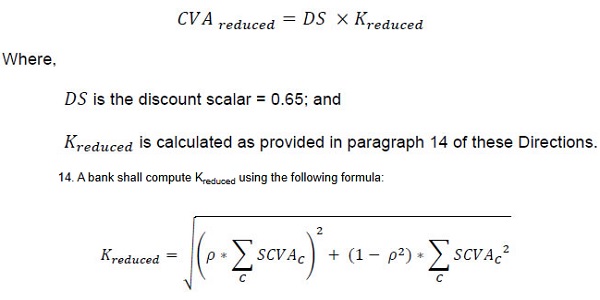
Where,
(i) The summations shall cover all counterparties that are within scope of the CVA charge.
(ii) SCVAc is the CVA capital requirement that counterparty c would receive if considered on a stand-alone basis (referred to as “stand-alone CVA capital”). The calculation of standalone CVA capital shall be as provided in paragraph 15 of these Directions.
(iii) ρ = 50 per cent is the supervisory correlation parameter. ρ2 = 25 per cent, represents the correlation between credit spreads of any two counterparties. The effect of ρ is to recognise the fact that the CVA risk to which a bank is exposed to is less than the sum of the CVA risk for each counterparty, given that the credit spreads of counterparties are typically not perfectly correlated. One of the basic assumptions underlying the reduced BA-CVA is that systematic credit spread risk is driven by a single factor. Under this assumption, ρ can be interpreted as the correlation between the credit spread of a counterparty and the single credit spread systematic factor.
(iv) The first and second terms under the square root in the formula above aggregates the systematic components and idiosyncratic components of CVA risk respectively.
15. The stand-alone CVA capital requirement for counterparty c (SCVAc) used in the formula in paragraph 14 of these Directions shall be calculated using the following formula: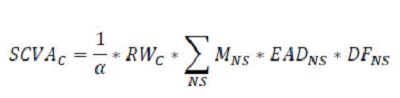
Where,
(i) the summation shall be across all netting sets with the counterparty c.
(ii) RWc is the risk weight for counterparty c and reflects the volatility of its credit spread. These risk weights are based on a combination of sector and credit quality of the counterparty, as prescribed in paragraph 16 of these Directions.
(iii) MNS is the effective maturity for the netting set NS, as prescribed in paragraph 17 of these Directions.
(iv) EADNS is the exposure at default (EAD) of the netting set NS, calculated in the same way as the bank calculates it as per the Standardised Approach for Counterparty Credit Risk (SA-CCR) in the draft Reserve Bank of India (Commercial Banks – Forthcoming Instructions) Amendment Directions, 2026.
(v) (a) DFNS is a supervisory discount factor, and is calculated using the following formula: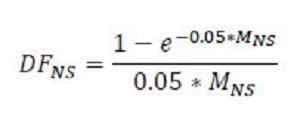
(b) DF is the supervisory discount factor averaged over time between today and the netting set’s effective maturity date. The interest rate used for discounting is set at 5 per cent, hence 0.05 in the formula. The product of EAD and effective maturity in the BA-CVA formula is a proxy for the area under the discounted expected exposure profile of the netting set. The netting set’s effective maturity is defined as an average of actual trade maturities. This definition lacks discounting and is compensated by adding the supervisory discount factor.
(vi) α set at 1.4 and is the multiplier used to convert Effective Expected Positive Exposure (EEPE) to EAD in the SA-CCR in the draft Reserve Bank of India (Commercial Banks – Forthcoming Instructions) Amendment Directions, 2026. It is used to convert the EAD of the netting set back to EEPE.
16. The supervisory risk weights (RWcin computation of stand-alone CVA capital requirement under paragraph 15 of these Directions or RWhin computation of SNHc under paragraph 23 of these Directions and for calculation of RWi in computation of IH under paragraph 24 of these Directions) are provided in Table 1 below. Credit quality of the counterparty is specified as investment grade (IG), high yield (HY), or not rated (NR) depending on the external ratings or lack of it, as following:
(a) Credit rating of BBB- / Baa3 (for long term rating) / A-3 / P-3 / F-3 (for short term rating) and above shall be considered as IG.
(b) Credit rating below BBB- / Baa3 (for long term rating) / A-3 / P-3 / F-3 (for short term rating) shall be considered as HY.
(c) In case a counterparty has more than one credit rating, the worst of the ratings shall be used to decide on the credit quality and resultant risk weight.
(d) Where there are no external ratings, the risk weights corresponding to NR is to be applied.
| Table 1 – Supervisory risk weights | |||
| Sr. No. | Sector of Counterparty | Credit Quality of Counterparty | |
| IG | HY and NR | ||
| 1 | Sovereigns including central banks and multilateral development banks | 0.5% | 2.0% |
| 2 | Local government, government-backed non-financials, education and public administration | 1.0% | 4.0% |
| 3 | Financials including government-backed financials | 5.0% | 12.0% |
| 4 | Basic materials, energy, industrials, agriculture, manufacturing, mining and quarrying | 3.0% | 7.0% |
| 5 | Consumer goods and services, transportation and storage, administrative and support service activities | 3.0% | 8.5% |
| 6 | Technology, telecommunications | 2.0% | 5.5% |
| 7 | Health care, utilities, professional and technical activities | 1.5% | 5.0% |
| 8 | Other sectors | 5.0% | 12.0% |
17. A bank shall calculate the effective maturity MNSas under:
(1) The effective maturity (MNS) is subject to a floor of one year, subject to the exemption provided in sub-paragraph 17(5) below.
(2) For an instrument subject to a determined cash flow schedule, effective maturity M for the instrument is defined as follows:

Where,
CF denotes the cash flows (principal, interest payments, and fees) contractually payable by the borrower / counterparty in period t;
Provided that, if the bank is not in a position to calculate the effective maturity of the contracted payments as noted above, it shall use a more conservative measure of M such as that M equals the maximum remaining time (in years) that the borrower / counterparty is permitted to take to fully discharge its contractual obligation (principal, interest, and fees) under the terms of the agreement. Normally, this will correspond to the nominal maturity of the instrument.
(3) For transactions that are not subject to a legally enforceable bilateral netting agreement (referred to hereafter as ‘netting agreement’) that is recognised for regulatory capital purposes, each such transaction is interpreted as its own netting set. For such transactions, the effective maturity of the instrument, M = MNS.
(4) For transactions that are part of a netting agreement, the effective maturity of the netting set MNS shall be the weighted average maturity (M) of the transactions within the netting agreement. Further, the notional amount of each transaction shall be used for weighting the maturity.
(5) The one-year floor for MNS, prescribed in sub-paragraph 17(1) above, shall not apply to fully or nearly-fully collateralised OTC derivatives transactions with an original maturity of less than one year, where the documentation contains daily re-margining clauses. Fully or nearly-fully collateralised OTC derivative transactions shall mean cases where variation margin covers the current mark-to-market exposure resulting from changes in the market value of a derivative contract. The intention is to include both parties of a transaction meeting these conditions where neither of the parties is systematically under-collateralised. To qualify for this exemption, the documentation of such eligible transactions shall require daily revaluation and must include provisions that allow for the prompt liquidation or setoff of the collateral in the event of default or failure to re-margin. The effective maturity MNS and floor for such transactions shall be calculated as follows:
(a) For transactions which are not subject to a netting agreement, the effective maturity is calculated as the greater of one day and effective maturity prescribed under sub-paragraph 17(3) above.
(b) For transactions which are subject to a netting agreement, the floor is determined by the minimum holding period for the transaction type, as under:
i. A floor equal to the minimum holding period for the transaction type set out in Table 29 under paragraph 163(8) of the Reserve Bank of India (Commercial Banks – Prudential Norms on Capital Adequacy) Directions, 2025, shall apply to the weighted average maturity of the transactions, as calculated under sub-paragraph 17(4) above.
ii. Where more than one transaction type is contained in the netting agreement, a floor equal to the highest of the minimum holding periods will apply to the average.
B. Full version of the BA-CVA
18. The full version of BA-CVA recognises the effect of counterparty credit spread hedges. The transactions used for the purpose of mitigating the counterparty credit spread component of CVA risk, and managed as such by a bank, shall be eligible hedges.
19. Only single-name credit default swaps (CDS), single-name contingent CDS and index CDS can be eligible CVA hedges. A bank is currently not permitted to engage in single-name contingent CDS. Accordingly, full version of BA-CVA shall not recognise the effect of counterparty credit spread hedges in single-name contingent CDS.
Provided that, eligible single-name CDS shall meet one of the following criteria:
(i) reference the counterparty directly; or
(ii) reference an entity legally related to the counterparty, where legally related refers to cases where the reference name and the counterparty are either a parent and its subsidiary or two subsidiaries of a common parent; or
(iii) reference an entity that belongs to the same sector and region as the counterparty.
20. A bank that uses the full version of BA-CVA shall also calculate Kreducedas provided in paragraph 14 of these Directions. The capital requirements for CVA risk under the full version of BA-CVA is calculated using the following formula:
Chapter-V: Capital Treatment of CVA Hedges
26. A bank may use CVA hedging instruments that are external (i.e., with an external counterparty) or internal (i.e., with one of the bank’s trading desks). Internal CVA involves two perfectly offsetting positions, one of the CVA desk and the opposite position of the trading desk. The capital treatment of CVA hedges is as follows:
(1) Capital treatment of external CVA hedges
(a) A bank shall include in the CVA calculation of the counterparty providing the hedge, all external CVA hedges (including both eligible and ineligible external CVA hedges) that are covered transactions.
(b) A bank shall exclude all eligible external CVA hedges from its market risk capital requirement.
(c) Ineligible external CVA hedges shall be treated as trading book instruments and shall be capitalised for market risk capital requirement.
(2) Capital treatment of internal CVA hedges
(a) If an internal CVA hedge is ineligible, both positions belong to the trading book where they cancel each other. Hence there is no impact on either the CVA portfolio or the trading book.
(b) If an internal CVA hedge is eligible, the CVA desk’s position is part of the CVA portfolio where it is capitalised for CVA risk, while the trading desk’s position is part of the trading book where it is capitalised for market risk capital requirement.
(3). Eligibility criteria of CVA hedges are specified in paragraphs 18 to 19 of these Directions.
Chapter-VI: Disclosures and Reporting Requirements
27. A bank shall make disclosures on CVA risk, as part of its Pillar 3 disclosure requirements. The disclosure requirements under these Directions are:
(a) Table CVAA – General qualitative disclosure requirements related to CVA.
(b) Template CVA1 – The reduced basic approach for CVA (BA-CVA).
(c) Template CVA2 – The full basic approach for CVA (BA-CVA).
28. The detailed templates and disclosure frequency are provided in Annex 2.
Chapter-VII: Repeal
29. Upon coming into effect of these Directions on April 01, 2027, para 85(3) of Reserve Bank of India (Commercial Banks – Prudential Norms on Capital Adequacy) Directions, 2025 shall stand repealed.
(Sunil T S Nair)
Chief General Manager