SEBI issued a consultation paper dated August 11, 2026, seeking comments on proposals to expand Foreign Portfolio Investor (FPI) participation in Exchange Traded Commodity Derivatives (ETCDs). The first proposal seeks to permit FPIs to participate in non-agricultural index derivatives irrespective of whether the underlying contracts are cash settled, noting that index derivatives are always cash settled. The second proposal seeks to permit FPI participation in non-cash settled, physically settled non-agricultural commodity derivatives, subject to safeguards. FPIs would be required to voluntarily square off or roll over open positions before the tender period, with a proposed automatic transfer mechanism to designated Trading Members/Trading-cum-Clearing Members where positions remain open. The proposal includes onboarding agreements, transfer at closing/daily settlement price, applicable statutory levies, restrictions on increasing positions before the tender period, and up to two trading days for Trading Members to reduce transferred positions exceeding limits. A pre-agreed Proprietary Risk Absorption Charge is also proposed. Comments are invited on specified proposals and Annexure-A by September 1, 2026.
Securities and Exchange Board of India
Consultation Paper on FPI Participation in Exchange Traded Commodity Derivatives (ETCDs)
SEBI-Aug 11, 2026| Reports : Reports for Public Comments
Click here to provide your comments
1. Objective: This consultation paper seeks stakeholder views on the following proposals:
1.1. FPI Participation in Non-Agricultural Index Derivatives Contracts
1.2. FPI Participation in Non-Cash Settled Non-Agricultural Commodity Derivatives Contracts
2. Background:
2.1. In order to promote institutional participation in Exchange Traded Commodity Derivatives (ETCDs), SEBI had permitted Category III Alternative Investment Funds, Mutual Funds and Portfolio Management Services to participate in ETCDs vide Circular No SEBI/HO/CDMRD/DMP/CIR/P/2017/61 dated June 21, 2017, Circular No. SEBI/HO/IMD/DF2/CIR/P/2019/65 dated May 21, 2019 and Circular No. SEBI/HO/IMD/DF1/CIR/P/2019/066 dated May 22, 2019, respectively.
2.2. Based on representations to permit FPI participation in ETCDs and after following due consultation process, SEBI Board in its meeting held on Jun 29, 2022, decided to allow foreign portfolio investors to participate in the exchange-traded commodity derivatives segment. Thus, SEBI vide Circular dated September 29, 2022 (now part of SEBI Master Circular SEBI/HO/MRD/MRD-PoD-1/P/CIR/2023/136 dated August 4, 2023), allowed participation of FPIs in Indian ETCDs. In this regard, Para 4.2.2(i) of the Master Circular is reproduced below:
4.2.2(i) To begin with, FPIs will be allowed to participate in cash settled nonagricultural commodity derivative contracts and indices comprising such nonagricultural commodities.
2.3. Given a long passage of time, SEBI has been receiving representations from exchanges and market participants seeking to widen the scope of FPI participation in the Indian commodity derivatives market. The proposals, inter alia, submit the case to enable FPI participation in non-agri indices and physically settled non-agri ETCDs. Accordingly, this consultation paper seeks views of stakeholders on proposals mentioned in Section 3 and Section 4.
3. Proposal – 1: FPI Participation in Non-Agricultural Index Derivatives Contracts
Current Status:
3.1. At present, FPIs may participate in only those cash settled non-agricultural derivative contracts whose underlying contracts are also cash settled.
Rationale of Proposal:
3.2. For Index Derivatives, SEBI has allowed FPIs to only trade in cash settled index contracts where the underlying of the indices are also cash settled. However, the nature of index derivatives is that they are always cash settled, irrespective of the underlying being cash-settled or not. Thus, there would be no possibility of delivery related issues with such index derivatives contracts, in case they are allowed for participation by FPIs.
Recommendations of the CDAC:
3.3. The Commodity Derivatives Advisory Committee (CDAC) was in agreement with the proposal and recommended that the FPIs may be allowed to participate in non-agricultural index derivatives contracts.
Views/comments sought on:
3.4. Whether FPIs should be allowed to participate in Non-Agricultural Index Derivatives Contracts irrespective of whether the underlying is cash settled or not?
4. Proposal – 2: FPI Participation in Non-Cash Settled Non-Agricultural Commodity Derivatives Contracts
Current Status:
4.1. Ever since the participation of foreign investors in Indian ETCDs through FPI route was permitted, there has been a notable rise in liquidity in Crude oil and Natural Gas options. There has been a considerable rise in overall open interest, with FPIs contributing a meaningful and growing share, enhancing market depth.
Rationale of Proposal:
4.2. Non-agricultural commodities such as crude oil, natural gas, gold, silver and base metals are internationally traded and their prices are closely linked to global benchmarks. Accordingly, permitting FPIs to participate in physically settled non-agricultural commodity derivatives, subject to appropriate safeguards, would broaden the participant base, enhance liquidity and market depth, improve price discovery and strengthen convergence between the derivatives and physical markets. It would also facilitate greater integration of India’s commodity derivatives market with international commodity markets and support the development of Indian commodity contracts as credible price-discovery venues.
4.3. In international commodity markets, foreign investors are allowed to trade in physically settled commodity derivative contracts. Japan’s OSE and TOCOM attract active participation from foreign investors, who have been driving the surge in trading activity witnessed in some of the physically settled commodity derivative contracts. China, in its bid towards internationalization of its commodity markets, has permitted the Qualified Foreign Investors (QFIs) to trade in a wide range of commodity futures and options contracts (including physically settled contracts).
4.4. In USA’s CME and Europe’s ICE, clearing members are required to assess whether clients possess the operational and financial capacity to fulfill delivery obligations and, where assurance is lacking, ensure that positions are liquidated prior to expiry.
4.5. China and Japan manage delivery risk through VAT invoicing requirements and stringent position limits, while exchanges such as CME and ICE place oversight duties on clearing members to assess and manage delivery capabilities.
4.6. In India, FPI may not be permitted to take or make delivery due to the absence of a permanent establishment in India. Even if the FPI may delegate a Trading Member (TM) to take/make delivery of the goods on FPI’s behalf, the FPIs would still be required to mandatorily obtain GST registration to buy/sell commodities in India.
4.7. Any open position at the start of the tender period of the contract triggers a requirement for taking/making physical delivery for FPIs, as is the case with other participants. Thus, it is felt that FPI may be allowed to trade in such contracts on condition that they exit their positions in the current contract either by squaring off or rolling over, before the start of the tender period. Further, the current risk management framework in commodity derivatives market is adequate to take care of the anticipated participation by FPI.
Proposal:
4.8. FPIs may take positions in non-cash based non-agri commodity derivative contracts available at domestic exchanges. However, FPIs must compulsorily square off or rollover positions before start of the tender period i.e. three days before the expiry of the contract.
4.9. However, it may be noted that a single safeguard (i.e., an exchange-advisory-based square-off requirement alone) is insufficient, since it depends entirely on timely voluntary action by the FPI. A layered, or two-tier, structure is therefore proposed, combining (i) a compulsory square-off obligation, backed by (ii) an automatic transfer mechanism that operates only if the first tier is not complied with. Thus, if not done voluntarily, the position shall devolve on the TM/TCM.
Safeguard Mechanism: Compulsory Square-off / Transfer of FPI Positions Before Tender Period(T):
4.10. The safeguard mechanism shall stand triggered only where an FPI has not voluntarily squared off or rolled over its open position by the close of market hours on T-3.
4.11. For FPIs, all open positions before the start of the tender period need to be compulsorily transferred to the Trading Member (TM) / Trading-cum-Clearing Member (TCM), in case square-off or rollover of positions is not done voluntarily by the FPI.
4.12. Where an open position is held by the FPI at the end of T-1, the TM/TCM shall provide a value-added service to the FPI by absorbing the FPI’s open position to its own books, for a service fee. This transfer of the open position would be akin to a sale of the underlying derivative position by the FPI to the TM/TCM.
4.13. To address situations where voluntary square-off or rollover does not occur before the start of Tender/Staggered delivery period, the following process is proposed:
4.13.1. FPIs desirous of trading in non-cash based, non-agricultural commodity derivative contracts shall enter into:
(i) a Tripartite agreement with the Professional Clearing Member (PCM), and the Trading Member (TM), or
(ii) a Bipartite agreement with the Trading-cum-Clearing Member (TCM)
(or any other nomenclature used by the exchanges in this regard), as applicable to the membership structure through which the FPI operates.
4.13.2. At its discretion, the FPI may enter into an agreement with:
i. One TM/ TCM across all exchanges and commodities; or
ii. One TM/ TCM per exchange; or
iii. Within each exchange, one TM/ TCM per commodity or group of commodities
4.13.3. The recognised exchanges having commodity derivatives segment shall, in consultation with each other, standardise the format and material terms of the agreement, so as to ensure consistency in the safeguards and disclosures applicable to FPIs across exchanges.
4.13.4. The TM/CM shall inform the Exchange/Clearing Corporation of such arrangement(s) prior to permitting the FPI to trade in the relevant deliverable commodity contracts. Trading for the FPI client shall be enabled only after such confirmation.
4.13.5. While the safeguard mechanism will in principle start at close of market hours on T-3, the FPI shall still be free to square off or roll over its open position(s) at any time up to the close of market hours on the day preceding the start of the tender period (T-1). Only where such square-off or rollover has not been effected voluntarily by the close of market hours shall the safeguard arrangement with the designated TM/TCM stand triggered. The designated TM/TCM shall agree, as part of the arrangement, to accept the transfer (square-off) of the FPI client’s position into its own proprietary account.
4.13.6. Under this arrangement, the trades effecting the transfer shall be executed at the Closing Price/Daily Settlement Price, as declared by the Exchange on the day of transfer of the position.
4.13.7. The above trade/s shall be executed automatically post closure of market hours of the day (the day prior to the start of Tender Period) before start of EOD activities of the clearing corporation. Upon execution of the transfer, the FPI’s open position in the contract shall be deemed to be closed, and the FPI shall cease to have any further right, title, obligation, or exposure in respect of such position, including in relation to the tender/delivery process. All rights and obligations in respect of the transferred position shall thereafter vest solely in the designated Trading Member/TCM.
4.13.8. Such trades shall be treated as Normal Market trades, and shall accordingly attract applicable exchange transaction charges, including SEBI turnover fees, Commodity Transaction Tax (CTT), stamp duty, and GST on turnover charges.
4.13.9. To avoid any shortfall of margin at the designated TM on account of the post-close transfer trade, the PCM, at end-of-day on T-2, where T being the start of the Tender Period, shall inform the designated TM of the FPI’s open position, allowing the TM adequate lead time to arrange for margin.
4.13.10. Since the transfer may result in the designated TM’s Proprietary account breaching applicable position limits, sufficient time — up to two trading days from the start of the tender period — should be provided to the TM to reduce the position, on lines analogous to the treatment of devolved option positions.
4.13.11. The Clearing Member shall not accept or clear trades that result in an increase of the FPI’s open position on T-1 in the near-month deliverable contract, so that the FPI cannot add to a position it is expected to be exiting.
4.13.12. The proposed transfer mechanism is conceptually akin to the ‘Post-Close’ trading window in the equity market. The proposed FPI position-transfer mechanism would similarly operate as a distinct, closing-price-based window rather than as continuous-market execution, so that the transfer price is objectively determined and not subject to negotiation between the FPI and the designated TM.
4.13.13. Upon execution of the said transfer, the FPI’s open position in the contract shall be deemed to be closed, and the FPI shall cease to have any further right, title, obligation, or exposure in respect of such position, including in relation to the tender/delivery process. All rights and obligations in respect of the transferred position shall thereafter vest solely in the designated Trading Member/TCM.
4.14. Proprietary Risk Absorption Charge: Where an FPI’s open position(s) are transferred to the proprietary account of the designated Trading Member/TCM on account of the FPI’s failure to voluntarily square off or roll over such position(s) before the start of the tender period, the tripartite/bipartite agreement referred to above may incorporate a pre-agreed charge payable by the FPI to the Trading Member/TCM, over and above the service fee for the transfer. The nature and quantum of such charge may be disclosed to, and agreed by, the FPI at the time of onboarding, and may be designed to disincentivize reliance on the safeguard mechanism as a substitute for voluntary square-off or rollover. However, it may be noted that such charge shall be without prejudice to any other penalty leviable by theExchange/Clearing Corporation under the extant framework for position-limit violations.
4.15. The flowchart of the proposed mechanism is presented below:
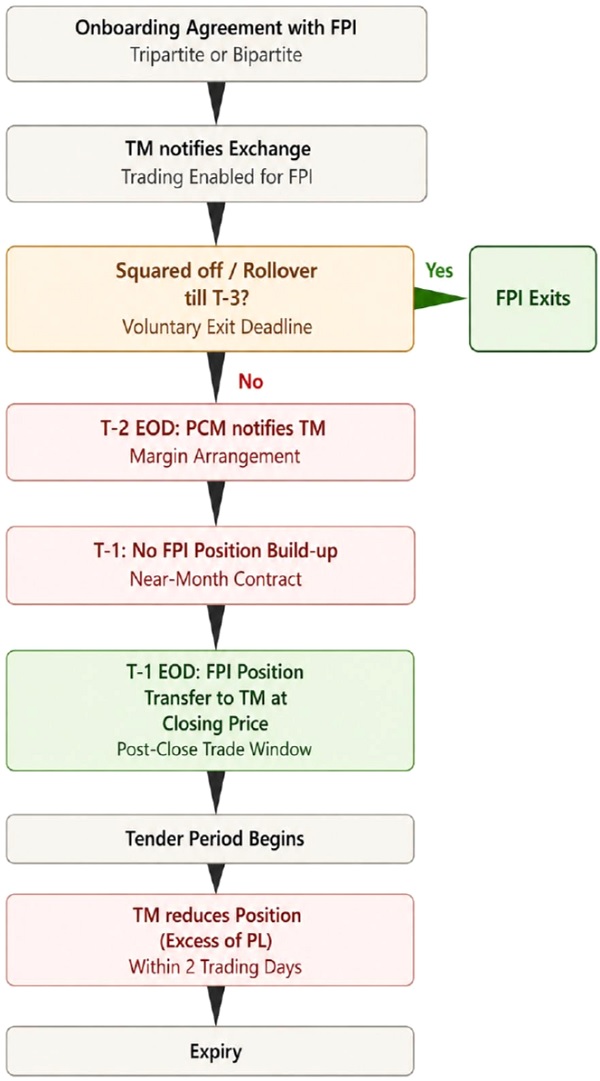
4.16. The following table illustrates, on an indicative day-wise basis, the operation of the safeguard mechanism where voluntary square-off or rollover does not occur:
Table-1: Indicative Timeline
| Stage | Action | Responsibility |
|---|---|---|
| T-3 | Compulsory square-off/rollover window opens; FPI expected to exit or rollover voluntarily | FPI, through TM/TCM |
| T-2 (EOD) | PCM informs designated TM of FPI’s open position, margin arrangement | PCM |
| T-1 | No fresh increase in FPI’s open position permitted in near-month deliverable contract |
Trading Member / Clearing Member |
| T-1 EOD (cut- off) |
Unsquared FPI position transferred, at closing price, to designated TM’s proprietary account, in a post-closure window, in case rollover or square off does not happen |
Exchange / Clearing Corporation (system-driven) |
| Start of Tender period (T) | Any residual position governed by extant tender/delivery provisions applicable to trading members generally. |
Trading Member |
| T to T+2 | TM permitted to reduce the transferred position (in excess of Position Limit) within two trading days, akin to treatment of devolved option positions, before start of tender period | Trading Member (Proprietary account) |
Recommendations of the CDAC:
4.17. The CDAC was in agreement with the proposal and recommended that the FPIs may be allowed to participate in non-cash settled non-agricultural commodity derivatives contracts, subject to the proposed safeguards to prevent obligation of delivery on FPIs.
|
|
Views/comments sought on:
4.18. Whether FPIs should be allowed to participate in Non-Cash Settled Non-Agricultural Commodity Derivatives Contracts?
4.19. Do you agree with the proposed framework for FPI participation in Non-Cash Settled Non-Agricultural Commodity Derivatives Contracts?
5. Based on the above proposals, a draft circular has been prepared modifying the provisions contained in Para 4.2 of Chapter 4 of SEBI Master Circular dated August 04, 2023, placed at Annexure-A.
Public Comments:
Comments are invited on Paras 3.4, 4.18, 4.19 and Annexure-A. The comments/ suggestions should be submitted latest by September 01, 2026, through the online web-based form which can be accessed using the following link:
https://www.sebi.gov.in/sebiweb/publiccommentv2/PublicCommentAction.do?doPubl icComments=yes
In case of any technical issue in submitting your comment through the web based public comments form, you may contact the following through email with the subject: “Consultation Paper on FPI Participation in Exchange Traded Commodity Derivatives (ETCDs)”.
ii. Ms Neetika Rajpal, DGM ([email protected])
iii. Mr Aayush Rastogi, AM ([email protected])
Issued on: August 11, 2026
Annexure-A
DRAFT CIRCULAR
HO/47/16/13(17)2026-MRD-POD1/___
#IssuedDate#
To,
The Managing Directors / Chief Executive Officers,
All Recognized Stock Exchanges/Clearing Corporations having Commodity Derivatives Segment
Sir / Madam,
Sub: FPI Participation in Exchange Traded Commodity Derivatives (ETCDs)
1. In terms of Para 4.2 of Chapter 4 of SEBI Master Circular for Commodity Derivatives Segment dated Aug 04, 2023, Foreign Portfolio Investors (FPIs) are currently permitted to participate in the commodity derivatives segment of recognised stock exchanges only through cash-settled non-agricultural commodity derivative contracts and indices comprising such commodities.
2. Based on representations received from stakeholders, deliberations of the Commodity Derivatives Advisory Committee (CDAC), and public comments received on the consultation paper on this subject, and with the objective of deepening institutional participation and liquidity in the commodity derivatives segment, it has been decided to permit FPIs to participate in non-cash (physically) settled nonagricultural commodity derivative contracts, subject to the safeguards specified in this circular. Accordingly, following provisions contained in Paragraph 4.2 of the aforesaid circular stand revised as under:
2.1 Para 4.2.2 (i) shall be revised as under:
4.2.2 (i) FPIs are allowed to participate in cash settled non-agricultural commodity derivative contracts and indices comprising non-agricultural commodities except in deliverable options contracts (i.e. option in goods).
2.2 Para 4.2.2(i)(a), 4.2.2(i)(b) and Para 4.2.2(i)(c) shall be inserted as under:
4.2.2(i)(a) However, in the deliverable commodity contracts, FPIs are allowed to participate up to the commencement of the tender/ staggered delivery period. Further, FPI shall unwind/square off their open positions, if any, prior to the commencement of the tender/ staggered delivery period.
4.2.2(i)(b) On the trading day immediately preceding the commencement of the tender/ staggered delivery period, no fresh positions that result in increasing of existing positions for the FPI in the expiring contract shall be allowed.
4.2.2(i)(c) Notwithstanding anything contained elsewhere in the Master Circular for Commodity Derivatives Segment and Master Circular for Foreign Portfolio Investors, Designated Depository Participants and Eligible Foreign Investors; the transfer of position from the FPI to TM on account of FPI being allowed to transfer non-cash settled non-agriculture commodity derivative contract prior to the tender period under the special arrangement shall not be treated as OTC derivatives, nor shall the extant regulations with respect to transfer of positions between client codes applicable to non-institutional transfer of positions, Error accounts or off market transfer related provisions be applicable to the said arrangement. The transfer shall be considered as a Trade with applicable statutory levies as applicable.
2.3 Para 4.2.2 (iii)(c) shall be inserted as under:
4.2.2(iii)(c) Due to post close transfer of positions from FPI to the designated TM, there is a possibility that open positions for the TM’s proprietary account may exceed their permissible position limits for future contracts. For such members, stock exchanges may permit maximum up to two trading days to reduce their futures positions to bring them within the permissible position limits.
2.4 Para 4.2.3 titled ‘Operational Framework for FPI Participation in Non-Cash Settled Contracts’ shall be inserted as under:
4.2.3 Operational Framework for FPI Participation in Non-Cash Settled Contracts
(i) Onboarding of FPI:
a. A Trading Member permitting an FPI to trade in non-cash settled nonagricultural commodity derivative contracts shall, prior to enabling such trading, put in place (i) a tripartite agreement among the Professional Clearing Member (PCM), the Trading Member (TM) and the FPI, or (ii) a bipartite agreement between the Trading Cum Clearing Member (TCM) (or any other nomenclature used by the exchanges in this regard) and the FPI, as applicable to the membership structure through which the FPI operates.
b. At its discretion, the FPI may enter into an agreement with:
I. One TM/ TCM across all exchanges and commodities; or
II. One TM/ TCM per exchange; or
III. Within each exchange, one TM/ TCM per commodity or group of commodities
(c) The TM/CM shall inform the Exchange/Clearing Corporation of the arrangement referred above, prior to permitting the FPI to trade in the relevant deliverable commodity derivative contracts. The Exchange shall enable trading for the FPI client only upon confirmation of such arrangement.
(ii) Voluntary Square-off / Rollover – Primary Obligation:
(a) The FPI shall be free to square off or roll over its open position(s) at any time up to the close of market hours on the day preceding the start of the tender period. This voluntary square-off or rollover is, and shall remain, the primary and preferred mode of exit for FPIs from such contracts.
(iii) Safeguard Mechanism: Compulsory Square-off / Transfer of FPI Positions Before Tender Period
a. Where a FPI has not voluntarily squared off or rolled over its open position by the close of market hours on T-3, the Safeguard Mechanism shall stand triggered, and the FPI’s open position shall be transferred to the proprietary account of the designated Trading Member/TCM automatically post closure of market hours of the T-1 day (the day prior to the start of Tender Period) before start of EOD activities of the clearing corporation.
b. To enable the designated TM to arrange adequate margin ahead of the transfer, the Professional Clearing Member shall, by end-of-day on T-2, inform the designated TM of the FPI’s open position that is liable to devolve under the Safeguard Mechanism.
c. Under this arrangement, the transfer of the open position of the FPI shall be executed at the Closing Price/Daily Settlement Price, as declared by the Exchange on the day of transfer of the position. Such transfer shall be treated as Normal Market trades for all purposes, including applicability of exchange transaction charges, SEBI turnover fees, Commodity Transaction Tax (CTT), stamp duty, and GST on turnover charges.
d. Upon execution of the transfer, the FPI’s open position in the contract shall be deemed to be closed, and the FPI shall cease to have any further right, title, obligation, or exposure in respect of such position, including in relation to the tender/delivery process. All rights and obligations in respect of the transferred position shall thereafter vest solely in the designated TM/TCM.
e. No Clearing Member shall accept or clear any trade that results in an increase of an FPI’s open position, in the near-month deliverable contract, on T-1 immediately preceding the start of the tender period.
(iv) Post-Transfer Position-Limit Reduction:
(a) Where the said transfer of FPI positions to TM/TCM results in the designated TM’s/TCM’s proprietary account exceeding position limits otherwise applicable to it, the TM/TCM shall be permitted a period up to two trading days from the date of transfer to reduce such position to within the prescribed limits, in a manner analogous to the treatment of devolved option positions. During this period, the position so transferred shall not, solely by reason of such transfer, be treated as a violation attracting penal action under Annexure J of the Master Circular for Commodity Derivatives Segment.
v. Proprietary Risk Absorption Charge:
(a) The onboarding agreement may incorporate a pre-agreed charge, to be styled as the ‘Proprietary Risk Absorption Charge’, payable by the FPI to the TM/TCM where the FPI’s open position is transferred under the backstop mechanism on account of the FPI’s failure to voluntarily square off or roll over such position by T-1. The Proprietary Risk Absorption Charge is intended to compensate the TM/TCM for the proprietary risk, margin, and position-limit burden it absorbs on account of the involuntary transfer, and shall be over and above any service fee agreed between the parties for effecting the transfer. The exchange shall prescribe the conditions under which the said charge is collected from the FPI, in cases the position is involuntarily transferred to the TM/TCM. The quantum and manner of computation of the said charge shall be disclosed to, and agreed by, the FPI at the time of onboarding and shall be without prejudice to any penalty leviable by the Exchange/Clearing Corporation under the extant framework.
vi. The recognised exchanges having commodity derivatives segment shall, in consultation with each other, standardise the format and material terms of the onboarding agreement, so as to ensure consistency in the safeguards and disclosures applicable to FPIs across exchanges. The Exchange/Clearing Corporation shall notify detailed scheme / guidelines outlining a facility of providing post-closure window between the designated TM and FPI for open positions held by the FPI (one day prior to the start of the tender period) after normal market hours at closing price in Commodity Derivatives Market Segment.
3. The circular shall come into force from DD/MM/YYYY.
4. The MIIs are advised to:
4.1 take necessary steps and put in place necessary systems for implementation of the above.
4.2 make necessary amendments to the relevant bye-laws, rules and regulations, wherever required, for the implementation of the above; and,
4.3 bring the provisions of this circular to the notice of the market participants (including investors) and disseminate the same on their website.
5. This circular is issued in exercise of the powers conferred under Section 11(1) of the Securities and Exchange Board of India Act 1992, read with Regulation 51 of the Securities Contracts (Regulation) (Stock Exchanges and Clearing Corporations) Regulations, 2018, to protect the interests of investors in securities and to promote the development of, and to regulate the securities market.
6. The Circular is issued with the approval of the competent authority.
7. This Circular is available on SEBI website sebi.gov.in under the category “Circulars” and “Info for Commodity Derivatives”.