The supplied material is a Regulatory Update describing the revised CBDT Guidance Note on FATCA and CRS, released on 24 July 2026, to guide Reporting Financial Institutions (RFIs) in complying with section 508 of the Income Tax Act, 2025, Rules 238 to 240, and Form 166 of the Income-tax Rules, 2026. It explains that the Guidance Note aligns with the Income Tax Act, 2025, the Income-tax Rules, 2026, and the OECD CRS 2025 amendments, including reporting relating to specified electronic money products, central bank digital currencies and relevant crypto-assets where applicable. The document updates references from Form 61B to Form 166, revises reporting, due diligence and account classification guidance, adds diagrams, flow charts and FAQs, and incorporates implementation experience. It outlines reporting obligations, categories of Reporting and Non-Reporting Financial Institutions, financial account types, reportable accounts, due diligence procedures, reporting timelines, and transitional measures, while stating that in case of any inconsistency, the statutory provisions of the Income Tax Act, 2025 and the Income-tax Rules, 2026 shall prevail.
Government of India
GUIDANCE NOTE ON FATCA and CRS
Ministry of Finance
Department of Revenue
Central Board of Direct Taxes
Foreign Tax & Tax Research Division
July 2026
Released on : 24th July 2026
DISCLAIMER
This Guidance Note intends to provide guidance to Reporting Financial Institutions (RFIs) for compliance with the reporting obligations under section 508 of the Income Tax Act, 2025, and under Rules 238 to 240 and Form 166 of the Income Tax Rules, 2026. The Guidance Note is intended to explain the reporting obligations of RFIs contained in the relevant Rules notified by the Government of India in a simple manner. Given that the Common Reporting Standard (CRS) is developed jointly by participating jurisdictions, including India, working with the OECD, the Commentary on CRS and other relevant materials have also been cited, so as to facilitate their reference by the RFIs, where so required.
This Guidance Note & the FAQs therein are issued for guidance purpose only. The information contained herein is subject to change based on amendments in law and does not constitute legal advice. In case of any actual or perceived inconsistency between the Guidance Note or FAQs therein and the Income-tax Act, 2025 or the Income Tax Rules, 2026, the statutory position in the Act and Rules shall invariably prevail.
The increasing mobility of capital, rapid developments in financial products and payment systems, and the growing use of digital assets have transformed the global financial landscape in recent years. These developments have reinforced the importance of effective international cooperation among tax administrations and highlighted the need for reporting and exchange frameworks to evolve in step with changing business models and emerging risks.
India has consistently supported global efforts aimed at enhancing tax transparency and combating offshore tax evasion. Through its participation in the Automatic Exchange of Information framework under the Common Reporting Standard (CRS) and the implementation of the Foreign Account Tax Compliance Act (FATCA) Inter-Governmental Agreement with the United States, India today exchanges financial account information with a large network of partner jurisdictions. The information received under these arrangements has become an important component of the Department’s compliance and risk assessment initiatives and has contributed significantly towards strengthening the integrity of the tax system.
Since the issuance of the earlier Guidance Note, there have been important developments both internationally and domestically. The amendments to the CRS agreed in 2023 seek to modernize the framework by addressing products and arrangements that have gained prominence in recent years, including certain electronic money products and central bank digital currencies. At the domestic level, the enactment of the Income Tax Act, 2025 and the Income Tax Rules, 2026 has provided an opportunity to revisit and update the guidance available to stakeholders to ensure that it remains aligned with the current legal and regulatory framework.
This revised Guidance Note seeks to respond to that need. While preserving the basic structure familiar to reporting entities and practitioners, the document has been substantially expanded and updated. It incorporates the legislative changes introduced under the Income-tax Act, 2025 and the Income-tax Rules, 2026, reflects the amendments made to the CRS, and provides greater clarity on a number of issues that have arisen during implementation. A dedicated section of frequently asked questions has been included to address practical concerns faced by reporting financial institutions and other stakeholders.

The objective of this Guidance Note is not merely to explain legal provisions, but also to promote a common understanding of reporting obligations and due diligence requirements. Voluntary compliance is best achieved when expectations are clear, guidance is accessible, and stakeholders have confidence that the administration is responsive to practical challenges encountered during implementation.
I am confident that this revised Guidance Note will serve as a useful reference for financial institutions, tax professionals, regulators, supervisory authorities and officers of the Income Tax Department engaged in administering the automatic exchange of information framework. As international standards continue to evolve, it will remain important for all stakeholders to work together to preserve the effectiveness, credibility and integrity of the system.
I place on record my appreciation for the efforts of the officers who have contributed to the preparation of this revised edition. Their commitment and diligence have helped produce a document that I hope will assist stakeholders in meeting their obligations with greater certainty and ease.
(Ravi Agrawal)
CHAIRMAN, CBDT
The Guidance Note on FATCA and CRS has, over the years, served as an important reference document for reporting financial institutions, intermediaries, professional advisers and officers of the Income-tax Department involved in implementing the Automatic Exchange of Information framework. The experience gained during nearly a decade of implementation has demonstrated the value of clear and practical guidance in supporting consistent compliance and reducing interpretational uncertainties.
Since the publication of the previous edition, the legal and operational landscape governing the exchange of financial account information has undergone significant changes. The coming into force of the Income Tax Act, 2025 and the Income Tax Rules, 2026 has necessitated corresponding updates to the guidance available to stakeholders. At the international level, the amendments adopted to the Common Reporting Standard in 2023 have expanded the scope of information to be reported and exchanged and introduced provisions to address developments in the financial sector.
This revised Guidance Note has been prepared with the objective of reflecting these developments comprehensively while retaining the practical orientation that users of the earlier edition have found useful. The relevant chapters have been updated to align references with the provisions of the Income Tax Act, 2025 and the Income Tax Rules, 2026. Explanations have been revisited in the light of implementation experience and issues raised by reporting entities over the years. Additional diagrams and flow charts have been introduced, and an extensive set of frequently asked questions has been incorporated to provide guidance on matters that commonly arise in the course of account classification, due diligence, self-certification, reporting and remediation exercises.
An effort has also been made to present the material in a manner that facilitates its use by a diverse set of stakeholders. While the Guidance Note is intended primarily for reporting financial institutions, it is expected to be equally useful to tax practitioners, compliance professionals, regulators, industry associations and officers of the Department responsible for administration, risk assessment and outreach activities.
I would like to acknowledge the valuable contribution made by the officers who undertook the exercise of reviewing existing guidance, examining implementation issues and preparing the revised text. Inputs received from stakeholders and the implementation experience gained over the years have also greatly enriched the document.
I would also like to place on record my sincere appreciation for the encouragement and guidance extended by the Hon’ble Chairman, CBDT, whose continued emphasis on taxpayer facilitation, clarity in communication and effective implementation of international commitments has been a source of support throughout this exercise.
I hope that this updated edition will contribute towards promoting better understanding, improving the quality of reporting and strengthening India’s continuing commitment to international tax transparency and cooperation.
(Prasenjit Singh)
MEMBER(LEGISLATION), CBDT
PURPOSE OF THIS GUIDANCE NOTE
This Guidance Note provides guidance to Reporting Financial Institutions (RFIs), Regulators and officers of the Income Tax Department for compliance with the reporting requirements provided in Rules 238 to 240 and Form 166 of the Income-tax Rules, 2026 (Rules 114F to 114H and Form 61B of the Income-tax Rules, 1962). The Guidance Note is intended to explain the reporting requirements of FATCA and CRS in a simple manner.
Since a large part of the Rules relevant to FATCA are based on the IGA between India and USA and the rules relevant to AEOI are based on the CRS, the Financial Institutions may refer to the IGA and CRS along with its Commentary to get further understanding of the terms used. The stakeholders are requested to provide feedback and suggestions so that Guidance Note can be further updated as per evolving issues in implementation of FATCA and CRS.
An attempt has been made to discuss and describe the various provisions contained in the relevant Rules notified by the Government of India. In case of any inconsistency between this Guidance Note and the Rules, the statutory positions as per the Income-tax Tax Act, 2025 and Income-tax Rules, 2026 (or Income-tax Act, 1961 and Income-tax Rules, 1962 as the case maybe) shall prevail.
DOCUMENT REVISION HISTORY
| Date | Details |
|---|---|
| 31 August 2015 | Guidance Note on FATCA and CRS (original) |
| 31 December 2015 | Updated: 31 December 2015 |
| 31 May 2016 | Updated: 31 May 2016 |
| 30 November 2016 | Updated: 30 November 2016 |
| 24 July 2026 | Updated as per the Income-tax Rules, 2026 and OECD CRS Consolidated Text of 2025 |
LIST OF ABBREVIATIONS
| Abbreviation | Full Form |
|---|---|
| AEOI | Automatic Exchange of Information |
| CARF | Crypto-Asset Reporting Framework |
| CBDC | Central Bank Digital Currency |
| CBDT | Central Board of Direct Taxes |
| CRS | Common Reporting Standard |
| CRS 2025 | Consolidated Text of the CRS (OECD, July 2025) |
| DTAA | Double Taxation Avoidance Agreement |
| FATCA | Foreign Account Tax Compliance Act (USA) |
| FATF | Financial Action Task Force |
| FI | Financial Institution |
| Form 166 | Annual Statement of Reportable Accounts (replaces Form 61B from 01.04.2026) |
| FT&TR | Foreign Tax and Tax Research Division, CBDT |
| GIIN | Global Intermediary Identification Number |
| IGA | Intergovernmental Agreement |
| I&CI | Intelligence and Criminal Investigation |
| IT ACT 2025 | Income-tax Act, 2025 |
| IT RULES 2026 | Income-tax Rules, 2026 |
| MCAA | Multilateral Competent Authority Agreement |
| NFE | Non-Financial Entity |
| NPFI | Non-Participating Financial Institution |
| NRFI | Non-Reporting Financial Institution |
| PMLA | Prevention of Money Laundering Act, 2002 |
| RBI | Reserve Bank of India |
| RFI | Reporting Financial Institution |
| SEBI | Securities and Exchange Board of India |
| SEMP | Specified Electronic Money Product |
| TIN | Taxpayer Identification Number |
INTRODUCTION
CHAPTER 1:
INTRODUCTION
1.1 Enactment of FATCA and the India-USA Intergovernmental Agreement
In 2010, the United States enacted the Foreign Account Tax Compliance Act (FATCA) to address tax evasion through offshore financial accounts held by US citizens and residents. FATCA requires Foreign Financial Institutions to report information on US persons or face a 30% withholding tax on US-source payments. Because domestic laws of many countries do not permit direct disclosure of client information to a foreign government, the United States negotiated Intergovernmental Agreements (IGAs) with partner jurisdictions.
The IGA between India and the United States was signed on 9 July 2015. Under this agreement, Indian RFIs report required information to the Indian tax authorities, who then transmit it to the US automatically.
The text of the IGA is available at India-USA IGA (Income Tax India website).
1.2 The Common Reporting Standard
To address offshore tax evasion globally, the OECD and G20 developed the Common Reporting Standard (CRS) on Automatic Exchange of Information (AEOI), presented to G20 Leaders in Brisbane in November 2014. India is an early adopter of CRS and began first exchanges under this standard in 2017.
The CRS requires the financial institutions of the source jurisdiction to collect and report information to their tax authorities about account holders resident in other jurisdictions, and such information is then transmitted by their tax authorities, to the tax authorities of the countries where account holders are resident, automatically on a yearly basis. The reporting is to be done for a wide range of financial products, by financial institutions including Depository Institutions, Custodial Institutions, Investment Entities and Specified Insurance Companies.
To combat offshore tax evasion in an increasingly evolving financial landscape, the global CRS framework was updated in 2025 to enhance tax transparency.
KEY FACT As of 2026, over 120 jurisdictions participate in the CRS exchange framework. India exchanges CRS information with all partner jurisdictions annually.
The 2025 consolidated text of the CRS is available at CRS 2025 Consolidated Text.
1.3 Steps Taken for Implementation
India amended section 285BA of the Income-tax Act, 1961 through the Finance (No. 2) Act, 2014, to establish the legal basis for AEOI under CRS and FATCA. The framework was originally implemented via Rules 114F to 114H of the Income-tax Rules, 1962 (notified on 7 August 2015), which mandated reporting by financial institutions through Form 61B.
Subsequent to this, the CRS framework has been amended globally to tighten transparency gaps and
cover modern financial instruments. India has legally integrated these changes into its domestic legal framework.
Following the changes of direct tax legislation, the current legal framework for CRS and FATCA is governed by the Income-tax Rules, 2026 (notified on 20 March 2026). The relevant governing provisions effective from 1 April 2026 are Rules 238 to 240 of Income-tax Rules, 2026. Reporting is to be done now in Form 166 (which replaces Form 61B). A copy of the notified Income-tax Rules, 2026 are available at Section : References at Page 123.
1.4 Key Timelines
| Event | Date |
|---|---|
| Cut-off date prior to which accounts are treated as Pre-existing account under FATCA | 30 June 2014 |
| Date for considering treating an account as a New Account under FATCA | 1 July 2014 |
| FATCA IGA came in force in India | 31 August 2015 |
| Cut-off date prior to which accounts are treated as Pre-existing account under CRS | 31 December 2015 |
| Date for considering New Account under CRS | 1 January 2016 |
| New account commencement date for CRS 2025 amendment accounts (new financial account types: SEMP, CBDC, etc.) | 1 January 2026 |
| Pre-existing account cut-off date for CRS 2025 amendment accounts | 31 December 2025 |
| Expiry of transitional window for Controlling Person role reporting and equity interest holder role reporting | 31 December 2027 |
| Annual reporting deadline (Form 166) | 31 May each year |
1.5 Overview of the Reporting Process under FATCA and CRS
The compliance related to reporting basically involves the following issues:
a. Who is required to report?
b. What is required to be reported?
c. What is the format and timeline for reporting?
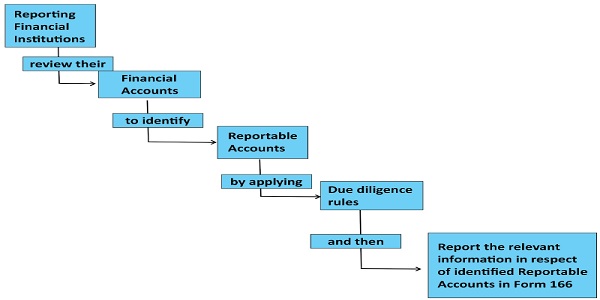
The process can be summarised in five steps:
CHAPTER 2:
REPORTING FINANCIAL INSTITUTIONS
2.1 Introduction
The reporting obligation applies to entities that qualify as Reporting Financial Institutions (RFIs). These may be legal persons or legal arrangements such as a company, a trust, a partnership, etc.
RFI is defined in Rule 238(8) of the Income-tax Rules, 2026 to mean:
a) a financial institution (other than a non-reporting financial institution) which is resident in India, but excludes any branch of such institution, that is located outside India; and
b) any branch, of a financial institution (other than a non-reporting financial institution) which is not resident in India, if that branch is located in India;
Non-Reporting Financial Institutions are excluded even where they otherwise meet the above conditions (see section 2.5).
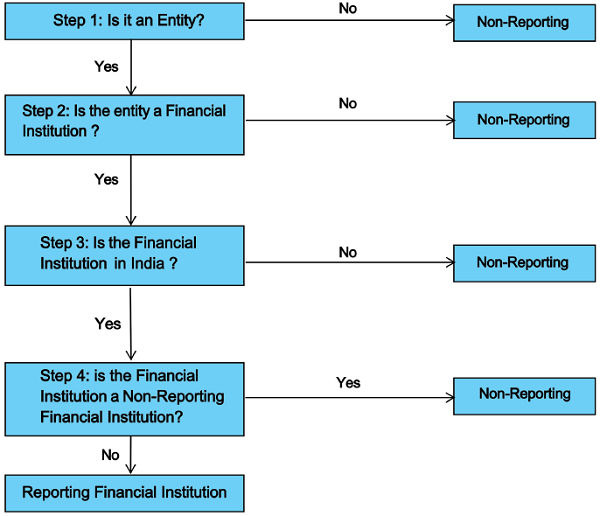
Following Steps may be followed to determine whether a person is a RFI and thus has reporting obligations:
Figure : The steps to identify a Reporting Financial Institution
2.2 Step 1: Is it an Entity?
Only Entities can be RFIs. The term ‘Entity’ includes legal persons and legal arrangements such as corporations, partnerships, trusts, foundations and HUFs. Individuals (including sole proprietorships) are not RFIs.
2.3. Step 2: Is the Entity a Financial Institution?
A Financial Institution is defined in Rule 238(3) as one of four categories- a custodial institution, a depository institution, an investment entity, or a specified insurance company. Each of these is further defined in the Explanation to Rule 238(3) as below
2.3.1 Custodial Institution
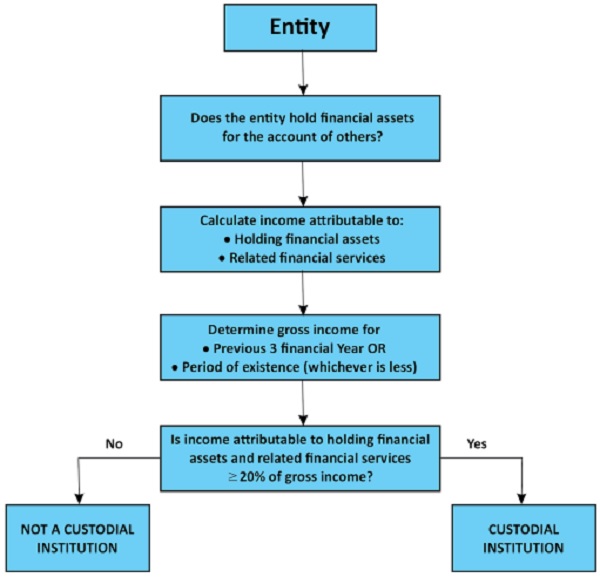
Custodial Institution is defined in Explanation (a) to Rule 238(3) as any entity which satisfies the following two conditions–
-it holds, as a substantial portion of its business, financial assets for the account of others and
-where its income attributable to the holding of financial assets and related financial services equals or exceeds twenty per cent of its gross income during the three financial years preceding the year in which determination is made or the period during which the entity has been in existence, whichever is less
Entities such as central securities depositories (CDSL, NSDL), custodian banks, brokers and depository participants would be generally considered Custodial Institutions.
Figure: Steps to identify a Custodial Institution
(Ref: Pages 16 & 82 of “Consolidated text of the Common Reporting Standard”; OECD, 2025 )
2.3.2 Depository Institution
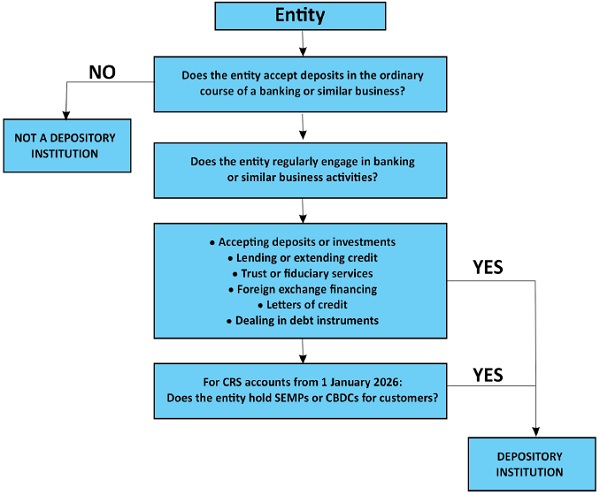
Depository Institution is defined in Explanation (b) to Rule 238(3) to mean any entity that accepts deposits in the ordinary course of a banking or similar business.
An Entity is considered to be engaged in a “banking or similar business” if, in the ordinary course of its business with customers, it regularly engages in activities such as:
(a) accepts deposits or other similar investments of funds;
(b) makes personal, mortgage, industrial, or other loans or provides other extensions of credit;
(c) purchases, sells, discounts, or negotiates accounts receivable, installment obligations, notes, drafts, checks, bills of exchange, acceptances, or other evidences of indebtedness;
(d) issues letters of credit and negotiates drafts drawn thereunder;
(e) provides trust or fiduciary services;
(f) finances foreign exchange transactions; or
(g) enters into, purchases, or disposes of finance leases or leased assets.
Effective from 1 January 2026, for an account other than a U.S. reportable account, “depository institution” shall also include an entity that holds specified electronic money products or central bank digital currencies for the benefit of customers. Savings banks, commercial banks, cooperative banks, credit unions, savings and loan associations, digital payment platforms holding SEMPs, and entities holding CBDCs for retail customers would generally be considered Depository Institutions.
2.3.2.1 Specified Electronic Money Product (SEMP):
As per Section 238(10) of Income-tax Rules 2026, “specified electronic money product” means any product that satisfies following criteria-
(i) it is a digital representation of a single fiat currency;
(ii) it is issued on receipt of funds for the purpose of making payment transactions;
(iii) it is represented by a claim on the issuer denominated in the same fiat currency;
(iv) it is accepted in payment by a natural or legal person other than the issuer; and
(v) it is redeemable at any time and at par value for the same fiat currency upon request of the holder of the product, by virtue of regulatory requirements to which the issuer is subject to,
but does not include a product created for the sole purpose of facilitating the transfer of funds from a customer to another person pursuant to instructions of the customer.
2.3.2.2 Central Bank Digital Currency (CBDC):
As per Section 241(10) (c) of Income-tax Rules 2026, “Central Bank Digital Currency” means any digital fiat currency issued by a Central Bank.
(Ref: Pages 17 & 87-88 of “Consolidated text of the Common Reporting Standard”; OECD, 2025 )
As per IT Rules 2026/ CRS 2025 : Mobile wallet operators and e-money issuers that hold SEMPs for customers are Depository Institutions. CBDC custodians for retail customers are also Depository Institutions.
Figure: Steps to identify a Depository Institution
(Ref: Pages 16 & 83 of “Consolidated text of the Common Reporting Standard”; OECD, 2025 )
2.3.3 Investment Entity
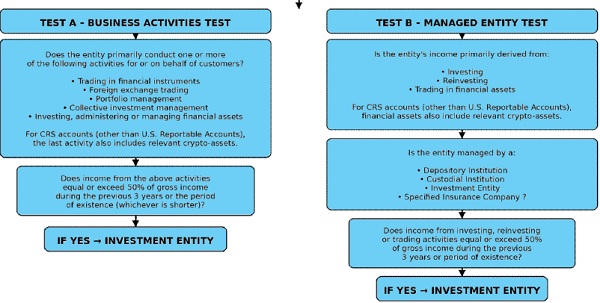
Investment entity is defined in Explanation (c) to Rule 238(3). The two types of investment entities are as below:
A. Entity’s primary business consists of one or more of the following activities for or on behalf of
-
-
- a customer, namely: –
- trading in money market instruments (cheques, bills, certificates of deposit, derivatives, etc.); foreign exchange; exchange, interest rate and index instruments; transferable securities; or commodity futures trading; or
- individual and collective portfolio management; or
- otherwise investing, administering, or managing financial assets or money or relevant crypto-assets (only for CRS1 ) on behalf of other persons; and
- the gross income attributable to such relevant activities is equal or more than 50% of the entity’s gross income over the shorter of the three-year period ending on 31st March of the year preceding the year in which the determination is made, or the period during which the entity has been in existence.
-
B. Entity’s primary income is from the business of investing, reinvesting, or trading in financial assets (or relevant crypto-assets in case of CRS2 ) and such entity is managed by another entity that is a depository institution, a custodial institution, an investment entity or a specified insurance company, and also the gross income of the entity from such business activities is more than 50% of the entity’s gross income over the shorter of the three-year period ending on 31st March of the year preceding the year in which the determination is made, or the period during which the entity has been in existence.
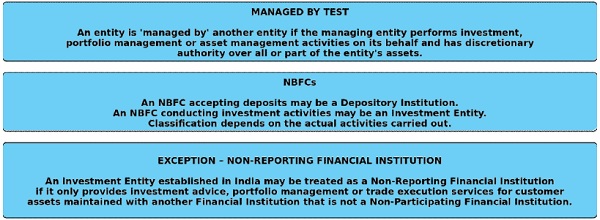
An Entity is “managed by” another Entity if the managing Entity performs, either directly or through another service provider, any of the activities or operations described in subparagraph A above, on behalf of the managed Entity. However, an Entity does not manage another Entity if it does not have discretionary authority to manage the Entity’s assets (in whole or part). Where an Entity is managed by a mix of Financial Institutions, NFEs or individuals, the Entity is considered to be managed by another Entity that is a Depository Institution, a Custodial Institution, a Specified Insurance Company, or an Investment Entity described in subparagraph A above, if any of the managing entities is such another entity.
Non-Banking Finance Companies (NBFCs) will be either depository institution or investment entity as per its activities. NBFC which accepts deposit in the course of a banking business or a similar business as mentioned in the definition of depository institution will be considered as Depository Institution and will report accordingly. An NBFC which is working as investment entity, will report accordingly.
It is clarified that the terms and phrases used in the definition of investment entity shall be interpreted in a manner consistent with similar language set forth in the definition of “financial institution” in the Financial Action Task Force Recommendations (as adopted in 2012 and as further updated from time to time).
Exception
An investment entity established in India that is a financial institution, will be treated as Non-Reporting Financial Institution (See para 2.5), if it only
(i) renders investment advice to, and acts on behalf of; or
(ii) manages portfolios for, and acts on behalf of; or
(iii) executes trades on behalf of,
a customer for the purposes of investing, managing, or administering funds or securities deposited in the name of the customer with a financial institution other than a non-participating financial institution. (Ref: Rule 238(5) (f) of the Income-tax Rules, 2026)
DID YOU KNOW ? NBFCs that accept deposits in the course of a banking or similar business are Depository Institutions. NBFCs operating as investment entities (portfolio management, asset management) are Investment Entities. An NBFC may qualify as both; in that case, it should register for all applicable categories and file Form 166 for all account types it maintains.
Figure: Steps to identify an Investment Entity
2.3.4 Specified Insurance Company
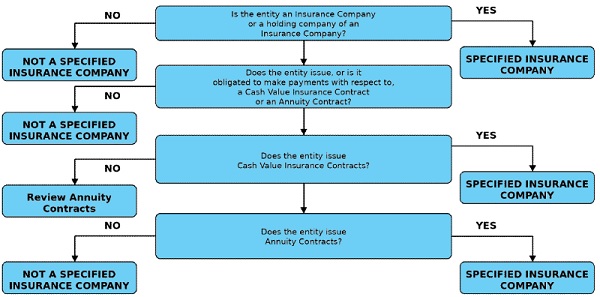
Specified Insurance Company is defined in Explanation (d) to Rule 238(3) to mean any entity that is an insurance company (or the holding company of an insurance company) that issues, or is obligated to make payments with respect to, a Cash Value Insurance Contract or an Annuity Contract.
A “cash value insurance contract” is defined in Explanation (f) of Rule 238(1) and it means an insurance contract (other than an indemnity reinsurance contract between two insurance companies) that has a cash value. For US Reportable account, a threshold of USD 50,000 has been provided.
Similarly, annuity contract has been defined in Explanation (e) of Rule 238(1).
A single premium life insurance contract which does not permit an amount to be paid on surrender or termination of the contract and which does not allow amounts to be borrowed under or with regard to the contract, shall not constitute a cash value insurance contract.
Insurance companies that only provide General Insurance or term Life Insurance should not be Financial Institutions and neither will reinsurance companies that only provide indemnity reinsurance contracts.
2.3.5 Institutions which are involved in more than one category of activity
If a reporting entity qualifies for more than one category of financial institutions [e.g. (i) Depository Institution (ii) Custodial Institution] then the reporting entity should get registered for all different categories and submit different Form 166 for different type of financial institutions.
There may be a situation in which one FI maintains more than one type of accounts [for example both Depository as well as Custodial account], however, the FI may qualify as only one type of financial institution. In this case, FI shall register only as one type of financial institution but will report both types of accounts.
For example, there may be one financial institution X which qualifies only as Depository Institution and maintains both depository as well as custodial accounts. X will get registered only as Depository Institution but will report both types of accounts – depository as well as custodial accounts.
2.4 Step 3: Is the Financial Institution in India?
The Financial Institutions resident in India, their branches located in India and branches of Foreign Financial Institutions that are located in India are the Reporting Financial Institutions (RFIs) while Foreign Financial Institutions, their foreign branches and foreign branches of Indian Financial Institutions are not treated as RFI. A “branch” is a unit, business, or office of a Financial Institution that is treated as a branch under the regulatory regime of a jurisdiction or that is otherwise regulated under the laws of a jurisdiction as separate from other offices, units, or branches of the Financial Institution. A branch includes a unit, business, or office of a Financial Institution located in a jurisdiction in which the Financial Institution is resident, and a unit, business, or office of a Financial Institution located in the jurisdiction in which the Financial Institution is created or organised. All units, businesses, or offices of a Reporting Financial Institution in a single jurisdiction shall be treated as a single branch.
In the case of Trusts, the reporting requirement is on the Trustees resident in India, unless the required information is being reported elsewhere because the trust is treated as resident there.
(Ref: Pages 15 & 81 of “Consolidated text of the Common Reporting Standard”; OECD, 2025 )
2.5 Step 4: Is it a Non-Reporting Financial Institution?
There are certain FIs which are not required to maintain or report the information and these are called Non-Reporting Financial Institutions (NRFIs). The following are the categories of NRFIs in India as per Rule 238(5) of Income-tax Rules, 2026, read with the explanations:
| Category of NRFI | Description |
|---|---|
| (a) Governmental Entity, International Organisation or Central Bank | Exempt as a general rule, subject to two exceptions where they are treated as RFIs: (i) where a payment is derived from an obligation held in connection with a commercial financial activity of the type engaged in by a specified insurance company, custodial institution, or depository institution; or (ii) where a Central Bank maintains Central Bank Digital Currencies (CBDCs) for account holders who are not financial institutions, governmental entities, international organisations, or central banks (applies to non-US reportable accounts only). |
| (b) Retirement Funds | Treaty Qualified Retirement Fund (applies to U.S. reportable accounts only)**; Broad Participation Retirement Fund; Narrow Participation Retirement Fund; or Pension Fund of a Governmental Entity, International Organisation, or Central Bank. |
| (c) Indian Public Sector Funds | Non-public fund of the armed forces**; Employees’ State Insurance Fund; gratuity fund**; or provident fund. |
| (d) Certain Wholly-owned Investment Entities such as – | An entity that is an Indian financial institution solely because it is an investment entity, provided that each direct equity interest holder is a financial institution falling under (a) to (c) above, and each direct debt interest holder is either a depository institution (in respect of a loan made to the entity) or a financial institution falling under (a) to (c) above. |
| (e) Qualified Credit Card Issuer | A qualified credit card issuer, as defined. |
| (f) Certain Investment Advisory and Portfolio Management Entities | An investment entity established in India that is a financial institution solely because it: (i) renders investment advice to, and acts on behalf of; or (ii) manages portfolios for, and acts on behalf of; or (iii) executes trades on behalf of, a customer for the purpose of investing, managing, or administering funds or securities deposited in the name of the customer with a financial institution other than a non-participating financial institution. |
| (g) Exempt Collective Investment Vehicle | An exempt collective investment vehicle, as defined. |
| (h) Trustee-Documented Trust | A trust established under any law for the time being in force, to the extent that the trustee is a Reporting Financial Institution and reports all information required under Rule 239 in respect of all reportable accounts of the trust. |
| (i) Financial Institution with a Local Client Base | Applies to US Reportable Accounts only. |
| (j) Local Bank | Applies to US Reportable Accounts only. |
| (k) Financial Institution with Only Low Value Accounts | Applies to US Reportable Accounts only. |
| (l) Sponsored Investment Entity and Controlled Foreign Corporation | Applies to US Reportable Accounts only. |
| (m) Sponsored Closely Held Investment Vehicle | Applies to US Reportable Accounts only. |
| (n) Qualified Non-Profit Entity | An entity established and operated exclusively for religious, charitable, scientific, artistic, cultural, athletic, or educational purposes, and satisfying certain conditions laid down in Explanation (S) to Rule 238(S) of Income-tax Rules 2026, confirmed as such by the Income Tax Department or other governmental authority of India. It applies to non-US reportable accounts only. |
Treaty Qualified Retirement Fund
A Treaty Qualified Retirement Fund means a fund established in India which is entitled to benefits under the agreement between India and USA on income derived from sources within the United States of America (or would be so entitled if it derived such income), as a resident of India satisfying any applicable limitation on benefits requirement, and which is operated principally to administer or provide pension or retirement benefits. Such a fund is a Non-Reporting Financial Institution under Rule 238(5) of the Income-tax Rules, 2026 and an exempt beneficial owner under paragraph II(A) of Annex II to the FATCA-IGA. The CRS has no corresponding category. A Treaty Qualified Retirement Fund shall not be treated as a Non-Reporting Financial Institution in respect of any reportable account other than a U.S. reportable account, and must therefore determine its status afresh under Rule 238 and discharge its obligations as an RFI for such accounts. Accounts held in such a fund may nonetheless qualify as Excluded Accounts where the conditions prescribed for retirement or pension accounts are satisfied.
** Reference is drawn to CBDT’s clarification dated 23.07.2023 regarding the classification of specific entities as non-reporting financial institutions under Rule 114F(5) of the Income-tax Rules, 1962 (Rule 238(5) of the Income-tax Rules, 2026)
(Ref: Pages 18 & 88 of “Consolidated text of the Common Reporting Standard”; OECD, 2025)
2.6 NPS Trust as a Reporting Financial Institution
National Pension System Trust (NPS Trust) is the nodal point for co-ordination of the operations of all intermediaries and is responsible for monitoring and evaluation of all operational and service level activities of all intermediaries in accordance with the provisions of the PFRDA Act, 2013 or the regulations made or guidelines or circulars issued by the Authority.
The Board of Trustees is also responsible with regard to taking of action on reports submitted by the intermediaries in order to ensure compliance with the regulations applicable to them under the National Pension System. Accordingly, the NPS Trust is the RFI and would report the information for the relevant NPS Investors.
CHAPTER 3:
FINANCIAL ACCOUNTS
3.1 Introduction
A Financial Account is an account maintained by a Financial Institution. RFIs must review all Financial Accounts to identify Reportable Accounts. Certain low-risk account types are excluded from review and are called Excluded Accounts.
3.2 Categories of Financial Accounts
Financial Account is defined in Rule 238(1). The different types of financial accounts and the financial institutions which maintains such financial account are given below:-
| Account Type | Account generally maintained by |
|---|---|
| Depository Account | The Financial Institution that is obligated to make payments with respect to the account (excluding an agent of a Financial Institution).
E.g. – Banks, payment institutions |
| SEMP Depository Account | E-money issuers and digital payment platforms holding SEMPs for customers |
| CBDC Account | Central Banks (retail CBDC) and any entity holding CBDCs on behalf of customers |
| Custodial Account | Custodian banks, brokers, depository participants |
| Equity or Debt Interest in certain Investment Entity | The equity or debt interest in a Financial Institution is maintained by that Financial Institution. |
| Cash Value Insurance Contract | Specified Insurance Companies |
| Annuity Contract | Specified Insurance Companies |
A Financial Institution may maintain more than one type of Financial Account. For example, a Depository Institution may maintain Custodial Accounts as well as Depository Accounts.
3.3 Financial Account Definitions
3.3.1 Depository Account
A Depository Account includes any commercial, checking, savings, time, or thrift account, or an account that is evidenced by a certificate of deposit, thrift certificate, investment certificate, certificate of indebtedness, or other similar instrument maintained by a financial institution in the ordinary course of a banking or similar business.
For an account other than a U.S. reportable account, the phrase “financial Institution in the ordinary course of a banking or similar business” shall be substituted by the phrase “depository institution”;
A Depository Account includes an amount that an insurance company holds under an agreement to pay or credit interest thereon.
A Depository Account does not have to be an interest bearing account.
With effect from 1 January 2026, for a non-US reportable account, a Depository Account also includes:
(i) a notional account or an account representing all Specified Electronic Money Products held for the benefit of a customer by an entity that holds such products in the ordinary course of its business; and
(ii) an account holding one or more Central Bank Digital Currencies for the benefit of a customer.
(Reference: Rule 238(1)(a) Explanation (A) and (B)(i) and (ii), Income-tax Rules 2026)
(Ref: Pages 21 & 98 of “Consolidated text of the Common Reporting Standard”; OECD, 2025)
3.3.2 Custodial Account
Custodial Account which means an account (other than an insurance contract or annuity contract) for the benefit of another person that holds one or more financial assets.
Custodial account would also include Mutual Fund holding in De-materialized format which would be required to be reported by depository/depository participant only. If mutual fund units are held in a physical format, the entity issuing the units will be responsible for reporting such custodial accounts.
3.3.3 Equity and Debt Interest
Equity and debt interests are financial accounts if they are interests in an investment entity.
3.3.3.1 An equity interest may vary depending on the nature of the investment entity. Equity interest in an investment entity, being –
(a) a partnership firm means either a capital or profits interest in the partnership firm;
(b) a trust means any interest held by any person treated as a settlor or beneficiary of all or a portion of the trust, or any other natural person exercising ultimate effective control over the trust. A person will be treated as a beneficiary of a trust if he has the right to receive directly or indirectly a mandatory distribution or may receive, directly or indirectly, a discretionary distribution from the trust.
With effect from 1 January 2026, as per Rule 238(1)(iii) read with Explanation (c)(A)(iii)(a) of Rule 238(3), for accounts other than US Reportable Accounts, equity and debt interests in an investment entity that invests in or manages Relevant Crypto-Assets also constitute Financial Accounts and are required to be reported accordingly.
3.3.3.2 However, a Financial Account will not include any equity or debt interest in an entity that is an investment entity solely because it –
(a) renders investment advice to, and acts on behalf of; or
(b) manages portfolios for, and acts on behalf of,
a customer for the purpose of investing, managing, or administering financial assets deposited in the name of the customer with a financial institution that is not a non-participating financial institution other than such entity.
Therefore, equity interests in an Investment Entity which is only an investment advisor or investment manager are not Financial Accounts.
3.3.3.3 Examples of an Investment Entity can be a collective investment vehicle, mutual fund, exchange traded fund, private equity fund, hedge fund, venture capital fund, leveraged buyout fund, or any similar investment vehicle established with an investment strategy of investing, reinvesting, or trading in Financial Assets. With effect from 1 January 2026, as per Rule 238(3), Explanation (c)(A) (iii)(a) of Income-tax Rules 2026, for CRS reportable accounts, the phrase ‘financial assets’ shall be substituted by ‘financial assets or relevant crypto-assets’. Accordingly, for CRS reportable accounts, an entity that primarily conducts, as a business, the activity of investing, reinvesting or trading in Relevant Crypto-Assets for or on behalf of customers also qualifies as an Investment Entity, but shall not include services effectuating exchange transactions for or on behalf of customers ..
3.3.3.4 There may be some situations in which a Financial Institution can circumvent reporting under Rule 239. Therefore, it has been expressly stated that if a class of interests was established for the avoidance of reporting, that class of interest will be a Financial Account and will be reported.
3.3.3.5 Debt or equity interests in a financial institution would constitute Financial Accounts if:
-
-
- the value of such interests is determined primarily by reference to assets that give rise to US Source Withholdable Payments; and
- the class of interests was established for the avoidance of reporting under the Agreement.
-
(Ref: Pages 21 & 96 of “Consolidated text of the Common Reporting Standard”; OECD, 2025)
3. 3.4 Cash Value Insurance Contracts
Insurance contract means a contract under which the issuer agrees to pay an amount upon the occurrence of a specified contingency involving mortality, morbidity, accident, liability, or property risk.
Cash value insurance contract means an insurance contract (other than an indemnity reinsurance contract between two insurance companies) that has a cash value and in case of a U.S. reportable account such value is greater than an amount equivalent to USD 50,000.
Generally, Cash Value Insurance Contract is a type of investment product that has an element of life insurance attached to it. The life insurance element is often small compared to the investment element of the contract. Policyholder is entitled to receive payment on surrender or termination of the contract.
Cash Value Insurance Contracts do not include:
-
-
- Indemnity insurance contracts between insurance companies
- Term life insurance contracts
- Property or motor insurance
- Policies indemnifying against economic loss arising from specified circumstances, for example personal injury, theft, etc.
- Micro insurance contracts that do not have a cash value
-
(Ref: Pages 22 & 74 of “Consolidated text of the Common Reporting Standard”; OECD, 2025)
3.3.5 Annuity Contracts
Annuity contract means a contract under which the issuer agrees to make payments for a period of time determined in whole or in part by reference to the life expectancy of one or more individuals.
It also includes a contract that is considered to be an annuity contract in accordance with the law, regulation, or practice of the country or territory in which the contract was issued, and under which the issuer agrees to make payments for a term of years.
(Ref: Pages 22 & 100 of “Consolidated text of the Common Reporting Standard”; OECD, 2025
3.4 Excluded Accounts
3.4.1 There are few categories of financial accounts which have low risk of being used to evade tax and thus have been excluded from the need to be reviewed or reported. These accounts are called “Excluded Accounts”. They are listed in Explanation (h) to Rule 238(1) of the Income-tax Rules, 2026:
| Category of Excluded Account | Description |
|---|---|
| (i) Retirement or | Account regulated as a personal retirement or pension account |
| Pension Account | (including disability or death benefits); tax-favoured; information
reporting required; withdrawals conditioned on retirement age, |
| (ii) Non-Retirement Tax-Favoured Savings or Investment Account | Account regulated as a tax-favoured savings vehicle for non-retirement purposes, or (non-US accounts only) an investment vehicle regularly traded on an established securities market; contributions tax-favoured; withdrawals conditioned on specific criteria (e.g., education or medical benefits); annual contributions < USD 50,000. Transfers from other qualifying accounts do not disqualify the account. |
| (iii) Senior Citizens Savings Scheme Account | Account established under the Senior Citizens Savings Scheme Rules, 2004 (Government Savings Banks Act, 1873). |
| (iv) Certain Life Insurance Contracts | Life insurance contract with coverage ending before age 90; periodic premiums payable at least annually and not decreasing over time; no accessible cash value without terminating the contract; cancellation amount does not exceed aggregate premiums paid less applicable charges; not held by a transferee for value. |
| (v) Estate Account | Account held solely by an estate; documentation includes a copy of the deceased’s will or death certificate. |
| (vi)(A) Court Order or Judgment Account | Account established in connection with a court order or judgment. |
| (B) Sale, Exchange or Lease of Property Account | Account funded solely with a down payment, earnest money, or similar payment in connection with a sale, exchange, or lease of real or personal property; used solely to secure obligations of the parties; assets distributed upon completion or termination of the transaction; not a margin account; not associated with a credit card overpayment account. |
| (C) Loan Servicing Taxes or Insurance | Obligation of a financial institution servicing a loan secured by real property to set aside amounts solely to facilitate payment of taxes or insurance related to the property at a later time. |
| (D) Tax Payment Facilitation Account | Obligation of a financial institution solely to facilitate payment of taxes at a later time. |
| (E) Foundation or Capital Increase Account |
For non-US accounts only. Account used exclusively to deposit capital for the foundation or capital increase of a company as prescribed by law; amounts blocked until independent confirmation obtained; account closed or converted into a company account after the event; repayments from a failed transaction made solely to contributing persons; account not established more than 12 months ago. |
| (vii) Credit Card Overpayment Account | For non-US accounts only. Depository account existing solely because a customer overpays a credit card or revolving credit facility balance and the overpayment is not immediately returned; financial institution has implemented policies from on or before 31 December 2015 to prevent or refund overpayments exceeding USD 50,000 within sixty days. |
| (viii) Low-Value Specified Electronic Money Product Account | For non-US accounts only. Depository account representing all Specified Electronic Money Products held for a customer; rolling average 90-day end-of-day aggregate balance did not exceed USD 10,000 at any day during the calendar year or other appropriate reporting period. |
(Ref: Pages 23 & 103 of “Consolidated text of the Common Reporting Standard”; OECD, 2025)
CHAPTER 4:
REPORTABLE ACCOUNTS
4.1 What is a Reportable Account?
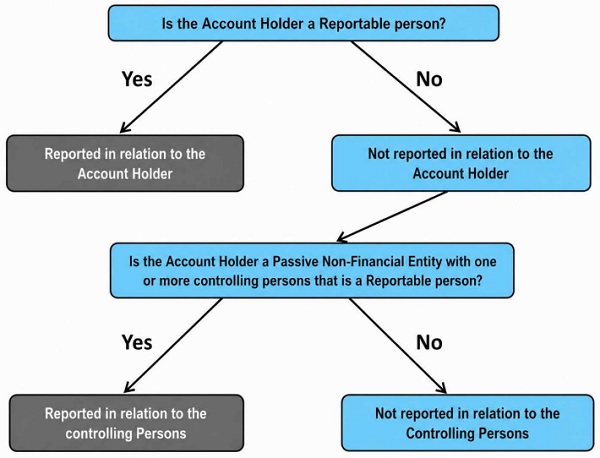
4.1.1 A Reportable Account is a Financial Account identified, through due diligence by the RFI, as held by one or more Reportable Persons or by a non-US entity with one or more Controlling Persons that is a specified U.S person or by a Passive NFE with one or more Controlling Persons who are Reportable Persons [Rule 238(6) of Income-tax Rules, 2026].
As per Explanation (a) (B)(i) and (ii) of Rule 238(1) and Rule 238(6) of Income-tax Rules 2026, from 1 January 2026, accounts relating to Specified Electronic Money Products and Central Bank Digital Currency are also Financial Accounts and hence may become Reportable Accounts.
4.1.2 Once a RFI has identified the Financial Accounts maintained by them, they are required to review those accounts to identify whether any of them are Reportable Accounts. If any of the financial account is found to be reportable account, information in relation to those accounts must be reported in Form 166.
4.1.3 In general terms, a Reportable Account means an account, which has been identified pursuant to the due diligence procedure, as held by
(a) a reportable person; or
(b) an entity, not based in United States of America, with one or more controlling persons that is a specified U.S. person; or
(c) a passive non-financial entity (passive NFE) with one or more controlling persons who are reportable persons.
4.1.4 Thus, an account can be a Reportable Account by virtue of the Account Holder or by virtue of the Account Holders’ Controlling Persons. This can be depicted as per following diagram:
4.2 Reportable Person
Rule 238(6) states that “reportable account” is a financial account which has been identified, pursuant to the due diligence procedures prescribed in Rule 240, as held by a reportable person.
Reportable person means –
(a) one or more specified U.S. persons; or
(b) one or more persons other than:
i. an entity the stock of which is regularly traded on one or more established securities markets;
ii. any entity that is a related entity of an entity described in item (i);
iii. a Governmental entity;
iv. an International organisation;
v. a Central bank; or
vi. a financial institution,
that is a resident of any country or territory outside India (except the United States of America) under the tax laws of such country or territory, or an estate of a decedent that was a resident of any country or territory outside India (except the United States of America) under the tax laws of such country or territory.
Thus, generally speaking, there are two types of reportable person. The first has been defined specifically for the USA for the purpose of FATCA. The second is for other jurisdictions for the purpose of CRS.
A specified U.S. Person means a U.S. person, other than the persons referred to in sub-clauses (i) to (xiii) of clause (ff) of Article 1 of the IGA.
A U.S. Person means-
(a) an individual, being a citizen or resident of the United States of America;
(b) a partnership or corporation organised in the United States of America or under the laws of the United States of America or any State thereof;
(c) a trust if –
(i) a court within the United States of America would have authority under applicable law to render orders or judgments concerning substantially all issues regarding administration of the trust; and
(ii) one or more U.S. persons have the authority to control all substantial decisions of the trust; or
(d) an estate of a decedent who was a citizen or resident of the United States of America.
Specified U.S. Person means a U.S. Person, other than the persons referred to in sub-clauses (i) to (xiii) of clause (ff) of Article 1 of the India-USA IGA.
(Ref: Pages 26 & 110 of “Consolidated text of the Common Reporting Standard”; OECD, 2025)
4.3 Reportable Accounts by virtue of the Account Holder’s Controlling Persons
4.3.1 Regardless of whether the Financial Account is a Reportable Account by virtue of the Account Holder, a second test in relation to the Controlling Persons of certain Entity Account Holders needs to be applied to ascertain whether the Controlling Persons of such Entities are residents of countries/ territories outside India. If this test is satisfied, the account would be Reportable Account.
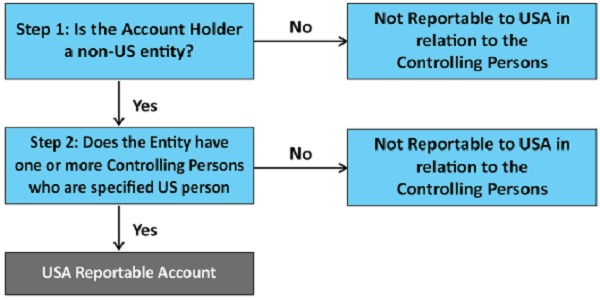
4.3.2 In case of USA, first it needs to be identified whether account is held by an entity, which is not based in USA and if yes, whether one or more controlling person of entity is specified U.S. person. If both of conditions are satisfied, the account will be US Reportable Account. This can be depicted as per following diagram:
4.3.3 In the case of other countries/territories, if the account is held by a Passive Non-Financial Entity (NFE) with one or more controlling persons resident in a country/territory outside India, then the account will be reportable. This can be depicted as per the following diagram:
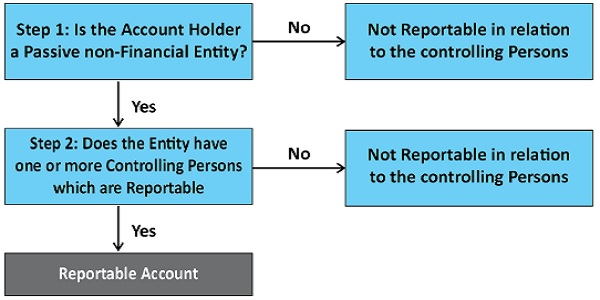
4.3.4 A Non-Financial Entity (NFE) is an entity which is not a financial institution. There are two types of NFE – active and passive. The distinction is important since a financial institution in India is required to apply a higher standard of due diligence to financial accounts held by a passive NFE. The financial institution is required to determine whether the passive NFE is controlled by one or more Reportable Persons. Active NFE has been defined in Explanation (A) to Rule 238(6) and includes regularly traded entities and others as described in para 4.3.5 below.
4.3.5 Passive NFE is defined in Explanation (D) of Rule 238(6) of the Income-tax Rules 2026 as –
(i) any non-financial entity which is not an active non-financial entity; or
(ii) an investment entity described in sub-clause (B) of clause (c) of the Explanation to clause (3), which is not located in any of the jurisdictions specified by the Central Board of Direct Taxes in this behalf; or
(iii) not a withholding foreign partnership or a withholding foreign trust;
4.3.6 The general rule is that a Passive NFE is an NFE that is not an Active NFE. The definition of Active NFE includes entities that are publicly traded (or related to a publicly traded entity), Governmental Entities, International Organisations, Central Banks, or holding NFEs of non-financial groups, and essentially excludes entities that primarily receive passive income or primarily hold assets that produce passive income (such as dividends, interest, rents, etc.).
However, an entity will not be an Active NFE if it functions or holds itself out as an investment fund, such as a private equity fund, venture capital fund, leveraged buyout fund, or any investment vehicle whose purpose is to acquire or fund companies and then hold interests in those companies as capital assets for investment purposes.
4.3.7 If the Entity Account Holder is a Passive NFE, then the Financial Institution must “look through” the entity to identify its Controlling Persons. If the Controlling Persons are Reportable Persons, then information in relation to the Financial Account must be reported, including details of the Account Holder and each Reportable Controlling Person.
4.4 Controlling Person
4.4.1 ‘Controlling Person’ is defined in Explanation (B) to Rule 238(6) of Income-tax Rules, 2026.
Controlling person means the natural person who exercises control over an entity and includes a beneficial owner as determined under sub-rule (3) of rule 9 of the Prevention of Money-laundering (Maintenance of Records) Rules, 2005. It has been specified that in determining the beneficial owner, the procedure specified in the following circular as amended from time to time shall be applied, namely:-
i. AML.BC. No.71/14.01.001/2012-13, issued on the 18th January, 2013 by the Reserve Bank of India; or
ii. CIR/MIRSD/2/2013, issued on the 24th January, 2013 by the Securities and Exchange Board of India; or
iii. IRDA/SDD/GDL/CIR/019/02/2013, issued on the 4th February, 2013 by the Insurance Regulatory and Development Authority.
4.4.2 Controlling person includes beneficial owner. For different type of entities, beneficial owner is described as below:
| Entity | Beneficial Owner is natural person(s) who whether acting alone or together, or through one or more juridical person |
|---|---|
| Company | has a controlling ownership interest (>25%) or who exercises control through right to appoint majority of the directors or to control the management or policy decisions including by virtue of their shareholding or management rights or shareholders agreements or voting agreements |
| Partnership Firm | has ownership of/entitlement to more than fifteen per cent (15 %) of capital or profits of the partnership |
| Unincorporated or Body of Association Individuals | has ownership of or entitlement to more than fifteen per cent (15 %) of the property or capital or profits of such association or body of individuals |
4.4.3 Where no natural person is identified as above, the beneficial owner is the relevant natural person who holds the position of senior managing official.
4.4.4 Where the client or the owner of the controlling interest is a company listed on a stock exchange, or is a subsidiary of such a company, it is not necessary to identify and verify the identity of any shareholder or beneficial owner of such companies.
4.4.5 In the case of a trust, the controlling person means the settlor, the trustees, the protector (if any), the beneficiaries or class of beneficiaries, and any other natural person exercising ultimate effective control over the trust, and in the case of a legal arrangement other than a trust, the said expression means the person in equivalent or similar position. If the settlor, trustee, protector, or beneficiary is an Entity, the Reporting Financial Institution must identify the Controlling Persons of such Entity as discussed above.
COMPLIANCE
The beneficial ownership threshold prescribed under Rule 9(3) of the PML (Maintenance of Records) Rules, 2005 for trust beneficiaries (currently 10% or more), does NOT apply for CRS or FATCA purposes. All beneficiaries of a trust must be treated as Controlling Persons, regardless of the size of their interest.
[CBDT Clarification dated 30 July 2020, placed at Section : References at Page 123]
4.4.6 Thus, if the Controlling Persons of a Passive NFE having an account in a Reporting Financial Institution are persons resident of a country/territory outside India, the account becomes a Reportable Account for all such countries/territories outside India , for which the controlling persons are tax resident. The details of the controlling person(s) will also be reportable to the respective country (ies) or territory (ies) outside India.
4.4.7 In the case of HUF, the financial account of HUF shall be treated as an entity account. The due diligence of HUF accounts will be same as prescribed under PMLA/ KYC procedures.
(Ref: Pages 27 & 115 of “Consolidated text of the Common Reporting Standard”; OECD, 2025)
4.5 Controlling Person Roles
4.5.1 From 1 January 2026, where an entity account is identified as having one or more Reportable Controlling Persons, the RFI must report – in addition to name, address, TIN, and DOB – the role by which each Controlling Person qualifies. The roles are:
| Role | Definition | Applicable to |
|---|---|---|
| Settlor | The person who has placed assets into the trust. May be a natural person or an entity (in which case, the Controlling Persons of the entity are treated as settlors). | Trusts |
| Trustee | The person(s) legally holding and managing trust assets. A corporate trustee is a Controlling Person regardless of whether it has practical discretion. | Trusts |
| Protector | A person (if any) who has the power to oversee the trustee, veto distributions, or otherwise influence the administration of the trust. | Trusts (where applicable) |
| Beneficiary | Any person entitled to receive mandatory distributions, or who may receive discretionary distributions, from the trust. ALL beneficiaries are Controlling Persons regardless of their percentage interest.
A person will be treated as a beneficiary of a trust if he has the right to receive directly or indirectly a mandatory distribution or may receive, directly or indirectly, a discretionary distribution from the trust. [Explanation to Rule 238(1)(c)(ii), Income-tax Rules 2026] |
Trusts |
| Other | Any natural person exercising ultimate effective control over the trust (or entity) through means other than the above roles. | Trusts and other legal arrangements |
| Controlling ownership interest | A natural person identified as a beneficial owner of the entity by virtue of direct or indirect ownership or entitlement in the entity, in accordance with the applicable AML/KYC requirements. | Companies |
| Control through management rights | A natural person with the right to appoint the majority of directors or control management/policy decisions. | Companies |
| Capital/profits interest | A natural person identified as a beneficial owner by virtue of a capital or profit-sharing interest in a partnership or similar arrangement. | Partnerships |
4.5.2 In all cases, the role of each Controlling Person should be recorded in the account management system in an electronically searchable field and not merely as free-text, so that the information can be extracted for inclusion in Form 166 at the time of reporting.
BEST PRACTICE RFIs should begin populating Controlling Person role fields in their core banking / account management systems now, so that they are ready to report roles for all Reportable Accounts from the CY 2027 filing onwards. Retroactively populating role data for large account portfolios is significantly more burdensome than capturing it at onboarding or during periodic AML/KYC reviews.]
4.5.3 Transitional measure: Under Rule 239(13) of the Income-tax Rules, 2026, for other than U.S. Reportable Accounts maintained as of 31 December 2025, Controlling Person role information need only be reported if it is available in the electronically searchable data maintained by the RFI, for reporting periods ending by 31 December 2027. After that date, the role must be reported for all Reportable Accounts.
(Ref: Pages 5 & 34 of “Consolidated text of the Common Reporting Standard”; OECD, 2025)
4.6 Centralized facilities for the clearing, settlement and deposit of securities
In India, an entity designated under federal legislation to provide centralized facilities for the clearing, settlement and deposit of securities, commonly referred to as a Clearing Corporation, will not be treated as maintaining financial accounts. In India, such entities are National Securities Clearing Corporation Ltd (NSCCL), Indian Clearing Corporation Ltd (ICCL) and MCX- SX Clearing Corporation Ltd (MCX-SXCCL).
CHAPTER 5:
DUE DILIGENCE PROCEDURE
5.1 Introduction
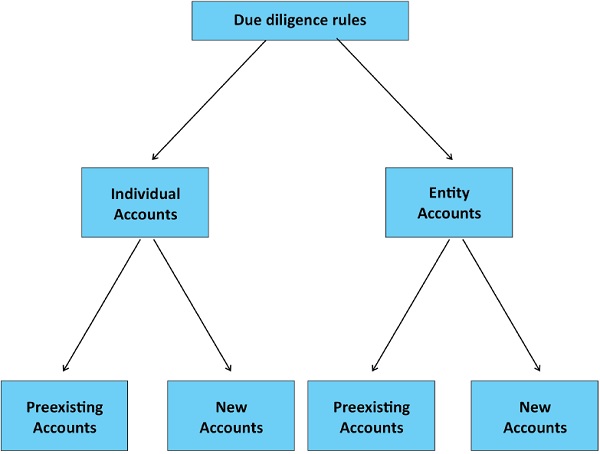
Reporting Financial Institutions (RFIs) are required to identify Reportable Accounts by carrying out due diligence procedures prescribed in Rule 240 of the Income-tax, 2026. There are different due diligence procedures for accounts held by individuals and accounts held by entities. There is a further classification of accounts as Pre-existing Accounts and New Accounts. This can be depicted as below:
The standardised approach to be applied for carrying out due diligence procedures ensures quality of information to be reported and exchanged. The rules also utilise the information available under existing processes such as those for Anti-Money Laundering purposes. This is particularly the case for Pre-existing Accounts where it is more challenging and costly for Financial Institutions to obtain new information from the Account Holder.
RFIs should record the date of identification of an account as a Reportable Account, which may be used for audit and compliance purposes.
5.2 Split Between Pre-existing Accounts and New Accounts
There are separate due diligence procedures for Pre-existing Accounts and New Accounts. These accounts are differentiated on the basis of cut-off dates. There are different cut-off dates for FATCA and CRS.
Pre-existing account means a Financial Account maintained by an RFI –
- in the case of a U.S. Reportable Account, as on 30 June 2014;
- in the case of other reportable accounts, as on 31 December 2015; and
- with effect from 1 January 2026, in the case of accounts that qualify as Financial Accounts solely by virtue of the CRS 2025 amendments, as on 31 December 2025. [Rule 240(2)(h), Income-tax Rules 2026]
New account means a Financial Account maintained by an RFI opened on or after –
- in the case of a U.S. Reportable Account, 1 July 2014;
- in the case of any other Reportable Account, the 1st January, 2016; or, if the account is treated as a Financial Account solely by virtue of the amendments to the Common Reporting Standard, on or after 1st January, 2026.
Note: For accounts that are treated as Financial Accounts solely by virtue of the CRS 2025 amendments – eg. accounts relating to Specified Electronic Money Products or Central Bank Digital Currencies, a Financial Account opened on or after 1 January 2026 is a New Account, and a Financial Account maintained as at 31 December 2025 is a Pre-existing Account.
[Reference: Rule 240(2)(d)(ii) and Rule 240(2)(h)(II) of Income-tax Rules 2026]
(Ref: Pages 23 & 101 of “Consolidated text of the Common Reporting Standard”; OECD, 2025)
The due diligence procedure is also dependent on the balance or value of the Financial Account. On the basis of balance or value, accounts are also classified as High Value and Lower Value accounts. This can be depicted in the following table:
| Classification of Accounts | Status | Value | Due Diligence Threshold |
|---|---|---|---|
| Pre-existing US (as on 30.06.2014) | Individual | High Value Account | Account balance or value exceeds USD 1,000,000 |
| Lower Value Account |
Account balance or value exceeds USD 50,000 but does not exceed USD 1,000,000 | ||
| Entity | NA | Account balance or value exceeds USD 250,000 |
| New US (opened after 30.06.2014) | Individual | NA | Account balance or value exceeds USD 50,000* |
| Entity | NA | No threshold | |
| Pre-existing Other (as on 31.12.2015) | Individual | High Value Account | Account balance or value exceeds USD 1,000,000 |
| Lower Value Account |
Account balance or value does not exceed USD 1,000,000 | ||
| Entity | NA | Account balance or value exceeds USD 250,000 | |
| New Other (opened after 31.12.2015) | Individual | NA | No threshold |
* Only for depository accounts and cash value insurance contracts
Note: For accounts which became financial accounts as per CRS 2025 amendment, the pre-existing account cut-off date is 31 December 2025 and the new account cut-off date is 1 January 2026. [Rule 240(2)(d) and (h), Income-tax Rules, 2026]
In the case of the USA, accounts opened from 1 July 2014 to the date of entry into force of the IGA between India and the USA (i.e., 31 August 2015), there is an alternate procedure for due diligence prescribed in Rule 240(8) of the Income-tax Rules 2026. This is further described in paragraph 5.9.
5.3 Due Diligence for Pre-existing Individual Accounts
There are separate due diligence procedures for High Value Accounts and Lower Value Accounts.
5.3.1 What is a High Value Account?
High Value Account is defined in Rule 240(2)(b) of the Income-tax Rules, 2026 as –
- In the case of U.S. Reportable Accounts: balance or value exceeding USD 1,000,000 as on 30 June 2014 or 31 December of any subsequent year.
- In the case of other reportable accounts: balance or value exceeding USD 1,000,000 as on 31 December 2015 or 31 December of any subsequent year.
Due Diligence Procedure
5.3.2 What is a Lower Value Account?
Lower Value Account is defined in Rule 240(2)(c) of the Income-tax Rules, 2026 as –
-
- In the case of U.S. Reportable Accounts: balance or value exceeds USD 50,000 but does not exceed USD 1,000,000 as on 30 June 2014 or 31 December of any subsequent year.
- In the case of other reportable accounts: does not exceed USD 1,000,000 as on 31 December 2015 or 31 December of any subsequent year.
Table: High Value and Lower Value Accounts
| Classification | Category | Balance or Value |
|---|---|---|
| U.S. Reportable | High Value | Balance exceeding USD 1,000,000 as on 30 June 2014 or 31 December of any subsequent year |
| Lower Value | Balance exceeding USD 50,000 but less than USD 1,000,000 as on 30 June 2014 or 31 December of any subsequent year | |
| Other Reportable | High Value | USD 1,000,000 as on 31 December 2015 or 31 December of any subsequent year |
| Lower Value | Balance less than USD 1,000,000 as on 31 December 2015 or 31 December of any subsequent year |
5.3.3 Accounts Not Required to be Reviewed or Reported
There are certain pre-existing individual accounts which are not required to be reviewed or reported. Rule 240(3)(a) of the Income-tax Rules, 2026 describes the criteria, which are as follows:
5.3.4 In the case of U.S. Reportable Accounts –
-
-
- if the account balance or value as on 30 June 2014 does not exceed USD 50,000;
- if the account is a Cash Value Insurance Contract or an Annuity Contract and the account balance or value as on 30 June 2014 does not exceed USD 250,000;
- if the account is a Cash Value Insurance Contract or an Annuity Contract and the RFI, under any other law for the time being in force in India or of the USA, is prevented from selling such contract to a person who is a resident of the USA.
-
5.3.5 In the case of other reportable accounts –
-
- if the account is a Cash Value Insurance Contract or an Annuity Contract and the RFI, under any other law for the time being in force in India, is prevented from selling such contract to a person who is not a tax resident of India.
- With effect from 1 January 2026: A Depository Account representing Specified Electronic Money Products where the rolling average 90-day end-of-day aggregate balance did not exceed USD 10,000 at any day during the calendar year is an Excluded Account and is not required to be reviewed or reported (non-US accounts only). [Rule 238(1)(h)(viii), of Income-tax Rules, 2026]
- All other accounts are required to be reviewed unless they are Excluded Accounts.
Thus it can be seen that while there is a threshold account balance below which pre-existing individual accounts are not required to be reviewed and reported under FATCA, there is no such threshold for CRS.
5.4 Due Diligence for Pre-existing Lower Value Individual Accounts
The due diligence procedure for lower value pre-existing individual accounts is prescribed in Rule 240(3)(b) of the Income-tax Rules, 2026.
5.4.1 RFIs must review their electronically searchable data to find out any of the following indicia:
-
- identification of the account holder as a resident of any country or territory outside India for tax purposes, or an unambiguous indication of a place of birth in the USA;
- current mailing or residence address (including a post office box) in any country or territory outside India;
- one or more telephone numbers in a country or territory outside India and no telephone number in India;
- standing instructions (other than with respect to a Depository Account in the case of CRS) to transfer funds to an account maintained in a country or territory outside India;
- currently effective power of attorney or signatory authority granted to a person with an address in a country or territory outside India;
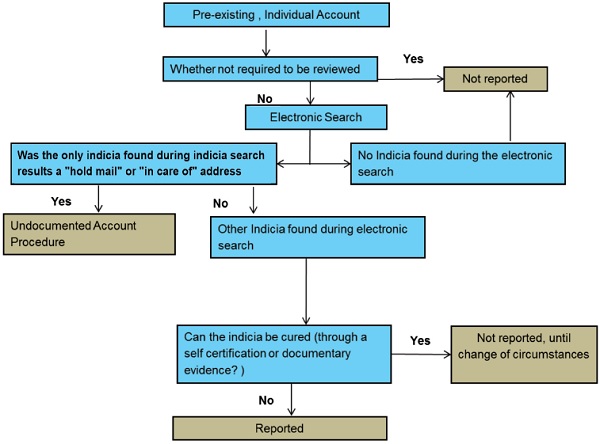
- a “hold mail” instruction or “in-care-of” address in a country or territory outside India if the RFI does not have any other address on file for the account holder.
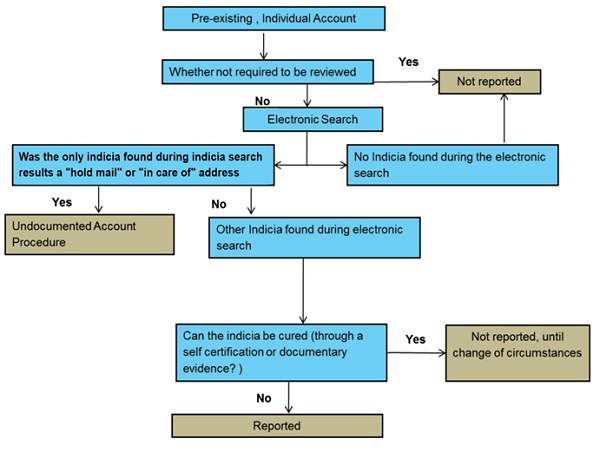
5.4.2 If none of the indicia are discovered in the electronic search, no further action is required unless –
-
- there is a change in circumstances which results in one or more indicia being associated with the account; or
- the account becomes a High Value Account.
If any indicia listed above are discovered in the electronic search, or if there is any change of circumstances which results in one or more indicia being associated with the account, then the RFI shall treat the account holder as a resident of each such country or territory for which an indicium is identified.
In cases where an RFI does not maintain an electronic database enabling a search, the RFI would be required to perform a paper search to identify the indicia.
5.4.3 Undocumented Account Procedure
However, if after the electronic search the only indicium found is a ‘hold mail’ or ‘in-care-of’ address, special procedures are applied and the RFI must –
-
- apply a paper record search; or
- obtain from the account holder a self-certification or documentary evidence to establish their residence.
If neither of these procedures successfully establishes the account holder’s residence for tax purposes, the RFI must report the account as an undocumented account.
5.4.4 Curing of Indicia
There may be occasions when the electronic record search gives indications of residence in any country or territory outside India that the RFI considers may be incorrect. In such circumstances, the RFI may take steps to ‘cure’ the information before treating the Account Holder as a Reportable Person.
Where the financial institution holds information about the Account Holder that includes any of the following –
-
- a current mailing address in any country or territory outside India;
- one or more telephone numbers in any country or territory outside India (and no telephone number in India);
- standing instructions to transfer funds to an account maintained in any country or territory outside India (other than with respect to a Depository Account in the case of CRS); or
- a currently effective power of attorney or signatory authority granted to a person with an address in any country or territory outside India;
then the RFI must obtain a self-certification from the Account Holder to establish the jurisdiction of residence. The RFI can rely on self-certifications it has previously reviewed and maintained a record of, but in either case the self-certification must be supported by Documentary Evidence. If the self-certification supported by Documentary Evidence establishes that the Account Holder is not a Reportable Person, the RFI is not required to treat the Account Holder as a Reportable Person.
5.4.5 Curing of Indicia (for U.S. Reportable Accounts)
In the case of a U.S. Reportable Account, indicia can be cured in one additional way. Where the indicium found is an unambiguous US place of birth, the RFI may decline to report the account if the RFI obtains or currently maintains a record of all of the following:
-
- a self-certification that the account holder is neither a citizen of the United States of America nor a resident thereof for tax purposes;
- a passport or other government-issued identification evidencing the account holder’s citizenship or nationality in a country other than the United States of America; and
- a copy of the account holder’s certificate of loss of nationality of the United States of America, or a reasonable explanation of –
- the reason the account holder does not have such a certificate despite relinquishing citizenship of the United States of America; or
- the reason the account holder did not obtain citizenship of the United States of America at birth.
5.5 Due Diligence for Pre-existing High Value Individual Accounts
The due diligence procedure for high value pre-existing individual accounts is prescribed in Rule 240(3)(c) of the Income-tax Rules, 2026.
5.5.1 For high value accounts, there is a three-stage due diligence procedure: electronic search, paper record search, and Relationship Manager enquiry. First, the RFI must search its electronically searchable database. If the database includes the following information, no further paper record search is required:
-
- the account holder’s residence status for tax purposes;
- the account holder’s residence address and mailing address currently on file with the RFI;
- the account holder’s telephone number or numbers currently on file, if any, with the RFI;
- in the case of Financial Accounts other than Depository Accounts, whether there are standing instructions (other than with respect to a Depository Account in the case of CRS) to transfer funds in the account to another account;
- whether there is a current ‘in-care-of’ address or ‘hold mail’ instruction for the account holder; and
- whether there is any power of attorney or signatory authority for the account.
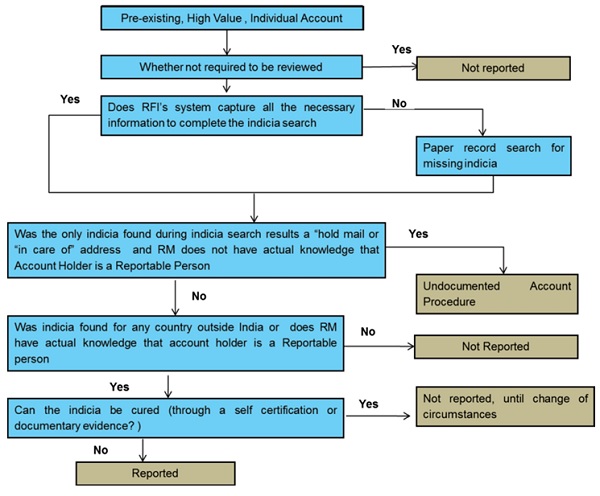
5.5.2 If the electronically searchable database includes fields for and captures all of the above information, the RFI is not required to conduct a paper record search.
However, if it does not, the RFI must review the current customer master file for a paper record search and review documents obtained during the last five years for identification of any of the following indicia:
-
- the most recent documentary evidence;
- the most recent account opening contract or documentation;
- the most recent documentation obtained by the RFI pursuant to rules framed under the Prevention of Money-Laundering Act, 2002 or any other law for the time being in force;
- any power of attorney or signature authority forms currently in effect; and
- any standing instructions (other than with respect to a Depository Account in the case of CRS) to transfer funds currently in effect.
5.5.3 Relationship Manager (RM) Test
In addition to the above electronic and paper searches, the RFI is required to apply the Relationship Manager (RM) test to high value accounts.
A Relationship Manager is an employee or officer of the Financial Institution who has been assigned responsibility for specific Account Holders on an ongoing basis. A Relationship Manager will provide advice to Account Holders regarding their accounts as well as recommending and arranging for the provision of financial products, services, and other related assistance.
Relationship management must be more than ancillary or incidental to a person’s job role. A person with some contact with Account Holders but whose functions are administrative or clerical in nature is not considered to be a Relationship Manager.
The RFI must consider whether any Relationship Manager associated with an account (including any accounts aggregated with such an account) has actual knowledge that would identify the Account Holder as a Reportable Person.
The Relationship Manager also has an important role in identifying any change of circumstances in relation to a high value individual account. A Financial Institution must ensure that it has procedures in place to capture changes that are made known to the Relationship Manager in respect of the Account Holder’s reportable status.
5.5.4 The following examples illustrate how to determine whether an employee of an RFI is a Relationship Manager:
Example 1
Individual P holds a custodial account with Bank R. The value in P’s account at year-end is USD 1,200,000. An employee of R’s private banking department, O, oversees P’s account on an ongoing basis. Because O satisfies the definition of ‘Relationship Manager’ and the value in P’s account exceeds USD 1,000,000, O is a Relationship Manager with respect to P’s account.
Example 2
Same facts as Example 1, except P’s custodial account balance at year-end is USD 800,000 and P also holds a depository account with a balance of USD 400,000, linked by an internal identification number. Because O satisfies the definition of ‘Relationship Manager’ and, once account aggregation rules are applied, the aggregate balance exceeds USD 1,000,000, O is a Relationship Manager with respect to both accounts.
Example 3
Same facts as Example 2, except O’s functions do not involve direct contact with P. Because O does not satisfy the definition of ‘Relationship Manager’, O is not a Relationship Manager with respect to P’s accounts.
An RFI shall implement procedures to ensure that a Relationship Manager identifies any change in circumstances of an account. Where the Relationship Manager is informed that the account holder has a new mailing address in any country or territory outside India, the RFI is required to treat the new address as a change in circumstances.
5.5.5 Effect of Finding Indicia
If, after application of the above due diligence procedures –
-
- none of the indicia are discovered and the account is not identified as held by a Reportable Person, no further action is required until there is a change of circumstances;
- if any of the indicia are discovered or there is a change of circumstances, the RFI shall treat the account as a Reportable Account with respect to each country or territory outside India for which an indicium is identified, unless the indicium is cured.
5.5.6 Curing of Indicia
The process for curing of indicia is the same as that for lower value accounts. Refer to paragraph 5.4.
5.5.7 Undocumented Account Procedure
If a ‘hold mail’ instruction or ‘in-care-of’ address is discovered in the electronic search and no other address or other indicia is discovered, special procedures are applied and the RFI must obtain from the account holder a self-certification or documentary evidence to establish the account holder’s residence. If neither procedure successfully establishes the account holder’s residence, the RFI must report the account as an undocumented account.
In respect of a pre-existing individual account, if a self-certification or documentary evidence is not obtained from the account holder (by the deadline for completing due diligence as laid down in the Rules) in remediation of any indicia found in the electronic search, paper record search, or RM’s inquiry, the account will be an undocumented reportable account.
5.5.8 Other Procedures
If a U.S. Reportable pre-existing individual account is not a High Value Account as on 30 June 2014, but becomes a High Value Account as on 31 December 2015 (or any subsequent 31 December), the RFI shall complete the enhanced review procedures within the calendar year following the year in which the account becomes a High Value Account. If, based on such review, the account is identified as a Reportable Account, the RFI shall report the required information on an annual basis unless the account holder ceases to be a Reportable Person.
Example
A U.S. Reportable Account with a balance of USD 48,000 as on 30 June 2014 becomes a High Value Account with a balance of USD 1,150,000 as on 31 December 2015. The RFI should carry out enhanced due diligence to determine whether it is a U.S. Reportable Account. If due diligence is completed in March 2016, the account becomes reportable for calendar year 2016 and subsequent years.
If an Other Reportable pre-existing individual account is not a High Value Account as on 31 December 2015 but becomes one at the end of any subsequent calendar year, the RFI shall complete the enhanced review procedures within the calendar year following the year in which the account becomes a High Value Account, and shall report accordingly.
If there is a change of circumstances with respect to a Pre-existing Individual High Value Account that results in one or more indicia, the RFI must treat the account as a Reportable Account unless it elects to apply one of the curing exceptions.
Any Pre-existing Individual Account that has been identified as a Reportable Account shall be treated as a Reportable Account in all subsequent years, unless the Account Holder ceases to be a Reportable Person.
5.5.9 Time Lines
The time lines for reviewing pre-existing individual accounts are provided in Rule 240(3)(d) of the Income-tax Rules, 2026 as under:
| Classification | Category | Time Limit for Due Diligence |
|---|---|---|
| U.S. Reportable Account | High Value Account as on 30.06.2014 | 31.12.2015 |
| U.S. Reportable Account | Lower Value Account as on 30.06.2014 | 30.06.2016 |
| Other Reportable Account | High Value Account as on 31.12.2015 | 31.12.2016 |
| Other Reportable Account | Lower Value Account as on 31.12.2015 | 30.06.2017 |
In the case of a U.S. Reportable Account which is a High Value Account as on 30 June 2014, due diligence shall be completed by 31 December 2015. If, based on this review, such account is identified as a U.S. Reportable Account after 31 December 2014 but before 31 December 2015, the RFI is not required to report information about such account for calendar year 2014, but shall report information about the account on an annual basis thereafter. Such accounts will be reported in the statement filed by 31 May 2016 for calendar year 2015.
(Ref: Pages 10 & 85 of “Consolidated text of the Common Reporting Standard”; OECD, 2025)
5.6 Due Diligence for Pre-existing Entity Accounts Accounts Not Required to be Reviewed or Reported
There are certain categories of pre-existing entity accounts which are not required to be reviewed, identified, or reported. These have been specified in Rule 240(5)(a) of the Income-tax Rules 2026. These are –
- in the case of U.S. Reportable Accounts, if the aggregate account balance or value as on 30 June 2014 does not exceed USD 250,000 until the aggregate account balance or value exceeds USD 250,000 as of the last day of any subsequent calendar year;
- in the case of other reportable accounts, if the balance or value as on 31 December 2015 does not exceed USD 250,000 until the aggregate account balance or value exceeds USD 250,000 as of the last day of any subsequent calendar year.
(Ref: Pages 13 & 67 of “Consolidated text of the Common Reporting Standard”; OECD, 2025)
Identification of Reportable Accounts
There is a two-step process to identify pre-existing entity Reportable Accounts –
- First, the RFI identifies whether the account holder entity is a Reportable Person. If so, the account is a Reportable Account.
- Second, if the account holder entity is a Passive NFE, the RFI must identify its Controlling Persons and determine whether any Controlling Person is a Reportable Person. If yes, the account becomes reportable in respect of that Controlling Person.
Review of Entity
To determine whether the entity is a Reportable Person, the RFI must review information maintained for regulatory or customer relationship purposes (including information collected under the Prevention of Money-Laundering Act, 2002) to determine whether the information indicates that the account holder is a Reportable Person.
However, the account may not be treated as a Reportable Account if –
- a self-certification is obtained from the account holder that the account holder is not a Reportable Person; or
- the financial institution reasonably determines, based on information in its possession or that is publicly available, that the account holder is not a Reportable Person.
If the information indicates that the Account Holder is a Financial Institution which is a non-USA entity, the RFI must verify the Account Holder’s Global Intermediary Identification Number (GIIN) on the published IRS FFI list (https://apps.irs.gov/app/fatcaFfiList/flu.xhtml). If the GIIN is verified, the account is not a U.S. Reportable Account.
The detailed process of due diligence to establish whether an entity is a Reportable Person can be depicted as per the following diagram:
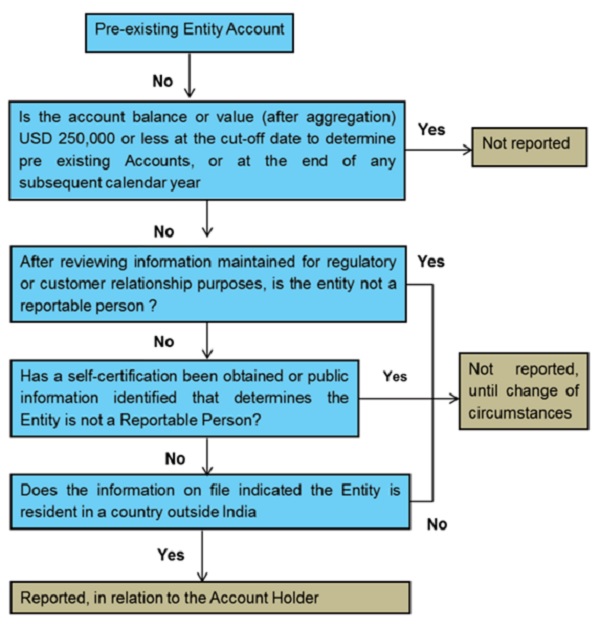
Review for Controlling Persons
Irrespective of whether the account is identified as a Reportable Account during the first part of the review, the RFI must carry out the second part of the review process to find out –
- whether the Account Holder is a Passive NFE; and
- whether any of the Controlling Persons of the Passive NFE is a Reportable Person.
For determining whether the account holder is a Passive NFE, the RFI shall obtain a self-certification from the account holder to establish its status, unless the RFI has information in its possession or which is publicly available based on which it can reasonably determine that the account holder is an Active NFE or a Financial Institution other than an Investment Entity referred to in sub-clause (B) of clause (c) of the Explanation to Rule 238(3) of the Income-tax Rules 2026.
If the account holder is a Passive NFE, the RFI must identify its Controlling Persons. For this purpose, the RFI may rely on information collected and maintained in accordance with the Prevention of Money-Laundering Act, 2002, provided such procedures are consistent with the 2012 FATF Recommendations.
To determine whether a Controlling Person is a Reportable Person or not, the RFI may rely on information collected and maintained in accordance with the PMLA where the aggregate account balance does not exceed USD 1,000,000.
If the aggregate account balance exceeds USD 1,000,000, a self-certification from the account holder or the Controlling Person(s) is required to determine whether the Controlling Person is a Reportable Person.
If the RFI is unable to obtain a self-certification, it must rely on the indicia search described in paragraph 5.4 for such Controlling Person. If the RFI has none of the relevant indicia in its records, no further action is required until a change in circumstances results in one or more indicia being associated with the account.
If any Controlling Person of a Passive NFE is a resident of any country or territory outside India for tax purposes, the account of the Passive NFE shall be treated as a Reportable Account with respect to each such country or territory. The details of each Controlling Person will also be reportable to the respective country or territory.
If there is a change of circumstances with respect to a Pre-existing Entity Account that causes the RFI to know, or have reason to know, that the self-certification or other documentation associated with the account is incorrect or unreliable, the RFI must re-determine the status of the account as soon as possible – by the later of the last day of the relevant calendar year or 90 calendar days following the notice or discovery of the change in circumstances.
Controlling Person Role Reporting
With effect from 1 January 2026, where an entity account is identified as having one or more Reportable Controlling Persons, the RFI must report – in addition to name, address, TIN, and date of birth – the role by which each Controlling Person qualifies (e.g., settlor, trustee, protector, beneficiary, or other).
In all cases, the role of each Controlling Person should be recorded in the account management system in an electronically searchable field and not merely as a free-text note, so that the information can be extracted for inclusion in Form 166 at the time of reporting.
5.7 Due Diligence for New Individual Accounts
Accounts Not Required to be Reviewed or Reported
- The following new U.S. Reportable Accounts are not required to be reviewed or reported, as per Rule 240(4)(a) of the Income-tax Rules 2026 –
- a depository account unless the account balance exceeds USD 50,000 at the end of any calendar year;
- a Cash Value Insurance Contract unless the cash value exceeds USD 50,000 at the end of any calendar year.
The above exemption is not available for U.S. custodial or investment accounts, which must be reviewed even if the account balance is less than USD 50,000.
There is no threshold in the case of other reportable accounts, and any individual account opened from 1 January 2016 must be reviewed to ascertain whether it is a Reportable Account.
Self-Certification
In the case of new U.S. Reportable Accounts that do not fall under the exemptions in paragraph 5.7 above, a self-certification shall be obtained on account opening, or within 90 days from the end of the calendar year in which the account ceases to qualify for the exemption, to determine the account holder’s residence or residences for tax purposes.
In the case of new other reportable accounts, on account opening, the RFI must obtain a self-certification from the customer, as part of the account opening documentation, to determine the account holder’s residence or residences for tax purposes.
The self-certification will specify where the individual is resident for tax purposes. If the self-certification establishes that the Account Holder is resident for tax purposes in a country or territory outside India, the RFI must treat the account as a Reportable Account. The self-certification shall also include the account holder’s TIN with respect to such country or territory and date of birth.
The self-certification can be provided in any form, but in order for it to be valid, it must be signed (or otherwise positively affirmed) by the Account Holder, be dated, and must include the Account Holder’s: name; residence address; jurisdiction(s) of residence for tax purposes; TIN(s); and date of birth.
The RFI must also confirm the reasonableness of the self-certification based on the information obtained in connection with the opening of the account, including any documentation collected in accordance with the Prevention of Money-Laundering (Maintenance of Records) Rules, 2005.
Where a self-certification has been obtained for a new individual account and there is a change of circumstances which causes the RFI to know, or have reason to know, that the self-certification is incorrect or unreliable, the RFI shall obtain a valid self-certification that establishes the residence or residences for tax purposes of the account holder. If the RFI is unable to obtain a valid self-certification, it shall treat the account as a Reportable Account with respect to each country or territory outside India for which an indicium is identified.
The due diligence process is depicted as under:
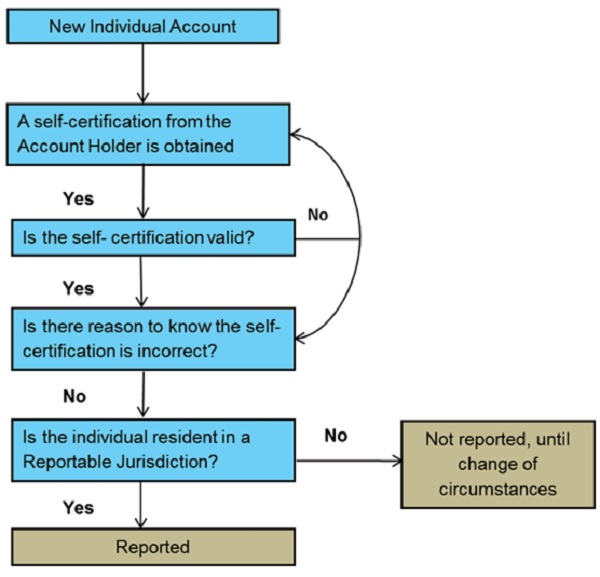
5.8 Due Diligence for New Entity Accounts
There is no threshold or exemption for new entity accounts and all such accounts must be reviewed and reported.
As in the case of pre-existing entity accounts, there is a two-step process to identify new entity Reportable Accounts –
- First, the RFI identifies whether the account holder entity is a Reportable Person. If so, the account is a Reportable Account.
- Second, if the account holder entity is a Passive NFE, the RFI must identify its Controlling Persons and determine whether any Controlling Person is a Reportable Person. If yes, the account becomes reportable in respect of that Controlling Person.
Review of Entity
The RFI must determine whether the entity itself is a Reportable Person (i.e., resident of a country or territory outside India). For this, the RFI will obtain a self-certification from the account holder, as part of the account opening documentation, to determine the account holder’s residence or residences for tax purposes. The RFI must also confirm the reasonableness of such self-certification based on information obtained in connection with the opening of the account, including any documentation collected under the PMLA.
The above process is depicted in the flow chart below:
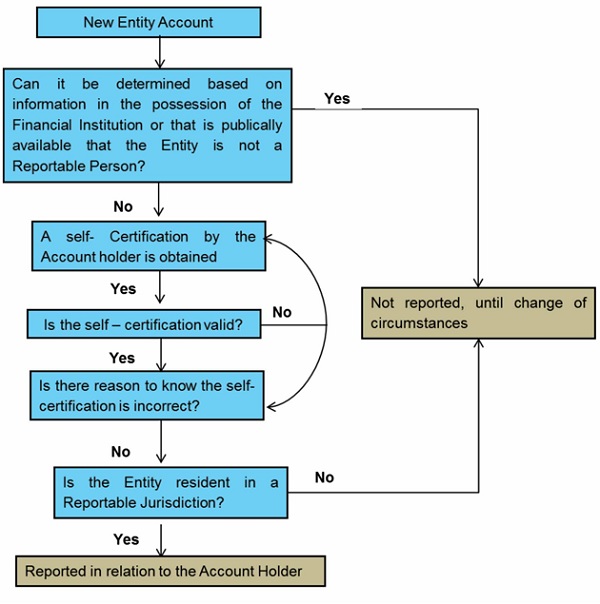
Review of Controlling Persons
Irrespective Review of Controlling Persons
Irrespective of whether the account is identified as a Reportable Account during the first part of the review, the RFI must carry out the second part of the review to find out –
- whether the Account Holder is a Passive NFE; and
- whether any of the Controlling Persons of the Passive NFE is a Reportable Person.
For determining whether the account holder is a Passive NFE, the RFI shall obtain a self-certification from the account holder to establish its status, unless the RFI has information in its possession or that is publicly available based on which it can reasonably determine that the account holder is not a Passive NFE.
If the account holder is a Passive NFE, the RFI must identify its Controlling Persons. For this purpose, the RFI may rely on information collected and maintained in accordance with the PMLA, provided such procedures are consistent with the 2012 FATF Recommendations.
For the purpose of determining whether a Controlling Person is a Reportable Person, the RFI may rely on a self-certification from the account holder or the Controlling Person. No other documentation may substitute for the purpose of determining whether a Controlling Person of a Passive NFE is a Reportable Person.
The RFI is also required to determine whether the account holder is a Non-Participating Financial Institution. Such accounts should be treated as U.S. Reportable Accounts and reported to the USA for calendar years 2015 and 2016.
(Ref: Pages 13 & 69 of “Consolidated text of the Common Reporting Standard”; OECD, 2025)
5.9 Alternate Procedure in the Case of U.S. Reportable Accounts
In the case of U.S. Reportable Accounts, the due diligence procedure for new accounts (including obtaining a self-certification from the account holder) applies from 1 July 2014. However, the legal basis for this due diligence procedure was introduced only on 7 August 2015, upon notification of Rules 114F to 114H. The IGA between India and the USA provides for an alternate procedure, which has been included in Rule 240(8) of the Income-tax Rules 2026.
As provided in the proviso to Rule 240(8), all new entity accounts which are U.S. Reportable Accounts opened from 1 July 2014 to 31 December 2014 may be treated by the RFI as pre-existing entity accounts and the due diligence procedure applicable to pre-existing accounts may be applied without regard to account balance or value threshold.
Further, as provided in Rule 240(8), for all individual and entity accounts opened from 1 July 2014 to the date of entry into force of the IGA (i.e., 31 August 2015), the RFI must obtain a self-certification and carry out due diligence to determine the reasonableness of the self-certification. The RFI must obtain the self-certification and documentation within one year of the entry into force of the IGA (i.e., by 31 August 2016), or otherwise close the accounts and report their information as Reportable Accounts.
The RFIs must report on any new account so identified, including accounts held by Non-Participating Financial Institutions, by the later of 31 May following the year in which the account is identified, or within 45 days of identification. Thus, all accounts identified during calendar year 2015 should be reported by 31 May 2016.
The information required to be reported with respect to such a new account shall be information which would have been reportable had the account been identified as a U.S. Reportable Account or as an account held by a Non-Participating Financial Institution, as applicable, as of the date the account was opened.
Rule 240(4)(a) states that depository accounts having a balance not exceeding USD 50,000 or cash value insurance contracts with cash value not exceeding USD 50,000 at the end of any calendar year are not required to be reviewed or reported in the case of U.S. Reportable Accounts. Accordingly, for accounts opened from 1 July 2014 to 31 December 2014, a value search should be carried out as on 31 December 2014; and for accounts opened between 1 January 2015 and 31 August 2015, a value search should be carried out as on 31 December 2015. The due diligence for new accounts (including obtaining a self-certification) needs to be carried out only where the value exceeds USD 50,000.
For new individual accounts (depository or cash value contract) opened after 1 September 2015, the alternate procedure will not be applicable and the due diligence procedure applicable to new accounts (including obtaining and verification of self-certification) will apply. A value search should be carried out as on 31 December 2015 and due diligence including obtaining a self-certification must be completed within 90 days from the end of calendar year 2015, i.e., by 31 March 2016.
For a depository entity account opened between 1 January 2015 and 31 August 2015, or after 1 September 2015, a value search should be carried out as on 31 December 2015 and due diligence applicable to new accounts including obtaining a self-certification needs to be carried out only where the value exceeds USD 250,000.
5.10 Aggregation
For the purposes of determining the aggregate balance or value of Financial Accounts held by an individual or entity, an RFI shall be required to take into account all Financial Accounts which are maintained by it, or by a related entity, but only to the extent that the computerised systems of that RFI link the Financial Accounts by reference to a data element such as client number or taxpayer identification number, and allow account balances or values to be aggregated. [Rule 240(7)(c), of Income-tax Rules 2026]
For the purpose of determining whether a Financial Account is a High Value Account, an RFI shall also be required – in the case of any Financial Accounts that a Relationship Manager knows, or has reason to know, are directly or indirectly owned, controlled, or established (other than in a fiduciary capacity) by the same person – to aggregate all such accounts.
Exempt Products
If a Financial Account is an Excluded Account, it should not be included for the purposes of aggregation. Consequently, if an individual holds a personal retirement account as well as several depository accounts with the same Financial Institution, and the information technology systems allow all holdings to be linked, the depository accounts are aggregated but the personal retirement account is not.
5.11 Joint Accounts
Where a Financial Account is jointly held, the balance or value to be reported in respect of the Reportable Person is the entire balance or value of the account. The entire balance or value should be attributed to each holder of the account. The same principle also applies to the following situations:
- an account held by a Passive NFE with more than one Controlling Person that is a Reportable Person;
- an account held by an Account Holder that is a Reportable Person (or an NFE with a Reportable Controlling Person) and is identified as having more than one jurisdiction of residence; and
- an account held by a Passive NFE that is a Reportable Person with a Controlling Person that is also a Reportable Person.
For example, where a jointly held account has a balance or value of USD 75,000, the amount to be attributed to each of the account holders is USD 75,000.
Income-tax Rules 2026/ CRS 2025 With effect from 1 January 2026, RFIs must also report whether the account is jointly held and the number of joint holders. This is a new mandatory field in Form 166. (Reference: Explanation 1 to Rule 240(7) , Income-tax Rules 2026)
However, it may be noted that while accounts may be aggregated to determine the threshold, for reporting purposes all accounts must be reported separately in Form 166.
5.12 Related Entity
Related entity is defined in Explanation (E) of Rule 238(6), of the Income-tax Rules 2026. An entity is a ‘related entity’ of another entity if either entity controls the other entity, or the two entities are under common control. Control includes direct or indirect ownership of more than 50% of the vote and value in an entity.
The following are examples of aggregation for U.S. Reportable Accounts. Unless specified otherwise, balance is as on 30.06.2014.
Example 1 – Application of the USD 50,000 threshold
Individual X holds two accounts with Bank A: a fixed deposit with a balance of USD 48,000 and a savings account with a balance of USD 8,000 (as on 30.06.2014). Bank A can link the accounts by the account holder’s Unique Identification Number. The aggregated balance is USD 56,000, exceeding USD 50,000. Both accounts are potentially reportable.
Example 2 – Application of the USD 50,000 threshold
Same facts as Example 1, except: depository account has a balance of USD 23,000 and custodial account has a balance of USD 15,000. The aggregated total is USD 38,000, below USD 50,000. Both accounts benefit from the exemption.
Example 3 – Application of the USD 50,000 threshold
Same facts, except depository account has a balance of USD 35,000 and custodial account has a balance of USD 18,000. Aggregated balance = USD 53,000. A depository account with a balance of USD 50,000 or less is exempt from reporting. No similar exemption is available to other types of Financial Accounts. Therefore, the depository account is not reportable, but the custodial account must be reviewed using the relevant due diligence procedures.
Example 4 – Application of the USD 250,000 cash value insurance contract threshold Company B can link: a Cash Value Insurance Contract with a value of USD 245,000 and a custodial account with a balance of USD 35,000 (as on 30.06.2014). For determining whether the insurance contract is reportable, it needs only to be aggregated with other Cash Value Insurance Contracts or Annuity Contracts. Therefore, it remains below the USD 250,000 threshold and does not have to be reviewed. The custodial account must be reviewed separately as there is no exemption for custodial accounts.
Example 5 – Aggregation involving joint accounts
Client A: has a balance of USD 37,000; Client B: has a balance of USD 25,000; Joint account: has a balance of USD 20,000. The joint account balance is attributed in full to each holder. Aggregate for Client A = USD 57,000 (exceeds USD 50,000; Client A’s account must be reviewed). Aggregate for Client B = USD 45,000 (below threshold; Client B’s account need not be reviewed).
Example 6 – Aggregation of negative balances
Client A: has a balance of USD 59,000; Client B: has a balance of USD 39,000; Joint account: negative USD 8,000. For aggregation purposes, the negative balance is treated as nil. After applying the USD 50,000 threshold, Client A’s account must be reviewed but Client B’s need not be reviewed.
Example 7 – Separate account reporting
Person Y holds three depository accounts with Bank Z: Account 1 has a balance of USD 35,000; Account 2 has a balance of USD 2,000; Account 3 has a balance of USD 26,000. Aggregated balance = USD 63,000. All three accounts are subject to review. The review determines that Person Y is a Specified U.S. Person. Therefore, all three accounts are reportable. Bank Z must report each account individually and not consolidate the information into a single return.
Example 8 – Aggregation of pre-existing entity accounts
Entity Y has two depository accounts with Bank X: current account USD 165,000 and term deposit USD 110,000. The aggregated balance of USD 275,000 exceeds the USD 250,000 entity threshold. The review determines that Entity Y is a Specified U.S. Person. Both accounts are reportable.
Example 9 – Aggregation of pre-existing entity accounts (no RM)
Individual P has a depository account (has a balance of USD 35,000) with Bank X. Individual P also controls 100% of Entity Y (depository account has a balance of USD 120,000) and 50% of Entity Z (depository account has a balance of USD 115,000), both with Bank X. There is no Relationship Manager. Where there is no Relationship Manager, an account held by a person can only be aggregated with other accounts held by that person. No account exceeds the relevant threshold when considered individually. No account is required to be reviewed.
Example 10 – Aggregation with Relationship Manager
Individual A has a custodial account (USD 35,000) with Bank X. Individual A controls 100% of Entity Y (custodial account has a balance of USD 1,180,000) and 50% of Entity Z (depository account has a balance of USD 110,000). A Relationship Manager is assigned to Individual A. The RM knows Individual A controls Entity Y and Entity Z and must therefore aggregate the three accounts. Individual A’s aggregate exceeds USD 1,000,000, making the account a High Value Account subject to enhanced review. Entity Y’s account (has a balance of USD 1,180,000) exceeds the USD 250,000 entity threshold and must be reviewed. Entity Z’s account (has a balance of USD 110,000) is below the threshold and need not be reviewed.
(Ref: Pages 28 & 117 of “Consolidated text of the Common Reporting Standard”; OECD, 2025)
5.13 New Fixed Deposit Account as Pre-existing Account
In banking practice, there are procedures where a Fixed Deposit (FD) can be opened by an existing customer who holds a savings bank account with the same Financial Institution, without any additional documentation. These fixed deposits are assigned separate account numbers. Therefore, they would normally be classified as new accounts. In such cases, no additional documentation is obtained for these fixed deposit accounts as they are intrinsically related to the existing savings bank account and all KYC documents are available for the existing savings bank account.
In these cases, where no additional documentation is required for certain FD accounts, the Financial Institution may treat the new FD account as a pre-existing account, subject to the following conditions –
- the savings bank account was opened on or before 30 June 2014 in the case of FATCA and 31 December 2015 in the case of CRS;
- the due diligence requirements have already been carried out, or are in the process of being carried out, for the pre-existing savings bank account; and
- the accounts are treated as linked or as a single account or obligation for the purposes of applying any of the due diligence requirements and reporting.
The above position also applies to an Auto Sweep facility linked to an existing savings bank account.
5.14 Global Custodian and Local Custodian
Generally, accounts opened in India by foreign investors, including Foreign Portfolio Investors (FPIs), are contracted through Global Custodians (GCs) who in turn appoint or contract with Local Sub-Custodians in India to facilitate registration and investment of these foreign investors in India.
In such cases, Local Sub-Custodians are required to carry out due diligence on the accounts held by the GC’s end-clients. However, for carrying out due diligence, the Local Sub-Custodian may rely on the KYC, FATCA, and CRS documentation carried out by the GC for the account holders, including self-certifications. The obligations for due diligence and reporting remain with the Local Custodian, who must also be able to access all documents in relation to an account holder.
5.15 Obtaining Self-Certification
Financial Institutions may obtain a self-certification from an account holder either in physical form or in electronic form. In the case of electronic form, self-certification should be obtained through an internet banking platform from a user account where the customer has transaction rights.
COMPLIANCE With effect from 1 January 2026, RFIs must record whether a valid self-certification has been provided for each Reportable Account Holder for each Reportable Controlling Person.
This is a new mandatory field in Form 166. RFIs must update their self-certification collection workflows and IT systems before the 31 May 2027 filing deadline for CY 2026 data.
5.16 Change in Circumstances
If there is a change of circumstances with respect to an account that causes the RFI to know, or have reason to know, that the self-certification or any other documentation associated with the account is incorrect or unreliable, the RFI must re-determine the status of the account in accordance with the applicable due diligence procedure immediately. This should be done by the later of the last day of the relevant calendar year or 90 calendar days following the notice or discovery of the change in circumstances.
A ‘change in circumstances’ includes any change that results in the addition of information relevant to a person’s status or otherwise conflicts with such person’s status. In addition, a change in circumstances includes any change or addition of information to the account holder’s account (including the addition, substitution, or other change of an account holder) or any change or addition of information to any account associated with such account (applying the account aggregation rules) if such change or addition of information affects the status of the account holder.
5.17 Documentary Evidence
For the purpose of due diligence procedures, ‘documentary evidence’ includes any of the following, as specified in Rule 240(2)(a) of the Income-tax Rules 2026 –
- a certificate of residence issued by an authorised government body, including a government agency or a municipality, of the country or territory in which the payee claims to be a resident;
- with respect to an individual, any valid identification issued by an authorised government body, including a government agency or a municipality, that includes the individual’s name and is used for identification purposes;
- with respect to an entity, any official documentation issued by an authorised government body, including a government agency or a municipality, which includes the name of the entity and either the address of its principal office in the country or territory in which it claims to be a resident, or the country or territory in which the entity was incorporated or organised; and
- any financial statement, third-party credit report, bankruptcy filing, or report of the government agency regulating the securities market. Any such financial statement should be audited by an appropriate authority.
The RFI is expected to institute procedures to ensure that any change constituting a change in circumstances is identified by the RFI. In addition, the RFI is expected to notify any person providing a self-certification of the person’s obligation to notify the RFI of a change in circumstances. The RFI must keep records of the steps undertaken and any evidence relied upon for the performance of the due diligence procedures, and must be able to obtain those records when required. The RFI should also record the date on which due diligence for an account was completed.
Every RFI must maintain information in respect of Financial Accounts in accordance with the procedure and manner as specified by its sectoral regulator from time to time. In a situation where no such procedure and manner has been specified by the sectoral regulator, information in respect of Financial Accounts shall be maintained for at least six years as specified under the Income-tax Act 2025.
CHAPTER 6:
INFORMATION TO BE MAINTAINED AND REPORTED
6.1 Mandatory Reporting Fields
After the RFI has identified the reportable accounts, RFI needs to report specific information in respect of each reportable account. After identifying Reportable Accounts, the RFI reports specific information under Rule 239(1) of the Income-tax Rules 2026. The following table shows all required fields, with new fields introduced as a result of CRS 2025, applicable to non-U.S. reportable accounts :
| Field | Existing/ new field? |
|---|---|
| Name, address and TIN(for both individual and entity account holder) Additional fields of Date of Birth and Place of Birth (only for individual account holder) | Existing |
| Whether valid self-certification provided for the account holder | New |
| Whether account is joint account & number of joint holders | New |
| Name, address and TIN of entity and name, address, Date of Birth, Place of Birth and TIN of Controlling Person (for an entity account holder having controlling person(s) that are reportable person(s)) | Existing |
| Role(s) of each Controlling Person; whether valid self-certification provided for each Controlling Person (for an entity account holder having controlling person(s) that are reportable person(s)) | New transitional measure applies until 31.12.2027 |
| Whether account is joint account &number of joint holders (for an entity account holder having controlling person(s) that are reportable person(s)) | New |
| Account number (or functional equivalent in the absence of account number) | Existing |
| Type of account; whether pre-existing or new account | New |
| Account balance or value at the end of relevant calendar year or, if the account was closed during such year, immediately before closure | Existing |
| In the case of custodial account:
i. Total gross interest, total gross dividends, or total other income generated with respect to the assets held in the account, in each case paid or credited to the account (or with respect to the account) during the calendar year ii. the total gross proceeds from the sale or redemption of financial assets paid or credited to or with respect to the account during the calendar year with respect to which the reporting financial institution acted as a custodian, broker, nominee, or otherwise as an agent for the account holder |
Existing |
| In the case of depository account:
Gross interest paid or credited to the account during the relevant calendar year |
Existing |
| In the case of any account other than custodial or depository account:
Total gross amount paid or credited to the account holder with respect to the account during the relevant calendar year with respect to which the reporting financial institution is the obligor or debtor, including the aggregate amount of any redemption payments made to the account holder during the relevant calendar year |
Existing |
| the name of each non-participating financial institution to which payments have been made and the aggregate amount of such payments | Existing |
| Equity interest holder roles (for investment entity legal arrangements) | New transitional measure applies until 31.12.2027 |
(Ref: Pages 5 & 37 of “Consolidated text of the Common Reporting Standard”; OECD, 2025)
6.2 Equity Interest Holder Roles in Investment Entity Legal Arrangements
6.2.1 Rule 239(1)(i) provides that, in the case of an account other than a US Reportable Account where any equity interest is held in an Investment Entity that is a legal arrangement, the RFI must report the role(s) by virtue of which the Reportable Person holds that equity interest.
This requirement applies principally to trusts that qualify as Investment Entities (Type B Investment Entities managed by another Financial Institution). In such cases, the persons holding equity interests in the trust-as-Investment-Entity are:
- any person treated as a settlor of all or a portion of the trust;
- any person treated as a beneficiary of all or a portion of the trust (whether entitled to mandatory or discretionary distributions); and
- any other natural person exercising ultimate effective control over the trust. The distinction from Controlling Person role reporting is important:
| Reporting requirement | When it applies | What is reported |
|---|---|---|
| Controlling Person roles | Account held by an Entity (including a Passive NFE trust) with a Reportable Controlling Person | The role of the Controlling Person (settlor, trustee, protector, beneficiary, other) |
| Equity Interest holder roles |
Account held by an Investment Entity that is a legal arrangement (e.g., a trust-as- Investment-Entity); the Account Holder itself is the trust | The role by which the Reportable Person holds the equity interest in the trust-Investment-Entity (settlor, beneficiary, other) |
6.2.2 Both requirements are subject to the transitional measure in Rule 239(13): for accounts maintained as of 31 December 2025, role reporting is required only if available in electronically searchable data, for reporting periods ending by 31 December 2027 (i.e. for reporting of information pertaining to Calendar Year 2026).
(Ref: Pages 6 & 34 of “Consolidated text of the Common Reporting Standard”; OECD, 2025)
6.3 Taxpayer Identification Numbers (TIN)
6.3.1 Definition
A Taxpayer Identification Number is a unique combination of letters or numbers, however described, assigned by a country to an individual or an Entity and used to identify the individual or Entity for purposes of administering the tax laws of such country.
Where the person is a resident of more than one country or territory outside India under the tax laws of such country or territory, the reporting financial institution shall maintain the TIN in respect of each such country or territory.
For example, if an individual X is tax resident of Belgium and account of such person is to be reported by an FI in India, the TIN of Belgium is required to be collected and reported by FI in respect of such person. TIN of Belgium is called Numéro National (NN).
In the same example, it may be the case that X is having a PAN. Then also, TIN for the purpose of reporting by FI will be Numéro National (NN) and not PAN.
In the above example, if X is tax resident of Belgium as well as France, TIN of both Belgium and France are required to be collected and reported by FI in respect of such person.
6.3.2 Functional Equivalent of TIN
Many countries do not issue TIN to their taxpayers. However, such countries issue some other high integrity number with an equivalent level of identification (a functional equivalent). Examples of such numbers are-
-
-
- Social Security Number
- National Insurance Number
- Citizen Or Personal Identification Code Or Number
- Resident Registration Number
-
For Entities, a business/ or company registration code/number may be used in case where no TIN has been issued to the entity. These numbers are functional equivalent of TIN.
TAX IDENTIFICATION NUMBER PORTAL OF OECD
OECD maintains an AEOI portal which contains useful information on AEOI. This has a section on TIN where information regarding issuance, collection and, to the extent possible and practical, the structure and other specifications of TIN of various countries have been complied. It also contains information on which documents, TIN of various countries can be found. You can go through this section to understand the TIN of various countries, which will help you in collecting and reporting the TIN of the account holders and controlling persons. The link is
https://www.oecd.org/tax/automatic-exchange/crs-implementation-and-assistance/tax-identification-numbers/
6.3.3 TIN for Pre-existing Accounts
TIN is essential to correctly identify taxpayers. With respect to each Reportable Account which is a pre-existing account, TIN was not required to be reported at the time of implementation of CRS, if it was not in the records of the Reporting Financial Institution. However, the RFI shall make reasonable efforts to obtain the TIN with respect to pre-existing accounts and shall report it from calendar year 2017 and subsequent years.
“Reasonable efforts” means genuine attempts to acquire the TIN and date of birth of the Account Holder of a Reportable Account. Such efforts must be made at least once a year. Examples of reasonable efforts include contacting the Account Holder (for example, by mail, in person, or by phone), including a request made as part of other documentation or electronically (for example, by facsimile or by e-mail); and reviewing electronically searchable information maintained by a Related Entity of the Reporting Financial Institution, in accordance with the aggregation principles.
6.3.4 Exceptions
There are a few exceptions to TIN reporting. TIN is not required to be reported if –
-
- a TIN (including its functional equivalent) is not issued by the relevant country or territory outside India in which the person is resident for tax purposes; or
- the domestic law of the relevant country or territory outside India does not require the collection of the TIN by any Financial Institution.
There are some jurisdictions, which issue TINs but whose domestic law does not require the collection of the TIN for domestic reporting purposes. If a Reportable Account is maintained by a person resident in such a jurisdiction, the RFI is not required to collect the TIN for that jurisdiction.
It is also clarified that TIN is not required to be collected by RFIs even from a person (who is resident for tax purposes in a country or territory outside India) who may be eligible to obtain a TIN (or functional equivalent) in their country or territory of residence but has not yet obtained one. However, in such cases, RFIs should note this fact, record the reason for non-availability in the account records and in any self-certification obtained, and make a request to the person to provide the TIN once obtained.
6.3.5 Data Quality and Importance of TIN
The quality of data reported by RFIs is critical to the effective functioning of both FATCA and CRS, since an inaccurate or incomplete TIN directly affects the ability of the recipient jurisdiction to match the information received against its own taxpayer records. A record furnished without no TIN or incorrect TIN, may not be capable of being linked to the correct taxpayer, thereby defeating the very purpose of automatic exchange. RFIs are, therefore required to exercise due care in collecting, validating and reporting TINs, and should not treat this as a mere formality to be completed at the time of onboarding.
RFIs should accordingly put in place internal validation checks, including, where feasible, verification of TIN format against the OECD TIN Reference Guide, before furnishing Form 166. Where a TIN cannot be obtained despite reasonable efforts, the RFI shall record the applicable reason, as the rather than leaving the field blank, so that the absence of a TIN is distinguishable from a data quality error at the stage of exchange. It is therefore incumbent upon all stakeholders, including RFIs, to ensure that the data furnished is accurate and complete, so that India continues to be regarded as a jurisdiction that meets the highest standards of tax transparency and international cooperation.
6.4 Government Verification Service
The term ‘Government Verification Service’ means an electronic process made available by a Reportable Jurisdiction to a Reporting Financial Institution for the purposes of ascertaining the identity and tax residence of an Account Holder or Controlling Person. In this respect, a unique reference number, code or other confirmation received by a Reporting Financial Institution in respect of an Account Holder or Controlling Person via a Government
CRS 2025 Section VIII (7) of the Consolidated Text of CRS 2025 mentions the term “Government Verification Service” as an electronic process made available by a Jurisdiction to a Reporting Financial Institution for the purposes of ascertaining the identity and tax residence of an Account Holder or Controlling Person.
Verification Service is also a functional equivalent to a TIN.
The Government Verification Service would provide an additional due diligence tool for RFIs. Where a Reportable Jurisdiction (i.e., a CRS partner jurisdiction) makes such a service available, an RFI may use it to verify:
- the identity of an Account Holder or Controlling Person; and
- the tax residence status of an Account Holder or Controlling Person in that Reportable Jurisdiction.
Use of a Government Verification Service is optional and supplementary to existing due diligence procedures. It does not replace the requirement to obtain a self-certification or documentary evidence where required under Rules 240(3) to 240(6).
CBDT will issue further guidance when such a service becomes available.
6.5 Account Holder
Account holder means the person listed or identified as the holder of a financial account by the financial institution that maintains the account. However, if a person, other than a financial institution, holds a financial account for the benefit or on account of some other person as agent, custodian, nominee, signatory, investment advisor, or intermediary, such other person will be treated as holding the account. In the case of a cash value insurance contract or an annuity contract, the account holder is any person entitled to receive a payment upon the maturity of the contract or any person entitled to access the cash value or change the beneficiary of the contract and if no person can access the cash value or change the beneficiary, the account holder is any person named as the owner in the contract and any person with a vested entitlement to payment under the terms of the contract;
6.6 Date of Birth
With respect to each reportable account where account holder is individual or controlling person of entity account holder is reportable person, RFI shall report his date of birth. However, with respect to each Reportable pre-existing account, date of birth was not required to be reported at the time of implementation of CRS if the date of birth was not in the records of the RFI. However, the RFIs are required to make reasonable efforts to obtain the date of birth with respect to pre-existing accounts and shall report it from calendar year 2017 and subsequent years. [Rule 239(5), Income-tax Rules 2026]
The date of birth is reportable for all new individual accounts.
6.7 Place of Birth
Place of birth is not required to be reported unless it is available in the electronically searchable data maintained by the RFI. [Rule 239(6), Income-tax Rules 2026]
6.8 Address
In the case of an account held by an individual that is a Reportable Person, or a Controlling Person, the address to be reported is the current residence address of the individual. If the RFI does not have such address in its records, the RFI should report the mailing address available on file.
In general, an ‘in-care-of’ address or a post office box is not a residence address. A post office box that forms part of an address that also includes details such as a street, apartment or suite number or a rural route, such that a place of residence can be clearly identified, can be accepted as a residence address. In special circumstances such as that of military personnel, an ‘in-care-of’ address may constitute a residence address.
In the case of an account held by an Entity that is identified as having one or more Controlling Persons who are Reportable Persons, the address to be reported is the address of the Entity and the address of each such Controlling Person.
6.9 Jurisdiction of Residence
After carrying out the due diligence, if an account is identified as a Reportable Account, the RFI must report the jurisdiction of residence of the account holder or Controlling Person, as the case may be.
If there is more than one jurisdiction of residence, all such jurisdictions must be reported.
The jurisdiction of residence identified as a result of due diligence is without prejudice to any residence determination made by the RFI for any other tax purposes.
6.10 Account Number
The account number to be reported with respect to an account is the identifying number assigned by the Reporting Financial Institution to the account.
If no such number is assigned to the account, the RFI must report a functional equivalent (i.e., a unique serial number or other number assigned to the Financial Account that distinguishes the account from other accounts maintained by such financial institution). For example, it will be the bank account number in the case of bank accounts, and the contract or policy number in the case of insurance contracts.
6.11 Account Type and Pre-existing or New Account Indicator
With effect from 1 January 2026, , the RFI must also report the type of account (for example, Depository Account, Custodial Account, equity or debt interest in an Investment Entity, Cash Value Insurance Contract, Annuity Contract, SEMP Account, CBDC Account, etc.) and whether the account is a pre-existing account or a new account. This is a new mandatory field in Form 166.
(Ref: Pages 5 & 35 of “Consolidated text of the Common Reporting Standard”; OECD, 2025)
6.12 Account Balance or Value
The RFI must report the balance or value of the account as of the end of the calendar year. An account with a balance or value that is negative must be reported as having zero account balance or value.
In the case of a Cash Value Insurance or Annuity Contract, the RFI must report the Cash Value or surrender value of the account.
In the case of an equity interest in a Financial Institution, the balance or value of the equity interest is the value calculated by the Financial Institution for the purpose that requires the most frequent determination of value.
In the case of a debt interest, the balance or value is its principal amount.
The balance or value of the account is not to be reduced by any liabilities or obligations incurred by an account holder with respect to the account or any of the assets held in the account.
The custodial account of a customer maintained with the Depository or Depository Participant or broker contains various kinds of securities. For calculating account balance or value, valuation of securities may be done at the values regularly communicated by the Depository (CDSL or NSDL) to the depository participants or brokers.
Each holder of a jointly held account is attributed the entire balance or value of the joint account, as well as the entire amounts paid or credited to the joint account.
For example, there is a joint account held by two individuals (X and Y) having a balance of USD 75,000. One of the account holders, X, is resident in France. The other person, Y, is resident in India. The amount reportable in respect of person X will be USD 75,000. Y is not reportable.
If both account holders in the above example are resident in France, then each would be attributed USD 75,000 in the report.
6.13 Closure of Accounts
If the financial account was closed during the reporting period, the account balance or value immediately before closure shall be reported.
In determining when an account is “closed”, reference must be made to the guidelines or procedures issued by the sectoral regulator in this regard.
For example, an equity or debt interest in a Financial Institution would generally be considered to be closed upon termination, transfer, surrender, redemption, cancellation, or liquidation.
An account with a balance or value equal to zero or that is negative will not be a closed account solely by reason of such balance or value.
6.14 Reporting Period
The information to be reported must be that as of 31 December of every calendar year.
6.15 Custodial Account
In the case of a custodial account, apart from the general reporting requirements, the following information is to be reported for each reporting period:
- the total gross amount of interest paid or credited to the account;
- the total amount of dividends paid or credited to the account;
- the total gross amount of other income generated with respect to the assets held in the account paid or credited to the account; and
- the total gross proceeds from the sale or redemption of Financial Assets paid or credited to the account.
The total gross proceeds from the sale or redemption of a Financial Asset is the total amount credited to the account of the person entitled to the payment, without regard to any sums netted off against the payment to satisfy outstanding liabilities. For example, a loan used to fund the acquisition of the asset may be repaid from the proceeds of sale. This must not be deducted from the amount reportable.
Commissions and fees paid with respect to the sale or redemption of the asset may be taken into account in arriving at the gross proceeds of sale.
Where the Financial Asset that is sold or redeemed is an interest-bearing debt obligation, the gross proceeds should include any interest that has accrued between interest payment dates.
CRS 2025 : CARF Non- Duplication
With effect from 1 January 2026, for accounts other than U.S. Reportable Accounts, the gross proceeds from the sale or redemption of a Financial Asset are not required to be reported in Form 166 to the extent that such gross proceeds have already been reported by the RFI under the Crypto-Asset Reporting Framework (CARF).
This non-duplication relief applies only to gross proceeds. All other reportable information (account balance, interest, dividends, Controlling Person details) must still be reported in Form 166 regardless of CARF reporting. [Rule 239(7), Income-tax Rules 2026]
6.16 Interest Paid or Credited
For depository and custodial accounts, the total gross amount of interest paid or credited to the account must be reported. This interest is the actual interest paid or credited to the account and will not include accrued interest.
6.17 Currency
The value of the account should be reported in the currency in which the account is denominated.
Any account maintained in Indian Rupees or in any permissible currency (other than the United States Dollar) as designated by the Reserve Bank of India shall be converted to United States Dollars at the end of the reporting period using the reference rates of the Reserve Bank of India, and such converted amount in United States Dollars shall be used for determining the balance or value of a financial account.
In determining whether a pre-existing account meets a threshold, the relevant date is the spot rate on 30 June 2014 (for U.S. Reportable Accounts) and as on 31 December 2015 (for other reportable accounts). In the case of an insurance contract or an annuity contract, the spot rate may be taken as on the most recent contract anniversary date.
In determining whether a pre-existing account continues to meet a threshold in subsequent years, or a new account meets or continues to meet a threshold, the relevant date is the spot rate on 31 December of the relevant calendar year. In the case of a closed account, the relevant date is the spot rate on the date the account is closed.
6.18 Currency conversion for CRS 2025 amendment accounts
For accounts that qualify as Financial Accounts solely by virtue of the CRS 2025 amendments (SEMP accounts, CBDC accounts, etc.), the relevant date for determining whether any threshold is met is 31 December 2025 (for pre-existing accounts) or 31 December of the relevant calendar year (for new accounts). The Telegraphic Transfer Buying Rate of the State Bank of India, as specified in Rule 241(17) of the Income-tax Rules 2026, shall be used for conversion of amounts denominated in currencies other than the United States Dollar.
6.19 Prior Year Remediation
The RFIs should ensure that deficiencies identified in due diligence procedures, account classification, self-certification collection, Controlling Person identification, or reporting obligations are corrected not only for the current reporting period but also, where relevant, for prior reporting periods.
Where an RFI becomes aware of failures to undertake required due diligence procedures or to report information that should have been reported in earlier years, appropriate remediation measures should be undertaken, including review of affected accounts and correction of previously furnished information, as applicable. The RFIs may undertake remediation in respect of failures relating to prior years, including up to six previous calendar years, to ensure completeness and accuracy of information reported under CRS and FATCA and as per the provisions of the Income-tax Act, 2025.
6.20 Due Date for Furnishing the Report
The statement of Reportable Accounts for each calendar year must be furnished in Form 166 by 31 May for Income-tax Rules 2026/ Form 61B for Income-tax Rules 1962 of the following year.
The information related to calendar year 2014 was required to be reported for only U.S. Reportable Accounts and the statement was to be furnished by 31 August 2015 (extended to 10 September 2015 by CBDT Order dated 25 August 2015). In that statement, only the information referred to in clauses (a) to (d) of the reporting requirements mentioned in Rule 114G (1) was required.
The information related to calendar year 2015 was also required to be reported for only U.S. Reportable Accounts and the statement was to be furnished by 31 May 2016. In this statement, only the information referred to in clause (a) to (d), e(i) and (f) to (h) of the reporting requirements mentioned in Rule 114G(1) was to be reported.
For calendar year 2016 onwards, all reportable information in the case of both U.S. and other Reportable Accounts was required to be reported in Form 61B. From 01 April 2026, these obligations are governed by Rule 239(1) of the Income-tax Rules, 2026 and the statement is required to be furnished in Form 166.
The statement of Reportable Accounts must be furnished in respect of each account identified by carrying out the due diligence procedure.
In case no account is identified as a Reportable Account, a Nil statement must be furnished.
6.21 FATCA: US TIN Reporting Requirements
6.21.1 Place of Birth
Place of birth is particularly relevant for FATCA, where US place of birth is one of the six indicia that trigger due diligence on pre-existing lower-value individual accounts. The indicia search itself may reveal US place of birth in the electronic records, in which case it must be reported if the account is ultimately identified as a US Reportable Account.
RFIs must report the US TIN for all US Reportable Accounts. The details of U.S TIN are available on U.S IRS website at https://www.irs.gov/tin/taxpayer-identification-numbers-tin
| Types of U.S. Taxpayer Identification Numbers (TINs) | ||
| Type | Description | Typical Format |
| Social Security Number (SSN) | Issued to U.S. citizens and eligible individuals. | XXX-XX-XXXX |
| Individual Taxpayer Identification Number (ITIN) | Issued to individuals who are not eligible for an SSN but require a U.S. TIN. | 9XX-XX-XXXX |
| Employer Identification Number (EIN) | Issued to businesses, trusts, estates and other entities. | XX-XXXXXXX |
| Adoption Taxpayer Identification Number (ATIN) | Temporary number issued in certain adoption cases. | 9XX-XX-XXXX |
| For FATCA purposes, a valid SSN, ITIN or EIN may constitute the U.S. TIN of the Account Holder, Controlling Person or Entity, as applicable. | ||
6.21.2 TIN Relief Codes
Where the U.S TIN is not obtained, the RFI must populate the TIN field with the applicable TIN Code as per U.S. IRS FAQ 6 . A summary of current TIN codes (updated as per U.S IRS Relief Notice 202311, effective from CY 2023 reporting) as provided in CBDT clarification dated 4 May 2023 (placed at Section : References at Page 123) is set out below:
| TIN Code | Applicable Scenario |
|---|---|
| 000222111 |
|
|
|
|
|
| 222222222 |
|
|
|
| 333333333 | New individual account with US place of birth indicia; and either:
|
| 444444444 |
|
(a) has a change in circumstances that either results in one or more U.S.
|
|
| 555555555 | New individual or entity account with US indicia other than place of birth; and either: |
|
|
| 666666666 |
|
|
|
| 777777777 | Dormant Accounts – For pre-existing accounts where there is no TIN
|
| A “dormant account” is one that meets the definition set out in U.S. Treasury Regulations §1.1471-4(d)(6)(ii) and had had no financial activity for three years, except for the posting of interest. |
|
| If an account could be classified into multiple TIN codes, the other code takes precedence. |
|
| 999999999 | Any account for which the RFI cannot obtain a TIN and none of the other TIN codes would be applicable. |
| The use of this code indicates that RFI has completed its review of accounts without U.S. TINs and has in good faith applied TIN codes to records when applicable. |
It may be noted that the U.S. IRS system will still generate an error notification to indicate the entry is invalid when actual TIN is not reported and only one of the above TIN codes is used. The error notification will provide 120 days to correct the issues. If the TIN is not provided within that 120 day period, the U.S. will evaluate the data received (including whether the reporting Model 1 FFI complies with the conditions set forth in Notice 2013-11) and whether there is significant non-compliance based on the facts and circumstances.
6.22 US IRS TIN RELIEF: NOTICES 2023-11 AND 2024-78
U.S IRS has released TIN relief notices, giving relief to RFIs who were not able to collect and report U.S TIN provided certain conditions are satisfied. The notices are placed at Section : References at Page 123.
Notice 2023-11 provides temporary relief from significant non-compliance findings for pre-existing accounts where US TINs cannot be obtained, for CYs 2022, 2023 and 2024.
Notice 2024-78 extends this relief to Calendar Years 2025, 2026 and 2027. To qualify for this relief, RFIs must:
(1) obtain and report the date of birth of each account holder that is an individual and controlling person whose U.S. TIN is not reported;
(2) annually request from each account holder any missing required U.S. TIN, as described in further detail in section 3.03 of the Notice 2024-78;
(3) annually search electronically searchable data maintained by the RFI for any missing required U.S. TINs;
(4) report an accurate TIN Code for each account that is missing a required U.S. TIN;
(5) if the FFI’s electronically searchable account information contains a foreign taxpayer identification number (or functional equivalent) assigned to a taxpayer by its country of residence (FTIN), report an FTIN for each specified U.S. person that is missing a required U.S. TIN [This condition is applicable to Notice 2024-78 only]; and
(6) using the Address Fix element, as described further below, report the city and country of residence for each specified U.S. person with a missing required U.S. TIN. [This condition is applicable to Notice 2024-78 only].
For getting relief under Notice 2023-11 for CYs 2022, 2023 and 2024, an RFI must retain records of the policies and procedures adopted to satisfy this requirement and documentation that those policies and procedures were followed to establish its compliance with the requirements of the Notice until the end of calendar year 2028.
RFIs seeking to obtain relief under Notice 2024-78 for the 2025, 2026, and 2027 calendar years must retain records of the policies and procedures adopted to satisfy this requirement and documentation that those policies and procedures were followed to establish its compliance with the requirements of this section until the end of calendar year 2031. To obtain the relief described in this notice, the FFI must also retain until 2031 any records or documentation adopted in previous years for the purpose of obtaining relief under Notice 2023-11 to the extent applicable.
[Refer CBDT Office Memorandum 21.02.2025, placed at Section : References at Page 123]
6.23 The Significant Non-Compliance (SNC) Process under FATCA by USA
Where an Indian RFI fails to report reportable US accounts or otherwise fails to meet its FATCA obligations (for example, by failing to report US TIN, date of birth, etc, the following process may apply under the provisions of the India-USA IGA:
- Step 1 – Notification: The US Competent Authority notifies CBDT that a specific RFI is potentially significantly non-compliant. The potential SNC is required to be corrected within a period of 30 days.
- Step 2 – Issue of SNC determination – If the RFI fails to correct the potential significant noncompliance within the given timeline, the US may issue a determination of Significant Non-Compliance (SNC) against the Indian RFI.
- Step 3 – Remediation period: CBDT through the Directorate of I&CI tries to get the RFI to address the significant non-compliance during the 18 months following the notification.
- Step 4 – NPFI treatment: If the RFI remains non-compliant after 18 months, the US may treat it as a Non-Participating Financial Institution (NPFI). Such action will lead to the removal of its Global Intermediary Identification Number (GIIN) from the US IRS Foreign Financial Institutions List and then be subject to withholding tax of 30% on certain U.S sourced payments under section 1471(a) of the U.S. Internal Revenue Code, to be imposed by US as well as all other countries which have agreed with US under the IGA to impose such tax on non-compliant FIs.
The use of IRS TIN codes (FAQ 6 codes, updated per Notice 2023-11) and compliance with the conditions of Notices 2023-11 and 2024-78 may protect an RFI from being found significantly noncompliant solely on account of not reporting US TINs for pre-existing accounts provided all other conditions laid down in the relief notices are complied with. However, this protection does not extend to other FATCA obligations (such as failure to report U.S accounts, account balances, income, entity account information, etc.).
Considering the potential consequences of obtaining a determination of Significant Non-compliance (SNC), the RFIs shall ensure that all reportable accounts are reported correctly with all relevant information including date of birth and TIN, and that wherever applicable the conditions of Notices 2023-11 and 2024-78 are followed. This is essential considering that removal of GIIN is a U.S domestic action and hence may not be resolved under the provisions of the India-USA IGA.
6.24 Reporting Period and Filing
Information must be reported as of 31 December of each year. The statement in Form 61B/ Form 166 is filed by 31 May of the following year. A NIL statement is required where no Reportable Accounts are found. All reportable account information (both FATCA and CRS) must be reported in Form 61B/ Form 166.
CHAPTER 7:
ISSUES RELATED TO TRUSTS AND PARTNERSHIPS
(a) In the case of a trust, two situations may arise:
(b) when a trust is itself a Reporting Financial Institution; or
when a trust is a NFE that maintains a Financial Account with a Reporting Financial Institution.
The most likely scenario in which a trust will be a Financial Institution is if it falls within the definition of Investment Entity. This is the case when a trust has gross income primarily attributable to investing, reinvesting, or trading in Financial Assets and is managed by another Entity that is a Financial Institution. This would also include trusts that are collective investment vehicles or other similar investment vehicles established with an investment strategy of investing, reinvesting, or trading in Financial Assets.
With effect from 1 January 2026, for CRS (i.e. accounts other than U.S. Reportable Accounts), as per Rule 238(3), of Income-tax Rules 2026 this also includes trusts whose gross income is primarily attributable to investing, reinvesting, or trading in Relevant Crypto-Assets. Explanation (c)(B) to Rule 238(3), defines a Type B Investment Entity as an entity whose gross income is primarily from investing, reinvesting or trading in financial assets, provided it is managed by another Financial Institution. For non-U.S. Reportable accounts, as mentioned in Explanation 2, the phrase “financial assets” has been substituted by the phrase “financial assets or relevant crypto-assets”.
If a trust is not a Financial Institution, it will be a Non-Financial Entity. NFEs are either Active NFEs or Passive NFEs depending on their activities.
7.1 The Treatment of a Trust that is a Reporting Financial Institution
The five steps set out in para 1.5 apply to a trust: (i) Reporting Financial Institutions (ii) review their Financial Accounts (iii) to identify their Reportable Accounts (iv) by applying the due diligence rules and (v) then report the relevant information.
7.1.1 Determining if the Trust is an RFI
If a trust is a Financial Institution resident in India and it is not a Non-Reporting Financial Institution, the trust will be a Reporting Financial Institution.
A trust may also be a Non-Reporting Financial Institution where the trustee itself is a Reporting Financial Institution, and that trustee undertakes all information reporting in respect of all Reportable Accounts of the trust and all such reports are exchanged with the relevant jurisdictions.
A trust will be considered to be resident where the trustee(s) is resident. If there is more than one trustee, the trust will be a Reporting Financial Institution in all such countries in which a trustee is resident.
7.1.2 Identifying the Financial Accounts of a Trust
Where a trust is an RFI, it must identify its Financial Accounts. If the trust is an Investment Entity, its Financial Accounts will be debt and Equity Interests in the Entity.
The Equity Interests are held by any person treated as a settlor or beneficiary of all or a portion of the trust, or any other natural person exercising ultimate effective control over the trust.
The reference to any other natural person exercising ultimate effective control over the trust will, at a minimum, include the trustee as an Equity Interest Holder.
If a settlor, beneficiary or other person exercising ultimate effective control over the trust is itself an Entity, that Entity must be looked through, and the ultimate natural controlling person(s) behind that Entity must be treated as the Equity Interest Holder. The term ‘Controlling Persons’ has been defined in Chapter 4 of this Guidance Note.
COMPLIANCE With effect from 1 January 2026, for accounts other than U.S. Reportable Accounts, where a Reportable Person holds an equity interest in a trust that is an Investment Entity, the Reporting Financial Institution must also report the role by virtue of which that person holds the equity interest (i.e., whether as settlor, beneficiary, or other person with ultimate effective control). This is a new mandatory field in Form 166.
7.1.3 Identifying the Reportable Accounts of a Trust
The debt and Equity Interests of the trust are Reportable Accounts if they are held by a Reportable Person.
For example, if a settlor or beneficiary is resident in a country outside India, their Equity Interest is a Reportable Account.
7.1.4 Applying the Due Diligence Rules
The trust will apply the due diligence rules in order to determine the identity and residence of its Account Holders. The due diligence procedure would be the same as for a pre-existing entity account or new entity account, as the case may be.
7.1.5 Reporting the Relevant Information
A trust that is an RFI will report the account information and the financial activity for the calendar year in respect of each Reportable Account.
The account information includes the identifying information for each Reportable Person (such as name, address, residence, Taxpayer Identification Number, date of birth and Account Number) and the identifying information of the trust (name and identifying number of the trust).
It is possible that a trust as a Financial Institution may not have an account number for each of the Equity Interest holders. The trust should in that case use a unique identifying number that will enable the trust to identify the subject of the report in the future.
The financial activity includes the account balance or value, as well as gross payments paid or credited during the year.
The account balance is the value calculated by the Reporting Financial Institution (the trust) for the purpose that requires the most frequent determination of value.
For settlors and beneficiaries, for example, this may be the value that is used for reporting to the Account Holder on the investment results for a given period. If the Financial Institution has not otherwise recalculated the balance or value for other reasons, the account balance for settlors and beneficiaries may be the value of the interest upon acquisition or the total value of all trust property.
The financial information to be reported will depend on the nature of the interest held by each Account Holder. Where the trust does not otherwise calculate the account value held by each Account Holder, or does not report the acquisition value, the account balance or value to be reported is as shown in the following table. Note that where a settlor or beneficiary is an Entity, the Account Holder will be the Controlling Persons of that Entity.
7.1.6 The Financial Activity to be Reported where a Trust is a Financial Institution that does not otherwise Calculate the Account Value
| Account Holder | Account Balance or Value | Gross Payments |
|---|---|---|
| Settlor | Total value of all trust property | Value of payments made to the settlor in the reporting period (if any) |
| Beneficiary | Total value of all trust property | Value of distributions made to the beneficiary in the reporting period |
| Any other person exercising ultimate effective control | Total value of all trust property | Value of distributions made to such person in the reporting period (if any) |
| Debt interest holder | Principal amount of the debt | Value of payments made in the reporting period |
| Any of the above, if account was closed |
The fact of closure and the account balance immediately before closure | |
7.2 The Treatment of a Trust that is a NFE
In the second situation, the trust is a NFE and holds a Financial Account with an RFI.
The same five steps will apply: (i) Reporting Financial Institutions (ii) review their Financial Accounts (iii) to identify their Reportable Accounts (iv) by applying the due diligence rules and (v) then report the relevant information.
Assuming that the first two steps are met (a trust has a Financial Account with a Reporting Financial Institution), the remaining three steps would be applied as follows.
7.2.1 Identifying whether the Account held by the Trust is a Reportable Account The account held by a trust that is a Passive NFE is a Reportable Account if:
-
- the trust is a Reportable Person; or
- the trust has one or more Controlling Persons that are Reportable Persons. The trust will be a Reportable Person only if it is resident for tax purposes in a country outside India.
The account held by a trust will also be reportable if the trust has one or more Controlling Persons that are Reportable Persons.
The Controlling Persons of a trust are the settlor(s), trustee(s), beneficiary(ies), protector(s) (if any) and any other natural person exercising ultimate effective control over the trust. All such persons are always treated as Controlling Persons of the trust, regardless of whether any of them exercises practical control. There is no threshold of interest or participation required.
If the settlor or beneficiaries are themselves Entities, the Reporting Financial Institution must identify the natural person(s) exercising control of that Entity. Although the natural person may be exercising ultimate control through a chain of ownership, only the ultimate natural controlling person(s) would be treated as Controlling Persons, and not the intermediary Entities in the chain of ownership.
7.2.2 Applying the Due Diligence Rules
The Reporting Financial Institution must apply the due diligence rules as described for pre-existing entity accounts or new entity accounts, as the case may be.
7.2.3 Reporting the Relevant Information
Where a trust is a Reportable Person, the Reporting Financial Institution will report the account information and the financial activity for the year with respect to the account of the trust. The account information includes the identifying information for each Reportable Person (such as name, address, residence, Taxpayer Identification Number, date of birth and account number) and the identifying information of the Reporting Financial Institution (name and identifying number).
In respect of a trust that is a Passive NFE, the Reporting Financial Institution must report the Controlling Persons of the trust, if they are Reportable Persons.
The financial information to be reported will be the account balance or value of the account held by the trust and payments made or credited to such account. Each Controlling Person is attributed the entire value of the account, as well as the entire amounts paid or credited to the account, as shown in the following table:
7.2.4 The Financial Activity to be Reported where a Trust is a Passive NFE
| Account Holder | Account Balance or Value | Gross Payments |
|---|---|---|
| Settlor | Total account balance or value | Gross payments made or credited |
| Trustee | Total account balance or value | Gross payments made or credited |
| Protector (if any) | Total account balance or value | Gross payments made or credited |
| Beneficiary (mandatory or discretionary) | Total account balance or value | Gross payments made or credited |
| Any other person with ultimate effective control | Total account balance or value | Gross payments made or credited |
| Any of the above, if account was closed |
The fact of closure and the account balance immediately before closure | |
7.3 Treatment of Partnership
Like in the case of a trust, two situations may arise in the case of a Partnership:
- when a Partnership is itself a Reporting Financial Institution; or
- when a Partnership is a NFE that maintains a Financial Account with a Reporting Financial Institution.
The same procedure may be followed as in the case of a trust. The Controlling Persons for a partnership are determined differently and have been defined in this Guidance Note.
CHAPTER 8:
PROCEDURE FOR FILING FORM 166
RFIs must file Form 166 electronically with the Director of Income-tax (Intelligence and Criminal Investigation) or Joint Director of Income-tax (Intelligence and Criminal Investigation) using a Digital Signature Certificate, in the data structure specified by the DGIT (Systems). [Rule 239(8) to (10) of Income-tax Rules 2026]
8.1 Step-by-Step Filing Process
| Step | Action |
|---|---|
| 1 | Generate ITDREIN: Log in to the Income Tax e-filing portal (https://eportal.incometax.gov. in/ ) using the RFI’s Login credentials.
Register under Pending Actions-> Reporting Portal-> Reporting Entities->New Registration |
| 2 | Submit reporting entity details: After ITDREIN generation, submit reporting financial institutions (RFI) details on the Reporting Portal (https://report.insight.gov.in). Once registered, the RFI will also have an option to edit the details. |
| 3 | Register Designated Director and Principal Officer: Submit details and activate registration via the email link and OTP. |
| 4 | Prepare Form 166: Download the schema and XML utility from the Reporting Portal. Prepare the XML file. |
| 5 | Upload Form 166: Log in with ITDREIN and PAN. Submit using Designated Director’s Digital Signature Certificate. |
| 6 | Submit Nil Statement: Where no Reportable Accounts are found, submit a nil statement by selecting the relevant option and signing with the Digital Signature Certificate. |
Please see ‘Resources’ section on Reporting Portal (https://report.insight.gov.in) for current schema and filing instructions.
8.2 New Mandatory Fields in Form 166 and XML Schema
The following fields are NEW in Form 166 and were not present in earlier Form 61B. They are mandatory for non-US Reportable Accounts:
| New Form 166 Field | Description |
|---|---|
| Valid self-certification indicator (Account Holder) | Whether a valid self-certification has been provided by the Account Holder. Required for each Reportable Account. |
| Joint account indicator & number of joint holders | Flag indicating whether the account is jointly held and the number of joint holders. |
| Controlling Person role(s) | The capacity in which each Controlling Person qualifies (e.g., settlor, trustee, protector, beneficiary, other). Subject to transitional measure: mandatory only if in electronically searchable data, until 31 December 2027. |
| Valid self-certification
indicator (Controlling Person) |
Whether a valid self-certification has been provided for each Reportable Controlling Person. |
| Account type and pre- existing/new indicator | Type of account (Depository, Custodial, Equity/Debt Interest, Cash Value Insurance, Annuity, SEMP, CBDC) and whether it is a preexisting or new account. |
| Equity interest holder role (investment entity legal arrangements) | The role by which a Reportable Person holds an equity interest in an Investment Entity that is a legal arrangement (e.g., trust). Required where identifiable. Subject to transitional measure, until 31 December 2027 |
| Account type and pre- existing/new indicator | Type of account (Depository, Custodial, Equity/Debt Interest, Cash Value Insurance, Annuity, SEMP, CBDC) and whether it is a preexisting or new account. |
| Equity interest holder role (investment entity legal arrangements) | The role by which a Reportable Person holds an equity interest in an Investment Entity that is a legal arrangement (e.g., trust). Required where identifiable. Subject to transitional measure, until 31 December 2027 |
RFIs should consult the updated Form 166 XML schema published by the Director General of Income Tax (Systems) on the Reporting Portal at https://report.insight.gov.in before preparing their CY 2026 submission.
COMPLIANCE RFIs must review and update:
(1) self-certification collection procedures to capture the validity indicator;
(1) Controlling Person identification systems to capture roles (settlor/trustee/ protector/beneficiary/other);
(2) account classification systems to capture account type and pre-existing/new status; (4) Form 166 XML generation software to include all new mandatory fields.
Failure to include these fields will result in validation errors on the Income Tax portal.
8.3 Requirement to obtain GIIN
RFIs with US Reportable Accounts must register with the US IRS and obtain a Global Intermediary Identification Number (GIIN). Registration is at: IRS FATCA FFI Registration.
(https://www.irs.gov/businesses/corporations/fatca-foreign-financial-institution-registration)
NRFIs claiming the ‘financial institution with a local client base’ exemption must also obtain a GIIN. Note: Obtaining FATCA-GIIN is not mandatory to report accounts under CRS.
CHAPTER 9:
MONITORING AND COMPLIANCE
9.1 By the Income Tax Department
The statement filed in Form 166 is furnished to the Directorate of Intelligence and Criminal Investigation, which is responsible for ensuring the compliance by RFIs. Penalties under Sections 454 and 455 of the Income-tax Act 2025 (as applicable from time to time) apply:
- Section 454(1) – Failure to furnish Form 166 within the prescribed time: 500 for every day during which the failure continues.
- Section 454(2) – Failure to furnish Form 166 within the period specified in a notice issued under section 508(7): 1,000 for every day during which the failure continues, from the day after expiry of the period mentioned in the notice.
- Section 455(1) – Furnishing inaccurate information, failure to furnish correct information within the specified period, or failure to comply with the due diligence requirement: 50,000.
- Section 455(2) – If an RFI provides inaccurate information in the statement required to be furnished under section 508(1); and the inaccuracy in the said statement is due to false or inaccurate information furnished by the holder or holders of the relevant reportable account or accounts: a further 5,000 for every inaccurate reportable account, in addition to the penalty under section 455(1).
9.2 By Regulators
Regulators (RBI, SEBI, IRDAI, PFRDA etc.) are required under Rule 239(12)(a) of Income-tax Rules 2026 to issue instructions and guidelines from time to time to incorporate AEOI reporting and due diligence requirements into regulated entities’ compliance frameworks.
COMPLIANCE RFIs must review and update:
(1) self-certification collection procedures to capture the validity indicator;
(1) Controlling Person identification systems to capture roles (settlor/trustee/ protector/beneficiary/other);
(2) account classification systems to capture account type and pre-existing/new status; (4) Form 166 XML generation software to include all new mandatory fields.
Failure to include these fields will result in validation errors on the Income Tax portal.
CHAPTER 10:
CONTACT DETAILS FOR FURTHER CLARIFICATION
For further clarification and feedback on this Guidance Note, the following officers of the Income Tax Department may be contacted:
For General Queries:
(a) Joint Secretary (FT&TR-I), Email ID – [email protected]
(b) Director (FT&TR-III), Email ID – [email protected]
(c) DCIT (OSD) (FT&TR-III), Email ID – [email protected]
For Systems related Queries:
Additional Director General (Systems)-2, CBDT,
Email ID – [email protected]
For Compliance related Queries:
DIT (Intelligence and Criminal Investigation)-1, Delhi
Email ID – [email protected]
GLOSSARY OF KEY TERMS
| Term | Definition |
|---|---|
| Account Holder |
The person listed or identified as the holder of a Financial Account by an RFI. A person holding an account for the benefit of another person as agent, custodian, nominee, signatory, or intermediary is not the Account Holder; the beneficial owner is. |
| Active Non- Financial Entity (Active NFE) | An NFE that meets any of the following: (i) less than 50 % of the entity’s gross income for the preceding financial year is passive income and less than 50 % of the assets held by the entity during the preceding financial year are assets that produce or are held for the production of passive income; (ii) the stock of the entity or related entity is regularly traded on an established securities market; (iii) entity is a Governmental entity, an International Organization, a Central Bank, or an entity wholly owned by one or more of these entities, (iv)substantially all activities consist of holding stock of, or financing, non-FI subsidiaries; (v) the entity is not yet operating a business and has no prior operating history, but is investing capital into assets with the intent to operate a business other than that of a financial institution; (vi) entity was not a financial institution in the past five years, and is in the process of liquidating its assets or is reorganising with intent to continue or recommence operations in a business other than that of a financial institution; (vii) entity primarily engages in intra-group financing/ hedging transactions with non-FI related entities; or (vi) a qualifying non-profit entity established for religious, charitable, scientific, athletic, or educational purposes satisfying certain conditions. |
| AML/KYC Procedures | Customer due diligence procedures of a Reporting Financial Institution or Reporting Crypto-Asset Service Provider as provided under the Prevention of Money-Laundering Act, 2002 (15 of 2003). For CRS purposes, such procedures must be consistent with the 2012 FATF Recommendations. |
| Annuity Contract |
A contract under which the issuer agrees to make payments for a period determined, in whole or in part, by reference to the life expectancy of one or more individuals |
| Cash Value | The greater of: (a)the amount the policyholder is entitled to receive on surrender or termination of a contract (before deducting any surrender charge or policy loan); and (b) the amount the policyholder can borrow under the contract. Excludes death benefits, personal injury or sickness benefits, premium refunds, policyholder dividends on certain contracts, and advance premium returns meeting specified conditions. |
| Cash Value Insurance Contract | An insurance contract (other than an indemnity reinsurance contract between two insurance companies) that has a Cash Value. In case of a U.S. reportable account such value is greater than 50000 USD. |
| Central Bank | An institution that is, by law or government sanction, the principal authority (other than the government itself) issuing instruments intended to circulate as currency. May include an instrumentality separate from, and whether or not owned by, the government of the country or territory. |
| Central Bank Digital Currency (CBDC) | Any digital fiat currency issued by a Central Bank. |
| Controlling Person | The natural person(s) who exercise control over an entity. In the case of a trust: the settlor(s), trustee(s), protector(s) (if any), all beneficiaries or classes of beneficiaries, and any other natural person with ultimate effective control. All such persons are always treated as Controlling Persons of a trust regardless of whether they exercise control. For other legal arrangements: persons in equivalent or similar positions. The term is interpreted consistently with the 2012 FATF Recommendations (as updated in June 2019). |
| Crypto-Asset | A digital representation of value that relies on a cryptographically secured distributed ledger or a similar technology to validate and secure transactions. The term has the meaning assigned to it in section 2(111)(d) of the Income-tax Act, 2025 |
| Custodial Account | A Financial Account (other than an insurance contract or annuity contract) that holds one or more Financial Assets for the benefit of another person, maintained by a Custodial Institution. |
| Custodial Institution | Any entity that holds, as a substantial portion of its business, financial assets for the account of others. ‘Substantial portion’ means gross income attributable to holding financial assets and related services equals or exceeds 20% of total gross income during the shorter of: (i) the preceding three-year period ending 31 December; or (ii) the period of the entity’s existence. |
| Depository Account | Any commercial, checking, savings, time, or thrift account, or certificate of deposit, held in the ordinary course of a banking or similar business. Also includes: (i) a notional account representing all Specified Electronic Money Products held for a customer; and (ii) an account holding one or more Central Bank Digital Currencies for a customer. Please refer Explanation to Rule 238(1). |
| Depository Institution |
Any entity that: (i) accepts deposits in the ordinary course of a banking or similar business; or (ii) holds Specified Electronic Money Products or Central Bank Digital Currencies for the benefit of customers. |
| Documentary Evidence | Evidence used to establish the status of an account holder or controlling person, including: a certificate of residence issued by an authorised government body; government-issued identification; a certificate of incorporation or extract from an official register; or audited financial statements, as specified in Rule 240(2) (a). |
| Entity | A legal person or a legal arrangement, such as a company, partnership firm, trust, or foundation. |
| Equity Interest | (i) In the case of a partnership that is a Financial Institution: a capital or profits interest in the partnership. (ii) In the case of a trust that is a Financial Institution: any interest held by a settlor, beneficiary (entitled to mandatory or discretionary distributions), or any other natural person exercising ultimate effective control over the trust. |
| Exchange Transaction | Any exchange between Relevant Crypto-Assets and fiat currencies, or any exchange between one or more forms of Relevant Crypto-Assets. |
| Excluded Account | A Financial Account listed in Rule 238(1)(h) that presents a low risk of tax evasion, including: retirement or pension accounts; non-retirement tax-favoured savings accounts; Senior Citizens Savings Scheme accounts; certain term life insurance contracts; estate accounts; escrow and court-order accounts; foundation or capital increase accounts; credit card overpayment accounts; and low-value Specified Electronic Money Product accounts (rolling 90-day average balance not exceeding USD 10,000, for non-US accounts). |
| FATCA | Foreign Account Tax Compliance Act, enacted by the United States in 2010. Requires Foreign Financial Institutions to report on US account holders or face 30% withholding on US-source payments. Implemented in India through the India-USA Intergovernmental Agreement (IGA) signed on 9 July 2015 and Rules 238-240 of the Income-tax Rules 2026. |
| Fiat Currency | The official currency of a country or territory, as represented by physical banknotes or coins or by money in different digital forms, including bank reserves, Central Bank Digital Currencies, commercial bank money, and electronic money products (including Specified Electronic Money Products). A stablecoin qualifying as a Specified Electronic Money Product is treated as Fiat Currency. |
| Financial Account |
An account maintained by a Financial Institution. Includes: Depository Accounts; Custodial Accounts; equity or debt interests in Investment Entities; Cash Value Insurance Contracts; and Annuity Contracts. With effect from 1 January 2026, also includes accounts representing Specified Electronic Money Product and CBDC accounts. |
| Financial Asset | Includes: (i) a security (share, note, bond, debenture, partnership interest, commodity, swap, insurance contract, or annuity contract); and (ii) any interest (including a futures or forward contract or option) in a security, Relevant Crypto-Asset, partnership interest, commodity, swap, insurance contract, or annuity contract. Does not include a non-debt, direct interest in immovable property. |
| Financial Institution (FI) | A Custodial Institution, Depository Institution, Investment Entity, or Specified Insurance Company. |
| Form 166 | The prescribed annual statement of reportable accounts required to be filed by Reporting Financial Institutions with the Directorate of Intelligence and Criminal Investigation (I&CI), under Rule 239 of the Income-tax Rules 2026. It replaces Form 61B (prescribed under the Income-tax Rules, 1962) from 01 April 2026 onwards.
Filing deadline: 31 May of the calendar year following the year for which information is to be reported. |
| Form 167 | The prescribed annual statement of relevant transactions filed by Reporting Crypto-Asset Service Providers (RCASPs) under Rule 243 of the Income-tax Rules 2026. It relates to CARF (Crypto-Asset Reporting Framework) obligations, distinct from CRS/FATCA reporting in Form 166.
Filing deadline: 31 May of the calendar year following the year for which information is to be reported. |
| GIIN (Global Intermediary Identification Number) | The identification number assigned by the US Internal Revenue Service (IRS) to a Foreign Financial Institution upon registration in the FATCA FFI registration system. Indian RFIs with US Reportable Accounts must obtain a GIIN. NRFIs claiming the local client base exemption must also obtain one for counterparty verification purposes. |
| Governmental Entity | The government of a country or territory or any political sub-division (including a state, province, county, or municipality), or any wholly owned agency or instrumentality thereof, including integral parts, controlled entities, and political sub-divisions. A controlled entity must be wholly owned and controlled by a governmental entity, with net earnings credited only to that entity. |
| Government Verification Service | An electronic process made available by a Reportable Jurisdiction to a Reporting Financial Institution for the purpose of ascertaining the identity and tax residence of an Account Holder or Controlling Person. Its use is optional and supplementary to self-certification and documentary evidence requirements. |
| High Value Account | A pre-existing individual Financial Account with an aggregate balance or value exceeding USD 1,000,000 as at the applicable pre-existing account cut-off date (30 June 2014 for FATCA; 31 December 2015 for CRS) or at the end of any subsequent calendar year. Subject to enhanced due diligence including electronic search, paper record search, and Relationship Manager inquiry. |
| IGA (Inter- governmental Agreement) | The agreement between India and the United States of America signed on 9 July 2015, providing the legal framework for FATCA implementation in India. Under the IGA, Indian RFIs report US account holder information to the Indian Income Tax Department, which then transmits it to the U.S. IRS. India and USA has entered into a Model 1 IGA. |
| Insurance Contract | A contract (other than an annuity contract) under which the issuer agrees to pay an amount upon the occurrence of a specified contingency involving mortality, morbidity, accident, liability, or property risk. |
| International Organisation |
Any international or inter-governmental or supranational organisation: (i) comprised primarily of governments; (ii) that has in effect a headquarters or substantially similar agreement with India; and (iii) whose income does not enure to the benefit of private persons. |
| Investment Entity | As defined in Section 238(3), Explanation (c) of Income-tax Rules 2026, and Investment Entity is an entity that primarily carries on investment-related activities, such as trading in financial instruments, portfolio management, or investing, administering or managing financial assets (and, for non-US reportable accounts, financial assets or relevant crypto-assets) on behalf of customers. It also includes certain entities whose income is primarily derived from investing, reinvesting or trading in financial assets and which are professionally managed by a Financial Institution. |
| Lower Value Account | A pre-existing individual Financial Account with an aggregate balance or value not exceeding USD 1,000,000 as at the applicable pre-existing account cut-off date. Subject to electronic database search only (no paper record search or RM inquiry required). |
| MCAA (Multilateral Competent Authority Agreement) | The multilateral instrument under which India and partner jurisdictions agreed to automatically exchange CRS information. India signed the MCAA on 3 June 2015. Together with section 508 of the Income-tax Act, 2025 and the Income-tax Rules 2026, it provides the complete legal basis for information exchange by India under CRS. |
| New Account | A Financial Account opened on or after: (i) 1 July 2014 for FATCA; (ii) 1 January 2016 for CRS; or (iii) 1 January 2026 for accounts that qualify as Financial Accounts solely by virtue of the CRS 2025 amendments. |
| Non-Financial Entity (NFE) | Any entity that is not a Financial Institution. An NFE is either an Active NFE or a Passive NFE. A Passive NFE with one or more Controlling Persons who are Reportable Persons may result in the account it holds with an RFI being a Reportable Account. |
| Non- Participating Financial Institution (NPFI) | A Foreign Financial Institution that is treated as a non-participating financial institution under the FATCA framework and the applicable India-U.S. FATCA Intergovernmental Agreement (Model 1 IGA) with the United States. |
| Non-Reporting Financial Institution (NRFI) | A Financial Institution exempt from CRS/FATCA reporting obligations under Rule 238(5) of Income-tax Rules 2026. Includes: Governmental Entities, International Organisations, Central Banks (subject to the retail CBDC exception); various retirement and pension funds; non-public armed forces fund, ESI Fund, gratuity fund, and provident fund; investment advisory entities (where client assets are held with a third-party FI); Qualified Credit Card Issuers; Exempt Collective Investment Vehicles; trustee-documented trusts; and Qualified Non-Profit Entities confirmed by the Income Tax Department. |
| Partner Jurisdiction | Any country or territory outside India that has put in place equivalent legal requirements and is specified by the Central Government by notification. |
| Passive Non-
Financial Entity (Passive NFE) |
Any Non-Financial Entity described in Rule 238(6) Explanation (D) that does not meet the criteria of an Active Non-Financial Entity. It generally includes entities that primarily earn passive income or hold passive assets, certain professionally managed investment entities located in non-participating jurisdictions, and, for FATCA purposes, entities that are not withholding foreign partnerships or withholding foreign trusts. |
| Pre-existing Account | A Financial Account maintained by an RFI as at: (i) 30 June 2014 for FATCA; (ii) 31 December 2015 for CRS; or (iii) 31 December 2025 for accounts that qualify as Financial Accounts solely by virtue of the CRS 2025 amendments. |
| Related Entity | An entity that either controls another entity or the two entities are under common control. Control means direct or indirect ownership of more than 50% of the vote and value in an entity. |
| Relevant Crypto-Asset | Any Crypto-Asset that is not: (i) a Central Bank Digital Currency; (ii) a Specified Electronic Money Product; or (iii) a Crypto-Asset for which the reporting entity has adequately determined that it cannot be used for payment or investment purposes. A relevant Crypto-Asset is not Fiat Currency for CRS purposes. |
| Reportable Account | A Financial Account maintained by an RFI that has been identified, through due diligence, as held by one or more Reportable Persons, or by a Passive NFE with one or more Reportable Controlling Persons. |
| Reportable Jurisdiction |
A country or territory outside India with which India has an agreement providing for automatic exchange of CRS information, and which is identified on a published list. A jurisdiction that has signed the MCAA but has not yet activated an exchange relationship with India is not a Reportable Jurisdiction for Indian RFIs until such exchange relationship is formally activated. |
| Reportable Person | For CRS: an individual or entity resident in any country or territory outside India (other than the USA) for tax purposes under the laws of that country or territory, excluding: publicly traded entities and their related entities; Governmental Entities; International Organisations; Central Banks; and Financial Institutions.
For FATCA: one or more Specified US Persons. |
| Reporting Crypto-Asset Service Provider (RCASP) | Any individual or entity that, as a business, provides a service for effecting Exchange Transactions for or on behalf of customers, including by acting as a counterparty or intermediary to such Exchange Transactions, or by making available a trading platform. It includes crypto-exchange operators, crypto-ATM operators, market makers, and crypto-asset brokers |
| Reporting Financial Institution (RFI) |
A Financial Institution that is: (a) resident in India (excluding any overseas branch); or (b) any branch of a non-resident Financial Institution located in India. Excludes Non-Reporting Financial Institutions (NRFIs). |
| Self-
Certification |
A declaration obtained by an RFI from an Account Holder or Controlling Person, establishing their jurisdiction(s) of tax residence, TIN(s), and other relevant information. Must be signed or positively affirmed by the account holder or Controlling Person, be dated, and include: name; residence address; jurisdiction(s) of tax residence; TIN(s) for each reportable jurisdiction; and date of birth (for individuals). From 1 January 2026, the RFI must report whether a valid self-certification has been provided [Rule 239(1)(a)(I) and 239(1)(b)]. |
| Specified Electronic Money Product (SEMP) |
SEMP is any product that is: (i) a digital representation of a single Fiat Currency;
(i) issued on receipt of funds for the purpose of making payment transactions; (ii) represented by a claim on the issuer denominated in the same Fiat Currency; (iii) accepted as payment by a natural or legal person other than the issuer; and (v) redeemable at par at any time upon request by virtue of regulatory requirements applicable to the issuer. A SEMP is treated as Fiat Currency for CRS and CARF purposes. |
| Specified Insurance Company | Any entity that is an insurance company (or the holding company of an insurance company) that issues, or is obligated to make payments under, a Cash Value Insurance Contract or an Annuity Contract. |
| Specified US
Person |
A US Person other than: a publicly traded US corporation or its affiliated group member; a US tax-exempt organisation; the US Government or its agencies; US states, territories and their instrumentalities; US banks, real estate investment trusts, regulated investment companies, common trust funds; and US-registered securities dealers and brokers. In practice, includes individual US citizens and residents, US partnerships, US trusts, and US private companies. |
| Telegraphic Transfer Buying Rate | In relation to a Fiat Currency other than the Indian Rupee: the rate or rates of exchange adopted by the State Bank of India (constituted under the State Bank of India Act, 1955) for buying such currency, having regard to guidelines specified from time to time by the Reserve Bank of India for buying such currency, where such currency is made available through a telegraphic transfer. |
| TIN (Taxpayer Identification Number) | A unique combination of letters or numbers assigned by a jurisdiction to an individual or entity to identify them for tax purposes. Where no TIN is issued, a functional equivalent (such as a Social Security Number, National Insurance Number, Resident Registration Number, or business registration code) may be used. |
| Transfer | For CARF purposes: a transaction that moves a Relevant Crypto-Asset from or to the crypto-asset address or account of one crypto-asset user (other than one maintained by the RCASP on behalf of the same user), where, based on the RCASP’s knowledge at the time of the transaction, it cannot determine that the transaction is an Exchange Transaction. |
| US Reportable Account | A Financial Account maintained by an Indian RFI, identified through due diligence as held by one or more Specified US Persons, or by a non-US entity with one or more Controlling Persons that are Specified US Persons. Information on US Reportable Accounts is reported in Form 166 and transmitted by CBDT to the US IRS under the India-USA IGA. |
Legal and Regulatory Framework
| Document | Link |
|---|---|
| India-USA FATCA IGA (2015) | https://www.incometaxindia.gov.in/w/automatic- exchange-of-information-aeoi |
| Income-tax Act, 2025 and Income-tax Rules 2026 (Rules 238-240, Form 166) – Primary legal framework from 2026 | https://www.incometaxindia.gov.in/income-tax- act-20251 of |
| MCAA Signatories list | https://www.oecd.org/content/dam/oecd/ en/topics/policy-issues/tax-transparency-and- international-co-operation/crs-mcaa-signatories. pdf |
| Prevention of Money-laundering (Maintenance of Records) Rules, 2005 | https://dor.gov.in/files/rules files/PMLA Rules.pdf |
| FATF Recommendations | https://www.fatf-gafi.org/content/dam/fatf-gafi/ recommendations/FATF%20Recommendations%20 2012.pdf |
| CBDT Clarifications and Notices | |
| Document | Link |
| CBDT Clarification on Controlling Persons (trusts, PMLA, self-certification), dated 30.07.2020 | https://www.incometaxindia.gov.in/documents/d/ guest/clarification-f-no-500-632-2015-fttr-iii- dated-30-07-2020-to-fis |
| CBDT Clarification on US TIN codes (FAQ 6 and FAQ 3), dated 31.01.2022 | https://www.incometaxindia.gov.in/documents/d/ guest/fatca-clarification-faq6-and-faq3 |
| CBDT Clarification on Updated FAQ 6 (Notice 2023-11), dated 04.05.2023 | https://www.incometaxindia.gov.in/documents/d/ guest/fatca-faq6-update |
| CBDT Clarification on Non-reporting financial institutions dated 26.07.2023 | https://www.incometaxindia.gov.in/documents/d/ guest/final-guidance-note-clarification-july-23 |
| CBDT Office Memorandum on Notices 2023-11 and 2024-78, dated 21.02.2025 | https://www.incometaxindia.gov.in/automatic- exchange-of-information-aeoi- |
OECD Resources
| Document | Link |
|---|---|
| CRS 2025 Consolidated Text (OECD) | https://www.oecd.org/content/dam/oecd/en/ publications/reports/2025/04/consolidated- text-of-the-common-reporting-standard-2025 e478bc04/055664b1-en.pdf |
| OECD CRS-related FAQs (December 2025) | https://www.oecd.org/content/dam/oecd/ en/topics/policy-issues/tax-transparency-and- international-co-operation/crs-related-faqs.pdf |
| OECD AEOI Implementation Handbook | https://www.oecd.org/content/dam/oecd/en/ publications/reports/2018/03/standard-for- automatic-exchange-of-financial-information-in- tax-matters-implementation-handbook-second- edition a52535ec/841e9512-en.pdf |
| TIN Reference Guide (all CRS jurisdictions) | https://www.oecd.org/en/networks/global-forum- tax-transparency/resources/aeoi-implementation- portal/tax-identification-numbers.html |
| CRS participating and reportable jurisdictions |
https://www.oecd.org/en/networks/global-forum- tax-transparency/resources/aeoi-implementation- portal/crs-by-jurisdiction.html |
| OECD AEOI Portal | https://www.oecd.org/en/networks/global-forum- tax-transparency/resources/aeoi-implementation- portal.html |
| Regulator Resources | |
| Resource | Link |
| RBI Master Direction on KYC (AML/KYC framework) | https://www.rbi.org.in/commonman/English/ scripts/notification. aspx? id=2607 |
| SEBI Circulars
1. FATCA & CRS Reporting Requirements 1. SEBI Circular – Centralisation of FATCA/CRS Certifications at KRAs 2. SEBI Master Circular for Mutual Funds |
https://www.sebi.gov.in/legal/circulars/sep-2015/ reporting-requirement-under-foreign-account- tax-compliance-act-fatca-and-common-reporting- standards-crs-guidance-note 30635.html https://www.sebi.gov.in/legal/circulars/feb-2024/ centralization-of-certifications-under-foreign- account-tax-complia nce-act-fatca-and-common- reporting-sta nda rd-crs-at-kyc-registration- agencies-kras- 81583.html https ://www. sebi. gov. in/legal/master- circulars/mar-2026/master-circular-for-mutual- funds 100491.html |
| IRDAI AML/CFT Master Guidelines | https://irdai.gov.in/document- detail?documentId=380635 |
| PFRDA Master Circular | https://pfrda.org.in/w/regulatory-framework/
circulars/active-circulars/registration-for-the- purpose-of-foreign-accounts-tax-compliant-act- fatca-? |
| Income Tax e-Filing Portal (ITDREIN Registration and Form 166 Filing) | https://www.incometax.gov.in/iec/foportal/ |
| U.S. IRS Resources | |
| Resource | Link |
| US IRS GIIN / FFI Registration | https://www.irs.gov/Businesses/Corporations/
FATCA-Foreign-Financial-Institution-Registration- Tool
|
| US IRS FFI List (GIIN verification) | https://apps.irs.gov/app/fatcaFfiList/flu.jsf
|
| IRS Notice 2023-11 (TIN relief CY 2022- 2024) | https://www.irs.gov/pub/irs-drop/n-23-11.pdf
|
| IRS Notice 2024-78 (TIN relief CY 2025- 2027) | https://www.irs.gov/pub/irs-drop/n-24-78.pdf
|
| IRS FATCA FAQs (FAQ 6 and FAQ 3) | https://www.irs.gov/businesses/corporations/
frequently-asked-questions-faqs-fatca-compliance- legal |
REQUENTLY ASKED
QUESTIONS
(FAQs)
FATCA and CRS
FAQS ON FATCA AND CRS
Disclaimer: These FAQs are issued for guidance purpose only. The information contained herein is subject to change based on amendments in law and does not constitute legal advice. In case of inconsistency between these FAQs and the Income-tax Act, 2025 or the Income-tax Rules, 2026, the statutory position in the Act and Rules shall prevail.
| I. LEGAL AND REGULATORY FRAMEWORK | |
| 1 | Which provisions of the Income-tax Act and the Income-tax Rules govern CRS and FATCA reporting in India?
The legal framework for CRS and FATCA reporting in India rests on the following provisions: Section 508 of the Income-tax Act, 2025 requires specified persons, including Reporting Financial Institutions (RFIs), to furnish statements of financial transactions or reportable accounts. It replaces Section 285BA of the Income-tax Act, 1961, w.e.f 01.04.2026. Rules 238 to 240 of the Income-tax Rules, 2026 (notified on 20 March 2026) contain the definitions, due diligence procedures and reporting requirements. These rules replace the earlier Rules 114F to 114H of the Income-tax Rules, 1962 w.e.f 01.04.2026. Form 166, prescribed under Rule 239 of the Income-tax Rules, 2026, is the annual statement of reportable accounts. It replaces Form 61B w.e.f 01.04.2026. |
| 2 | What international agreements govern CRS and FATCA information exchange for India?
Two separate international agreements govern India’s Automatic Exchange of Information (AEOI) obligations under CRS and FATCA: For CRS: The Multilateral Competent Authority Agreement (MCAA), signed by India on 3 June 2015, is the international agreement under which CRS operates. The MCAA operates under the umbrella of the Multilateral Convention on Mutual Administrative Assistance in Tax Matters (MAAC). The MCAA together with the Income-tax Act 2025 and Income-tax Rules 2026 forms the complete legal basis for India’s CRS programme, enabling India to automatically exchange financial account information with partner jurisdictions under CRS. For FATCA: This framework is governed by the India-USA Intergovernmental Agreement (IGA), signed on 9 July 2015. Under the IGA, Indian RFIs report information on US persons to the Income Tax Department, which then transmits it to the US Internal Revenue Service (IRS). The IGA is implemented in India through Rules 238 to 240 of the Income-tax Rules 2026. |
| 3 | What are the key dates and timelines that every RFI must be aware of? The following are the critical compliance dates:
30 June 2014: FATCA pre-existing account cut-off date. Financial accounts maintained by an RFI as on this date are classified as pre-existing accounts under FATCA. 1 July 2014: Commencement date for New accounts under FATCA. Every financial account opened on or after this date is classified as a New Account under FATCA. 31 December 2015: CRS pre-existing account cut-off date. 1 January 2016: Commencement date for New accounts under CRS. 31 December 2025: Pre-existing account cut-off date for CRS 2025 amendment accounts 1 January 2026: Commencement date for New accounts for CRS 2025 amendment accounts. 31 May (annually): Deadline for filing Form 166 for the preceding calendar year. 31 December 2027: Expiry of the transitional window for Controlling Person role and Equity Interest holder role reporting. Note on Reportable Jurisdictions: The list of countries with which India exchanges CRS information is published by CBDT and updated periodically. A jurisdiction that has signed the MCAA but has not yet activated a bilateral exchange relationship with India is not a Reportable Jurisdiction until that relationship is formally activated. RFIs should monitor the OECD website for updates to this list. Link- https://www.oecd.org/en/topics/sub-issues/international-standards-on-tax- ransparency/automatic-exchange-of-information-exchange-relationships.html |
| 4 | Which regulators are required to issue guidelines to RFIs for AEOI compliance?
Under Rule 239(12)(a) of the Income-tax Rules 2026, various regulators such as the Reserve Bank of India (RBI), Securities and Exchange Board of India (SEBI), Insurance Regulatory and Development Authority of India (IRDAI), Pension Fund Regulatory and Development Authority (PFRDA) etc. are required to issue instructions and guidelines to their respective regulated entities for ensuring AEOI compliance. These regulators must direct RFIs to incorporate AEOI reporting and due diligence requirements into their customer onboarding and Know Your Customer (KYC) frameworks and ensure that RFIs have access to the information needed to meet their obligations. |
| 5 | What are the consequences for an RFI found to be significantly non-compliant with FATCA?
Where an Indian RFI fails to meet its FATCA obligations, the following process applies under Article 5(2) and 5(3) of the India-USA IGA: Step 1: The US Competent Authority notifies Indian Competent Authority that the Indian RFI is significantly non-compliant.
Step 2: CBDT applies the domestic law and monitors the RFI to remedy the non-compliance during the 18 months following the notification.
Step 3: If the RFI remains non-compliant after 18 months, the US shall treat it as a Non-Participating Financial Institution (NPFI) pursuant to Article 5(2)(b) of the IGA. Consequently, the RFI becomes subject to withholding under Section 1471 of the U.S. Internal Revenue Code (which enforces a 30% domestic tax on U.S.-source withholdable payments). Note: The TIN relief under U.S IRS Notices 2023-11 and 2024-78 covers RFIs solely against findings of significant non-compliance arising from the failure to report US TINs for preexisting accounts, provided the RFI utilizes the prescribed TIN codes and satisfies the other conditions laid down in the said Notices. This protection does not extend to new accounts or to any other FATCA obligation. This relief does not extend to New Accounts or to any other substantive FATCA obligation. |
| II. | REPORTING FINANCIAL INSTITUTIONS: WHO MUST REPORT |
| 6 | What is a Reporting Financial Institution (RFI)?
A Reporting Financial Institution (RFI) is defined in Rule 238(8) of the Income-tax Rules 2026 as: (a) a Financial Institution resident in India, excluding any branch of such institution located outside India; and (b) any branch of a Financial Institution not resident in India, if that branch is located in India. Non-Reporting Financial Institutions (NRFIs) are excluded even where they otherwise satisfy these conditions. |
| 7 | What are the four types of Financial Institutions that can qualify as an RFI?
A Financial Institution falls within one of below four categories under Rule 238(3) of the Income-tax Rules 2026, as under- (a) “Custodial institution” means any entity that holds, as a substantial portion of its business, financial assets for the account of others and where its income attributable to the holding of financial assets and related financial services equals or exceeds twenty per cent of its gross income during the three financial years preceding the year in which determination is made or the period during which the entity has been in existence, whichever is less; (b) “Depository institution” means any entity that accepts deposits in the ordinary course of a banking or similar business but for an account other than a U.S. reportable account, “depository institution” shall also include an entity that holds specified electronic money products or central bank digital currencies for the benefit of customers; (c) “Investment entity” means any entity,- (A) that primarily conducts as a business one or more of the following activities or operations for or on behalf of a customer: – (i) trading in money market instruments (cheques, bills, certificates of deposit, derivatives, etc.); foreign exchange; exchange, interest rate and index instruments; transferable securities; or commodity futures trading; or (ii) individual and collective portfolio management; or (iii) otherwise investing, administering, or managing financial assets or money on behalf of other persons but for an account other than U.S. reportable account, the provisions of this item,- (a) shall apply with the effect that the phrase “financial assets” shall be substituted by the phrase “financial assets or relevant crypto-assets”; (b) shall not include the provision of services effectuating exchange transactions for or on behalf of customers. Explanation. -For the purposes of item (iii), the term “exchange transaction” shall have the same meaning as assigned in rule 241; (B) the gross income of which is primarily attributable to investing, reinvesting, or trading in financial assets, if the entity is managed by another entity that is a depository institution, a custodial institution, a specified insurance company, or an investment entity mentioned in sub-clause (A) of this clause. Explanation 1.- An entity is treated as primarily conducting as a business one or more of the activities described in sub-clause (A) of this clause, or an entity’s gross income is primarily attributable to investing, reinvesting, or trading in financial assets for purposes of sub-clause (B) of this clause, if the entity’s gross income attributable to the relevant activities equals or exceeds fifty per cent of the gross income of the entity during the shorter of the three-year period ending on 31st March of the year preceding the year in which the determination is made or the period during which the entity has been in existence. Explanation 2.-The term “investment entity” shall not include an entity that is an active non-financial entity merely because it meets any of the criteria provided in sub-clause (iv), (v), (vi) or (vii) of clause (A) of Explanation to clause (6) of this rule but for an account other than a U.S. reportable account, the provisions of sub-clause (B) and Explanation 1 shall apply with the effect that the phrase “financial assets” shall be substituted by the phrase “financial assets or relevant crypto-assets”; (d) “Specified insurance company” means any entity that is an insurance company (or the holding company of an insurance company) that issues, or is obligated to make payments with respect to, a Cash Value Insurance Contract or an Annuity Contract; |
| 8 | A fund’s gross income is primarily from investing in financial assets and it is managed by a bank. Does it qualify as a Reporting Financial Institution?
Yes. A fund that meets both conditions qualifies as a Type B Investment Entity and is therefore a Reporting Financial Institution. The two conditions that must be cumulatively satisfied are: – (a) The fund’s gross income is primarily attributable to investing, reinvesting, or trading in financial assets (or Relevant Crypto-Assets for non-US Reportable accounts). The term “primarily” means the income from these activities equals or exceeds 50% of the fund’s total gross income during the shorter of: · The three-year period ending on 31 March of the preceding financial year; or · The period during which the fund has been in existence (b) The fund is managed by a Depository Institution, Custodial Institution, Specified Insurance Company, or a Type A Investment Entity. To satisfy condition (b) (i.e. ‘managed by test’), the managing entity (in this case, the bank) must exercise discretionary authority to manage, invest, or administer the fund’s assets. If the managing entity provides mere administrative services or executes transactions without discretionary authority, the ‘managed by’ test is not satisfied, and the fund |
| 9 | Are digital payment platforms and e-money issuers RFIs under the amended rules?
Yes, with effect from 1 January 2026. The definition of Depository Institution in Rule 238(3) Explanation (b) has been expanded to include any entity that holds Specified Electronic Money Products (SEMPs) or Central Bank Digital Currencies (CBDCs) for the benefit of customers. Consequently, digital payment platforms, mobile wallet operators and e-money issuers that hold SEMPs for customers are Depository Institutions and RFIs (unless they meet the criteria of NRFI), and are required to apply the prescribed due diligence procedures and report Reportable Accounts in Form 166. |
| 10 | Is the NPS Trust an RFI, or is each pension fund manager individually an RFI?
The National Pension System Trust (NPS Trust) is the Reporting Financial Institution for compliance under NPS. NPS Trust is the nodal point for co-ordination of the operations of all intermediaries and is responsible for monitoring and evaluation of all operational and service level activities of all intermediaries in accordance with the provisions of the PFRDA Act, 2013 or the regulations made or guidelines or circulars issued by the Authority. It is responsible for reporting information on relevant NPS investors in Form 166. Individual pension fund managers operating within the NPS are not separately required to file Form 166 for accounts already covered by the NPS Trust’s reporting. Accordingly, the NPS Trust is the RFI and would report the information for the relevant NPS Investors. |
| 11 | Which entities are Non-Reporting Financial Institutions (NRFIs) and are therefore exempt from reporting?
A Non-Reporting Financial Institution is not required to identify or report Reportable Accounts and is not required to furnish Form 166. The categories of entities that constitute Non-Reporting Financial Institutions, together with the conditions applicable to each such category, are prescribed under Rule 238(5) of the Income-tax Rules, 2026, read with the Explanation thereto. RFIs may refer to the said rule for the complete list and the detailed conditions. |
| 12 | Are Central Banks NRFIs if they issue retail CBDCs to individual customers?
Not in all cases. Central Banks are generally NRFIs. However, under Rule 238(5)(a)(ii), a Central Bank that maintains Central Bank Digital Currencies for customers who are not Financial Institutions, Governmental Entities, International Organisations or other Central Banks is an RFI with respect to those retail CBDC accounts. For such accounts, the Central Bank must apply applicable due diligence procedures and report in Form 166. This provision applies only to non-US Reportable Accounts. |
| 13 | An NBFC both accepts deposits and manages client portfolios. How does it affect its RFI classification?
An NBFC may qualify simultaneously as a Depository Institution (for its deposit-accepting activity) and as an Investment Entity (for portfolio management with discretionary authority). In such cases, the NBFC must register for each applicable category on the Income Tax portal under a separate ITDREIN and file Form 166 separately for each type of financial account it maintains. |
| III. | FINANCIAL ACCOUNTS |
| 14 | What is a Financial Account for CRS and FATCA purposes?
A Financial Account is an account (other than an Excluded Account) maintained by a Financial Institution. It includes Depository Accounts, Custodial Accounts, equity or debt interests in Investment Entities, Cash Value Insurance Contracts and Annuity Contracts. With effect from 1 January 2026, for non-US Reportable accounts, Financial Accounts also include accounts representing Specified Electronic Money Products (SEMPs), Central Bank Digital Currency (CBDC) accounts, subject to the provisions of the Income-tax Rules, 2026. |
| 15 | What is a Specified Electronic Money Product (SEMP) and when does a SEMP account become a reportable Financial Account?
A Specified Electronic Money Product (SEMP) is defined in Rule 238(10) of the Income-tax Rules 2026 as a product that satisfies all five of the following conditions: (a) It is a digital representation of a single Fiat Currency. (b) It is issued on receipt of funds for the purpose of making payment transactions. (c) It is represented by a claim on the issuer denominated in the same Fiat Currency. (d) It is accepted as payment by a natural or legal person other than the issuer. (e) It is redeemable at par value at any time upon the holder’s request, by virtue of regulatory requirements applicable to the issuer. A SEMP account is treated as a Depository Account with effect from 1 January 2026. Low-value exclusion: A SEMP Depository Account where the rolling 90-day average end-of-day balance did not exceed USD 10,000 at any point during the year is an Excluded Account. |
| 16 | What is a Central Bank Digital Currency (CBDC) and how is a CBDC account treated?
As defined in Rule 241(10) of the Income-tax Rules 2026, a Central Bank Digital Currency (CBDC) is any digital Fiat Currency issued by a Central Bank. A CBDC account is treated as a Depository Account from 1 January 2026, for non-US Reportable accounts. Any entity holding CBDCs for the benefit of customers is a Depository Institution and must apply prescribed due diligence and report Reportable Accounts in Form 166. |
| 17 | What is a Relevant Crypto-Asset for CRS purposes?
A Relevant Crypto-Asset is defined in Rule 238(7) and Rule 241(9) of the Income-tax Rules 2026 as any Crypto-Asset: (a) that is not a Central Bank Digital Currency; or (b) that is not a Specified Electronic Money Product; or (c) for which the reporting crypto-asset service provider has adequately determined that it cannot be used for payment or investment purposes. In practice, relevant crypto-assets include assets such as Bitcoin, Ether, etc. SEMPs and CBDCs are treated as Fiat Currency, not as relevant crypto-assets. |
| 18 | Are Relevant Crypto-Assets legal tender in India, and does the CRS/FATCA framework treat them as currency?
No. Relevant Crypto-Assets are not legal tender in India. Only the Indian Rupee, issued by the Reserve Bank of India, constitutes legal tender. Rule 240(9) of the Income-tax Rules 2026 expressly provides that for the purposes of rules 238, 239 and 240, exchange of any information in respect of any transaction in relevant crypto-assets is only for the limited purposes of administration of taxes by the relevant jurisdiction. |
| 19 | What are Cash Value Insurance Contracts and how are they treated as Financial Accounts?
A Cash Value Insurance Contract is an insurance contract (other than an indemnity reinsurance contract between two insurance companies) that has a cash value. Cash value means the greater of: – (d) the amount the policyholder is entitled to receive on surrender or termination (determined without reduction for any surrender charge or policy loan); and (e) the amount the policyholder can borrow under or with regard to the contract. Threshold: For US Reportable Accounts, a cash value insurance contract, the balance or value does not exceed 2,50,000 USD as on 30 June, 2014 is exempt from reviewing and reporting. Pure term life insurance contracts that have no cash value and no borrowing facility are Excluded Accounts. Reference – Rule 240(3)(a) of Income-tax Rules, 2026 |
| IV. | REPORTABLE ACCOUNTS AND CONTROLLING PERSONS |
| 20 | What makes an account a Reportable Account?
A Financial Account is a Reportable Account if it is identified, through the prescribed due diligence procedures, as held by one or more Reportable Persons, or by a Passive Non-Financial Entity (NFE) with one or more Controlling Persons who are Reportable Persons. |
| 21 | Who is a Reportable Person?
A Reportable Person is defined in Rule 238(9) of the Income-tax Rules 2026 as: for FATCA: one or more Specified US Persons; for CRS: a resident of any country or territory outside India (other than the United States of America) under the tax laws of such country or territory (including an estate of a decedent who was a resident of any country or territory outside India (other than the United States of America). The following are generally not Reportable Persons: entities whose stock is regularly traded on one or more established securities markets; related entities of such publicly traded entities; Governmental Entities; International Organisations; Central Banks; and Financial Institutions. |
| 22 | How are Controlling Persons defined, and does the PMLA threshold apply to trust beneficiaries?
A Controlling Person is the natural person who exercises control over an entity, including a beneficial owner as determined under Rule 9(3) of the Prevention of Money-Laundering (Maintenance of Records) Rules, 2005 [Rule 238(6) Explanation (B), Income-tax Rules 2026]. In the case of a trust, the Controlling Persons are: the settlor(s); the trustee(s); the protector(s) (if any); all beneficiaries or classes of beneficiaries; and any other natural person exercising ultimate effective control. Important: The beneficial ownership threshold prescribed under Rule 9(3) of the PML (Maintenance of Records) Rules, 2005 for trust beneficiaries does not apply for CRS or FATCA purposes. All beneficiaries of a trust are Controlling Persons, regardless of the size of their interest. [CBDT Clarification dated 30.07.2020] For entities other than trusts, the beneficial ownership thresholds currently prescribed under Rule 9(3) of the PML (Maintenance of Records) Rules, 2005, as amended, are: Companies – ownership of, or entitlement to, more than 10% of the shares or capital or profits, or exercise of control through other means; Partnership firms – ownership of, or entitlement to, more than 10% of the capital or profits, or exercise of control through other means; (Ref: Pages 27 & 115 of “Consolidated text of the Common Reporting Standard”; OECD, 2025) |
| 23 | What roles must be reported for each Controlling Person of a trust from 1 January 2026?
From 1 January 2026, for non-US Reportable Accounts, the role by which each Controlling Person qualifies must be reported in Form 166 [Rule 239(1)(b)(i)]. The prescribed roles are: Settlor: the person who has placed assets into the trust. Trustee: the person legally holding and managing the trust assets. Protector: a person (if any) with powers to oversee the trustee or influence the administration of the trust. Beneficiary: a beneficiary or member of a class of beneficiaries of the trust. any person entitled to mandatory or discretionary distributions (no threshold applies). Other: any natural person exercising ultimate effective control through means other than the above roles. Transitional measure [Rule 239(13)]: For Reportable Accounts maintained as at 31 December 2025, role information need only be reported if it is already available in the RFI’s electronically searchable data. This transitional period applies to reporting periods ends on 31 December 2027. (Ref – Rule 238(1)(c)(II) of Income-tax Rules, 2026) |
| 24 | What is the CARF non-duplication rule and how does it interact with CRS reporting?
Rule 239(7) of the Income-tax Rules 2026 provides that gross proceeds from the sale or redemption of a Financial Asset are not required to be reported in Form 166 to the extent that those proceeds have already been reported by the RFI under the Crypto-Asset Reporting Framework (CARF). This non-duplication relief applies to non-US Reportable Accounts only and is limited to only gross proceeds. All other information required to be reported under Form 166 must continue to be reported, even if information relating to the same customer has been reported under CARF. |
| V. | DUE DILIGENCE PROCEDURES |
| 25 | What are the four categories of due diligence procedures and when does each apply? Rule 240 of the Income-tax Rules 2026 prescribes four categories of due diligence:
Rule 240(3): Pre-existing individual accounts (cut-off date is 30 June 2014 for FATCA; 31 December 2015 for CRS). Rule 240(4): New individual accounts (opened on or after 1 July 2014 for FATCA; 1 January 2016 for CRS). Rule 240(5): Pre-existing entity accounts (same cut-off dates as pre-existing individual accounts). Rule 240(6): New entity accounts. For the accounts introduced by the CRS 2025 amendments, accounts maintained as on 31 December 2025 are treated as pre-existing accounts and accounts opened on or after 1 January 2026 are treated as new accounts. |
| 26 | Which pre-existing individual accounts are exempt from FATCA due diligence review?
Under Rule 240(3)(a), the following pre-existing individual accounts are not required to be reviewed for FATCA: (f) accounts with a balance or value not exceeding USD 50,000 as at 30 June 2014; and (g) Cash Value Insurance Contracts or Annuity Contracts with a value not exceeding USD 250,000 as at 30 June 2014. There is no equivalent balance threshold exemption for CRS; all pre-existing individual accounts must be reviewed for CRS purposes regardless of balance. |
| 27 | What indicia must be searched for when reviewing pre-existing lower-value individual accounts?
For pre-existing individual accounts with a balance not exceeding USD 1,000,000 (lower-value accounts), the RFI must search its electronically searchable data for the following six indicia: (f) Identification of the account holder as a tax resident of a country or territory outside India. (g) A current mailing or residence address in a country or territory outside India. (h) One or more telephone numbers in a country or territory outside India and no telephone number in India. (i) Standing instructions to transfer funds to an account in a country or territory outside India. (j) A currently effective power of attorney or signatory authority granted to a person with an address in a country or territory outside India. (k) A ‘hold mail’ instruction or ‘in-care-of’ address in a country or territory outside India, with no other address on file. |
| 28 | What enhanced due diligence applies to pre-existing high-value individual accounts (above USD 1,000,000)?
High-value accounts (balance exceeding USD 1,000,000) are subject to a three-stage review: (h) an electronic data search for the same six indicia as lower-value accounts; (i) a paper record search where the electronic database does not capture all required fields; and (j) a Relationship Manager (RM) inquiry. If the RM has actual knowledge that the account holder is a Reportable Person, the account must be treated as a Reportable Account regardless of what the electronic or paper search reveals. High-value accounts must be re-reviewed annually. |
| 29 | When can indicia be ‘cured’ so that an account is not treated as a Reportable Account? Where an indicium is found, the RFI may cure it by obtaining a valid self-certification supported by documentary evidence establishing the account holder’s non-reportable status.
For accounts where the only indicium is a US place of birth, the cure requires all three of the following: (l) a self-certification that the account holder is neither a citizen of the United States of America nor its resident for tax purposes; (m) a passport or other Government-issued identification evidencing the account holder’s citizenship or nationality in a country other than the United States of America; and (n) a copy of the account holder’s Certificate of Loss of Nationality of the United States of America or a reasonable explanation of – (i) the reason the account holder does not have such a certificate despite relinquishing (ii) the reason the account holder did not obtain citizenship of the United States of America at birth. (Ref.: As prescribed in Rule 240(3)(b)(v)(A) of the Income-tax Rules, 2026, and Annex I, |
| Section II, subparagraph B(4)(a) of the India-USA FATCA-IGA.) | |
| 30 | What is required for a valid self-certification from an individual account holder? A valid self-certification must be signed or positively affirmed by the account holder, be dated, and include: full name; current residence address; jurisdiction(s) of tax residence; TIN(s) for each reportable jurisdiction; and date of birth.
With effect from 1 January 2026, the RFI must also record whether the self-certification is valid, as this is a new mandatory field in Form 166 [Refer to Rule 239(1)(a)(I) of Income-tax Rules 2026]. Electronic self-certifications are accepted when obtained through a secure internet banking platform where the customer holds transaction rights. |
| 31 | A RFI (X) has acquired another RFI (Y) through a merger. How should the RFI (X) treat the accounts transferred to them for CRS and FATCA due diligence and reporting purposes? The acquiring RFI may rely on due diligence already performed by the acquired institution, including self-certifications and documentary evidence, provided it has access to all such documentation and is satisfied that the procedures applied were consistent with Rules 238 to 240 of the Income-tax Rules, 2026. Transferred accounts retain their original classification as pre-existing or new accounts based on the date they were opened with the acquired institution – the merger does not reset the account opening date. The acquiring RFI must register the transferred accounts under its own ITDREIN and report them in its own Form 166 from the reporting period in which the transfer takes effect. Where the acquired institution had outstanding correction obligations at the time of merger, the acquiring RFI inherits responsibility for completing those corrections. |
| 32 | Can an RFI rely on AML/KYC records to determine whether a Controlling Person is a Reportable Person?
For new entity accounts, the rules distinguish between two separate steps: Identifying who the Controlling Persons are: The RFI may rely on information collected under the Prevention of Money-Laundering Act, 2002, provided those procedures are consistent with the 2012 FATF Recommendations [Rule 240(6)(a)(ii)(B) of Income-tax Rules 2026]. Determining whether a Controlling Person is a Reportable Person: A self-certification from the account holder or the Controlling Person is the only permitted basis. No other documentation may substitute for this purpose [Rule 240(6)(a)(ii)(C) of Income-tax Rules 2026; CBDT Clarification 30.07.2020]. In summary: AML/KYC data may be used to identify who the Controlling Persons are. But self-certification is required to determine their tax residence. |
| 33 | How do the account aggregation rules work for threshold determination purposes? The following aggregation rules apply under Rule 240(7)(c) of Income-tax Rules 2026: Electronic linkage: An RFI must aggregate all Financial Accounts that its computerised systems can link by a common data element such as client number or TIN.
Joint accounts: Each holder of a jointly held account is attributed the entire balance of that account. Negative balances: A negative balance is treated as nil for aggregation purposes. Relationship Manager: A Relationship Manager must aggregate all accounts known to be owned or controlled by the same person. Excluded Accounts are not taken into account for aggregation. Each account is reported separately in Form 166, even where accounts have been aggregated for threshold purposes. Example: An individual holds a depository account (Balance: USD 35,000) and a custodial account (Balance: USD 18,000). The aggregate balance is USD 53,000, which exceeds the USD 50,000 FATCA threshold. Both accounts are subject to due diligence. |
| VI. | SELF-CERTIFICATION: COLLECTION, VALIDITY AND CHANGES IN CIRCUMSTANCES |
| 34 | In what format may self-certifications be collected?
A self-certification may be obtained in physical or electronic form. If obtained electronically, the system must ensure data integrity, maintain a record of all occasions of user access that result in submission or modification and ensure the form is completed by the named account holder or Controlling Person. Self-certifications may be maintained in electronic format as well, provided these requirements are satisfied. |
| 35 | In what format may self-certifications be collected?
A self-certification may be obtained in physical or electronic form. If obtained electronically, the system must ensure data integrity, maintain a record of all occasions of user access that result in submission or modification and ensure the form is completed by the named account holder or Controlling Person. Self-certifications may be maintained in electronic format as well, provided these requirements are satisfied. |
| 36 | What is the reasonableness test, and what must an RFI do if a self-certification fails it?
After obtaining a self-certification, the RFI must assess whether it is reasonable in the light of all information available, including AML/KYC documentation. A self-certification fails the reasonableness test if the RFI knows or has reason to know that it is incorrect or unreliable – for example, a claim of tax residence in a jurisdiction that conflicts with the address information available in in KYC records. If a self-certification fails, the RFI must obtain either: (a) a new valid self-certification; or (b) a reasonable explanation supported by relevant documentation. |
| 37 | What constitutes a ‘change in circumstances’ that invalidates an existing self-certification?
A change in circumstances is any event that adds information relevant to an account holder’s status or that conflicts with the existing self-certification. Common examples include: a new foreign mailing address; a new foreign telephone number; new standing instructions to transfer funds to a foreign account; or conflicting information obtained during AML/KYC re-documentation. Once the RFI knows or has reason to know of the change in circumstances affecting the reliability of the self-certification, it may no longer rely on the existing self-certification. The RFI may continue applying the existing status for up to 90 days while obtaining a fresh self-certification or a reasonable explanation. |
| 38 | Are any self-certification templates available that incorporate the new requirements?
RFIs may use the OECD model self-certification forms as a reference basis, provided the information required under the Income-tax Rules is collected. RFIs must update their self-certification collection workflows and IT systems to capture the self-certification validity indicator before the 31 May 2027 filing deadline for CY 2026 data. |
| 39 | How must self-certifications for Controlling Persons of entity accounts be obtained?
A self-certification for a Controlling Person must be obtained from the entity account holder or the Controlling Person directly. It must be signed (or positively affirmed) and must include: name; residence address; jurisdiction(s) of tax residence; TIN(s); and date of birth. From 1 January 2026, the RFI must also record the role of each Controlling Person and whether a valid self-certification has been provided per Controlling Person [Rule 239(1)(b)(i) of Income-tax Rules 2026]. |
| VII. | INFORMATION TO BE REPORTED IN FORM 166 |
| 40 | What information must an RFI report in Form 166 for each Reportable Account?
Under Rule 239(1) of the Income-tax Rules 2026, the following information must be reported. Fields marked [NEW] are new CRS 2025 requirements for non-US Reportable Accounts: a) Name, address, TIN(s) and date of birth of the account holder (individual accounts). b) Whether a valid self-certification has been provided by the account holder [NEW]. c) Whether the account is jointly held and the number of joint holders [NEW]. d) For entity accounts: entity name, address, TIN; and for each Controlling Person: name, address, date of birth, TIN and role [NEW]. e) Whether a valid self-certification has been provided per Controlling Person [NEW]. f) Account number or functional equivalent. g) Type of account and whether it is pre-existing or new [NEW]. h) Account balance or value at year-end. i) Gross interest, dividends, other income and proceeds (custodial accounts). j) Gross interest paid or credited (depository accounts). k) Total gross payments made (other accounts). l) Role by virtue of which a Reportable Person holds an equity interest in an Investment Entity that is a legal arrangement [NEW]. |
| 41 | What are the six new mandatory data elements to be reported in Form 166 introduced by the CRS 2025 amendments?
The following six additional data elements are required in Form 166 and are mandatory. RFIs must update their Form 166 XML generation software to include all six before the 31 May 2027 filing deadline for CY 2026 data: 1. Valid self-certification indicator (account holder): A flag recording whether a valid self-certification has been provided. 2. Joint account indicator and number of joint holders: Required for both individual and entity accounts. 3. Controlling Person role(s): The role of each Controlling Person (settlor, trustee, protector, beneficiary or other). Subject to transitional measure: only required if in electronically searchable data until 31 December 2027. 4. Valid self-certification indicator per Controlling Person: A flag per Controlling Person. 5. Account type and pre-existing/new indicator: Account types include Depository, Custodial, Equity/Debt Interest, Cash Value Insurance, Annuity, SEMP, CBDC. 6. Equity interest holder role in investment entity legal arrangements: The role by which a Reportable Person holds an equity interest in a trust that is an Investment Entity. Transitional measure applies until 31 December 2027. |
| 42 | How are Taxpayer Identification Numbers (TINs) to be reported and what are the recognised exceptions?
TINs must be reported for each Reportable Person in respect of each jurisdiction of tax residence. Only in cases where no TIN is issued, a functional equivalent may be reported. TINs are not required to be reported in the following circumstances: (o) Reason A: The relevant jurisdiction does not issue TINs to its taxpayers. (p) Reason B: The account holder is eligible to obtain a TIN but has not yet done so. In such cases, the RFI should record this fact and actively request the TIN once obtained. (q) Reason C: The domestic law of the relevant jurisdiction does not require Financial Institutions to collect TINs. TIN formats for all CRS jurisdictions are available at the OECD TIN Reference Guide. |
| 43 | What are the rules governing the reporting of place of birth?
Place of birth is not required to be reported unless it is already available in the RFI’s electronically searchable data [Rule 239(6) of Income-tax Rules 2026]. The RFI is not required to search paper records or manually gather place of birth information. However, where place of birth is already available in the RFI’s electronically searchable data, it must be included in Form 166. This is particularly relevant for FATCA, where a US place of birth is one of the six indicia that trigger due diligence on pre-existing lower-value individual accounts. |
| 44 | What are the reporting obligations for jointly held accounts?
Where an account is jointly held, the entire balance or value of the account is attributed to each account holder for both aggregation and reporting purposes. Each account is reported separately in Form 166. From 1 January 2026, for non-US Reportable Accounts, the RFI must also record whether the account is jointly held and the number of joint holders. These are new mandatory fields in Form 166. |
| 45 | By when must Form 166 be filed, and is a NIL statement required where no Reportable Accounts are found?
Form 166 must be filed by 31 May of the calendar year following the year for which information is being reported. Reporting is on a calendar year basis (1 January to 31 December). A NIL statement is required to be filed where, after completing due diligence, no Reportable Accounts are found. The nil statement must be filed in the same manner as a substantive report, using the Designated Director’s Digital Signature Certificate. [Rule 239(8) to (11)] |
| 46 | What are the rules for reporting account balance or value, and what happens when an account is closed?
The balance or value of the account must be reported as at 31 December of each year. For specific account types: Cash Value Insurance or Annuity Contract: report the Cash Value or surrender value. Equity interest in a Financial Institution: report the value calculated for the purpose requiring the most frequent valuation. Debt interest: the principal amount is to be reported. A negative balance is reported as NIL. Closure: If the account was closed during the reporting period, the balance immediately before closure must be reported. Jointly held accounts: each holder is attributed the entire balance. For example, if a joint account has a balance of USD 75,000 and one holder is resident in France, the reportable amount for that person is USD 75,000. Custodial accounts: in addition to the balance, report gross interest, dividends, other income, and gross proceeds from the sale or redemption of financial assets during the year. |
| VIII. | U.S. TIN REPORTING AND FATCA-SPECIFIC COMPLIANCE |
| 47 | What is the primary obligation on Indian RFIs with respect to US Taxpayer Identification Numbers?
Indian RFIs must obtain and report the US TIN for all US Reportable Accounts. For pre-existing accounts where a US TIN cannot be obtained despite reasonable efforts, the RFI must populate the TIN field in Form 166 with the applicable U.S. IRS FAQ 6 TIN placeholder codes. Using an incorrect TIN code may itself constitute furnishing inaccurate information. The temporary TIN relief provided under U.S. IRS Notices applies only to certain preexisting accounts and does not extend to new accounts. |
| 48 | What are the current US TIN placeholder codes (FAQ 6 codes) and when does each apply?
The following codes apply for CY 2023 onwards per U.S. IRS Notice 2023-11 and CBDT Office Memorandum dated 21 February 2025: 000222111: Pre-existing depository individual account; only US indicium is a US place of birth; account holder is resident for AML and tax purposes. This code takes precedence over all other FAQ 6 codes. 222222222: Pre-existing individual account; only US indicium is a US place of birth (and 000222111 does not apply). This code applies only where code 000222111 is not applicable. 333333333: New individual account with a US place of birth indicium; change in circumstances or threshold exceeded without a new self-certification. 444444444: Pre-existing individual or entity account; US indicia other than place of birth; change in circumstances or threshold exceeded without new documentation. 555555555: New individual or entity account; US indicia other than place of birth; change in circumstances or threshold exceeded without new documentation. 666666666: Pre-existing entity account; Passive NFFE; no Controlling Person self- certifications obtained; no US indicia for any Controlling Person. 777777777: Dormant or inactive pre-existing account; no TIN available; account above threshold; no financial activity for three years except interest. 999999999: TIN cannot be obtained and no other FAQ 6 code applies. It may be noted that the U.S. IRS system will still generate an error notification to indicate the entry is invalid when actual TIN is not reported and only one of the above TIN codes is used |
| 49 | What TIN relief is available under U.S. IRS Notices 2023-11 and 2024-78, and what must an RFI do to qualify?
U.S. IRS Notice 2023-11 (CY 2022-2024) and Notice 2024-78 (CY 2025-2027) provide temporary relief from significant non-compliance findings where US TINs cannot be obtained for pre-existing accounts. To qualify, an RFI must: Notice 2023-11 conditions: Report the date of birth of account holders and Controlling Persons for whom TINs are unavailable; make annual TIN requests to account holders; annually search electronically searchable data; use accurate FAQ 6 TIN codes. Notice 2024-78 additional conditions: All of the above, plus report the Foreign TIN (FTIN) if available, and report the city and country of residence via the AddressFix element. Records must be retained until the end of CY 2031. Annual TIN outreach is mandatory: To qualify for the relief provided under the Notices, the RFI must undertake and document annual efforts to obtain the missing US TIN from account holders and retains the records. For guidance on how to communicate with account holders, refer to the US State Department’s Joint FATCA FAQs at: https://travel.state.gov/content/travel/en/ international-travel/while-abroad/Joint-Foreign-Account-Tax-Compliance-FATCA-FAQ. html Note: This TIN relief applies only to certain pre-existing accounts. There is no equivalent relief for new accounts. |
| 50 | What is a GIIN and which RFIs are required to obtain one?
A Global Intermediary Identification Number (GIIN) is the identification number assigned by the U.S. IRS to a Foreign Financial Institution upon registration in the FATCA FFI system. Indian RFIs that maintain US Reportable Accounts must register with the U.S. IRS and obtain a GIIN. Registration: https://www.irs.gov/Businesses/Corporations/FATCA-Foreign- Financial-Institution-Registration-Tool Monthly FFI list: https://apps.irs.gov/app/fatcaFfiList/flu.jsf |
| 51 | What is a recalcitrant account holder and how is such an account reported in Form 166? For FATCA purposes, a recalcitrant account holder is an account holder who fails to comply with an RFI’s requests for information or documentation required to determine the account holder’s FATCA status or to comply with FATCA reporting requirements – including failure to provide a self-certification of non-US status, documentary evidence, or a US TIN when required. Such an account must still be reported in Form 166 with the applicable IRS TIN placeholder code. The account balance, income and other required information must be reported. The account is not excluded from reporting merely because the account holder has refused to cooperate, and where applicable, efforts to obtain the missing US TIN should continue in accordance with the relevant U.S. IRS TIN relief provisions and CBDT guidance. |
| IX. | TRUSTS, PARTNERSHIPS AND LEGAL ARRANGEMENTS |
| 52 | When is a trust a Reporting Financial Institution and when is it a Passive NFE?
A trust’s classification depends on whether it qualifies as a Financial Institution: Trust as RFI: A trust qualifies as an RFI if it meets the definition of an Investment Entity under Rule 238. In practice, this commonly includes a trust whose gross income is primarily attributable to investing, reinvesting or trading in Financial Assets and that is managed by a Financial Institution, which is referred to as Type B Investment Entity in common terminology. In this case, the trust must comply with the due diligence and reporting requirements in respect of its Financial Accounts. Trust as Passive NFE: Where the trust is not a Financial Institution, it is a Non-Financial Entity. If the trust holds a Financial Account with an RFI, is a passive NFE and has one or more Reportable Controlling Persons, that account is a Reportable Account and must be reported by the RFI. Trustee-documented trust: A trust may qualify as an NRFI where the trustee is itself an RFI that reports all the trust’s Reportable Accounts. |
| 53 | A trust is itself a Reporting Financial Institution. What all information should be reported?
Where a trust qualifies as an RFI, its Financial Accounts are the equity and debt interests in the trust. These are held by: Any person treated as a settlor of all or a portion of the trust. Any beneficiary or class of beneficiaries (including a beneficiary entitled to mandatory or discretionary distributions). Any other natural person exercising ultimate effective control (including the trustee). For each such person who is a Reportable Person, the trust must report: name; address; TIN; date of birth; account balance (the total value of all trust property); gross payments made to that person during the year; and, from 1 January 2026, the role by which the person holds the equity interest [Rule 239(1)(i) of Income-tax Rules 2026]. Where the trust cannot readily assign an account balance to individual equity interest holders, reporting may be based on the total value of all trust property is reportable for each such person in accordance with the applicable reporting rules. |
| 54 | How does the look-through requirement work when a trust is a Passive NFE?
Where a trust is a Passive NFE holding a Financial Account with an RFI, the RFI must identify all Controlling Persons of the trust: the settlor(s); the trustee(s); the protector(s) (if any); all beneficiaries or classes of beneficiaries (regardless of interest size); and any other natural person exercising ultimate effective control. If any Controlling Person is a Reportable Person, the account is a Reportable Account. The PMLA Rule 9(3) threshold for trust beneficiaries does not apply for CRS or FATCA purposes and all beneficiaries are Controlling Persons irrespective of the size of their interest. |
| 55 | How are partnerships treated for CRS and FATCA purposes? A partnership may be either:(k) an RFI, if it qualifies as an Investment Entity; or(l) a Passive NFE that holds a Financial Account with an RFI.If a partnership is a Passive NFE, the RFI must identify its Controlling Persons. For partnerships, Controlling Persons are the natural persons who own, or are entitled to, more than 10% of the capital or profits of the partnership firm, or who exercise control through other means, as determined under Rule 9(3) of the Prevention of Money-Laundering (Maintenance of Records) Rules, 2005. If any Controlling Person is a Reportable Person, the account is a Reportable Account. |
| 56 | What steps must an RFI follow when opening a new entity account for a trust?
Step 1: Obtain a self-certification from the trust (signed by an authorised trustee) establishing the trust’s jurisdiction(s) of tax residence and TIN(s). Step 2: Determine whether the trust is a Financial Institution or a Non-Financial Entity. Step 3: If the trust is a Non-Financial Entity, determine whether it is an Active NFE, Passive NFE or otherwise excluded from reporting. Step 4: Determine whether the trust is itself a Reportable Person (i.e., tax resident outside India). Step 5: If the trust is a Passive NFE, identify all Controlling Persons: settlors, trustees, protectors, all beneficiaries (no threshold applies), and any other natural person exercising ultimate effective control. Step 6: Obtain self-certifications from each Controlling Person establishing their jurisdiction(s) of tax residence and TIN(s). AML/KYC information may be used to identify who the Controlling Persons are, but self-certification is required for determining whether they are Reportable Persons. Step 7: Treat the account as a Reportable Account and report it in Form 166 if:
|
| 57 | Can an Indian sub-custodian rely on documentation collected by a global custodian?
Yes. A local sub-custodian may rely on the KYC, FATCA and CRS documentation collected by the global custodian, including self-certifications. However, the reporting obligation remains with the local custodian. The local custodian must have access to all relevant documentation such as account holder documents and must be satisfied that the procedures applied by the global custodian are consistent with the applicable due diligence requirements under Income-tax Rules 2026. The local custodian remains legally responsible for the accuracy and completeness of Form 166. |
| X. | FILING FORM 166: MONITORING AND ENFORCEMENT |
| 58 | What is the step-by-step process for filing Form 166 on the Income Tax portal?
Step 1: Generate ITDREIN: Log in to the Income Tax e-filing portal (https://eportal. incometax.gov.in/ ) using the RFI’s Login credentials. Register under Pending Actions-> Reporting Portal-> Reporting Entities->New Registration Step 2: Submit the reporting financial institutions’ details on the reporting portal after ITDREIN generation. Step 3: Register the Designated Director and Principal Officer, and activate their registration via the email confirmation link and OTP. Step 4: Prepare the Form 166 XML file by downloading the schema and XML utility from the reporting portal. Ensure that all fields prescribed in the applicable Form 166 XML schema are completed, including the new mandatorily fields. Step 5: Upload Form 166 by logging in, and submit using the Designated Director’s Digital Signature Certificate. Step 6: Where no Reportable Accounts are found, file a NIL statement by selecting the relevant option and signing with the Digital Signature Certificate. |
| 59 | What are the penalties for non-compliance with AEOI reporting obligations?
The following penalties apply under sections 454 and 455 of the Income-tax Act, 2025: Section 454(1) – Failure to furnish Form 166 within the prescribed time: 500 for every day during which the failure continues. Section 454(2) – Failure to furnish Form 166 within the period specified in a notice issued under section 508(7): 1,000 for every day during which the failure continues, from the Section 455(1) – Furnishing inaccurate information, failure to furnish correct information within the specified period, or failure to comply with the due diligence requirement: 50,000. Section 455(2) If an RFI provides inaccurate information in the statement required to be furnished under section 508(1); and the inaccuracy in the said statement is due to false or inaccurate information furnished by the holder or holders of the relevant reportable account or accounts: a further ₹5,000 for every inaccurate reportable account, in addition to the penalty under section 455(1). In addition, FATCA non-compliance may result in the significant non-compliance process under India-USA IGA as described earlier, potentially leading to NPFI treatment and 30% withholding on US-source payments. |
| 60 | What are the obligations of sectoral regulators in the AEOI framework?
Under Rule 239(12)(a) of the Income-tax Rules 2026, sectoral regulators (RBI, SEBI, IRDAI, PFRDA etc.) are required to: (a) issue instructions and guidelines to regulated entities incorporating AEOI reporting and due diligence requirements into their compliance frameworks; (b) specify the procedure and manner of maintaining the required |
| 61 | What are the specified grounds for imposition of penalty under section 455(1) of the
Income-tax Act 2026 ? The grounds include: a) furnishing inaccurate information in the statement; b) failure to furnish correct information within the specified period; or c) failure to comply with the requirement of due diligence as specified. |
| 62 | How long must an RFI retain AEOI compliance records?
AEOI related records & documents must be retained in accordance with the procedure and manner as specified by the sectoral regulator of the RFI from time to time. In a rare situation, where no such procedure and manner has been specified by sectoral regulator, the information in respect of financial accounts shall be maintained for at least 6 years. For FATCA TIN relief related records under Notice 2023-11 (CY 2022-2024): until end of CY 2028. For FATCA TIN relief related records under Notice 2024-78 (CY 2025-2027): until end of CY 2031. |
| 63 | Can an RFI appoint a third party to carry out its due diligence and reporting obligations?
Yes. An RFI may engage a third-party service provider to assist with due diligence and reporting. However, the legal responsibility for compliance remains with the RFI at all times. The RFI must ensure that appropriate contractual arrangements are in place, the service provider has access to all information needed, the RFI can retrieve all documentation for audit purposes and the report is filed in the name of the RFI. Appointing a third party does not discharge the RFI from its obligations under Rules 238 to 240 of the Income-tax Rules 2026. |
| 64 | What must an RFI do if it discovers, after filing Form 166, that the information reported was inaccurate?
Step 1: Notify the Directorate of Intelligence and Criminal Investigation (I&CI) of the inaccuracy . Step 2: File a corrected Form 166 as soon as feasible, following the procedure specified by the Director General of Income Tax (Systems) on the Income Tax portal. Step 3: Retain records of the original filing, the nature of the inaccuracy, the date of discovery, the date of notification, and the corrected filing. |
| 65 | What happens to Form 166 data after an RFI files it with the Income Tax Department?
Step 1: The Directorate of Intelligence and Criminal Investigation (I&CI) receives and processes the Form 166 data. Step 2: For CRS, CBDT transmits the information to the tax authorities of the relevant partner jurisdictions through the OECD Common Transmission System (CTS) pursuant to the MCAA. RFIs have no direct role in this process. Step 3: For FATCA, US Reportable Account information is transmitted to the U.S. IRS pursuant to the India-USA IGA. Step 4: Reciprocal exchange – Partner jurisdictions also transmit information about Indian tax residents holding accounts in their jurisdictions to CBDT, which uses it for domestic compliance purposes. RFIs must treat all AEOI-related account holder data as strictly confidential and restrict access to it on a need-to-know basis. |
| XI. | SEMPs, CBDCs and Relevant Crypto-Assets |
| 66 | An entity on its platform holds both SEMP balances and traditional INR deposits for the same customers. Should it be reported in the same Form 166 or separately?
Both categories are Depository Accounts and are included in the same Form 166 filing. Each must be reported as a distinct Financial Account with its own account number and account type indicator. From 1 January 2026, Form 166 requires the account type to be specified: ‘Depository Account (SEMP)’ for SEMP accounts and ‘Depository Account’ for traditional INR deposit accounts. The low-value SEMP exclusion (rolling 90-day average balance not exceeding USD 10,000) applies only to SEMP accounts and not to traditional deposit accounts. |
| 67 | A customer holds Ether (ETH) in a wallet managed by a platform. Is this a Custodial Account, a Depository Account, or neither?
ETH is a Relevant Crypto-Asset. The correct categorisation depends on the nature of the arrangement. Custodial Account: Where the platform qualifies as a Custodial Institution as per Rule 238 and holds Relevant Crypto-Assets for the benefit of customers, the customer relationship may constitute a Custodial Account. Equity or Debt Interest in an Investment Entity: Where customers invest through a fund, trust or similar arrangement that qualifies as an Investment Entity, the customer’s interest may constitute an equity or debt interest in that Investment Entity. No Financial Account: If the platform merely provides wallet infrastructure and does not hold relevant crypto-assets for customers or otherwise maintain a Financial Account, the arrangement may fall outside the CRS reporting framework, though it may be a Reporting Crypto-Asset Service Provider under CARF and CARF reporting obligations may still apply. RFIs should assess their specific business model carefully and decide as to their reporting obligations. |
| 68 | An entity through its platform holds relevant crypto-assets for customers and also provides crypto–to-fiat exchange services. Does this make it an RFI, an RCASP, or both? And how double-reporting should be avoided?
Both obligations can apply simultaneously and are independent of each other: CRS/FATCA (RFI obligation): If the platform qualifies as a Custodial Institution under Rule 238, it must apply Rules 238 to 240 and file Form 166 CARF (RCASP obligation): If the platform also effectuates exchange transactions (crypto-to fiat or crypto- to crypto), it must file Form 167 under Rules 241 to 244. Non-duplication: Gross proceeds from relevant crypto-asset transactions already reported in Form 167 need not be reported again in Form 166 [Rule 239(7) of Income-tax Rules 2026]. All other Form 166 information (account balance, income, Controlling Person details) must still be reported. |
| 69 | The Reserve Bank of India issues a retail digital rupee ((e₹). If a commercial bank holds digital rupee wallets for retail customers, is it a Depository Institution for those accounts?
Yes, from 1 January 2026. The RBI’s digital rupee is a Central Bank Digital Currency (CBDC) as defined in Rule 241. Under the CRS 2025 amendments, an entity that holds CBDCs for the benefit of customers as part of its ordinary banking or similar business may qualify as a Depository Institution, and those accounts may constitute Depository Accounts. |
| 70 | A fintech platform issues prepaid payment instruments (PPIs) under RBI authorisation. Are all PPIs automatically Specified Electronic Money Products?
Not automatically. A PPI qualifies as a SEMP only if it satisfies all five conditions in Rule 238(10). The condition most likely to be determinative is condition (e): the product must be redeemable at par at any time upon the holder’s request by virtue of regulatory requirements applicable to the issuer. RBI-regulated PPIs that are redeemable at par pursuant to the Payment and Settlement Systems Act, 2007 will generally meet this condition. Each PPI product must be assessed individually against all five SEMP conditions. |
| 71 | An entity manages a fund that invests in Relevant Crypto-Assets. Do their investors’ interests in the fund constitute Reportable Accounts from 1 January 2026?
From 1 January 2026, the definition of Financial Asset in Rule 238(2) explicitly includes interest in Relevant Crypto-Assets for non-US Reportable accounts (i.e. for CRS reporting). Where the fund satisfies the definition of an Investment Entity under Rule 238, the interests held by investors constitute Equity Interests in a Financial Institution and therefore Financial Accounts. Then the entity must apply due diligence to all investor accounts and report Reportable Accounts in Form 166 from CY 2026 (due by 31 May 2027). Investors who subscribed before 1 January 2026: pre-existing accounts procedures apply. Investors who subscribed on or after 1 January 2026: new account procedures apply. |
| XII. | CURRENCY CONVERSION AND THRESHOLD CALCULATIONS |
| 72 | All CRS and FATCA thresholds are in US Dollars. At what rate and on what date do Indian RFIs convert these to Indian Rupees?
Use the RBI reference rate (or the Telegraphic Transfer Buying Rate of the State Bank of India) prevailing on the date the account balance is being assessed. For initial pre-existing account thresholds: use the rate on 30 June 2014 (for FATCA) or 31 December 2015 (for CRS). For annual re-assessment: use the rate on 31 December of the relevant calendar year. RFIs should document their chosen conversion methodology, apply it consistently, and retain records of the exchange rates used |
| 73 | An account crosses the USD 50,000 FATCA threshold partway through the year. When does the due diligence obligation arise?
The balance for threshold purposes is assessed as at 30 June 2014 (for the initial review of pre-existing accounts) and at 31 December of each subsequent year. An account that was below USD 50,000 on 30 June 2014 is exempt from FATCA review unless it exceeds USD 50,000 at any subsequent 31 December year-end. Intra-year fluctuations above or below the threshold do not trigger or remove the review obligation. The RFI must therefore monitor year-end balances annually. |
| 74 | How is the rolling 90-day average balance calculated for the purposes of the low-value SEMP exclusion?
The low-value SEMP exclusion requires that the rolling 90-day average end-of-day balance did not exceed USD 10,000 at any day during the calendar year. The calculation works as follows: For each day of the calendar year, calculate the average of the closing balance on that day and the preceding 89 days. If that rolling average exceeds USD 10,000 on any single day, the exclusion does not apply for that year and the account is subject to due diligence and reporting. Convert USD 10,000 to INR at the RBI reference rate prevailing on the relevant day. This is a daily monitoring obligation. RFIs with large volumes of SEMP accounts may automate this calculation. |
| 75 | A corporate account was above USD 250,000 in July but below it on 31 December. Does it need to be reviewed?
No. The entity account threshold is assessed as at the applicable cut-off date (30 June 2014 for FATCA; 31 December 2015 for CRS) and at each subsequent 31 December year-end. If the balance is at or below the threshold on 31 December, the account is not required to be reviewed for that year, even if it exceeded the threshold during the year. However, once the threshold is exceeded at any year-end, the account must be reviewed for that year and annually thereafter. |
| 76 | An individual holds accounts in their personal name and also as a sole proprietor. Are these aggregated for threshold purposes?
Aggregation is generally required where the RFI’s computerised systems can link the accounts by a common data element (such as PAN, customer ID or any other identifier). If the systems treat both accounts as belonging to the same client and can link them, they must be aggregated. If the systems treat them separately with no common linkage, aggregation is not required, to the extent that the accounts cannot be linked under the RFI’s computerized systems. RFIs should review their account linkage policies and document the basis on which aggregation decisions are made. However, where a Relationship |
| 77 | Does the USD 1,000,000 high-value account threshold apply to each individual account separately, or to the aggregate of all linked accounts?
The threshold applies to the aggregate balance of all Financial Accounts that the RFI can link to the same individual by a common data element. If the aggregate exceeds USD 1,000,000 at any 31 December year-end, the individual is treated as holding a High value account and the enhanced due diligence (electronic search, paper record search and Relationship Manager inquiry) applicable to high value accounts must be performed. Each account is still reported separately in Form 166 even where multiple accounts have been aggregated for the threshold determination. |
| XIII. | SECTOR-SPECIFIC ISSUES |
| 78 | A dormant bank account has been reactivated. Must the RFI apply fresh due diligence?
Not necessarily. Reactivation does not by itself constitute a change in circumstances. A change in circumstances arises where RFI obtains information that affects the reliability of the existing self-certification or indicia status. If no new or conflicting information comes to light, fresh due diligence is not required. However, if the reactivation involves a KYC refresh that reveals new or changed information (such as a new foreign address or telephone number), this is a change in circumstances, and the RFI must obtain a fresh self-certification or a reasonable explanation within 90 days. |
| 79 | Are cooperative banks that accept deposits from members Depository Institutions? Does income tax exemption affect their classification?
Yes, cooperative banks that accept deposits in the ordinary course of a banking or similar business are Depository Institutions and are therefore RFIs, regardless of whether they enjoy income tax exemption. The RFI classification is based on the nature of the entity’s activities, not on its tax exempt status. However, a cooperative society that does not accept deposits in the ordinary course of a banking or similar business may not qualify as a Depository Institution. The specific facts of each cooperative’s business model should be assessed against Rule 238(3) Explanation (b). (Note: For FATCA reporting, a ‘financial institution with a local client base’ or a ‘local bank’ may be an NRFI provided it satisfies the conditions laid down in Rule 238(5). However, reporting under CRS is still required by such institutions.) |
| XIV. | CHANGE IN CIRCUMSTANCES |
| 80 | A customer provides a foreign mobile number during a routine KYC renewal. Is this a change in circumstances?
A foreign telephone number (with no Indian telephone number on record) is one of the six indicia for pre-existing lower-value individual accounts. When an RFI obtains a new foreign telephone number during a KYC renewal, this constitutes a change in circumstances. The RFI must either obtain a self-certification supported by documentary evidence and, if satisfactory, cure the indicium; or treat the account as a Reportable Account for the relevant jurisdiction(s). |
| 81 | A customer changes their surname following marriage. Does this trigger a change-in-circumstances review?
A change of surname following marriage does not, by itself, constitute a change in circumstances for CRS or FATCA purposes. A change in circumstances must be information that affects the account holder’s tax residence status or that conflicts with the existing self-certification or indicia. A name change does not affect tax residence, citizenship or any of the six indicia. However, if the KYC update that accompanies the name change reveals a new foreign address, foreign telephone number or any other indicium, that new information is a change in circumstances and must be acted upon. |
| 82 | An entity account holder relocates its registered office from India to Singapore. What steps must the RFI take?
Step 1: RFI may no longer rely on the existing self-certification once it knows or has reason to know that information contained in it is no longer reliable. Step 2: Obtain a new self-certification from the entity within 90 days, establishing its new jurisdiction(s) of tax residence and TIN(s). Step 3: If Singapore is a Reportable Jurisdiction, treat the account as a Reportable Account and include it in Form 166 for the year in which the change occurs. Step 4: If the entity is a Passive NFE, obtain updated self-certifications from its Controlling Persons and determine whether any are Reportable Persons. Document the date on which the RFI became aware of the change and the steps taken in response. |
| 83 | A Controlling Person of an entity account has died. How does the RFI update its records and reporting?
Step 1: Update the account records to reflect that the deceased individual is no longer a Controlling Person. Step 2: Identify whether new Controlling Persons have emerged (for example, heirs inheriting the deceased’s shareholding or trust interest). Step 3: Apply due diligence to any new Controlling Persons: obtain self-certifications establishing their tax residence(s) and TIN(s). Step 4: Update Form 166 reporting accordingly for the year in which the change occurs. No retrospective re-reporting for prior years is required solely on account of this event. |
| 84 | The RFI discovers that an account holder’s self-certification contains a minor error, such as an abbreviated country name. Can it still be treated as valid?
Yes, provided the RFI holds sufficient documentary evidence to supplement the missing or incorrect information. For example, a self-certification with an abbreviated jurisdiction of residence may be treated as valid where the RFI holds a government-issued ID from a jurisdiction that reasonably matches the abbreviation. However, a complete omission of a jurisdiction of residence is not inconsequential. An abbreviation that cannot be reasonably matched to any document on file is not inconsequential. The documentation relied upon must support the conclusion that the self-certification remains reliable. |
| 85 | A Relationship Manager is replaced during the year. Does the incoming RM inherit the outgoing RM’s knowledge of aggregation links and indicia for high-value accounts?
Yes. The obligation to maintain and act on knowledge of aggregation links and indicia belongs to the RFI as an institution, not merely to the individual Relationship Manager. When a RM changes, the RFI must ensure that information relevant to aggregation, indicia and account classification remains available to the incoming Relationship Manager. The RFI must have systems in place to ensure this knowledge transfers seamlessly and that change-in-circumstances monitoring continues without interruption. A gap in knowledge caused by a RM transition does not excuse the RFI from its due diligence obligations. |
| XV. | FATCA-SPECIFIC COMPLIANCE: NPFI, WITHHOLDING AND RECALCITRANT ACCOUNTS |
| 86 | What is a Non-Participating Financial Institution (NPFI) and does an Indian RFI have withholding obligations when paying US-source amounts to one?
A Non-Participating Financial Institution (NPFI) is a Foreign Financial Institution that has not registered with the U.S. IRS under FATCA or that has been identified as non-compliant. Under FATCA, a Participating FFI (which includes Indian RFIs operating under the IGA) is required to deduct 30% withholding on withholdable payments (US-source FDAP income: interest, dividends, rents and royalties) made to NPFIs in accordance with the FATCA withholding rules and the applicable IGA framework. Indian RFIs should verify the FATCA status of financial institution counterparty, including through GIIN verification on the U.S. IRS FFI list (https://apps.irs.gov/app/fatcaFfiList/flu.jsf) before making US-source payments, wherever applicable. |
| 87 | Does an Indian RFI operating under the Model 1 IGA need to sign a separate FFI Agreement with the IRS?
No. India operates under a Model 1 IGA, which means that Indian RFIs are not required to enter into individual Foreign Financial Institution Agreements with the IRS. Indian RFIs are treated as Compliant FFIs by virtue of operating under the IGA, provided they comply with the applicable FATCA requirements implemented through Rules 238 to 240 of the Income-tax Rules 2026 and the IGA, and obtain a GIIN through the U.S. IRS FATCA FFI registration portal. |
| 88 | A US-resident account holder refuses to provide a self-certification but does not deny being a US person. How should the account be treated?
Where an account holder refuses to provide a self-certification but the RFI has actual knowledge or reason to know from other information (such as a US address, a US telephone number or a US place of birth) that the account holder is likely a US person, the account must be treated as a US Reportable Account. The absence of a self-certification does not permit the RFI to disregard existing US indicia. The RFI must report the account in Form 166 with the applicable TIN placeholder code (typically 444444444 for pre-existing accounts or 555555555 for new accounts) and must continue annual TIN outreach. |
| XVI. | RECORD RETENTION, AUDIT AND VOLUNTARY CORRECTION |
| 89 | Which records must an RFI retain for AEOI compliance and in what format? RFIs must retain the following records:
a) Self-certifications (physical or electronic) for all account holders and Controlling Persons. b) Documentary evidence (passports, government-issued IDs, certificates of incorporation, audited financial statements) used to verify self-certifications or establish indicia. c) Records of all indicia searches conducted for pre-existing accounts. d) Aggregation calculations and supporting account data for each reporting year. e) Evidence of annual TIN outreach (letters, emails requesting missing US TINs). f) Copies of all Form 166 filings and filing acknowledgements. g) Records of any inaccuracy notifications made to the Department. |
| h) Electronic records are acceptable provided the system ensures data integrity and the
ability to produce hard copies on request. Records must be retained for at least six years from the end of the reporting year. For FATCA TIN relief records under Notice 2023-11 must be retained until end of CY 2028. Under Notice 2024-78 records must be retained until end of CY 2031. |
|
| 90 | What should an RFI do when it receives an inquiry from the Directorate of Intelligence and Criminal Investigation (I&CI) about a reported account?
Step 1: Designate a single point of contact (the Principal Officer or Designated Director) to handle the inquiry. Step 2: Retrieve all relevant records: self-certification, documentary evidence, account statements and Form 166 entries. Step 3: Respond fully within the time period specified in the inquiry or notice. Step 4: If the inquiry reveals a Form 166 error, follow the correction procedure as applicable. RFIs should maintain AEOI records in a manner that allows prompt retrieval and production upon request. Disorganised record-keeping will itself attract scrutiny in a compliance review. |
| 91 | Can AEOI records be maintained in electronic format only, or must original physical documents be retained?
Electronic records are acceptable for AEOI purposes, provided: the system ensures data integrity (information stored equals information received); an audit trail is maintained recording all access and any modifications; and the system can produce hard copies of all documents on request. A self-certification originally in physical form may be retained as a certified electronic copy. A self-certification provided electronically may exist solely in electronic format. The RFI must be able to demonstrate in the event of a verification / audit that its electronic record-keeping meets these standards. |
| 92 | An RFI has been applying the wrong TIN placeholder code to its FATCA accounts for several years and has now identified the error. What corrective steps should it take?
Step 1: Identify all accounts to which the incorrect code was applied and determine the correct applicable code for each. Step 2: Notify the Directorate of Intelligence and Criminal Investigation (I&CI) of the inaccuracy. Step 3: File corrected Form 166 returns for all affected years using the portal’s correction facility. Step 4: Review and update TIN code assignment procedures within the organisation to prevent recurrence. CBDT clarifications dated 31 January 2022, 4 May 2023 and 21 February 2025 provide detailed guidance on the correct TIN code for each scenario. |
| 93 | What is the procedure where an RFI ceases business entirely?
Cessation of business: The RFI must file Form 166 covering the period up to the date of cessation. All AEOI records must be retained for the required periods even after the RFI ceases to operate. The Principal Officer and Designated Director should be formally deregistered on the Income Tax portal after the final filing. |
| XVII. | COMPLIANCE BY COOPERATIVE BANKS / LOCAL BANKS |
| 94 | Whether a local area bank, regional rural bank, urban cooperative bank or district central cooperative bank is required to register on the reporting portal and file Form 166 even if it does not maintain any reportable accounts?
Yes. An entity that qualifies as a Reporting Financial Institution (RFI) under Rule 238 is required to comply with the reporting obligations prescribed under the Income-tax Rules, 2026. Where no Reportable Accounts are identified after conducting the due diligence procedures for a reporting period, the RFI shall furnish a NIL statement in accordance with the reporting framework. |
| 95 | Can a bank treat all resident accounts as non-reportable and do away with CRS due diligence procedures?
No. A Reporting Financial Institution (RFI) cannot bypass due diligence procedures based on a preliminary assumption of Indian residency. The determination of whether an account is reportable can be made only after carrying out the due diligence procedures prescribed under Rule 240 of the Income-tax Rules, 2026, including searching for indicia and obtaining and validating self-certifications where required. The mere fact that an account holder appears to be resident in India does not relieve the RFI from its due diligence obligations. Treating accounts as non-reportable without conducting the prescribed due diligence procedures constitutes a compliance failure. |
| 96 | Whether a cooperative bank or other small bank can rely solely on KYC records maintained under RBI directions for determining tax residency and CRS status?
No. AML/KYC records may be used to the extent permitted under the Income-tax Rules 2026 and may assist in identifying indicia and Controlling Persons. However, where the Rules require a self-certification, the RFI must obtain and validate such self-certification and cannot rely solely on AML/KYC information. Relying solely on standard KYC records without a valid self-certification constitutes a failure of due diligence. |
| 97 | Is a self-certification required for every new account opened after the CRS implementation date?
Yes. For New Accounts, an RFI is required to obtain a valid self-certification at account opening or within the period permitted under the Rules. The account should not be treated as correctly documented unless the RFI has obtained and validated the self-certification in accordance with the prescribed procedures. |
| 98 | If a pre-existing account was incorrectly classified in an earlier year and the error is subsequently identified, is the bank required to undertake remediation for prior years?
Yes. Where deficiencies are identified in due diligence procedures, account classification or reporting, the RFI should take appropriate corrective action. Such remediation may include review of affected accounts, obtaining missing documentation, correcting account classifications and correction of previously furnished information, as applicable, The scope of such remediation may extend upto at least six preceding calendar years for which deficiencies were identified. |
| 99 | Many accounts in cooperative banks are opened by agricultural societies, self-help groups, cooperatives and local associations. Are such accounts automatically excluded from CRS review? |
| No. The status of each entity account holder must be determined based on the definitions prescribed under Rule 238 of the Income-tax Rules 2026. The RFI should determine whether the entity is a Financial Institution, Active NFE or Passive NFE and apply the relevant due diligence procedures. | |
| 100 | How should an RFI furnish a NIL statement under CRS/FATCA when no Reportable Accounts have been identified?
An RFI that has not obtained an ITDREIN should first register itself as a Reporting Entity on the Reporting Portal through the Income Tax e-Filing Portal and obtain an ITDREIN. After obtaining the ITDREIN, the RFI may log in to the reporting portal and furnish a NIL statement in Form 166 by selecting the applicable reporting type (CRS or FATCA), the relevant reporting period, and the NIL Reporting option. The acknowledgement generated upon successful submission should be retained for record and verification purposes. |
CROSS-REFERENCES
| PARAGRAPH NO. | REFERENCES |
|---|---|
| CHAPTER – 1 | |
| INTRODUCTION | |
| Para 1.1, 1.2, 1.3, 1.5 | • Section 508 of the Income-tax Act, 2025• Rules 238 to 240 of the Income-tax Rules, 2026• India-USA FATCA IGA• Common Reporting Standard – Multilateral Competent Authority Agreement (CRS – MCAA) on Automatic Exchange Of Financial Account Information |
| Para 1.4 | • Rule 240(2),(3),(4) of the Income-tax Rules, 2026• Article 3 of the India-USA FATCA IGA• Section IX of “Consolidated text of the Common Reporting Standard”, OECD, 2025 |
| CHAPTER – 2 | |
| REPORTING FINANCIAL INSTITUTIONS | |
| Para 2.1 | • Rule 238(8) of the Income-tax Rules, 2026 |
| Para 2.2 | • Rule 238(2) of the Income-tax Rules, 2026• Pages 28 & 117 of “Consolidated text of the Common Reporting Standard”, OECD, 2025 (Section VIII.E.3) |
| Para 2.3, 2.3.1 and 2.3.2 | • Rule 238(3) of the Income-tax Rules, 2026• Pages 16 & 82 of “Consolidated text of the Common Reporting Standard”, OECD, 2025 (Section VIII.A.4 and Section VIII.A.5) |
| Para 2.3.2.1 | • Rule 238(10) of the Income-tax Rules, 2026• Pages 17 & 87 of “Consolidated text of the Common Reporting Standard”, OECD, 2025 (Section VIII.A.9) |
| Para 2.3.2.2 | • Rule 238(3) read with Rule 241 of the Income-tax Rules, 2026• Pages 17 & 88 of “Consolidated text of the Common Reporting Standard”, OECD, 2025 (Section VIII.A.10) |
| Para 2.3.3 | • Rule 238(3), Explanation (c) of the Income-tax Rules, 2026• Rule 238(5)(f) of the Income-tax Rules, 2026• Pages 16 & 84 of “Consolidated text of the Common Reporting Standard”, OECD, 2025 (Section VIII.A.6) |
| PARAGRAPH NO. | REFERENCES |
| Para 2.3.4 | • Rule 238(3), Explanation (d) of the Income-tax Rules, 2026• Pages 17 & 87 of “Consolidated text of the Common Reporting Standard”, OECD, 2025 (Section VIII.A.8) |
| Para 2.3.5 | • Rule 238(3) of the Income-tax Rules, 2026• Page 16 of “Consolidated text of the Common Reporting Standard”, OECD, 2025 (Section VIII.A.3) |
| Para 2.4 | • Rule 238(3) read with Rule 238(8) of the Income-tax Rules, 2026• Pages 16 & 81 of “Consolidated text of the Common Reporting Standard”, OECD, 2025 (Section VIII.A.2) |
| Para 2.5 | • Rule 238(5) of the Income-tax Rules, 2026• Paragraph II of Annex II to the India-USA FATCA IGA• Pages 18 & 89 of “Consolidated text of the Common Reporting Standard”, OECD, 2025 (Section VIII.B) |
| CHAPTER – 3 | |
| FINANCIAL ACCOUNTS | |
| Para 3.1 & 3.2 | • Rule 238(1) of the Income-tax Rules, 2026• Pages 21 & 96 of “Consolidated text of the Common Reporting Standard”, OECD, 2025 (Section VIII.C.1) |
| Para 3.3.1 & Para 3.3.2 | • Rule 238(1) Explanation (a) of the Income-tax Rules, 2026• Pages 21 & 98 of “Consolidated text of the Common Reporting Standard”, OECD, 2025 (Section VIII.C.2) |
| Para 3.3.3 | • Rule 238(1)(iii) read with Rule 238(3), Explanation (c)(A)(iii)(a) of the Income-tax Rules, 2026• Pages 21 & 96 of “Consolidated text of the Common Reporting Standard”, OECD, 2025 (Section VIII.C.1(a)) |
| Para 3.3.4 | • Rule 238(1) the Income-tax Rules, 2026• Pages 22 & 74 of “Consolidated text of the Common Reporting Standard”, OECD, 2025 (Section VIII.C.7) |
| Para 3.3.5 | • Rule 238(1) of the Income-tax Rules, 2026• Pages 22 & 100 of “Consolidated text of the Common Reporting Standard”, OECD, 2025 (Section VIII.C.6) |
| Para 3.4 | • Rule 238(1) Explanation (h) of the Income-tax Rules, 2026• Pages 23 & 103 of “Consolidated text of the Common Reporting Standard”, OECD, 2025 (Section VIII.C.17) |
| CHAPTER – 4 | |
| REPORTABLE ACCOUNTS | |
| Para 4.1 | • Rule 238(6) read with Rule 240 of the Income-tax Rules, 2026• Pages 26 & 109 of “Consolidated text of the Common Reporting Standard”; OECD, 2025 (Section VIII.D.1) |
| Para 4.2 | • Rule 238(6) of the Income-tax Rules, 2026• Pages 26 & 110 of “Consolidated text of the Common Reporting Standard”; OECD, 2025 (Section VIII.D.2) |
| Para 4.3 | • Rule 238(1), Explanation (a)(B) and Rule 238(6), Explanation (D) of the Income-tax Rules, 2026• Pages 27 & 115 of “Consolidated text of the Common Reporting Standard”; OECD, 2025 (Section VIII.D.7 & D.8) |
| Para 4.4 | • Rule 238(6), Explanation (B) of the Income-tax Rules, 2026• Rule 9(3) of the PML (Maintenance of Records) Rules, 2005• Pages 27 & 115 of “Consolidated text of the Common Reporting Standard”; OECD, 2025 (Section VIII.D.6) |
| Para 4.5 | • Rule 239(1)(b)(i) and Rule 239(13) of the Income-tax Rules, 2026• Pages 5 & 29 and Pages 34 & 126 of “Consolidated text of the Common Reporting Standard”; OECD, 2025 (Section I.A.1 & Section V.B) |
| Para 4.6 | • Rule 238(5), Explanation of the Income-tax Rules, 2026• Page 18 of “Consolidated text of the Common Reporting Standard”; OECD, 2025 (Section VIII.B.1(c) & B.5(b)) |
| CHAPTER – 5 | |
| DUE DILIGENCE PROCEDURE | |
| Para 5.1 | • Rule 240 of the Income-tax Rules, 2026• Pages 8–14 of “Consolidated text of the Common Reporting Standard”; OECD, 2025 (Sections II to VII) |
| Para 5.2 | • Rule 240(2)(d)(ii) & Rule 240(2)(h)(II) of the Income-tax Rules, 2026• Pages 23 & 101 of “Consolidated text of the Common Reporting Standard”; OECD, 2025 (Section VIII.C.9 & C.10) |
| Para 5.3 | • Rule 240(2)(b) & (c) of the Income-tax Rules, 2026• Pages 8–10 of “Consolidated text of the Common Reporting Standard”; OECD, 2025 (Section III) |
| Para 5.3.3 – 5.3.5 | • Rule 240(3)(a) of the Income-tax Rules, 2026• Pages 8–9 of “Consolidated text of the Common Reporting Standard”; OECD, 2025 (Section III.A & B) |
| Para 5.4 | • Rule 240(3)(b) of the Income-tax Rules, 2026• Pages 9 & 50 of “Consolidated text of the Common Reporting Standard”; OECD, 2025 (Section III.B) |
| Para 5.4.4 & 5.4.5 | • Rule 240(3)(b)(v) & (v)(A) of the Income-tax Rules, 2026• Annex I, Section II, subparagraph B(4)(a) of the India-USA FATCA IGA• Page 9 of “Consolidated text of the Common Reporting Standard”; OECD, 2025 (Section III.B.6) |
| Para 5.5 | • Rule 240(3)(c) of the Income-tax Rules, 2026• Pages 9–10 & 52–53 of “Consolidated text of the Common Reporting Standard”; OECD, 2025 (Section III.C) |
| Para 5.5.9 | • Rule 240(3)(d) of the Income-tax Rules, 2026• Pages 10 & 55 of “Consolidated text of the Common Reporting Standard”; OECD, 2025 (Section III.D) |
| Para 5.6 | • Rule 240(5)(a), Rule 240(4)(a) and Rule 238(3), Explanation of the Income-tax Rules, 2026• Pages 13 & 67 of “Consolidated text of the Common Reporting Standard”; OECD, 2025 (Section V) |
| Para 5.7 | • Rule 240(4) and Rule 240(7)(a)(II) of the Income-tax Rules, 2026• Pages 11, 14 & 77 of “Consolidated text of the Common Reporting Standard”; OECD, 2025 (Section IV & Section VII.A.bis) |
| Para 5.8 | • Rule 240(6) read with Rule 240(2)(d),(h) and Rule 240(8) of the Income-tax Rules, 2026• Pages 13, 14 & 69 of “Consolidated text of the Common Reporting Standard”; OECD, 2025 (Section VI) |
| Para 5.9 | • Rule 240(8) of the Income-tax Rules, 2026• Annex I, Section VI(F) of the India-USA FATCA IGA |
| Para 5.10 & 5.11 | • Rule 240(4)(a) and Rule 240(7)(c) of the Income-tax Rules, 2026• Page 14 of “Consolidated text of the Common Reporting Standard”; OECD, 2025 (Section VII.C) |
| Para 5.12 | • Rule 238(6), Explanation (E) of the Income-tax Rules, 2026• Pages 28 & 117 of “Consolidated text of the Common Reporting Standard”; OECD, 2025 (Section VIII.E.4) |
| Para 5.13 & 5.14 | • Rule 240(2) and Rule 240(7) of the Income-tax Rules, 2026 |
| Para 5.15 – 5.17 | • Rule 240(7)(a) & (b) of the Income-tax Rules, 2026• Page 14 of “Consolidated text of the Common Reporting Standard”; OECD, 2025 (Section VII.A & B) |
| CHAPTER – 6 | |
| INFORMATION TO BE MAINTAINED AND REPORTED | |
| Para 6.1 | • Section 508 of the Income-tax Act, 2025• Rule 239(1) of the Income-tax Rules, 2026 read with Form 166• Pages 5 & 37 of “Consolidated text of the Common Reporting Standard”; OECD, 2025 (Section I.A) |
| Para 6.2 | • Rule 239(1)(i) and Rule 239(13) of the Income-tax Rules, 2026• Pages 6 & 29 and 34 & 126 of “Consolidated text of the Common Reporting Standard”; OECD, 2025 (Section I.A.6bis & Section X.B) |
| Para 6.3 | • Rule 239(1)(a)(I), Rule 239(5) & (6) of the Income-tax Rules, 2026• Article 3(1)(a) of the India-USA FATCA IGA• Pages 5, 6 and 35 of “Consolidated text of the Common Reporting Standard”; OECD, 2025 (Section I.A & I.E) |
| Para 6.4 | • Rule 239(1) of the Income-tax Rules, 2026 |
| Para 6.5 – 6.12 | • Rule 239(1) and Rule 240(2)(a) of the Income-tax Rules, 2026• Page 5 of “Consolidated text of the Common Reporting Standard”; OECD, 2025 (Section I.A) |
| Para 6.13 | • Rule 239(1) of the Income-tax Rules, 2026• Page 6 of “Consolidated text of the Common Reporting Standard”; OECD, 2025 (Section I.C) |
| Para 6.14 – 6.17 | • Rule 239(1) and Rule 239(7) of the Income-tax Rules, 2026• Pages 5 & 37 of “Consolidated text of the Common Reporting Standard”; OECD, 2025 (Section I.A.5) |
| Para 6.18 | • Rule 240(7)(c)(iv) of the Income-tax Rules, 2026• Page 14 of “Consolidated text of the Common Reporting Standard”; OECD, 2025 (Section VII.C) |
| Para 6.19 | • Rule 239 of the Income-tax Rules, 2026 |
| Para 6.20 | • Section 508(2) of the Income-tax Act, 2025• Rule 239(4) of the Income-tax Rules, 2026 |
| Para 6.21 | • Rule 239(1)(a)(II) of the Income-tax Rules, 2026• Article 3(1)(a) & Article 4 of the India-USA FATCA IGA• US IRS Notice 2023-11; FATCA FAQ 3 (TIN Codes) |
| Para 6.22 | • US IRS Notice 2023-11 and Notice 2024-78• Article 3(1)(a) of the India-USA FATCA IGA |
| Para 6.23 | • Article 5(2) & 5(3) of the India-USA FATCA IGA |
| Paragraph | Reference / Provision |
| Para 6.24 | • Section 508 of the Income-tax Act, 2025• Rule 239(4) of the Income-tax Rules, 2026 |
| CHAPTER – 7 | |
| ISSUES RELATED TO TRUSTS AND PARTNERSHIPS | |
| Para 7.1 | • Rule 238(3), Explanation (c) of the Income-tax Rules, 2026• Pages 16 & 84 of “Consolidated text of the Common Reporting Standard”; OECD, 2025 (Section VIII.A.6) |
| Para 7.2 | • Rule 238(6), Explanation (D) of the Income-tax Rules, 2026• Pages 27 & 115 of “Consolidated text of the Common Reporting Standard”; OECD, 2025 (Section VIII.D.6 & D.8) |
| Para 7.3 | • Rule 238(3) & (6) of the Income-tax Rules, 2026• Pages 15–28 of “Consolidated text of the Common Reporting Standard”; OECD, 2025 (Section VIII) |
| CHAPTER – 8 | |
| PROCEDURE FOR FILING FORM 166 | |
| Para 8.1 | • Rule 239 read with Form 166 of the Income-tax Rules, 2026 |
| Para 8.2 | • Rule 239(1) of the Income-tax Rules, 2026 read with Form 166 |
| Para 8.3 | • Rule 239(1)(a) and (b) of the Income-tax Rules, 2026• Article 4 of the India-USA FATCA IGA |
| CHAPTER – 9 | |
| MONITORING AND COMPLIANCE | |
| Para 9.1 | • Section 454 & 455 of the Income-tax Act, 2025• Rule 239(8) to (12) of the Income-tax Rules, 2026 |
| Para 9.2 | • Section 508 of the Income-tax Act, 2025• CRS & FATCA Implementation Guidelines issued by RBI, SEBI, IRDAI, PFRDA and other regulators |
Notes:
1 Investing, administering, or managing crypto-assets on behalf of other persons, makes an entity an investment entity only for reporting for CRS. However, provision of services effectuating exchange transactions for or on behalf of customers shall not be included within the scope of this activity.
2 For CRS, the provisions of B above shall apply with the effect that the phrase “financial assets” shall be substituted by the phrase “financial assets or relevant crypto-assets”.
3 However, such transactions are reportable by RCASPs in Form 167 for purpose of Crypto-asset Reporting Framework of CARF.