Central Board of Direct Taxes (CBDT), Foreign Tax & Tax Research Division, in July 2026, issued a Guidance Note for Reporting Crypto-Asset Service Providers (RCASPs) on compliance with section 509 of the Income-tax Act, 2025, Rules 241 to 244, and Form 167 of the Income-tax Rules, 2026. The Guidance Note explains reporting obligations, due diligence procedures, identification of reportable persons, reporting nexus, and reporting requirements under the Crypto-Asset Reporting Framework (CARF). It states that the document is issued solely for guidance, does not constitute legal advice or regulate the permissibility of crypto-asset transactions, and that the statutory provisions prevail in case of inconsistency. The material describes CARF as a global framework developed by the OECD at the request of the G20 to facilitate automatic exchange of tax-relevant information on crypto-asset transactions, outlines India’s participation in its development, and explains the legislative framework, scope of relevant crypto-assets, reporting obligations of RCASPs, identification of reportable users and controlling persons, due diligence based on self-certifications and AML/KYC procedures, and reporting hierarchy for entities with connections to multiple jurisdictions.
Government of India
Crypto-Asset Reporting Obligations under Section 509 of the Income Tax Act, 2025: Guidance Note
Ministry of Finance
Department of Revenue
Central Board of Direct Taxes
Foreign Tax & Tax Research Division
July 2026
Released on : 24th July 2026
Disclaimer
This Guidance Note intends to provide guidance to Reporting Crypto-Asset Service Providers (RCASPs) for compliance with the reporting obligations under section 509 of the Income-tax Act, 2025, and under Rules 241 to 244 and Form 167 of the Income-tax Rules, 2026. The Guidance Note is intended to explain the reporting obligations of RCASPs contained in the relevant Rules notified by the Government of India in a simple manner. Given that the Crypto-Asset Reporting Framework (CARF) is developed jointly by participating jurisdictions, including India, working with the OECD, the Commentary on CARF and other relevant materials have also been cited, so as to facilitate their reference by the RCASPs, where so required.
This Guidance Note & the FAQs therein are issued for guidance purpose only. The information contained herein is subject to change based on amendments in law and does not constitute legal advice. In case of any actual or perceived inconsistency between the Guidance Note or FAQs therein and the Income-tax Act, 2025 or the Income-tax Rules, 2026, the statutory position in the Act and Rules shall invariably prevail.
Nothing in this Guidance Note & FAQs shall be construed as affecting the permissibility or otherwise, or the legitimacy or otherwise of the transactions in crypto-assets. Further, nothing in the Guidance Note & FAQs shall be construed as a regulation in respect of transactions in crypto-assets. The purpose of the Guidance Note and FAQs is only to facilitate the RCASPs in complying with the relevant provisions of the Income-tax Act, 2025 and the Income-tax Rules, 2026, and is limited to exchange of information for the limited purposes of administration of taxes by the relevant jurisdiction, as stated in Rule 244 (14) of Income-tax Rules, 2026.
FOREWORD
The strengthening of tax transparency has been one of the defining achievements of international tax cooperation over the past decade. Through the Automatic Exchange of Information, first under the Foreign Account Tax Compliance Act (FATCA) and subsequently under the Common Reporting Standard (CRS), tax administrations across the world have acquired an effective means of addressing offshore tax evasion and safeguarding their tax bases. India has been an early and committed participant in this endeavour and today receives financial account information relating to its residents from a large number of partner jurisdictions, while reciprocally sharing such information with them.
India’s commitment to combating tax evasion and protecting its revenue base has remained steadfast. The rapid growth of crypto-assets, however, brought with it a fresh challenge. Assets that can be issued, held and transferred outside the traditional financial system, across national borders, and may escape the reporting obligations applicable to financial institutions under the CRS & FATCA. Recognising this risk, the G20 mandated the OECD to develop a dedicated framework for the automatic exchange of information on crypto-assets. The Crypto-Asset Reporting Framework that emerged from this work was welcomed by the G20 as an important addition to the global standards for exchange of information.
India’s Presidency of the G20 in 2023 lent decisive momentum to the implementation of CARF. The New Delhi Leaders’ Declaration called for the swift implementation of CARF and the amendments to the CRS, and invited the Global Forum on Transparency and Exchange of Information for Tax Purposes to coordinate the commencement of exchanges, noting the aspiration of a significant number of jurisdictions to begin exchanges by 2027. India has actively contributed to the development of these standards through its participation in the Global Forum’s CARF Group and the OECD’s Working Party 10. The obligation to report transactions in crypto-assets is now provided for under section 509 of the Income-tax Act, 2025, with the due diligence and reporting requirements prescribed under the Income-tax Rules, 2026.
This Guidance Note has been prepared to assist Reporting Crypto-Asset Service Providers in understanding and discharging their obligations under the Income-tax Act and Income-tax Rules in a clear and practical manner. I am confident that this document will serve as a useful reference for crypto-asset service providers and officers alike, and will facilitate the timely and effective implementation of the reporting framework for crypto-asset transactions in India and reinforce India’s standing as a pillar of global tax transparency, both today and in the years to come.
(Ravi Agrawal)
CHAIRMAN, CBDT
PREFACE
The emergence of crypto-assets has, in a relatively short span of time, created a new class of holdings that can be acquired, held and transferred outside the traditional financial system. By their very nature, such assets were capable of escaping the reporting obligations that apply to financial institutions under the Foreign Account Tax Compliance Act (FATCA) and, subsequently under the Common Reporting Standard (CRS), thereby leaving a gap in the framework of global tax transparency. The Crypto-Asset Reporting Framework (CARF), developed by the OECD at the request of the G20, was conceived to address this gap by providing for the standardised and automatic exchange of tax-relevant information on transactions in crypto-assets between jurisdictions.
India has been an active participant in the development of this framework. As a member of the CARF Group, and through the Foreign Tax and Tax Research (FT&TR) Division acting as the Competent Authority, India has engaged closely in the deliberations that shaped the framework, and has actively supported efforts to advance tax transparency in the digital asset space. The necessary legislative framework for collection and exchange of this information has now been put in place through the relevant provisions of the Income-tax Act and the Income-tax Rules.
It is in this context that the present Guidance Note has been prepared. It seeks to explain, in a simple and practical manner, the obligations of Reporting Crypto-Asset Service Providers under the framework. The Note describes the scope of the crypto-assets and intermediaries that are covered, the basis on which a service provider is required to report, the identification of reportable persons, the due diligence procedures to be followed, and the requirements and procedure for furnishing the report. It is accompanied by a set of Frequently Asked Questions intended to address the practical questions that crypto-asset service providers are likely to encounter in implementing their obligations.
This Guidance Note is the result of the sustained efforts of the officers of the FT&TR Division, who have drawn upon India’s engagement in the CARF Group and the wider work undertaken across the Department towards strengthening tax transparency, including by the Tax Policy and Legislation Division, the Directorate of Systems and the Directorate of Income Tax (Intelligence and Criminal Investigation). The team has taken considerable care to translate a complex framework into this guidance for facilitating those who will be required to apply it. I place on record my sincere appreciation of their diligence and commitment in bringing this document to fruition.
I also take this opportunity to express my gratitude to the Chairperson, CBDT, whose guidance and encouragement have been a constant source of support in this exercise. It is my hope that this Guidance Note will assist Reporting Crypto-Asset Service Providers in meeting their obligations with clarity and confidence, and it will contribute to the smooth and timely implementation of the reporting framework for crypto-asset transactions in India.
(Prasenjit Singh)
MEMBER (LEGISLATION), CBDT
ABBREVIATIONS & ACRONYMS
| ABBREVIATION | FULL FORM |
|---|---|
| AEOI | Automatic Exchange of Information |
| CRS | Common Reporting Standard |
| FATCA | Foreign Account Tax Compliance Act |
| OECD | Organisation for Economic Co-operation and Development |
| CARF | Crypto-Asset Reporting Framework |
| WP10 | Working Party No. 10 |
| RCASP | Reporting Crypto-Asset Service Provider |
| CBDT | Central Board of Direct Taxes |
| FT&TR | Foreign Tax and Tax Research Division, CBDT |
| IT Act | Income-tax Act, 2025 |
| IT Rules | Income-tax Rules, 2026 |
| Form 167 | Statement to furnish information on transaction of crypto-asset under section 509 in the Income-tax Rules, 2026 |
| MCAA | Multilateral Competent Authority Agreement |
| Global Forum | Global Forum on Transparency and Exchange of Information for Tax Purposes |
| FATF | Financial Action Task Force |
| PMLA | Prevention of Money Laundering Act, 2002 |
| TIN | Taxpayer Identification Number |
| NFT | Non-Fungible Token |
| ATM | Automated Teller Machine |
| USD | United States Dollar |
| AML | Anti-Money Laundering |
| KYC | Know Your Customer |
| FAQ | Frequently Asked Question |
| ITDREIN | Income Tax Department Registration Identification Number |
| OTP | One Time Password |
CHAPTER -1
INTRODUCTION
1.1 India currently engages in the Automatic Exchange of Information (AEOI) with competent authorities in other jurisdictions through established global tax transparency initiatives, namely the Common Reporting Standard (CRS) and the Foreign Account Tax Compliance Act (FATCA). Building on these frameworks, the OECD has developed the Crypto-Asset Reporting Framework (CARF) to extend global tax transparency standards to crypto-asset activities.
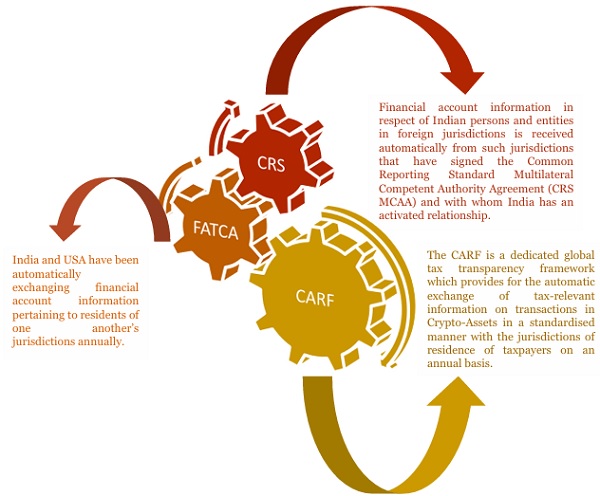
Financial account information in respect of Indian persons and entities in foreign jurisdictions is received automatically from such jurisdictions that have signed the Common Reporting Standard Multilateral Competent Authority Agreement (CRS MCAA) and with whom India has an activated relationship.
The CARF is a dedicated global tax transparency framework which provides for the automatic exchange of tax-relevant information on transactions in Crypto-Assets in a standardised manner with the jurisdictions of residence of taxpayers on an annual basis.
DEVELOPMENT OF CARF TO COMPLEMENT CRS
1.2 The increasing use of crypto-assets has given rise to concerns among tax administrations across the world on their potential use for evading tax compliance. It was observed that assets capable of being transferred and held outside the traditional financial sector can avoid being captured and reported by CRS and thereby reduce the effectiveness of automatic exchange of information under CRS. This led to a quest for measures that can plug this loophole.
1.3 Since crypto-assets generally fall outside the scope of the due diligence and reporting obligations applicable to Reporting Financial Institutions under the CRS, and the nature of these assets and their transactions significantly differed from the more traditional financial assets covered under CRS, discussions commenced at the international level on the need for a dedicated reporting framework for crypto-assets.
1.4 Taking cognisance of this challenge, work was initiated by the G20 and OECD jurisdictions, during the ongoing review of CRS and the need for its amendments, by the Working Party No. 10 (WP10) of the Committee on Fiscal Affairs of OECD, which includes G20 and other non-OECD jurisdictions and which deals with Exchange of Information standards and their compliance, including the development and maintenance of the CRS. This work led to the examination of the risks posed by crypto-assets, consultation with stakeholders and participating jurisdictions. It also led to the creation of the Crypto-Asset Reporting Framework (CARF) Group by the Global Forum with more than 50 countries, including India, as members. The work undertaken in WP10 and CARF Group was aimed at development of CARF and its implementation.
1.5 The development of CARF was fully supported by the G20. In April 2021, the G20 Finance Ministers and Central Bank Governors noted the importance of taking forward work in this area and stated in the G20 Finance Ministers and Central Bank Governors’ Communiqué (April 2021), “We ask the OECD to continue its work on developing a framework for the automatic exchange of information on crypto-assets.” This provided the G20 mandate to the development of CARF.
1.6 The work on developing CARF was concluded in 2022, and received the approval of OECD in August 2022. It standardises reporting of tax information on Crypto-Asset transactions for automatic exchange. The CARF defines relevant Crypto-Assets, specifies reporting obligations for intermediaries and service providers, and aligns with global anti-money laundering standards.
1.7 Subsequently, in November 2022, the G20 Bali Leaders’ Declaration endorsed CARF by stating,” We also welcome the Crypto-Asset Reporting Framework and the amendments to the Common Reporting Standard, both of which we consider to be integral additions to the global standards for automatic exchange of information. We call on the OECD to conclude the work on implementation packages, including possible timelines, and invite the Global Forum on Transparency and Exchange of Information for Tax Purposes to build on its commitment and monitoring processes to ensure widespread implementation of both packages by relevant jurisdictions.” Under the G20 mandate, further work was continued to develop implementation packages for facilitating the implementation of CARF by interested jurisdictions around the world.
INDIA’S G20 PRESIDENCY IN 2023
1.8 India’s G20 Presidency in 2023 provided further impetus to the implementation phase of CARF. In September 2023, the G20 New Delhi Leaders’ Declaration1 gave it further impetus with a timeline by stating, “We call for the swift implementation of the Crypto Asset Reporting Framework (“CARF”) and amendments to the CRS. We ask the Global Forum on Transparency and Exchange of Information for Tax Purposes (“Global Forum”) to identify an appropriate and coordinated timeline to commence exchanges by relevant jurisdictions, noting the aspiration of a significant number of these jurisdictions to start CARF exchanges by 2027 and to report to our future meetings on the progress of its work.”
1.9 As a G20 country, India has been involved in this work, participating in Working Party 10 as well CARF Group, and has contributed to its development. These developments have since become an important component of the new international tax transparency architecture that is expected to be implemented by 2027, and complements the existing AEOI framework comprising FATCA and CRS in ensuring that effective tax transparency implemented by the G20, OECD and other countries around the world addresses the challenges of tax compliance arising from use of crypto-assets.
OVERVIEW OF THE CRYPTO-ASSET REPORTING FRAMEWORK
1.10 The CARF is a dedicated global tax transparency framework which provides for the automatic exchange of tax-relevant information on transactions in Crypto-Assets in a standardised manner with the jurisdictions of residence of taxpayers on an annual basis.
CRYPTO-ASSET
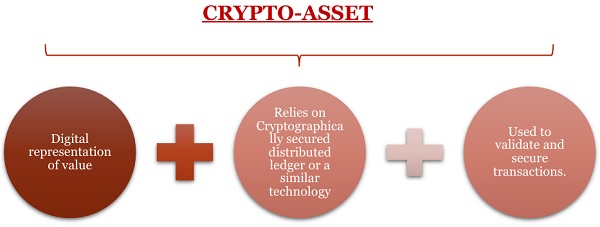
A “Crypto-Asset” is defined as a digital representation of value that relies on a cryptographically secured distributed ledger or a similar technology to validate and secure transactions.
[Section 2(111)(d) of the Income-tax Act, 2025 & Rule 241(10)(a) of Income-tax Rules, 2026]
1.11 The CARF defines “Crypto-Assets” as “a digital representation of value that relies on a cryptographically secured distributed ledger or a similar technology to validate and secure transactions”, which includes cryptocurrencies, as well as cryptography- based tokens. The definition of “Crypto-Assets” has been kept broad intentionally, as the market for Crypto-Assets continues to develop at a rapid rate. Crypto-Assets’ rely on cryptography and distributed ledger technology, in particular blockchain technology, means that they can be issued, recorded, transferred and stored in a decentralised manner, without the need to rely on traditional financial intermediaries or central administrators. Recent years have witnessed increasing popularity, transactions in and the value of a number of Crypto-Asset types, attracting professional investors, as well as individuals, to the sector. Unlike traditional currencies issued by governments, Crypto-Assets rely on new technologies (i.e. cryptography and distributed ledger technology) that allow for the issuing, recording, transferring and storing of Crypto-Assets in a decentralised manner, without the need to rely on traditional financial intermediaries or a centralised administrator (e.g. a central bank or government authority). Crypto-Assets can also be used to make payments for goods and services, again without the need to rely on traditional financial intermediaries. The attraction for many users lies in the decentralised nature of Crypto-Assets, which can allow them to be sent across national borders faster, more cheaply and more easily than traditional currency issued by governments and financial assets and offer potentially novel forms of investment. In view of this, the CARF is therefore designed to apply to such activities, in a similar way as the CRS applies to Financial Accounts.
1.12 The CARF is significant because it extends tax transparency principles to the rapidly growing Crypto-Asset sector, closing the gaps left by traditional reporting standards. It will bring tax transparency to the Crypto-Asset sector which, once implemented, imposes obligations on a new subset of service providers, Reporting Crypto-Asset Service Providers i.e RCASPs, which are the service providers best positioned to collect and report information on transactions of Crypto-Assets. Specifically, the CARF requires RCASPs to identify their users and to report on specified transactions, with a view to ensuring the annualised reporting of tax-relevant information concerning certain activities in relation to Crypto-Assets. Once received by tax authorities, the information will be automatically exchanged with the tax authorities of the jurisdiction(s) of residence of the Crypto-Asset Users, pursuant to an international agreement that provides a legal basis for the automatic exchange of such information for tax purposes. A graphical representation of how CARF works is as below:
Are you a RCASP?
Which country/jurisdiction are you obligated to report in?
Apply Due Diligence Rules
Identify Reportable Persons
Which are the Relevant Crypto-Assets?
Identify Relevant Transactions for each Relevant Crypto-Asset of each Reportable
Person
Report Relevant Information
1.13 While the CARF is considered to be an “integral part” of the international standards for AEOI, which also includes the CRS, it is a standalone framework from the CRS and other forms of AEOI as it applies to the Crypto-Asset sector. Nevertheless, the CARF shares several features with the CRS that are relevant for tax administrations and service providers to understand possible approaches to implementation. The CARF also helps strengthen the CRS by removing the gaps by which the CRS may be circumvented.
INDIA’S LEGISLATIVE FRAMEWORK
1.14 With a view to enforce reporting obligations by RCASPs in India, the necessary legislative framework has been put in place, as follows:
- Inclusion of the definition of a ‘Crypto-Asset’ :
Section 2(111)(d)1 of the Income-tax Act, 2025 - Obligation to furnish information on transaction of Crypto-Asset :
Section 5092 of the Income-tax Act, 2025 - Relevant definitions, Obligation for reporting transaction of Crypto-Asset, Reporting requirements for transaction of Crypto-Assets and Due diligence procedures under Section 509 :
Rules 2413, 2424, 2435 & 2446 of the Income-tax Rules, 2026 - Statement to furnish information on transaction of crypto-asset under Section 509 : Form 1677 of the Income-tax Rules, 2026
- Penalty for failure to furnish information or for furnishing inaccurate information on transaction of crypto-asset :
Section 4468 of the Income-tax Act, 2025
CHAPTER – 2
SCOPE OF CRYPTO-ASSETS TO BE COVERED
2.1 While the definition of Crypto-Assets is intended to cover a broad range of assets, not all Crypto-Assets are subject to the scope of the reporting obligations under the Income-tax Act, 2025 & Income-tax Rules, 2026. It is only Relevant Crypto-Assets in respect of which RCASPs must fulfil reporting and due diligence requirements. If an individual or Entity is a RCASP (e.g. because it otherwise carries out exchanges in Relevant Crypto-Assets), it would nevertheless not be required to report information with respect to exchanges carried out in Crypto-Assets that are not Relevant Crypto-Assets.
CRYPTO-ASSET
2.2 A “Crypto-Asset”1 is defined as a digital representation of value that relies on a cryptographically secured distributed ledger or a similar technology to validate and secure transactions.
CRYPTO-ASSET
2.3 A “digital representation of value”1 means that a Crypto-Asset must represent a right to value, and that the ownership of, or right to, such value can be traded or transferred to other individuals or Entities in a digital manner. The definition of Crypto-Asset is thus functional and does not depend on labels that may be used to describe it, such as “cryptocurrency,” “security token,” or “non-fungible token,” all of which may be Crypto-Assets. For instance, a token based on cryptography that allows individuals to store value, engage in payments and that does not represent any claims or rights of memberships against a person, rights to property or other absolute or relative rights is a Crypto-Asset.
2.4 A Crypto-Asset must rely on a cryptographically secured distributed ledger or similar technology to validate and secure transactions.
2.5 A distributed ledger is a decentralised manner for recording transactions in Crypto- Assets in multiple places and at the same time. The definition of Crypto-Assets under the Act focuses on the use of cryptographically secured distributed ledger technology, as this is a distinguishing factor underpinning the creation, holding and transferability of Crypto-Assets.
2.6 Cryptography refers to a mathematical and computational practice of encoding and decoding data that is used to validate and secure transactions in a decentralised or non-intermediated manner. Validation refers to the process of confirming and recording a transfer or other transaction, similar to the settlement of a financial asset transaction. The cryptographic process is used to ensure, in a decentralised manner, the integrity of Crypto-Assets, the clear assignment of Crypto-Assets to users, and the disposal of Crypto-Assets. This cryptographic process allows multiple parties to engage in disintermediated validations of transactions in the Crypto-Asset, often by verifying public and private cryptographic keys to a transaction. This validation ensures that users in possession of a Crypto-Asset have not already exchanged the same Crypto-Asset in another transaction. The cryptographic process also secures transactions made in Crypto-Assets by compiling each transaction within a block of other transactions. The block of transactions is then added to the official, publicly accessible, transaction ledger (such as a blockchain) once the user completes a cryptographic hash.
2.7 Crypto-Assets may also rely on similar technology that allows for the disintermediated holding or validating of Crypto-Assets. Regardless of the type of software used, if the technology underpinning the Crypto-Asset allows for validating and securing digital transactions in a decentralised or disintermediated manner, it is considered a similar technology to a cryptographically secured distributed ledger. The definition also includes a reference to “similar technology” to ensure it can include new technological developments that emerge in the future and that operate in a functionally similar manner to Crypto-Assets and raise similar tax risks. The definition of Crypto-Assets thereby targets those assets that can be held and transferred in a decentralised manner, without the intervention of traditional financial intermediaries, including stablecoins, derivatives issued in the form of a Crypto-Asset and certain non-fungible tokens (NFTs).
RELEVANT CRYPTO-ASSETS
2.8 As stated above, it is only Relevant Crypto-Assets1 in respect of which RCASPs must fulfil reporting and due diligence requirements. If an individual or Entity is a RCASP (e.g. because it otherwise carries out exchanges in Relevant Crypto-Assets), it would nevertheless not be required to report information with respect to exchanges carried out in Crypto-Assets that are not Relevant Crypto-Assets.
RELEVANT CRYPTO-ASSET
The term Relevant Crypto-Assets applies to all Crypto-Assets except the following three types:
1. Central Bank Digital Currencies2
2. Specified Electronic Money Products3
3. Crypto-Assets for which the RCASP has adequately determined that they cannot be used for payment or investment purposes.
(I) CENTRAL BANK DIGITAL CURRENCIES1
The term “Central Bank Digital Currencies” means any digital Fiat Currency issued by a Central Bank. Central Bank Digital Currencies are not considered Relevant Crypto-Assets, given that they are a digital form of Fiat Currency. In this respect, the term Fiat Currency refers to the official currency of a jurisdiction, issued by a jurisdiction or by a jurisdiction’s designated Central Bank or monetary authority, as represented by physical banknotes or coins or by money in different digital forms, including bank reserves, and Central Bank Digital Currencies. The term also includes commercial bank money and electronic money products (including Specified Electronic Money Products). Accordingly, a stablecoin that qualifies as a Specified Electronic Money Product is treated as Fiat Currency.
(II) SPECIFIED ELECTRONIC MONEY PRODUCTS2
The term “Specified Electronic Money Product” means any Crypto-Asset that is:
a) a digital representation of a single Fiat Currency;
b) issued on receipt of funds for the purpose of making payment transactions;
c) represented by a claim on the issuer denominated in the same Fiat Currency;
d) accepted in payment by a natural or legal person other than the issuer; and
e) redeemable at any time and at par value for the same fiat currency upon request of the holder of the product, by virtue of regulatory requirements to which the issuer is subject to,
The term “Specified Electronic Money Product” does not include a product created for the sole purpose of facilitating the transfer of funds from a customer to another person pursuant to instructions of the customer. A product is not created for the sole purpose of facilitating the transfer of funds if, in the ordinary course of business of the transferring Entity, either the funds connected with such product are held longer than 60 days after receipt of instructions to facilitate the transfer, or, if no instructions are received, the funds connected with such product are held longer than 60 days after receipt of the funds.
(III) CRYPTO-ASSETS FOR WHICH THE RCASP HAS ADEQUATELY DETERMINED THAT THEY CANNOT BE USED FOR PAYMENT OR INVESTMENT PURPOSES.
Other Crypto-Assets (other than the two types listed above) are treated as usable for payment or investment purposes unless a RCASP makes affirmative determination that they cannot be so used.
Non-fungible tokens that are traded on a marketplace are treated as assets that can be used for payment or investment purposes and therefore would be considered Relevant Crypto-Assets.
CHAPTER – 3
INTERMEDIARIES AND OTHER SERVICE PROVIDERS IN SCOPE
3.1 In view of this definition, the following steps have to be considered when determining whether a service provider is a RCASP :
REPORTING CRYPTO-ASSET SERVICE PROVIDER
The term “Reporting Crypto-Asset Service Provider” 1 (RCASP) refers to any Individual or Entity that, as a business, provides a service effecting Exchange Transactions for or on behalf of customers, including by acting as a counterparty, or as an intermediary, to Exchange Transactions, or by making available a trading platform.
3.1 In view of this definition, the following steps have to be considered when determining whether a service provider is a RCASP :
Step :- 1 Determine whether the Service Provider is an Entity or an Individual.
Step 2 Check whether the service provider provides a service effecting Exchange Transactions.
Step 3 Confirm if an Individual or Entity carious out such activities for or on behalf of Customers?
Step 4Examine that the Individual or Entity is conducting aforementioned activities as a business
STEP 1 :
DETERMINE WHETHER THE SERVICE PROVIDER IS AN ENTITY OR AN INDIVIDUAL.
3.2 The first step is to determine whether an Entity or individual is acting as a RCASP. As opposed to the CRS, which specifies that only Entities can be Reporting Financial Institutions, the Rule specifies that RCASPs can be either Entities or Individuals. The term “Entity”1 covers a legal person or a legal arrangement, such as a company or partnership firm or trust or foundation. This term is intended to cover any person other than an individual (i.e. a natural person), in addition to any legal arrangement. An Entity is a “Related Entity”2 of another Entity, if either Entity controls the other Entity, or the two Entities are under common control. For this purpose control includes direct or indirect ownership of more than 50% of the vote and value in an Entity. In this respect, Entities are considered Related Entities if these Entities are connected through one or more chains of ownership by a common parent Entity and if the common parent Entity directly owns more than 50% of the stock or other equity interest in at least one of the other Entities. A chain of ownership is to be understood as the ownership by one or more Entities of more than 50% of the total voting power of the stock of an Entity and more than 50% of the total value of the stock of an Entity, as illustrated by the following example: Entity A owns 51% of the total voting power and 51% of the total value of the stock of Entity B. Entity B in its turn owns 51% of the total voting power and 51% of the total value of the stock of Entity C. Entities A and C are considered “Related Entities” pursuant to sub-clause (8) of Rule 241 because Entity A has a direct ownership of more than 50% of the total voting power of the stock and more than 50% of total value of the stock of Entity B, and because Entity B has a direct ownership of more than 50% of the total voting power of the stock and more than 50% of total value of the stock of Entity C. Entities A and C are, hence, connected through chains of ownership. Notwithstanding the fact that Entity A proportionally only owns 26% of the total value of the stock and voting rights of Entity C, Entity A and Entity C are Related Entities.
Individuals are also included in the definition of RCASP, given that the services of RCASPs can be offered equally by individuals as by Entities. Hence, an individual meeting the requirements of the definition would be considered a RCASP. In addition, a group of individuals meeting the requirements of the definition would be considered a RCASP or multiple RCASPs.
Specifically, an individual or Entity that as a business, provides a service effecting Exchange Transactions for or on behalf of customers, including by making available a trading platform, is a RCASP. The technology involved in providing such service is irrelevant to determine whether an individual or Entity is a RCASP.
STEP 2 :
CHECK WHETHER THE SERVICE PROVIDER PROVIDES A SERVICE EFFECTING EXCHANGE TRANSACTIONS.
3.3 The RCASP definition is functional and based on the set of activities such service providers engage in. An individual or Entity may effect Exchange Transactions for or on behalf of customers by acting as a counterparty or intermediary to the Exchange Transactions. The Rule identifies a number of different types of activities that, when performed as a business, are to be considered effecting Exchange Transactions and therefore giving rise to classification as a RCASP. “Effecting Exchange Transactions”1 refers to a service through which the customer can receive Relevant Crypto-Assets for Fiat Currencies, or vice versa, or exchange Relevant Crypto-Assets for other Relevant Crypto-Assets. For instance, the activities of an investment fund investing in Relevant Crypto-Assets do not constitute a service effecting Exchange Transactions since such activities do not permit the investors in the fund to effect Exchange Transactions.
3.4 Examples of Individuals or Entities that may provide services effecting Exchange Transactions “as a counterparty, or as an intermediary”2, include:
| TYPE OF SERVICE PROVIDER |
DESCRIPTION |
|---|---|
| Dealers acting for their own account to buy and sell Relevant Crypto-Assets to customers | This can include individuals or Entities who stand ready to, as part of its regular business, to buy or sell Relevant Crypto-Assets with other customers, while acting as a principal for their own account. |
| Operators of Crypto-Asset ATMs, permitting the exchange of Relevant Crypto-Assets for Fiat Currencies or other Relevant Crypto-Assets through such ATMs | Entities or individuals may also provide services effecting Exchange Transactions where they run kiosks, such as automated teller machines, that actively convert Relevant Crypto-Assets to Fiat Currencies or other Relevant Crypto-Assets via physical electronic terminals. |
| Crypto-Asset exchanges that act as a market makers and take a bid-ask spread as a transaction commission for their services | This could include exchange services that provide liquidity to the Crypto-Asset market by bringing together orders for buyers and sellers. Services provided as a market maker, subscriber or other market facilitator to acquire and/or dispose of Relevant Crypto-Assets would constitute effecting an Exchange Transaction for purposes of the definition of RCASP. |
| Brokers in Relevant Crypto- Assets where they act on behalf of clients to complete orders to buy or sell an interest in Relevant Crypto- Assets | As for other brokerage services in relation to traditional Financial Assets, this can cover the actions of brokers to exchange Relevant Crypto-Assets with other Relevant Crypto-Assets and/or Fiat Currencies on behalf of their customers in an agent or intermediary capacity. |
| Individuals or Entities subscribing one or more Relevant Crypto-Assets | While the sole creation and issuance of a Relevant Crypto-Asset would not be considered a service effecting Exchange Transactions as a counterparty or intermediary, the direct purchase of Relevant Crypto-Assets from an issuer, to resell and distribute such Relevant Crypto-Assets to customers would be considered effecting an Exchange Transaction. |
3.5 An individual or Entity may also effect Exchange Transactions for or on behalf of customers by making available a trading platform that provides the ability for such customers to effect Exchange Transactions on such platform. A “trading platform”1 includes any software program or application that allows users to effect (either partially or in their entirety) Exchange Transactions. An individual or Entity that is making available a platform that solely includes a bulletin board functionality for posting buy, sell or conversion prices of Relevant Crypto-Assets would not be a RCASP as it would not provide a service allowing users to effect Exchange Transactions. For the same reason, an Individual or Entity that solely creates or sells software or an application is not a Reporting Crypto-Asset Service Provider, as long as it is not using such software or application for the provision of a service effecting Exchange Transactions for or on behalf of customers.
3.6 An individual or Entity will be considered to make available a trading platform to the extent it exercises control or sufficient influence over the platform, allowing it to comply with the due diligence and reporting obligations with respect to Exchange Transactions concluded on the platform. This may occur through the coordinated efforts of multiple individuals and/or Entities, which may be located in multiple jurisdictions. In such cases, each Individual or Entity that exercises control or sufficient influence over the platform is considered an RCASP. For such scenarios, the due diligence rules provide for the option of RCASPs to designate a single party to fulfil the due diligence requirements of the RCASP. Whether an Individual or Entity exercises such control or sufficient influence should be assessed in a manner consistent with the 2012 FATF Recommendations 1 (as amended in June 2019 with respect to virtual assets and virtual asset service providers) and related FATF guidance.
STEP 3 :
CONFIRM IF AN INDIVIAL OR ENTITY CARRIES OUT SUCH ACTIVITIES FOR OR ON BEHALF OF CUSTOMERS?
3.7 An Individual or Entity may be a RCASP by carrying out activities other than acting as a counterparty, or intermediary, to an Exchange Transaction, or making available a trading platform, as long as it functionally provides a service, as a business, effecting Exchange Transactions for or on behalf of customers. Hence, a RCASP may effect transactions in Crypto-Assets in a manner similar to a traditional financial institution, by acting as a dealer or broker with respect to those assets, or it may effect transactions in Crypto-Assets by providing access to “decentralised” services such as software that automatically matches a buyer and seller and facilitates Exchange Transactions between those Crypto-Asset Users. Hence, an Individual or Entity effecting Exchange Transactions will only be a RCASP if it carries out such activities for or on behalf of customers. In this context, the simple passive investment of an investment fund investing in Relevant Crypto-Assets does not constitute a service effecting Exchange Transactions since such activities do not permit the fund or its investors to effect Exchange Transactions. Furthermore, an Individual or Entity that is solely engaged in validating distributed ledger transactions in Relevant Crypto-Assets, even if it receives payment for such purposes, is not considered to conduct Exchange Transactions on behalf of customers and, therefore, is not a RCASP.
STEP 4 :
EXAMINE THAT THE INDIVIDUAL OR ENTITY IS CONDUCTING AFOREMENTIONED ACTIVITIES AS A BUSINESS
3.8 When effecting Exchange Transactions on behalf of customers, a RCASP must be carrying on the activities “as a business”. The phrase “as a business”1 excludes individuals or entities who carry out a service on infrequent basis for non-commercial reasons. It is meant to ensure that reporting requirements are not placed on Individuals or Entities who effect Exchange Transactions but do not do so as part of a business (e.g. on a very infrequent basis for non-commercial reasons). In this regard, one-off transactions that are completed on behalf of other persons do not constitute conducting activities “as a business”.
CHAPTER – 4
IDENTIFYING WHERE RCASPs SHOULD REPORT
4.1 Once a RCASP has been correctly identified, the next step is to determine if it has sufficient connection to a jurisdiction, in order to report the required information to such jurisdiction’s tax authority. RCASPs with sufficient connection to a partner jurisdiction are considered to have a reporting nexus to that partner jurisdiction.
4.2 Accordingly, a criterion1 is set out pursuant to which a RCASP will be considered to have a nexus in India, as follows:
(i) An entity or individual resident for tax purposes in India; or
(ii) An entity that is incorporated or organised under the laws of India; or
(iii) An entity that either has legal personality in India or has an obligation to file return of income under section 263; or
(iv) An entity managed from India; or
(v) An entity or individual that has a regular place of business in India.
Additionally, a RCASP shall be subject to the reporting requirements under Rule 243 and due diligence requirements under Rule 244 with respect to relevant transactions effected through a branch based in India.
4.3 Furthermore, it is recognised that some RCASPs may have a nexus in more than one partner jurisdiction1. The Income-tax Rules, 2026 therefore contains a hierarchy of nexus rules2, with the intention that, where there are multiple jurisdictions where a nexus exists that are both partner jurisdictions, the jurisdiction with the strongest link should be considered the primary jurisdiction for reporting purposes (i.e. a nexus higher on the list represents a stronger link than a nexus lower on the list). For example, an Entity RCASP may have a nexus with two partner jurisdictions, where its tax residence is in one jurisdiction, while its place of incorporation is in a different jurisdiction. To prevent RCASPs from being subject to duplicate reporting requirements in multiple jurisdictions under such circumstances, a cascading hierarchy of nexus criteria requires the RCASP to report where it has the strongest link (in this case, in the jurisdiction of tax residence). If a RCASP has a nexus of the same priority (for example, a place of management) in two partner jurisdictions, the RCASP can report in either jurisdiction, provided it lodges a notification3 in the jurisdiction where it does not report. Hence, a RCASP is not required to complete the reporting requirements under Rule 243 and due diligence requirements under Rule 244 in India, pursuant to Rule 242(1), if it has lodged a notification with India in a format specified by India confirming that such requirements are completed by such RCASP under the rules of a partner jurisdiction pursuant a substantially similar nexus that it is subject to in India. The RCASP may refer to the list of such partner jurisdictions, notified by the Central Government by notification, for the above.
4.4 The reporting by Branches of RCASPs is also described under the Rules. A “Branch”4 means a unit, business or office of a RCASP that is treated as a branch under the regulatory regime of a country or territory, or that is otherwise regulated under the laws of such country or territory as separate from other offices, units, or branches of the RCASP. The general rule is that a RCASP is considered to have a regular place of business in any jurisdiction where it has a Branch. If the RCASP has a nexus that is higher in the hierarchy in another partner jurisdiction, then the RCASP must generally comply with reporting and due diligence requirements in that other jurisdiction with respect to the Branch’s activities, in addition to the jurisdiction where the Branch is located. However, the RCASP is relieved of those requirements with respect to the Branch’s activities if the Branch itself reports the information to the tax authorities of the partner jurisdiction in which it is located. A RCASP that maintains one or more Branches fulfils the due diligence and reporting requirements with respect to a Crypto-Asset User if any one of its Branches in a partner jurisdiction fulfils such requirements. Hence, a RCASP shall be subject to the reporting requirements under Rule 243 and due diligence requirements under Rule 244 with respect to relevant transactions effected through a branch based in India. All units, businesses, or offices of a RCASP in a single country or territory shall be treated as a single branch.
4.5 This hierarchy of nexus rules is set out below, in the order of precedence :
| NEXUS HIERARCHY | DESCRIPTION | WHERE SHOULD THE RCASP REPORT? |
|---|---|---|
| Jurisdiction of tax residence | Refers to the jurisdiction where the RCASP (either an Entity or Individual) has its tax residence. | If an Entity RCASP reports in a partner jurisdiction by virtue of it being resident there for tax purposes, then it has no reporting requirements in India pursuant to being incorporated or organised, having legal personality or obligation to file return of income under section 263, management or regular place of business in India. Furthermore, the RCASP is not required to complete reporting and due diligence requirements in India with respect to Relevant Transactions it effects through a Branch located in a Partner Jurisdiction, if the Branch itself completes the reporting and due diligence requirements for these transactions in the Partner Jurisdiction. If an Individual that is a RCASP reports in a partner jurisdiction by virtue of it being resident there for tax purposes, then it has no reporting requirements in India where it has a regular place of business. |
| Jurisdiction of incorporation or organisation, or where the Entity has legal personality or the obligation to file taxes | For Entity RCASPs, this criterion captures situations where an Entity RCASP is (a) incorporated or organised under the laws of a certain jurisdiction; or (b) has legal personality or is subject to an obligation to file tax returns or tax information returns to the tax authorities in the jurisdiction with respect to its income. A tax information return is any filing used to notify the tax administration regarding part or all of the income of the Entity, but which does not necessarily state a pursuant tax liability of the Entity. | If an Entity RCASP reports in a partner jurisdiction by virtue of it being incorporated or organised, having legal personality or obligation to file returns or tax information returns to the tax authorities in such a partner jurisdiction, then it has no reporting requirements in India pursuant to having a place of management or regular place of business. Furthermore, an Entity RCASP is not required to complete reporting and due diligence requirements in India with respect to Relevant Transactions it effects through a Branch located in a Partner Jurisdiction, if the Branch itself completes the reporting and due diligence requirements for these transactions in the Partner Jurisdiction. |
| Jurisdiction of management | For Entity RCASPs, this criterion captures the place of effective management, as well as any other place of management of the Entity. This criterion also includes situations where a trust (or a functionally similar Entity) that is a RCASP is managed by a trustee (or functionally similar representative) that is tax resident in a jurisdiction. | If an Entity RCASP reports in a partner jurisdiction by virtue of it being managed from there, then it has no reporting requirements in India pursuant to having a regular place of business. Furthermore, an Entity RCASP is not required to complete reporting and due diligence requirements in India with respect to Relevant Transactions it effects through a Branch located in a Partner Jurisdiction, if the Branch itself completes the reporting and due diligence requirements for these transactions in the Partner Jurisdiction. |
| Jurisdiction that is a regular place of business | For Entity or Individual RCASPs, this criterion captures a principal place of business as well as other regular places of business of the RCASP. A Branch of an Entity RCASP is to be considered a regular place of business of such Entity RCASP. | In the absence of a nexus as per the 3 aforementioned criteria, the RCASP will report in the jurisdiction in which it has a regular place of business. Furthermore, the RCASP is not required to complete reporting and due diligence requirements in India with respect to Relevant Transactions it effects through a Branch located in a Partner Jurisdiction, if the Branch itself completes the reporting and due diligence requirements for these transactions in the Partner Jurisdiction. |
CHAPTER – 5
IDENTIFICATION OF REPORTABLE PERSONS
REPORTABLE PERSON
5.1 Each RCASP needs to identify all Reportable Users1 and Reportable Persons2 with respect to which it must report information. Reportable Persons include Crypto-Asset Users3 that are Reportable Users (which may be Individuals and Entities that are resident in a country or territory outside India under the tax laws of such country or territory) and Controlling Persons4 of certain Entity Crypto-Asset Users (essentially Entities that are not Active or otherwise excluded) that are resident in a country or territory outside India under the tax laws of such country or territory. RCASPs must therefore first review and identify their customer base to determine whether any of their Crypto-Asset Users or the Controlling Persons of their relevant Entity Crypto Asset Users are subject to exclusions and should therefore not be reported on or are resident in a country or territory outside India under the tax laws of such country or territory. To make this determination, RCASPs will need to follow the due diligence procedures set out in the Rules.
5.2 A basic summary of relevant terms is as below:
CRYPTO-ASSET USERS
The term “Crypto-Asset User” means :
(i) an individual or entity that is a customer of a RCASP for the purposes of carrying out relevant transactions;
(ii) where an individual or entity (other than a financial institution or a reporting crypto-asset service provider), acts as a crypto-asset user for the benefit or account of another individual or entity as agent, custodian, nominee, signatory, investment advisor, or intermediary, such other individual or entity, so however that the first mentioned individual or entity shall not be treated as a crypto-asset user;
(iii)where a reporting crypto-asset service provider provides a service for effecting reportable retail payment transactions for or on behalf of a merchant, the customer that is the counterparty to the merchant for such reportable retail payment transaction.
REPORTABLE USERS
The term “Reportable User” means a Crypto-Asset User that is a Reportable Person.
REPORTABLE PERSONS
The term “Reportable Person” means :
(i) an entity or an individual that is resident in a country or territory outside India under the tax laws of such country or territory; or
(ii) an estate of a decedent that was a resident of a country or territory outside India,
other than excluded person;
For this purpose, an Entity such as a partnership, limited liability partnership or similar legal arrangement that has no residence for tax purposes shall be treated as resident in the jurisdiction in which its place of effective management is situated. If the Entity Crypto-Asset User certifies that it has no residence for tax purposes, the RCASP may rely on the place of effective management or the address of the principal office to determine the residence of the Entity Crypto-Asset User. The “place of effective management” is the place where key management and commercial decisions that are necessary for the conduct of the Entity’s business as a whole are in substance made. All relevant facts and circumstances must be examined to determine the place of effective management.
The term “Reportable Person” also includes an estate of a decedent that was a resident of a country or territory outside India. In determining what is meant by “estate”, reference must be made to each jurisdiction’s particular rules on the transfer or inheritance of rights and obligations in the event of death (e.g. the rules on universal succession).
5.3 The entire exercise of Identification of Reportable Persons can be broken down in 2 steps, as follows :
STEP 1 :
IDENTIFICATION OF CRYPTO-ASSET USERS (INDIVIDUAL OR ENTITY) WHO ARE REPORTABLE USERS.
5.4 The first step is for RCASPs to identify their Crypto-Asset Users1. The Rule specifies that a Crypto-Asset User is any individual (i.e. Individual Crypto-Asset User) or Entity (i.e. Entity Crypto-Asset User) for whom a RCASP carries out Relevant Transactions. A Relevant Transaction means an Exchange Transaction or a Transfer of Relevant Crypto- Assets, which is discussed in detail in the Chapter 7. Hence, any Individual Crypto-Asset Users as well as Entity Crypto-Asset Users must be identified by the RCASP, irrespective of whether the RCASP is safekeeping the Relevant Crypto-Assets on behalf of the Crypto-Asset User or the legal characterisation of the relationship between the RCASP and such Individual or Entity.
5.5 In addition to identifying Crypto-Asset Users according to the general rule described above, there are also two distinct cases where RCASPs will need to apply specific rules for identifying Crypto-Asset Users.
- First, where a Crypto-Asset User (other than a RCASP or a Financial Institution) is acting for the benefit or account of another individual or Entity as an agent, custodian, nominee, signatory, investment advisor, or intermediary, the RCASP should not treat the intermediary as a Crypto- Asset User. Instead, the individual or Entity on whose behalf the Crypto-Asset User relationship is in place should be treated as the Crypto-Asset User, and identification should be carried out on that basis.
- Secondly, a RCASP may conduct Relevant Transactions (in this case, Transfers) that allow a merchant to offer its customers payment in the form of Relevant Crypto-Assets, in consideration of a purchase of goods or services, where the value exceeds USD 50,000. Depending on the RCASP’s relationship with the merchant and the customer, either the merchant or the customer may be a Crypto-Asset User for the RCASP. In addition, if in the relationship only the merchant is the Crypto-Asset User with respect to the RCASP, the RCASP is required to verify the identity of the merchant’s customers pursuant to Prevention of Money Laundering Act, 2002, the RCASP must then also treat the customers of the merchant as its Crypto-Asset User(s) and ensure their identification as such. The requirement to verify the identity of the customer means a requirement pursuant to Prevention of Money-Laundering Act, 2002 (15 of 2003).
5.6 A Crypto-Asset User is classified, firstly, depending on whether it is an Individual or an Entity and, secondly, depending on the date it established a relationship as such with a RCASP. Thus, a Crypto-Asset User can be either an “Individual Crypto-Asset User”1 and/or an “Entity Crypto-Asset User”2 or a “Pre-existing Individual Crypto-Asset User”3 (“Pre-existing individual crypto-asset user” means an individual crypto-asset user that has established a relationship with the RCASP as of the 31st December, 2025) and/or a “Pre-existing Entity Crypto-Asset User”4 (“Pre-existing entity crypto-asset user” means an entity crypto-asset user that has established a relationship with the RCASP as of the 31st December, 2025).
STEP 2 :
IDENTIFICATION OF CONTROLLING PERSONS (OF ENTITY CRYPTO- ASSET USERS) WHO ARE REPORTABLE PERSONS.
5.7 If the Entity Crypto-Asset User is not an Active Entity or an Excluded Person, then the RCASP must “look-through” the Entity Crypto-Asset User to identify its “Controlling Persons”5. If the Controlling Persons are Reportable Persons (i.e. are resident of a country or territory outside India), then information in relation to the Controlling Person and the Entity Crypto-Asset User they control must be reported to the jurisdiction to which the RCASP reports to so that that jurisdiction can provide that information to the Controlling Person’s jurisdiction of residence. This is the same process for identifying Controlling Persons as set out under the CRS, where Controlling Persons of certain Entity Account Holders are also required to be identified. The term Controlling Persons corresponds to the term “beneficial owner” as described in Recommendation 10 and the Interpretative Note on Recommendation 10 of the FATF Recommendations (as adopted in February 2012, and as updated in June 2019 pertaining to Virtual Asset Service Providers) and must be interpreted in a manner consistent with such Recommendations, with the aim of protecting the international financial system from misuse including with respect to tax crimes.
5.8 To determine the Controlling Persons of the Entity Crypto-Asset User, a RCASP may rely on information collected and maintained pursuant to AML/KYC Procedures 1 (Anti Money Laundering or Know Your Customer Procedures) or apply substantially similar procedures, provided that such procedures are consistent with the 2012 FATF Recommendations (as updated in June 2019 pertaining to Virtual Asset Service Providers), and as further updated from time to time. AML/KYC means the customer due diligence procedures of a RCASP as provided under the Prevention of Money-Laundering Act, 2002 (15 of 2003). These procedures include identifying and verifying the identity of the customer (including the beneficial owners of the customer), understanding the nature and purpose of the transactions, and on-going monitoring.
5.9 For an Entity that is a legal person, the term “Controlling Persons” means the natural person(s) who exercises control over the Entity :
– “Control” over an Entity is generally exercised by the natural person(s) who ultimately has a controlling ownership interest in the Entity. A “controlling ownership interest” depends on the ownership structure of the legal person and is usually identified on the basis of a threshold applying a risk-based approach (e.g. any person(s) owning more than a certain percentage of the legal person, such as 25%).
– Where no natural person(s) exercises control through ownership interests, the Controlling Person(s) of the Entity will be the natural person(s) who exercises control of the Entity through other means.
– Where no natural person(s) is identified as exercising control of the Entity, the Controlling Person(s) of the Entity will be the natural person(s) who holds the position of senior managing official.
– In the case of a trust, the term “Controlling Persons” means the settlor(s), the trustee(s), the protector(s) (if any), the beneficiary(ies) or class(es) of beneficiaries, and any other natural person(s) exercising ultimate effective control over the trust. The settlor(s), the trustee(s), the protector(s) (if any), and the beneficiary(ies) or class(es) of beneficiaries, must always be treated as Controlling Persons of a trust, regardless of whether or not any of them exercises control over the trust. In addition, any other natural person(s) exercising ultimate effective control over the trust (including through a chain of control or ownership) must also be treated as a Controlling Person of the trust. With a view to establishing the source of funds in the account(s) held by the trust, where the settlor(s) of a trust is an Entity, RCASPs must also identify the Controlling Person(s) of the settlor(s) and report them as Controlling Person(s) of the trust. For beneficiary(ies) of trusts that are designated by characteristics or by class, RCASPs should obtain sufficient information concerning the beneficiary(ies) to satisfy the RCASP that it will be able to establish the identity of the beneficiary(ies) at the time of the pay-out or when the beneficiary(ies) intends to exercise vested rights. Therefore, that occasion will constitute a change in circumstances and will trigger the relevant procedures.
– In the case of a legal arrangement other than a trust, the term “Controlling Persons” means persons in equivalent or similar positions as those that are Controlling Persons of a trust.
Thus, taking into account the different forms and structures of legal arrangements, RCASPs should identify and report persons in equivalent or similar positions, as those required to be identified and reported for trusts. In relation to legal persons that are functionally similar to trusts (e.g. foundations), RCASPs should identify Controlling Persons through similar customer due diligence procedures as those required for trusts, with a view to achieving appropriate levels of reporting.
5.10 Identification of Controlling Persons of the Entity Crypto-Asset User can be broken down into two steps. First, the RCASP must ask whether the Entity Crypto-Asset User is an Active Entity1 and second, whether the Entity Crypto-Asset User is an Excluded Person2. If the Entity Crypto-Asset User is neither of these, then the RCASP must identify whether the Entity Crypto-Asset User has one or more Controlling Persons which are Reportable Persons.
A. IDENTIFYING WHETHER THE ENTITY CRYPTO-ASSET USER IS AN ACTIVE ENTITY.
5.11 As a first step, RCASPs will need to identify whether any of their Entity Crypto-Asset Users qualify as Active Entities and should therefore be excluded from the requirements to identify their Controlling Persons. An Entity is an Active Entity, provided that it meets any of the criteria listed at Rule 241(16)(l) of the Income-tax Rules, 2026. One of the criteria to qualify as an Active Entity essentially includes Entities with passive income consisting of less than 50% of their total income and where under 50% of their assets produce passive income (such as dividends, interest, capital gains, rents etc.). However, all other qualifications and criteria to define an Active Entity are detailed in the Income-tax Rules, 2026.
B. IDENTIFYING WHETHER THE ENTITY CRYPTO-ASSET USER IS AN EXCLUDED PERSON
5.12 The Rules define Excluded Persons3 to mean any of the following: (a) an Entity the stock of which is regularly traded on one or more established securities markets; (b) any Entity that is a Related Entity of an Entity described in clause (a); (c) a Governmental Entity;
(d) an International Organisation; (e) a Central Bank; or (f) a Financial Institution other than an Investment Entity described in Rule 241 (6)(d)(ii) (of the Income-tax Rules, 2026).
5.13 Entities that are covered by the term “Excluded Person” are not subject to reporting obligations.
CHAPTER – 6
DUE DILIGENCE PROCEDURES
6.1 Rule 244 of the Income-tax Rules, 2026, contains the due diligence procedures to be followed by RCASPs in identifying their Crypto-Asset Users, determining the relevant tax jurisdictions for reporting purposes and collecting relevant information needed to comply with the reporting requirements under the Rule 243. The due diligence requirements are designed to allow RCASPs to efficiently and reliably determine the identity and tax residence of their Individual and Entity Crypto-Asset Users, as well as of the natural persons controlling certain Entity Crypto-Asset Users.
6.2 The due diligence procedures build on the self-certification-based process of the CRS, as well as existing AML/KYC1 obligations enshrined in the 2012 FATF Recommendations, including updates in June 2019 with respect to obligations applicable to virtual asset service providers. However, unlike the CRS, the due diligence rules under section 509 apply substantive requirements equivalent to the CRS New Account Procedures for both Preexisting Crypto-Asset Users2, as well as New Crypto-Asset Users (whether individuals or Entities, as well as the Controlling Persons of certain Entities).
| Under Rule 241(16)(d) & (f),”pre-existing crypto-asset user” means a crypto- asset user that has established a relationship with the CASP as of 31st December, 2025. |
Pre-existing Crypto-Asset User |
| New Crypto-Asset User |
The only difference between the due diligence requirements for Pre-existing Crypto-Asset User and New Crypto-Asset User is one of timing. With respect to all Pre-existing Crypto-Asset Users and the Controlling Persons of certain Entity Crypto-Asset Users (i.e. those with an existing relationship with the RCASP as of 31st December, 2025), the RCASPs should carry out due diligence procedures equivalent to New Account Procedures with respect to all individuals or Entities identified as Crypto-Asset Users and the Controlling Persons of certain Entity Crypto-Asset Users. Such due diligence procedures have to be carried out within 12 months on and from 1st January 20261. With respect to New Crypto-Asset Users and the Controlling Persons of certain Entity Crypto-Asset Users, the RCASP is required to conduct due diligence and obtain a valid self-certification at the time of account opening, as well as one-off transactions.
USING VALID SELF-CERTIFICATIONS TO IDENTIFY CRYPTO-ASSET USERS THAT ARE REPORTABLE USERS
6.3 Once the RCASP has identified its Crypto-Asset Users according to the rules and definitions described in Chapter 5, it is required to identify whether any of its Crypto-Asset Users are Reportable Users and, on that basis information in relation to those customers must be reported, in line with the Reporting Obligations under the Rules. RCASPs will make this determination on the basis of information obtained via the collection of valid self-certifications, as well as other information in their possession and, in certain cases, information that is publicly available. Overall, the process for identifying Crypto-Asset Users that are Reportable Users is very similar to requirements under the CRS.
6.4 The below sections set out the process that RCASPs should use for obtaining the valid self- certifications necessary to determine whether Individual Crypto-Asset Users, as well as Entity Crypto-Asset Users, are Reportable Users. As mentioned above, with respect to certain Entity Crypto-Asset Users, RCASPs will also need to apply an additional step to determine whether its Controlling Persons are themselves Reportable Persons who should be reported on. Each of these processes is very similar to the due diligence rules of the CRS as applicable to new accounts.
INDIVIDUAL CRYPTO-ASSET USERS
STEP 1 :
OBTAINING VALID SELF-CERTIFICATIONS
6.5 Upon the establishment of a relationship with the user, which may include a one-off transaction, a RCASP must collect a self- certification, and confirm its reasonableness, in respect of its Individual Crypto-Asset Users.
6.6 A key requirement associated with the due diligence procedures for a Crypto-Asset User is obtaining a valid self-certification which establishes where the individual is resident for tax purposes. If the self-certification establishes that the Crypto-Asset User is resident for tax purposes outside India, then the RCASP must treat the Crypto-Asset User as a Reportable User. The domestic laws of the various jurisdictions lay down the conditions under which an individual is to be treated as “resident” for tax purposes. They cover various forms of attachment to a jurisdiction which, in the domestic taxation laws, form the basis of a comprehensive taxation (full liability to tax). If an individual is resident for tax purposes in more than one jurisdiction, all jurisdictions of residence must be included in the self-certification and the RCASP must treat the Individual Crypto-Asset User as a Reportable User in respect of each such jurisdiction. The self-certification may be pre-populated by the RCASP to include the Individual Crypto-Asset User’s or Controlling Person’s information, except for the jurisdiction(s) of residence for tax purposes, to the extent already available in its records.
6.7 A self-certification referred is a certification by the Individual Crypto-Asset User that provides the Individual Crypto-Asset User’s status and any other information that may be reasonably requested by the RCASP to fulfil its reporting and due diligence obligations, such as the jurisdiction where the Individual Crypto-Asset User is resident for tax purposes.
6.8 In order for the self-certification to be valid, it must be signed or otherwise positively affirmed, (i.e. involving some level of active input or confirmation) by the Crypto-Asset User, be dated at the latest date of receipt, and must include the Crypto-Asset User’s name; address; country(s) or territory(s) of residence; TIN(s) and date and place of birth.
| Required elements for valid self-certifications for Individual Crypto-Asset Users1 and Controlling Persons2 |
| Name |
| Address |
| Country(s) or Territory(s) of residence |
| For each Reportable Person, the TIN for each jurisdiction of residence |
| Date and Place of birth |
6.9 The requirements of a valid self-certification in the case of a Controlling Person are the same as that for an Individual Crypto-Asset User. However, there are additional requirements for a Controlling person3 such as name; address; country(s) or territory(s) of residence and TIN(s) of the concerned Entity, as well as the role(s) by virtue of which each reportable person is a controlling person of the entity.
6.10 If the self-certification is provided electronically, the electronic system must ensure that the information received is the information sent, and must document all occasions of user access that result in the submission, renewal, or modification of a self-certification. In addition, the design and operation of the electronic system, including access procedures, must ensure that the person accessing the system and furnishing the self-certification is the person named in the self-certification, and must be capable of providing upon request a hard copy of all self-certifications provided electronically. A RCASP may retain an original, certified copy, or photocopy (including a microfiche, electronic scan, or similar means of electronic storage) or electronic copy of the self-certification. The self-certification (including the original) may also exist solely in electronic format.
6.11 A self-certification may be signed (or otherwise positively affirmed) by any person authorised to sign on behalf of the Individual Crypto-Asset User or Controlling Person under domestic law.
6.12 If the Individual Crypto-Asset User or Controlling Person that is identified as having more than one country or territory of residence, the country or territory of residence and TIN to be reported are of all such country(s) or territory(s) of residence and all TIN(s) identified by the RCASP in the self-certification. Notwithstanding the requirements to obtain a TIN in respect of Reportable Users and of Controlling Persons of Entity Crypto-Asset Users that are Reportable Persons, the TIN is not required to be collected if1 :
(i) a TIN is not issued by the country or territory outside India in which reportable user is resident for tax purposes; or
(ii) the domestic law of the country or territory outside India does not require the collection of the TIN issued by such country or territory in which reportable user is resident for tax purposes; and
In such cases, a TIN is considered not to be issued by a country or territory outside India —
(A) where such country or territory does not issue a TIN nor a functional equivalent in the absence of TIN; or
(B) where such country or territory has not issued a TIN to a particular individual or entity.
STEP 2 :
CHECK FOR REASONABLENESS OF SELF-CERTIFICATIONS
6.13 Once the RCASP has obtained a completed self-certification, in order for it to be valid, the RCASP must confirm its reasonableness based on the information obtained in connection with the establishment of the customer relationship, including any documentation collected pursuant to AML/KYC procedures (i.e. the reasonableness test). A RCASP is considered to have confirmed the reasonableness of a self- certification if it does not know or have reason to know that the self-certification is incorrect or unreliable. RCASPs are not expected to carry out an independent legal analysis of relevant tax laws to confirm the reasonableness of a self-certification.
6.14 Where a self-certification fails the reasonableness test, the RCASP is expected to either obtain (i) a valid self- certification or (ii) a reasonable explanation and documentation (as appropriate) supporting the reasonableness of the self-certification (and retain a copy or a notation of such explanation and documentation), before it provides services effecting Relevant Transactions on behalf of the Individual Crypto-Asset User. The FAQs to this Guidance Note contain examples of “reasonable explanation” and the applicable standards of knowledge.
STEP 3 :
RELIANCE ON SELF-CERTIFICATIONS – STANDARDS OF KNOWLEDGE APPLICABLE TO SELF-CERTIFICATIONS
6.15 If, at any point, there is a change of circumstances with respect to an Individual Crypto-Asset User that causes the RCASP to know, or have reason to know, that the original self-certification is incorrect or unreliable, the RCASP cannot rely on the original self-certification and must obtain a valid self- certification, or a reasonable explanation and documentation (as appropriate) supporting the validity of the original self-certification. The standards of knowledge applicable to self-certifications are as below:
- A RCASP has reason to know that a self-certification is unreliable or incorrect if its knowledge of relevant facts or statements contained in the self-certification or other documentation is such that a reasonably prudent person in the position of the RCASP would question the claim being made. A RCASP also has reason to know that a self-certification is unreliable or incorrect if there is information in the documentation or in the RCASP’s files that conflicts with the person’s claim regarding its status.
- A RCASP has reason to know that a self-certification provided by a person is unreliable or incorrect if the self-certification is incomplete with respect to any item on the self-certification that is relevant to the claims made by the person, the self-certification contains any information that is inconsistent with the person’s claim, or the RCASP has other information that is inconsistent with the person’s claim. A RCASP that relies on a service provider to review and maintain a self-certification is considered to know or have reason to know the facts within the knowledge of the service provider.
- A RCASP may not rely on documentation provided by a person if the documentation does not reasonably establish the identity of the person presenting the documentation. For example, documentation is not reliable if it is provided in person by an individual and the photograph or signature on the documentation does not match the appearance or signature of the person presenting the document. A RCASP may not rely on documentation if the documentation contains information that is inconsistent with the person’s claim as to its status, the RCASP has other information that is inconsistent with the person’s status, or the documentation lacks information necessary to establish the person’s status.
STEP 4 :
IN CASE OF A “CHANGE OF CIRCUMSTANCES”
6.16 A “change of circumstances”1 includes any change that results in the addition of information relevant to an Individual Crypto-Asset User’s status or otherwise conflicts with such user’s status or any change or addition of information to any profile associated with such Individual Crypto-Asset User if such change or addition of information affects the status of the Individual Crypto-Asset User. For these purposes, the RCASP should determine whether new information that is obtained with respect to the Individual Crypto-Asset User’s profile in accordance with re-documentation undertaken in accordance with AML/KYC Procedures or other regulatory obligations includes new information that constitutes a change of circumstances. A change of circumstances affecting the self-certification provided to the RCASP will terminate the validity of the self-certification with respect to the information that is no longer reliable, until the information is updated.
6.17 When a change of circumstances occurs, the RCASP cannot rely on the original self-certification and must obtain either (i) a valid self-certification that establishes the residence(s) for tax purposes of the Individual Crypto-Asset User, or (ii) a reasonable explanation and documentation (as appropriate) supporting the validity of the original self-certification (and retain a copy or a notation of such explanation and documentation). Therefore, a RCASP is expected to institute procedures to ensure that any change that constitutes a change in circumstances is identified by the RCASP. In addition, a RCASP is expected to notify any person providing a self-certification of the person’s obligation to notify the RCASP of a change in circumstances.
6.18 A self-certification becomes invalid on the date that the RCASP holding the self-certification knows or has reason to know that circumstances affecting the correctness of the self-certification have changed. However, a RCASP may choose to treat a person as having the same status that it had prior to the change in circumstances until the earlier of 90 calendar days 1 from the date that the self-certification became invalid due to the change in circumstances, the date that the validity of the self-certification is confirmed, or the date that a new self-certification is obtained. If the RCASP cannot obtain a confirmation of the validity of the original self-certification or a valid self-certification during such 90-day period2, the RCASP must treat the Individual Crypto-Asset User as resident of the jurisdiction(s) in which the Individual Crypto-Asset User claimed to be resident in the original self-certification and the jurisdiction(s) in which the Individual Crypto-Asset User may be resident as a result of the change in circumstances.
6.19 A RCASP may rely on a self-certification without having to inquire into possible changes of circumstances that may affect the validity of the statement, unless it knows or has reason to know that circumstances have changed. For instance, where the RCASP obtains information pursuant to its AML/KYC Procedures or other regulatory requirements that information contained in the self-certification is no longer accurate or reliable, the RCASP must update the self-certification with respect to the information identified, before the self-certification can be relied on.
STEP 5 :
CURING SELF-CERTIFICATION ERRORS
6.20 A RCASP may treat a self-certification as valid, notwithstanding that the self-certification contains an inconsequential error, if the RCASP has sufficient documentation on file to supplement the information missing from the self-certification due to the error. In such case, the documentation relied upon to cure the inconsequential error must be conclusive. For example, a self-certification in which the Individual Crypto-Asset User submitting the form abbreviated the jurisdiction of residence may be treated as valid, notwithstanding the abbreviation, if the RCASP has government issued identification for the person from a jurisdiction that reasonably matches the abbreviation. On the other hand, an abbreviation for the jurisdiction of residence that does not reasonably match the jurisdiction of residence shown on the person’s passport is not an inconsequential error. A failure to provide a jurisdiction of residence is not an inconsequential error. In addition, information on a self-certification that contradicts other information contained on the self-certification or in the files of the RCASP is not an inconsequential error.
ENTITY CRYPTO-ASSET USERS
STEP 1 :
OBTAINING VALID SELF-CERTIFICATIONS
6.21 The due diligence procedure for Entity Crypto-Asset Users is made up of two parts:
- First, the RCASP must establish whether the Entity is a Reportable User. If so, the Crypto-Asset User is a Reportable User.
- Second, for Entity Crypto-Asset Users other than Active Entities and Excluded Persons, the RCASP must establish whether the Entity is controlled by Controlling Person(s) that are Reportable Persons(s).
6.22 In order to determine whether an Entity Crypto-Asset User is a Reportable User, due diligence procedures require that, when establishing a relationship with the Entity Crypto-Asset User, or with respect to Pre-existing Entity Crypto-Assets Users by 12 months on and from date specified in Rule 244(3)(b)(i) of Income-tax Rules, 2026, the RCASP obtains a self-certification that allows the RCASP to determine the Entity Crypto-Asset User’s residence(s) for tax purposes. If a self-certification indicates that the Entity Crypto-Asset User is resident in a country or territory outside India, then the RCASP must treat the Entity Crypto-Asset User as a Reportable User unless it reasonably determines based on the self-certification or information in its possession or that is publicly available, that the Entity Crypto-Asset User is an Excluded Person.
6.23 The self-certification must allow the determination of the Entity Crypto-Asset User’s residence(s) for tax purposes. The domestic laws of the various jurisdictions lay down the conditions under which an Entity is to be treated as “resident” for tax purposes. They cover various forms of attachment to a jurisdiction which, in the domestic taxation laws, form the basis of a comprehensive taxation (full tax liability). Generally, an Entity will be resident for tax purposes in a jurisdiction if, under the laws of that jurisdiction, it pays or should be paying tax therein by reason of its place of management or incorporation, or any other criterion of a similar nature, and not only from sources in that jurisdiction. If an Entity is subject to tax as a resident in more than one jurisdiction, all jurisdictions of residence are to be declared in a self-certification and the RCASP must treat the Entity Crypto-Asset User as a Reportable User in respect of each such Jurisdiction. If an Entity Crypto-Asset User certifies that it has no residence for tax purposes, the RCASP may rely on the place of effective management or, as a proxy, on the address of the principal office of the Entity Crypto-Asset User to determine its residence. Examples of cases where an Entity Crypto-Asset User has no residence for tax purposes includes Entities treated as fiscally transparent and Entities resident in a jurisdiction with no corporate income tax system.
CAN IT BE DETERMINED BASED ON INFORMATION IN THE POSSESSION OF THE RCASP OR THAT IS PUBLICLY AVAILABLE THAT THE ENTITY IS NOT A REPORTABLE USER?
6.24 As stated above, the RCASP will not treat the Entity Crypto-Asset User as a Reportable User if it reasonably determines based on the self-certification or information in its possession or that is publicly available, that the Entity Crypto-Asset User is an Excluded Person. In determining whether an Entity Crypto-Asset User is an Excluded Person, the RCASP may follow the procedures in the order most appropriate under the circumstances. For example, as publicly traded corporations, Government Entities and Financial Institutions (other than certain types of Investment Entities) are among those Entities explicitly excluded from being Reportable Users, the RCASP may first establish on the basis of the available information that the Entity Crypto-Asset User is such an Entity and therefore not a Reportable User.
6.25 “Publicly available” information includes information published by an authorised government body (for example, a government or an agency thereof, or a municipality) of a jurisdiction, such as information in a list published by a tax administration; information in a publicly accessible register maintained or authorised by an authorised government body of a jurisdiction; or information disclosed on an established securities market. In this respect, the RCASP is expected to retain a notation of the type of information reviewed, and the date the information was reviewed.
IS THE SELF-CERTIFICATION VALID?
6.26 A self-certification is a certification by the Entity Crypto-Asset User that provides the Entity Crypto-Asset User’s status and any other information that may be reasonably requested by the RCASP to fulfil its reporting and due diligence obligations, such as whether the Entity Crypto-Asset User is resident for tax purposes in India. For the self-certification to be valid it must be signed (or otherwise positively affirmed, i.e. involving some level of active input or confirmation) by a person authorised to sign on behalf of the Entity, be dated, and must include the Entity Crypto-Asset User’s1: name; address; country(s) or territory(s) of residence, all TIN(s) and date and place of incorporation.
| Required elements for valid self-certifications for Entity Crypto-Asset Users |
| Legal name. |
| Address. |
| Country(s) or Territory(s) of residence. |
| With respect to each Reportable Person, the TIN with respect to each Country(s) or Territory(s) of residence. |
| Date and Place of Incorporation. |
| In case of an Entity Crypto-Asset User other than an Active Entity or an Excluded Person, the information described for ‘Valid Self Certification of an Individual Crypto-Asset User’ with respect to each Controlling Person of the Entity Crypto-Asset User, as well as the role(s) by virtue of which each Reportable Person is a Controlling Person of the Entity, if not already determined on the basis of AML/KYC Procedures. |
| If applicable, information as to the criteria it meets to be treated as an Active Entity or Excluded Person. |
The self-certification may be pre-populated by the RCASP to include the Entity Crypto-Asset User’s information, except for the jurisdiction(s) of residence for tax purposes, to the extent already available in its records.
6.27 A self-certification may be signed (or otherwise positively affirmed) by any person authorised to sign on behalf of the Entity Crypto-Asset User under domestic law. A person with authority to sign a self- certification of an Entity Crypto-Asset User generally includes an officer or director of a corporation, a partner of a partnership, a trustee of a trust, any equivalent of the former titles, and any other person that has been provided written authorisation by the Entity Crypto-Asset User to sign documentation on such person’s behalf.
6.28 The other requirements for the validity of self-certifications with respect to Individual Crypto-Asset Users discussed in earlier paragraphs of this Chapter are also applicable for the validity of self- certifications with respect to Entity Crypto-Asset Users.
STEP 2 :
CHECK FOR REASONABLENESS OF SELF-CERTIFICATIONS
6.29 In addition, for the self-certification to be valid, the RCASP must confirm the reasonableness of the self-certification based on the information obtained in connection with the opening of the account (the reasonableness test). Essentially the RCASP must not know or have reason to know that the self- certification is incorrect or unreliable, based on the information obtained in connection with the establishment of the relationship, including any documentation collected pursuant to AML/KYC Procedures. If the self-certification fails the reasonableness test, a new valid self-certification would be expected to be obtained in the course of the account opening procedures. RCASPs are not expected to carry out an independent legal analysis of relevant tax laws to confirm the reasonableness of a self-certification.
6.30 In the case of a self-certification that fails the reasonableness test, it is expected that the RCASP would obtain either (i) a valid self-certification, or (ii) a reasonable explanation and documentation (as appropriate) supporting the reasonableness of the self-certification (and retain a copy or a notation of such explanation and documentation) before providing services effecting Relevant Transactions to the Entity Crypto-Asset User.
6.31 Further guidance in this respect can be found in the explanations and examples given for Individual Crypto-Asset Users.
STEP 3 :
OBTAINING A SELF-CERTIFICATION WITH RESPECT TO CONTROLLING PERSONS
6.32 The RCASP has to determine whether an Entity Crypto-Asset User, other than an Excluded Person, is held by one or more Controlling Persons that are Reportable Persons, unless it determines that the Entity Crypto-Asset User is an Active Entity. Such determination should be made based on a self-certification, the reasonableness of which should be confirmed based on any relevant information available to the RCASP.
6.33 When the RCASP has not determined that the Entity Crypto-Asset User is an Active Entity, then the RCASP must follow the procedures in the order most appropriate under the circumstances, which are aimed at:
- Determining the Controlling Persons of an Entity Crypto-Asset User For the purposes of determining the Controlling Persons of an Entity Crypto-Asset User, a RCASP may rely on information collected and maintained pursuant to AML/KYC Procedures, provided that such procedures are consistent with the 2012 FATF Recommendations (as updated in June 2019 pertaining to virtual asset service providers) and as further updated from time to time. Where the RCASP is not legally required to apply AML/KYC Procedures that are consistent with the 2012 FATF Recommendations (as updated in June 2019 pertaining to virtual asset service providers), it must apply substantially similar procedures for the purpose of determining the Controlling Persons.
- Determining whether any Controlling Persons of the Entity Crypto-Asset User are Reportable Persons. For the purposes of determining whether a Controlling Person of an Entity Crypto-Asset User is a Reportable Person, a RCASP must rely on a self-certification from either the Entity Crypto-Asset User or the Controlling Person and confirm the reasonableness of such self-certification based on the information obtained by the RCASP, including any documentation collected pursuant to AML/KYC Procedures.
6.34 A self-certification referred is a certification by the Controlling Person that provides the Controlling Person’s status and any other information that may be reasonably requested by the RCASP to fulfil its reporting and due diligence obligations, such as whether the Controlling Person is resident for tax purposes in a country or territory outside India. The requirements of a valid self-certification in the case of a Controlling Person are the same as that for an Individual Crypto-Asset User. The self-certification can be provided in any form but in order for it to be valid the Rules sets out that it must be signed (or otherwise positively affirmed, i.e. involving some level of active input or confirmation) by the Controlling Person(s) or the Entity Crypto-Asset User, be dated at the latest date of receipt, and must include the Controlling Person’s: name; residence address; country(s) or territory(s) of residence; TIN(s) and date and place of birth.
6.35 The requirements for the validity of self-certifications with respect to Individual Crypto-Asset Users discussed in earlier paragraphs of this Chapter are also applicable for the validity of self- certifications with respect to Controlling Persons.
STEP 4 :
IN CASE OF A “CHANGE OF CIRCUMSTANCES”
6.36 If there is a change in circumstances that causes the RCASP to know, or have reason to know, that the self-certification or other documentation associated with an account is incorrect or unreliable, the RCASP cannot rely on the original self-certification and must redetermine their status. In doing so, the procedures set forth with respect to Individual Crypto-Asset Users discussed in earlier paragraphs of this Chapter should be applied.
6.37 Other applicable provisions with respect to Due Diligence from the case of Individual Crypto-Asset Users (Steps 2, 3, 4 & 5) may be referred to for similar application in the case of Entity Crypto-Asset Users as well.
OTHER GENERAL DUE DILIGENCE RULES
THIRD PARTIES
6.38 RCASPs are allowed to use third-party service providers to fulfil their due diligence obligations as per Rule 244(11) of the Income-tax Rules, 2026. The following situations apply in which RCASP will rely on documentation of a third party to fulfil its due diligence obligations:
Firstly, with respect to documentation collected by third party service providers, agents or where a RCASP relies on documentation of an acquired business and, Secondly, with respect to the situation where a RCASP relies on other RCASPs that handle the same Relevant Transaction.
6.39 These scenarios, in turn, are described below:
- RCASPs are allowed to use service providers to fulfil their due diligence obligations. In such cases, RCASPs may use the documentation (including a self-certification) collected by service providers, subject to the conditions, however, the due diligence obligations remain the responsibility of the RCASPs. Additionally, the reporting should be done in the name of the RCASP.
- RCASPs may also rely on documentation (including a self-certification) collected by an agent of the RCASP. The agent may retain the documentation as part of an information system maintained for a single RCASP or multiple RCASPs provided that under the system, any RCASP on behalf of which the agent reains documentation may easily access data regarding the nature of the documentation, the information contained in the documentation (including a copy of the documentation itself) and its validity, and must allow such RCASP to easily transmit data, either directly into an electronic system or by providing such information to the agent, regarding any facts of which it becomes aware that may affect the reliability of the documentation. The RCASP must be able to establish, to the extent applicable, how and when it has transmitted data regarding any facts of which it became aware that may affect the reliability of the documentation and must be able to establish that any data it has transmitted has been processed and appropriate due diligence has been exercised regarding the validity of the documentation. The agent must have a system in effect to ensure that any information it receives regarding facts that affect the reliability of the documentation or the status assigned to the Crypto-Asset User are provided to all RCASPs for which the agent retains the documentation.
- RCASPs that acquire the business of another RCASP that has completed all the due diligence required under the Rules with respect to the Individual/Entity Crypto-Asset Users (Including the Entity’s Crypto-Asset User’s Controlling Persons) transferred, would generally be permitted to also rely upon the predecessor’s or transferor’s determination of status of an Individual/Entity Crypto-Asset Users (Including the Entity’s Crypto-Asset User’s Controlling Persons) until the acquirer knows, or has reason to know, that the status is inaccurate or a change in circumstances occurs.
- This provision also seeks to avoid duplicative or multiple application of the due diligence procedures by individuals or Entities that are all RCASPs effecting the same Relevant Transaction with respect to the same Crypto-Asset User. This is particularly relevant in instances where another RCASP may have better access to information to carry out the due diligence procedures, as it is recognised that not all functionalities or services associated with a given Relevant Transaction are necessarily provided by a single Individual or Entity. In certain instances, these functionalities may be split among different Individuals or Entities that could each be a RCASP in respect of the Relevant Transaction. For instance, a broker in Relevant Crypto-Assets may receive an order from a client to conduct a Relevant Transaction in Crypto-Assets. The broker could transmit the client’s order to a trading platform, which effects the transaction on behalf of the client. In this case, the broker is a RCASP where it acts on behalf of a client to complete orders to buy or sell interest in Relevant Crypto-Assets. Similarly, the trading platform is also a RCASP as it conducts the actual Exchange Transaction. As a result there may be more than one RCASP effecting the same Relevant Transaction with respect to the same Crypto-Asset User. This allows RCASPs to designate a single RCASP to comply with all due diligence requirements, in case multiple RCASPs provide services effecting the same Relevant Transaction.
6.40 To that end, a RCASP may rely on a third party to fulfil the due diligence obligations set out under the due diligence provisions as per the Rules. In order for a RCASP to be able to rely on a third party (including another RCASP) for the performance of the due diligence obligations under the Rules, appropriate contractual arrangements should be put in place. Such arrangements should include an obligation for the RCASP to make the information necessary to comply with the due diligence procedures of the Crypto -Asset Reporting Framework available to the third party(ies) fulfilling such obligations. This would include information held by the RCASP that is needed by a third party(ies) to complete the due diligence procedures. The arrangements should also ensure that the RCASP can obtain any information collected and verified in respect of Crypto-Asset Users from the third party(ies) to allow the RCASP to demonstrate compliance with the requirements of the due diligence provisions of the Rules, for instance in the framework of an audit.
6.41 It is important to note that the fact that a RCASP relies on a third party (including another RCASP) to complete the due diligence procedures does not mean that the RCASP is discharged from its obligations under the due diligence provisions of the Rules. Rather, this provision stipulates that the RCASP remains responsible for the completion of the due diligence procedures.
RETENTION OF RECORDS
KEY REQUIREMENT: RECORD RETENTION
All documentation and data must remain available for a period of not less than 7 tax years after the end of the reporting period, including in instances where the RCASP is liquidated or otherwise terminates its business.
6.42 Rule 244(12) of the Income-tax Rules, 2026 specifies relevant information retention obligations, whereby a RCASP is required to ensure that all documentation and data remain available for a period of not less than seven tax years after the end of the period within which the RCASP must report the information required to be reported pursuant to Rule 243, including in instances where the RCASP is liquidated or otherwise terminates its business. Such information includes any information used to identify the Crypto-Asset User, as well as any external wallet addresses (or other equivalent identifiers) associated with Transfers of Relevant Crypto-Assets that are subject to reporting under the Rules.
TIMING
6.43 A Crypto-Asset User is treated as a Reportable User beginning as of the date it is identified as such by a RCASP pursuant to the due diligence procedures specified in Rule 244, and the Crypto-Asset User maintains such status until the date it ceases to be a Reportable User (e.g. because the Crypto-Asset User ceases to be a Reportable User or becomes an Excluded Person, is closed, or is transferred in its entirety).
EXCHANGE OF INFORMATION FOR LIMITED PURPOSES
6.44 As stated in Rule 244 (14) of the Income-tax Rules, 2026, for the purposes of Rules 241, 242 and 243, exchange of any information in respect of any transaction in relevant crypto-asset shall be only for the limited purposes of administration of taxes by the relevant jurisdiction.
CHAPTER – 7
REPORTING REQUIREMENTS
7.1 Once Crypto-Asset Users are determined to be Reportable Users, or where Controlling Persons of Entity Crypto-Asset Users are determined to be Reportable Persons, the RCASP must report the relevant information. This is the information which has to be filed under Form 167 read with Rule 243 of the Income-tax Rules, 2026. The information is:
I. IDENTIFYING INFORMATION ON THE RCASP
7.2 Identifying information on the RCASP1 to allow the identification of the source of the information reported and subsequently exchanged in order to allow for, e.g. follow-up on an error that may have led to incorrect or incomplete information reporting.
INFORMATION ON THE RCASP
Name, Address and Permanent Account Number, along with other relevant information fields are detailed in Form 167.
II. IDENTIFYING INFORMATION ON THE REPORTABLE PERSON
7.3 Information required to identify the Reportable Person2 (i.e. the Individual or Entity Crypto-Asset User or the Controlling Person of a relevant Entity Crypto-Asset User) concerned (Identification information);
| Identification information required to be reported in relation to Individual and Entity Crypto- Asset Users that are Reportable Users, Entity Crypto-Asset Users with Controlling Persons that are Reportable Users and the Controlling Persons themselves | |
| Name | Name of individual or Entity concerned. |
| Address | The address recorded for the Crypto-Asset User or Controlling Person pursuant to the due diligence procedures. For individuals this is their current residence address. |
| Country or Territory of Residence |
This will be the country(s) or territory(s) of residence identified by the RCASP pursuant to the due diligence rules. |
| TIN | Definition : “TIN” means Taxpayer Identification Number (or functional equivalent in the absence of a Taxpayer Identification Number) assigned to the crypto-asset user in the country or territory in which he is a resident for tax purposes (Rule 241(18) of Income Tax Rules).A Taxpayer Identification Number is a unique combination of letters or numbers, however described, assigned by a jurisdiction to an individual or an Entity and used to identify the individual or Entity for purposes of administering the tax laws of such jurisdiction.TINs are also useful for identifying taxpayers who invest in other jurisdictions. TIN specifications (i.e. structure, syntax, etc.) are set by each jurisdiction’s tax administrations. Some jurisdictions even have a different TIN structure for different taxes or different categories of taxpayers (e.g. residents and non- residents).While many jurisdictions utilise a TIN for personal or corporate taxation purposes, some jurisdictions do not issue a TIN. However, these jurisdictions often utilise some other high integrity number with an equivalent level of identification (a “functional equivalent”).Reporting : In this regard, it is clarified here that the TIN to be reported with respect to a Crypto- Asset User or the Controlling Person is the TIN assigned to the Crypto-Asset User or Controlling Person by its country(s) or territory(s) of residence (i.e. not by a jurisdiction of source). However, The TIN is not required to be reported if either the TIN is not issued by such a country(s) or territory(s), or if the domestic law of such a country(s) or territory(s)does not require the collection of the TIN.In this respect, the OECD AEOI Portal contains both a compilation of tax residency rules 1 and the information on the principles for issuance and the formats of TINs in various jurisdictions2.Exception : There is an exception pursuant to Rule 243(2)(a) vide which a TIN is not required to be reported if either:a TIN is not issued by the country or territory outside India in which reportable user is resident for tax purposes; orA TIN is considered not to be issued by a country or territory outside India (i) where such a country or territory does not issue a TIN nor a functional equivalent in the absence of a TIN, or (ii) where such a country or territory has not issued a TIN to a particular individual or Entity. As a consequence, a TIN is not required to be reported with respect to a Reportable Person that is resident in such a country or territory, or with respect to whom a TIN has not been issued. However, if and when such a country or territory starts issuing TINs and issues a TIN to a particular Reportable Person, this exception no longer applies and the Reportable Person’s TIN would be required to be reported if the RCASP obtains a self-certification that contains such TIN, or otherwise obtains such TIN.(B) the domestic law of the country or territory outside India does not require the collection of the TIN issued by such country or territory in which reportable user is resident for tax purposes;This exception focuses on the domestic law of the Reportable Person’s jurisdiction. Where a jurisdiction has issued a TIN to a Reportable Person and the collection of such TIN cannot be required under such jurisdiction’s domestic law (e.g. because under such law the provision of the TIN by a taxpayer is on a voluntary basis), the RCASP is not required to obtain and report the TIN. However, the RCASP is not prevented from asking for, and collecting the Reportable Person’s TIN for reporting purposes if the Reportable Person chooses to provide it. In this case, the RCASP must report the TIN. In practice, there may be only a few jurisdictions where this is the case. |
| Date of Birth |
Date of birth of the Individual Crypto-Asset User or Controlling Person, as determined by the RCASP pursuant to the due diligence rules.This may be read as Date of Incorporation for the Entity Crypto-Asset User. |
| Place of Birth |
Additionally, Place of birth of the Individual Crypto-Asset User or Controlling Person is to be reported, as determined by the RCASP pursuant to the due diligence rules.This may be read as Place of Incorporation for the Entity Crypto-Asset User. |
| Other Relevant Information |
As detailed in Form 167. |
III. TRANSACTION INFORMATION
7.4 Information in relation to the relevant activity that has occurred in connection with the Reportable Person (Transaction information). In this regard, the following definitions are relevant:
EXCHANGE TRANSACTION
An Exchange Transaction, as defined in Rule 241(12)(a), refers to any exchange between Relevant Crypto-Assets and Fiat Currencies as well as any exchange between one or more forms of Relevant Crypto-Assets. For this purpose, an exchange includes the movement of a Relevant Crypto-Asset from one wallet address to another, in consideration of another Relevant Crypto-Asset or Fiat Currency.
EXCHANGE TRANSACTION
An Exchange Transaction, as defined in Rule 241(12)(a), refers to any exchange between Relevant Crypto-Assets and Fiat Currencies as well as any exchange between one or more forms of Relevant Crypto-Assets. For this purpose, an exchange includes the movement of a Relevant Crypto-Asset from one wallet address to another, in consideration of another Relevant Crypto-Asset or Fiat Currency.
“Fiat currency” as defined in Rule 241(12)(d), means the official currency of a country or territory, issued by such country or territory, or by the designated Central Bank or monetary authority of such country or territory, as represented by physical banknotes or coins or by money in different digital forms, including bank reserves and Central Bank Digital Currencies, including commercial bank money and electronic money products (including specified electronic money products). Accordingly, a stablecoin that qualifies as a Specified Electronic Money Product is treated as Fiat Currency.
+
REPORTABLE RETAIL PAYMENT TRANSACTION
A “Reportable Retail Payment Transaction” as defined in Rule 241(12)(b), as a Transfer of Relevant Crypto-Assets in consideration of goods or services for a value exceeding USD 50,000. This term covers situations where a RCASP transfers Relevant Crypto-Assets used by a customer to purchase goods or services from a merchant who receives the Relevant Crypto-Assets as consideration. For example, a RCASP may carry out Relevant Transactions between a merchant and its customers to allow payment for goods or services with Relevant Crypto-Assets. Where a RCASP transfers payment made in Relevant Crypto-Assets from a customer to the merchant for a value above the specified threshold, the RCASP should report such Transfer as a Reportable Retail Payment Transaction. With respect to such Transfers, the RCASP is required to also treat the customer of the merchant as the Crypto- Asset User (subject to the conditions specified in the definition of Crypto-Asset User), and therefore as the Reportable User, in addition to the merchant.
If the RCASP is acting as an agent of the merchant, the Transfer is reported as such and not as a Reportable Retail Payment Transaction. However, with respect to such Transfers, the RCASP is required to also treat the customer of the merchant as the Crypto-Asset User and to report the transaction as a Reportable Retail Payment Transaction with respect to the customer.
+
TRANSFERS
The term “Transfer” as defined in Rule 241(12)(c), means a transaction that moves a Relevant Crypto-Asset from or to the Crypto-Asset address or account of one Crypto-Asset User, other than one maintained by the RCASP on behalf of same Crypto-Asset User. A RCASP can only classify a Relevant Transaction as a Transfer if, based on the knowledge of the RCASP at the time of transaction, the RCASP cannot determine that the transaction is an Exchange Transaction. Such knowledge should be determined by reference to the RCASP’s actual knowledge based on readily available information and the degree of expertise and understanding required to conduct the Relevant Transaction. For example, there may be instances where a Crypto-Asset User acquires or disposes of a Relevant Crypto-Asset against Fiat Currency, although the RCASP does not have actual knowledge of the underlying consideration. This would, for example, be the case if the RCASP only conducted the Transfer of the Relevant Crypto-Assets to and from the Crypto-Asset User’s account, without visibility over the Fiat Currency leg of the transaction. Such transactions would still be considered Relevant Transactions, but the RCASP would need to report such Relevant Transactions as Transfers.
Transfers to and by Reportable Users, include acquisitions and disposals in respect of which the RCASP has no actual knowledge of the consideration paid or received, as well as Transfers that are not acquisitions or disposals (e.g. a Transfer of Crypto-Assets by a user to its private wallet or to its account with another RCASP).
A “Transfer” would also include the instance where a RCASP facilitates an individual or Entity receiving a Relevant Crypto-Asset by means of an airdrop when the Crypto-Asset is newly issued. For instance, in the context of a “hard-fork” a new Relevant Crypto-Asset diverges from a legacy Relevant Crypto-Asset. As a result, developers of the hard fork typically send an airdrop of new Relevant Crypto-Assets to all holders of the legacy Relevant Crypto-Asset and such Crypto-Asset Users will hold the new Relevant Crypto-Assets in addition to the legacy Relevant Crypto-Assets. For example, the receipt of an airdrop of a new Relevant Crypto-Asset is considered an inbound Transfer to the receiving Crypto-Asset User.
=
RELEVANT TRANSACTION
The term “Relevant Transaction” as defined in Rule 241(11), means any :
(a) exchange transaction; and
(b) transfer of relevant crypto-assets;
That is, it refers to any exchange of Relevant Crypto-Assets and Fiat Currencies, any exchange between one or more forms of Relevant Crypto-Assets and Transfers of Relevant Crypto-Assets, including Reportable Retail Payment Transactions. This definition targets those transactions likely to give rise to taxation events (i.e. capital gains and income taxation).
7.5 Reflecting the different categories of Relevant Transactions, RCASPs must, for each type of Relevant Crypto-Asset, report on:
a) the full name of the type of Relevant Crypto-Asset
b) acquisitions and disposals of Relevant Crypto-Assets against Fiat Currency
c) acquisitions and disposals of Relevant Crypto-Assets against other Relevant Crypto-Assets
d) Reportable Retail Payment Transactions
e) other Transfers of Relevant Crypto-Assets to and by the Reportable User
f) Transfers to external wallet addresses
7.6 Together, this information should be sufficient to identify the RCASP, the Reportable Person and to help establish a picture of the compliance risk of that Reportable Person (i.e. whether they have properly declared the relevant transaction information concerning their Crypto-Assets or the Crypto Assets of Entities they control).
7.7 The Reporting Rules contains a series of different currency and valuation rules that apply depending on the type of transaction that takes place. The description of each of the above listed items, along with the applicable valuation and currency translation rules, is tabulated below:
| WHAT IS TO BE REPORTED? | VALUATION AND CURRENCY TRANSLATION RULES |
|---|---|
| (A) TYPE OF RELEVANT CRYPTO-ASSET | |
| The information from (b) through (e) given above in Para 7.5, must be reported by type of Relevant Crypto-Asset. For these purposes, the full name of the type of Relevant Crypto-Asset is required to be reported, rather than a Relevant Crypto-Asset’s “ticker” or abbreviated symbol that a RCASP uses to identify a specific type of Relevant Crypto-Asset. This should be reported in line with the digital token identifier, where feasible. The name of the Relevant Crypto-Asset is to be reported using the Digital Token Identifier code registered in the Digital Token Identifier Foundation (dtif.org), whenever such identifier is issued in respect of the Relevant Crypto-Asset. Where a Digital Token Identifier is not available, the full name of the Relevant Crypto-Asset is to be reported. | |
| (B) CRYPTO-ASSET-TO-FIAT CURRENCY TRANSACTIONS | |
| Rule 243(1)(e)(ii) requires that, in the case of acquisitions of Relevant Crypto-Assets against Fiat Currency, RCASPs must report the aggregate amount paid net of transaction fees by the Reportable User for each type of Relevant Crypto-Assets acquired by the Reportable User. An acquisition is any transaction effected by the RCASP where the Reportable User obtains a Relevant Crypto-Asset, irrespective of Whether such asset is obtained from a third-party seller, or from the RCASP itself.In the case of disposals of Relevant Crypto-Assets against Fiat Currency, 243(1)(e)(iii) requires that the RCASP must report the aggregate amount received in Fiat Currency net of transaction fees for any Relevant Crypto-Assets alienated by the Reportable User.A disposal is any transaction effected by the RCASP where the Reportable User alienates a Relevant Crypto-Asset, irrespective of whether such asset is delivered to a third-party purchaser, or to the RCASP itself.There may be instances where a Reportable User acquires or disposes of a Relevant Crypto-Asset against Fiat Currency, although the RCASP does not have actual knowledge of the underlying Fiat Currency consideration. This would, for example, be the case if the RCASP only conducted the Transfer of the Relevant Crypto-Assets to and from the Reportable User, without actual knowledge of the Fiat Currency leg of the transaction. Such transactions should be reported upon as Transfers sent to or by a Reportable User under Rules 243(1)(e)(vii). and 243(1)(e)(viii), respectively. Hence, in such cases, the RCASP is not required to report on the disposal amount and should treat the transaction as a transfer.A Crypto-Asset-to-Crypto-Asset transaction that is effected by a RCASP will give rise to reporting under both Rules 243(1)(e)(iv) and 243(1)(e)(v).In this respect, Rule 243(1)(e)(iv) provides that in the case of acquisitions against other Relevant Crypto-Assets, the RCASP must report the fair market value of the Relevant Crypto-Assets acquired net of transaction fees. Similarly, Rule 243(1)(e)(v) requires that in the case of disposals against other Relevant Crypto-Assets, the RCASP must report the fair market value of the Relevant Crypto-Assets disposed net of transaction fees.By way of an example, in respect of an exchange of Relevant Crypto-Asset A for Relevant Crypto-Asset B, the RCASP must report both the fair market value of Relevant Crypto-Asset A, i.e. the Relevant Crypto-Asset disposed, under Rule 243(1)(e)(v) and the fair market value of Relevant Crypto-Asset B, i.e. the Relevant Crypto-Asset acquired, under Rule 243(1)(e)(iv), valued at the time of the Relevant Transaction and both net of transaction fees.All Crypto-Asset-to-Crypto-Asset transactions conducted by the same RCASP are subject to reporting under both Rules 243(1)(e)(iv) and 243(1)(e)(v). As for Crypto-Asset-to-Fiat Currency transactions, there may be instances where a Reportable User effects a Crypto-Asset-to-Crypto-Asset transaction, although the RCASP does not have actual knowledge of the Relevant Crypto-Asset acquired or disposed. This would, for example, be the case when the RCASP only effects the Transfer of either the Relevant Crypto-Assets disposed or acquired, without actual knowledge of the other leg of the transaction. Depending on which leg of the transaction the RCASP has actual knowledge of, such transactions should be reported upon as Transfers.sent to or by a Reportable User under Rules 243(1)(e)(vii) and 243(1)(e)(viii), respectively. Example: A Reportable User acquires Relevant Crypto-Asset D in exchange for Relevant Crypto-Asset C. The RCASP effects the Transfer of Relevant Crypto-Asset C to the wallet of the seller of Relevant Crypto-Asset D. In exchange, the seller of Relevant Crypto-Asset D transfers Relevant Crypto-Asset D directly to a cold wallet controlled by the Reportable User. Unless the RCASP has actual knowledge of the consideration, i.e. the Relevant Crypto-Asset D Transfer, it should report the transaction as a Transfer by a Reportable User of Relevant Crypto-Asset C under Rule 243(1)(e)(viii). | As detailed in Rule 243(8)(a), for the purposes of the aforementioned Relevant Transactions:(i) The RCASPs shall report the amount paid or received by the reportable user net of transaction fees;(ii) The amounts paid or(ii) received shall be reported in Indian Rupee;(iii) Where amounts were paid or received in fiat currencies (other than Indian Rupee),–(A) They shall be reported in Indian Rupee, converted at the time of each relevant transaction; and(B) The rate of conversion for calculation of value of such fiat currency in Indian Rupee shall be the telegraphic transfer buying rate (Defined in Rule 241(17)) of such fiat currency as on date on which relevant transaction takes place;(iv) The RCASP shall aggregate, that is, sum up, all transactions attributable to each reporting category for each type of relevant crypto-asset.(C) CRYPTO-ASSET-TO-CRYPTO-ASSET TRANSACTIONSAs detailed in Rule 243(8)(b), for the purposes of the aforementioned Relevant Transactions:(i) The RCASPs shall report the fair market value of the relevant crypto-asset acquired or disposed, net of transaction fees;(ii) The fair market value shall be determined and reported in Indian Rupee, valued at the time of each relevant transaction;(iii) For the purposes of sub-clause (ii)—(A) A RCASP shall rely on applicable crypto-asset to Indian Rupee trading pairs, that it maintains to determine the fair market value of both relevant crypto-assets; or(B) Where a difficult-to-value relevant crypto-asset is exchanged for a relevant crypto-asset that can be readily valued, the valuation in Indian Rupee of the relevant crypto-asset against which the difficult-to-value relevant crypto-asset is exchanged shall be relied upon to establish Indian Rupee value for the difficult-to-value relevant crypto-asset;Example: a Crypto-Asset User makes use of a RCASP to dispose of Relevant Crypto-Asset A against the acquisition of Relevant Crypto-Asset B. Relevant Crypto-Asset A has a readily obtainable Indian Rupee equivalent value and the RCASP can perform an implicit conversion to determine the fair market value of the disposal of Relevant Crypto-Asset A. However, Relevant Crypto-Asset B is a recently launched Crypto-Asset and the RCASP is not able to determine an equivalent fair market value as there is no available Indian Rupee conversion amount. In this case, to determine the acquisition value attributable to the Crypto-Asset User’s acquisition of Crypto-Asset B, the RCASP can perform an implicit conversion of Relevant Crypto-Asset B by attributing to it the same Indian Rupee amount attributed to Relevant Crypto-Asset A. (iv) The RCASP shall aggregate, that is, sum up, all transactions attributable to each reporting category. |
| (D) REPORTABLE RETAIL PAYMENT TRANSACTIONS | |
| Pursuant to Rule 243(1)(e)(vi), aggregate information on Transfers that constitute Reportable Retail Payment Transactions is required to be reported as a separate category of Relevant Transactions. With respect to such Reportable Retail Payments Transactions, the customer of the merchant for, or on behalf of, whom the RCASP is Providing a service effecting Reportable Retail Payment Transactions must be treated as the Crypto-Asset User (subject to the conditions specified in the definition of Crypto-Asset User), and therefore as the Reportable User, in addition to the merchant.Aggregate information with respect to Reportable Retail Payment Transactions by the customer of the merchant must not be included in the aggregate information reported with respect to Transfers under Rule 243(1)(e)(viii).Aggregate information with respect to Transfers that do not constitute Reportable Retail Payment Transactions solely by virtue of not meeting the de minimis threshold, should be included in the aggregate information reported with respect to Transfers under Rules 243(1)(e)(vii) and 243(1)(e)(viii).Example 1: (Reportable Retail Payment Transaction): To facilitate the use of Crypto-Assets by customers to purchase goods, a merchant has entered into an agreement with a RCASP to process payments to the merchant made in Crypto-Assets by the merchant’s customers. The RCASP does not maintain a separate relationship with the merchant’s customers. The customer makes a payment in Relevant Crypto-Assets for goods acquired from the merchant for a value exceeding USD 50,000. This transaction is a Reportable Retail Payment Transaction. The RCASP should treat the customer of the merchant as the Crypto-Asset User, and report the payment in Relevant Crypto-Assets as specified under Rule 243(1)(e)(vi) (Reportable Retail Payment Transactions) (subject to the conditions specified in the definition of Crypto-Asset User), by virtue of the Reportable Retail Payment Transaction. The RCASP should also treat the merchant as the Crypto-Asset User of this transaction, and the transaction is reportable as a Transfer to the merchant under Rule 243(1)(e)(vii).Example 2: (transaction that is not a Reportable Retail Payment Transaction by virtue of de minimis threshold): The customer engages in another transaction with the merchant that is identical to the transaction described in Example 1, except that the transaction amount is less than USD 50,000. The transaction is not a Reportable Retail Payment Transaction. The RCASP should therefore treat the merchant as the Crypto-Asset User of this transaction, and the transaction is reportable as a Transfer to the merchant under Rule 243(1)(e)(vii). | The Valuation and Currency translation rules are the same for Reportable Retail Payment Transactions and Other Transfers. As detailed in Rule 243(8)(e), for the purposes of the aforementioned Relevant Transactions:(i) The fair market value shall be determined and reported in Indian Rupee, using the valuation method as specified in sub-clause (ii);(ii) In performing the valuation, the RCASP shall use as a reference, the values of relevant crypto-asset and Indian Rupee trading pairs it maintains to determine the fair market value of the relevant crypto-asset at the time it is transferred;(iii) Where the RCASP effecting the transfer does not maintain an applicable reference value of the relevant crypto-asset and Indian Rupee trading pairs, the following valuation methods shall be relied upon:(A) Firstly, the internal accounting book values maintained by the RCASP with respect to the relevant crypto-asset shall be used;(B) If a book value is not available, a value provided by third-party companies or websites that aggregate current prices of relevant crypto-assets shall be used, if the valuation method used by that third party is reasonably expected to provide a reliable indicator of value;(C) If neither of the methods specified in item (A) and (B) is available, the most recent valuation of the relevant crypto-asset by the RCASP shall be used; and(D) If a value can still not be attributed, a reasonable estimate may be applied as a measure of last resort;(iv) The information reported shall also identify the fiat currency in which each amount is reported; and(v) The RCASP shall aggregate, that is, sum up, all transactions attributable to each reporting category for each type of relevant crypto-asset |
| (E) TRANSFERS OTHER THAN REPORTABLE RETAIL PAYMENT TRANSACTIONS | |
| Rules 243(1)(e)(vii) and 243(1)(e)(viii) require that RCASPs must report the fair market value of other Transfers sent to, and by, a Reportable User, respectively. Furthermore, the RCASP should subdivide the aggregate fair market value, aggregate number of units and number of Transfers effected on behalf of a Reportable User, during the reporting period, per underlying transfer type, where such transfer type is known by the RCASP. For instance, where a RCASP is aware that Transfers effected on behalf of a Reportable User are due to an airdrop (resulting from a hard-fork), an airdrop (for reasons other than a hard-fork), income derived from staking, the disbursement, reimbursement or associated return on a In case of a loan, or an exchange for goods or services, it should indicate the aggregate fair market value, aggregate number of units and number of Transfers effected for each transfer type. | The Valuation and Currency translation rules are the same for Reportable Retail Payment Transactions and Other Transfers, as detailed in Rule 243(8)(e). Hence, the same rules given at Point (D) of this table may be applicable. |
| (F) TRANSFERS TO EXTERNAL WALLET ADDRESSES | |
| Rule 243(1)(e)(ix) requires the RCASP to report, by type of Relevant Crypto-Asset, the aggregate number of units, as well as the aggregate fair market value, in Fiat Currency, of Transfers it effectuates on behalf of a Reportable User to any wallet addresses (including other equivalent identifiers used to describe the destination of a Transfer) not known to be associated with a virtual asset service provider or financial institution, as defined in the FATF Recommendations. The RCASP is not required to report the aggregate number of units or the aggregate fair market value of Transfers, under Rule 243(1)(e)(ix), in case the RCASP knows that the wallet address to which the Relevant Crypto-Asset is transferred is associated with a virtual asset service provider or financial institution, as defined in the FATF Recommendations.This rule does not require the reporting of wallet addresses associated with Transfers of Relevant Crypto-Assets.However, to ensure that necessary information is available to tax administrations in the context of follow up requests, a RCASP is required to collect and retain within its records, for a period not less than seven years, any external wallet addresses (including other equivalent identifiers) associated with Transfers of Relevant Crypto-Assets that are subject to reporting under Rule 243(1)(e)(ix). | The Valuation and Currency translation rules are the same for Reportable Retail Payment Transactions and Other Transfers, as detailed in Rule 243(8)(e). Hence, the same rules given at Point (D) of this table may be applicable. |
AGGREGATION RULES
7.8 For all reporting categories for each type of Relevant Transactions, the rules require the aggregation, i.e. summing up, of all transactions attributable to each reporting category for each type of Relevant Crypto-Asset, as converted and valued pursuant to rules stated above. For example, if units of a Relevant Crypto-Asset can be mutually substituted for corresponding units of the same Relevant Crypto- Asset, then they should all be treated as the same type of Relevant Crypto-Asset for aggregation purposes. If, however, a Relevant Crypto-Asset is non-fungible, and different variations of the Relevant Crypto-Asset do not have the same value among fixed units, each unit should be treated as a separate type of Relevant Crypto-Asset.
PERIOD & TIME OF REPORTING
KEY REQUIREMENT : REPORTING TIMELINES
Reporting Period: Each relevant calendar year starting on or after the 1st January, 2026.
Filing Deadline: The statements shall be furnished in Form No. 167 by the 31st of May of the calendar year following the year to which the information relates.
7.9 The statement of relevant transactions required to be furnished under sub-section (1) of section 509, shall be furnished by a RCASP in respect of each crypto-asset user or controlling person which has been identified, as a reportable user or reportable person, as the case may be. For each relevant calendar year starting on or after the 1st January, 20261 and subject to the obligations of the RCASP under Rule 242 and due diligence procedures under Rule 244, the aforementioned information listed in this section shall be maintained and reported by the RCASPs in respect of crypto-asset users that are reportable users, or that have controlling persons that are reportable persons. The statements reported by the concerned RCASPs shall be furnished in Form No. 167 by the 31st of May of the calendar year following the year to which the information relates2.
NIL REPORTING
7.10 Where, pursuant to the due diligence procedure specified in rule 244, no crypto-asset user or controlling person is identified as a reportable user or reportable person, a nil statement1 shall be furnished by the RCASP.
1 Rule 243(6) of Income-tax Rules, 2026
CHAPTER – 8
PROCEDURE FOR FURNISHING THE REPORT
8.1 As stated in Rule 243 (9) of the Income-tax Rules, 2026, the RCASP must file Form 167 to be furnished to the Director of Income-tax (Intelligence and Criminal Investigation) or the Joint Director of Income-tax (Intelligence and Criminal Investigation), through online transmission of electronic data, to a server designated for this purpose under the digital signature, in accordance with the data structure specified in this regard by the Director General of Income-tax (Systems).
STEP-BY-STEP FILING PROCESS
8.2 The Step-by-Step Filing Process is summarised as below :
| STEP | ACTION |
|---|---|
| 1 | Generate ITDREIN: Log in to the Income Tax e-filing portal (https://eportal.incometax.gov.in) using the RCASP’s Login credentials. Register under Pending Actions->Reporting Portal->Reporting Entities->New Registration. |
| 2 | Submit reporting entity details: After ITDREIN generation, submit RCASP details on the reporting portal (https://report.insight.gov.in). Once registered, the RCASP will also have an option to edit the details. |
| 3 | Register Designated Director and Principal Officer: Submit details and activate registration via the email link and OTP. |
| 4 | Prepare Form 167: Download the schema and XML utility from the reporting portal. Prepare the XML file. |
| 5 | Upload Form 167: Log in with ITDREIN and PAN. Submit using Designated Director’s Digital Signature Certificate. |
| 6 | Submit Nil Statement: Where no crypto-asset user or controlling person is identified as a reportable user or reportable person, submit a Nil statement by selecting the relevant option and signing with the Digital Signature Certificate. |
8.3 Please see the Reporting Portal 1 for current schema and filing instructions.
CHAPTER – 9
MONITORING AND COMPLIANCE
9.1 The Income-tax Act, 2025, allows for imposition of penalty under section 446 as follows :
(1) If any person who is required to furnish a statement in respect of a transaction of a crypto-asset under section 509(1), fails to furnish such statement within the time prescribed under the said section, the prescribed income-tax authority under that section may impose on him, a penalty of 200 for every day for which such failure continues.
(2) The prescribed income-tax authority may impose a penalty of 50000 on a person referred in sub-section (1), if such person—
a) provides inaccurate information in the statement and fails to remove such inaccuracy as per section 509(4); or
b) fails to comply with due diligence the requirement under section 509(5)
9.2 The RCASPs are accordingly obligated to duly follow the applicable provisions of the Income-tax Act, 2025 and Income-tax Rules, 2026, failing which the aforementioned penalties may be imposed.
CHAPTER – 10
CONTACT DETAILS FOR FURTHER CLARIFICATION
10.1 For further clarification and feedback on this Guidance Note, the following officers of the Income Tax Department may be contacted:
For General Queries:
| For General Queries: | |
| Joint Secretary (FT&TR-I) | [email protected] |
| Director (FT&TR-III) | [email protected] |
| Under Secretary (FT&TR-III) (2) | [email protected] |
| For Systems related Queries: | |
| Additional Director General (Systems)-2, CBDT | [email protected] |
| For Compliance related Queries: | |
| DIT (Intelligence and Criminal Investigation)-1, Delhi | [email protected] |
Government of India
CRYPTO-ASSET REPORTING OBLIGATIONS
UNDER SECTION 509 OF
THE INCOME TAX ACT, 2025
FREQUENTLY ASKED QUESTIONS
Ministry of Finance
Department of Revenue
Central Board of Direct Taxes
Foreign Tax & Tax Research Division
LIST OF FAQs
| SL. NO. | QUESTION | PAGE NO. |
|---|---|---|
| I. | SCOPE OF CRYPTO-ASSETS TO BE COVERED | – 90 – |
| 1 | Which are the relevant sections of the Income-tax Act, 2025 & Income-tax Rules, 2026 to enforce reporting obligations by RCASPs in India? | – 90 – |
| 2 | What is the definition of a “Crypto-Asset”? | – 91 – |
| 3 | What is the definition of “digital representation of value” in the context of a “Crypto-Asset”? | – 91 – |
| 4 | What is the definition of “cryptographically secured distributed ledger” in the context of a “Crypto-Asset”? | – 91 – |
| 5 | What is the definition of “similar technology” in the context of a “Crypto-Asset”? | – 92 – |
| 6 | Does a digitally issued or tokenised Financial Asset qualify as a “Crypto-Asset” as per the Rules where, for regulatory or other legal reasons, such asset can only be held by and transferred through Custodial Accounts maintained with one or more Depository or Custodial Institutions or where such asset is an Equity Interest in a regulated Investment Entity that, for regulatory or other legal reasons, can only be registered and transferred through the Investment Entity by traditional means or distributed ledger controlled by the issuing Investment Entity or its agent or both? | – 93 – |
| 7 | Are all Crypto-Assets are subject to the scope of the IT Act and Rules? | – 93 – |
| 8 | What is the definition of a “Relevant Crypto-Asset”? | – 94 – |
| 9 | What is the definition of “Central Bank Digital Currencies” in the context of a “Relevant Crypto-Asset”? | – 94 – |
| 10 | What is the definition of “Specified Electronic Money Product” in the context of a “Relevant Crypto-Asset”? | – 95 – |
| 11 | Can a token based on cryptography that allows individuals to store value, engage in payments and that does not represent any claims or rights of memberships against a person, rights to property or other absolute or relative rights, be treated as a Crypto-Asset under the Rules? | – 95 – |
| 12 | Can Non Fungible Tokens be treated as Crypto-Assets for the purpose of Reporting Obligations under section 509 of the Income-tax Act, 2025? | – 97 – |
| 13 | Can certain other uses of cryptographic technology that are not digital representations of value, be treated as Crypto-Assets for the purpose of Reporting Obligations under the IT Act and Rules? | – 98 – |
| 14 | Please explain in detail the relevant test to determine whether a Crypto-Asset cannot be used for payment or investment purposes, in order for it to be considered a Relevant Crypto-Asset for purposes of Reporting Obligations under the IT Act and Rules. | – 98 – |
| 15 | Can a Crypto-Asset that reflects the value of multiple currencies or assets be treated as a Specified Electronic Money Product? | – 100 – |
| 16 | Do multiple balances each in a single Fiat Currency held in multi-currency e-money wallets meet the definition as per the Rules, which requires a Specified Electronic Money Product to be a digital representation of a single Fiat Currency? | – 100 – |
| 17 | Can a Specified Electronic Money Products be a prepaid product for the purpose of Reporting Obligations under the IT Rules? | – 100 – |
| 18 | Can the Crypto-Assets that are created solely to facilitate a funds transfer pursuant to instructions of a customer and that cannot be used to store value, be treated as Specified Electronic Money Product? | – 101 – |
| 19 | Rule 241(10)(d) of Income-tax Rules, 2026 defines the term “Specified Electronic Money Product” as a product that is: “[…] v) redeemable at any time and at par value for the same fiat currency upon request of the holder of the product, by virtue of regulatory requirements to which the issuer is subject to.” What is the scope of application of this requirement and to what extent do restrictions or conditions on the holder’s regulatory right to redeem at any time and at par value for the same Fiat Currency disqualify a product from being a Specified Electronic Money Product? | – 101 – |
| 20 | How should RCASPs treat, for reporting purposes, a Relevant Crypto-Asset that becomes a Specified Electronic Money Product during the course of a reporting period, for instance as a result of the introduction of regulatory requirements that meet the condition of Rule 241(10)(d)(v) of Income-tax Rules, 2026? | – 102 – |
| II. | INTERMEDIARIES AND OTHER SERVICE PROVIDERS IN SCOPE |
– 104 – |
| 21 | What is the definition of a Reporting Crypto-Asset Service Provider i.e RCASP? | – 104 – |
| 22 | What are broad steps to be followed to determine whether an Individual or an Entity is a RCASP? | – 104 – |
| 23 | Can both, an Individual and an Entity be defined as a RCASP? | – 104 – |
| 24 | What is meant by an “Entity” or a “Related Entity”? | – 105 – |
| 25 | What is the definition of “Effecting Exchange Transactions” in the context of a RCASP? | – 106 – |
| 26 | Please give examples of individuals or Entities that may provide services effecting Exchange Transactions “as a counterparty, or as an intermediary”, in the context of a RCASP. | – 106 – |
| 27 | What is the definition of “trading platform” in the context of a RCASP? | – 108 – |
| 28 | Does the definition of RCASP provided for in Rule 241(13) of the Income-tax Rules, 2026, exclude non-custodial services effecting Exchange Transactions? | – 109 – |
| 29 | Will an individual or Entity effecting Exchange Transactions only be a RCASP if it carries out such activities for or on behalf of customers? | – 109 – |
| 30 | Can an investment fund which is only investing in Relevant Crypto-Assets be a RCASP? | – 110 – |
| 31 | Can an individual or Entity that is solely engaged in validating distributed ledger transactions in Relevant Crypto-Assets, be a RCASP? | – 110 – |
| 32 | What is the definition of “as a business” in the context of a RCASP? | – 110 – |
| III. | IDENTIFYING WHERE RCASPs SHOULD REPORT |
– 111 – |
| 33 | In which jurisdiction should a RCASP report? | – 111 – |
| 34 | Where should a RCASP report in cases where a RCASP is subject to the same nexus in two or more jurisdictions? | – 111 – |
| 35 | What is the definition of a “Branch” with respect to reporting nexus of a RCASP? Where should the RCASP report the relevant transactions with respect to its Branch’s activities? | – 112 – |
| 36 | Does the sole existence of a customer base in a jurisdiction mean that a RCASP is subject to the reporting and due diligence requirements in that jurisdiction by virtue only of having a regular place of business under Rule 242(1)(e) of the Income-tax Rules, 2026? | – 113 – |
| 37 | What is the hierarchy of nexus rules, in the order of precedence? | – 113 – |
| 38 | What happens if an Entity/Individual RCASP reports in its jurisdiction of residence? | – 114 – |
| 39 | What happens if an Entity RCASP reports in its Jurisdiction of incorporation or organisation, or where the Entity has legal personality or the obligation to file taxes? | – 115 – |
| 40 | What happens if an Entity RCASP reports in its Jurisdiction of management? | – 115 – |
| 41 | When should the RCASP report in the Jurisdiction that is a regular place of business? | – 115 – |
| 42 | If a RCASP is subject to the reporting and due diligence requirements in a Jurisdiction pursuant to Rule 242(1)(e) of the Income-tax Rules, 2026, by virtue of having a Branch that is a regular place of business in that jurisdiction and the RCASP does not have a higher nexus to another partner jurisdiction, should the RCASP complete the reporting and due diligence requirements in that Jurisdiction with respect to Relevant Transactions effected by the Branch only or with respect to all Relevant Transactions effected by the Entity? | – 116 – |
| IV. | IDENTIFICATION OF REPORTABLE PERSONS | – 117 – |
| 43 | Who are the persons with respect to whom the RCASP has to collect the reportable information? | – 117 – |
| 44 | What is the definition of the term “Crypto-Asset User”? | – 117 – |
| 45 | On what basis can a RCASP determine whether a Crypto-Asset User (other than a RCASP or a Financial Institution) is acting for the benefit or account of another individual or Entity as an agent, custodian, nominee, signatory, investment advisor, or intermediary? | – 118 – |
| 46 | Who is a “Reportable User”? | – 119 – |
| 47 | What is meant by the term “Reportable Person”? | – 119 – |
| 48 | With respect to an Entity Crypto-Asset User that is a partnership, limited liability partnership or similar legal arrangement without residence for tax purposes, can a RCASP rely on the address of the principal office of the Entity for purposes of determining what jurisdiction such Entity is resident in for purposes of the Rules? | – 120 – |
| 49 | What are the different types of “Crypto-Asset Users”? | – 120 – |
| 50 | What are the broad steps that a RCASP is required to follow in order to Identify Reportable Persons? | – 121 – |
| 51 | How is the term “Controlling Person” defined? | – 122 – |
| 52 | What is the procedure to determine/identify the “Controlling Person” of an Entity Crypto-Asset User? | – 124 – |
| 53 | What is the criteria to qualify as an Active Entity? | – 124 – |
| 54 | What is meant by “passive income” with respect to Active Entities for the purpose of Rule 241(16) sub-clause (l)(i)? | – 126 – |
| 55 | What is meant by “substantially all” under the criteria of an Active Entity at Rule 241(16) sub-clause (l)(ii)? | – 127 – |
| 56 | Can “Non-Profit Entities” qualify for the Active Entity status? | – 128 – |
| 57 | What is meant by the term “Excluded Persons”? | – 128 – |
| 58 | If an entity renders non-binding investment advice to a customer, can it be interpreted to an Investment Entity as defined in Rule 241(6)(d)(i) of the Income-tax Rules, 2026? | – 129 – |
| 59 | With respect to the definition of an Investment Entity, how is the term Customer interpreted? | – 129 – |
| 60 | Is the provision of services for effecting exchange transactions for or on behalf of customers included in the definition of an Investment Entity? | – 129 – |
| 61 | Does an entity that primarily conducts as a business investing, administering, or managing non-debt, direct interests in real property | – 129 – |
| on behalf of other persons, such as a type of real estate investment trust, included in the definition of an Investment Entity? | ||
| 62 | With respect to the definition of an Investment Entity at Rule 241(6)(d)(ii) of the Income-tax Rules, 2026, how is the term “managed” interpreted? | – 130 – |
| 63 | With respect to the definition of an Investment Entity at Rule 241(6)(e)(i) of the Income-tax Rules, 2026, how is the term ‘gross income’ interpreted? | – 131 – |
| 64 | Does the term Investment Entity include an Active Entity? | – 131 – |
| V. | DUE DILIGENCE PROCEDURES | – 132 – |
| 65 | What is meant by the “Due Diligence Procedures” that a RCASP is mandated to follow? | – 132 – |
| 66 | What is meant by AML/KYC Procedures? | – 132 – |
| 67 | Do the due diligence rules apply substantive requirements for both Pre-existing Crypto-Asset Users as well as New Crypto-Asset Users? | – 132 – |
| 68 | What are “Self-Certifications” collected by RCASPs during the due diligence procedures? | – 133 – |
| 69 | What are the broad Due Diligence steps required to be followed by a RCASP? | – 134 – |
| 70 | What the required elements for valid self-certifications for Individual Crypto-Asset Users and Controlling Persons? | – 134 – |
| 71 | Are the requirements of a valid self-certification in the case of a Controlling Person the same as that for an Individual Crypto-Asset User? | – 135 – |
| 72 | What are the aspects with respect to the element of “Jurisdiction(s) of residence for tax purposes” for a valid self-certification that a RCASP needs to keep in mind, for an Individual Crypto-Asset User? | – 135 – |
| 73 | Can a self-certification be pre-populated by the RCASP? | – 136 – |
| 74 | In what format or manner should the self-certification be provided by the RCASP? | – 136 – |
| 75 | If the Individual Crypto-Asset User or Controlling Person is resident for tax purposes outside India, should the self-certification include the Individual Crypto-Asset User’s or Controlling Person’s TIN with respect to each such jurisdiction? | – 136 – |
| 76 | What is meant by the “reasonableness test” with respect to self-certifications obtained by a RCASP, for an Individual Crypto-Asset User? | – 137 – |
| 77 | What are some examples of the “reasonableness” test which the RCASP is required to undertake in the case of Individual Crypto-Asset Users? | – 137 – |
| 78 | What should a RCASP do if a self-certification fails the reasonableness test, for an Individual Crypto-Asset User? | – 138 – |
| 79 | What are some examples of a “reasonable explanation” in case a self-certification fails the “reasonableness” test in the case of Individual Crypto-Asset Users? | – 138 – |
| 80 | What are the “Standards of knowledge applicable to self-certifications” based on which a RCASP can rely on them with respect to Individual Crypto-Asset Users? | – 139 – |
| 81 | Can a RCASP rely on documentation provided by a person if the documentation does not reasonably establish the identity of the person presenting the documentation? | – 140 – |
| 82 | What is meant by “change of circumstances” with respect to Individual Crypto-Asset Users? | – 140 – |
| 83 | What should a RCASP do when a change of circumstances occurs with respect to Individual Crypto-Asset Users? | – 141 – |
| 84 | With respect to above, for Individual Crypto-Asset Users, what is the date of validity of a self-certification, if the RCASP holding the self-certification knows or has reason to know that circumstances affecting the correctness of the self-certification have changed? | – 141 – |
| 85 | Can a RCASP treat a self-certification as valid, notwithstanding that the self-certification contains an inconsequential error? | – 142 – |
| 86 | Can a RCASP treat a self-certification as valid, notwithstanding that the self-certification contains an inconsequential error, if the RCASP has sufficient documentation on file to supplement the information missing from the self-certification due to the error? | – 142 – |
| 87 | What are the essential 2 steps required to be followed by a RCASP specifically for due diligence procedure for Entity Crypto-Asset Users? | – 143 – |
| 88 | What the required elements for valid self-certifications for Entity Crypto-Asset Users? | – 143 – |
| 89 | What are the aspects with respect to the element of “Jurisdiction(s) of residence for tax purposes” for a valid self-certification that a RCASP needs to keep in mind, for an Entity Crypto-Asset User? | – 144 – |
| 90 | What should the RCASP report as the jurisdiction of residence if the Entity Crypto-Asset User has no residence for tax purposes? | – 144 – |
| 91 | Can it be determined based on information in the possession of the RCASP or that is publicly available that the Entity is not a Reportable User? | – 145 – |
| 92 | Who can sign a self-certification with respect to an Entity Crypto-Asser User? | – 146 – |
| 93 | What are some examples of the “reasonableness” test which the RCASP is required to undertake in the case of Entity Crypto-Asset Users? | – 146 – |
| 94 | What should a RCASP do if a self-certification fails the reasonableness test? | – 146 – |
| 95 | What are some examples of the “reasonableness” test which the RCASP is required to undertake in the case of Entity Crypto-Asset Users? | – 146 – |
| 96 | What is meant by “change of circumstances” with respect to Entity Crypto-Asset Users? | – 147 – |
| 97 | How should a RCASP obtain a self-certification with respect to Controlling Persons for an Entity Crypto-Asset User? | – 148 – |
| 98 | What are the conditions mandated for a valid self-certification with respect to a Controlling Person of an Entity Crypto-Asset User? | – 149 – |
| 99 | Can a RCASP rely on third-party service providers to fulfil their due diligence obligations as per Rule 244(11) of the Income-tax Rules, 2026? | – 149 – |
| 100 | What are the scenarios to be kept in mind is a situation where a RCASP relies on third-party service providers to fulfil their due diligence obligations as per Rule 244(11) of the Income-tax Rules, 2026? | – 149 – |
| 101 | What is the period of Retention of Records specified for RCASPs? | – 152 – |
| 102 | Till which time is a Crypto-Asset User treated as a Reportable User? | – 152 – |
| 103 | What are the permissible purposes for which the exchange of any information in respect of any transaction in relevant crypto-asset collected as per Rules 241, 242 and 243 is allowed? | – 152 – |
| VI. | REPORTING REQUIREMENTS | – 153 – |
| 104 | What broadly are the Reporting Requirements to be made by the RCASP? | – 153 – |
| 105 | What is the basic information that is to be reported by a RCASP with respect to “Identifying information on the RCASP”? | – 153 – |
| 106 | What is the basic information that has to be shared by the RCASP with respect to “Identification information of the Reportable Person”? | – 153 – |
| 107 | What is defined as an “Exchange Transaction”? | – 156 – |
| 108 | What is defined as a “Fiat Currency”? | – 156 – |
| 109 | What is defined as a “Reportable Retail Payment Transaction”? | – 157 – |
| 110 | What is defined as a “Transfer”? | – 158 – |
| 111 | What is defined as a “Relevant Transaction”? | – 159 – |
| 112 | Certain Relevant Transactions involve the exchange of Relevant Crypto-Assets for a token representing the exchanged Relevant Crypto-Assets. This includes instances where a Relevant Crypto-Asset on one blockchain represents a Relevant Crypto-Asset from another blockchain or the creation of a Relevant Crypto-Asset on the same blockchain that can be used in an automatically executing transaction that the original Relevant Crypto-Asset cannot be used in. The new Relevant Crypto-Asset is supposed to match the asset value it is representing, and it can normally be redeemed at any time. Similarly, a Crypto-Asset User may transfer Relevant-Crypto Assets into an automatically executing contract for the purpose of being used as part of a proof-of-stake consensus mechanism to validate transactions on a distributed ledger. In exchange the Crypto-Asset User may then be issued a tokenised version of their Relevant Crypto-Assets, which carries the same value and is transferable or tradable.Are such transactions, as described above, Exchange Transactions? | – 159 – |
| 113 | Should a Relevant Transaction where Relevant Crypto-Assets are transferred as collateral in exchange for a transaction denominated as a loan of Relevant Crypto-Assets or Fiat Currency, and whereby the terms of the agreement require the return of the collateral and the borrowed Relevant Crypto-Assets or Fiat Currency, be reported as an Exchange Transaction or as a Transfer? | – 160 – |
| 114 | Where a RCASP has knowledge that the Relevant Transactions it is effecting consists of a transfer of Relevant Crypto-Assets as collateral in exchange for a loan of Relevant Crypto-Assets, which Transfer types should it use for reporting such transactions over the lifetime of the loan? | – 160 – |
| 115 | What is the RCASP required to report with respect to each Relevant Crypto-Asset? | – 161 – |
| 116 | How are the naming requirements of the Relevant Crypto-Asset to be applied in practice by a RCASP? | – 161 – |
| 117 | What is to be reported with respect to a “Crypto-Asset-to-Fiat Currency” transaction? | – 162 – |
| 118 | What are the Valuation and Currency translation rules for a “Crypto-Asset-to-Fiat Currency” Transaction? | – 163 – |
| 119 | What is to be reported with respect to a “Crypto-Asset-to-Crypto-Asset” transaction? | – 163 – |
| 120 | What are the Valuation and Currency translation rules for a “Crypto-Asset-to-Crypto-Asset” Transaction? | – 165 – |
| 121 | What is to be reported with respect to a “Reportable Retail Payment Transaction”? | – 166 – |
| 122 | What are the Valuation and Currency translation rules for a “Reportable Retail Payment Transaction”? | – 167 – |
| 123 | What is to be reported with respect to “Transfers other than Reportable Retail Payment Transactions”? | – 168 – |
| 124 | What are the Valuation and Currency translation rules for “Transfers other than Reportable Retail Payment Transactions”? | – 169 – |
| 125 | What is to be reported with respect to “Transfers to external wallet addresses”? | – 169 – |
| 126 | What are the Valuation and Currency translation rules for a “Transfers other than Reportable Retail Payment Transactions” Transaction? | – 170 – |
| 127 | What are the rules of Aggregation for reporting details of various Relevant Transactions? | – 170 – |
| 128 | What is the period for which Reporting has to be done by the RCASP and what is the compliance date for the same? | – 170 – |
| 129 | Is it mandatory for a RCASP to register and obtained ITDREIN, and file Form 167, even in case no crypto-asset user or controlling person is identified as a reportable user or reportable person? | – 171 – |
| 130 | What is the penalty imposable on a RCASP for its failure to furnish the statement within the time prescribed? | – 171 – |
| 131 | What are the specified grounds for imposition of penalty under section 446(2)? | – 171 – |
| 132 | What is the amount of penalty imposable in respect of defaults specified in section 446(2)? | – 171 – |
FAQs
I. SCOPE OF CRYPTO-ASSETS TO BE COVERED
1. Which are the relevant sections of the Income-tax Act, 2025 & Income-tax Rules, 2026 to enforce reporting obligations by RCASPs in India?
With a view to enforce reporting obligations by RCASPs in India, the necessary legislative framework has been put in place, as follows:
- Inclusion of the definition of a ‘Crypto-Asset’ :
Section 2(111)(d)1 of the Income-tax Act, 2025 - Obligation to furnish information on transaction of Crypto-Asset : Section 5092 of the Income-tax Act, 2025
- Relevant definitions, Obligation for reporting transaction of Crypto-Asset, Reporting requirements for transaction of Crypto-Assets and Due diligence procedures under Section 509 :
Rules 2413, 2424, 2435 & 2446 of the Income-tax Rules, 2026 - Statement to furnish information on transaction of crypto-asset under Section 509 :
Form 1677 of the Income-tax Rules, 2026 - Penalty for failure to furnish information or for furnishing inaccurate information on transaction of crypto-asset :
- Section 4461 of the Income-tax Act, 2025
2. What is the definition of a “Crypto-Asset”?
A “crypto-asset”2 is defined as a digital representation of value that relies on a cryptographically secured distributed ledger or a similar technology to validate and secure transactions.
3. What is the definition of “digital representation of value” in the context of a “Crypto-Asset”?
A “digital representation of value”3 means that a Crypto-Asset must represent a right to value, and that the ownership of, or right to, such value can be traded or transferred to other individuals or Entities in a digital manner. The definition of Crypto-Asset is thus functional and does not depend on labels that may be used to describe it, such as “cryptocurrency,” “security token,” or “non-fungible token,” all of which may be Crypto-Assets. For instance, a token based on cryptography that allows individuals to store value, engage in payments and that does not represent any claims or rights of memberships against a person, rights to property or other absolute or relative rights is a Crypto-Asset.
4. What is the definition of “cryptographically secured distributed ledger” in the context of a “Crypto-Asset”?
A Crypto-Asset must rely on a cryptographically secured distributed ledger or similar technology to validate and secure transactions.
A distributed ledger is a decentralised manner for recording transactions in Crypto-Assets in multiple places and at the same time. The definition of Crypto-Assets under the Act focuses on the use of cryptographically secured distributed ledger technology, as this is a distinguishing factor underpinning the creation, holding and transferability of Crypto-Assets.
Cryptography refers to a mathematical and computational practice of encoding and decoding data that is used to validate and secure transactions in a decentralised or non-intermediated manner. Validation refers to the process of confirming and recording a transfer or other transaction, similar to the settlement of a financial asset transaction. The cryptographic process is used to ensure, in a decentralised manner, the integrity of Crypto-Assets, the clear assignment of Crypto-Assets to users, and the disposal of Crypto-Assets. This cryptographic process allows multiple parties to engage in disintermediated validations of transactions in the Crypto-Asset, often by verifying public and private cryptographic keys to a transaction. This validation ensures that users in possession of a Crypto-Asset have not already exchanged the same Crypto-Asset in another transaction. The cryptographic process also secures transactions made in Crypto-Assets by compiling each transaction within a block of other transactions. The block of transactions is then added to the official, publicly accessible, transaction ledger (such as a blockchain) once the user completes a cryptographic hash.
5. What is the definition of “similar technology” in the context of a “Crypto- Asset”?
Crypto-Assets may also rely on similar technology that allows for the disintermediated holding or validating of Crypto-Assets. Regardless of the type of software used, if the technology underpinning the Crypto-Asset allows for validating and securing digital transactions in a decentralised or disintermediated manner, it is considered a similar technology to a cryptographically secured distributed ledger. The definition also includes a reference to “similar technology” to ensure it can include new technological developments that emerge in the future and that operate in a functionally similar manner to Crypto-Assets and raise similar tax risks. The definition of Crypto-Assets thereby targets those assets that can be held and transferred in a decentralised manner, without the intervention of traditional financial intermediaries, including stablecoins, derivatives issued in the form of a Crypto-Asset and certain non-fungible tokens (NFTs).
6. Does a digitally issued or tokenised Financial Asset qualify as a “Crypto-Asset” as per the Rules where, for regulatory or other legal reasons, such asset can only be held by and transferred through Custodial Accounts maintained with one or more Depository or Custodial Institutions or where such asset is an Equity Interest in a regulated Investment Entity that, for regulatory or other legal reasons, can only be registered and transferred through the Investment Entity by traditional means or distributed ledger controlled by the issuing Investment Entity or its agent or both?
The definition of Crypto-Assets targets those assets that can be held and transferred in a decentralised manner, without the intervention of traditional financial intermediaries. In addition, the definition of Crypto-Assets aims to cover assets that rely on technology that allows for validating and securing digital transactions in a decentralised or disintermediated manner. Therefore, a digitally issued or tokenised Financial Asset does not fall within the definition of Crypto- Asset of the Act where such disintermediation is not possible since the asset can, for regulatory or other legal reasons, only be held by and transferred through Custodial Accounts maintained with one or more Depository or Custodial Institutions, or where the asset is an Equity Interest in a regulated Investment Entity that, for regulatory or other legal reasons, can only be registered and transferred through the Investment Entity by traditional means or a distributed ledger controlled by the issuing Investment Entity or its agent or both. Conversely, where the above conditions are not met, a digitally issued or tokenised Financial Asset qualifies as a Crypto-Asset under the Act.
REFERENCE: SECTION IV, Q.6, OECD CARF-RELA TED FREQUENTLY ASKED QUESTIONS1
No.
While the definition of Crypto-Assets is intended to cover a broad range of assets, not all Crypto-Assets are subject to the scope of the Act and Rules. It is only Relevant Crypto-Assets are Crypto-Assets in respect of which RCASPs must fulfil reporting and due diligence requirements. If an individual or Entity is a RCASP (e.g. because it otherwise carries out exchanges in Relevant Crypto-Assets), it would nevertheless not be required to report information with respect to exchanges carried out in Crypto-Assets that are not Relevant Crypto-Assets.
8. What is the definition of a “Relevant Crypto-Asset”?
As stated above, it is only Relevant Crypto-Assets1 in respect of which RCASPs must fulfil reporting and due diligence requirements. If an individual or Entity is a RCASP (e.g. because it otherwise carries out exchanges in Relevant Crypto-Assets), it would nevertheless not be required to report information with respect to exchanges carried out in Crypto-Assets that are not Relevant Crypto-Assets. The term Relevant Crypto-Assets applies to all Crypto-Assets except three types:
i. Central Bank Digital Currencies2
ii. Specified Electronic Money Products3
iii. Crypto-Assets for which the RCASP has adequately determined that they cannot be used for payment or investment purposes.
Non-fungible tokens that are traded on a marketplace are treated as assets that can be used for payment or investment purposes and therefore would be considered Relevant Crypto-Assets.
9. What is the definition of “Central Bank Digital Currencies” in the context of a “Relevant Crypto-Asset”?
The term “Central Bank Digital Currencies” means any digital Fiat Currency issued by a Central Bank. Central Bank Digital Currencies are not considered Relevant Crypto-Assets, given that they are a digital form of Fiat Currency. In this respect, the term Fiat Currency refers to the official currency of a jurisdiction, issued by a jurisdiction or by a jurisdiction’s designated Central Bank or monetary authority, as represented by physical banknotes or coins or by money in different digital forms, including bank reserves, and Central Bank Digital Currencies. The term also includes commercial bank money and electronic money products (including Specified Electronic Money Products). Accordingly, a stablecoin that qualifies as a Specified Electronic Money Product is treated as Fiat Currency.
10. What is the definition of “Specified Electronic Money Product” in the context of a “Relevant Crypto-Asset”?
The term “Specified Electronic Money Product” means any Crypto-Asset that is:
a) a digital representation of a single Fiat Currency;
b) issued on receipt of funds for the purpose of making payment transactions;
c) represented by a claim on the issuer denominated in the same Fiat Currency;
d) accepted in payment by a natural or legal person other than the issuer; and
e) redeemable at any time and at par value for the same fiat currency upon request of the holder of the product, by virtue of regulatory requirements to which the issuer is subject to,
The term “Specified Electronic Money Product” does not include a product created for the sole purpose of facilitating the transfer of funds from a customer to another person pursuant to instructions of the customer. A product is not created for the sole purpose of facilitating the transfer of funds if, in the ordinary course of business of the transferring Entity, either the funds connected with such product are held longer than 60 days after receipt of instructions to facilitate the transfer, or, if no instructions are received, the funds connected with such product are held longer than 60 days after receipt of the funds.
11. Can a token based on cryptography that allows individuals to store value, engage in payments and that does not represent any claims or rights of memberships against a person, rights to property or other absolute or relative rights, be treated as a Crypto-Asset under the Rules?
Yes.
A cryptographic token that represents claims or rights of membership against an individual or Entity, rights to property or other absolute or relative rights (e.g. a security token or a derivative contract or right to purchase or sell an asset, including a Financial Asset and a Crypto-Asset, at a set date, price or other pre-determined factor), and that can be digitally exchanged for Fiat Currencies or other Crypto-Assets, is a Crypto-Asset.
For instance, the following examples illustrate the reporting requirements in respect of derivatives:
I) EXAMPLE 1:
(Crypto-Derivative A, a cryptographic token, purchased with Relevant Crypto-Assets (i.e. stablecoins that are not Specified Electronic Money Products)): Crypto-Derivative A, represents a leveraged interest in an underlying Relevant Crypto-Asset, such that, the value of Crypto-Derivative A will mirror changes in the price of the underlying Relevant Crypto-Asset (either upwards or downwards) at three times the change in market price.
User 1 purchases one unit of Crypto-Derivative A through consideration in the form of stablecoins. As Crypto-Derivative A is a Relevant Crypto-Asset, it is reportable under the Crypto-Asset Reporting Framework, provided the trade is carried out through a RCASP. The trade entails the following Relevant Transactions:
1. Disposal of the stablecoin by User 1, reported in Fiat Currency at the fair market value, along with the number of units; and
2. Acquisition of Crypto-Derivative A by User 1, reported in Fiat Currency at the fair market value, along with the number of units.
II) EXAMPLE 2:
(Redeeming Crypto-Derivative A, with settlement in stablecoins): Further to the trade in Example 1, User 1 redeems Crypto-Derivative A with the issuer. When User 1 redeems Crypto-Derivative A, the market price of the underlying Relevant Crypto-Asset has gained 10% since User 1 purchased Crypto-Derivative A. User 1’s gains are magnified by the leverage of the token, and User 1 redeems Crypto-Derivative A with the issuer for a value 30% greater than the initial purchase price. The RCASP pays this redemption amount to User 1’s wallet in stablecoins. The trade entails the following Relevant Transactions: 1. Disposal of Crypto-Derivative A, valued in Fiat Currency at its fair market value, along with the number of units; and 2. Acquisition of stablecoin, valued in Fiat Currency at their fair market value, along with the number of units.
III) EXAMPLE 3:
(Traditional derivative contract settled by physical delivery of a Relevant Crypto-Asset): Two counterparties, Buyer and Seller, enter into opposing positions of a futures contract to, respectively, purchase and sell Relevant Crypto-Asset B on a specified date. The settlement of the derivative requires Buyer to purchase Relevant Crypto-Asset B from Seller on a specified date and at a pre-determined price, paid in Fiat Currency. Seller is then obliged to physically deliver Relevant Crypto-Asset B to Buyer’s wallet address. On the specified date, Buyer and Seller conduct the transaction, by using a RCASP to facilitate the following Relevant Transactions in respect of Relevant Crypto-Asset B: 1. Disposal of Relevant Crypto-Asset B by Seller, reported at the Fiat Currency received, along with the number of units; and 2. Acquisition of Relevant Crypto-Asset B by Buyer, reported at the Fiat Currency paid, along with the number of units.
REFERENCE : PARA 3, PAGE 49, OECD : INTERNATIONAL STANDARDS FOR AUTOMATIC EXCHANGE OF INFORMATION IN TAX MATTERS1
12. Can Non Fungible Tokens be treated as Crypto-Assets for the purpose of Reporting Obligations under section 509 of the Income-tax Act, 2025?
The term “Crypto-Asset” encompasses both fungible and non-fungible tokens and therefore includes non-fungible tokens (NFTs) representing rights to collectibles, games, works of art, physical property or financial documents that can be traded or transferred to other individuals or Entities in a digital manner.
NFTs are in many instances marketed as collectibles. This function does, however, by itself not prevent an NFT from being able to be used for payment or investment purposes. It is important to consider the nature of the NFT and its function in practice and not what terminology or marketing terms are used. NFTs that can be used for payment or investment purposes in practice are Relevant Crypto-Assets. RCASPs should therefore consider on a case-by-case basis whether an NFT cannot be used for payment or investment purposes, taking into account the commonly accepted usage of the Crypto-Asset. NFTs that are traded on a marketplace can be used for payment or investment purposes and are therefore to be considered Relevant Crypto-Assets.
REFERENCE: SECTION IV, Q.5, OECD CARF-RELA TED FREQUENTLY ASKED QUESTIONS1
13. Can certain other uses of cryptographic technology that are not digital representations of value, be treated as Crypto-Assets for the purpose of Reporting Obligations under the IT Act and Rules?
Other uses of cryptographic technology that are not digital representations of value, are not Crypto-Assets. EXAMPLES include the use of cryptography to:
-
- Create a decentralised immutable record of activities or materials involved in making, storing, shipping or delivering a product, where the record does not convey any ownership rights in such product; or
- A declarative record of ownership of assets (such as a real estate ledger or similar agreement) where the record does not convey any ownership rights in the assets represented by such record.
REFERENCE : PARA 5, PAGE 50, OECD : INTERNATIONAL STANDARDS FOR
AUTOMATIC EXCHANGE OF INFORMATION IN TAX MATTERS2
14. Please explain in detail the relevant test to determine whether a Crypto-Asset cannot be used for payment or investment purposes, in order for it to be considered a Relevant Crypto-Asset for purposes of Reporting Obligations under the IT Act and Rules.
A. For the purpose of adequately determining whether a Crypto-Asset cannot be used for payment or investment purposes, RCASPs may, in a first step, rely on the classification of the Crypto-Asset that was made for the purpose of determining whether the Crypto-Asset is a virtual asset for AML/KYC purposes pursuant to the FATF Recommendations. In case a Crypto-Asset is considered a virtual asset pursuant to FATF Recommendations by virtue of being able to be used for payment or investment purposes, it is to be considered a Relevant Crypto-Asset for purposes of the Crypto-Asset Reporting Framework.
B. Where an asset is not a virtual asset pursuant to FATF Recommendations or the RCASP has not made a determination to that effect, the RCASP must determine, for each Crypto-Asset, whether it cannot be used for payment or investment purposes. Only when this test can be positively affirmed, the Crypto-Asset is not to be considered a Relevant Crypto-Asset.
C. In case of doubts as to whether the Crypto-Asset can be used for payment or investment purposes, the Crypto-Asset is to be considered a Relevant Crypto-Asset.
D. In assessing whether a Crypto-Asset cannot be used for payment or investment purposes, the following aspects may be taken into account:
i) Crypto-Assets that represent Financial Assets or are subject to financial regulation can be used for payment or investment purposes and are therefore to be considered Relevant Crypto- Assets.
ii) NFTs are in many instances marketed as collectibles. This function does, however, by itself not prevent an NFT from being able to be used for payment or investment purposes. It is important to consider the nature of the NFT and its function in practice and not what terminology or marketing terms are used. NFTs that can be used for payment or investment purposes in practice are Relevant Crypto-Assets. RCASPs should therefore consider on a case-by-case basis whether an NFT cannot be used for payment or investment purposes, taking into account the commonly accepted usage of the Crypto-Asset. NFTs that are traded on a marketplace can be used for payment or investment purposes and are therefore to be considered Relevant
iii) Certain Crypto-Assets can only be exchanged or redeemed within a limited fixed network or environment for specified goods and services, such as food, book, and restaurant vouchers, as well airline miles or other loyalty program rewards. In this context, the term “goods and services” may also include digital goods and services, such as digital music, games, books or other media, as well as tickets, software applications and online subscriptions. Provided these Crypto-Assets are characterised by operating in a limited fixed network or environment beyond which the Crypto-Assets cannot be transferred or exchanged in a secondary market outside of the closed-loop system, and cannot be sold or exchanged at a market rate inside or outside of the closed-loop, such Crypto-Assets would generally not be able to be used for payment or investment purposes.
15. Can a Crypto-Asset that reflects the value of multiple currencies or assets be treated as a Specified Electronic Money Product?
No. A Crypto-Asset must be a digital representation of a single Fiat Currency, in order to be a Specified Electronic Money Product. A Crypto-Asset will be considered to digitally represent and reflect the value of the Fiat Currency that it is denominated in. Consequently, a Crypto-Asset that reflects the value of multiple currencies or assets is not a Specified Electronic Money Product.
16. Do multiple balances each in a single Fiat Currency held in multi-currency e-money wallets meet the definition as per the Rules, which requires a Specified Electronic Money Product to be a digital representation of a single Fiat Currency?
Yes.
Each of these balances represent e-money products denominated in a single Fiat Currency that meet the definition as per the Rules.
REFERENCE: SECTION IV, Q.9, OECD CARF-RELA TED FREQUENTLY ASKED QUESTIONS1
17. Can a Specified Electronic Money Products be a prepaid product for the purpose of Reporting Obligations under the IT Rules?
Under the Rules, the term “Specified Electronic Money Product” as any Crypto-Asset that is issued on receipt of funds for the purpose of making payment transactions. The act of “issuing” is interpreted broadly to include the activity of making available prepaid stored value and means of payment in exchange for funds.
However, a Crypto-Asset must be accepted by a natural or legal person other than the issuer in order to be a Specified Electronic Money Product, whereby such third parties must accept the Crypto-Asset as a means of payment. Consequently, monetary value stored on specific pre-paid instruments, designed to address precise needs that can be used only in a limited way, because they allow the electronic money holder to purchase goods or services only in the premises of the electronic money issuer or within a limited network of service providers under direct commercial agreement with a professional issuer, or because they can be used only to acquire a limited range of goods or services, are not considered Specified Electronic Money Products.
18. Can the Crypto-Assets that are created solely to facilitate a funds transfer pursuant to instructions of a customer and that cannot be used to store value, be treated as Specified Electronic Money Product?
The definition of Specified Electronic Money Product excludes those products that are created solely to facilitate a funds transfer pursuant to instructions of a customer and that cannot be used to store value. For EXAMPLE, such products may be used to enable an employer to transfer the monthly wages to its employees or to enable a migrant worker to transfer funds to relatives living in another country. A product is not created for the sole purpose of facilitating the transfer of funds if, in the ordinary course of business of the transferring Entity, either the funds connected with such product are held longer than 60 days after receipt of instructions to facilitate the transfer, or, if no instructions are received, the funds connected with such product are held longer than 60 days after receipt of the funds.
REFERENCE : PARA 20, PAGE 53, OECD : INTERNATIONAL STANDARDS
FOR AUTOMATIC EXCHANGE OF INFORMATION IN TAX MATTERS1
19. Rule 241(10)(d) of Income-tax Rules, 2026 defines the term “Specified Electronic Money Product” as a product that is: “[…] v) redeemable at any time and at par value for the same fiat currency upon request of the holder of the product, by virtue of regulatory requirements to which the issuer is subject to.” What is the scope of application of this requirement and to what extent do restrictions or conditions on the holder’s regulatory right to redeem at any time and at par value for the same Fiat Currency disqualify a product from being a Specified Electronic Money Product?
The requirement must be satisfied with respect to the issuance of the product as a whole, such that all units or tokens forming part of a given issuance are effectively subject to the requirement. Substantive restrictions or conditions that effectively restrict or limit the holder’s regulatory right to request redemption at any time and at par value for the same Fiat Currency are not compatible with the requirements set out in Rule 241(10)(d)(v). Procedural and prudential restrictions or conditions that are applicable in accordance with the laws to which the issuer is subject, are compatible with the requirements set out in this Rule, provided they do not undermine par redemption. This may include, for instance, the application of reasonable redemption fees, AML/CFT or other checks for illegal activity, or the limitation of redemption to business hours or designated customer service channels. In determining whether a specific product qualifies as a Specified Electronic Money Product in respect of the condition set out in Rule 241(10)(d)(v), a RCASP may rely on the relevant regulatory authorisations or approvals granted in respect of that product.
REFERENCE: SECTION IV, Q.7, OECD CARF-RELA TED
FREQUENTLY ASKED QUESTIONS1
20. How should RCASPs treat, for reporting purposes, a Relevant Crypto-Asset that becomes a Specified Electronic Money Product during the course of a reporting period, for instance as a result of the introduction of regulatory requirements that meet the condition of Rule 241(10)(d)(v) of Income-tax Rules, 2026?
Until the date on which the definitional requirements for a Specified Electronic Money Product pursuant to Rule 241(10)(d)(v) of Income-tax Rules, 2026 are met, the product remains a Relevant Crypto-Asset. Accordingly, RCASPs should continue to apply the Rules and include transactional reporting for all Relevant Transactions involving the product up to (but not including) such date.
No. retroactive reclassification should be undertaken for Relevant Transactions executed prior to that date. From the date on which the definitional requirements for a Specified Electronic Money Product pursuant to Rule 241(10)(d) are met, the product is excluded from the Rules. As a result, Exchange Transactions involving the product are to be treated as Exchanges with Fiat Currency for the purpose of Reporting Obligations under the IT Act and Rules. Any Entity that holds the product for the benefit of customers, is a Depository Institution for CRS purposes and must comply with year-end account balance reporting (and, if any, gross interest payments).
As a means of simplification, jurisdictions may specify that RCASPs are allowed to treat the product as either a Relevant Crypto-Asset or a Specified Electronic Money Product for all or part of the calendar year or other appropriate reporting period in which such product becomes a Specified Electronic Money Product.
REFERENCE: SECTION IV, Q.8, OECD CARF-RELA TED FREQUENTLY ASKED QUESTIONS1
II. INTERMEDIARIES AND OTHER SERVICE PROVIDERS IN SCOPE
21. What is the definition of a Reporting Crypto-Asset Service Provider i.e RCASP?
The term “Reporting Crypto-Asset Service Provider” 1 (RCASP) refers to any individual or Entity that, as a business, provides a service effecting Exchange Transactions for or on behalf of customers, including by acting as a counterparty, or as an intermediary, to Exchange Transactions, or by making available a trading platform.
22. What are broad steps to be followed to determine whether an Individual or an Entity is a RCASP?
• Step 1
Determine whether the Service Provider is an Entity or an Individual.
• Step 2
Check whether the service provider provides a service effecting Exchange Transactions.
• Step 3
Confirm if an Individual or Entity carious out such activities for or on behalf of Customers?
• Step 4
Examine that the Individual or Entity is conducting aforementioned activities as a business
23. Can both, an Individual and an Entity be defined as a RCASP?
The Rule specifies that RCASPs can be either Entities or individuals. The term “Entity” 1 covers a legal person or a legal arrangement, such as a company or partnership firm or trust or foundation. Individuals are also included in the definition of RCASP, given that the services of RCASPs can be offered equally by individuals as by Entities. Hence, an individual meeting the requirements of the definition would be considered a RCASP. In addition, a group of individuals meeting the requirements of the definition would be considered a RCASP or multiple RCASPs. Specifically, an individual or Entity that as a business, provides a service effecting Exchange Transactions for or on behalf of customers, including by making available a trading platform, is a RCASP. The technology involved in providing such service is irrelevant to determine whether an individual or Entity is a RCASP.
24. What is meant by an “Entity” or a “Related Entity”?
The term “Entity”2 covers a legal person or a legal arrangement, such as a company or partnership firm or trust or foundation. This term is intended to cover any person other than an individual (i.e. a natural person), in addition to any legal arrangement.
An Entity is a “Related Entity”3 of another Entity, if either Entity controls the other Entity, or the two Entities are under common control. For this purpose control includes direct or indirect ownership of more than 50% of the vote and value in an Entity. In this respect, Entities are considered Related Entities if these Entities are connected through one or more chains of ownership by a common parent Entity and if the common parent Entity directly owns more than 50% of the stock or other equity interest in at least one of the other Entities. A chain of ownership is to be understood as the ownership by one or more Entities of more than 50% of the total voting power of the stock of an Entity and more than 50% of the total value of the stock of an Entity, as illustrated by the following EXAMPLE: Entity A owns 51% of the total voting power and 51% of the total value of the stock of Entity B. Entity B in its turn owns 51% of the total voting power and 51% of the total value of the stock of Entity C. Entities A and C are considered “Related Entities” pursuant to Rule 241 sub-clause (8) because Entity
A has a direct ownership of more than 50% of the total voting power of the stock and more than 50% of total value of the stock of Entity B, and because Entity B has a direct ownership of more than 50% of the total voting power of the stock and more than 50% of total value of the stock of Entity C. Entities A and C are, hence, connected through chains of ownership. Notwithstanding the fact that Entity A proportionally only owns 26% of the total value of the stock and voting rights of Entity C, Entity A and Entity C are Related Entities.
REFERENCE : PARA 76, PAGE 62, OECD : INTERNATIONAL STANDARDS FOR AUTOMATIC EXCHANGE OF INFORMATION IN TAX MATTERS1
25. What is the definition of “Effecting Exchange Transactions” in the context of a RCASP?
“Effecting Exchange Transactions” 2 refers to a service through which the customer can receive Relevant Crypto-Assets for Fiat Currencies, or vice versa, or exchange Relevant Crypto-Assets for other Relevant Crypto-Assets.
The RCASP definition is functional and based on the set of activities such service providers engage in. An individual or Entity may effect Exchange Transactions for or on behalf of customers by acting as a counterparty or intermediary to the Exchange Transactions. The Rule identifies a number of different types of activities that, when performed as a business, are to be considered effecting Exchange Transactions and therefore giving rise to classification as a RCASP.
26. Please give examples of individuals or Entities that may provide services effecting Exchange Transactions “as a counterparty, or as an intermediary”, in the context of a RCASP.
Examples of individuals or Entities that may provide services effecting Exchange Transactions “as a counterparty, or as an intermediary”3, include:
- Dealers acting for their own account to buy and sell Relevant Crypto-Assets to customers; This can include individuals or Entities who stand ready to, as part of its regular business, to buy or sell Relevant Crypto- Assets with other customers, while acting as
- Operators of Crypto-Asset ATMs, permitting the exchange of Relevant Crypto-Assets for Fiat Currencies or other Relevant Crypto-Assets through such ATMs;
- Entities or individuals may also provide services effecting Exchange Transactions where they run kiosks, such as automated teller machines, that actively convert Relevant Crypto-Assets to Fiat Currencies or other Relevant Crypto- Assets via physical electronic terminals.
- Crypto-Asset exchanges that act as a market makers and take a bid-ask spread as a transaction commission for their services;
- This could include exchange services that provide liquidity to the Crypto-Asset market by bringing together orders for buyers and sellers. Services provided as a market maker, subscriber or other market facilitator to acquire and/or dispose of Relevant Crypto-Assets would constitute effecting an Exchange Transaction for purposes of the definition of RCASP.
- Brokers in Relevant Crypto-Assets where they act on behalf of clients to complete orders to buy or sell an interest in Relevant Crypto-Assets; and As for other brokerage services in relation to traditional Financial Assets, this can cover the actions of brokers to exchange Relevant Crypto-Assets with other Relevant Crypto-Assets and/or Fiat Currencies on behalf of their customers in an agent or intermediary capacity.
- Individuals or Entities subscribing one or more Relevant Crypto-Assets. While the sole creation and issuance of a Relevant Crypto-Asset would not be considered a service effecting Exchange Transactions as a counterparty or intermediary, the direct purchase of Relevant Crypto-Assets from an issuer, to resell and distribute such Relevant Crypto-Assets to customers would be considered effecting an Exchange Transaction.
27. What is the definition of “trading platform” in the context of a RCASP?
An individual or Entity may also effect Exchange Transactions for or on behalf of customers by making available a trading platform that provides the ability for such customers to effect Exchange Transactions on such platform. A “trading platform”1 includes any software program or application that allows users to effect (either partially or in their entirety) Exchange Transactions. An individual or Entity that is making available a platform that solely includes a bulletin board functionality for posting buy, sell or conversion prices of Relevant Crypto-Assets would not be a RCASP as it would not provide a service allowing users to effect Exchange Transactions. For the same reason, an individual or Entity that solely creates or sells software or an application is not a RCASP, as long as it is not using such software or application for the provision of a service effecting Exchange Transactions for or on behalf of customers.
An individual or Entity will be considered to make available a trading platform to the extent it exercises control or sufficient influence over the platform, allowing it to comply with the due diligence and reporting obligations with respect to Exchange Transactions concluded on the platform. This may occur through the coordinated efforts of multiple individuals and/or Entities, which may be located in multiple jurisdictions. In such cases, each individual or Entity that exercises control or sufficient influence over the platform is considered an RCASP. For such scenarios, the due diligence rules provide for the option of RCASPs to designate a single party to fulfil the due diligence requirements of the RCASP. Whether an individual or Entity exercises such control or sufficient influence should be assessed in a manner consistent with the 2012 FATF Recommendations2 (as amended in June 2019 with respect to virtual assets and virtual asset service providers) and related FATF guidance.
28. Does the definition of RCASP provided for in Rule 241(13) of the Income-tax Rules, 2026, exclude non-custodial services effecting Exchange Transactions?
No.
Pursuant to Rule 241(13), a RCASP means “any individual or Entity that, as a business, provides a service effecting Exchange Transactions for or on behalf of customers, including […] by making available a trading platform”. For that purpose, a trading platform may be made available by an individual or Entity with or without offering custodial services.
An individual or Entity will be considered to make available a trading platform to the extent it exercises control or sufficient influence over the platform, allowing it to comply with the due diligence and reporting obligations with respect to Exchange Transactions concluded on the platform.
REFERENCE: SECTION IV, Q.1, OECD CARF-RELA TED FREQUENTLY ASKED QUESTIONS1
29. Will an individual or Entity effecting Exchange Transactions only be a RCASP if it carries out such activities for or on behalf of customers?
Yes.
An individual or Entity may be a RCASP by carrying out activities other than acting as a counterparty, or intermediary, to an Exchange Transaction, or making available a trading platform, as long as it functionally provides a service, as a business, effecting Exchange Transactions for or on behalf of customers. Hence, a RCASP may effect transactions in Crypto-Assets in a manner similar to a traditional financial institution, by acting as a dealer or broker with respect to those assets, or it may effect transactions in Crypto-Assets by providing access to “decentralised” services such as software that automatically matches a buyer and seller and facilitates Exchange Transactions between those Crypto-Asset Users. Hence, an individual or Entity effecting Exchange Transactions will only be a RCASP if it carries out such activities for or on behalf of customers.
30. Can an investment fund which is only investing in Relevant Crypto -Assets be a RCASP?
The activities of an investment fund investing in Relevant Crypto-Assets do not constitute a service effecting Exchange Transactions since such activities do not permit the investors in the fund to effect Exchange Transactions. The simple passive investment of an investment fund investing in Relevant Crypto-Assets does not constitute a service effecting Exchange Transactions since such activities do not permit the fund or its investors to effect Exchange Transactions. Hence, if it does not allow the investors to effect Exchange Transactions of Relevant Crypto-Assets, it is not a RCASP under the Rules.
31. Can an individual or Entity that is solely engaged in validating distributed ledger transactions in Relevant Crypto-Assets, be a RCASP?
No. The individual or Entity that is solely engaged in validating distributed ledger transactions in Relevant Crypto-Assets, even if it receives payment for such purposes, is not considered to conduct Exchange Transactions on behalf of customers and, therefore, is not a RCASP.
32. What is the definition of “as a business” in the context of a RCASP?
The phrase “as a business”1 excludes individuals or entities who carry out a service on infrequent basis for non-commercial reasons. It is meant to ensure that reporting requirements are not placed on individuals or Entities who effect Exchange Transactions but do not do so as part of a business (e.g. on a very infrequent basis for non-commercial reasons). In this regard, one-off transactions that are completed on behalf of other persons do not constitute conducting activities “as a business”.
III. IDENTIFYING WHERE RCASPs SHOULD REPORT
33. In which jurisdiction should a RCASP report?
RCASPs with sufficient connection to a partner jurisdiction are considered to have a reporting nexus to that partner jurisdiction. Accordingly, a criterion1 is set out pursuant to which a RCASP will be considered to have a nexus in India, as follows:
i. An entity or individual resident for tax purposes in India; or
ii. An entity that is incorporated or organised under the laws of India; or
iii. An entity that either has legal personality in India or has an obligation to file return of income under section 263; or
iv. An entity managed from India; or
v. An entity or individual that has a regular place of business in India. Additionally, A RCASP shall be subject to the reporting requirements under rule 243 and due diligence requirements under rule 244 with respect to relevant transactions effected through a branch based in India.
The Rules have a provision to avoid duplicative reporting in case a RCASP has nexus with more than one jurisdiction by creating a hierarchy of nexus rules. This hierarchy ensures that the due diligence and reporting requirements in the jurisdiction do not apply in instances where there is a stronger link with another jurisdiction.
34. Where should a RCASP report in cases where a RCASP is subject to the same nexus in two or more jurisdictions?
it is recognised that some RCASPs may have a nexus in more than one jurisdiction. The Rules therefore contains a hierarchy of nexus rules2, with the intention that, where there are multiple jurisdictions where a nexus exists, the jurisdiction with the strongest link should be considered the primary jurisdiction for reporting purposes (i.e. a nexus higher on the list represents a stronger link than a nexus lower on the list).
If a RCASP has a nexus of the same priority in two partner jurisdictions, the RCASP can report in either jurisdiction, provided it lodges a notification in the jurisdiction where it does not report.
For example, a RCASP that is tax resident in two or more jurisdictions, may select one of the two jurisdictions of tax residence where it complies with the due diligence and reporting requirements, to the extent it has a lodged a notification with the jurisdiction confirming that such reporting and due diligence requirements are completed by such RCASP under the rules of a Partner Jurisdiction pursuant to a substantially similar nexus that it is subject to said jurisdiction.
Hence, A RCASP is not required to complete the reporting requirements under Rule 243 and due diligence requirements under Rule 244 in India, pursuant to Rule 242(1), if it has lodged a notification with India in a format specified by India confirming that such requirements are completed by such RCASP under the rules of a partner jurisdiction pursuant a substantially similar nexus that it is subject to in India.
The RCASP may refer to the list of such partner jurisdictions, notified by the Central Government by notification, for the above.
35. What is the definition of a “Branch” with respect to reporting nexus of a RCASP? Where should the RCASP report the relevant transactions with respect to its Branch’s activities?
The reporting by Branches of RCASPs is also described under the Rules. A “Branch”1 means a unit, business or office of a RCASP that is treated as a branch under the regulatory regime of a country or territory, or that is otherwise regulated under the laws of such country or territory as separate from other offices, units, or branches of the RCASP. The general rule is that a RCASP is considered to have a regular place of business in any jurisdiction where it has a Branch.
If the RCASP has a nexus that is higher in the hierarchy in another partner jurisdiction, then the RCASP must generally comply with reporting and due diligence requirements in that other jurisdiction with respect to the Branch’s activities, in
addition to the jurisdiction where the Branch is located. However, the RCASP is relieved of those requirements with respect to the Branch’s activities if the Branch itself reports the information to the tax authorities of the partner jurisdiction in which it is located. A RCASP that maintains one or more Branches fulfils the due diligence and reporting requirements with respect to a Crypto-Asset User if any one of its Branches in a partner jurisdiction fulfils such requirements. Hence, a RCASP shall be subject to the reporting requirements under Rule 243 and due diligence requirements under Rule 244 with respect to relevant transactions effected through a branch based in India. All units, businesses, or offices of a RCASP in a single country or territory shall be treated as a single branch.
36. Does the sole existence of a customer base in a jurisdiction mean that a RCASP is subject to the reporting and due diligence requirements in that jurisdiction by virtue only of having a regular place of business under Rule 242(1)(e) of the Income-tax Rules, 2026?
No. The sole existence of a customer base in a jurisdiction does not constitute a regular place of business for purposes of Rule 242(1)(e) of the Income-tax Rules, 2026.
REFERENCE: SECTION I, Q.2, OECD CARF-RELA TED FREQUENTLY ASKED QUESTIONS1
37. What is the hierarchy of nexus rules, in the order of precedence?
The hierarchy of nexus rules is set out below, in the order of precedence :
(i) Jurisdiction of tax residence
Refers to the jurisdiction where the RCASP (either an Entity or individual) has its tax residence.
(i) Jurisdiction of incorporation or organisation, or where the Entity has legal personality or the obligation to file taxes
For Entity RCASPs, this criterion captures situations where an Entity RCASP is (a) incorporated or organised under the laws of a certain jurisdiction; or (b) has legal personality or is subject to an obligation to file tax returns or tax information returns to the tax authorities in the jurisdiction with respect to its income. A tax information return is any filing used to notify the tax administration regarding part or all of the income of the Entity, but which does not necessarily state a pursuant tax liability of the Entity.
(iii) Jurisdiction of management
For Entity RCASPs, this criterion captures the place of effective management, as well as any other place of management of the Entity. This criterion also includes situations where a trust (or a functionally similar Entity) that is a RCASP is managed by a trustee (or functionally similar representative) that is tax resident in a jurisdiction. This criterion captures the place of effective management, as well as any other place of management of the Entity.
(iv) Jurisdiction that is a regular place of business
For Entity or individual RCASPs, this criterion captures a principal place of business, as well as other regular places of business of the RCASP. A Branch of an Entity RCASP is to be considered a regular place of business of such Entity RCASP. However, an Entity RCASP is not required to complete reporting and due diligence requirements with respect to Relevant Transactions it effects through a Branch located in a Partner Jurisdiction, if the Branch itself completes the reporting and due diligence requirements for these transactions in the Partner Jurisdiction.
38. What happens if an Entity/Individual RCASP reports in its jurisdiction of residence?
If an Entity RCASP reports in a partner jurisdiction by virtue of it being resident there for tax purposes, then it has no reporting requirements in India pursuant to being incorporated or organised, having legal personality or obligation to file return of income under section 263, management or regular place of business in India.
Furthermore, the RCASP is not required to complete reporting and due diligence requirements in India with respect to Relevant Transactions it effects through a Branch located in a Partner Jurisdiction, if the Branch itself completes the reporting and due diligence requirements for these transactions in the Partner Jurisdiction.
If an Individual that is a RCASP reports in a partner jurisdiction by virtue of it being resident there for tax purposes, then it has no reporting requirements in India where it has a regular place of business.
39. What happens if an Entity RCASP reports in its Jurisdiction of incorporation or organisation, or where the Entity has legal personality or the obligation to file taxes?
If an Entity RCASP reports in a partner jurisdiction by virtue of it being incorporated or organised, having legal personality or obligation to file returns or tax information returns to the tax authorities in such a partner jurisdiction, then it has no reporting requirements in India pursuant to having a place of management or regular place of business.
Furthermore, an Entity RCASP is not required to complete reporting and due diligence requirements in India with respect to Relevant Transactions it effects through a Branch located a Partner Jurisdiction, if the Branch itself completes the reporting and due diligence requirements for these transactions in the Partner Jurisdiction.
40. What happens if an Entity RCASP reports in its Jurisdiction of management?
If an Entity RCASP reports in a partner jurisdiction by virtue of it being managed from there, then it has no reporting requirements in India pursuant to having a regular place of business.
Furthermore, an Entity RCASP is not required to complete reporting and due diligence requirements in India with respect to Relevant Transactions it effects through a Branch located in a Partner Jurisdiction, if the Branch itself completes the reporting and due diligence requirements for these transactions in the Partner Jurisdiction.
41. When should the RCASP report in the Jurisdiction that is a regular place of business?
In the absence of a nexus as per the 3 aforementioned criteria, the RCASP will report in the jurisdiction in which it has a regular place of business.
Furthermore, the RCASP is not required to complete reporting and due diligence requirements in India with respect to Relevant Transactions it effects through a Branch located in a Partner Jurisdiction, if the Branch itself completes the reporting and due diligence requirements for these transactions in the Partner Jurisdiction.
If a RCASP is subject to the reporting and due diligence requirements in a Jurisdiction pursuant to Rule 242(1)(e) of the Income-tax Rules, 2026, by virtue of having a Branch that is a regular place of business in that jurisdiction and the RCASP does not have a higher nexus to another partner jurisdiction, should the RCASP complete the reporting and due diligence requirements in that Jurisdiction with respect to Relevant Transactions effected by the Branch only or with respect to all Relevant Transactions effected by the Entity?
Because the highest nexus that the RCASP has to a partner jurisdiction is a regular place of business through a Branch, the RCASP should complete the reporting and due diligence requirements in the Jurisdiction with respect to all Relevant Transactions effected by the Entity, not only those effected by the Branch, unless the Entity has another Branch in a partner jurisdiction and Rule 242(3)(c)&(d) are applicable.
REFERENCE: SECTION I, Q.1, OECD CARF-RELA TED FREQUENTLY ASKED QUESTIONS1
IV. IDENTIFICATION OF REPORTABLE PERSONS
43. Who are the persons with respect to whom the RCASP has to collect the reportable information?
Each RCASP needs to identify all Reportable Users1 and Reportable Persons2 with respect to which it must report information. Reportable Persons include Crypto-Asset Users 3 that are Reportable Users (which may be individuals and Entities that are resident in a country or territory outside India under the tax laws of such country or territory) and Controlling Persons4 of certain Entity Crypto-Asset Users (essentially Entities that are not Active or otherwise excluded) that are resident in a country or territory outside India under the tax laws of such country or territory. RCASPs must therefore first review and identify their customer base to determine whether any of their Crypto-Asset Users or the Controlling Persons of their relevant Entity Crypto Asset Users are subject to exclusions and should therefore not be reported on or are resident in a country or territory outside India under the tax laws of such country or territory. To make this determination, RCASPs will need to follow the due diligence procedures set out in the Rules.
44. What is the definition of the term “Crypto-Asset User”?
The term “Crypto-Asset User” means :
(iv) an individual or entity that is a customer of a RCASP for the purposes of carrying out relevant transactions;
(v) where an individual or entity (other than a financial institution or a RCASP), acts as a crypto-asset user for the benefit or account of another individual or entity as agent, custodian, nominee, signatory, investment advisor, or intermediary, such other individual or entity, so however that the first mentioned individual or entity shall not be treated as a crypto-asset user;
(vi) where a RCASP provides a service for effecting reportable retail payment transactions for or on behalf of a merchant, the customer that is the counterparty to the merchant for such reportable retail payment transaction.
45. On what basis can a RCASP determine whether a Crypto-Asset User (other than a RCASP or a Financial Institution) is acting for the benefit or account of another individual or Entity as an agent, custodian, nominee, signatory, investment advisor, or intermediary?
An individual or Entity, other than a Financial Institution or RCASP, acting as a Crypto-Asset User for the benefit or account of another individual or Entity as agent, custodian, nominee, signatory, investment advisor, or intermediary, is not treated as a Crypto-Asset User, and such other individual or Entity is treated as the Crypto-Asset User. For these purposes a RCASP may rely on information in its possession (including information collected pursuant to AML/KYC Procedures), based on which it can reasonably determine whether the individual or Entity is acting for the benefit or account of another individual or Entity. In confirming whether a Crypto-Asset User may be a RCASP or a Financial Institution, a RCASP may, for instance, rely on cross-checking the information provided by its Crypto-Asset User with regulated institutions lists that indicate other RCASPs or Financial Institutions, where available.
The following EXAMPLES illustrate the application of this definition:
- F holds a power of attorney from U that authorises F to establish a relationship as a Crypto-Asset User at RCASP X for carrying out Relevant Transactions on behalf of U. F has established a relationship at RCASP X as the person who can carry out Relevant Transactions. However, because F is not a Financial Institution or RCASP and the RCASP has information in its AML/KYC files indicating that F acts as an agent for the benefit of U, the RCASP must treat U as the Crypto-Asset User;
- RCASP A uses the services of RCASP B to effect Relevant Transactions on the exchange platform maintained by B. Therefore, A is a Crypto-Asset User for B, and B will report the Relevant Transactions effected by A. Because A is a RCASP, it is immaterial whether A effects such Relevant Transactions in its own name or as an agent, custodian, nominee, signatory, investment advisor or intermediary.
REFERENCE : PARA 38, PAGE 56, OECD : INTERNATIONAL STANDARDS FOR AUTOMATIC EXCHANGE OF INFORMATION IN TAX MATTERS1
46. Who is a “Reportable User”?
The term “Reportable User” means a Crypto-Asset User that is a Reportable Person.
47. What is meant by the term “Reportable Person”?
The term “Reportable Person” means :
(iii) an entity or an individual that is resident in a country or territory outside India under the tax laws of such country or territory; or
(iv) an estate of a decedent that was a resident of a country or territory outside India, other than excluded person;
For this purpose, an Entity such as a partnership, limited liability partnership or similar legal arrangement that has no residence for tax purposes shall be treated as resident in the jurisdiction in which its place of effective management is situated. If the Entity Crypto-Asset User certifies that it has no residence for tax purposes, the RCASP may rely on the place of effective management or the address of the principal office to determine the residence of the Entity Crypto-Asset User. The “place of effective management” is the place where key management and commercial decisions that are necessary for the conduct of the Entity’s business as a whole are in substance made. All relevant facts and circumstances must be examined to determine the place of effective management.
The term “Reportable Person” also includes an estate of a decedent that was a resident of a country or territory outside India. In determining what is meant by “estate”, reference must be made to each jurisdiction’s particular rules on the transfer or inheritance of rights and obligations in the event of death (e.g. the rules on universal succession).
48. With respect to an Entity Crypto -Asset User that is a partnership, limited liability partnership or similar legal arrangement without residence for tax purposes, can a RCASP rely on the address of the principal office of the Entity for purposes of determining what jurisdiction such Entity is resident in for purposes of the Rules?
Yes, to the extent the RCASP has no other documentation available to determine the place of effective management of the Entity Crypto-Asset User, the RCASP may rely on the address of the principal office of the Entity for purposes of determining what jurisdiction such Entity is resident in for purposes of the Rules.
REFERENCE: SECTION III, Q.1, OECD CARF-RELA TED FREQUENTLY ASKED QUESTIONS1
49. What are the different types of “Crypto-Asset Users”?
A Crypto-Asset User is classified, firstly, depending on whether it is an individual or an Entity and, secondly, depending on the date it established a relationship as such with a RCASP. Thus, a Crypto-Asset User can be either an “Individual Crypto-Asset User” 2 and/or an “Entity Crypto-Asset User” 3 or a “Pre-existing Individual Crypto-Asset User” 4 (“Pre-existing individual crypto-asset user” means an individual crypto-asset user that has established a relationship with the RCASP as of the 31st December, 2025), a “Pre-existing Entity Crypto-Asset User”5 (“Pre-existing entity crypto-asset user” means an entity crypto-asset user that has established a relationship with the RCASP as of the 31st December, 2025).
50. What are the broad steps that a RCASP is required to follow in order to Identify Reportable Persons?
The entire exercise of Identification of Reportable Persons can be broken down in 2 steps, as follows :
Step 1 : Identification of Crypto-Asset Users (Individual or Entity) who are Reportable Users.
The first step is for RCASPs to identify their Crypto-Asset Users1. The Rule specifies that a Crypto-Asset User is any individual (i.e. Individual Crypto-Asset User) or Entity (i.e. Entity Crypto-Asset User) for whom a RCASP carries out Relevant Transactions. Any Individual Crypto-Asset Users as well as Entity Crypto-Asset Users must be identified by the RCASP, irrespective of whether the RCASP is safekeeping the Relevant Crypto-Assets on behalf of the Crypto-Asset User or the legal characterisation of the relationship between the RCASP and such individual or Entity.
In addition to identifying Crypto-Asset Users according to the general rule described above, there are also two distinct cases where RCASPs will need to apply specific rules for identifying Crypto-Asset Users.
- First, where a Crypto-Asset User (other than a RCASP or a Financial Institution) is acting for the benefit or account of another individual or Entity as an agent, custodian, nominee, signatory, investment advisor, or intermediary, the RCASP should not treat the intermediary as a Crypto- Asset User. Instead, the individual or Entity on whose behalf the Crypto-Asset User relationship is in place should be treated as the Crypto-Asset User, and identification should be carried out on that basis.
- Secondly, a RCASP may conduct Relevant Transactions (in this case, Transfers) that allow a merchant to offer its customers payment in the form of Relevant Crypto-Assets, in consideration of a purchase of goods or services, where the value exceeds USD 50,000. Depending on the RCASP’s relationship with the merchant and the customer, either the merchant or the customer may be a Crypto-Asset User for the RCASP. In addition, if in the relationship only the merchant is the Crypto-Asset User with respect to the RCASP, the RCASP is required to verify the identity of the merchant’s customers pursuant to Prevention of Money Laundering Act, 2002, the RCASP must then also treat the customers of the merchant as its Crypto-Asset User(s) and ensure their identification as such. The requirement to verify the identity of the customer means a requirement pursuant to Prevention of Money-Laundering Act, 2002 (15 of 2003).
Step 2 : Identification of Controlling Persons (of Entity Crypto-Asset Users) who are Reportable Persons.
If the Entity Crypto-Asset User is not an Active Entity or an Excluded Person, then the RCASP must “look-through” the Entity Crypto-Asset User to identify its “Controlling Persons”1. If the Controlling Persons are Reportable Persons (i.e. are resident of a country or territory outside India), then information in relation to the Controlling Person and the Entity Crypto-Asset User they control must be reported to the jurisdiction to which the RCASP reports to so that that jurisdiction can provide that information to the Controlling Person’s jurisdiction of residence. This is the same process for identifying Controlling Persons as set out under the CRS, where Controlling Persons of certain Entity Account Holders are also required to be identified.
51. How is the term “Controlling Person” defined?
For an Entity that is a legal person, the term “Controlling Persons” means the natural person(s) who exercises control over the Entity :
– “Control” over an Entity is generally exercised by the natural person(s) who ultimately has a controlling ownership interest in the Entity. A “controlling ownership interest” depends on the ownership structure of the legal person and is usually identified on the basis of a threshold applying a risk-based approach (e.g. any person(s) owning more than a certain percentage of the legal person, such as 25%).
– Where no natural person(s) exercises control through ownership interests, the Controlling Person(s) of the Entity will be the natural person(s) who exercises control of the Entity through other means.
– Where no natural person(s) is identified as exercising control of the Entity, the Controlling Person(s) of the Entity will be the natural person(s) who holds the position of senior managing official.
– In the case of a trust, the term “Controlling Persons” means the settlor(s), the trustee(s), the protector(s) (if any), the beneficiary(ies) or class(es) of beneficiaries, and any other natural person(s) exercising ultimate effective control over the trust. The settlor(s), the trustee(s), the protector(s) (if any), and the beneficiary(ies) or class(es) of beneficiaries, must always be treated as Controlling Persons of a trust, regardless of whether or not any of them exercises control over the trust. In addition, any other natural person(s) exercising ultimate effective control over the trust (including through a chain of control or ownership) must also be treated as a Controlling Person of the trust. With a view to establishing the source of funds in the account(s) held by the trust, where the settlor(s) of a trust is an Entity, RCASPs must also identify the Controlling Person(s) of the settlor(s) and report them as Controlling Person(s) of the trust. For beneficiary(ies) of trusts that are designated by characteristics or by class, RCASPs should obtain sufficient information concerning the beneficiary(ies) to satisfy the RCASP that it will be able to establish the identity of the beneficiary(ies) at the time of the pay-out or when the beneficiary(ies) intends to exercise vested rights. Therefore, that occasion will constitute a change in circumstances and will trigger the relevant procedures.
– In the case of a legal arrangement other than a trust, the term “Controlling Persons” means persons in equivalent or similar positions as those that are Controlling Persons of a trust.
– Thus, taking into account the different forms and structures of legal arrangements, RCASPs should identify and report persons in equivalent or similar positions, as those required to be identified and reported for trusts.
– In relation to legal persons that are functionally similar to trusts (e.g. foundations), RCASPs should identify Controlling Persons through similar customer due diligence procedures as those required for trusts, with a view to achieving appropriate levels of reporting.
52. What is the procedure to determine/identify the “Controlling Person” of an Entity Crypto-Asset User?
The term Controlling Persons corresponds to the term “beneficial owner” as described in Recommendation 10 and the Interpretative Note on Recommendation 10 of the FATF Recommendations (as adopted in February 2012, and as updated in June 2019 pertaining to Virtual Asset Service Providers) and must be interpreted in a manner consistent with such Recommendations, with the aim of protecting the international financial system from misuse including with respect to tax crimes.
To determine the Controlling Persons of the Entity Crypto-Asset User, a RCASP may rely on information collected and maintained pursuant to AML/KYC Procedures1 (Anti Money Laundering or Know Your Customer Procedures) or apply substantially similar procedures, provided that such procedures are consistent with the 2012 FATF Recommendations (as updated in June 2019 pertaining to Virtual Asset Service Providers), and as further updated from time to time.
Identification of Controlling Persons of the Entity Crypto-Asset User can be broken down into two steps. First, the RCASP must ask whether the Entity Crypto-Asset User is an Active Entity2 and second, whether the Entity Crypto-Asset User is an Excluded Person3. If the Entity Crypto-Asset User is neither of these, then the RCASP must identify whether the Entity Crypto-Asset User has one or more Controlling Persons which are Reportable Persons.
53. What is the criteria to qualify as an Active Entity?
An Entity is an Active Entity, provided that it meets any of the criteria listed at Rule 241(16)(l) of the Income-tax Rules, 2026. The same is reproduced here for reference :
“active entity” means any entity that meets any of the following criteria:—
(i) less than 50% of the gross income of the entity for the preceding calendar year (or for the preceding non-calendar accounting period) is passive income and less than 50% of the assets held by the entity during the preceding calendar year (or the preceding non-calendar accounting period) are assets that produce or are held for the production of passive income; or
(ii) substantially all of the activities of the entity consist of holding (in whole or in part) the outstanding stock of, or providing financing and services to, one or more subsidiaries that engage in trades or businesses other than the business of a financial institution, except that an entity does not qualify for this status if the entity functions (or holds itself out) as an investment fund, such as a private equity fund, venture capital fund, leveraged buyout fund, or any investment vehicle whose purpose is to acquire or fund companies and then hold interests in those companies as capital assets for investment purposes; or
(iii) the entity is not yet operating a business and has no prior operating history, but is investing capital into assets with the intent to operate a business other than that of a financial institution, provided that the entity does not qualify for this exception after twenty-four months from the date of the initial organisation of the entity; or
(iv) the entity was not a financial institution in the past five years, and is in the process of liquidating its assets or is reorganising with the intent to continue or recommence operations in a business other than that of a financial institution; or
(v) the entity primarily engages in financing and hedging transactions with, or for, related entities that are not financial institutions, and does not provide financing or hedging services to any entity that is not a related entity, provided that the group of such related entities is primarily engaged in a business other than that of a financial institution; or
(vi) the entity meets all of the following requirements:—
A. it is established and operated in the country or territory (outside India) of its residence exclusively for religious, charitable, scientific, artistic, cultural, athletic, or educational purposes, or it is established and operated in the country or territory (outside India) of its residence and it is a professional organisation, business league, chamber of commerce, labour organisation, agricultural or horticultural organisation, civic league or an organisation operated exclusively for the promotion of social welfare;
B. it is exempt from income tax in the country or territory (outside India) of its residence;
C. it has no shareholders or members who have a proprietary or beneficial interest in its income or assets;
D. the applicable laws of the country or territory (outside India) of its residence or the formation documents of the entity do not permit any income or assets of the entity to be distributed to, or applied for the benefit of, a private person or non-charitable entity other than pursuant to the conduct of the charitable activities of the entity, or as payment of reasonable compensation for services rendered, or as payment representing the fair market value of property which the entity has purchased; and
E. the applicable laws of the country or territory (outside India) of its residence or the formation documents of the entity require that, upon the liquidation or dissolution of the entity, all of its assets be distributed to a Governmental entity or other non-profit organisation, or escheat to the Government of the country or territory (outside India) of its residence or any political sub-division thereof;
54. What is meant by “passive income” with respect to Active Entities for the purpose of Rule 241(16) sub-clause (l)(i)?
“Passive income” is defined at Rule 241(16)(m) of the Income-tax Rules, 2026. The same is reproduced here for reference :
Rule 241(16)(m)
for the purposes of item (i) of sub-clause (l), “passive income” includes the portion of gross income that consists of:—
(i) dividends; or
(ii) interest; or
(iii) income equivalent to interest or dividends; or
(iv) rents and royalties, other than rents and royalties derived in the active conduct of a business conducted, at least in part, by employees of the entity; or
(v) annuities; or
(vi) income derived from relevant crypto-assets; or
(vii) the excess of gains over losses from the sale or exchange of relevant crypto-assets or financial assets; or
(viii) the excess of gains over losses from transactions (including futures, forwards, options, and similar transactions) in any relevant crypto-assets or financial assets; or
(ix) the excess of foreign currency gains over foreign currency losses; or
(x) net income from swaps; or
(xi) amounts received under cash value insurance contracts;
However, notwithstanding the foregoing, passive income will not include, in the case of an Entity that regularly acts as a dealer in Relevant Crypto-Assets or Financial Assets, any income from any transaction entered into in the ordinary course of such dealer’s business as such a dealer. Further, income received on assets to invest the capital of an insurance business can be treated as active income.
55. What is meant by “substantially all” under the criteria of an Active Entity at Rule 241(16) sub-clause (l)(ii)?
“Substantially all” is defined at Rule 241(16)(n) of the Income-tax Rules, 2026. The same is reproduced here for reference :
Rule 241(16)(n)
for the purposes of sub-clause (l)(ii), “substantially all” means 80% or more
If, however, the Entity’s holding or group finance activities constitute less than 80% of its activities but the Entity receives also active income (i.e. income that is not passive income) otherwise, it qualifies for the Active Entity status, provided that the total sum of activities meets the “substantially all test”. For purposes of determining whether the activities other than holding and group finance activities of the Entity qualify it as an Active Entity, the test of Rule 241(l)(i) can be applied to such other activities.
For EXAMPLE, if a holding company has holding or finance and service activities to one or more subsidiaries for 60% and also functions for 40% as a distribution center for the goods produced by the group it belongs to and the income of its distribution center activities is active according to Rule 241(l)(i), it is an Active Entity, irrespective of the fact that less than 80% of its activities consist of holding the outstanding stock of, or providing finance and services to, one or more subsidiaries. The term “substantially all” covers also a combination of holding stock of and providing finance and services to one or more subsidiaries. The term “subsidiary” means any entity whose outstanding stock is either directly or indirectly held (in whole or in part) by the Entity.
REFERENCE : PARA 59, PAGE 59-60, OECD :
INTERNATIONAL STANDARDS FOR AUTOMATIC EXCHANGE OF INFORMATION IN TAX MATTERS1
56. Can “Non-Profit Entities” qualify for the Active Entity status?
Yes, if an entity meets all of the requirements listed in Rule 241(l)(vi) of the Income-tax Rules, 2026, it can qualify as an Active Entity. However, with respect to sub-clause (l)(vi)(D), it may be noted that in addition, the income or assets of the Entity could be distributed to, or applied for the benefit of, a private person or noncharitable Entity as payment of reasonable compensation for the use of property.
57. What is meant by the term “Excluded Persons”?
The Rules define Excluded Persons2 to mean any of the following: (a) an Entity the stock of which is regularly traded on one or more established securities markets; (b) any Entity that is a Related Entity of an Entity described in clause (a); (c) a Governmental Entity; (d) an International Organisation; (e) a Central Bank; or (f) a Financial Institution other than an Investment Entity described in Rule 241 (6)(d)(ii) (of the Income-tax Rules, 2026).
Entities that are covered by the term “Excluded Person” are not subject to reporting obligations.
58. If an entity renders non-binding investment advice to a customer, can it be interpreted to an Investment Entity as defined in Rule 241(6)(d)(i) of the Income-tax Rules, 2026?
No, such activities or operations do not include rendering non-binding investment advice to a customer.
59. With respect to the definition of an Investment Entity, how is the term Customer interpreted?
For purposes of Rule 241(6)(d)(i) of the Income-tax Rules, 2026, the term “customer” includes the Equity Interest holder of a collective investment vehicle, whereby the collective investment vehicle is considered to conduct its activities or operations as a business.
60. Is the provision of services for effecting exchange transactions for or on behalf of customers included in the definition of an Investment Entity?
As stated in Rule 241(6)(e)(ii) of the Income-tax Rules, 2026, for purposes of sub-clause (d)(i)(C), the term “otherwise investing, administering, or managing financial assets, money, or relevant crypto-assets on behalf of other persons”, does not include the provision of services for effecting exchange transactions for or on behalf of customers.
61. Does an entity that primarily conducts as a business investing, administering, or managing non-debt, direct interests in real property on behalf of other persons, such as a type of real estate investment trust, included in the definition of an Investment Entity?
No.
An Entity would generally be considered an Investment Entity if it functions or holds itself out as a collective investment vehicle, mutual fund, exchange traded fund, private equity fund, hedge fund, venture capital fund, leveraged buy-out fund or any similar investment vehicle established with an investment strategy of investing, reinvesting, or trading in Financial Assets or Relevant Crypto-Assets. Hence, an Entity that primarily conducts as a business investing, administering, or managing non-debt, direct interests in real property on behalf of other persons, such as a type of real estate investment trust, will not be an Investment Entity.
62. With respect to the definition of an Investment Entity at Rule 241(6)(d)(ii) of the Income-tax Rules, 2026, how is the term “managed” interpreted?
An Entity is ‘managed by’ another Entity if the managing Entity performs, either directly or through another service provider, any of the activities or operations described in Rule 241(6)(d)(i) on behalf of the managed Entity. However, an Entity does not manage another Entity if it does not have discretionary authority to manage the Entity’s assets (in whole or part). Where an Entity is managed by a mix of Financial Institutions and individuals or Entities other than Financial Institutions, the Entity is considered to be managed by another Entity that is a Depository Institution, a Custodial Institution, a Specified Insurance Company, or an Investment Entity described in Rule 241(6)(d)(i), if any of the managing Entities is such another Entity.
For EXAMPLE, a private trust company that acts as a registered office or registered agent of a trust or performs administrative services unrelated to the Financial Assets, Relevant Crypto-Assets or money of the trust, does not conduct the activities and operations described in subparagraph Rule 241(6)(d)(i) on behalf of the trust and thus the trust is not “managed by” the private trust company within the meaning of subparagraph Rule 241(6)(d)(ii). Also, an Entity that invests all or a portion of its assets in a mutual fund, exchange traded fund, or similar vehicle will not be considered “managed by” the mutual fund, exchange traded fund, or similar vehicle. In both of these examples, a further determination needs to be made as to whether the Entity is managed by another Entity for the purpose of ascertaining whether the first-mentioned Entity falls within the definition of Investment Entity, as set out in subparagraph Rule 241(6)(d)(ii).
REFERENCE : PARA 66, PAGE 61, OECD : INTERNATIONAL
STANDARDS FOR AUTOMATIC EXCHANGE OF INFORMATION IN TAX MATTERS1
63. With respect to the definition of an Investment Entity at Rule 241(6)(e)(i) of the Income-tax Rules, 2026, how is the term ‘gross income’ interpreted?
For the purposes of the gross income test, all remuneration for the relevant activities of an Entity is to be taken into account, independent of whether that remuneration is paid directly to the Entity to which the test is applied or to another Entity.
64. Does the term Investment Entity include an Active Entity?
The term “Investment Entity”, as defined in Rule 241(6)(d), does not include an Entity that is an Active Entity because it meets any of the criteria in subparagraphs Rule 241(16)(l)(ii) through (v).
V. DUE DILIGENCE PROCEDURES
65. What is meant by the “Due Diligence Procedures” that a RCASP is mandated to follow?
Rule 244 of the Income-tax Rules, 2026, contains the due diligence procedures to be followed by RCASPs in identifying their Crypto-Asset Users, determining the relevant tax jurisdictions for reporting purposes and collecting relevant information needed to comply with the reporting requirements under the Rule 243. The due diligence requirements are designed to allow RCASPs to efficiently and reliably determine the identity and tax residence of their Individual and Entity Crypto-Asset Users, as well as of the natural persons controlling certain Entity Crypto-Asset Users.
The due diligence procedures build on the self-certification-based process of the CRS, as well as existing AML/KYC obligations enshrined in the 2012 FATF Recommendations, including updates in June 2019 with respect to obligations applicable to virtual asset service providers.
66. What is meant by AML/KYC Procedures?
AML/KYC Procedures 1 (Anti Money Laundering or Know Your Customer Procedures) mean the customer due diligence procedures of a RCASP as provided under the Prevention of Money-Laundering Act, 2002 (15 of 2003). These procedures include identifying and verifying the identity of the customer (including the beneficial owners of the customer), understanding the nature and purpose of the transactions, and on-going monitoring.
67. Do the due diligence rules apply substantive requirements for both Pre-existing Crypto-Asset Users as well as New Crypto-Asset Users?
Yes.
Unlike the CRS, the due diligence rules under section 509 apply substantive
requirements equivalent to the CRS New Account Procedures for both Pre-existing Crypto-Asset Users1, as well as New Crypto-Asset Users (whether individuals or Entities, as well as the Controlling Persons of certain Entities). Under Rule 241(16)(d) & (f), “pre-existing crypto-asset user” means a crypto-asset user that has established a relationship with the RCASP as of the 31st December, 2025. Indeed, the only difference between the due diligence requirements for Pre-existing Crypto-Asset User and New Crypto-Asset User is one of timing. With respect to all Preexisting Crypto-Asset Users and the Controlling Persons of certain Entity Crypto-Asset Users (i.e. those with an existing relationship with the RCASP as of the 31st December, 2025), the RCASPs should carry out due diligence procedures equivalent to New Account Procedures with respect to all individuals or Entities identified as Crypto-Asset Users and the Controlling Persons of certain Entity Crypto-Asset Users. Such due diligence procedures have to be carried out within 12 months on and from 1st January 20262. With respect to New Crypto-Asset Users and the Controlling Persons of certain Entity Crypto-Asset Users, the RCASP is required to conduct due diligence and obtain a valid self-certification at the time of account opening, as well as one-off transactions.
68. What are “Self-Certifications” collected by RCASPs during the due diligence procedures?
A self-certification referred is a certification by the Crypto-Asset User that provides the Crypto-Asset User’s status and any other information that may be reasonably requested by the RCASP to fulfil its reporting and due diligence obligations, such as whether the Crypto-Asset User is resident for tax purposes in a Reportable Jurisdiction.
Hence, once the RCASP has identified its Crypto-Asset Users, it is required to identify whether any of its Crypto-Asset Users are Reportable Users and, on that basis, information in relation to those customers must be reported, in line with the Reporting Obligations under the Rules. RCASPs will make this determination on the basis of information obtained via the collection of valid self-certifications, as well as other information in their possession and, in certain cases, information that is publicly available. Overall, the process for identifying Crypto-Asset Users that are Reportable Users is very similar to requirements under the CRS.
RCASPs should obtain the valid self- certifications necessary to determine whether Individual Crypto-Asset Users, as well as Entity Crypto-Asset Users, are Reportable Users. With respect to certain Entity Crypto-Asset Users, RCASPs will also need to apply an additional step to determine whether its Controlling Persons are themselves Reportable Persons who should be reported on. Each of these processes is very similar to the due diligence rules of the CRS.
69. What are the broad Due Diligence steps required to be followed by a RCASP?
The broad steps to be followed by a RCASP in this respect, for both, an Individual and an Entity Crypto-Asset User are as below:
Step 1 : Obtaining valid self-certifications
Step 2 : Check for Reasonableness of Self-Certifications
Step 3 : Reliance on Self-Certifications – Standards of knowledge applicable to self- certifications
Step 4 : In Case of a “Change of circumstances”
Step 5 : Curing Self-Certification Errors
Step 6 (To be followed for applicable Entity Crypto-Asset Users only) : Obtaining a self-certification with respect to Controlling Persons
70. What the required elements for valid self-certifications for Individual Crypto-Asset Users and Controlling Persons?
The self-certification can be provided in any form but in order for it to be valid, it must be signed or otherwise positively affirmed, (i.e. involving some level of active input or confirmation) by the Crypto-Asset User, be dated at the latest date of receipt, and must include1 the Crypto-Asset User’s: name; address; country(s) or territory(s) of residence; TIN(s) and date and place of birth.
The requirements of a valid self-certification in the case of a Controlling Person are the same as that for an Individual Crypto-Asset User. However, there are additional requirements for a Controlling person 1 such as name; address; country(s) or territory(s) of residence and TIN(s) of the concerned Entity, as well as the role(s) by virtue of which each reportable person is a controlling person of the entity.
A self-certification may be signed (or otherwise positively affirmed) by any person authorised to sign on behalf of the Individual Crypto-Asset User or Controlling Person under domestic law.
71. Are the requirements of a valid self-certification in the case of a Controlling Person the same as that for an Individual Crypto-Asset User?
Yes, the requirements of a valid self-certification in the case of a Controlling Person are the same as that for an Individual Crypto-Asset User. However, there are additional requirements for a Controlling person2 such as name; address; country(s) or territory(s) of residence and TIN(s) of the concerned Entity, as well as the role(s) by virtue of which each reportable person is a controlling person of the entity.
72. What are the aspects with respect to the element of “Jurisdiction(s) of residence for tax purposes” for a valid self-certification that a RCASP needs to keep in mind, for an Individual Crypto-Asset User?
A key requirement associated with the due diligence procedures for a Crypto- Asset User is obtaining a valid self-certification which establishes where the individual is resident for tax purposes. If the self-certification establishes that the Crypto-Asset User is resident for tax purposes outside India, then the RCASP must treat the Crypto-Asset User as a Reportable User. The domestic laws of the various jurisdictions lay down the conditions under which an individual is to be treated as “resident” for tax purposes. They cover various forms of attachment to a jurisdiction which, in the domestic taxation laws, form the basis of a comprehensive taxation (full liability to tax). If an individual is resident for tax purposes in more than one jurisdiction, all jurisdictions of residence must be included in the self-certification and the RCASP must treat the Individual Crypto-Asset User as a Reportable User in respect of each such jurisdiction.
If the Individual Crypto-Asset User or Controlling Person is resident for tax purposes outside India, the self-certification must include the Individual Crypto-Asset User’s or Controlling Person’s TIN with respect to each such jurisdiction.
73. Can a self-certification be pre-populated by the RCASP?
The self-certification may be pre-populated by the RCASP to include the Crypto-Asset User’s or Controlling Person’s information, except for the jurisdiction(s) of residence for tax purposes, to the extent already available in its records.
74. In what format or manner should the self-certification be provided by the RCASP?
If the self-certification is provided electronically, the electronic system must ensure that the information received is the information sent, and must document all occasions of user access that result in the submission, renewal, or modification of a self-certification. In addition, the design and operation of the electronic system, including access procedures, must ensure that the person accessing the system and furnishing the self-certification is the person named in the self-certification, and must be capable of providing upon request a hard copy of all self-certifications provided electronically.
A RCASP may retain an original, certified copy, or photocopy (including a microfiche, electronic scan, or similar means of electronic storage) or electronic copy of the self-certification. The self-certification (including the original) may also exist solely in electronic format.
75. If the Individual Crypto-Asset User or Controlling Person is resident for tax purposes outside India, should the self-certification include the Individual Crypto-Asset User’s or Controlling Person’s TIN with respect to each such jurisdiction?
If the Individual Crypto-Asset User or Controlling Person is resident for tax purposes outside India, the self-certification must include the Individual Crypto-Asset User’s or Controlling Person’s TIN with respect to each such jurisdiction.
Notwithstanding the requirements to obtain a TIN in respect of Reportable Users and of Controlling Persons of Entity Crypto-Asset Users that are Reportable Persons, the TIN is not required to be collected if the jurisdiction of residence of the Reportable Person does not issue a TIN to the Reportable Person or the domestic law of the relevant country or territory outside India does not require the collection of the TIN issued by such country or territory.
76. What is meant by the “reasonableness test” with respect to self-certifications obtained by a RCASP, for an Individual Crypto -Asset User?
Once the RCASP has obtained a completed self-certification, in order for it to be valid the RCASP must confirm its reasonableness based on the information obtained in connection with the establishment of the customer relationship, including any
documentation collected pursuant to AML/KYC procedures (i.e. the reasonableness test). A RCASP is considered to have confirmed the reasonableness of a self- certification if it does not know or have reason to know that the self-certification is incorrect or unreliable. RCASPs are not expected to carry out an independent legal analysis of relevant tax laws to confirm the reasonableness of a self-certification.
77. What are some examples of the “reasonableness” test which the RCASP is required to undertake in the case of Individual Crypto-Asset Users?
The following EXAMPLES illustrate the application of the “reasonableness” test:
Example 1: A RCASP obtains a self-certification from the Individual Crypto-Asset User upon the establishment of the relationship. The jurisdiction of the residence address contained in the self-certification conflicts with that contained in the documentation collected pursuant to AML/KYC Procedures. Because of the conflicting information, the self-certification is incorrect or unreliable and, as a consequence, it fails the reasonableness test.
Example 2: A RCASP obtains a self-certification from the Individual Crypto-Asset User upon the establishment of the relationship. The residence address contained in the self-certification is not in the jurisdiction in which the Individual Crypto-Asset User claims to be resident for tax purposes. Because of the conflicting information, the self- certification fails the reasonableness test.
REFERENCE : PARA 9, PAGE 39, OECD : INTERNATIONAL STANDARDS FOR AUTOMATIC EXCHANGE OF INFORMATION IN TAX MATTERS1
78. What should a RCASP do if a self-certification fails the reasonableness test, for an Individual Crypto-Asset User?
Where a self-certification fails the reasonableness test the RCASP is expected to either obtain (i) a valid self- certification or (ii) a reasonable explanation and documentation (as appropriate) supporting the reasonableness of the self-certification (and retain a copy or a notation of such explanation and documentation), before it provides services effecting Relevant Transactions on behalf of the Crypto-Asset User.
79. What are some examples of a “reasonable explanation” in case a self-certification fails the “reasonableness” test in the case of Individual Crypto-Asset Users?
EXAMPLES of such “reasonable explanation” include a statement by the individual that he or she (1) is a student at an educational institution in the relevant jurisdiction and holds the appropriate visa (if applicable); (2) is a teacher, trainee, or intern at an educational institution in the relevant jurisdiction or a participant in an educational or cultural exchange visitor program, and holds the appropriate visa (if applicable); (3) is a foreign individual assigned to a diplomatic post or a position in a consulate or embassy in the relevant jurisdiction; or (4) is a frontier worker or employee working on a truck or train travelling between jurisdictions.
The following EXAMPLE illustrates the same in detail:
A RCASP obtains a self-certification for the Individual Crypto-Asset User upon the establishment of the relationship. The jurisdiction of residence for tax purposes contained in the self-certification conflicts with the residence address contained in the documentation collected pursuant to AML/KYC Procedures. The Individual Crypto-Asset User explains that she is a diplomat from a particular jurisdiction and that, as a consequence, she is resident in such jurisdiction; she also presents her diplomatic passport. Because the RCASP obtained a reasonable explanation and documentation supporting the reasonableness of the self-certification, the self-certification passes the reasonableness test.
REFERENCE : PARA 10, PAGE 39-40, OECD : INTERNATIONAL STANDARDS FOR AUTOMATIC EXCHANGE OF INFORMATION IN TAX MATTERS1
80. What are the “Standards of knowledge applicable to self-certifications” based on which a RCASP can rely on them with respect to Individual Crypto-Asset Users?
If, at any point, there is a change of circumstances with respect to an Individual Crypto-Asset User that causes the RCASP to know, or have reason to know, that the original self-certification is incorrect or unreliable, the RCASP cannot rely on the original self-certification and must obtain a valid self- certification, or a reasonable explanation and documentation (as appropriate) supporting the validity of the original self-certification. The standards of knowledge applicable to self-certifications are as below:
- A RCASP has reason to know that a self-certification is unreliable or incorrect if its knowledge of relevant facts or statements contained in the self-certification or other documentation is such that a reasonably prudent person in the position of the RCASP would question the claim being made. A RCASP also has reason to know that a self-certification or is unreliable or incorrect if there is information in the documentation or in the RCASP’s files that conflicts with the person’s claim regarding its status.
A RCASP has reason to know that a self-certification provided by a person is unreliable or incorrect if the self-certification is incomplete with respect to any item on the self-certification that is relevant to the claims made by the person, the self-certification contains any information that is inconsistent with the person’s claim, or the RCASP has other information that is inconsistent with the person’s claim. A RCASP that relies on a service provider to review and maintain a self-certification is considered to know or have reason to know the facts within the knowledge of the service provider.
A RCASP may not rely on documentation provided by a person if the documentation does not reasonably establish the identity of the person presenting the documentation.
81. Can a RCASP rely on documentation provided by a person if the documentation does not reasonably establish the identity of the person presenting the documentation?
No. For EXAMPLE, documentation is not reliable if it is provided in person by an individual and the photograph or signature on the documentation does not match the appearance or signature of the person presenting the document. A RCASP may not rely on documentation if the documentation contains information that is inconsistent with the person’s claim as to its status, the RCASP has other information that is inconsistent with the person’s status, or the documentation lacks information necessary to establish the person’s status.
REFERENCE : PARA 14, PAGE 40, OECD : INTERNATIONAL STANDARDS FOR AUTOMATIC EXCHANGE OF INFORMATION IN TAX MATTERS1
82. What is meant by “change of circumstances” with respect to Individual Crypto-Asset Users?
A “change of circumstances”2 includes any change that results in the addition of information relevant to an Individual Crypto-Asset User’s status or otherwise conflicts with such user’s status or any change or addition of information to any profile associated with such Individual Crypto-Asset User if such change or addition of information affects the status of the Individual Crypto-Asset User. For these purposes, the RCASP should determine whether new information that is obtained with respect to the Individual Crypto-Asset User’s profile in accordance with re-documentation undertaken in accordance with AML/KYC Procedures or other regulatory obligations includes new information that constitutes a change of circumstances. A change of circumstances affecting the self-certification provided to the RCASP will terminate the validity of the self-certification with respect to the information that is no longer reliable, until the information is updated.
A RCASP may rely on a self-certification without having to inquire into possible changes of circumstances that may affect the validity of the statement, unless it knows or has reason to know that circumstances have changed. For instance, where the RCASP obtains information pursuant to its AML/KYC Procedures or other regulatory requirements that information contained in the self-certification is no longer accurate or reliable, the RCASP must update the self-certification with respect to the information identified, before the self-certification can be relied on.
83. What should a RCASP do when a change of circumstances occurs with respect to Individual Crypto-Asset Users?
When a change of circumstances occurs, the RCASP cannot rely on the original self-certification and must obtain either (i) a valid self-certification that establishes the residence(s) for tax purposes of the Individual Crypto-Asset User, or (ii) a reasonable explanation and documentation (as appropriate) supporting the validity of the original self-certification (and retain a copy or a notation of such explanation and documentation). Therefore, a RCASP is expected to institute procedures to ensure that any change that constitutes a change in circumstances is identified by the RCASP. In addition, a RCASP is expected to notify any person providing a self-certification of the person’s obligation to notify the RCASP of a change in circumstances.
84. With respect to above, for Individual Crypto-Asset Users, what is the date of validity of a self-certification, if the RCASP holding the self-certification knows or has reason to know that circumstances affecting the correctness of the self-certification have changed?
A self-certification becomes invalid on the date that the RCASP holding the self-certification knows or has reason to know that circumstances affecting the correctness of the self-certification have changed. However, a RCASP may choose to treat a person as having the same status that it had prior to the change in circumstances until the earlier of 90 calendar days1 from the date that the self-certification became invalid due to the change in circumstances, the date that the validity of the self-certification is confirmed, or the date that a new self-certification is obtained. If the RCASP cannot obtain a confirmation of the validity of the original self-certification or a valid self-certification during such 90-day period 1 , the RCASP must treat the Individual Crypto-Asset User as resident of the jurisdiction(s) in which the Individual Crypto-Asset User claimed to be resident in the original self-certification and the jurisdiction(s) in which the Individual Crypto-Asset User may be resident as a result of the change in circumstances.
85. Can a RCASP treat a self-certification as valid, notwithstanding that the self-certification contains an inconsequential error?
A RCASP may treat a self-certification as valid, notwithstanding that the self-certification contains an inconsequential error, if the RCASP has sufficient documentation on file to supplement the information missing from the self-certification due to the error. In such case, the documentation relied upon to cure the inconsequential error must be conclusive.
86. Can a RCASP treat a self-certification as valid, notwithstanding that the self-certification contains an inconsequential error, if the RCASP has sufficient documentation on file to supplement the information missing from the self-certification due to the error?
Yes, however, in such case, the documentation relied upon to cure the inconsequential error must be conclusive. For EXAMPLE, a self-certification in which the Crypto-Asset User submitting the form abbreviated the jurisdiction of residence may be treated as valid, notwithstanding the abbreviation, if the RCASP has government issued identification for the person from a jurisdiction that reasonably matches the abbreviation. On the other hand, an abbreviation for the jurisdiction of residence that does not reasonably match the jurisdiction of residence shown on the person’s passport is not an inconsequential error. A failure to provide a jurisdiction of residence is not an inconsequential error. In addition, information on a self-certification that contradicts other information contained on the self-certification or in the files of the RCASP is not an inconsequential error.
REFERENCE : PARA 19, PAGE 41-42, OECD : INTERNATIONAL STANDARDS FOR AUTOMATIC EXCHANGE OF INFORMATION IN TAX MATTERS1
87. What are the essential 2 steps required to be followed by a RCASP specifically for due diligence procedure for Entity Crypto-Asset Users?
The due diligence procedure for Entity Crypto-Asset Users is made up of two parts:
- First, the RCASP must establish whether the Entity is a Reportable User. If so, the Crypto-Asset User is a Reportable User.
- Second, for Entity Crypto-Asset Users other than Active Entities and Excluded Persons, the RCASP must establish whether the Entity is controlled by Controlling Person(s) that are Reportable Persons(s).
In order to determine whether an Entity Crypto-Asset User is a Reportable User, due diligence procedures require that, when establishing a relationship with the Entity Crypto-Asset User, or with respect to Preexisting Entity Crypto-Assets Users by 12 months on and from the date specified in Rule 244(3)(b)(i) of Income-tax Rules, 2026, the RCASP obtains a self-certification that allows the RCASP to determine the Entity Crypto-Asset User’s residence(s) for tax purposes. If a self-certification indicates that the Entity Crypto-Asset User is resident in a country or territory outside India, then the RCASP must treat the Entity Crypto-Asset User as a Reportable User unless it reasonably determines based on the self-certification or information in its possession or that is publicly available, that the Entity Crypto-Asset User is an Excluded Person.
88. What the required elements for valid self-certifications for Entity Crypto-Asset Users?
A self-certification is a certification by the Entity Crypto-Asset User that provides the Entity Crypto-Asset User’s status and any other information that may be reasonably requested by the RCASP to fulfil its reporting and due diligence obligations, such as whether the Entity Crypto-Asset User is resident for tax purposes outside India. For the self-certification to be valid it must be signed (or otherwise positively affirmed, i.e. involving some level of active input or confirmation) by a person authorised to sign on behalf of the Entity, be dated, and must include the Entity Crypto-Asset User’s: name; address; country(s) or territory(s) of residence, all TIN(s) and date and place of incorporation.
The other requirements for the validity of self-certifications with respect to Individual Crypto-Asset Users discussed in earlier FAQs are also applicable for the validity of self- certifications with respect to Entity Crypto-Asset Users.
89. What are the aspects with respect to the element of “Jurisdiction(s) of residence for tax purposes” for a valid self-certification that a RCASP needs to keep in mind, for an Entity Crypto-Asset User?
The self-certification must allow the determination of the Entity Crypto-Asset User’s residence(s) for tax purposes. The domestic laws of the various jurisdictions lay down the conditions under which an Entity is to be treated as “resident” for tax purposes. They cover various forms of attachment to a jurisdiction which, in the domestic taxation laws, form the basis of a comprehensive taxation (full tax liability). Generally, an Entity will be resident for tax purposes in a jurisdiction if, under the laws of that jurisdiction, it pays or should be paying tax therein by reason of its place of management or incorporation, or any other criterion of a similar nature, and not only from sources in that jurisdiction. If an Entity is subject to tax as a resident in more than one jurisdiction, all jurisdictions of residence are to be declared in a self-certification and the RCASP must treat the Entity Crypto-Asset User as a Reportable User in respect of each such jurisdiction.
90. What should the RCASP report as the jurisdiction of residence if the Entity Crypto-Asset User has no residence for tax purposes?
If an Entity Crypto-Asset User certifies that it has no residence for tax purposes, the RCASP may rely on the place of effective management or, as a proxy, on the address of the principal office of the Entity Crypto-Asset User to determine its residence. EXAMPLES of cases where an Entity Crypto-Asset User has no residence for tax purposes includes Entities treated as fiscally transparent and Entities resident in a jurisdiction with no corporate income tax system.
REFERENCE : PARA 28, PAGE 43, OECD : INTERNATIONAL STANDARDS FOR AUTOMATIC EXCHANGE OF INFORMATION IN TAX MATTERS1
91. Can it be determined based on information in the possession of the RCASP or that is publicly available that the Entity is not a Reportable User?
The RCASP will not treat the Entity Crypto-Asset User as a Reportable User if it reasonably determines based on the self-certification or information in its possession or that is publicly available, that the Entity Crypto-Asset User is an Excluded Person. In determining whether an Entity Crypto-Asset User is an Excluded Person, the RCASP may follow the procedures in the order most appropriate under the circumstances. For EXAMPLE, as publicly traded corporations, Government Entities and Financial Institutions (other than certain types of Investment Entities) are among those Entities explicitly excluded from being Reportable Users, the RCASP may first establish on the basis of the available information described in the preceding paragraph that the Entity Crypto-Asset User is such an Entity and therefore not a Reportable User.
REFERENCE : PARA 87, PAGE 28, OECD STEP-BY-STEP TO IMPLEMENTING CARF2
“Publicly available” information includes information published by an authorised government body (for example, a government or an agency thereof, or a municipality) of a jurisdiction, such as information in a list published by a tax administration; information in a publicly accessible register maintained or authorised by an authorised government body of a jurisdiction; or information disclosed on an established securities market. In this respect, the RCASP is expected to retain a notation of the type of information reviewed, and the date the information was reviewed.
92. Who can sign a self-certification with respect to an Entity Crypto-Asser User?
A self-certification may be signed (or otherwise positively affirmed) by any person authorised to sign on behalf of the Entity Crypto-Asset User under domestic law. A person with authority to sign a self- certification of an Entity Crypto-Asset User generally includes an officer or director of a corporation, a partner of a partnership, a trustee of a trust, any equivalent of the former titles, and any other person that has been provided written authorisation by the Entity Crypto-Asset User to sign documentation on such person’s behalf.
93. What are some examples of the “reasonableness” test which the RCASP is required to undertake in the case of Entity Crypto-Asset Users?
In addition, for the self-certification to be valid, the RCASP must confirm the reasonableness of the self-certification based on the information obtained in connection with the opening of the account (the reasonableness test). Essentially the RCASP must not know or have reason to know that the self- certification is incorrect or unreliable, based on the information obtained in connection with the establishment of the relationship, including any documentation collected pursuant to AML/KYC Procedures. If the self-certification fails the reasonableness test, a new valid self-certification would be expected to be obtained in the course of the account opening procedures. RCASPs are not expected to carry out an independent legal analysis of relevant tax laws to confirm the reasonableness of a self-certification.
94. What should a RCASP do if a self-certification fails the reasonableness test?
In the case of a self-certification that fails the reasonableness test, it is expected that the RCASP would obtain either (i) a valid self-certification, or (ii) a reasonable explanation and documentation (as appropriate) supporting the reasonableness of the self-certification (and retain a copy or a notation of such explanation and documentation) before providing services effecting Relevant Transactions to the Entity Crypto-Asset User.
95. What are some examples of the “reasonableness” test which the RCASP is required to undertake in the case of Entity Crypto-Asset Users?
The following EXAMPLES illustrate the application of the “reasonableness” test:
EXAMPLE 1: A RCASP obtains a self-certification from the Entity Crypto-Asset User upon the establishment of the relationship. The address contained in the self-certification conflicts with that contained in the documentation collected pursuant to AML/KYC Procedures. Because of the conflicting information, the self-certification is incorrect or unreliable and, as a consequence, it fails the reasonableness test.
EXAMPLE 2: A RCASP obtains a self-certification from the Entity Crypto-Asset User upon the establishment of the relationship. The documentation collected pursuant to AML/KYC Procedures only indicates the Entity Crypto-Asset User’s place of incorporation. In the self-certification, the Entity Crypto-Asset User claims to be resident for tax purposes in a jurisdiction that is different from its jurisdiction of incorporation. The Entity Crypto-Asset User explains to the RCASP that under relevant tax laws its residence for tax purposes is determined by reference to place of effective management, and that the jurisdiction where its effective management is situated differs from the jurisdiction in which it was incorporated. Thus, because there is a reasonable explanation of the conflicting information, the self-certification is not incorrect or unreliable and, as a consequence, passes the reasonableness test.
REFERENCE : PARA 31, PAGE 43-44, OECD : INTERNATIONAL STANDARDS FOR AUTOMATIC EXCHANGE OF INFORMATION IN TAX MATTERS1
96. What is meant by “change of circumstances” with respect to Entity Crypto-Asset Users?
If there is a change in circumstances that causes the RCASP to know, or have reason to know, that the self-certification or other documentation associated with an account is incorrect or unreliable, the RCASP cannot rely on the original self-certification and must re-determine their status. In doing so, the procedures set forth with respect to Individual Crypto-Asset Users discussed in earlier FAQs should be applied.
97. How should a RCASP obtain a self-certification with respect to Controlling Persons for an Entity Crypto-Asset User?
The RCASP has to determine whether an Entity Crypto-Asset User, other than an Excluded Person, is held by one or more Controlling Persons that are Reportable Persons, unless it determines that the Entity Crypto-Asset User is an Active Entity. Such determination should be made based on a self-certification, the reasonableness of which should be confirmed based on any relevant information available to the RCASP.
When the RCASP has not determined that the Entity Crypto-Asset User is an Active Entity, then the RCASP must follow the procedures in the order most appropriate under the circumstances, which are aimed at:
- Determining the Controlling Persons of an Entity Crypto-Asset User
For the purposes of determining the Controlling Persons of an Entity Crypto-Asset User, a RCASP may rely on information collected and maintained pursuant to AML/KYC Procedures, provided that such procedures are consistent with the 2012 FATF Recommendations (as updated in June 2019 pertaining to virtual asset service providers) and as further updated from time to time. Where the RCASP is not legally required to apply AML/KYC Procedures that are consistent with the 2012 FATF Recommendations (as updated in June 2019 pertaining to virtual asset service providers), it must apply substantially similar procedures for the purpose of determining the Controlling Persons.
Determining whether any Controlling Persons of the Entity Crypto-Asset User are Reportable Persons.
For the purposes of determining whether a Controlling Person of an Entity Crypto-Asset User is a Reportable Person, a RCASP must rely on a self-certification from either the Entity Crypto-Asset User or the Controlling Person and confirm the reasonableness of such self-certification based on the information obtained by the RCASP, including any documentation collected pursuant to AML/KYC Procedures.
98. What are the conditions mandated for a valid self-certification with respect to a Controlling Person of an Entity Crypto-Asset User?
A self-certification referred is a certification by the Controlling Person that provides the Controlling Person’s status and any other information that may be reasonably requested by the RCASP to fulfil its reporting and due diligence obligations, such as whether the Controlling Person is resident for tax purposes in a country or territory outside India. The requirements of a valid self-certification in the case of a Controlling Person are the same as that for an Individual Crypto-Asset User. The self-certification can be provided in any form but in order for it to be valid the Rules sets out that it must be signed (or otherwise positively affirmed, i.e. involving some level of active input or confirmation) by the Controlling Person(s) or the Entity Crypto-Asset User, be dated at the latest date of receipt, and must include the Controlling Person’s: name; residence address; country(s) or territory(s) of residence; TIN(s) and date and place of birth.
99. Can a RCASP rely on third-party service providers to fulfil their due diligence obligations as per Rule 244(11) of the Income-tax Rules, 2026?
RCASPs are allowed to use third-party service providers to fulfil their due diligence obligations as per Rule 244(11) of the Income-tax Rules, 2026. The following situations apply in which RCASP will rely on documentation of a third party to fulfil its due diligence obligations:
- Firstly, with respect to documentation collected by third party service providers, agents or where a RCASP relies on documentation of an acquired business and,
- Secondly, with respect to the situation where a RCASP relies on other RCASPs that handle the same Relevant Transaction.
100. What are the scenarios to be kept in mind is a situation where a RCASP relies on third-party service providers to fulfil their due diligence obligations as per Rule 244(11) of the Income-tax Rules, 2026?
These scenarios, in turn, are described below:
- RCASPs are allowed to use service providers to fulfil their due diligence obligations. In such cases, RCASPs may use the documentation (including a self-certification) collected by service providers, subject to the conditions, however, the due diligence obligations remain the responsibility of the RCASPs. Additionally, the reporting should be done in the name of the RCASP.
- RCASPs may also rely on documentation (including a self-certification) collected by an agent of the RCASP. The agent may retain the documentation as part of an information system maintained for a single RCASP or multiple RCASPs provided that under the system, any RCASP on behalf of which the agent retains documentation may easily access data regarding the nature of the documentation, the information contained in the documentation (including a copy of the documentation itself) and its validity, and must allow such RCASP to easily transmit data, either directly into an electronic system or by providing such information to the agent, regarding any facts of which it becomes aware that may affect the reliability of the documentation. The RCASP must be able to establish, to the extent applicable, how and when it has transmitted data regarding any facts of which it became aware that may affect the reliability of the documentation and must be able to establish that any data it has transmitted has been processed and appropriate due diligence has been exercised regarding the validity of the documentation. The agent must have a system in effect to ensure that any information it receives regarding facts that affect the reliability of the documentation or the status assigned to the Crypto-Asset User are provided to all RCASPs for which the agent retains the documentation.
RCASPs that acquire the business of another RCASP that has completed all the due diligence required under the Rules with respect to the Individual/Entity Crypto-Asset Users (Including the Entity’s Crypto-Asset User’s Controlling Persons) transferred, would generally be permitted to also rely upon the predecessor’s or transferor’s determination of status of an Individual/Entity Crypto-Asset Users (Including the Entity’s Crypto-Asset User’s Controlling Persons) until the acquirer knows, or has reason to know, that the status is inaccurate or a change in circumstances occurs. - This provision also seeks to avoid duplicative or multiple application of the due diligence procedures by individuals or Entities that are all RCASPs effecting the same Relevant Transaction with respect to the same Crypto-Asset User. This is particularly relevant in instances where another RCASP may have better access to information to carry out the due diligence procedures, as it is recognised that not all functionalities or services associated with a given Relevant Transaction are necessarily provided by a single individual or Entity. In certain instances, these functionalities may be split among different individuals or Entities that could each be a RCASP in respect of the Relevant Transaction. For instance, a broker in Relevant Crypto-Assets may receive an order from a client to conduct a Relevant Transaction in Crypto-Assets. The broker could transmit the client’s order to a trading platform, which effects the transaction on behalf of the client. In this case, the broker is a RCASP where it acts on behalf of a client to complete orders to buy or sell interest in Relevant Crypto-Assets. Similarly, the trading platform is also a RCASP as it conducts the actual Exchange Transaction. As a result there may be more than one RCASP effecting the same Relevant Transaction with respect to the same Crypto-Asset User.
- This allows RCASPs to designate a single RCASP to comply with all due diligence requirements, in case multiple RCASPs provide services effecting the same Relevant Transaction.
To that end, a RCASP may rely on a third party to fulfil the due diligence obligations set out under the due diligence provisions as per the Rules. In order for a RCASP to be able to rely on a third party (including another RCASP) for the performance of the due diligence obligations under the Rules, appropriate contractual arrangements should be put in place. Such arrangements should include an obligation for the RCASP to make the information necessary to comply with the due diligence procedures of the Crypto-Asset Reporting Framework available to the third party(ies) fulfilling such obligations. This would include information held by the RCASP that is needed by a third party(ies) to complete the due diligence procedures. The arrangements should also ensure that the RCASP can obtain any information collected and verified in respect of Crypto-Asset Users from the third party(ies) to
allow the RCASP to demonstrate compliance with the requirements of the due diligence provisions of the Rules, for instance in the framework of an audit.
It is important to note that the fact that a RCASP relies on a third party (including another RCASP) to complete the due diligence procedures does not mean that the RCASP is discharged from its obligations under the due diligence provisions of the Rules. Rather, this provision stipulates that the RCASP remains responsible for the completion of the due diligence procedures.
101. What is the period of Retention of Records specified for RCASPs?
Rule 244(12) of the Income-tax Rules, 2026 specifies relevant information retention obligations, whereby a RCASP is required to ensure that all documentation and data remain available for a period of not less than seven tax years after the end of the period within which the RCASP must report the information required to be reported pursuant to Rule 243, including in instances where the RCASP is liquidated or otherwise terminates its business. Such information includes any information used to identify the Crypto-Asset User, as well as any external wallet addresses (or other equivalent identifiers) associated with Transfers of Relevant Crypto-Assets that are subject to reporting under the Rules.
102. Till which time is a Crypto-Asset User treated as a Reportable User?
A Crypto-Asset User is treated as a Reportable User beginning as of the date it is identified as such by a RCASP pursuant to the due diligence procedures specified in Rule 244, and the Crypto-Asset User maintains such status until the date it ceases to be a Reportable User (e.g. because the Crypto-Asset User ceases to be a Reportable User or becomes an Excluded Person, is closed, or is transferred in its entirety).
103. What are the permissible purposes for which the exchange of any information in respect of any transaction in relevant crypto-asset collected as per Rules 241, 242 and 243 is allowed?
As stated in Rule 244 (14) of the Income-tax Rules, 2026, for the purposes of Rules 241, 242 and 243, exchange of any information in respect of any transaction in relevant crypto-asset shall be only for the limited purposes of administration of taxes by the relevant jurisdiction.
REPORTING REQUIREMENTS
104. What broadly are the Reporting Requirements to be made by the RCASP?
Once Crypto-Asset Users are determined to be Reportable Users, or where Controlling Persons of Entity Crypto-Asset Users are determined to be Reportable Persons, the RCASP must report the relevant information to the tax authority. This is the information which has to be filed under Form 167 read with Rule 243 of the Income-tax Rules, 2026. The information is:
I. Identifying information on the RCASP to allow the identification of the source of the information reported and subsequently exchanged in order to allow for, e.g. follow-up on an error that may have led to incorrect or incomplete information reporting.
II. Information required to identify the Reportable Person (i.e. the Individual or Entity Crypto-Asset User or the Controlling Person of a relevant Entity Crypto-Asset User) concerned (Identification information);
III. Information in relation to the relevant activity that has occurred in connection with the Reportable Person (Transaction information).
105. What is the basic information that is to be reported by a RCASP with respect to “Identifying information on the RCASP”?
As detailed in Rule 243(1) (d) of Income-tax Rules, 2026 : Name, Address and Permanent Account Number, along with other relevant information fields are detailed in Form 167.
106. What is the basic information that has to be shared by the RCASP with respect to “Identification information of the Reportable Person”?
The same is as below:
Identification information required to be reported in relation to Individual and Entity Crypto- Asset Users that are Reportable Users, Entity Crypto-Asset Users with Controlling Persons that are Reportable Users and the Controlling Persons themselves
| Identification information required to be reported in relation to Individual and Entity Crypto- Asset Users that are Reportable Users, Entity Crypto-Asset Users with Controlling Persons that are Reportable Users and the Controlling Persons themselves | |
| Name | Name of individual or Entity concerned. |
| Address | The address recorded for the Crypto-Asset User or Controlling Person pursuant to the due diligence procedures. For individuals this is their current residence address. |
| Country or Territory of Residence | This will be the country(s) or territory(s) of residence identified by the RCASP pursuant to the due diligence rules. |
| Definition : “TIN” means Taxpayer Identification Number (or functional equivalent in the absence of a Taxpayer Identification Number) assigned to the crypto-asset user in the country or territory in which he is a resident for tax purposes (Rule 241(18) of Income Tax Rules).A Taxpayer Identification Number is a unique combination of letters or numbers, however described, assigned by a jurisdiction to an individual or an Entity and used to identify the individual or Entity for purposes of administering the tax laws of such jurisdiction.TINs are also useful for identifying taxpayers who invest in other jurisdictions. TIN specifications (i.e. structure, syntax, etc.) are set by each jurisdiction’s tax administrations. Some jurisdictions even have a different TIN structure for different | |
| TIN | taxes or different categories of taxpayers (e.g. residents and non- residents). |
| While many jurisdictions utilise a TIN for personal or corporate taxation purposes, some jurisdictions do not issue a TIN. However, these jurisdictions often utilise some other high integrity number with an equivalent level of identification (a“functional equivalent”).Reporting : In this regard, it is clarified here that the TIN to be reported with respect to a Crypto- Asset User or theControlling Person is the TIN assigned to the Crypto-Asset User or Controlling Person by its country(s) or territory(s) of residence (i.e. not by a jurisdiction of source). However, the TIN is not required to be reported if either the TIN is not issued by such a country(s) or territory(s), or if the domestic law ofsuch a country(s) or territory(s)does not require the collection of the TIN.In this respect, the OECD AEOI Portal contains both a compilation of tax residency rules1 and the informationon the principles for issuance and the formats of TINs invarious jurisdictions2.Exception : There is an exception pursuant to Rule 243(2)(a) vide which a TIN is not required to be reported if either:(A) a TIN is not issued by the country or territory outside India in which reportable user is resident for tax purposes; or A TIN is considered not to be issued by a country or territory outside India (i) where such a country or territory does not issue a TIN nor a functional equivalent in the absence of a TIN, or (ii) where such a country or territory has not issued a TIN to a particular individual or Entity. As a consequence, a TIN is not required to be reported with respect to a Reportable Person that is resident in such a country or territory, or with respect to whom a TIN has not been issued. However, if and when such a country or territory starts issuing TINs and issues a TIN to a particular Reportable Person, this exception no longer applies and the Reportable Person’s TIN would be required to be reported if the RCASP obtains a self-certification that contains such TIN, or otherwise obtains such TIN. (B)the domestic law of the country or territory outside India does not require the collection of the TIN issued by such country or territory in which reportable user is resident for tax purposes;This exception focuses on the domestic law of the Reportable Person’s jurisdiction. Where a jurisdiction has issued a TIN to a Reportable Person and the collection of such TIN cannot berequired under such jurisdiction’s domestic law (e.g. because under such law the provision of the TIN by a taxpayer is on voluntary basis), the RCASP is not required to obtain and report the TIN. However, the RCASP is not prevented from asking for, and collecting the Reportable Person’s TIN reporting purposes if the Reportable Person chooses to provide it. In this case, the RCASP must report the TIN. In practice, there may be only a few jurisdictions where this is the case. |
|
| Date of Birth | Date of birth of the Individual Crypto-Asset User or Controlling Person, as determined by the RCASP pursuant to the due diligence rules.This may be read as Date of Incorporation for the Entity Crypto-Asset User. |
| Place of Birth | RCASP pursuant to the due diligence rules.This may be read as Place of Incorporation for the Entity Crypto-Asset User. |
| Other Relevant Information | As detailed in Form 167. |
107. What is defined as an “Exchange Transaction”?
An Exchange Transaction, as defined in Rule 241(12)(a), refers to any exchange between Relevant Crypto-Assets and Fiat Currencies as well as any exchange between one or more forms of Relevant Crypto-Assets. For this purpose, an exchange includes the movement of a Relevant Crypto-Asset from one wallet address to another, in consideration of another Relevant Crypto-Asset or Fiat Currency.
108. What is defined as a “Fiat Currency”?
Crypto-Asset Reporting Obligations – Guidance Note
“Fiat currency” as defined in Rule 241(12)(d), means the official currency of a country or territory, issued by such country or territory, or by the designated Central Bank or monetary authority of such country or territory, as represented by physical banknotes or coins or by money in different digital forms, including bank reserves and Central Bank Digital Currencies, including commercial bank money and electronic money products (including specified electronic money products). Accordingly, a stablecoin that qualifies as a Specified Electronic Money Product is treated as Fiat Currency.
109. What is defined as a “Reportable Retail Payment Transaction”?
A “Reportable Retail Payment Transaction” as defined in Rule 241(12)(b), as a Transfer of Relevant Crypto-Assets in consideration of goods or services for a value exceeding USD 50,000. This term covers situations where a RCASP transfers Relevant Crypto-Assets used by a customer to purchase goods or services from a merchant who receives the Relevant Crypto-Assets as consideration. For example, a RCASP may carry out Relevant Transactions between a merchant and its customers to allow payment for goods or services with Relevant Crypto-Assets. Where a RCASP transfers payment made in Relevant Crypto-Assets from a customer to the merchant for a value above the specified threshold, the RCASP should report such Transfer as a Reportable Retail Payment Transaction. With respect to such Transfers, the RCASP is required to also treat the customer of the merchant as the Crypto-Asset User (subject to the conditions specified in the definition of Crypto-Asset User), and therefore as the Reportable User, in addition to the merchant.
Where a RCASP transfers payments made in Relevant Crypto-Assets from a customer to the merchant for a value greater than USD 50,000 as an agent for the customer, the RCASP should report such Transfer as a Reportable Retail Payment Transaction. If the RCASP is acting as an agent of the merchant, the Transfer is reported as such and not as a Reportable Retail Payment Transaction. However, with respect to such Transfers, the RCASP is required to also treat the customer of the merchant as the Crypto-Asset User and to report the transaction as a Reportable Retail Payment Transaction with respect to the customer.
110. What is defined as a “Transfer”?
The term “Transfer” as defined in Rule 241(12)(c), means a transaction that moves a Relevant Crypto-Asset from or to the Crypto-Asset address or account of one Crypto-Asset User, other than one maintained by the RCASP on behalf of same Crypto-Asset User. A RCASP can only classify a Relevant Transaction as a Transfer if, based on the knowledge of the RCASP at the time of transaction, the RCASP cannot determine that the transaction is an Exchange Transaction. Such knowledge should be determined by reference to the RCASP’s actual knowledge based on readily available information and the degree of expertise and understanding required to conduct the Relevant Transaction. For example, there may be instances where a Crypto-Asset User acquires or disposes of a Relevant Crypto-Asset against Fiat Currency, although the RCASP does not have actual knowledge of the underlying consideration. This would, for example, be the case if the RCASP only conducted the Transfer of the Relevant Crypto-Assets to and from the Crypto-Asset User’s account, without visibility over the Fiat Currency leg of the transaction. Such transactions would still be considered Relevant Transactions, but the RCASP would need to report such Relevant Transactions as Transfers.
Transfers to and by Reportable Users, include acquisitions and disposals in respect of which the RCASP has no actual knowledge of the consideration paid or received, as well as Transfers that are not acquisitions or disposals (e.g. a Transfer of Crypto-Assets by a user to its private wallet or to its account with another RCASP).
A “Transfer” would also include the instance where a RCASP facilitates an individual or Entity receiving a Relevant Crypto-Asset by means of an airdrop when the Crypto-Asset is newly issued. For instance, in the context of a “hard-fork” a new Relevant Crypto-Asset diverges from a legacy Relevant Crypto-Asset. As a result, developers of the hard fork typically send an airdrop of new Relevant Crypto-Assets to all holders of the legacy Relevant Crypto-Asset and such Crypto-Asset Users will hold the new Relevant Crypto-Assets in addition to the legacy Relevant Crypto-Assets. For example, the receipt of an airdrop of a new Relevant Crypto-Asset is considered an inbound Transfer to the receiving Crypto-Asset User.
111. What is defined as a “Relevant Transaction”?
The term “Relevant Transaction” as defined in Rule 241(11), means any :
a. exchange transaction; and
b. transfer of relevant crypto-assets;
That is, it refers to any exchange of Relevant Crypto-Assets and Fiat Currencies, any exchange between one or more forms of Relevant Crypto-Assets and Transfers of Relevant Crypto-Assets, including Reportable Retail Payment Transactions. This definition targets those transactions likely to give rise to taxation events (i.e. capital gains and income taxation).
Certain Relevant Transactions involve the exchange of Relevant Crypto-Assets for a token representing the exchanged Relevant Crypto-Assets. This includes instances where a Relevant Crypto-Asset on one blockchain represents a Relevant Crypto-Asset from another blockchain or the creation of a Relevant Crypto-Asset on the same blockchain that can be used in an automatically executing transaction that the original Relevant Crypto-Asset cannot be used in. The new Relevant Crypto-Asset is supposed to match the asset value it is representing, and it can normally be redeemed at any time.
112. representing, and it can normally be redeemed at any time. Similarly, a Crypto-Asset User may transfer Relevant-Crypto Assets into an automatically executing contract for the purpose of being used as part of a proof-of-stake consensus mechanism to validate transactions on a distributed ledger. In exchange the Crypto-Asset User may then be issued a tokenised version of their Relevant Crypto-Assets, which carries the same value and is transferable or tradable.
Are such transactions, as described above, Exchange Transactions?
Yes, because they involve the exchange of a Relevant Crypto-Asset for another Relevant Crypto-Asset they constitute Exchange Transactions. This is irrespective of whether an Exchange Transaction gives rise to a taxable disposition under applicable tax rules. Such transactions come under the category of “Wrapping and Liquid Staking”.
REFERENCE: SECTION IV, Q.2, OECD CARF-RELA TED FREQUENTLY ASKED QUESTIONS1
113. Should a Relevant Transaction where Relevant Crypto-Assets are transferred as collateral in exchange for a transaction denominated as a loan of Relevant Crypto-Assets or Fiat Currency, and whereby the terms of the agreement require the return of the collateral and the borrowed Relevant Crypto-Assets or Fiat Currency, be reported as an Exchange Transaction or as a Transfer?
A RCASP must only treat a Relevant Transaction as an Exchange Transaction if, based on its available knowledge at the time of the Relevant Transaction it can determine that the transaction consists of an acquisition or disposal of one or more Relevant Crypto-Assets as compensation for Fiat Currency or other Relevant Crypto-Assets.
Where Relevant Crypto-Assets are transferred as a loan or as collateral, they are not transferred as compensation for the acquisition of other Relevant Crypto-Assets. Therefore, in those instances, or where the RCASP does not have knowledge about the characteristics of the Relevant Transaction, it must report it as a Transfer.
REFERENCE: SECTION IV, Q.3, OECD CARF-RELA TED FREQUENTLY ASKED QUESTIONS2
114. Where a RCASP has knowledge that the Relevant Transactions it is effecting consists of a transfer of Relevant Crypto-Assets as collateral in exchange for a loan of Relevant Crypto-Assets, which Transfer types should it use for reporting such transactions over the lifetime of the loan?
Both the Transfers effected for the borrowing and the return of the borrowed Relevant Crypto-Assets must be reported as Transfer type “Crypto loan”. The transfer of Relevant Crypto-Assets in connection with the deposit and return of the collateral must be reported as Transfer type “Collateral”. If, separately from the return of the borrowed Relevant Crypto-Assets, an amount of Relevant Crypto- Assets is transferred to the lender by way of compensation for the loan, such Transfer must be reported as Transfer type “Other”.
REFERENCE: SECTION IV, Q.3, OECD CARF-RELA TED FREQUENTLY ASKED QUESTIONS1
115. What is the RCASP required to report with respect to each Relevant Crypto-Asset?
Reflecting the different categories of Relevant Transactions, RCASPs must, for each type of Relevant Crypto-Asset, report on:
g) the full name of the type of Relevant Crypto-Asset
a) acquisitions and disposals of Relevant Crypto-Assets against Fiat Currency
b) acquisitions and disposals of Relevant Crypto-Assets against other Relevant Crypto-Assets
c) Reportable Retail Payment Transactions
d) other Transfers of Relevant Crypto-Assets to and by the Reportable User
e) Transfers to external wallet addresses
Together, this information should be sufficient to identify the RCASP, the Reportable Person and to help establish a picture of the compliance risk of that Reportable Person (i.e. whether they have properly declared the relevant transaction information concerning their Crypto-Assets or the Crypto Assets of Entities they control).
116. How are the naming requirements of the Relevant Crypto-Asset to be applied in practice by a RCASP?
The information from (b) through (e) given in the above FAQ, must be reported by type of Relevant Crypto-Asset. For these purposes, the full name of the type of Relevant Crypto-Asset is required to be reported, rather than a Relevant Crypto-Asset’s “ticker” or abbreviated symbol that a RCASP uses to identify a specific type of Relevant Crypto-Asset. This should be reported in line with the digital token identifier, where feasible. The name of the Relevant Crypto-Asset is to be reported Crypto-Asset Reporting Obligations – Guidance Note using the Digital Token Identifier code registered in the Digital Token Identifier Foundation (dtif.org), whenever such identifier is issued in respect of the Relevant Crypto-Asset. Where a Digital Token Identifier is not available, the full name of the Relevant Crypto-Asset is to be reported.
REFERENCE: SECTION II, Q.2, OECD CARF-RELA TED FREQUENTLY ASKED QUESTIONS1
117. What is to be reported with respect to a “Crypto-Asset-to-Fiat Currency” transaction?
Rule 243(1)(e)(ii) requires that, in the case of acquisitions of Relevant Crypto-Assets against Fiat Currency, RCASPs must report the aggregate amount paid net of transaction fees by the Reportable User for each type of Relevant Crypto-Assets acquired by the Reportable User.
An acquisition is any transaction effected by the RCASP where the Reportable User obtains a Relevant Crypto-Asset, irrespective of whether such asset is obtained from a third-party seller, or from the RCASP itself.
In the case of disposals of Relevant Crypto-Assets against Fiat Currency, 243(1)(e)(iii) requires that the RCASP must report the aggregate amount received in Fiat Currency net of transaction fees for any Relevant Crypto-Assets alienated by the Reportable User.
A disposal is any transaction effected by the RCASP where the Reportable User alienates a Relevant Crypto-Asset, irrespective of whether such asset is delivered to a third-party purchaser, or to the RCASP itself.
There may be instances where a Reportable User acquires or disposes of a Relevant Crypto- Asset against Fiat Currency, although the RCASP does not have actual knowledge of the underlying Fiat Currency consideration. This would, for example, be the case if the RCASP only conducted the Transfer of the Relevant Crypto-Assets to and from the Reportable User, without actual knowledge of the Fiat Currency leg of the transaction. Such transactions should be reported upon as Transfers sent to or by a Reportable User under Rules 243(1)(e)(vii) and 243(1)(e)(viii), respectively. Hence, in such cases, the RCASP is not required to report on the disposal amount and should treat the transaction as a transfer.
118. What are the Valuation and Currency translation rules for a “Crypto-Asset-to-Fiat Currency” Transaction?
As detailed in Rule 243(8)(a), for the purposes of the aforementioned Relevant Transactions :
(i) The RCASPs shall report the amount paid or received by the reportable user net of transaction fees;
(ii) The amounts paid or received shall be reported in Indian Rupee;
(iii) Where amounts were paid or received in fiat currencies (other than Indian Rupee),-
(C) They shall be reported in Indian Rupee, converted at the time of each relevant transaction; and
(D) The rate of conversion for calculation of value of such fiat currency in Indian Rupee shall be the telegraphic transfer buying rate (Defined in Rule 241(17)) of such fiat currency as on date on which relevant transaction takes place;
(iv) The RCASP shall aggregate, that is, sum up, all transactions attributable to each reporting category for each type of relevant crypto-asset.
119. What is to be reported with respect to a “Crypto-Asset-to-Crypto-Asset” transaction?
A Crypto-Asset-to-Crypto-Asset transaction that is effected by a RCASP will give rise to reporting under both Rules 243(1)(e)(iv) and 243(1)(e)(v).
In this respect, Rule 243(1)(e)(iv) provides that in the case of acquisitions against other Relevant Crypto-Assets, the RCASP must report the fair market value of the Relevant Crypto-Assets acquired net of transaction fees.
Similarly, Rule 243(1)(e)(v) requires that in the case of disposals against other Relevant Crypto-Assets, the RCASP must report the fair market value of the Relevant Crypto-Assets disposed net of transaction fees.
By way of an example, in respect of an exchange of Relevant Crypto-Asset A for Relevant Crypto- Asset B, the RCASP must report both the fair market value of Relevant Crypto-Asset A, i.e. the Relevant Crypto-Asset disposed, under Rule 243(1)(e)(v) and the fair market value of Relevant Crypto-Asset B, i.e. the Relevant Crypto-Asset acquired, under Rule 243(1)(e)(iv), valued at the time of the Relevant Transaction and both net of transaction fees.
All Crypto-Asset-to-Crypto-Asset transactions conducted by the same RCASP are subject to reporting under both Rules 243(1)(e)(iv) and 243(1)(e)(v). As for Crypto-Asset-to-Fiat Currency transactions, there may be instances where a Reportable User effects a Crypto-Asset-to-Crypto-Asset transaction, although the RCASP does not have actual knowledge of the Relevant Crypto-Asset acquired or disposed. This would, for example, be the case when the RCASP only effects the Transfer of either the Relevant Crypto-Assets disposed or acquired, without actual knowledge of the other leg of the transaction. Depending on which leg of the transaction the RCASP has actual knowledge of, such transactions should be reported upon as Transfers sent to or by a Reportable User under Rules 243(1)(e)(vii) and 243(1)(e)(viii), respectively.
EXAMPLE: A Reportable User acquires Relevant Crypto-Asset D in exchange for Relevant Crypto- Asset C. The RCASP effects the Transfer of Relevant Crypto-Asset C to the wallet of the seller of Relevant Crypto-Asset D. In exchange, the seller of Relevant Crypto-Asset D transfers Relevant Crypto-Asset D directly to a cold wallet controlled by the Reportable User. Unless the RCASP has actual knowledge of the consideration, i.e. the Relevant Crypto-Asset D Transfer, it should report the transaction as a Transfer by a Reportable User of Relevant Crypto-Asset C under Rule 243(1)(e)(viii).
REFERENCE : PARA 20, PAGE 34, OECD : INTERNATIONAL STANDARDS FOR AUTOMATIC EXCHANGE OF INFORMATION IN TAX MATTERS1
120. What are the Valuation and Currency translation rules for a “Crypto-Asset-to-Crypto-Asset” Transaction?
As detailed in Rule 243(8)(b), for the purposes of the aforementioned Relevant Transactions :
i. The RCASPs shall report the fair market value of the relevant crypto-asset acquired or disposed, net of transaction fees;
ii. The fair market value shall be determined and reported in Indian Rupee, valued at the time of each relevant transaction;
iii. For the purposes of sub-clause (ii) –
A. A RCASP shall rely on applicable crypto-asset to Indian Rupee trading pairs, that it maintains to determine the fair market value of both relevant crypto-assets; or
B. Where a difficult-to-value relevant crypto-asset is exchanged for a relevant crypto-asset that can be readily valued, the valuation in Indian Rupee of the relevant crypto-asset against which the difficult-to-value relevant crypto-asset is exchanged shall be relied upon to establish Indian Rupee value for the difficult-to-value relevant crypto-asset;
EXAMPLE: a Crypto-Asset User makes use of a RCASP to dispose of Relevant Crypto-Asset A against the acquisition of Relevant Crypto-Asset B. Relevant Crypto-Asset A has a readily obtainable Indian Rupee equivalent value and the RCASP can perform an implicit conversion to determine the fair market value of the disposal of Relevant Crypto-Asset A. However, Relevant Crypto-Asset B is a recently launched Crypto-Asset and the RCASP is not able to determine an equivalent fair market value as there is no available Indian Rupee conversion amount. In this case, to determine the acquisition value attributable to the Crypto-Asset User’s acquisition of Crypto-Asset B, the RCASP can perform an implicit conversion of Relevant Crypto-Asset B by attributing to it the same Indian Rupee amount attributed to Relevant Crypto-Asset A.
REFERENCE : PARA 36, PAGE 37, OECD : INTERNATIONAL STANDARDS FOR AUTOMATIC EXCHANGE OF INFORMATION IN TAX MATTERS1
(iv) The RCASP shall aggregate, that is, sum up, all transactions attributable to each reporting category.
121. What is to be reported with respect to a “Reportable Retail Payment Transaction”?
Pursuant to Rule 243(1)(e)(vi), aggregate information on Transfers that constitute Reportable Retail Payment Transactions is required to be reported as a separate category of Relevant Transactions.
With respect to such Reportable Retail Payments Transactions, the customer of the merchant for, or on behalf of, whom the RCASP is providing a service effecting Reportable Retail Payment Transactions must be treated as the Crypto-Asset User (subject to the conditions specified in the definition of Crypto-Asset User), and therefore as the Reportable User, in addition to the merchant.
Aggregate information with respect to Reportable Retail Payment Transactions by the customer of the merchant must not be included in the aggregate information reported with respect to Transfers under Rule 243(1)(e)(viii).
Aggregate information with respect to Transfers that do not constitute Reportable Retail Payment Transactions solely by virtue of not meeting the de minimis threshold, should be included in the aggregate information reported with respect to Transfers under Rules 243(1)(e)(vii) and 243(1)(e)(viii).
The following examples illustrate the application of Rules 243(1)(e)(vi) and 243(1)(e)(vii):
EXAMPLE 1: (Reportable Retail Payment Transaction): To facilitate the use of Crypto-Assets by customers to purchase goods, a merchant has entered into an agreement with a RCASP to process payments to the merchant made in Crypto-Assets by the merchant’s customers. The RCASP does not maintain a separate relationship with the merchant’s customers. The customer makes a payment in Relevant Crypto-Assets for goods acquired from the merchant for a value exceeding USD 50,000. This transaction is a Reportable Retail Payment Transaction. The RCASP should treat the customer of the merchant as the Crypto-Asset User, and report the payment in Relevant Crypto-Assets as specified under Rule 243(1)(e)(vi) (Reportable Retail Payment Transactions) (subject to the conditions specified in the definition of Crypto-Asset User), by virtue of the Reportable Retail Payment Transaction. The RCASP should also treat the merchant as the Crypto-Asset User of this transaction, and the transaction is reportable as a Transfer to the merchant under Rule 243(1)(e)(vii).
EXAMPLE 2: (transaction that is not a Reportable Retail Payment Transaction by virtue of de minimis threshold): The customer engages in another transaction with the merchant that is identical to the transaction described in Example 1, except that the transaction amount is less than USD 50,000. The transaction is not a Reportable Retail Payment Transaction. The RCASP should therefore treat the merchant as the Crypto-Asset User of this transaction, and the transaction is reportable as a Transfer to the merchant under Rule 243(1)(e)(vii).
REFERENCE : PARA 22-23, PAGE 34, OECD : INTERNATIONAL STANDARDS FOR AUTOMATIC EXCHANGE OF INFORMATION IN TAX MATTERS1
122. What are the Valuation and Currency translation rules for a “Reportable Retail Payment Transaction”?
The Valuation and Currency translation rules are the same for Reportable Retail Payment Transactions and Other Transfers.
As detailed in Rule 243(8)(e), for the purposes of the aforementioned Relevant Transactions :
(i) The fair market value shall be determined and reported in Indian Rupee, using the valuation method as specified in sub-clause (ii);
(ii) In performing the valuation, the RCASP shall use as a reference, the values of relevant crypto-asset and Indian Rupee trading pairs it maintains to determine the fair market value of the relevant crypto-asset at the time it is transferred;
(iii) Where the RCASP effecting the transfer does not maintain an applicable reference value of the relevant crypto-asset and Indian Rupee trading pairs, the following valuation methods shall be relied upon:-
A. Firstly, the internal accounting book values maintained by the RCASP with respect to the relevant crypto-asset shall be used;
B. If a book value is not available, a value provided by third-party companies or websites that aggregate current prices of relevant crypto-assets shall be used, if the valuation method used by that third party is reasonably expected to provide a reliable indicator of value;
C. If neither of the methods specified in item (A) and (B) is available, the most recent valuation of the relevant crypto-asset by the RCASP shall be used; and
D. If a value can still not be attributed, a reasonable estimate may be applied as a measure of last resort;
(iv) The information reported shall also identify the fiat currency in which each amount is reported; and
(v) The RCASP shall aggregate, that is, sum up, all transactions attributable to each reporting category for each type of relevant crypto-asset.
123. What is to be reported with respect to “Transfers other than Reportable Retail Payment Transactions”?
Rules 243(1)(e)(vii) and 243(1)(e)(viii) require that RCASPs must report the fair market value of other Transfers sent to, and by, a Reportable User, respectively. Furthermore, the RCASP should subdivide the aggregate fair market value, aggregate number of units and number of Transfers effected on behalf of a
Reportable User, during the reporting period, per underlying transfer type, where such transfer type is known by the RCASP.
For instance, where a RCASP is aware that Transfers effected on behalf of a Reportable User are due to an airdrop (resulting from a hard-fork), an airdrop (for reasons other than a hard-fork), income derived from staking, the disbursement, reimbursement or associated return on a loan, or an exchange for goods or services, it should indicate the aggregate fair market value, aggregate number of units and number of Transfers effected for each transfer type.
124. What are the Valuation and Currency translation rules for “Transfers other than Reportable Retail Payment Transactions”?
The Valuation and Currency translation rules are the same for Reportable Retail Payment Transactions and Other Transfers, as detailed in Rule 243(8)(e), as referred to in FAQ : 122. Hence, the same Valuation and Currency translation rules
given for the FAQ pertaining to Reportable Retail Payment Transactions may be applicable.
125. What is to be reported with respect to “Transfers to external wallet addresses”?
Rule 243(1)(e)(ix) requires the RCASP to report, by type of Relevant Crypto-Asset, the aggregate number of units, as well as the aggregate fair market value, in Fiat Currency, of Transfers it effects on behalf of a Reportable User to any wallet addresses (including other equivalent identifiers used to describe the destination of a Transfer) not known to be associated with a virtual asset service provider or financial institution, as defined in the FATF Recommendations.
The RCASP is not required to report the aggregate number of units or the aggregate fair market value of Transfers, under Rule 243(1)(e)(ix), in case the RCASP knows that the wallet address to which the Relevant Crypto-Asset is transferred is associated with a virtual asset service provider or financial institution, as defined in the FATF Recommendations.
This rule does not require the reporting of wallet addresses associated with Transfers of Relevant Crypto-Assets.
However, to ensure that necessary information is available to tax administrations in the context of follow up requests, a Reporting Crypto- Asset Service Provider is required to collect and retain within its records, for a period not less than seven years, any external wallet addresses (including other equivalent identifiers) associated with Transfers of Relevant Crypto-Assets that are subject to reporting under Rule 243(1)(e)(ix).
126. What are the Valuation and Currency translation rules for a “Transfers other than Reportable Retail Payment Transactions” Transaction?
The Valuation and Currency translation rules are the same for Reportable Retail Payment Transactions and Other Transfers, as detailed in Rule 243(8)(e), as referred to in FAQ : 122. Hence, the same Valuation and Currency translation rules
given for the FAQ pertaining to Reportable Retail Payment Transactions may be applicable.
127. What are the rules of Aggregation for reporting details of various Relevant Transactions?
For all reporting categories for each type of Relevant Transactions, the rules require the aggregation, i.e. summing up, of all transactions attributable to each reporting category for each type of Relevant Crypto-Asset, as converted and valued pursuant to rules stated above. For example, if units of a Relevant Crypto-Asset can be mutually substituted for corresponding units of the same Relevant Crypto- Asset, then they should all be treated as the same type of Relevant Crypto-Asset for aggregation purposes. If, however, a Relevant Crypto-Asset is non-fungible, and different variations of the Relevant Crypto-Asset do not have the same value among fixed units, each unit should be treated as a separate type of Relevant Crypto-Asset.
128. What is the period for which Reporting has to be done by the RCASP and what is the compliance date for the same?
The statement of relevant transactions required to be furnished under sub-section (1) of section 509, shall be furnished by a RCASP in respect of each crypto-asset user or controlling person which has been identified, as a reportable user or reportable person, as the case may be. For each relevant calendar year starting on or after the 1st January, 20261 and subject to the obligations of the RCASP under Rule 242 and due diligence procedures under Rule 244, the aforementioned information listed in this section shall be maintained and reported by the RCASPs in respect of crypto-asset users that are reportable users, or that have controlling persons that are reportable persons.
The statements reported by the concerned RCASPs shall be furnished in Form No. 167 by the 31st of May of the calendar year following the year to which the information relates1.
129. Is it mandatory for a RCASP to register and obtained ITDREIN, and file Form 167, even in case no crypto-asset user or controlling person is identified as a reportable user or reportable person?
Yes.
It is mandatory for a RCASP to register and file Form-167, even if pursuant to the due diligence procedure specified in rule 244, no crypto-asset user or controlling person is identified as a reportable user or reportable person. In such a scenario, a nil statement2 shall be furnished by the RCASP.
130. What is the penalty imposable on a RCASP for its failure to furnish the statement within the time prescribed?
As per section 446(1) of the IT Act, a penalty of Rs. 200 for every day may be imposed on a RCASP for which the failure of non-furnishing the statement continuous.
131. What are the specified grounds for imposition of penalty under section 446(2)?
The grounds include (a) provides inaccurate information in the statement and fails to remove such inaccuracy as per section 509(4); or (b) fails to comply with due diligence the requirement under section 509(5).
132. What is the amount of penalty imposable in respect of defaults specified in section 446(2)?
A penalty of Rs. 50,000 is imposable on a defaulting RCASP under section 446(2) of the Income-tax Act, 2026.
REFERENCES
DOCUMENT |
LINK |
|---|---|
Definition of a ‘Crypto-Asset’: Section 2(111)(d) of the Income-tax Act, 2025 |
https://www.incometaxindia.gov.in/w/section-2-263 |
Obligation to furnish information on transaction of Crypto-Asset: Section 509 of the Income-tax Act, 2025 |
https://www.incometaxindia.gov.in/w/section-509-4 |
Definitions for purposes of rules 242, 243 and 244: Rule 241 of the Income-tax Rules, 2026 |
https://www.incometaxindia.gov.in/w/rule-241-1 |
Obligation for reporting transaction of Crypto-Asset under Section 509: Rule 242 of the Income-tax Rules, 2026 |
https://www.incometaxindia.gov.in/w/rule-242-1 |
Reporting requirements for transaction of Crypto-Asset under Section 509: Rule 243 of the Income-tax Rules, 2026 |
https://www.incometaxindia.gov.in/w/rule-243-1 |
Due diligence procedures under Section 509: Rule 244 of the Income-tax Rules, 2026 |
https://www.incometaxindia.gov.in/w/rule-244-1 |
Statement to furnish information on transaction of crypto-asset under Section 509: Form 167 of the Income-tax Rules, 2026 |
https://www.incometaxindia.gov.in/documents/d/guest/form-no-167-1 |
Penalty for failure to furnish information or for furnishing inaccurate information on transaction of crypto-asset: Section 446 of the Income-tax Act, 2025 |
https://www.incometaxindia.gov.in/w/section-446-6 |
OECD: International Standards for Automatic Exchange of Information in Tax Matters (Published June 2023) |
https://www.oecd.org/content/dam/oecd/en/publications/reports/2023/06/international-standards-for-automatic-exchange-of-information-in-tax-matters_ab3a23bc/896d79d1-en.pdf |
OECD: List of Signatories of the CARF MCAA |
https://www.oecd.org/content/dam/oecd/en/topics/policy-issues/tax-transparency-and-international-co-operation/carf-mcaa-signatories.pdf |
OECD: CARF-related Frequently Asked Questions (Updated in December 2025) |
https://www.oecd.org/content/dam/oecd/en/topics/policy-issues/tax-transparency-and-international-co-operation/faqs-crypto-asset-reporting-framework.pdf |
OECD: A Step-by-Step Guide to Understanding and Implementing the Crypto-Asset Reporting Framework (Published November 2024) |
https://www.oecd.org/content/dam/oecd/en/networks/global-forum-tax-transparency/step-by-step-guide-understanding-implementing-crypto-asset-reporting-framework.pdf |
OECD: Crypto-Asset Reporting Framework XML Schema (Published July 2025) |
https://www.oecd.org/content/dam/oecd/en/publications/reports/2024/10/crypto-asset-reporting-framework-xml-schema_d15d81d3/578052ec-en.pdf |
2012 FATF Recommendations (Updated June 2026) |
https://www.fatf-gafi.org/content/dam/fatf-gafi/recommendations/fatf-recommendations-2012.pdf |
REFERENCES
PARAGRAPH
REFERENCES
NUMBER
Para 2.3
- Para 2, Page 49, OECD : International Standards for Automatic Exchange of Information in Tax Matters
- Para 68-Box 1, Page 20, OECD : A Step-by-Step Guide to Understanding and Implementing the Crypto-Asset Reporting Framework
- Rule 241(10)(b) of Income-tax Rules, 2026
Para 2.4, 2.5 & 2.6
- Para 6 & 7, Page 50, OECD : International Standards for Automatic Exchange of Information in Tax Matters
- Para 68-Box 3, Page 20, OECD : A Step-by-Step Guide to Understanding and Implementing the Crypto-Asset Reporting Framework
Para 2.7
- Para 11, Page 13; Para 8, Page 50 & Para 9, Page 51, OECD : International Standards for Automatic Exchange of Information in Tax Matters
- Para 68-Box 3, Page 20, OECD : A Step-by-Step Guide to Understanding and Implementing the Crypto-Asset Reporting Framework
Para 2.8
- Rule 241-(9), (10)(c) & (10)(d) of Income-tax Rules, 2026
- Para 12, Page 51 & Para 34, Page 55, OECD : International Standards for Automatic Exchange of Information in Tax Matters
- Para 68-Box 1 & 2, Page 21, OECD : A Step-by-Step Guide to Understanding and Implementing the Crypto-Asset Reporting Framework
CHAPTER – 3
INTERMEDIARIES AND OTHER SERVICE PROVIDERS IN SCOPE
Para 3.1
- Rule 241-(4), (8) & (13) of Income-tax Rules, 2026
PARAGRAPH
REFERENCES
NUMBER
- Para 3-4, Page 27, Para 75-76, Page 62, OECD : International
- Standards for Automatic Exchange of Information in Tax Matters
Para 3.2
- Para 66 & 67, Page 19, OECD : A Step-by-Step Guide to
- Understanding and Implementing the Crypto-Asset Reporting
Framework
- Rule 241(14)-(i) & (iii) of Income-tax Rules, 2026
- Para 21-23 & 25, Page 53, OECD : International Standards for
Para 3.3 &3.6
- Automatic Exchange of Information in Tax Matters
3.4 •
- Para 68, Page 19 & Para 68-Box 3, Page 21, OECD : A Step-by-Step
- Guide to Understanding and Implementing the Crypto-Asset
Reporting Framework
- Rule 241(14)(iv) of Income-tax Rules, 2026
- Para 26, Page 54, OECD : International Standards for Automatic
Para 3.5 &3.6
- Exchange of Information in Tax Matters
3.6
- Para 67, Page 19, OECD : A Step-by-Step Guide to Understanding and Implementing the Crypto-Asset Reporting Framework
- Para 23-24, Page 53, OECD : International Standards for
Automatic Exchange of Information in Tax Matters
Para 3.7
- Para 68, Page 21, OECD : A Step-by-Step Guide to Understanding and Implementing the Crypto-Asset Reporting Framework
- Rule 241(14)(ii) of Income-tax Rules, 2026
- Para 22, Page 53, OECD : International Standards for Automatic
Para 3.8
Exchange of Information in Tax Matters
- Para 69, Page 22, OECD : A Step-by-Step Guide to Understanding and Implementing the Crypto-Asset Reporting Framework
CHAPTER – 4
IDENTIFYING WHERE RCASPs SHOULD REPORT
Para 4.1
- Para 70, Page 22, OECD : A Step-by-Step Guide to Understanding and Implementing the Crypto-Asset Reporting Framework
PARAGRAPH
NUMBER
REFERENCES
Para 4.2
- Rule 242(1) & (2) of Income-tax Rules, 2026
- Rule 241-(3)(c) & (7), 242(3) of Income-tax Rules, 2026
- Section I, Page 17-18 & Para 4-8 & 10-11, Page 29-30, OECD :
- International Standards for Automatic Exchange of Information
Para 4.3
in Tax Matters
- Para 34-35, Page 12-13 & Para 71-72 (Including Box), Page 22-24,
- OECD : A Step-by-Step Guide to Understanding and
- Implementing the Crypto-Asset Reporting Framework
- Rule 241(2)&(3) of Income-tax Rules, 2026
- Section I, Page 17 & Para 6, Page 27 & Para 9, Page 30, OECD :
International Standards for Automatic Exchange of Information in Tax Matters
- Para 35, Page 13 & Para 72 (Including Box), Page 23-24, OECD :
A Step-by-Step Guide to Understanding and Implementing the
Crypto-Asset Reporting Framework
Para 4.5
- Rule 242(3) of Income-tax Rules, 2026
CHAPTER – 5
IDENTIFICATION OF REPORTABLE PERSONS
Para 5.1 & 5.2
- Rule 241-(15) & (16)(a),(16)(g), (16)(i) of Income-tax Rules, 2026
- Para 35-49, Page 55-56, OECD : International Standards for Automatic Exchange of Information in Tax Matters
- Para 73-74, Page 24-25, OECD : A Step-by-Step Guide to Understanding and Implementing the Crypto-Asset Reporting Framework
PARAGRAPH
REFERENCES
NUMBER
- Rule 241(16)(a)-(f) of Income-tax Rules, 2026
- Para 36-42, Page 56-57, OECD : International Standards for
Para 5.4 –
- Automatic Exchange of Information in Tax Matters
5.6
- Para 75 & 77-78, Page 25-26, OECD : A Step-by-Step Guide to
- Understanding and Implementing the Crypto-Asset Reporting
Framework
- Rule 241-(1) & (16)(i) of Income-tax Rules, 2026
- Section III, Page 20, Para 33-35, Page 44 & Para 50-54, Page 58, OECD : International Standards for Automatic Exchange of
Para 5.7 – 5.9
- Information in Tax Matters
- Para 96-97 (Including Box), Page 30-31, OECD : A Step-by-Step
- Guide to Understanding and Implementing the Crypto-Asset
Reporting Framework
- Rule 241 (16)(l),(m)&(n) of Income-tax Rules, 2026
- Rule 241 (5),(6)&(8) of Income-tax Rules, 2026
- Section III, Page 20, Section IV, Page 24 & Para 33-35, Page 44 &
Para 5.10 –
- Para 55-61, Page 59-60, OECD : International Standards for
5.13
- Automatic Exchange of Information in Tax Matters
Para 91-95, Page 29-30, OECD : A Step-by-Step Guide to
- Understanding and Implementing the Crypto-Asset Reporting
Framework
CHAPTER – 6
DUE DILIGENCE PROCEDURES
Para 6.1 & 6.2
- Rule 241(1), 242(2)(a) & 244(3)(b)(i) of Income-tax Rules, 2026
- Para 6.1 &
- Para 75-76, Page 26, OECD : A Step-by-Step Guide to
- Understanding and Implementing the Crypto-Asset Reporting
Framework
Para 6.3 &6.4
- Section III, Page 19 & Para 5, Page 39, OECD : International
6.4
- Standards for Automatic Exchange of Information in Tax Matters
PARAGRAPH
NUMBER
REFERENCES
- Para 79-80, Page 26-27, OECD : A Step-by-Step Guide to Understanding and Implementing the Crypto-Asset Reporting Framework
- Rule 243-(1)(a) & (2)(a) & (b) of the Income-tax Rules, 2026 Section III, Page 19-21, Para 5-6, Page 39 & Para 38-43, Page 45-
- 46, OECD : International Standards for Automatic Exchange of
Para 6.5-6.12
- Information in Tax Matters
Para 81-82, Page 27, OECD : A Step-by-Step Guide to
- Understanding and Implementing the Crypto-Asset Reporting
Framework
- Section III, Page 19-21, Para 7-10, Page 39-40, OECD :
- International Standards for Automatic Exchange of Information
Para 6.13 &
- in Tax Matters
6.14
Para 83, Page 27-28, OECD : A Step-by-Step Guide to
- Understanding and Implementing the Crypto-Asset Reporting
- Framework
- Section III, Page 19, Para 11-14, Page 40, OECD : International
- Standards for Automatic Exchange of Information in Tax Matters
Para 84, Page 28, OECD :
- A Step-by-Step Guide to Understanding and Implementing the Crypto-Asset Reporting Framework
- Rule 244(13)(a)-(x), (xiv) & (xv) of Income-tax Rules, 2026
- Para 15-18, Page 41, OECD : International Standards for
Para 6.16 –
- Automatic Exchange of Information in Tax Matters
6.19
- Para 84, Page 28, OECD : A Step-by-Step Guide to Understanding and Implementing the Crypto-Asset Reporting Framework
- Para 19, Page 41-42, OECD : International Standards for
- Automatic Exchange of Information in Tax Matters
Para 6.20
- Para 84, Page 28, OECD : A Step-by-Step Guide to Understanding and Implementing the Crypto-Asset Reporting Framework
PARAGRAPH
REFERENCES
NUMBER
- Rule 243(1)(a) to (c) of Income-tax Rules, 2026
- Section III, Page 19-21, Para 21-28, Page 42-43 & Para 44-47, Page
Para 6.21 –
46, OECD : International Standards for Automatic Exchange of
Information in Tax Matters
6.28
•Para 85-90 (Including Box), Page 28-29, OECD : A Step-by-Step Guide to Understanding and Implementing the Crypto-Asset Reporting Framework
• Section III, Page 20 & Para 29-32, Page 43-44, OECD :
International Standards for Automatic Exchange of Information
Para 6.29 –
in Tax Matters
6.31
•Para 90 (Including Box), Page 29, OECD : A Step-by-Step Guide to Understanding and Implementing the Crypto-Asset Reporting
Framework
• Section III, Page 20-21 & Para 33-35, Page 44, Para 38-43 & Page 45-46, OECD : International Standards for Automatic Exchange
Para 6.32 – of Information in Tax Matters
6.35
• Para 90 (Including Box), Page 29 & Para 98-100, Page 31-32, OECD : A Step-by-Step Guide to Understanding and Implementing the Crypto-Asset Reporting Framework
• Section III, Page 20 & Para 36, Page 44-45, OECD : International Standards for Automatic Exchange of Information in Tax Matters
Para 6.36
• Para 100, Page 32, OECD : A Step-by-Step Guide to Understanding and Implementing the Crypto-Asset Reporting
Framework
Para 6.37
• Rule 244 of Income-tax Rules, 2026
• Section III, Page 21 & Para 50-57, Page 47-48, OECD :
Para 6.38 –
International Standards for Automatic Exchange of Information
6.41
in Tax Matters
Crypto-Asset Reporting Obligations – Guidance Note
PARAGRAPH
REFERENCES
NUMBER
•Para 102-103, Page 32, OECD : A Step-by-Step Guide to Understanding and Implementing the Crypto-Asset Reporting Framework
Para 6.42
• Section III, Page 21 & Para 58, Page 48, OECD : International Standards for Automatic Exchange of Information in Tax Matters
Para 6.43
Section III, Page 19-21, OECD : International Standards for Automatic Exchange of Information in Tax Matters
Para 101, Page 32, OECD : A Step-by-Step Guide to Understanding and Implementing the Crypto-Asset Reporting Framework
Para 6.44
Rule 244 (14) of the Income-tax Rules, 2026
CHAPTER – 7
REPORTING REQUIREMENTS
Para 7.1
· Section II, Page 18, OECD : International Standards for Automatic Exchange of Information in Tax Matters
· Form 167 read with Rule 243 of the Income-tax Rules, 2026
Para 7.2
· Rule 243(1) (d) of Income-tax Rules, 2026
· Section II, Page 18 & Para 4, Page 31, OECD : International Standards for Automatic Exchange of Information in Tax Matters
Para 7.3
· Rule 243(1) (a) to (c) of Income-tax Rules, 2026
· Section II, Page 18-19, Para 2-3, Page 31, Para 28-32, Page 35-36 & Para 77-81, Page 63, OECD : International Standards for Automatic Exchange of Information in Tax Matters
· Para 104-106, Page 32-34 (Including Box-1 & 2), OECD : A Step-by-Step Guide to Understanding and Implementing the Crypto-Asset Reporting Framework
Crypto-Asset Reporting Obligations – Guidance Note
PARAGRAPH
REFERENCES
NUMBER
Para 7.4
· Rule 241(12)(a), Rule 241(12)(d), Rule 241(12)(b), Rule 241(12)(c) & Rule 241(11) of Income-tax Rules, 2026
· Section IV, Page 22-23 & Para 29-34, Page 54-55, OECD : International Standards for Automatic Exchange of Information in Tax Matters
Para 7.5 – 7.7
· Rule 243(1)(e) & Rule 243(8) & Rule 241(17) of Income-tax Rules, 2026
· Section II, Page 18-19, Para 6, Page 32 & Para 8-9, 11-26, 33-41, Page 32-38, OECD : International Standards for Automatic Exchange of Information in Tax Matters
· Para 106, Page 34-36 (Including Box-3) & Para 108-113, Page 3637, OECD : A Step-by-Step Guide to Understanding and Implementing the Crypto-Asset Reporting Framework
· Page 21, Crypto‑Asset Reporting Framework XML Schema
Para 7.8
· Para 10, Page 32, OECD : International Standards for Automatic Exchange of Information in Tax Matters
· Para 114, Page 38, OECD : A Step-by-Step Guide to Understanding and Implementing the Crypto-Asset Reporting Framework
Para 7.9
· Rule 243(1) & 243(7) of Income-tax Rules, 2026
· Section II, Page 18-19, OECD : International Standards for Automatic Exchange of Information in Tax Matters
Para 7.10
· Rule 243(6) of Income-tax Rules, 2026
CHAPTER – 8
PROCEDURE FOR FURNISHING THE REPORT
Para 8.1 –
8.3
· Form 167 read with Rule 243 (9) of the Income-tax Rules, 2026
· Income Tax Portal
PARAGRAPH NUMBER
REFERENCES
CHAPTER – 9
MONITORING AND COMPLIANCE
Para 9.1 – 9.2
Section 446 of Income-tax Act, 2025
Notes:
1 https://www.mea.gov.in/images/CPV/G20-New-Delhi-Leaders-Declaration.pdf
2 https://www.incometaxindia.gov.in/w/section-2-263
3 https://www.incometaxindia.gov.in/w/section-509-4
4 https://www.incometaxindia.gov.in/w/rule-241-1
5 https://www.incometaxindia.gov.in/w/rule-242-1
6 https://www.incometaxindia.gov.in/w/rule-243-1
7 https://www.incometaxindia.gov.in/w/rule-244-1
8 https://www.incometaxindia.gov.in/documents/d/guest/form-no-167-1
9 https://www.incometaxindia.gov.in/w/section-446-6
10 Section 2(111)(d) of the Income-tax Act, 2025 & Rule 241(10)(a) of Income-tax Rules, 2026
11 Rule 241(10)(b) of Income-tax Rules, 2026
12 Rule 241(9) of Income-tax Rules, 2026
13 Rule 241(10)(c) of Income-tax Rules, 2026
14 Rule 241(10)(d) of Income-tax Rules, 2026
15 Rule 241(10)(c) of Income-tax Rules, 2026
16 Rule 241(10)(d) of Income-tax Rules, 2026
17 Rule 241(13) of Income-tax Rules, 2026
18 Rule 241(4) of Income-tax Rules, 2026
19 Rule 241(8) of Income-tax Rules, 2026
20 Rule 241(14)(i) of Income-tax Rules, 2026
21 Rule 241(14)(iii) of Income-tax Rules, 2026
22 Rule 241(14)(iv) of Income-tax Rules, 2026
23 https://www.fatf-gafi.org/content/dam/fatf-gafi/recommendations/fatf-recommendations-2012.pdf
24 Rule 241(14)(ii) of Income-tax Rules, 2026
25 Rule 242(1) & (2) of Income-tax Rules, 2026
26 Rule 241(7) of Income Tax Rules, 2026
27 Rule 242(3) of Income-tax Rules, 2026
28 Rule 242(3)(c) of Income-tax Rules, 2026
29 Rule 241(2)&(3) of Income-tax Rules, 2026
30 Rule 241(15) of Income-tax Rules, 2026
31 Rule 241(16)(g) of Income-tax Rules, 2026
32 Rule 241(16)(a) of Income-tax Rules, 2026
33 Rule 241(16)(i) of Income-tax Rules, 2026
34 Rule 241(16)(a)&(b) of Income-tax Rules, 2026
35 Rule 241(16)(c) of Income-tax Rules, 2026
36 Rule 241(16)(e) of Income-tax Rules, 2026
37 Rule 241(16)(d) of Income-tax Rules, 2026
38 Rule 241(16)(f) of Income-tax Rules, 2026
39 Rule 241(16)(i) of Income-tax Rules, 2026
40 Rule 241(1) of Income-tax Rules, 2026
41 Rule 241 (16)(l),(m)&(n) of Income-tax Rules, 2026
42 Rule 241 (5),(6)&(8) of Income-tax Rules, 2026
43 Defined vide Rule 241 (5),(6)&(8) of Income-tax Rules, 2026
44 Rule 241(1) of Income-tax Rules, 2026
45 Rule 241(16)(d)&(f) of Income-tax Rules, 2026
46 Rule 244(2)(a) of Income-tax Rules, 2026
47 Rule 243(1)(a) of the Income Tax Rules, 2026
48 Rule 243(1)(c) of the Income Tax Rules, 2026
49 Rule 243(1)(c) of the Income Tax Rules, 2026
50 Rule 243(2)(a) & (b) of the Income Tax Rules, 2026
51 Rule 244(13)(a)(x) of Income-tax Rules, 2026
52 Rule 244(13)(a)(xiv) of Income-tax Rules, 2026
53 Rule 244(13)(a)(xv) of Income-tax Rules, 2026
54 Rule 243(1)(a) to (c) of Income Tax Rules, 2026
55 Rule 243(1) (d) of Income Tax Rules, 2026
56 Rule 243(1) (a) to (c) of Income Tax Rules, 2026
57 Tax Residency: Jurisdiction-specific guidance at https://www.oecd.org/en/networks/global-forum-tax-transparency/resources/aeoi-implementation-portal/tax-residency.html
58 Tax Residency: Jurisdiction-specific guidance at https://www.oecd.org/en/networks/global-forum-tax-transparency/resources/aeoi-implementation-portal/tax-identification-numbers.html
59 Rule 243(1) of Income-tax Rules, 2026
60 Rule 243(7) of Income-tax Rules, 2026
61 https://report.insight.gov.in
62 https://www.incometaxindia.gov.in/w/section-2-263
63 https://www.incometaxindia.gov.in/w/section-509-4
64 https://www.incometaxindia.gov.in/w/rule-241-1
65 https://www.incometaxindia.gov.in/w/rule-242-1
66 https://www.incometaxindia.gov.in/w/rule-243-1
67 https://www.incometaxindia.gov.in/w/rule-244-1
68 https://www.incometaxindia.gov.in/documents/d/guest/form-no-167-1
69 https://www.incometaxindia.gov.in/w/section-446-6
70 Section 2(111)(d) of the Income-tax Act, 2025 & Rule 241(10)(a) of Income-tax Rules, 2026
71 Rule 241(10)(b) of Income-tax Rules, 2026
72 https://www.oecd.org/content/dam/oecd/en/topics/policy-issues/tax-transparency-and-international-co-operation/faqs-crypto-asset-reporting-framework.pdf
73 Rule 241(9) of Income-tax Rules, 2026
74 Rule 241(10)(c) of Income-tax Rules, 2026
75 Rule 241(10)(d) of Income-tax Rules, 2026
76 https://www.oecd.org/content/dam/oecd/en/publications/reports/2023/06/international-standards-for-automatic-exchange-of-information-in-tax-mattersab3a23bc/896d79d1-en.pdf
77 https://www.oecd.org/content/dam/oecd/en/topics/policy-issues/tax-transparency-and-international-co-operation/faqs-crypto-asset-reporting-framework.pdf
78 https://www.oecd.org/content/dam/oecd/en/publications/reports/2023/06/international-standards-for-automatic-exchange-of-information-in-tax-mattersab3a23bc/896d79d1-en.pdf
79 https://www.oecd.org/content/dam/oecd/en/topics/policy-issues/tax-transparency-and-international-co-operation/faqs-crypto-asset-reporting-framework.pdf
80 https://www.oecd.org/content/dam/oecd/en/publications/reports/2023/06/international-standards-for-automatic-exchange-of-information-in-tax-mattersab3a23bc/896d79d1-en.pdf
81 https://www.oecd.org/content/dam/oecd/en/topics/policy-issues/tax-transparency-and-international-co-operation/faqs-crypto-asset-reporting-framework.pdf
82 https://www.oecd.org/content/dam/oecd/en/topics/policy-issues/tax-transparency-and-international-co-operation/faqs-crypto-asset-reporting-framework.pdf
83 Rule 241(13) of Income-tax Rules, 2026
84 Rule 241(4) of Income-tax Rules, 2026
85 Rule 241(4) of Income-tax Rules, 2026
87 Rule 241(8) of Income-tax Rules, 2026
88 https://www.oecd.org/content/dam/oecd/en/publications/reports/2023/06/international-standards-for-automatic-exchange-of-information-in-tax-mattersab3a23bc/896d79d1-en.pdf
89 Rule 241(14)(i) of Income-tax Rules, 2026
90 Rule 241(14)(iii) of Income-tax Rules, 2026
91 Rule 241(14)(iv) of Income-tax Rules, 2026
92 https://www.fatf-gafi.org/content/dam/fatf-gafi/recommendations/fatf-recommendations-2012.pdf
93 https://www.oecd.org/content/dam/oecd/en/topics/policy-issues/tax-transparency-and-international-co-operation/faqs-crypto-asset-reporting-framework.pdf
94 Rule 241(14)(ii) of Income-tax Rules, 2026
95 Rule 242(1) & (2) of Income-tax Rules, 2026
96 Rule 242(3) of Income-tax Rules, 2026
97 Rule 241(2)&(3) of Income-tax Rules, 2026
98 https://www.oecd.org/content/dam/oecd/en/topics/policy-issues/tax-transparency-and-international-co-operation/faqs-crypto-asset-reporting-framework.pdf
99 https://www.oecd.org/content/dam/oecd/en/topics/policy-issues/tax-transparency-and-international-co-operation/faqs-crypto-asset-reporting-framework.pdf
100 Rule 241(15) of Income-tax Rules, 2026
101 Rule 241(16)(g) of Income-tax Rules, 2026
103 Rule 241(16)(a) of Income-tax Rules, 2026
104 Rule 241(16)(i) of Income-tax Rules, 2026
105 https://www.oecd.org/content/dam/oecd/en/publications/reports/2023/06/international-standards-for-automatic-exchange-of-information-in-tax-mattersab3a23bc/896d79d1-en.pdf
106 https://www.oecd.org/content/dam/oecd/en/topics/policy-issues/tax-transparency-and-international-co-operation/faqs-crypto-asset-reporting-framework.pdf
107 Rule 241(16)(c) of Income-tax Rules, 2026
108 Rule 241(16)(e) of Income-tax Rules, 2026
109 Rule 241(16)(d) of Income-tax Rules, 2026
110 Rule 241(16)(f) of Income-tax Rules, 2026
111 Rule 241(16)(a)&(b) of Income-tax Rules, 2026
112 Rule 241(16)(i) of Income-tax Rules, 2026
113 Rule 241(1) of Income-tax Rules, 2026
114 Rule 241 (16)(l),(m)&(n) of Income-tax Rules, 2026
115 Rule 241 (5),(6)&(8) of Income-tax Rules, 2026
116 https://www.oecd.org/content/dam/oecd/en/publications/reports/2023/06/international-standards-for-automatic-exchange-of-information-in-tax-mattersab3a23bc/896d79d1-en.pdf
117 Defined vide Rule 241 (5),(6)&(8) of Income-tax Rules, 2026
118 https://www.oecd.org/content/dam/oecd/en/publications/reports/2023/06/international-standards-for-automatic-exchange-of-information-in-tax-mattersab3a23bc/896d79d1-en.pdf
119 Rule 241(1) of Income-tax Rules, 2026
120 Rule 241(16)(d)&(f) of Income-tax Rules, 2026
122 Rule 244(2)(a) of Income-tax Rules, 2026
123 Rule 243(1)(a) of the Income Tax Rules, 2026
124 Rule 243(1)(c) of the Income Tax Rules, 2026
125 Rule 243(1)(c) of the Income Tax Rules, 2026
126 https://www.oecd.org/content/dam/oecd/en/publications/reports/2023/06/international-standards-for-automatic-exchange-of-information-in-tax-mattersab3a23bc/896d79d1-en.pdf
127 https://www.oecd.org/content/dam/oecd/en/publications/reports/2023/06/international-standards-for-automatic-exchange-of-information-in-tax-mattersab3a23bc/896d79d1-en.pdf
128 https://www.oecd.org/content/dam/oecd/en/publications/reports/2023/06/international-standards-for-automatic-exchange-of-information-in-tax-mattersab3a23bc/896d79d1-en.pdf
129 Rule 244(13)(a)(x) of Income-tax Rules, 2026
130 Rule 244(13)(a)(xiv) of Income-tax Rules, 2026
131 Rule 244(13)(a)(xv) of Income-tax Rules, 2026
132 https://www.oecd.org/content/dam/oecd/en/publications/reports/2023/06/international-standards-for-automatic-exchange-of-information-in-tax-mattersab3a23bc/896d79d1-en.pdf
133 https://www.oecd.org/content/dam/oecd/en/publications/reports/2023/06/international-standards-for-automatic-exchange-of-information-in-tax-mattersab3a23bc/896d79d1-en.pdf
134 https://www.oecd.org/content/dam/oecd/en/networks/global-forum-tax-transparency/step-by-step-guide-understanding-implementing-crypto-asset-reporting-framework.pdf
135 https://www.oecd.org/content/dam/oecd/en/publications/reports/2023/06/international-standards-for-automatic-exchange-of-information-in-tax-mattersab3a23bc/896d79d1-en.pdf
136 Person’s jurisdiction. Where a jurisdiction has issued a TIN to a Reportable Person and the collection of such TIN cannot be
1 Tax Residency: Jurisdiction-specific guidance at https://www.oecd.org/en/networks/global-forum-tax-transparency/resources/aeoi-implementation-portal/tax-residency.html
137 Tax Residency: Jurisdiction-specific guidance at https://www.oecd.org/en/networks/global-forum-tax-transparency/resources/aeoi-implementation-portal/tax-identification-numbers.html
138 https://www.oecd.org/content/dam/oecd/en/topics/policy-issues/tax-transparency-and-international-co-operation/faqs-crypto-asset-reporting-framework.pdf
139 https://www.oecd.org/content/dam/oecd/en/topics/policy-issues/tax-transparency-and-international-co-operation/faqs-crypto-asset-reporting-framework.pdf
140 https://www.oecd.org/content/dam/oecd/en/topics/policy-issues/tax-transparency-and-international-co-operation/faqs-crypto-asset-reporting-framework.pdf
141 https://www.oecd.org/content/dam/oecd/en/topics/policy-issues/tax-transparency-and-international-co-operation/faqs-crypto-asset-reporting-framework.pdf
142 https://www.oecd.org/content/dam/oecd/en/publications/reports/2023/06/international-standards-for-automatic-exchange-of-information-in-tax-mattersab3a23bc/896d79d1-en.pdf 1 https://www.oecd.org/content/dam/oecd/en/publications/reports/2023/06/international-standards-for-automatic-exchange-of-information-in-tax-mattersab3a23bc/896d79d1-en.pdf
143 https://www.oecd.org/content/dam/oecd/en/publications/reports/2023/06/international-standards-for-automatic-exchange-of-information-in-tax-mattersab3a23bc/896d79d1-en.pdf
144 Rule 243(1) of Income-tax Rules, 2026
145 Rule 243(7) of Income-tax Rules, 2026
146 Rule 243(6) of Income-tax Rules, 2026