In re Sam Impex (CAAR Mumbai)
The Customs Authority for Advance Ruling (CAAR), Mumbai examined an application seeking an advance ruling on the classification of Corinthian Raisin (Greek Black Colour Zante Currant) having the botanical name Vitis vinifera, and whether it qualifies for partial exemption from customs duty under Serial No. 28 of Notification No. 45/2025-Customs (ADD) dated 24.10.2025.
The applicant proposed to import the product from Greece and submitted extensive scientific literature, university publications, government regulations, international standards, trade publications, encyclopaedic references, supplier specifications, and historical material. According to the applicant, the imported goods are dark seedless raisins, also known as Corinthian Raisins, Zante Currants, or Corinthian Currants, obtained from the grape species Vitis vinifera. The evidence consistently described these goods as dried grapes and recognised them as a variety of raisins.
The applicant contended that dried grapes classified as raisins fall under CTSH 08062010, whereas dried grapes other than raisins fall under CTSH 08062090. It was further submitted that raisins are grapes dried naturally in the sun or by artificial heat, while products such as freeze-dried grapes are distinct because they undergo a different dehydration process. Based on the scientific literature and definitions relied upon, the applicant argued that the proposed imports are sun-dried grapes and therefore qualify as raisins classifiable under CTSH 08062010 and eligible for the partial customs duty exemption.
In response to additional queries, the applicant explained the manufacturing process. The grapes are hand-harvested during ripening, sun-dried for approximately 10–15 days, cleaned, sorted, and packaged. The applicant also submitted that the goods had not been previously imported by it and provided a representative sample. Although comments were sought from the jurisdictional customs commissionerate, no response was received, and no departmental representative appeared during the personal hearing.
The Authority examined the material on record and noted that the dispute concerned the correct classification of the imported goods and their eligibility for the concessional rate under the notification. It observed that the applicant had produced comprehensive documentary evidence establishing that the goods are derived from Black Corinth grapes of the species Vitis vinifera.
CAAR further analysed the historical and commercial understanding of the term “currant.” It observed that the term originated from the historical expression referring to raisins exported from the Greek port of Corinth and later from Zakynthos (Zante). Accordingly, the Authority held that the expression “currant” in this context is a historical trade name for raisins and does not refer to fruits of the genus Ribes, nor does it alter the essential character of the goods as raisins.
The Authority referred to the Customs Tariff, the General Rules for Interpretation, and the Harmonized System Explanatory Notes. It observed that Heading 0806 covers fresh or dried grapes and that the Explanatory Notes specifically recognise currants as one of the principal kinds of dried grapes alongside raisins. Since the imported product consists of dried grapes, it falls within Heading 0806. Applying Rule 6, the Authority concluded that the goods satisfy the description of “Raisins” under tariff item 08062010, rather than the residual entry 08062090.
The Authority also noted that the production process merely involves natural dehydration followed by cleaning and packaging without altering the essential character of the grapes. It found this conclusion to be consistent with earlier CAAR rulings recognising dried Black Corinth grapes (Vitis vinifera), including Zante Currants and Corinthian Currants, as raisins for customs classification purposes.
Accordingly, CAAR ruled that Corinthian Raisin (Greek Black Colour Zante Currant) having the botanical name Vitis vinifera is classifiable under CTH 08062010 as “Raisins” under the First Schedule to the Customs Tariff Act, 1975, and is eligible for the exemption benefit available under Serial No. 28 of Notification No. 45/2025-Customs (ADD) dated 24.10.2025.
FULL TEXT OF THE ORDER OF CUSTOMS AUTHORITY OF ADVANCE RULING, MUMBAI
M/s. Sam Impex (IEC No.: AIZPM1824D) (hereinafter referred to as ‘the Applicant’) filed an application (CAAR-1) for advance ruling in the Office of Secretary, Customs Authority for Advance Ruling (CAAR) Mumbai. The said application was received in the secretariat of the CAAR, Mumbai on 20.02.2026 along with its enclosures in terms of Section 28H (1) of the Customs Act, 1962 (hereinafter referred to as the ‘Act also’). The Applicant is seeking advance ruling on the issue of classification of “Corinthian Raisin (known as Greek Black colour Zante Currant having botanical name “Vitis Vinifera) and as to whether eligible for partial exemption from custom duty under Sr. No. 28 of Notification No. 45/2025-Customs (ADD) dated 24.10. 2025”. The applicant intends to import the said goods from the ports of Nhava Sheva, Uran, Distt. Raigad.
2. Applicant’s Submissions:
2.1 The Applicant proposes to import at the Port of Nhava Sheva, Corinthian Raisin also known as Greek Black colour Zante Currant having botanical name “Vitis Vinifera”. The Applicant proposes to import the said goods from Agricultural Cooperatives Union-Aeghion, Greece (P.E.S. Union).
2.2 The applicant stated that it would be evident from the following literature/ material/evidence, that Corinthian Raisins or Black colour Currants of Greece, which are also known as Zante Currants or Corinthian Currants, having the Botanical name “Vitis Vinifera”, are Dark Seedless Raisins:
a. Raisin Production Manual, Technical Editor, L. Peter Christensen, published by University of California, Agriculture & Natural Resources. In Chapter 6 this Book, which bears the title “Raisin Grape Varieties”, it is stated that Currant (also known as Zante Currant or Black Corinth) is one of the oldest raisins known and the same is a true grape (Vitis Vinifera). It is stated that the name currant gradually evolved from Corinth, the name of the Port whence the early supplies of this fruit reached western Europe. It further states that Greece is still the major producer of “Black Corinth raisins”. Under the heading “Physical Description” is stated that seed traces in the berries are almost undetectable and that the raisin is bluish dark brown to black. Copy of the relevant extract from the said Book, is hereto annexed as Exhibit “A”,
b. Article in Journal of Berry Research, having the title “Greek Raisins: A Traditional Nutritious Delicacy”, written by Effie Vasilopoulou of Department of Hygiene, Epidemiology and Medical Statistics, University of Athens Medical School, Athens, Greece and Antonia Trichopoulou of Hellenic Health Foundation, Athens, Greece. As per this Article, Raisins, one of the most important traditional Greek products, are dried grapes of seedless varieties. Two types of raisins are produced in Greece. The Zante currants, or currants or Corinthian raisins, which derive from the grape cultivar ‘Black Corinth’ and the sultana, a “white” (pale green), oval seedless grape variety also called the “Sultanina”. The article states that in the 14th century, black raisins were sold in the English market under the label “reysyns de Corauntz” or “grapes of Corinth”, after the Greek harbor which was the primary source of export. Gradually, the name got corrupted into “currant”. However, by the 17th century, the trade shifted towards the Ionian Islands, particularly Zakynthos (Zante), after which it was named “Zante currant”. A copy of the said Article is hereto annexed as Exhibit “B”.
c. Royal Decree of Greece dated 30-12-1995, which lays down the rules to be applied during collection, dehydration, packaging and vending of processed raisins, namely the Corinthian raisin (currant raisins). All stages of processing must comply with tie standards established in this Decree in order to protect different levels of quality of the final product. Clearly as per this Decree, the Currant produced in Greece is a Raisin. Hereto annexed as Exhibit “C”, is information about the said Royal Decree appearing in the Database of FAO (Food and Agriculture Organisation of the United Nations),
d. Article, “Currants: Their I ligh Nutritional Value”, by Vaios Karathanos, D., Professor of School of Nutrition & Dietetics, I larokopion University of Athens, published by INC-International Nut and Dried Fruit Council appearing on the website https://www.nutfruit.org/consumers/news/detailicurrants-their-high-nutritional-value . As per this Article, Currants (black Corinthian raisins) are a unique dried vine product that is produced mainly in southern Greece and in smaller quantities in California, South Africa and Australia. Copy of the said Article is hereto annexed as Exhibit “D”.
e. Website of Agricultural Co-operatives Union Aeghion S.A. Greece, from whom Applicant proposes to import the goods, refers to their product as Corinthian Raisin. It states that the Corinthian raisin is the natural product obtained after the drying of the grapes of the corresponding Greek grape variety with the scientific name Vitis Vinifera L. A copy of the print-out taken from the said website is hereto annexed as Exhibit “E”.
f. Ambrosia Magazine, which in an article, “Rise in Greek raisin demand ups prices for 2020 – Ambrosia Magazine” states Raisins or currants. as they arc also called, have been cultivated for many centuries in specific areas in Greece, where the cultivar thrives and prospers. Nowadays, Greek raisins arc exported all over the world and are considered a quality, gourmet product with many chlinary uses. It further states that the Corinthian currant, the main raisin variety in Greece where we also encounter it with other names such as %ante currants, is one of the oldest cnown raisins. A copy of the said article is hereto annexed as Exhibit “F”.
g) E Encylopedia, which under the entry “Raisins” states as follows:
“Raisins are dried grapes mostly obtained from different cultivars of Vitis vinifera L. and are extensively consumed worldwide. The type of raisin depends on the grape variety, colour and size. The most common are dark raisins, usually obtained from Thompson seedless grapes. Golden raisins, or Muscats, are normally produced from white Muscat grapes. Sultanas originate from seedless yellow grapes and are usually sweeter and softer than other varieties.
Zante currants, currants or Corinthian raisins are produced from black Corinth grapes and are smaller in size”. Copy of the same is hereto annexed as Exhibit “G”.
h. Ilistory of Greek Food, Article appearing on website https:// I h i storyofgreekfood .wordpress.com/2007/10/02/rais i ns-currants-sultanas/ which states that Raisins include two distinct products which are currants, or black raisins or Corinthian raisins and sultaninas or sultanas. Black raisins arc also called currants or Corinthian raisins. The name “currant” is derived from the old French raisins de Corauntz, the raisins of Corinth (Peloponnese), because for a long time the surrounding areas of the city of Corinth were the main producing regions. Copy of the said article is hereto annexed as Exhibit “II”.
i. Vitieultural Information – The California Garden Web, University of California, which states that the “currant” is one of the oldest raisins known (the term currant is used to describe its small berry size, but it is a true grape Vitis vinifera] and not a member of the Ribes species). Copy of the same is hereto annexed as Exhibit “I”.
j. United States Standards for Grades of Processed Raisins, which lists Zante Currant Raisins, as one of the Types of Raisins. Copy of same is annexed hereto as Exhibit “J”.
k. https://www.wellcurve.in/blog/different-types-of-raisins/ which lists Zante Currants as one of the Types of Raisins (Kismis). Copy of the same is hereto annexed as Exhibit “K”.
I) A Guide to Different Types of Raisins appearing on hups://slurrp.com/article/a-guide-to-the-different-types-o f-raisins-
I 656597417526 , as per which Currant (Zante Currant) are one of the types of Raisins. Copy of the same is hereto annexed as Exhibit “L”..
m) Grape Post-Harvest Operations, by FAO (Food and Agriculture Organisation of the United Nations), which under “Raisins Production” states that. Farmers of Corinth, Greece, grew another kind-tiny, seedless, tangy raisins called currants. Copy of same is hereto annexed as Exhibit “M”.
The aforesaid literature/ material/evidence, establishes that Corinthian Raisins (Black colour Currants of Greece), which are also known as Zante Currants or Corinthian Currants, having the Botanical name “Vitis Vinifera”, are Dark Seedless Raisins.
3. The applicant also stated that Corinthian Raisins (Black colour Currants of Greece), which are also known as Zante Currants or Corinthian Currants, having the Botanical name “Vitis Vinifera”, are Dark Seedless Raisins and are therefore rightly classifiable under CTSH 08062010 and eligible for partial exemption from duty under Sr. No.28 of Table I of Notification No.45/2025-CUS dated 24-10-2025.
4. Heading 0806 of the Customs Tariff covers “Grapes, Fresh or Dried”. The said Heading 0806 is divided into two Single dash (-) Sub-headings viz. 08061000- Fresh and 080620-Dried.
5. Therefore, it would follow that Dried Grapes which arc “Raisins” will fall under CTSI-1 08062010 and Dried Grapes which are other than Raisins will fall under CTSI-1 08062090.
6. Further, the applicant submitted the evident from the following that “Raisin” is a Grape which has been dried in the Sun or by artificial heat (dehydrated):
a. https://www.merriam-webster.com/dictionary/raisin
b. https://www.voeabulary.com/dictionary/raisin
c. https://www.dicti com/browse/raisin
d. https://www.britzinnica.com/topic/raisin
Accordingly, all varieties of Grapes which have been dried in the Sun or by artificial heat are “Raisins” and will be classifiable as Raisins under CTSI-1 08062010, which is specific for Raisins.
7. On the other hand, Dri grapes which are other than Raisins, will fall under CTSI I 08062090 as ‘Other’. Example of Such Dried grapes which are other than Raisins arc “Freeze Dried Grapes”. Freeze Dried grapes are not Raisins since they are not dried in Sun or by application of heat. They are freeze Dried which involves freezing the grapes as a result of which the water in the Grapes turns into ice which is then removed by placing the frozen grapes in Vacuum which results in sublimation of the ice into vapour.
8. The applicant stated that it would be evident from the following literature and the other literature referred to in Statement of Facts, that the goods proposed to be imported by the Applicant viz. Corinthian Raisins (Black colour Currants of Greece), which are also known as ‘,ante Currants or Corinthian Currants, having the Botanical name “V itis V ini [‘era”, are Sun-Dried Grapes and are therefore Raisins:
a. Article, “Currants: Their High Nutritional Value”, by Vaios Karathanos, Ph.D., Professor of School of Nutrition & Dietetics, I larokopion University of Athens, published by INC-International Nut and Dried Fruit Council appearing on the website https://www.nutfruit.org/consumers/news/detail/eurrants-their-high-nutritional-value
b. Raisin Production Manual, Technical Editor, L.Peter Christensen, published by University of California, Agriculture & Natural Resources
c. History of Greek Food, Article appearing on website httpS://lh wordnress.com/2007/10/02/rais ins-cu rrants-sultanas/
The same are therefore correctly classifiable as Raisins under CTSI-1 08062010.
9. The said literature/ material/ evidence clearly establishes that the goods proposed to he imported by the Applicant viz. Corinthian Raisins (Black colour Currants of Greece), which arc also known as Zante Currants or Corinthian Currants having the Botanical name “Vitis Vinifera”, arc Dark Seedless Raisins. The same are therefore correctly classifiable under CISI I 08062010 as Raisins and are eligible for partial exemption from customs duty under Sr. No.28 of ‘Fable I of Notification No.45/2025-CUS dated 24-10-2025 which covers Dark Seedless Raisins of CTSI 108062010.
10. Further, vide this office’s communication dated 05.06.2026,. additional information regarding the nature of the goods and the process of manufacture was sought from the Applicant. In response, vide letter dated 09.06.2026. the Applicant submitted that the product proposed to be imported is “Corinthian Raisin / Black Zante Currant (Vitis vinifera)” and that the said product has not been previously imported by the applicant. The applicant also submitted a representative sample of the goods bearing the manufacturer’s name, address and description of the product. Further, the applicant furnished the detailed production process of the imported goods, which is summarised below:
a. Harvesting: – During the ripening period, the grapes are hand -picked
b. Sun drying: – The same arc then spread on threshing floor to dry in the sun for about 10-15 days.
c. Shaking, Sorting and Cleaning: – After drying, the raisins arc cleaned and separated from foreign matter using special machines.
d. Packaging: After cleaning the same are packaged.
11. Port of Import and reply from jurisdictional Commissionerate,
The applicant in their CAAR-1 indicated that they intend to import the subject goods from the jurisdiction of Office of the Commissioner of Customs, NS-I, Nhava Sheva, JNCH, Uran, Distt. Raigad. The applications were forwarded to the Office of the Commissioner of Customs, NS-I, Nhava Sheva, JNCH, Uran for their comments on 04.03.2026, 25.03.2026, 16.04.2026 and 08.05.2026, however, no replies have been received in this regard.
12. Details of Personal Hearing: –
Shti J. C. Patel and Miss Shamita Patel Advocates represented from the applicant side Presented case and pleaded for classification of their proposed import goods, “Greek Black colour Zante Currant” having botanical name “Vitis Vinifera” from Greece, in CTSI4 08062010. They produce various source material from literature available on said goods and also definitions of “Raisin” and how if can’t fall in category of “Rebes Species”.
Nobody appeared for Personal Hearing from the department side.
13. Discussion and findings: –
13.1 I have considered all the materials placed before me in respect of the classification of subject goods. I have also gone through the submissions made by the applicant during the personal hearing on 29.05.2026. Therefore, I proceed to pronounce a ruling on the basis of information available on record as well as existing legal framework.
13.2 observe that the issue involved in the case is to arrive at correct classification of the “Corinthian Raisin (known as Greek Black colour Zante Currant having botanical name “Vitis Vinifera) and as to whether eligible for partial exemption from custom duty under Sr. No. 28 we find that the issue raised is squa ely covered under Section 281-1(2)(a) of the Customs Act, 1962 being a matter related to class’fication of goods under the provisions of this Act.
13.3 The applicant proposes to import the goods from Agricultural Cooperatives Union-Aeghion (P.E.S. Union), Greece. The applicant has produced extensive documentary evidence comprising scientific literature, university publications, government regulations, trade standards, supplier specification encyclopaedic references, historical records, and international food publications. 1 le evidence consistently establishes that the proposed imported goods are obtained from llack Corinth grapes belonging to the species Vitis vinUera.
13.4 In this case, the issue for (known as Greek Black colour Z classifiable under CTSH 080620 consequently whether such goods’ letermination is whether the product “Corinthian Raisin nte Currant having botanical name “Vitis Vinifera) are 0- Raisins or under CTSH 08062090 – Others and e eligible for the concessional rate of duty available under Sr. no. 28 of table I of Notification No. 45/2025 -Customs dated 24.10.2025.
14. I observed that historical and Commercial understanding of “Currants” a substantial part of the applicant’s evidence concerns the historical development of the expression “currant”. The Journal of Berry Research records that black raisins exported from the Port of Corinth were historically sold in European markets as “raisins of Corinth”. Over time, the expression evolved linguistically into “currants”. The article further records that trade subsequently shifted towards Zakynthos (Zante), leading to the expression “Zante Currants”. The article “Ilistory of Greek Food” similarly records that the term “currant” originates froM the old French expression “raisins de Corauntz” meaning raisins of Corinth. These historical materials establish that the expression “currant” in relation to Greek currants is not a reference to fruits of the genus Ribe,v but rather a historical trade name for raisins exported from Corinth and Zakynthos. Thus, the commercial designation “currant” does not alter the essential character of the goods as raisins.
15. Before deciding on the issue, let me deliberate on the legal framework prescribed in Customs Tariff Act, 1975, Chapter/Section notes along with 11SN explanatory notes, Classification of goods in the Harmonized System of Nomenclature (HSN) is governed by the General Rules for the interpretations Rule 1 of the General Rules for the interpretation of the Import Tariff to the Customs Tariff Act, 1975 stipulate that for legal purpose, the classification of the import item –shall be determined according to the terms of the heading and any relative section or chapter notes. Accordingly, the first issue requiring examination is whether the imported goods satisfy the legal requirements of I leading 0806.
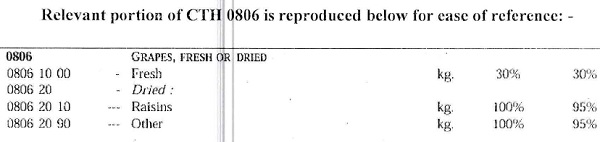
Relevant portion of CTH 0806 is reproduced below for ease of reference: –
Relevant portion of Explanatory notes as under:
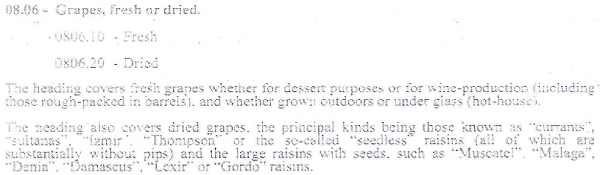
Harmonized System Explanatory Notes constitute an internationally recognised aid for tariff interpretation. The Explanatory Notes to 1-leading 0806 provide that the heading covers dried grapes, the principal kinds being those known as currants, sultanas, Izmir, Thompson and seedless raisins. The Explanatory Notes are significant for three reasons:
- First, they expressly recognise “currants” as one of the principal kinds of dried grapes.
- Secondly, they place currants and raisins within the same category of dried grapes.
- Thirdly, they do not create any distinction between currants and raisins for tariff purposes.
The Explanatory Notes therefore support the view that currants obtained from grapes are classifiable as raisins.
16. I find that application of Rule 1 of the General Rules for Interpretation Rule 1 provides that classification shall be determined according to the terms of the headings and any relevant Section or Chapter Notes. Heading 0806 covers “Grapes, fresh or dried.” The imported goods are admittedly derived from grapes and arc imported in dried form. Accordingly, by application of Rule 1, the goods are correctly classifiable within Heading 0806.
17. I also find that application of Rule 6 requires classification at the sub-heading level according to the wording of the sub-headings. Within Heading 0806, the relevant tariff entries are:
Tariff Item Description
08062010 Raisins
08062090 Others
The issue therefore is whether the imported goods answer the description “Raisins”. The scientific evidence, commercial literature, producer specifications, international standards and historical materials uniformly establish that the imported goods are raisins. Consequently, the goods are appropriately classifiable under the residual tariff item 08062010 as “Raisins”.
18. Further, vide letter dated 09.06.2026, the applicant furnished the detailed production process of the proposed imported goods, namely Corinthian Raisin/Black Zante Currant (Vitis vinifera). The process consists of hand-harvesting ripe grapes, Sundays, followed by cleaning, sorting an undertaken is natural dehydrati preparatory and packing operatio essential character of the grapes. species Vitis vinifera, commercial thereby supporting their calcific
19. This finding is consistent (Frizwell Agro Foods) wherein tfi from grapes and does not alter t reiterated in CAAR/Del/Whole wherein dried currants obtained fr recognised as raisins classifiable
20. I further observe from thq record that the expression “curr Corinth”, referring to dried grapes ackaging. It is observed that the only substantive process of grapes, while the remaining activities are merely No manufacturing process is carried out which alters the cordingly, the imported goods remain dried grapes of the y recognised as Corinthian Raisins or Zante Currants, n as raisins under Tariff Item 08062010. with the observations made in CAAR/Mum/ARC/12/2022 Authority held that dehydration merely removes moisture r essential character as raisins. The same principle was me/5/2023 and CAAR/Del/Sacred-Nuts/121/2025-26, Black Corinth grapes of the species Vitis vinifera were er Tariff Item 08062010. istorical, scientific and commercial evidence placed on originated from the historical trade term “raisins of ported from the region of Corinth in Greece. The evidence further establishes that Corinthian Currants, also known as %ante Currants, have historically and commercially been recognised as dried Black Corinth. grapes obtained from the species Vitis vinifera and not as fruits of the genus Ribes. The various scientific publications, international standards, trade literature and producer specifications consistently describe such goods as a recognised variety of raisin. Furthermore, the Harmonized System Explanatory Notes to I-leading 0806 specifically recognise “currants” as one of the principal categories of dried grapes, and . the rulings of CAARin CAA.R/Mum/ARC/12/2022, CAAR/Del/Wholesome/5/2023 and CAAR/Del/Sacred-Nuts/121/2025-26 have also recognised Zante Currants/Corinthian Currants obtained from Vitis vinifera as raisins for customs classification purposes. Accordingly, the use of the expression “currant” in the description of the imported goods does not alter their essential character as dried grapes or raisins.
21. On the basis of foregoine, discussions and findings, I reach to conclusion that the subject goods “Corinthian Raisin (known as•Greek Black colour Zante Currant having botanical name “Vitis Vinifera) is classifiable under CT1-1 0806, more specifically under C 1’1 080620’1’0- “Raisins” .of the first schedule to the Customs Tariff Act, 1975 and are eligible for exemption benefit allowed under Sr. No. 28 of Notification No. 45/2025-Customs (ADD) dated 24.10. 2025.
22. I rule accordingly.