Hindware Ltd. Vs Grohe India Pvt Ltd & Ors. (Delhi High Court)
The Delhi High Court decided two connected trademark infringement suits filed by Hindware Limited concerning the unauthorized use of its registered trademark “HINDWARE” as a keyword under Google’s AdWords advertising programme. The plaintiff alleged that competing sanitaryware companies had purchased the trademark as advertising keywords, resulting in their sponsored links appearing when internet users searched for “HINDWARE” and related search terms. During the proceedings, the disputes with the competing companies were settled, leaving Google India and Google LLC as the remaining contesting defendants.
The plaintiff contended that Google’s AdWords programme permitted advertisers to purchase the registered trademark “HINDWARE” as keywords, thereby enabling competitors’ advertisements to appear in response to searches for the plaintiff’s mark. It argued that such conduct amounted to trademark infringement, passing off, unfair competition, dilution, and unauthorized commercial exploitation of its registered trademark. According to the plaintiff, Google actively monetized trademarks through its keyword advertising system, suggested trademarked keywords to advertisers, and profited from such use. The plaintiff further argued that Google could not claim protection as an intermediary because it actively participated in the keyword advertising process.
Google opposed the suits on multiple grounds. It challenged the territorial jurisdiction of the Delhi High Court, disputed the maintainability of the suits, and argued that keywords function merely as backend triggers that are invisible to internet users and therefore do not amount to trademark use under the Trade Marks Act. Google maintained that advertisers independently selected keywords, while Google only provided an advertising platform. It also contended that its keyword planner merely supplied statistical information and that the use of trademarks as keywords neither caused confusion nor constituted infringement. Google further claimed the benefit of intermediary protection under the Information Technology Act.
The Court first examined the issue of territorial jurisdiction. Referring to Section 20 of the Code of Civil Procedure and Section 134 of the Trade Marks Act, it held that these provisions operate in addition to one another. Since the plaintiff carried on business in Delhi, the defendants’ products were available in Delhi, and Google’s services were accessible within the jurisdiction, the Court held that it possessed territorial jurisdiction to entertain the suits.
After considering the evidence and submissions, the Court decided the issues in favour of the plaintiff. It held that Google LLC and Google India were liable in relation to the use of the plaintiff’s trademark as advertising keywords. The Court rejected Google’s defences and granted a permanent injunction restraining Google from using the plaintiff’s trademark “HINDWARE”, including “HINDWARE SANITARYWARE”, “HINDWARE SANITARY”, “HINDWARE SANITARYWARE INDIA”, or any combination thereof, as advertising keywords, AdWords, or in any other manner amounting to infringement.
The Court awarded nominal damages of ₹30,00,000, payable jointly and severally by Google LLC and Google India to the plaintiff. It also awarded actual litigation costs jointly and severally against Google LLC and Google India, directing the plaintiff to file its Bill of Costs before the Taxing Officer for computation.
Regarding the settlement with Omkara Infoweb, the Court accepted the settlement agreement, found no impediment to passing a decree in its terms, held the parties bound by the settlement, and decreed the suit accordingly. The Court finally disposed of both suits and all pending applications in terms of its judgment and the recorded settlements.
FULL TEXT OF THE JUDGMENT/ORDER OF DELHI HIGH COURT
1. The present suits have been filed seeking a permanent injunction against the defendants, restraining violation of the plaintiff’s rights in their registered mark, ‘HINDWARE’, along with passing off, unfair competition, dilution, rendition of accounts, etc.
Parties:
2. At the outset, it is pertinent to note the facts in relation to the parties, and the substitution of the names thereof.
2.1 The plaintiff, i.e., Hindware Limited, is in the business of sanitaryware products, which are being sold under the registered mark, ‘HINDWARE’.
2.2 The suits were initially filed by the plaintiff under their erstwhile name, i.e., M/s HSIL Limited. However, pursuant to order dated 26th June, 2019, passed by the National Company Law Tribunal (“NCLT”), Kolkata Bench, sanction was granted to the scheme of arrangement between the plaintiff and M/s Brilloca Limited, whereby, the assets, liabilities, rights and claims of M/s HSIL Limited were transferred to/ vested in, M/s Brilloca Limited. Thus, during the course of the proceedings, vide order dated 22nd November, 2019, this Court had allowed the prayer for substitution of M/s Brilloca Limited with the erstwhile plaintiff in both suits, in view of the order of the NCLT.
2.3 Thereafter, the name of the erstwhile plaintiff, i.e., M/s Brilloca Limited was changed to Hindware Limited, by virtue of the new Certificate for Incorporation of the plaintiff company dated 13th April, 2022. Consequently, vide orders dated 18th July, 2022 in CS (COMM) 591/2017 and 29th July, 2022 in CS (COMM) 592/2017, the name of the plaintiff in the present suits has been amended as Hindware Limited.
2.4 In CS (COMM) 591/2017, the defendant no. 1 – Grohe India Private Limited (“hereinafter referred to as Grohe”), is also in the business of sanitaryware and kitchen appliances products. The remaining defendants, i.e., defendant nos. 2 and 3 – Google India Private Limited (“hereinafter referred to as Google India”) and Google Inc., run the Google AdWords Programme, which is a paid referencing and keyword advertising service, on their search engine, www.google.com.
2.5 In CS (COMM) 592/2017, the defendant no. 1 – Omkara Infoweb Private Limited (“hereinafter referred to as Omkara Infoweb”) is a website developer who has developed the website, i.e., www.cera-india.com for defendant no. 2 – Cera Sanitaryware Limited (“hereinafter referred to as Cera”). The defendant no. 2 is also in the business of sanitaryware and kitchen appliances products. In this suit, Google India and Google Inc. were impleaded as defendant nos. 3 and 4.
2.6 In both the suits, the defendant – Google Inc., had filed applications for change of name of Google Inc. to Google LLC, and the same was recorded vide order dated 14th November, 2017 in CS (COMM) 591/2017 and CS (COMM) 592/2017. In view thereof, the current contesting defendants in both the suits are Google India and Google LLC.
Settlements:
3. During the course of the proceedings, certain developments arose in relation to the parties, which are required to be underscored for the purposes of adjudication of the present suits.
3.1 The defendant no. 1 – Grohe in CS (COMM) 591/2017, entered into a settlement with the plaintiff vide Settlement Agreement dated 24th November, 2015, and the same was recorded in the order dated 27th November, 2015, wherein, the suit was decreed against defendant no. 1, and a direction was made to have the said Settlement Agreement and application being I.A. 24410/2015, filed under Order XXIII Rule 3 of the Code of Civil Procedure, 1908 (“CPC”), to form part of the decree. The order dated 27th November, 2015, is reproduced as under:
“xxx xxx xxx
The plaintiff has filed the present suit for permanent injunction restraining violation and infringement of rights in the trademark “HINDWARE”, passing off, unfair competition, dilution, rendition of accounts etc. against the three defendants. Defendant No.1 is Grohe India Pvt Ltd. Defendant No.2 is Google India Pvt. Ltd and defendant No.3 is Google Inc.
Defendant No.1 has settled the dispute with the plaintiff. The abovementioned joint application under Order XXIII Rule 3 CPC has been filed. The settlement agreement which is arrived between plaintiff and defendant No.1 before Mediation Centre on 24th November, 2015 is not on record. Learned counsel for the plaintiff undertakes to file the copy of settlement agreement within one week from today. The application is signed by both the parties i.e. plaintiff and defendant No.1. It is also supported by the affidavit of both the parties. Parties shall be bound by the terms and conditions of the settlement dated 24th November, 2015. The suit of the plaintiff is accordingly decreed against defendant No.1. Application under Order XXIII Rule 3 CPC and settlement agreement dated 24th November, 2015 shall form part of the decree. Learned counsel for defendant No.1 is agreeable that the written statement is taken off from the record.
xxx xxx xxx”
(Emphasis Supplied)
3.2 In CS (COMM) 592/2017, in similar circumstances, both the defendant nos. 1 and 2, i.e., Omkara Infoweb and Cera, have entered into a settlement with the plaintiff vide Settlement Agreements dated 08th November, 2017 and 03rd March, 2019, respectively.
3.3This Court notes that decree has only been passed against defendant no. 2 – Cera, and the same is recorded vide order dated 07th March, 2019 in CS (COMM) 592/2017. However, with regard to defendant no. 1 – Omkara Infoweb, the Court kept the Order XXIII Rule 3 CPC application, i.e., I.A. 13863/2017 filed by plaintiff and defendant no. 1, to be decided at the stage of final hearing, after defendant no. 1 has given its evidence as plaintiff’s witness. The relevant portion of order dated 07th September, 2019, is reproduced as under:
“xxx xxx xxx
Today in Court, learned counsel for the plaintiff and learned senior counsel for defendant no. 2-CERA have handed over a copy of the settlement agreement dated 3rd March, 2019 executed between the said parties as the original has been placed on record in CS (COMM) 103/2019. The same is taken on record. Learned counsel for the plaintiff and defendant no. 2 pray that present settlement agreement be treated as an application under Order 23 Rule 3 CPC. Ordered accordingly.
xxx xxx xxx
Consequently, the suit is decreed qua defendant no. 2-CBRA in
accordance with the settlement agreement dated 3rd March, 2019, which is marked as Ex. C-1.
xxx xxx xxx
This Court is of the opinion that IA. 13863/2017 should be taken up for hearing and disposal after the evidence of defendant no. 1 has been recorded as a witness of the plaintiff.
xxx xxx xxx”
(Emphasis Supplied)
3.4Thus, in view of the settlements entered between the parties, the present suits are being pursued by the plaintiff against the contesting defendants, i.e., Google India and Google LLC.
FACTUAL MATRIX:
4. The factual matrix in the present suits is as follows:
Plaintiff:
4.1 The plaintiff, through its predecessor, was established in the year 1960, and was first in the country to make available vitreous china ceramics, offering significant improvement from the prevalent earthware sanitary products. Further, from 1991 the plaintiff has been exclusively, extensively and continuously been in the business of sanitaryware including bathroom accessories.
4.2 The plaintiff, as on date of filing the suits, enjoyed 40% of the market share in the organized sector of the Indian sanitaryware industry, and has 18 service centres across India, apart from 25 HINDWARE boutiques and more than 450 HINDWARE shops located in the country, along with having more than 1235 institutional partners across India. Further, the plaintiff exports its products across various countries in Europe, Africa and Middle East.
4.3 The plaintiff has its registered mark, i.e., HINDWARE, since the year 1991, and had total sales in excess of Rs. 500 Crores for the year 2011-12. The sales figures of the plaintiff company under the mark, HINDWARE since 2005-2006 to 2011-12, as per the plaint, are as follows:
4.4 Further, the plaintiff has spent considerable amounts of money on advertisement and promotion of its mark, ‘HINDWARE’ and related marks, which are in excess of Rs. 50 Crores for the year 2011-12. The expenditure for advertisement by the plaintiff company pertaining to the mark, HINDWARE, from the year 2005-06 to 2011-12, as per the plaint, is as follows:
| Year | Sales Figures (Rupees in Crores) |
|---|---|
| 2005–06 | 214.44 |
| 2006–07 | 247.25 |
| 2007–08 | 279.72 |
| 2008–09 | 313.79 |
| 2009–10 | 367.86 |
| 2010–11 | 430.30 |
| 2011–12 | 534.87 |
4.5 The plaintiff has been in continuous use of its registered mark, HINDWARE and related marks, and has procured several trademark registrations in that regard.
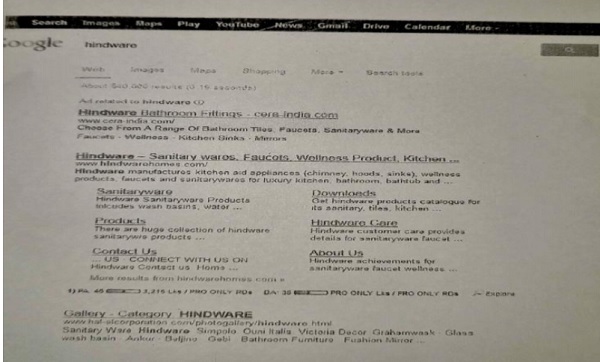
4.6 In early 2013, the plaintiff came to know that Omkara Infoweb and Cera were advertising Cera’s mark, ‘CERA’ on Google’s platform, i.e., www.google.com, and availed the services of the AdWords Programme run and managed by Google. Further, Omkara Infoweb and Cera purchased the plaintiff’s registered trademark, ‘HINDWARE’ and/or a combination of words thereof as keyword(s), in a manner that the first result that appears when a consumer would search for ‘HINDWARE’, is for the website of Cera, i.e., www.cera-india.com. A screenshot of the same on the website of Google, is reproduced as under:
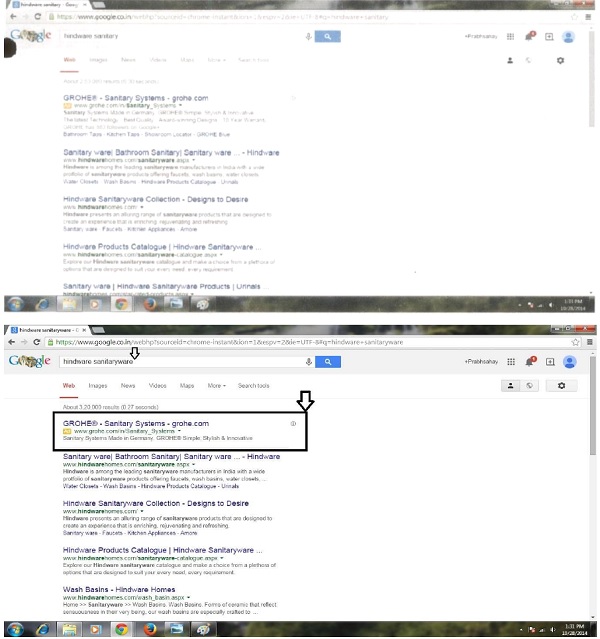
4.7 In October, 2014, the plaintiff came to know that Grohe was advertising its mark ‘GROHE’ on Google’s platform, i.e., www.google.com and had availed the AdWords Programme run and managed by Google. Further, Grohe had purchased the plaintiff’s registered trademark, ‘HINDWARE’ and/or a combination of words thereof as keyword(s), in a manner that the first result that appears when a consumer would search for ‘HINDWARE SANITARY’, or ‘HINDWARE SANITARYWARE’ or ‘HINDWARE SANITARY WARE INDIA’, is for the website of Grohe, i.e., www.grohe.com. Screenshots of the same on the website of Google, is reproduced as under:
Google/Contesting Defendants:
4.8 The contesting defendants, i.e., Google India and Google LLC (“hereinafter jointly referred as Google”), in relation to the present suit are in the business of online advertising, and run a programme known as ‘Google AdWords’, which is a form of keyword advertising that allows advertisers to place advertisements along with search results in their search engine, i.e., www.google.com. The AdWords service enables commercial entities, by means of reservation of one or more words/ keywords, which could be any word, including, the brand names of its competitors, to obtain an advertising link to its site when an internet user enters one or more of the keywords into a search request.
4.9 As per the written statement of Google, it is a service provider for various services such as internet search, email, social networking sites, bloggers etc., and most services offered by the Google are premised on sharing of information and knowledge without the exercise of any editorial control or monitoring by Google, in any manner whatsoever. 4.10 The AdWords Programme of Google has the following components:
i. AdText: This refers to the title and text of the advertisement that describes the product or service offered by the advertiser. The AdText is visible to internet users.
ii. Uniform Resource Locator (“URL”): The URL of the advertisement provides the link to the website of the advertiser.
iii. Keywords: This refers to the words or phrases that trigger or generate an advertisement when a user of the internet searches for that particular word or phrase on sites such as Google Search.
4.11 Google has an AdWords Policy which covers the aspects of administering third-party advertisements on its website. When an advertiser signs up with the AdWords Programme, it enters into an agreement with Google. The AdWords Policy, as applicable to India, does not prohibit the use of trademarked terms as keywords to trigger advertisements.
4.12 Google under the Adwords Programme also provides for an easy to use process that can be availed by any owner of trademarks to report a case of infringement of trademarks, which would enable the support team of Google to review the complaint and to take appropriate action, as per applicable laws and policies.
Grohe, Cera and Omkara Infoweb:
4.13 Grohe and Cera are both companies that are also engaged in similar businesses as that of plaintiff, i.e., sanitaryware products. Omkara Infoweb is the company which maintained the website of Cera, i.e., www.cera-india.com.
4.14 Both Grohe and Cera while using the Google AdWords Programme had purchased AdWords rights on the website of Google for the plaintiff’s mark, HINDWARE. Due to the same, when a person searched the word, ‘HINDWARE’ or related words on the website of Google, the ‘sponsored links/website’ of Cera and Grohe would appear as the first search results. 4.15 Omkara Infoweb in relation to a campaign for advertising on Google under the AdWords Programme, assisted Cera to enter into an Agreement dated 06th February, 2013 with respect to the AdWords service, with Google. During the campaign period, Google provided User ID and Password for submitting and pasting a particular keyword so that the rating of a particular brand or product starts getting displayed on the first or the second page. This campaign as per the Service Agreement started on 18th February, 2013 and ended on 11th March, 2013, i.e., 21 days.
4.16 As noted, during the course of the present suits, Grohe, Cera and Omkara Infoweb, have all entered into Settlement Agreements with the plaintiff, and decree has been passed by this Court in relation thereof in favour of the plaintiff and against the defendants, i.e., Cera and Grohe. Further, in relation to Omkara Infoweb, the settlement and passing of decree was kept pending on account of the said party appearing as a witness for the plaintiff. Thus, the present suits and the prayers therein are agitated by the plaintiff in relation to Google only.
SUBMISSIONS OF THE PARTIES:
5. As noted above, the present matter is pending adjudication only related to the prayers by the plaintiff against Google. Thus, the submissions of the parties in the present suits are being recorded in relation thereto.
Plaintiff’s submissions:
6. The submissions made by the plaintiff, in relation to the contesting defendants, i.e., Google, are as follows:
6.1 The mark of the plaintiff, ‘HINDWARE’, was declared as a well- known mark vide judgement and order dated 21st April, 2017 passed by this Court in CS (OS) 2736/2014, titled as ‘HSIL Limited Versus Kripton Ceramics Pvt. Ltd. & Ors.’. Therefore, there is a significant goodwill and reputation of the plaintiff’s marks across different classes of products.
6.2 This Court has territorial jurisdiction to entertain the present suits as the plaintiff has their office in Delhi and plaintiff is conducting business in Delhi through its extensive network of dealers, showrooms etc., located in Delhi. Further, cause of action has also arisen in Delhi as the website of Google, can be accessed in Delhi, i.e., within the jurisdiction of this Court.
6.3 The contention of Google that its foreign entity, i.e., Google LLC, has no role to play in the AdWords Programme is baseless on the ground that its Indian subsidiary, i.e., Google India, is wholly owned by Google LLC. Further, the argument of Google that they have no liability, as the AdWords Agreement absolves them from the same, and the onus is on the advertiser, has no merit as Google plays an active role and makes substantial gains from the AdWords Agreement.
6.4 The use of trademark as keywords amounts to use of those marks for the purposes of Section 29 of the Trade Marks Act, 1999 (“Trade Marks Act”). Sections 2(1)(zb) read with Section 2(2)(c)(i) of the Trade Marks Act is couched in wide terms and any reference to use of a mark is not just limited to the physical form, but also includes any other form.
6.5 The use of a trademark as a keyword for display of advertisements in respect of goods/services clearly amounts to use of the trademark “in advertising” within the meaning Section 29(6) of the Trade Marks Act. It is not necessary that the trademark physically appears in the advertisement, and the use to trigger display of advertisement itself amounts to use of the trademark in advertising.
6.6 The contention of Google that the use of plaintiff’s trademark is for the purpose of advertising or comparative advertising, and that there is no likelihood of confusion is completely false and incorrect on the ground that the internet is a major advertising platform. Therefore, the use of trademark on the internet would also amount to use within the course of trade.
6.7 Google offered/suggested the plaintiff’s registered mark as keywords and the same has been acknowledged and admitted by Grohe, Cera and Omkara Infoweb. The registered and well-known trademark of the plaintiff is being used by Google by offering/suggesting the same to the plaintiff’s competitors or any other entity for generation of advertisements. The same is without any prior consent/approval from the plaintiff company. Therefore, there is no permitted use by Google for the registered mark of the plaintiff within the meaning of Section 2(1)(r) of the Trade Marks Act. Thus, Google by selling the trademark of the plaintiff as a keyword without any authorisation for commercial gains is infringing the plaintiff’s right to exclusive use of its trademark under Section 28 of the Trade Marks Act.
6.8 There is blatant infringement and abuse of the plaintiff’s registered trademark “HINDWARE” as Grohe and Cera are direct competitors of the plaintiff, selling the same product range, i.e., sanitaryware through identical trade channels to identical customers. Since there is use of a mark identical to the registered trademark, i.e., HINDWARE, in relation to identical goods, i.e., sanitaryware, the present case falls under the ambit of Section 29(2)(c) of the Trade Marks Act read with Section 29(3) of the Trade Marks Act. By virtue of Section 29(2)(c) read with Section 29(3) of the Trade Marks Act, the Court is obligated to presume that the admitted use of identical mark of the plaintiff as a keyword was likely to cause confusion on the part of the public.
6.9 Even otherwise, the Settlement Agreement between the plaintiff and Omkara Infoweb shows that the illegal and unauthorised use of the plaintiff’s trademark resulted in confusion. The standard of confusion is to be tested on the anvil of an average consumer of ordinary prudence and not a legal expert. Thus, the use of plaintiff’s coined and well-known mark by Goggle amounts to unauthorised use and infringement under Section 29 of the Trade Marks Act. Thus, PW-3 is an average consumer whose testimony corroborates the confusion and satisfies the test of confusion under the Trade Marks Act.
6.10 Google through its AdWords Programme is the only one who earns guaranteed revenue, and if a consumer specifically searches the term, ‘Hindware Sanitaryware’, it is clear that he is specifically looking for the products of the plaintiff. Therefore, the fact that the first search result of another company is shown to the consumer is bound to cause confusion and show some relation with the plaintiff. Thus, such use of the mark amounts to infringement under Section 29 of the Trade Marks Act, as well as constitutes passing off.
6.11 In terms of the AdWords Policy of Google, as applicable in India, Google itself did not allow a trademark to be used as a keyword till the year 2009, and later changed its policy in 2015 to the effect that Google would not investigate or restrict use of trademarked terms in keywords. Further, the policy applicable in India is a deviation from the policy of Google followed for countries in European Union (“EU”) and European Free Trade Association (“EUFTA”), which provides a higher duty of care in a jurisdiction where majority of the population comprises of “internet literate” people, and such a policy ought to be followed in India as well.
6.12 Google’s witness in its cross-examination confirmed that the policy was changed post the year 2009 as Google was confident that users in India would not be confused by competitive keyword bidding. Thus, if it is proven that due to the current policy of Google, a user is confused, nothing more remains to be established for infringement at behest of Google.
6.13 Further, Google conducts an auction of the keywords in real time and advertisers bid for the keyword, including trademarked terms. Google’s AdWords Programme is a commercial venture to monetise the use of the search engine for advertising by displaying the sponsored links of various advertisers, who seek to display their advertisements on the Search Engine Results Page (“SERP”) pursuant to search queries initiated by an internet user. Google actively encourages and suggests use of keyword and, by use of its software and algorithms, determines the advertisements that will be displayed on the SERP. The advertiser that bids the highest for the keyword is accorded priority for display of its advertisements.
6.14 The act of Google to rank an advertisement on the basis of the Quality Score, which depends on several factors, shows that Google admittedly is aware of the fact that it is a competitor applying for a third-party trademark and not the trademark owner itself. Despite this, Google sells/ auctions registered trademarks to competitors of the proprietor simply because it earns a commercial advantage from such conduct.
6.15 The AdWords Programme of Google is anti-competitive and illegal as it encourages and gives impetus to infringement, by providing a platform for the same. Further, Google cannot compel any person to approach it with complaints and bid for their own trademark as if it runs a parallel regulatory regime. The plaintiff, being the owner of the registered trademark cannot approach Google for enforcement of its rights when admittedly Google itself is a partner in the infringement of the plaintiff’s trademark.
6.16 Thus, Google is taking unfair advantage of the plaintiff’s trade mark, which is contrary to honest practices, by selling of the plaintiff’s registered mark as a keyword in the AdWords Programme for the purpose of advertising, and providing a platform for infringement. Such conduct falls within the definition of infringement under Section 29(8) of the Trade Marks Act.
6.17 Google in some form or the other commits infringement as it sells keywords through its AdWords Programme and suggests or prompts the advertisers to purchase the trademark of a competitor using its Keyword Suggestion Tool.
6.18 In the present case, no generic term is being sold as a keyword by Google. Rather, Google has suggested and auctioned the coined registered mark, HINDWARE to the plaintiff’s competitors. The suggestion made by Google in its own AdWords Programme, based on its own policy as well as user statistics, makes it more likely for an advertiser to take the suggestion of Google in this regard. Therefore, Google has an onus to not allow third parties to use trademarked terms.
6.19 The adoption of deceptively similar mark by Google erodes the distinctiveness associated with the plaintiff’s registered mark, and adversely affects the future market expansion plans of the plaintiff. Thus, the same results into dilution of the plaintiff’s mark by blurring.
6.20 The decisions of the Division Bench in the case of Google LLC Versus DRS Logistics (P) Limited and Others1 as well as Google LLC Versus Makemytrip (India) Private Limited and Others2, to contend that use of trademarks as keywords does not amount to infringement under the Trade Marks Act, is not applicable to the present case. The trademarks forming the subject matter in the aforesaid cases were generic words/ conjugation of generic words, having a dictionary meaning. The Courts in the said cases did not have any occasion to deal with a well-known mark, being a coined word, such as the plaintiff’s trademark “HINDWARE”. Likewise, the decision of this Court in the case of Policybazaar Insurance Web Aggregator and Another Versus Coverfox Insurance Broking Pvt. Ltd. and Others3, would be of no help to Google, as the said decision also dealt with a trademark being a generic word. Furthermore, the Courts in the aforementioned decision did not have the occasion to deal with infringement of trademark under Section 29(2)(c) read with Section 29(3) of the Trade Marks Act, nor did the Courts in the said decisions return any finding on the independent and exclusive right of a registered trademark proprietor to the use of the trademark sans the right to sue for infringement under Section 28(1) of the Trade Marks Act.
6.21 The defence taken by Google that it is an intermediary and is exempted from liability under Section 79 of the Information Technology Act, 2000 (“IT Act”), is not available to Google, as the said exemption is not available if the function of the intermediary is not limited to merely providing access to the communication system over which information made available by a third-party is transmitted or hosted. The exemption is also not available to the intermediary if he selects the receiver of the transmission, and where an intermediary has conspired, abetted, aided or induced the commission of an unlawful act, without requisite due diligence.
6.22 Google is an active participant in use of trademarks of proprietors as keywords, and was selecting the recipients of the information for the infringing links. Moreover, the trademarks are undisputedly monetized by Google by using the same as keywords for displaying the paid advertisements on their website. Thus, Google cannot seek the benefit of exemption under Section 79 of the IT Act.
6.23 Google has adopted a modus operandi, whereby, the registered mark of the plaintiff was offered to the plaintiff’s competitors for a price to be paid to Google, allowing them to make huge gains at the cost of infringement of the plaintiff’s registered mark. Further, there is a categorical admission that Google by using trademarks has increased its revenue to at least US 100 million dollars, as shown in the E-mail of Google’s Project Manager, Baris Glutekin.
6.24 The Settlement Agreements entered by the plaintiff with Grohe, Cera and Omkara Infoweb, shows that the said defendants have admitted that by choosing the plaintiff’s registered trademark as a keyword through Google’s AdWords Policy, the registered trademark of the plaintiff was blatantly infringed. Thus, Google is at the epicentre of infringement, and liability for the same shall be fastened upon Google as well.
6.25 Google entered into Agreements with advertisers, i.e., Grohe and Cera, and knowingly enabled and assisted them in infringing the registered mark of the plaintiff. The fact that the said Agreements are entered by Google LLC, which is located outside of India, does not absolve the liability of Google which has its Indian subsidiary as well.
Defendants’ submissions – Google:
7. The submissions made on behalf of the contesting defendants, i.e., Google, are as follows:
7.1 This Court does not have the territorial jurisdiction to entertain the present suits, as the plaintiff’s registered office is in Kolkata, and the plaintiff has invoked the jurisdiction based on the address of its trading division located in Delhi. The plaintiff has failed to fulfil the criteria for instituting the instant suits as per Section 134 of the Trade Marks Act, and no proof is adduced by the plaintiff to substantiate that any business is carried out from the trading division address, nor any particulars of the employees or proof of occupation or ownership is provided in relation to the purported trading division of the plaintiff.
7.2 The amended memo of parties filed by the plaintiff also only mentions the address of plaintiff at Kolkata and does not mention the Delhi address. Further, the screenshot dated 05th December, 2013 of the website of the plaintiff also shows that the plaintiff does not have any office in Delhi, and the testimony of DW-4 in this regard has been unrebutted and therefore stands admitted.
7.3 The contention of the plaintiff that the jurisdiction of this Court can be invoked as the website of Google can be accessed within the jurisdiction of this Court is unsustainable, as mere accessibility of allegedly infringing content available upon google search would not enable the Court to exercise jurisdiction. Further, the plaintiff has failed to prove that allegedly infringing content was targeted at or has actually been accessed by any customers, caused any confusion to consumers or any transaction was concluded in that regard. Moreover, plaintiff has failed to prove any injury to its business, goodwill or reputation, within the jurisdiction of this Court. Therefore, the plaintiff has been unable to prove any cause of action arising in the jurisdiction of this Court.
7.4 None of the defendants reside or carry on business or personally work for gain within the territorial jurisdiction of this Court to invoke the jurisdiction of this Court under Section 20 of the CPC.
7.5 The plaintiff company is not entitled to reliefs sought, as PW-1, Mr. A.K. Mohanty, has no authorization to institute the suit on behalf of the plaintiff company. Further, PW-1 had no authority from the board of the plaintiff company at the time of instituting the suits, which has been admitted in his cross-examination as well. Further, the board resolution dated 18th April, 2016 authorizing PW-1, does not ratify the past acts.
7.6 The suit is not maintainable owing to lack of cause of action as the suit was originally instituted against the advertiser, and the cause of action was restricted to Omkara Infoweb and Cera. The allegation against Google was only in relation to assisting or aiding the said advertisement, which as on date does not exist, and no fresh cause of action is pleaded against Google, therefore, the prayers with respect to paragraphs 34 (a) and (b) of the plaint are liable to be rejected for lack of cause of action against Google.
7.7 The present suit is bad in law for non-joinder of necessary parties, as Omkara Infoweb and Cera who are alleged to be actually advertising on Google Ads Programme, are absent on account of settlement with the plaintiff. Further, on account of the same Google cannot be sought to be restrained in rem.
7.8 The plaintiff has suppressed material facts that they have a Google AdWords account and have themselves bid for third party trademarks as keywords. Thus, the plaintiff cannot approbate and reprobate at the same time by continuing to avail of the benefits of the AdWords Programme, accepting to abide by Google’s terms and conditions, including, the trademark policies, and at the same time claiming that the use of a trademark as a keyword amount to purported infringement of trademark rights.
7.9 Google had served notices to plaintiff for admitting the facts in relation to the said third party trademarks, however, no response has been provided to the same, therefore, the said notices shall be deemed to be admitted. Further, Cera had filed a suit against the plaintiff, wherein, the plaintiff gave the undertaking that they shall not use the marks of Cera. Thus, the plaintiff is contradicting its own stand in the present suit and in the earlier suit proceedings.
7.10 The plaintiff, being a user of the Google Ads Programme has complete knowledge of the terms of service and availability of the grievance redressal mechanism in relation to trademarked words, yet no complaint or intimation was filed by the plaintiff with regard to use of the mark ‘HINDWARE’ in the AdText by Cera and Omkara Infoweb in CS (COMM) 592/2017. Further, the advertising campaign in relation to the impugned advertisement had already been stopped even before filing of the suit. Therefore, the said suit is misconceived and unwarranted.
7.11 The trademark policy of Google in India does not restrict the use or bidding of trademarks as keywords to display an advertisement. Only where the advertiser has included a third-party’s registered trademark in its AdText, Google restricts the said Ad, upon intimation by a complaint. 7.12 The Evidence Affidavit of PW-1 is not in compliance with Order XIX Rule 6(b) of the CPC, and is a mere reproduction of the plaint, therefore, the same is liable to be struck off. Further, the said Affidavit has not been verified appropriately under Order XIX Rule 3 of CPC.
7.13 The advertiser has to first create an account on Google Ads, specifically agreeing to Google Ads Terms of Service, Privacy Policies, Google Ads Policies, Google Ads Trademark Policy, all of which are binding in nature. Further, if a user clicks on an advertisement, he is taken to the landing page of the advertiser’s website which is a “third-party website” neither hosted nor owned or controlled by Google. Moreover, Google has no knowledge as regards the content of any such third-party website and is not responsible for the same.
7.14 In relation to keywords, complete discretion to provide the keyword vests with the advertiser, who alone decides what words or combination of words to provide as keywords. Further, an advertiser can provide multiple keywords for triggering its advertisements at its sole discretion if in its opinion, such keywords are relevant to its website, and Google merely provides the advertising space wherein the keyword used to trigger such an advertisement, is typed/created by the advertiser and him alone. Moreover, the keyword is treated by Google Ads as a mere backend trigger for an advertisement to be displayed and is never used in a trademark sense, and the keywords provided by the advertiser are not visible anywhere within the advertisement.
7.15 Google’s Keyword Planner Tool merely displays a chart or an index of search terms that are popularly searched for by users on the internet, i.e., statistical information about the search trends for the category of business/product of the advertiser, and an advertiser has complete discretion and is solely responsible for providing the keywords for its advertisement.
7.16 The keywords are never ‘sold’ by Google, but merely ‘reserved’ for the purpose of triggering the search-based Ads, and the displaying of Ads does not solely depend upon the keyword uses, but also on the Quality Score of an advertiser’s website, which is a function of multiple factors. Thus, Google Ads system is designed to ensure that irrelevant Ads do not appear as the same could degrade user experience on Google’s website.
7.17 Google does not earn any revenue from mere display of an advertisement on the SERP under the Google Ads Programme, and the same depends upon the Cost-Per-Click on the advertiser’s website.
7.18 Keywords are different from Meta-Tags, and in any case, Meta-Tags are neither used by Google in the organic search result nor are part of the sponsored links/Ads section.
7.19 No case of infringement or passing off is made out by the plaintiff against Google as a keyword is only used at the backend for displaying sponsored search results. It is the advertiser who creates the advertisement and its content/AdText. Therefore, none of the provisions of Section 29 of the Trade Marks Act are satisfied. Further, the PW-1 deposed that he has no knowledge regarding the Google Ads Programme, and therefore, his testimony in his cross examination does not corroborate his Evidence Affidavit.
7.20 For the purposes of satisfying infringement, each sub-section of Section 29 of the Trade Marks Act requires that the use of the infringing mark has to be used as a trademark. Further, the use in the present case is imperceptible to the consumer and cannot be held to be use as a trademark, as such a use cannot convey to the consumer about the origin or source of the goods and services. Therefore, since the use of trademarked terms as keywords on Google Ads cannot be perceived by the consumers in any manner, it does not meet the test of infringement under Section 29(1) of the Trade Marks Act.
7.21 The use of the trademark as per Section 2(2)(b) and (c) of the Trade Marks Act requires printed or visual form of representation of trademark, and therefore, the mark must be seen/visible/perceivable/discoverable by the consumer. Therefore, mere use of trademarks as keywords as a backend trigger does not amount to use of the trademark and does not satisfy the ingredients of Section 29 of the Trade Marks Act.
7.22 Section 29(6) lists out instances when a person is said to ‘use’ a registered mark, however, Google has not affixed “HINDWARE” to any goods or its packaging nor has Google offered/exposed/stocked or imported any goods under the mark “HINDWARE” for sale. Google has not offered or supplied Ad services under the trademark “HINDWARE”. Google has not used “HINDWARE” on Google’s business papers or in Google’s advertising. The meaning of “uses….in advertising” ought to be construed as a visible usage of the trademark “HINDWARE” by Google i.e., within the AdText which is visible to the consumers. Keywords used as a backend trigger for displaying ads cannot be construed as ‘used in advertising’ for the purposes of trademark infringement. Further, mere display of “HINDWARE” in an auto-generated list of popular search terms in the Keyword Planner Tool does not amount to ‘use’ or ‘use as a trademark’ by Google.
7.23 Google is neither providing services identical or similar to the plaintiff, nor the use of trademark as keyword amounts to likelihood of confusion. Thus, Section 29(2) of the Trade Marks Act is not applicable to Google in the present case. Section 29(2) rests on proving the likelihood of confusion, however, the plaintiff has failed to prove any confusion or likelihood thereof on the part of the internet users solely on account of use of third-party trademarks as keywords in the Google Ads Programme.
7.24 Where the advertisement itself is clear as to its source, there is no likelihood of confusion on the part of the public. In any event, even this analysis can only be performed with respect to the advertiser’s conduct and not Google, since Google is not providing services identical or similar to that of the plaintiff, making Section 29(2) of the Trade Marks Act non-applicable to Google.
7.25 Section 29(2) is a confusion-based provision, and the confusion must be attributable to the advertisement and not to the keyword, which is imperceptible to the consumer. Section 29(3) is not a standalone infringement provision and does not create any liability for infringement, but merely provides a presumption in case of Section 29(2)(c). Therefore, Section 29(3) is an aid to Section 29(2), and the plaintiff cannot read Section 29(3) in isolation or divorced from the scheme of Section 29 as a whole. The rules of presumption are deduced from enlightened human knowledge and experience and are drawn from the connection, relation and coincidence of facts, and circumstances, therefore, even the question of presumption under Section 29(3) of the Trade Marks Act does not come to aid of the plaintiff, on account of there being no confusion or likelihood of confusion as per Section 29 of the Trade Marks Act.
7.26 Section 29(4) of the Trade Marks Act which applies to dissimilar goods or services, cannot apply as the plaintiff, Grohe and Cera are all engaged in a similar business, i.e., sanitaryware. Further, as plaintiff has relied upon Section 29(2) of the Trade Marks Act which is for similar goods and services, thus, the plaintiff cannot simultaneously apply two mutually exclusive provisions to make out its case. Even otherwise, where the advertisement is shown to provide alternatives to the consumer, the same cannot be regarded as being unfair advantage without due cause. The inclusion of trademarks as keywords in the Google Ads Programme, does not per se amount to taking an unfair advantage of the trademark without cause, and cannot be construed as being detrimental to the distinctive character or repute of the trademark.
7.27 An internet user may be looking for an array of information, products or services that may be relevant to the trademark or covered under a trademark, including its reviews or information regarding competitors who deal in similar goods or services, and there is nothing illegal in seeking out such internet users as targets for advertisements that may be relevant. Further, reliance has been placed on analogies with respect to the brick-and-mortar world, where there would be no question of infringement if customers looking for a product were also offered products of rival competitors or if an entity would put its advertising billboard next to a competitor’s exclusive store or when a competitor would buy a shelf next to a competing brand.
7.28 Section 29(5) of the Trade Marks Act does not apply to the present case as the mark “HINDWARE” is not used by Google as its trade name or as part of its trade name or business concern and in any case no allegations are made to this effect by the plaintiff as well.
7.29 Section 29(6), Section 29(7) and Section 29(8) of the Trade Marks Act are also not attracted in the present case, as the word “advertising” under Section 29(6)(d) of the Trade Marks Act has to be read as a noun (as opposed to a verb), and therefore has to mean that the trademark must appear in the advertisement/AdText.
7.30 Section 29(7) of the Trade Marks Act requires the mark to be applied to a material that is intended to be used for labelling or packaging goods, as a business paper, or for advertising goods or services. However,
in the present case, there is no “material that is being intended to be used for advertising goods or services”, and therefore the said provision is inapplicable to the present case.
7.31 Section 29(7) of the Trade Marks Act is not a standalone provision of infringement, and has to be read in conjunction with other provisions within Section 29 of the Trade Marks Act. If this subsection is read as a standalone provision, then it would effectively lead to an anomalous situation wherein any application of a mark to a material intended to be used for advertising would constitute infringement sans any requirement of marks being confusingly similar or used in relation to similar goods or services.
7.32 Section 29(8) of the Trade Marks Act deals with comparative advertising and is wholly inapplicable to the facts of the present case. In any case, the said provision states that a registered trademark is infringed by “any advertising of that mark”. Therefore, the advertisement has to be of that very trademark and not any other mark. Keyword is provided as a backend trigger and therefore does not amount to advertising of the said mark.
7.33 Section 29(8) of the Trade Marks Act requires that an advertisement must take unfair advantage of the registered mark, however, in the present case, there are other similarly placed entities which offer online search advertising which follow similar policies as Google that permit the use of trademark terms as keywords as a signal to display an ad or a relevant product to end users. Thus, the practice of Google is legitimate advertising practice.
7.34 The search engine is not a directory service and it cannot be assumed that the internet user is merely searching the address of the proprietor of the trademark. An internet user may be looking for information that may be relevant to the trademark. Thus, use of trademarked terms as keywords promotes fair competition and is in the interest of the consumer.
7.35 Even though use of trademarks as keywords may have added to the cost of advertisement for the plaintiff, however, the same does not amount to infringement of registered trademarks. Merely because a trademark proprietor has to bid on its own trademark for using it as a keyword is not a sufficient basis for concluding that the trademark’s advertising function is adversely affected. The policy of Google Ads to allow the use of trademarked terms as keywords has been held to be pro-competition by the Competition Commission of India (“CCI”) as it provides similar consumer benefits and choice as compared to traditional advertising.
7.36 Section 29(9) of the Trade Marks Act brings within its ambit spoken use of a mark. However, use of trademarked terms as keywords is not perceivable by the user, as it can neither be seen, heard, or, understood by the user. Therefore, it does not come within the ambit of Section 29(9) of the Trade Marks Act.
7.37 Confusion or likelihood of confusion is a sine qua non for trademark infringement and passing off. Any alleged violations under the Trade Marks Act have to be looked at from the lens of consumer confusion or deception. The Courts in various jurisdictions have acknowledged that for determining confusion or likelihood of confusion, the relevant or proper comparison ought to be between the resulting advertisements and the trademarked term so alleged to be infringed. The clear labelling of advertisements or the sponsored search result eliminates the likelihood of confusion among the users. Thus, per se use of trademark as a keyword does not amount to confusion as keywords cannot be perceived by consumers. Further, no proof has been produced by the plaintiff that there was an actual confusion or likelihood of confusion, therefore, no case for infringement is made out.
7.38 The use of the trademark as a keyword coupled with the display of a sponsored link must have real likelihood of confusion. Mere generation of interest in the sponsored link without any likelihood of confusion cannot be construed as infringement of a trademark. Doctrine of Initial Interest Confusion is inapplicable to the present facts and circumstance, and the said doctrine must not be conflated with initial interest as mere diversion, without any hint of confusion, is not actionable.
7.39 In the present case, absolutely no proof has been produced by the plaintiff to prove that there was an actual confusion, or a likelihood of confusion caused by the mere availability of the mark “HINDWARE” as a keyword on Google for displaying relevant websites. No evidence has been produced by the plaintiff to show even diversion of internet traffic on account of use of the trademarks as keywords. Even otherwise, mere diversion of users is not actionable per se, without any confusion of likelihood of confusion on part of the consumers.
7.40 The evidence of PW-3 is directly in conflict with the written statement, and further, the allegations and facts stated in PW-3’s evidence affidavit are not corroborated and in fact stand disproved. PW-3 is not a legal expert, and the statement at best constitutes his personal opinion, which cannot be treated as evidence of law or as binding upon other co- defendants.
7.41 In CS(COMM.) 591/2017, plaintiff’s trademark was not visible in the Ad-text of the impugned advertisement, thereby, ruling out the possibility of any confusion. On the other hand, in CS(COMM.) 592/2017, the plaintiff alleges that its trademark “HINDWARE” was visible in the Ad-text of the advertisement of Cera. This is in violation of Google’s trademark policy. However, admittedly, no complaint was received by Google regarding such purported use, and the advertisements have already been removed.
7.42 There is no case of passing off also, as in the absence of perceivable use of a mark, there is no representation as to the origin or source made to the consumers. In any case, Google is not liable for passing off as even the plaintiff has not made any case against Google for the same.
7.43 The claim of the plaintiff regarding infringement of their derivative marks and variants is not valid as all such marks of the plaintiff are generic in nature, and the plaintiff cannot claim proprietary rights, thereto. 7.44 The contention of the plaintiff in relation to Section 28 of the Trade Marks Act is not applicable as exclusive right in a trademark, can operate at best as defence to an alleged infringement action, and cannot give rise to cause of action without establishing infringement under Section 29 of the Trade Marks Act. Section 28 of the Trade Marks Act does not dispense with the requirement of establishing infringement under Section 29 of the Trade Marks Act, which alone enumerates and governs the grounds for infringement.
7.45 Even if it is assumed that there is use by Google of the plaintiff’s mark, regardless, there is no ‘infringing use’, as the use would be fair, nominative, descriptive, honest and non-confusing in nature and is statutorily exempt under Sections 30(1), 30(2)(a) and 35 of the Trade Marks Act. Google’s policy on use of trademarks is in line with the honest and widespread industrial and commercial practices followed in the online keyword advertising industry and amounts to nominative fair use under Section 30 of the Trade Marks Act. The Descriptive use of a trademark is permissible under Section 30(2)(a) and Section 35 of the Trade Marks Act.
7.46 “Advertising” is a part of free speech/right to carry on business protected by the Constitution of India. The trademark law itself recognizes international exhaustion of rights and also various instances of “fair use” of a trademark where a registered trademark can be lawfully used by a person/advertiser, not being its registered proprietor or permitted user even within the text of his advertisement, such as in case of comparative advertising, bona fide use of the trademark by informational, news related and review based websites or by authorized resellers.
7.47 If a competitor can be permitted to include the trademark of his competitor within his advertisement under the principles of comparative advertising or in a descriptive sense or in a nominative sense in the physical world, the same principles and the same defences ought to apply to the field of internet advertising as well.
7.48 Further, Google is an ‘intermediary’ under the IT Act, and falls under the benefit of exception under Section 79 of the IT Act. The advertisements as well as the keywords used to trigger the display of eligible advertisements vide Google Ads Programme are third-party data, in respect to which Google plays a content-neutral role. This information is available over Google Ads on an “as is” basis. Each and every element of an Ad is created and provided solely by the advertiser and the triggering of display of the Ad on Google Search is subject to advertiser’s inputs and approvals.
7.49 Google Ads merely provides an advertising platform and interface for creating and placing such an Ad on Google Search. Google is thereby an intermediary in relation to Google Ads. Google is entitled to safe harbour in the context of advertisements, which are solely generated by advertisers. If such advertisements violate the law, it is the advertiser who is liable for such violation and Google enjoys immunity to the extent that it is a platform provider. Google’s takedown of advertisements which violate its policies, either on a voluntary basis or on receipt of a complaint, does not take away or dilute its safe harbour and is in accordance with the role of an intermediary under Rule 3(1)(d) of the Information Technology (Intermediary Guidelines and Digital Media Ethics Code) Rules, 2021 (“Intermediary Guidelines”).
7.50 The Keyword Planner Tool does not disentitle Google from the defence under Section 79 of the IT Act. The Keyword Planner Tool is a standalone, optional research tool offered by Google for the benefit of advertisers to gain statistical information and understanding/insight about the kind of words, expressions, combinations that may be relevant for an advertiser to consider as keywords. It is only for the internal reference of advertisers and is not publicly accessible to anyone. Keyword Planner Tool is not a mandatory step for creating and/or running advertisements on Google Ads. It is merely a free of cost software tool that is additionally made available to an advertiser to help the advertiser to plan an ad campaign, subject to the advertiser actually wanting to avail himself of the said software/ tool.
7.51 An advertiser is free at all times to use /not use the Keyword Planner Tool and has the full discretion to provide or not provide a keyword, irrespective of whether it forms a part of Keyword Planner or not, and can provide a keyword that is not a part of the Keyword Planner Tool at all. Providing a legitimate tool as an online platform provider does not dilute or take away Google’s safe harbour as there is no restriction on the provision of optional assistive tools by an intermediary under Section 79 of the IT Act. Provision of value-added services does not disentitle the intermediary from the safe harbour provided under Section 79 of the IT Act.
7.52 Google has placed reliance on the decisions of the Division Bench in the case of Google LLC Versus DRS Logistics (P) Limited and Others4 as well as Google LLC Versus Makemytrip (India) Private Limited and Others5, in order to contend that use of trademarks as keywords does not amount to infringement under the Trade Marks Act. Google has further placed reliance on the decision of this Court in the case of Policybazaar Insurance Web Aggregator and Another Versus Coverfox Insurance Broking Pvt. Ltd. and Others6.
7.53 The plaintiff is not entitled to any damages as no case of infringement has been made out by the plaintiff. Further, no evidence has been produced by the plaintiff to substantiate that the purported loss and damage was attributable directly to Google’s acts or omission.
ANALYSIS AND FINDINGS OF COURT:
8. I have heard learned counsels for the parties and perused the record.
Proceedings before the Court:
8.1 At the outset, it is noted that vide order dated 04th September, 2017, both the suits, i.e., CS (COMM) 591/2017 and CS (COMM) 592/2017, were re-numbered as commercial suits from the erstwhile nomenclature of original suits bearing nos. CS (OS) 3314/2014 and CS (OS) 594/2013, respectively, upon request of the parties.
8.2 Further, both the suits, i.e., CS (COMM) 591/2017 and CS (COMM) 592/2017, were consolidated by this Court with the consent of the parties vide order dated 18th December, 2018, for the purpose of recording of evidence.
8.3 It is noted that vide order dated 03rd April, 2013 in CS (COMM) 592/2017 (earlier numbered as CS (OS) 594/2013), this Court had granted an ex-parte ad interim injunction in favour of the plaintiff and against the defendants. The directions as issued in order dated 03rd April, 2013, are reproduced as under:
“xxx xxx xxx
9. Having regard to the submissions made by the counsel for the plaintiff, as noted hereinabove, and upon perusing the averments made in the plaint and the documents placed on record, this Court is of the prima facie opinion that the plaintiff is entitled to grant of an ex parte ad interim injunction in its favour. Accordingly, till further orders, the defendants, their officers, partners, servants, dealers, agents, franchisees, representatives, etc., are restrained from using/permitting user of the word “HINDWARE”, which is the registered trademark of the plaintiff or any other mark/name that is identical/deceptively similar to the plaintiff’s registered trademark, “HINDWARE” as an adword/key word for the purpose of advertising on the internet in respect of the products that are manufactured and sold by the defendant No.2 under the mark “CERA”.
xxx xxx xxx”
(Emphasis Supplied)
8.4 Further, vide order dated 10th November, 2014 in CS (COMM) 591/2017 (earlier numbered as CS (OS) 3314/2014), this Court took note of the interim order dated 03rd April, 2013 passed in CS (COMM) 592/2017, and passed an interim injunction against the defendants in CS (COMM) 591/2017, in the following manner:
“xxx xxx xxx
For the detailed reasons given in the order dated 03.04.2013 in CS(OS) 594/2013 and having regard to the submissions made by the counsel for the plaintiff and upon perusal of the averments in the plaint and documents on record, till the next date of hearing, the defendants, their representatives, dealers, distributors and/or anyone acting for on their behalf are restrained from using or permitting user of the word ‘HINDWARE’, which is the registered trademark of the plaintiff or any other mark/name i.e. identical/deceptively similar to the plaintiff’s registered trademark, ‘HINDWARE’ as an adword/key word for the purpose of advertising on the internet in respect of the products that are manufactured and sold by the defendant No.1 under the mark ‘GROHE’.
xxx xxx xxx”
(Emphasis Supplied)
8.5 Subsequently, vide order dated 18th December, 2018, both the interim orders dated 03rd April, 2013 and 10th November, 2014, were made absolute till the disposal of the suits. The relevant portion of order dated 18th December, 2018, is reproduced as under:
“xxx xxx xxx
Since the evidence is already being recorded in the present cases and as the reliefs sought in the injunction applications are the same as the final reliefs, this Court is of the view that it would not be appropriate to dispose of the injunction applications or the applications for vacation of the interim orders by way of a detailed order as it may prejudice either of the parties.
Consequently, the interim arrangements made by learned Predecessors of this Court vide order dated 10th November, 2014 in CS (COMM) 591/2017 and the order dated 3rd April, 2013 in CS (COMM) 592/2017 shall continue till the disposal of the suits.
xxx xxx xxx”
(Emphasis Supplied)
8.6 Separate issues were framed in both the suits. In CS (COMM) 591/2017, this Court vide order dated 21st December, 2016, framed the following issues:
“xxx xxx xxx
On the pleadings of the parties following issues are framed: 1. Whether this court has no territorial jurisdiction? OPD
1. Whether the plaintiff is entitled to relief claimed by it and objections raised by defendant no.
2 in its written statement? OPD-2
3. Whether the suit is not maintainable qua defendant nos.2 and 3 in view of settlement dated 24.11.2015 between the plaintiff and defendant no. 1? OPD-2 and 3
4. Whether the plaintiff is entitled to relief claimed by it in Para 34 (a) and (b) of the plaint? OPP
5. Whether the plaintiff is entitled to damages of ₹21 lakhs as claimed by it? OPP
6. Relief.
xxx xxx xxx”
8.7 In CS (COMM) 592/2017, this Court vide order dated 21st December, 2016, framed the following issues:
“xxx xxx xxx
On the pleadings of the parties following issues are framed:
1. Whether this court has no territorial jurisdiction? OPD
2. Whether the suit is bad for mis-joinder of parties i.e. Defendant no.1? OPD-1
3. Whether the plaintiff is entitled to relief claimed by it in Para 34 (a) and (b) of the plaint? OPP
4. Whether the plaintiff is entitled to damages of ₹21 lakhs as claimed by it? OPP
5. Relief.
xxx xxx xxx”
8.8 In relation to framing of issues, this Court also notes that the plaintiff had filed applications, i.e., I.A. 10073/2017 in CS (COMM) 591/2017 and I.A. 10067/2017 in CS (COMM) 592/2017, by way of which the plaintiff sought to place on record a judgment declaring ‘HINDWARE’ as a well-known mark. However, this Court vide order dated 14th November, 2017, passed in both the suits, disposed of both the applications, while noting that an issue would have to be framed in that regard, to which the plaintiff stated that they shall cite the judgment declaring their mark as well-known at the time of arguments. Thus, no issue was framed in that regard. The relevant portion of order dated 14th November, 2017, is reproduced as under:
“xxx xxx xxx
Present application has been filed by plaintiff for placing on record two documents. First is the judgment declaring HINDWARE as well known mark and second is a Board Resolution of 2016 granting authority to Mr. A.K. Mohanty to file the present suit.
In the opinion of this Court, if the plaintiff wishes to lead evidence to show that the mark in question is a well known mark, then an issue with regard to the same would have to be framed.
At this stage, learned counsel for plaintiff states that he would cite the judgment declaring the plaintiffs mark to be a well known mark as a precedent at the time of arguments.
Recording the aforesaid statement, the present application is allowed qua only the Board Resolution of 2016.
xxx xxx xxx”
(Emphasis Supplied)
8.9 At this stage, it would be relevant to advert to the timelines with regard to the evidence led by the parties, which is reproduced in tabular form, as under:
| S.NO. | STAGE | CS (COMM) 591/2017 | CS (COMM) 592/2017 |
|---|---|---|---|
| 1. | Recording of Evidence | To be listed before Joint Registrar – order dated 21st December, 2017 | |
| 2. | Recording of Evidence | Appointment of Local Commissioner for recording of evidence – order dated 12th April, 2017 |
Appointment of Local Commissioner – order dated 24th April, 2017 |
| 3. | Recording of Evidence | Order dated 12th April, 2017 recalled, the Joint Registrar to record evidence – order dated 07th September, 2018 | |
| 4. | Plaintiff’s evidence commenced | PW-1/Mr. A.K. Mohanty – Order dated 02nd November, 2018 | |
| 5. | Consolidation of suits for recording the evidence | Order dated 18th December, 2018 | |
| 6. | PW-1 discharged by defendant nos. 3 and 4 | – | Order dated 10th January, 2019 |
| 7. | PW-1 discharged | – | Settlement of plaintiff with defendant no. 2, therefore, PW-1 is not required to be examined by defendant no. 2 – Order dated 24thApril, 2019 |
| 8. | Plaintiff’s evidence closed | PW-2/Mr. A.K. Thakur discharged by defendant nos. 2 and 3. Plaintiff’s evidence is closed in affirmative – Order dated 16th May, 2019 |
PW-3/Mr. Pradeep Sugachand discharged. Plaintiff’s evidence closed in affirmative – Order dated 30th July, 2019 |
| 9. | Defendant no. 3/4’s evidence | D3 W-1, i.e., Mr. Gavin Chariston examined in chief – 04th December, 2019 | D4 W-1, i.e., Mr. Gavin Chariston examined in chief/cross examination complete, and he is discharged – Order dated 04th December, 2019 |
| 10. | Defendant nos. 2 and 3’s/3 and 4’s evidence closed | D2 W-1/Ms. Gitanjali Duggal examined and discharged.
D3 W-1/Mr. Gavin Chariston cross- examined and discharged. Evidence closed – order dated 05th |
D3 W-1/Ms. Gitanjali Duggal examined and discharged.
Evidence closed – order dated 05th December, 2019 |
Issue-wise findings:
Issue No. 1 in CS (COMM) 591/2017: Whether this court has no
territorial jurisdiction? OPD
Issue No. 1 in CS (COMM) 592/2017: Whether this court has no territorial jurisdiction? OPD
9. The present suit has been filed for permanent injunction for restraining the defendants from violation and infringement of rights of the plaintiff in its trademark HINDWARE. Though the present suits stand settled qua the other defendants, the question of jurisdiction of this Court has been raised in the present issues which has to be seen from the time of filing of the present suits.
10. It is the case on behalf of Google that the plaintiff does not have an office in Delhi, but rather in Kolkata, indicative of which is the Screenshot of plaintiff’s website that shows they have no office in Delhi. Further, no evidence has been led by the plaintiff to show that business has been carried out from the trading division address in Delhi.
11. The aspect of territorial jurisdiction of a Court in trademark matters attracts two provisions, i.e., Section 20 of CPC and Section 134 of the Trade Marks Act. In light of the applicability of the two aforesaid provisions, it would be apposite to understand the interplay between the said provisions, with regard to the right of the plaintiff in instituting a suit. Thus, this Court in the case of Burger King Corporation Versus Techchand Shewakramani and Others7, while relying upon the judgements of the Supreme Court and the Division Bench of this Court, held as follows:
“xxx xxx xxx
17. A perusal of the above paras clearly shows that insofar as the explanation to Section 20 is concerned, the same relates to Section 20(a). The Supreme Court categorically observes that Section 20 enables the plaintiff to file a suit where the cause of action arises under Section 20(c). The remainder of the judgment in IPRS v. Sanjay Dalia [Indian Performing Rights Society Ltd. v. Sanjay Dalia, (2015) 10 SCC 161 : (2016) 1 SCC (Civ) 55 : (2015) 63 PTC 1] primarily deals with and interprets the manner in which Section 134 of the TM Act and Section 62 of the Copyright Act can be invoked, but does not dilute the principle of Section 20(c) CPC in any manner whatsoever. Even the Division Bench judgment of this Court in Ultra Home Construction (P) Ltd. case [Ultra Home Construction (P) Ltd. v. Purushottam Kumar Chaubey, 2016 SCC OnLine Del 376 : (2016) 227 DLT 320] while interpreting Section 134 of the TM Act and Section 62(2) of the Copyright Act has laid down various tests. However, what is interesting is the observation of the Division Bench in Ultra Home Construction (P) Ltd. case [Ultra Home Construction (P) Ltd. v. Purushottam Kumar Chaubey, 2016 SCC OnLine Del 376 : (2016) 227 DLT 320] is as under : (Ultra Home Construction (P) Ltd. case, SCC OnLine Del para 14)
“14. It is evident from the above observations that the interpretation given to the expression ‘carries on business’ in the context of a defendant under Section 20 of the Code has also been employed in the context of a plaintiff under the said Sections 134(2) and 62(2). Thus, in addition to the places where suits could be filed under Section 20 of the Code, the plaintiff can also institute a suit under the Trade Marks Act, 1999 and the Copyright Act, 1957, as the case may be, by taking advantage of the provisions of Section 134(2) or Section 62(2), respectively. Both the latter provisions are in pari materia. Under these provisions four situations can be contemplated in the context of the plaintiff being a corporation (which includes a company). First of all, is the case where the plaintiff has a sole office. In such a case, even if the cause of action has arisen at a different place, the plaintiff can institute a suit at the place of the sole office. Next is the case where the plaintiff has a principal office at one place and a subordinate or branch office at another place and the cause of action has arisen at the place of the principal office. In such a case, the plaintiff may sue at the place of the principal office but cannot sue at the place of the subordinate office. The third case is where the plaintiff has a principal office at one place and the cause of action has arisen at the place where its subordinate office is located. In this eventuality, the plaintiff would be deemed to carry on business at the place of his subordinate office and not at the place of the principal office. Thus, the plaintiff could sue at the place of the subordinate office and cannot sue [under the scheme of the provisions of Sections 134(2) and 62(2)] at the place of the principal office. The fourth case is where the cause of action neither arises at the place of the principal office nor at the place of the subordinate office but at some other place. In this case, the plaintiff would be deemed to carry on business at the place of its principal office and not at the place of the subordinate office. And, consequently, it could institute a suit at the place of its principal office but not at the place of its subordinate office. All these four cases are set out in the table below for greater clarity: ……….
18. Thus, the provisions of Section 134 of the TM Act and Section 62 of the Copyright Act are in addition to and not in exclusion of Section 20 CPC. If the plaintiff can make out a cause of action within the territorial jurisdiction of this court under Section 20, no reference needs to be made to Section 134.
xxx xxx xxx”
(Emphasis Supplied)
12. Reading of the aforesaid judgement makes it apparent that the provision of Section 134 of the Trade Marks Act is in addition to and not in exclusion of Section 20 of CPC. The plaintiff can make out a case under Section 20 of CPC or under Section 134 of the Trade Marks Act, for the purposes of territorial jurisdiction.
13. Section 20 of CPC, is reproduced as under:
“20. Other suits to be instituted where defendants reside or cause of action arises.
Subject to the limitations aforesaid, every suit shall be instituted in a Court within the local limits of whose jurisdiction
(a) the defendant, or each of the defendants where there are more than one, at the time of the commencement of the suit, actually and voluntarily resides, or carries on business, or personally works for gain; or
(b) any of the defendants, where there are more than one, at the time of the commencement of the suit, actually and voluntarily resides, or carries on business, or personally works for gain, provided that in such case either the leave of the Court is given, or the defendants who do not reside, or carry on business, or personally works for gain, as aforesaid, acquiesce in such institution; or
(c)The cause of action, wholly or in part, arises.
[Explanation].–A corporation shall be deemed to carry on business at its sole or principal office in [India] or, in respect of any cause of action arising at any place where it has also a subordinate office, at such place.”
(Emphasis Supplied)
14. Thus, Section 20(c) of CPC provides the plaintiff with the right to file a suit at any place where the cause of action arises wholly or in part. Further, Section 20(a) provides for a right to the plaintiff to file a suit at a place of business of the defendant or where the defendant carries on business or personally works for gain.
15. Section 134 of the Trade Marks Act provides an ancillary right to the plaintiff, to choose a forum for filing a suit for infringement in a place where it carries on business or personally works for gain. Section 134 of the Trade Marks Act, is reproduced as under:
“xxx xxx xxx
134. Suit for infringement, etc. to be instituted before District Court.—(1) No suit—
a. for the infringement of a registered trade mark; or
b. relating to any right in a registered trade mark; or
c. for passing off arising out of the use by the defendant of any trade mark which is identical with or deceptively similar to the plaintiff’s trade mark, whether registered or unregistered, shall be instituted in any court inferior to a District Court having jurisdiction to try the suit.
(2) For the purpose of clauses (a) and (b) of sub-section (1), a “District Court having jurisdiction” shall, notwithstanding anything contained in the Code of Civil Procedure, 1908 (5 of 1908) or any other law for the time being in force, include a District Court within the local limits of whose jurisdiction, at the time of the institution of the suit or other proceeding, the person instituting the suit or proceeding, or, where there are more than one such persons any of them, actually and voluntarily resides or carries on business or personally works for gain.
Explanation.—For the purposes of sub-section (2), “person” includes the registered proprietor and the registered user.
xxx xxx xxx”
(Emphasis Supplied)
16. The aforesaid provision provides for a right to a registered proprietor to institute a suit for infringement and/or passing off in relation to violation of their registered trademarks, in a Court having jurisdiction to try the suit. The provision provides for an additional forum to the plaintiff to institute a suit where such plaintiff actually and voluntarily resides or carries on business or personally works for gain.
17. The usage of the word, ‘District Court’ in the provision, on a bare reading may allow for interpretation that a suit for infringement can only be instituted before the District Courts. However, the position of law already stands clarified that keeping into consideration the mention of, “No suit….shall be instituted in any court inferior to a District Court having jurisdiction to try the suit”, would verily include High Courts which are not inferior to a District Court. Moreover, keeping in view the original jurisdiction of this Court, along with the mandate of the Commercial Courts Act, 2015, would make it apparent that harmonious reading of the enactments provides that all Courts not inferior to District Court, including High Courts, are read into the definition of ‘District Court’ for the purposes of Section 134 of the Trade Marks Act. Reference in this regard is made to the judgement in the case of Tractors & Farm Equipment Limited Versus Massey Ferguson Corp.8, wherein it was held as follows:
“xxx xxx xxx
13.4. One other point (fourth point) that was urged is that the High Court (Original Side) is not a District Court. A straightforward answer to this lies in the language in which Section 134(1) of ‘the Trade Marks Act, 1999’ [‘TM Act, 1999’ for the sake of convenience] is couched. Section 134(1) of TM Act, 1999 makes it clear that a suit shall not be instituted in any Court inferior to a District Court having jurisdiction, meaning, as long as there is territorial jurisdiction, a Court which is not inferior i.e., below the District Court in the ‘hierarchy of Courts’ (connotation) as we understand the expression ‘inferior’ cannot be approached. High Court (Original Side) is obviously above the District Court in the hierarchy of Courts and therefore, this does not present a problem.
xxx xxx xxx”
(Emphasis Supplied)
18. Keeping into consideration the aforesaid discussion and the facts of the case, it is noted that the products of all the defendants are available and sold within the jurisdiction of Delhi. Further, the website of contesting defendants, Google, i.e., www.google.com, can be accessed from Delhi. Moreover, the plaintiff also conducts its business in Delhi, and its products are available in Delhi. Thus, in the case of Corona Remedies Pvt. Ltd. Versus UMAC Pharmaceuticals and Others9, this Court held that since both plaintiff and defendant carry out business in Delhi, this Court would have jurisdiction. Further, the Court also held that if the products of the plaintiff are available on the E-commerce website accessible in Delhi and the same are sold by distributors and stockists, jurisdiction would be conferred on this Court. Further, Section 20 of CPC allows the jurisdiction to be invoked where the defendant carries on business and Section 134 of Trade Marks Act, allows jurisdiction of a Court where the plaintiff carries on business, and the plaintiff can choose the same as per convenience. Thus, in the aforesaid judgement, it has been held as follows:
“xxx xxx xxx
17. In the afore-extracted paragraphs 43 and 44, the plaintiff has clearly averred that the respondent’s medicines, bearing the impugned mark, were being sold within the territorial jurisdiction of the Saket District Court. The plaintiff, in fact, claimed to have procured the goods from Respondent, situated at Govindpuri, Kalkaji, which was within the jurisdiction of the Saket District Court. The plaintiff also claimed to be carrying on business within such jurisdiction, by averring that it had its distributors and stockists in Delhi and was selling goods under the trade mark “MAC-RD” in South East Delhi in Okhla, Badarpur, Lajpat Nagar, Defence Colony, Kalkaji through its authorised distributor Novopharm, as well as at Balaji Medicos, Kotla Mubarakpur. These areas also fell within the jurisdiction of the learned Saket District Court. As such, there were pointed averments in the plaint to the effect that the plaintiff as well as the defendants were both carrying on their business within the jurisdiction of the learned Saket District Court.
18. Moreover, in para 17 of the plaint, the plaintiff has also averred that the products of the plaintiff are available for sale on e-commerce websites which could be accessed, and across which transactions could be concluded, within the territorial jurisdiction of the learned Saket District Court. The said paragraph reads thus:
“17. The Plaintiff’s products under the trademark are also available on leading e-commerce portal such www.1mg.com, www.apollopharmacy.in, www.indiamart.c om etc. Further, the search on www.google.in for the term MAC-RD reflect the products of the Plaintiff only and also leads to the Plaintiff’s website www.coronaremedies.com which indicates that the goods of Plaintiff under the trade mark MAC-RD are extremely popular in India. Moreover, the Plaintiff has its presence in all the metro cities of India.”
19. Section 134 of the Trade Marks Act permits an infringing suit to be instituted within the territorial jurisdiction of any court within which the plaintiff carries on business. Section 20 of the CPC permits a plaint to be instituted before any court within whose territorial jurisdiction, the defendant carries on business or the whole, or part, of the cause of action arises.
20. In Ultra Homes Construction Pvt. Ltd. v. Purushottam Kumar Chaubey, the Division Bench of this Court, speaking through S. Ravindra Bhat, J. as he then was, has clearly held that Section 134 of the Trade Marks Act provides an additional forum before which infringing suit could be instituted, apart from the court which would have territorial jurisdiction to deal with the matter under Section 20 of the CPC. As such, an infringing suit could be instituted before any court which would have territorial jurisdiction either under Section 134 of the Trade Marks Act or under Section 20 of the CPC.
21. In the present case, the averments contained in paras 43 and 44 of the plaint conferred territorial jurisdiction on the learned Saket District Court to entertain a decide the plaintiff’s suit both under Section 134 of the Trade Marks Act as well as under Section 20 of the CPC. The impugned judgment of the learned ADJ indicates that, in fact, the learned ADJ has not even addressed the issue of jurisdiction vis-à-vis Section 134 of the Trade Marks Act and has merely restricted his discussion to Section 20 of the CPC, with respect to which, too, the findings in the impugned judgment are not sustainable in law or on facts.
xxx xxx xxx”
(Emphasis Supplied)
19. In the present case, the plaintiff has clearly deposed in its Evidence by way of Affidavit that the plaintiff has its office in Delhi and conducts business in Delhi. Further, the defendant nos. 1 and 2 respectively in both suits, i.e., Grohe and Cera, have been stated to be carrying on business for profit and gain in Delhi through their extensive network of dealers and showrooms located in Delhi.
20. Section 20 of CPC confers jurisdiction on the Courts within the local limits of whose jurisdiction the cause of action, wholly or in part, arises. In the present case, Google operates its website, i.e., google.com, which is accessible all across the country. Along with the same, Google provides its AdWords Programme services all across the country as well, indicative of which is Google’s AdWords Policy which is specifically for India. Further, Google having its AdWords Programme available in Delhi as well, by way of which Google enters into commercial transactions, would also inure jurisdiction upon this Court.
21. In this regard, reference is made to the judgement of the Division Bench of this Court in the case of Raju Kumar Versus Vinod Sah10, wherein, it has been held as follows:
“xxx xxx xxx
20. Section 20 CPC specifically empowers a plaintiff to sue a defendant before any court within which the defendant principally carries on its business or where the whole or part of the cause of action has arisen. As we have held in our decisions in Diamond Modular and Kohinoor-II, prominently following the earlier Division Bench in World Wrestling Entertainment, in the e-commerce age, every virtual platform over which the defendant’s goods or services would be available operates as a brick and mortar store present in every location where that website is accessible. Though, in Banyan Tree Holding, the Court had held that it is necessary to show conclusion of a commercial transaction over the said website, that position now does not survive after the decision in World Wrestling Entertainment, which postulates that even the possibility of concluding a commercial transaction would be sufficient. Tata Sons further dilutes the principle by holding that even the possibility of interacting over a website, without any commercial element involved, would also be sufficient to invoke territorial jurisdiction of a particular court within whose jurisdiction the website is accessible.
xxx xxx xxx”
(Emphasis Supplied)
22. During his cross examination, the witness for Google, D3W-1, clearly admitted that the Google search engine is accessible on online portal in India, including, Delhi. Further, it was also admitted that after Grohe was successful in bidding for the keywords in question in the AdWords Programme, their advertisement was visible online on Google’s website throughout India, including, Delhi. The relevant portions of the cross examination read as under:
“xxx xxx xxx
Q. Is it correct that after GROHE was successful in bidding for the key words in question in ADWORD programme, their advertisement was visible, on online, through out India during the relevant time?
A. Yes. It may have in Delhi also.
Q2. Is it correct that for the purpose of key words bid by GROHE, the agreement was between GROHE and defendant no.2 but the ADWORD programme was managed by defendant no.3?
A. Yes.
It is correct that the normal Google research results are distinct from ADWORD advertisement result and are not organic search results i.e. advertisements are not organic search results.
xxx xxx xxx”
(Emphasis Supplied)
23. Perusal of the aforesaid cross examination clearly evidences that the advertisement of defendant – Grohe after bidding successfully for keywords in AdWords Programme, was visible in Delhi. Clearly, part cause of action has arisen in Delhi against Google, and this Court has territorial jurisdiction over the subject matter of the present suits.
24. Further, in the case of Laxman Prasad Versus Prodigy Electronics Ltd. and Another11, the Supreme Court held that even if part cause of action has arisen in New Delhi, such as use of the trademark in Delhi, the Court would have territorial jurisdiction to deal with the matter. In the present case, Google entered into an Agreement with Cera and Grohe and the use of the plaintiff’s mark in the AdWords Programme of Google could be accessed from Delhi. Thus, this Court would have jurisdiction to deal with the matters at hand. The Supreme Court in the aforesaid judgement, accordingly, has held as follows:
“xxx xxx xxx
46. Territorial jurisdiction of a court, when the plaintiff intends to invoke jurisdiction of any court in India, has to be ascertained on the basis of the principles laid down in the Code of Civil Procedure. Since a part of “cause of action” has arisen within the local limits of Delhi as averred in the plaint by the plaintiff Company, the question has to be considered on the basis of such averment. Since it is alleged that the appellant-defendant had committed breach of agreement by using trade mark/trade name in Trade Fair, 2005 in Delhi, a part of cause of action has arisen in Delhi. The plaintiff Company, in the circumstances, could have filed a suit in Delhi. So far as applicability of law is concerned, obviously as and when the suit will come up for hearing, the Court will interpret the clause and take an appropriate decision in accordance with law. It has, however, nothing to do with the local limits of the jurisdiction of the Court.
47. The High Court, in our opinion, was right in rejecting the application and in overruling preliminary objection. Since prima facie the plaint disclosed a cause of action as also territorial jurisdiction of the Court, the High Court rightly rejected both the contentions and no error was committed by it in not rejecting plaint, nor returning it for presentation to proper court. “Applicability of Hong Kong law”, “entering into an agreement in Hong Kong” or “defendant residing in Ghaziabad (Uttar Pradesh)” or any of them does not take away the jurisdiction of the Delhi Court since a “cause of action” at least in part, can be said to have arisen in Delhi. We, therefore, see no substance in the contention of the appellant-defendant.
xxx xxx xxx”
(Emphasis Supplied)
25. Likewise, holding that a suit can be filed in terms of Section 20 of the CPC in a Court within whose territorial jurisdiction the defendant carries on business or cause of action wholly or partly arises, the Supreme Court in the case of Harshad Chiman Lal Modi Versus DLF Universal Ltd. and Another12, held as follows:
“xxx xxx xxx
21. A plain reading of Section 20 of the Code leaves no room for doubt that it is a residuary provision and covers those cases not falling within the limitations of Sections 15 to 19. The opening words of the section, “subject to the limitations aforesaid” are significant and make it abundantly clear that the section takes within its sweep all personal actions. A suit falling under Section 20 thus may be instituted in a court within whose jurisdiction the defendant resides, or carries on business, or personally works for gain or cause of action wholly or partly arises.”
xxx xxx xxx
(Emphasis Supplied)
26. Considering the aforesaid discussion, it is held that this Court has the territorial jurisdiction to entertain the present cases. Therefore, issue no. 1 in both suits is decided in favour of the plaintiff and against the defendant.
Issue No. 2 in CS (COMM) 592/2017: Whether the suit is bad for mis-joinder of parties, i.e., Defendant no.1? (OPD-1)
27. This Court notes that in CS (COMM) 592/2017, the issue was framed in relation to mis-joinder of defendant no. 1, i.e., Omkara Infoweb to be proved on part of defendant no. 1. However, this Court notes that defendant no. 1 has entered into a settlement with the plaintiff vide Settlement Agreement dated 08th November, 2017. Further, an application, i.e., A. No. 13863/2017 in CS (COMM) 592/2017, has been filed under Order XXIII Rule 3 of CPC, by plaintiff and defendant no. 1 to bring on record the said settlement and for passing of decree in favour of plaintiff and against defendant no. 1.
28. In light of the aforesaid development, no evidence has been led on part of defendant no. 1 in that regard, and accordingly, on account of the settlement, the issue of mis-joinder is decided in favour of the plaintiff and against defendant no. 1.
29. At this stage, this Court notes that Google has made certain averments in relation to non-joinder of parties, i.e., defendant nos. 1 and 2 respectively in both the suits, on the ground that the present suits cannot be decided in the absence of the parties that are alleged to be actually advertising on the Google’s AdWords Programme. However, the argument raised by Google claiming non-joinder of parties was not framed as an issue before this Court.
30. In this regard, this Court notes that the issues in both the suits were framed vide orders dated 21st December, 2016. In the said orders the Court had categorically recorded that, “No other issue is pressed or arises”.
31. Moreover, the aspect of settlement of defendant nos. 1 and 2 respectively in both the suits, i.e., Grohe and Cera, was known to Google as the Settlement Agreements were entered by the said defendants with the plaintiff on 24th November, 2015 and 07th March, 2019, respectively. However, no attempt was made or application was filed on behalf of Google for amendment, or, for raising additional issues, which as per Order XIV Rule 5 of CPC could have been amended at any time before passing of a decree. It was only at the time of filing the written submissions at the stage of final hearing of the matters, which were filed on 16th December, 2024, that the issue of non-joinder was first raised before this Court by Google.
32. Thus, in light of the same, this Court cannot adjudicate upon the issue of non-joinder of parties raised by Google at this belated stage. The law in this regard is well-settled that a Court is not to decide on a matter on which no issue has been framed. Further, it is the issues that are fixed and not the pleadings that guide the parties in the matter of adducing evidence. Thus, the Supreme Court in the case of Kalyan Singh Chouhan Versus C.P. Joshi13, has held as follows:
“xxx xxx xxx
24. Therefore, it is neither desirable nor required for the court to frame an issue not arising on the pleadings. The court should not decide a suit on a matter/point on which no issue has been framed. (Vide Bommadevara Venkata Narasimha Naidu v. Bommadevara Bhashyakarlu Naidu [(1901-02) 29 IA 76], Sita Ram v. Radha Bai [AIR 1968 SC 534], Gappulal v. Thakurji Shriji Shriji Dwarakadheeshji [(1969) 1 SCC 792: AIR 1969 SC 1291] and Biswanath Agarwalla v. Sabitri Bera [(2009) 15 SCC 693: (2009) 5 SCC (Civ) 695].)
25. object of framing issues is to ascertain/shorten the area of dispute and pinpoint the points required to be determined by the The issues are framed so that no party at the trial is taken by surprise. It is the issues fixed and not the pleadings that guide the parties in the matter of adducing evidence. (Vide Sayad Muhammad v. Fatteh Muhammad [(1894-95) 22 IA 4 (PC)])
xxx xxx xxx”
(Emphasis Supplied)
33. Thus, in view of the aforesaid discussion, the argument of Google qua mis-joinder and non-joinder of parties is rejected.
34. The present issue is decided in favour of the plaintiff and against the defendants.
Issue No. 3 in CS (COMM) 591/2017: Whether the suit is not maintainable qua defendants no. 2 and 3 in view of settlement dated 24.11.2015 between the plaintiff and defendant no. 1? (OPD 2 & 3)
35. The issue at hand requires this Court to consider whether in view of the settlement arrived at between plaintiff and defendant no. 1, i.e., Grohe, the suit is maintainable against Google.
36. It is the case on behalf of Google that on account of the settlement, the suit would not be maintainable, as defendant no. 1 is one of the advertisers on Google’s platform, and in the absence of the party who was advertising or the advertisement, no cause of action will arise against Google.
37. It is also the case of Google that on account of the Settlement Agreement dated 24th November, 2015 and decree against defendant no. 1 vide order dated 27th November, 2015, in an application under Order XXIII Rule 3 of CPC, i.e., A. 24410/2015, the plaintiff cannot seek to restrain Google in rem.
38. It is to be noted that for maintaining a case against Google, the plaintiff has to show that a cause of action has arisen against Google. The moot question in that regard would be whether there exists any actionable claim of the plaintiff against Google with respect to infringement of its trademark. The answer to the same would be in the positive.
39. In the present case, the plaintiff has alleged independent and joint cause of action against Google. Further, the plaintiff has since the stage of registration of plaint, claimed specific reliefs against Google. It is noted that Google has admittedly used the registered mark of the plaintiff, HINDWARE, in relation to its AdWords Programme. In this regard, reference is made to the cross examination of D3W-1, Mr. Gavin Chariston, reading of which, clearly manifests that Google allows for bidding and auction of registered trademarks. In this case, the mark of the plaintiff, i.e., HINDWARE was also being bid upon by other persons and the same was available for bidding on Google’s AdWords Programme. Further, it is admitted that no “prior consent or approval” was taken from the owner of the registered trademarks before auctioning through Google’s AdWords Programme. Moreover, it has categorically been admitted that Google does not share any revenue with the owner of the trademark after the successful bidding of such marks to other persons.
40. Thus, use of the mark of the plaintiff by Google for the purposes of bidding and auctioning of the registered trademark of the plaintiff for use as a keyword in furtherance of its AdWords Programme, itself suffices as an independent cause of action against Google for institution of the present suit. Further, Google entered into the AdWords Agreement with Grohe with regard to the registered trademark of the plaintiff. Google’s involvement in the present matter is significant and it plays a major role in the matter under consideration, as without the accessibility of the AdWords Programme provided by Google on its own website, by advertisers such as Grohe, the question of use of the plaintiff’s trademark by the said defendants, would not have arisen at all.
41. Thus, it is apparent that a separate, independent, distinct and actionable cause of action exists against Google. An independent claim can be lawfully maintained against Google. Therefore, the settlement of defendant no. 1 and plaintiff, in no manner renders the suit qua Google, as not maintainable.
42. At this stage, this Court also finds it apposite to address the argument advanced by Google in relation to involvement of Google India, wherein it has been stated that Google India is a distinct entity from Google LLC. It is the case of Google LLC that it operates the AdWords Programme through its website, i.e., google.com, therefore, on account of the same, there is no involvement of Google India in the present matter.
43. This Court also notes another contention of Google that no case can be made out against Google LLC also, as the same is not an Indian company, and does not have its office in India. Therefore, it is contended that no case is maintainable against Google LLC, as well.
44. The aforesaid contentions of Google are ex-facie flawed and if accepted, no case or cause of action would ever arise against Google in relation to its AdWords Programme.
45. In the present cases, cause of action has arisen against both Google LLC and Google India. The website and the AdWords Programme as per Google itself are being maintained by Google LLC. On that account itself, taking into account the discussion hereinabove, there is a clear cause of action against Google LLC. Further, Google India is a wholly owned subsidiary of Google LLC which manages the operations of Google LLC in India. Moreover, as is evident from the cross examination of D2W-1 and the Evidence Affidavit of D3W-1, it is an admitted fact that Google India entered into the AdWords Agreement with the Indian entities for the purposes of advertisement under the AdWords Programme run by Google LLC.
46. Thus, Google India being a subsidiary of Google LLC and Google LLC conducting operations in India through the said entity, allows for a cause of action against both Google LLC and Google India.
47. Thus, in view of the discussion above, and on account of there being a clear cause of action against Google, which is independent of any cause of action against defendant no. 1, the settlement arrived between plaintiff and defendant no. 1, does not render the present suit as not maintainable against Google.
48. Accordingly, the present issue is decided in favour of the plaintiff and against defendant nos. 2 and 3.
Issue No. 2 in CS (COMM) 591/2017: Whether the plaintiff is entitled to relief claimed by it and objections raised by defendant no. 2 in its written statement? OPD-2
Issue No. 4 in CS (COMM) 591/2017: Whether the plaintiff is entitled to relief claimed by it in Para 34 (a) and (b) of the plaint? OPP
Issue No. 3 in CS (COMM) 592/2017: Whether the plaintiff is entitled to relief claimed by it in Para 34 (a) and (b) of the plaint? OPP
49. The plaintiff has filed the present suit seeking a decree of permanent injunction in its favour and against the defendants for restraining infringement, unfair competition and misuse of its registered trademark HINDWARE. The plaintiff has also sought a decree of permanent injunction restraining the defendants from using/misusing its registered trademark “HINDWARE” or any other registered brand/name of the plaintiff either as a part of advertising keywords, AdWords, or in any manner whatsoever, so as to result in infringement of the plaintiff’s statutory and common law rights.
50. The plaintiff-company is one of the oldest sanitaryware companies in the country and operates and undertakes its business under its trademark “HINDWARE”. It is to be noted that vide judgment and order dated 21st April, 2017 passed by this Court in CS(OS) 2736/2014, titled as “HSIL Limited Versus Kripton Ceramics Pvt. Ltd. & Ors.”, the mark “HINDWARE” was recognised to be a well-known mark.
51. The disputes between the parties essentially emanates from the plaintiff’s grievance in respect of use of its registered well-known trademark “HINDWARE” as a keyword. As per the plea raised by the plaintiff, the use of its trademark as a keyword amounts to infringement of its registered trademark. The same has resulted in diversion of internet traffic from its website to that of its competitor.
52. As per the pleadings on record, somewhere in October, 2014, plaintiff came to know that defendant no. 1 in CS(COMM) 591/2017, was advertising its mark GROHE on defendant no. 2 and 3’s platform, google.com. It transpired that the defendant no. 1 had availed the AdWords Programme run and managed by Google and had purchased the plaintiff’s registered trademark “HINDWARE” and/or a combination of words thereof, in a manner that when a user would search for “hindware sanitaryware”, “hindware sanitary ware India”, or “hindware sanitary” on Google’s search engine, the first result that appeared was the website of defendant no. 1, www.grohe.com. The screenshots of the SERP on the Google platform and the result suggesting Grohe sanitary systems showing as a top result, are reproduced as under:
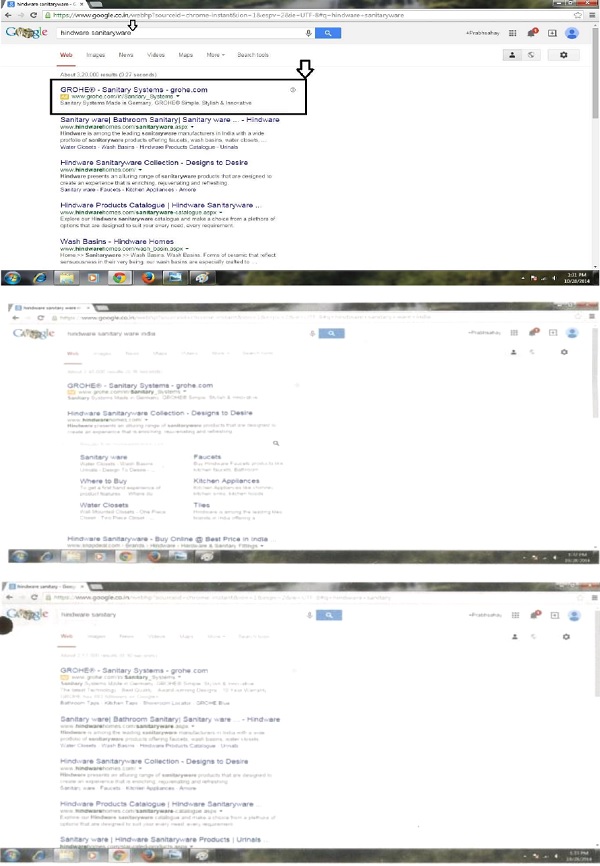
53. Likewise, in CS(COMM) 592/2017, as per the pleadings on record, somewhere in early 2013, plaintiff came to know that defendant nos. 1 and 2 were advertising defendant no. 2’s mark ‘CERA’ on the Google’s platform, google.com. It again transpired that defendant nos. 1 and 2 had availed the services of the AdWords Programme run and managed by Google, and had purchased the plaintiff’s registered trademark “HINDWARE” and/or a combination of words thereof as keyword(s), in a manner that the first result that appeared when a consumer would search for “hindware”, was of the website of defendant no. 2, www.cera-india.com. The screenshot with regard to the same is reproduced as under:
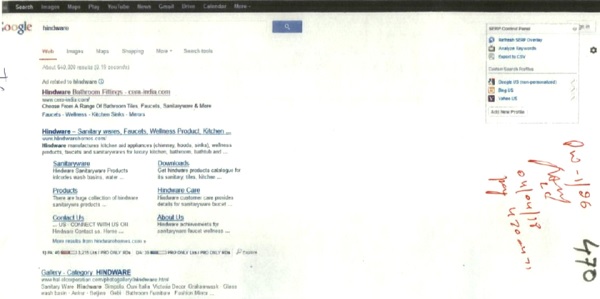
Google’s AdWords Policy:
54. Before delving in this issue further, it is imperative to understand Google’s AdWords Policy (now known as Google’s Ads Programme). The AdWords Policy is essentially an advertising self-service platform managed by Google, through which advertisers can create and display online advertisements with respect to their websites. The said advertisements are displayed on the first page of the SERP.
55. The AdWords Policy of Google functions as a paid referencing service. The Ads Programme enables any commercial entity by means of reservation of one or more words as keywords, which could be any word, to obtain an advertising link to its site when an internet user enters one or more of the keywords into a search request.
56. The search results yielded by search engine when a user searches a word, are primarily of two types:
i. Organic or Natural
ii Inorganic or Sponsored
57. The inorganic or sponsored search results are labelled with a prefix ‘ad’ to distinguish the same from organic search results. The said advertisement comprises of the AdHeading or AdTitle; URL or the website address; and the AdDescription. The AdHeading and AdDescription are collectively referred to as ‘AdText’ and are editable in nature, whereas, the URL displays the website domain of the advertiser.
58. As brought forth before this Court, in order to avail the service of the AdWords Policy, the advertiser, firstly, proceeds to ads.google.com to sign into their account. Thereafter, the advertiser can choose the option to create a new campaign for the advertisement it wishes to display on the search engine. The advertiser has the option of setting an ‘average daily budget’ for the campaign in the ‘Budget and Bidding’ section and furthermore, choose specific targeting options like location, language etc., in the ‘Campaign Settings’ option.
59. Thereafter, the advertiser chooses a set of keywords. Keywords are words or phrases that are used by advertisers in their campaign to trigger their advertisements. The keywords used by advertisers can be selected with the help of assistance of the ‘Keyword Planner Tool’ provided by Google. The said tool is a statistical research tool built into the Ads Programme interface, which provides an integrated work flow to guide users through the process of finding keywords for creating new ad groups and/or campaigns.
60. A user, who wishes to choose appropriate keywords for an advertisement, will have to type one or more descriptive words or phrases to solicit keyword ideas on the Keyword Planner. Thereafter, the Keyword Planner Tool will display, inter alia, certain keywords related to the words entered by the advertiser, along with the volume of monthly searches made on the same keyword and the additional keywords that could possibly be considered for use by the advertiser.
61. In order to enable the advertisers to select appropriate AdWords, so that the links to their sites are advertised in appropriate locations, search engines themselves guide the advertisers in the selection of AdWords. While doing so, search engines provide an unlimited choice to the advertisers, to choose from millions of words. If the keyword selected by the advertiser is not selected by anybody else, the search engine makes it available to the advertiser at a fixed rate. However, if the keyword selected by the advertiser is already in use by others, the advertisers who vie with one another are asked to bid upon a basic price fixed by the search engine.
62. Though all the advertisers are allowed to use the same keyword as their AdWords, the highest bidder is given the top slot in the list of sponsored links, subject to other factors. Therefore, in essence, an advertiser is entitled to choose any number of keywords for advertising his website on the sponsored links, but the slot allotted to him in the list of sponsored links, depends, amongst other factors, upon the price offered by him for the keyword, in comparison to the price offered by others for the very same keyword.
63. Google conducts an auction of the keywords in real time. The advertisers bid in advance by specifying the keywords for triggering the display of their advertisement, and the maximum price they are willing to pay if a user clicks on the said advertisement.
64. The advertisers do not pay when their advertisement appears on the SERP, but only when a user clicks on the said advertisement to view the website, referred to as ‘Pay-Per-Click’ (“PPC”). The algorithms used by Google determine the advertisements and the order in which the sponsored result appear on the SERP.
65. With regard to the Ads Programme of Google, previously known as Google AdWords, the cross examination of D3W-1 in CS (COMM) 591/2017 and D4W-1 in CS (COMM) 592/2017, i.e., Mr. Gavin Chariston, appearing on behalf of Google, records as under:
“xxx xxx xxx
CS (COMM) 591/2017
Q2. Is it correct that for the purpose of key words bid by GROHE, the agreement was between GROHE and defendant no.2 but the ADWORD programme was managed by defendant no.3?
A. Yes.
It is correct that the normal Google research results are distinct from ADWORD advertisement result and are not organic search results i.e. advertisements are not organic search results.
xxx xxx xxx
Q3. As for example, whether a company named Samsung can bid for key words like Nokia, Apple and Sony etc. for the purposes of their advertisements for mobile phones online?
A. Yes.
Q3. Whether if a online search is made using word Nokia or Apple or Sony, the ADWORD programme will show the advertisement of Samsung?
A. Yes may be. But subject to other factors.
Q4. Whether Google LLC promotes that company/establishment having trademarks buy key words of their competitors?
A. No.
It is correct that we do not take any prior consent or approval from the owners of the trademark before auctioning their trademarks as key words through our ADWORD programme. It is correct that Google LLC does not share any revenue or compensate the owners of the trademark after the successful bidding of such trademark by some other persons.
1. Whether, as on today, key word HINDWARE is still available with the ADWORD programme for bidding by other entities except GROHE?
a. Yes
Q.8 Is it correct that even after 10.11.2014, this key word HINDWARE was available continuously till date for bidding at ADWORD programme of Google?
b. Yes.
At this Stage, witness is offered to use the computer of the court (computer attached with the reader of the court) and asked to do the following and thereafter answer the questions.
Q9. Can you type “HINDWARE Faucets” and search on Google search engine?
b. Yes
Witness typed “HINDWARE Faucets” on Google search engine and results followed.
Q10. Is it correct that the search result is showing advertisement by Kohler?
b. Yes.
The hard copy is taken by using print screen option. The hard copy exhibited as Ex. D3W1/PX-1.
It is wrong to suggest that Google is violating the injunction order dated 10.11.2014 despite the pendency of the contempt petition in the connected case.
xxx xxx xxx
Q3. Whether word HINDWARE was available to be chosen for successful bidding on ADWORD programme as key word?
a. Yes.
b. Whether Google had ever tried to search word HINDWARE in any published dictionary around the world?
a. I do not know.
Google had not taken any permission or prior consent or approval from plaintiff to put word HINDWARE as key word for ADWORD programme.
xxx xxx xxx
i. Is there any difference between bidding price and “cost per click”?
ii. Yes. The bidding price is what the advertiser is willing to pay when someone clicks on their advertisement. The cost per click is what the advertiser actually pays when someone clicks on their advertisement. We have a second price auction. The advertiser pays Rs. 1 more than the second highest bid.
iii. Is it correct that if the plaintiff were to bid for its own trademark i.e. HINDWARE as a key word, its Ad-relevance, expected click through rate and landing page experience would be higher as compared to when GROHE bids for the key word HINDWARE because it has otherwise no relation with trademark HINDWARE?
iii. Yes.
iv. Is It also correct that in such a case where the ad-relevance, expected click through rate and landing page experience of defendant no. l is comparatively low, it would have to pay Google a higher bidding amount (cost per click) as compared to the plaintiff?
v. Yes.
vi. Is it correct that the bidding price (cost per click) is linked with the quality score and the ad-rank of the advertisement?
vii. I would not say necessarily the word “linked” but it is a factor taken into consideration.
xxx xxx xxx
Q21. Is it correct that if a trademark owner bids for its trademark and any other person bids for the same trademark, the ADWORD programme earn more from the bidding from other person than if the bidding is done by the trademark owner?
I cannot say since may factors are involved in pricing the bids. The other factors are quality score, Advocate-relevance and landing page experience for example if there is comparison of quality of products between GROHE’s products and HINDWARE product’s on GROHE’s website, it may also be a relevant factor.
xxx xxx xxx
Q26. What do you mean by “adwords policy as applicable to India”?
a. Even on that day it was a global policy. This phrase has been used possibly to show that even it applies to India.
The policy whereby the prohibition of using trademark terms as key words was lifted in the year 2009 in India.
xxx xxx xxx
Q28. Is it correct that post 2009, even, if the trademark owner i.e. plaintiff were to complain to Google regarding use of its trademark as a key word by a third party, Google would not take any action thereupon?
b. Yes.
xxx xxx xxx
Q30. What was the reason behind change of policy?
Google thought that it is justified as it is within the realm of law of various countries, good for consumers and for advertisers since it gives more choices available for users. Volunteered:
We were confident that the users would not be confused by competitive key word bidding.
xxx xxx xxx”
(Emphasis Supplied)
66. Perusal of the aforesaid cross-examination on behalf of Google establishes the following:
i. Google runs an AdWords Programme, pursuant to which, a user is routed to the advertiser’s link/web page.
ii. The word “HINDWARE” was available to be chosen for successful bidding on AdWords Programme as keyword.
iii. The witness of Google confirmed that even if a user would specifically search for a particular product, for example, Nokia or Sony, another company such as Samsung could purchase the keywords Nokia or Sony in return for a fee earned by Google, whereupon, instead of the organic result, i.e., websites of Nokia or Sony, the user would be shown the advertisement/websites of Samsung.
iv. The witness confirmed that despite passage of the injunction order dated 10th November, 2014, the keyword HINDWARE was available for bidding in the AdWords Programme, and in fact, on searching ‘HINDWARE Faucets’ before this Court, the results shown by Google was of ‘Kohler’.
v. The witness confirmed that Google had not taken any permission or prior consent from the plaintiff company to put its trademark “HINDWARE” in its AdWords Programme.
vi. Google does not share any revenue or compensate the owners of the trademark after the successful bidding of such trademark by some other persons.
vii. Google’s witness confirmed that a trademark owner can bid for its own trademark under the AdWords Programme.
viii. The witness confirmed that in terms of its AdWords Policy as applicable to India, Google did not allow a trademark to be used as a keyword till 2009 and the policy was changed as Google was confident that users would not be confused by competitive keyword bidding.
ix. The witness confirmed that post 2009, even if the trademark owner, i.e., plaintiff, were to complain to Google regarding use of its trademark as a keyword by a third party, Google would not take any action thereupon.
Trademark of the plaintiff, i.e., “HINDWARE” is a coined and distinctive mark:
67. In this context it is to be noted that the trademark “HINDWARE” is a registered trademark of the plaintiff since the year 1991 and has been used exclusively, extensively and continuously since then by the plaintiff in respect of various sanitaryware products and bathroom accessories.
68. “HINDWARE” is a coined word and has no dictionary meaning. The plaintiff company has the following trademark registration in its favour pertaining to its trademark HINDWARE, as brought forth in the Evidence Affidavit of PW-1, Exhibit PW-1/A:
olill
69. Submission of the plaintiff as brought forth in the Evidence Affidavit of its witness, Exhibit PW-1/A, with regard to extensive use of the trademark “HINDWARE”, the sales figures of its products with the trademark “HINDWARE” and the amount spent on advertisement and promotion of the mark “HINDWARE”, is reproduced as under:
“xxx xxx xxx
8. I say that the Plaintiff company enjoys a market share of 40% in the organized sector of the sanitary-ware industry. I say that the Plaintiff company has 18 service centres across India, 25 HINDWARE boutiques and more than 450 HINDWARE shops. I say that while the Plaintiff predominantly caters to the Indian market, in this era of globalization, it also has a Building Products Division and a Container Glass Division which have expanded their horizons to cater to the international market as well. I say that the Plaintiff exports its products to various countries in Europe, Africa and the Middle East.
9. I say that the Plaintiff is recognized among the top 300 companies in India, while rated amongst the best 100 small and medium sized companies in the world by the Forbes Magazine. I say further that the Plaintiff has more than 1,235 institutional partners including respectable business houses such as DLF, Taj Hotels, GMR Group, Unitech, ITC Hotels, PepsiCo, Coca Cola, Dr. Reddy’s Laboratories, Hindustan Unilever, Pfizer, Dabur and Nestle to name a few.
10. I say that the mark/brand HINDWARE is the flagship brand of the Plaintiff, offering the widest range of sanitaryware in India. I say that the brand/ trademark HINDWARE is a registered trademark of the Plaintiff since year 1991, and has been used exclusively, extensively and continuously since then by the Plaintiff in respect of Sinks, wash basins, bathtubs, bidets, water closets and other sanitary-ware products including bathroom accessories.
11. I say that the popularity of the product range sold under the trademark HINDWARE is evident from the growing sales of the products. I say that true copies of the Annual Report of Plaintiff company for 2011-2012, the Original Certificates from Chartered Accountants stating the sales and advertisement figures pertaining to the Plaintiff from 1990-1991 and 2010-2011 along with copies of some sample sale invoices from the years 1991-2008 have already been filed in the present proceedings and I crave leave to produce the Annual Report of Plaintiff company for 2011-2012, Original Certificates from Chartered Accountants stating the sales and advertisement figures pertaining to the Plaintiff from 1990-1991 and 2010-2011 along with the sample sale invoices from the years 19912008 to exhibit the same as Ex PW 1/6, Ex PW 1/7 [Colly] and Ex PW 1/8 [Colly] respectively.
12. I say that the total sales under the mark HINDWARE for the year 2011-12 are in excess of Rs. 500 Crores. I say that the following are the sales figures of the Plaintiff company pertaining to the trademark HINDWARE:
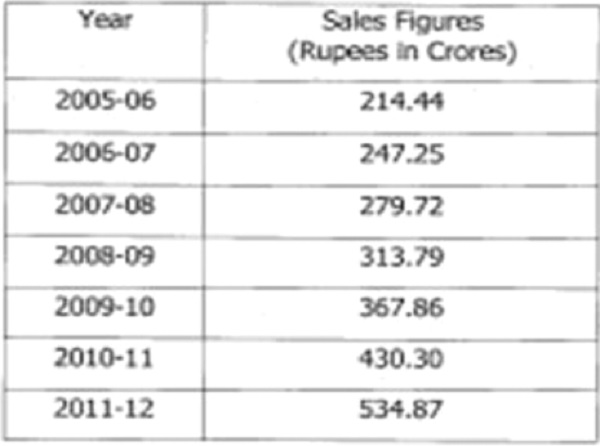
I say that the Plaintiff has also spent considerable amounts of money on advertisement and promotion of the mark HINDWARE and related marks and also the website www.hindwarehomes.com. I say that true copies of the various advertising brochures of the Plaintiff company, true copies of advertisements of the Plaintiff’s products in various magazines along with true copies of printouts from www.hindwarehomes.com have already been filed in the present proceedings and I crave leave to produce the various advertising brochures of the Plaintiff company, the advertisements of the Plaintiff’s products in various magazines along with the printout from www.hindwarehomes.com to exhibit the same as Ex PW 1/9 [Colly], Ex PW 1/10 [Colly] and Ex PW 1/11 respectively.
13. I say that the total expenditure on advertising and marketing for the mark HINDWARE for the year 2011-12 is in excess of Rs. 50 crore. I say that following are the advertisement figures of the Plaintiff company pertaining to the trademark HINDWARE and its derivative marks:
| Year | Marketing, Selling and Distribution Expenses (Rupees in Crores) |
|---|---|
| 2005–06 | 37.24 |
| 2006–07 | 41.86 |
| 2007–08 | 45.24 |
| 2008–09 | 49.86 |
| 2009–10 | 61.65 |
| 2010–11 | 41.86 |
| 2011–12 | 55.98 |
xxx xxx xxx
13. I say that the Plaintiff also owns various registered designs for its range of sanitary products. I say that the Plaintiff being one of the oldest companies in India, manufacturing and selling sanitary-wares, tiles and various other building and construction related material, enjoys unparalleled reputation and goodwill. I say that the Plaintiff company is duly ISO and OHSAS certified as well, implying effective quality management and environment systems. I say that true copies of the ISO and OHSAS certification of the Plaintiff Company dated 03.05.2012 have already been filed in the present proceedings and I crave leave to exhibit the same as Ex PW 1/13 [Colly].
xxx xxx xxx”
(Emphasis Supplied)
70. Perusal of the aforesaid establishes that the trademark of the plaintiff “HINDWARE” has acquired distinctiveness in the trade as a result of its long, extensive and continuous use, since as far back as 1991. The plaintiff has acquired enormous goodwill and reputation in trademark “HINDWARE”, which is reflected in the huge turnover, as above. Since the trademark “HINDWARE” is a coined word and has no dictionary meaning, the said mark relates to the trade of the plaintiff and customers identify the same as related only to the plaintiff and no one else. In this regard reference is made to the judgement passed by the Division Bench of this Court in the case of Marico Limited Versus Agro Tech Foods Limited14, wherein it was held as follows:
“xxx xxx xxx
15. The word ‘distinctive’ is not directly defined in the Act. However meaning of distinctive is indicated in the definitions of ‘trade mark’ [Section 2(zb)] and ‘well known trade mark’ [Section 2(zg)]. The word has been explained in a plethora of judgments. Distinctive has been explained to mean such use of the trade mark with respect to the goods of a person that the public will immediately and unmistakably co-relate the mark with the source or a particular manufacturer/owner thereof. The real issue which however arises is what should be the meaning of the expression ‘distinctiveness’ in the situation when the trade mark is a word mark of descriptive nature. When a trade mark, which is a word mark, is arbitrarily adapted and is such having no co-relation to the goods in question, then in such a case distinctiveness is achieved by normal and ordinary use of the trade mark with respect to the goods and it has been repeatedly held that such trade mark is entitled to the highest degree of protection. However this is not and cannot/should not be so for a trade mark which is a descriptive word mark. Some colour has to be taken for the word ‘distinctive’ as found in the proviso to Section 9 from the expression ‘well known trade mark’ which follows the distinctiveness aspect as found in the said proviso. Courts should ordinarily lean against holding distinctiveness of a descriptive trade mark unless the user of such trade mark is over such a long period of time of many many years that even a descriptive word mark is unmistakably and only and only relatable to one and only source i.e. the same has acquired a secondary meaning. A case in point is the use of ‘Glucon-D’ for 60 years in the recent judgment in the case of Heinz Italia v. Dabur India Ltd., (2007) 6 SCC 1 A period of 60 years is indeed a long period of time and thus distinctiveness of the descriptive word mark used as a trade mark was accepted, albeit in a tweaked form of the normal descriptive word ‘Glucose’. Therefore, when the descriptive trade mark is used only by one person undisturbed for a very long period of time, without anyone else attempting to use the trade mark during this long period time, a case can be established of a descriptive word having achieved distinctiveness and a secondary meaning.
xxx xxx xxx”
(Emphasis Supplied)
71. This Court also takes note of the fact that the plaintiff company has also been given several awards and recognitions by various publications on international and national level, one of the awards being, “India’s most powerful brand chosen by consumers (2011)” by Indian Institute of Planning and Management (“IIPM”). This clearly indicates that the mark of the plaintiff, “HINDWARE” is distinctively associated with the goods of the plaintiff company. The summary of the said awards as given by the plaintiff in its Annual Report is as under:
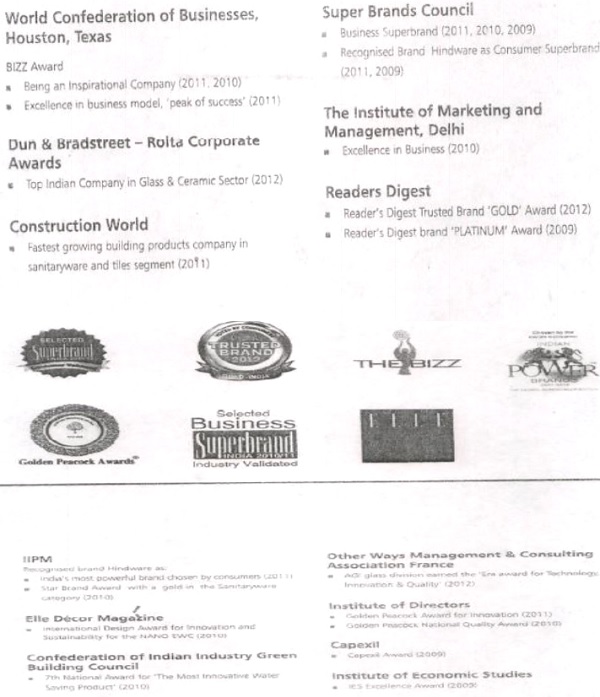
72. This Court also takes note of the fact that the trademark of the plaintiff “HINDWARE” has been recognised as a well-known mark by this Court in the order dated 21st April, 2017 in CS(OS) 2736/2014, titled as “HSIL Limited Versus Kripton Ceramics Pvt. Ltd. & Ors.”, in the following manner:
“1 The present suit has been filed by the plaintiff against the defendants for permanent injunction restraining infringement of trademarks, delivery up, rendition of accounts of profits as also damages.
2. The plaintiff HSIL Limited, formerly known as Hindustan Twyfords Ltd. is a company established in 1960, incorporated under the provisions of the Companies Act, 1956, and is a leading manufacturer and seller of sanitary ware products, kitchen appliances, tiles etc. under the trademark “HINDWARE”, which is a registered trademark of the plaintiff since the year 1993, as well other supplementary marks/logos/labels such as H-VITREOUS HINDWARE, HINDWARE ITALIAN COLLECTION, HSIL etc. The history of HINDWARE has been detailed in the plaint establishing its business reputation and goodwill not only in any single class of goods but across various classes due to wide range of products. The plaintiff also owns the domain name www.hindwarehomes.com which provides information about the company and also offers its entire range of products.
3. Defendant No.1 is the manufacturer of tiles under the trademark “TLINDWARE” which is registered as a label mark. Defendant No.2 is the director of Defendant No.1, Defendant No.3 has designed the infringing trademark and gotten it registered in his own name on behalf of Defendant No. 1 and Defendant No.4 is the shop from which the infringing products are sold.
4. In June, 2014 the plaintiff received information that the defendants were manufacturing and selling tiles prominently displaying the plaintiff’s trademark HINDWARE. Upon investigating further, the plaintiff discovered that the defendants were not only using a mark deceptively similar to the plaintiff’s registered trademark HINDWARE but were also copying the font and writing style. Plaintiff had requested Defendant No. 3 to visit the office of the Plaintiff in Gujarat where he disclosed that though the defendants sell under the mark TLINDWARE, the manner in which the alphabets T and L are written, present a visual impression that the two alphabets combined form the alphabet H (for HINDWARE) so as to cause confusion in the minds of the customers without being liable in any manner, and also assured the plaintiff that he would dispose of the infringing cartons, printing plates and give up the registration for TLINDWARE. Despite the assurances the defendants continued with the infringement and chose to ignore the reminder emails sent to them by the plaintiff.
5. Present suit has accordingly been filed praying for a relief of permanent injunction and seeking a restraint on the infringement of the trademark of the plaintiff. Restraint on passing off, delivery up of goods and damages to the tune of Rs.21,00,000/- have also been prayed for.
6. In the course of proceedings of the suit, on 09.09.2014 an ex parte interim injunction was granted in favour of the plaintiff and against the defendants restraining them from using the trademark HINDWARE or any other mark which is identical to or similar to the plaintiff’s mark. The ex-parte interim injunction was then made absolute on 27.01.2017.
7. Summons of the suit were issued to the defendants who in spite of the service did not appear. They were proceeded ex parte on 16.01.2015.
8. Ex parte evidence by way of affidavit of PW-1 (Vice President-IR & Legal of the plaintiff) and PW-2 (senior officer-IT of the plaintiff) has been filed. PW-1 has reiterated all the averments made in the plaint and has proved various documents delineated as Ex.PW1/1 to Ex.PW-1/25 (except Ex.PW1/19). PW-2 has also reiterated the averments made in plaint.
9. The plaintiff has established that the mark HINDWARE is a well known mark. He has proved his case. In view of the testimony of the witnesses of the plaintiff i.e. both PW-1 and PW-2 as also documentary evidence adduced and proved in the court, the plaintiff is entitled to a decree of permanent injunction. It is clear that the defendants have copied the trademark and logo of the plaintiff’s in all respects. This adoption of the trademark of the plaintiff is fraudulent and is done with a malafide intention and has caused huge losses to the plaintiff not only in monetary terms but even in terms of loss to its reputation and goodwill. Accordingly, the suit of the plaintiff is decreed and by way of the permanent injunction, the defendants, directors, officers, servants and agents and all others acting for and on their behalf are restrained from using the plaintiff’s trademark HINDWARE or any other trademark of the plaintiff, on its products or in any manner which is deceptively similar with the plaintiff’s trademarks amounting to infringement/passing off the plaintiff’s registered trademarks as also from misrepresenting or holding out to be connected or related to the plaintiff in any manner whatsoever.
10.The defendants are also directed to destroy all the printed and electronic material, invoices, letter heads, visiting cards, products, product packaging, carton, cardboard boxes, printing plates or any other material bearing the plaintiff’s trademark HINDWARE.
11.The plaintiff has also claimed damages. In the affidavit by way of evidence it has been reiterated that the use of the infringing trademark by the defendants has caused huge losses to the plaintiff not only in monetary terms, but also to the goodwill and reputation of the plaintiff. The plaintiff has also made out a case for entitlement of damages and is awarded damages quantified at Rs.21,00,000/-. Cost of the suit also be granted in favour of the plaintiff. Decree sheet be drawn. File be consigned to record room.”
(Emphasis Supplied)
73. Thus, it is evident that the trademark of the plaintiff is a distinct mark on account of its extensive and continuous use by the plaintiff, since long. Further, the plaintiff’s trademark being a coined word is entitled to a greater amount of protection from infringement. In this regard, reference is made to the judgement of the Supreme Court in the case of Pernod Ricard India Private Limited and Another Versus Karanveer Singh Chhabra15, wherein the Supreme Court held that the more distinctive a mark, whether inherently or through acquired reputation, the stronger its position in an action for infringement or passing off, and the higher the degree of protection it commands. Thus, it was held as follows:
“xxx xxx xxx
31.4. The strength of a trademark lies in its inherent distinctiveness or the distinctiveness acquired through use. Invented or coined marks – such as Kodak or Solio – are inherently distinctive and command the highest degree of protection. These marks immediately signify the commercial origin of the goods or services. In contrast, descriptive marks – such as Air India, Mother Dairy, HMT, Windows, Doordarshan, LIC, and SBI – are not inherently distinctive and must acquire secondary meaning in the minds of the public to qualify for protection. That is, the public must come to associate the mark with a particular source. Similarly, geographical terms like Simla or Liverpool, or generic trade terms, are generally not registrable unless they have acquired distinctiveness through long and exclusive use. The more distinctive a mark – whether inherently or through acquired reputation – the stronger its position in infringement or passing off actions.
xxx xxx xxx”
(Emphasis Supplied)
74. Thus, it is evident that the trademark of the plaintiff is a distinct mark on account of its extensive and continuous use by the plaintiff since long. Further, the plaintiff’s trademark being a coined word being inherently distinctive is entitled to greater amount of protection from infringement.
Functions of a Trade Mark:
75. A trade mark is a mark capable of distinguishing the goods and services of one person from those of others. The underlying principle behind trademark protection is to ensure that the goods or services of one enterprise can be distinguished from those of others. This serves the dual purpose of protecting the consumers from confusion, and protecting the goodwill and reputation of the trade mark owner from being used by its competitors.
76. Thus, the primary function of trademark is to act as a source identifier, i.e., enable the consumer to identify the source of goods or services, and distinguish them from those of others. Any use of a mark, which is likely to confuse or deceive the consumer, or create a likelihood of an association or link between certain goods/services and the goods/services of the proprietor of the trade mark, are actionable.
77. Additionally, trademarks also have an investment function, which seeks to protect the investment made by the proprietor in building reputation and goodwill of the trademark. Thus, even in the absence of a likelihood of confusion, any use of a trademark which leads to dilution, either by blurring or by tarnishing, or which is detrimental to the reputation of the trademark is actionable. Trademarks have also been recognised to have an advertising function, which seeks to prevent any advertising of the trademark if it amounts to unfair advantage and is contrary to honest practices in industry, or harms the distinctive character or reputation of the trademark. These functions may overlap in some scenarios.
78. In this regard, it may be apposite to refer to the decision of the Division Bench in the case of Google LLC Versus DRS Logistics (P) Limited and Others16, wherein, the functions of trademark have been discussed in the following manner:
“xxx xxx xxx
136. It is essential to bear in mind that the protection afforded in respect of a trade mark is both to the public as well as the proprietor of the trade mark. The primary function of a trade mark is to serve as a source identifier of the goods and services. It is necessary for protection of the public that when they purchase goods and services associated with the trade mark, they are not deceived in any manner in accepting goods and services from a source other than that associated with the trade mark. Any use of a mark, which is likely to confuse or deceive the user is impermissible and is actionable. In addition to the primary function of serving as a source identifier, the trade mark also has an investment function, that is, to preserve the value of investment of the proprietor in popularising the trade mark and the attendant goodwill. Extended protection is also afforded to this function of the trade mark, to ensure that the value of the trade mark is not diluted or compromised, either by blurring or by tarnishment, by use of an identical or deceptively similar mark even though there is no likelihood of any confusion.
xxx xxx xxx”
(Emphasis Supplied)
Use of the Trademark amounts to Use under the Trade Marks Act:
79. Google has contended that keywords act as a backend trigger for displaying the advertisements in response to the search query entered by a user, and such keywords are only within the knowledge of the advertiser who has provided them. Since, users can neither see, or otherwise perceive the keywords provided by the advertiser, such use of trademarks as keywords, being imperceptible or invisible to consumers, cannot be said to amount to ‘use’ under the Trade Marks Act.
80. Thus, the first question that bears consideration by this Court would be as to whether the use of trademark as keyword for display of advertisements in respect of goods or services amounts to “use” of the mark.
81. As to what constitutes use of a mark, Section 2(2)(b) and (c) of the Trade Marks Act, stipulates as under:
“xxx xxx xxx
(2) In this Act, unless the context otherwise requires, any reference— xxx xxx xxx
b. to the use of a mark shall be construed as a reference to the use of printed or other visual representation of the mark;
c. to the use of a mark,—
i. in relation to goods, shall be construed as a reference to the use of the mark upon, or in any physical or in any other relation whatsoever, to such goods;
ii. in relation to services, shall be construed as a reference to the use of the mark as or as part of any statement about the availability, provision or performance of such services;
xxx xxx xxx”
(Emphasis Supplied)
82. Perusal of Section 2(2)(c) of the Trade Marks Act shows that use of the mark in relation to goods shall be construed as not only use of the mark upon or in any physical form, but in any other relation whatsoever. The use of the words “in any other relation whatsoever” must be interpreted widely and would include even invisible use of the mark. Thus, use of a trademark as a keyword, even though not visible to the end user, would amount to use of the mark.
83. It would also be relevant to refer to Section 29(6) of the Trade Marks Act, which lays down as to what amounts to use of a registered mark for the purpose of Section 29 of the Trade Marks Act, in the following manner:
“xxx xxx xxx
(6) For the purposes of this section, a person uses a registered mark, if, in particular, he—
a. affixes it to goods or the packaging thereof;
b. offers or exposes goods for sale, puts them on the market, or stocks them for those purposes under the registered trade mark, or offers or supplies services under the registered trade mark;
c. imports or exports goods under the mark; or
d. uses the registered trade mark on business papers or in
xxx xxx xxx”
(Emphasis Supplied)
84. Section 29(6)(d) of the Trade Marks Act elucidates that use of a registered trademark in advertising is use of a registered trademark. Thus, use of trademark as a keyword for display of advertisements in respect of goods or services clearly amounts to use of the trademark ‘in advertising’ within the meaning of Section 29(6)(d) of the Trade Marks Act.
85. This Court does not accept the contention of Google that the words “in advertising” as appearing under Section 29(6)(d) of Trade Marks Act should be read as a noun, and not a verb. The language used by the legislature in Section 29(6)(d) is “in advertising” and not “in an advertisement”. It is a settled principle of law that effect must be given to the plain meaning of words used by the legislature. Thus, when the legislature in its wisdom has used the word “in advertising”, it would naturally encompass all uses of a trademark in the process of advertising. Thus, even where a registered trademark does not appear or is not visible in the advertisement in question, if the trademark has been used in advertising, such as in the present case by use as a keyword, the same would amount to use of the trademark. Since, in the present case, the trademark “HINDWARE” is used as a keyword to trigger display of advertisements of goods or services, it would in the plain sense, be use of the mark in advertising, and amount to use of the trademark under the Trade Marks Act.
86. A reference may be made to the judgement of the Division Bench of this Court in the case of Google LLC Versus DRS Logistics (P) Limited and Others17, wherein, it has been held that use of trademark as keyword amounts to use of marks for the purpose of Section 29 of the Trade Marks Act, in the following manner:
“xxx xxx xxx
82. Section 29 of the TM Act uses the term “mark” as well as “trade mark”. These terms are defined under sub-clauses (m) and (zb) of Section 2(1) of the TM Act respectively. The said clauses are set out below:
“2. (1)(m) ‘mark’ includes a device, brand, heading, label, ticket, name, signature, word, letter, numeral, shape of goods, packaging or combination of colours or any combination thereof.
∗∗∗
(zb) ‘trade mark’ means a mark capable of being represented graphically and which is capable of distinguishing the goods or services of one person from those of others and may include shape of goods, their packaging and combination of colours; and
i. in relation to Chapter XII (other than Section 107), a registered trade mark or a mark used in relation to goods or services for the purpose of indicating or so as to indicate a connection in the course of trade between the goods or services, as the case may be, and some person having the right as proprietor to use the mark; and
ii. in relation to other provisions of this Act, a mark used or proposed to be used in relation to goods or services for the purpose of indicating or so as to indicate a connection in the course of trade between the goods or services, as the case may be, and some person having the right, either as proprietor or by way of permitted user, to use the mark whether with or without any indication of the identity of that person, and includes a certification trade mark or collective mark;”
83. Clauses (b) and (c) of Section 2(2) of the TM Act provides for the meaning to be ascribed to the expression, “use of a mark”. The said provisions are set out below:
“(2) In this Act, unless the context otherwise requires, any reference—
∗∗∗
b. to the use of a mark shall be construed as a reference to the use of printed or other visual representation of the mark;
c. to the use of a mark,—
i. in relation to goods, shall be construed as a reference to the use of the mark upon, or in any physical or in any other relation whatsoever, to such goods;
ii. in relation to services, shall be construed as a reference to the use of the mark as or as part of any statement about the availability, provision or performance of such services;”
84. Section 2(2)(c)(i) of the TM Act is couched in wide terms. Any reference to the use of a mark in relation to goods is not only limited to use in any physical form but also “in other relation whatsoever” to such goods. The words “in relation to” have been interpreted in wide terms. In Hardie Trading Ltd. v. Addisons Paint & Chemicals Ltd. [Hardie Trading Ltd. v. Addisons Paint & Chemicals Ltd., (2003) 11 SCC 92] , the Supreme Court considered the scope of Section 2(2)(b) of the TM Act [which is now Section 2(2)(c)(i) of the TM Act] and interpreted the words “in other relation whatsoever” in wide terms. The court further observed that use of the words “in” and “whatsoever” indicated that the expression “other relation” was of a wide amplitude. The relevant extract of the said decision is as under: (SCC pp. 108-109, paras 41, 42 and 45)
“41. The question therefore is — is the word ‘use’ in Section 46(1) so limited? The phrase used in Section 46 is ‘bona fide use thereof in relation to those goods’. The phrase has been defined in Section 2(2)(b) of the Act as:
‘2. (2)(b) to the use of a mark in relation to goods shall be construed as a reference to the use of the mark upon, or in any physical or in any other relation whatsoever, to such goods.’
(emphasis supplied)
42. This shows that the use may be other than physical. It may be in any other relation to the goods. Given this statutory meaning, we see no reason to limit the user to use on the goods or to sale of goods bearing the trade mark.
∗∗∗
45. In Section 2(2)(b) of the Act, we have the additional words ‘any’ and ‘whatsoever’ qualifying the words ‘other relation’ giving the words a much wider meaning. Reading this definition into Section 46(1) it is clear that the word ‘use’ in Section 46(1) may encompass actions other than actual sale.”
85. We are unable to accept that the use of a trade mark must necessarily be limited to use in a visual form on the goods. The words “in any other relation” to goods would also include use in relation to the goods, in any form whatsoever.
86. Section 2(2)(c)(ii) of the TM Act requires the reference to the use of the mark as or as a part of any statement about availability, provision or performance of such services. The expression “or in any other relation whatsoever” is not used under Section 2(2)(c)(ii) of the TM Act. It is difficult to accept that the use of a mark in relation to services must be construed in a narrower sense than use of the mark in respect of goods. However, the same would depend on the context in which the expression “use of the mark” is used.
87. Section 2(2) of the TM Act serves as an aid to interpret the words and terms as used in the TM Act. However, the same is by no means exhaustive. The expression “use of a mark” is used in the TM Act in several sections and in the context of various aspects including removal of the trade mark on account of abandonment or non-use, and for lack of any bona fide intention to use the mark. Thus, the question whether a reference to the expression “use of a trade mark” is to be understood as instructed by Section 2(2)(b) or Section 2(2)(c) of the TM Act would depend on the context in which the said expression is used.
88. Section 29(6) of the TM Act expressly lists out certain actions, which would amount to use of a registered mark for the purposes of Section 29 of the TM Act. Clearly, the words of Section 2(2) of the TM Act do not control the width of Section 29(6) of the TM Act. Thus, if any action falls within the scope of Section 29(6) of the TM Act, the same would necessarily have to be construed as use of the mark, for ascertaining whether the trade mark is infringed in terms of Section 29 of the TM Act.
89. We concur with the view that the words “unless the context otherwise requires” in the opening sentence of Section 2(2) of the TM Act, limits the applicability of Section 2(2) of the TM Act to where it is contextually relevant.
90. Indisputably, the Ads programme is Google’s commercial venture to monetise the use of the search engine for advertising by displaying the sponsored links of various advertisers, who seek to display their advertisements on the SERP pursuant to search queries initiated by an internet user. The use of a trade mark as keywords for display of advertisements in respect of goods or services clearly amounts to use of the trade mark in advertising within the meaning of Section 29(6) of the TM Act.
91. The expression “in advertising” as used in Section 29(6)(d) of the TM Act is not synonymous to the expression “in an advertisement”. It is not necessary that the registered trade mark physically appears in an advertisement for the same to be used “in advertising”. The use of a trade mark as a keyword to trigger display of an advertisement of goods or services would, in plain sense, be use of the mark in advertising.
xxx xxx xxx”
(Emphasis Supplied)
87. Perusal of the aforesaid decision shows that Section 2(1)(zb) of Trade Marks Act defines a trademark, while Section 2(2)(c)(i) of Trade Marks Act defines use of a mark to include reference to the use of the mark upon, or in any physical or in any other relation whatsoever, to such goods. Thus, the definition of the use of a mark under the Trade Marks Act under Section 2(2)(c)(i), is couched in very wide terms. Any reference to the use of the mark is not only limited to use in any physical form, but also “in other relation whatsoever” to such goods. Hence, use of a trademark would necessarily include use in relation to goods, in any form whatsoever. Furthermore, the use of a trademark as keywords for display of advertisements in respect of goods or services clearly amounts to use of the trademark in advertising within the meaning of Section 29(6) of the Trade Marks Act. As noted hereinabove, the expression ‘in advertising’, as used in Section 29(6)(d) of the Trade Marks Act, is not synonymous to the expression, ‘in an advertisement’. It is not necessary that the registered trademark physically appears in an advertisement for the same to be used ‘in advertising’. The use of a trademark as a keyword to trigger display of an advertisement of goods or services would be use of the mark ‘in advertising’.
88. In the case of DRS Logistics (P) Ltd. and Another Versus GOOGLE India Pvt. Ltd. and Others18, the learned Single Judge has further held that keywords are comparable with meta-tags, as the end result from use of meta-tags and keywords is not different. It was held that no doubt meta-tags and keywords may be conceptually different, however, both are used to show relevancy and appear on the top of the search engine result page, whether in organic or sponsored result. The use of meta-tags within codes and keywords with respect to the sponsored search produces a desired result which is on the basis of Google’s algorithm. It was held in categorical terms that invisible use of trademark to divert the traffic from proprietors’ website to the advertisers’ website shall amount to use of the mark for the purpose of Section 29, which includes Section 29(6) and 29(8) of the Trade Marks Act, related to advertising. The relevant paragraphs of the aforesaid judgment are reproduced as under:
“xxx xxx xxx
82. Mr. Lall is right in saying that Sections 2(2)(b) and 2(2)(c) have to be read in addition to Section 29(6), 29(7), 29(8) and 29(9). Having said that a perusal of Section 29(9) makes it clear that an infringement of a trademark can be by way of spoken use which is different from printed or visual representations of the mark. That is invisible use of the mark can also infringe a trademark.
83. This I say in view of the Judgment of this Court in the case of Hamdard National Foundation v. Hussain Dalal, (2013) 202 DLT 291, wherein the Court while considering the suit for infringement, passing off and disparagement held that on a reading of Section 29 (9) it is clear that the said section provides that it is an infringement of the trademark by way of spoken use of the words which are contained in the trademark and the visual representation thereof. So, it follows, what is infringement, is not merely visual representation of the product in bad light under the provision of Section 29(9) but it is infringement of the trademark if the same is caused by way of spoken use of the words and the visual representation of the said words. Furthermore, a Division Bench of this Court in the case of Kapil Wadhwa v. Samsung Electronics Co. Ltd., (2012) 194 DLT 23 has found usage of a trademark in the source code i.e., through meta-tagging even though invisible to the end-user/consumer to be illegal. Albeit the appellant therein sold imported goods manufactured by the respondent therein although without the consent of the latter.
84. Having said that, the question is whether the “invisible use” of a mark, as contended by Mr. Sethi shall not amount to “use” within meaning of Sections 2(2)(b) and 2(2)(c) of the TM Act as it is not a case which falls within the meaning of Section 29. This issue is no more res integra, at least in view of the Judgment in the case of Amway India Enterprises Pvt. Ltd. v. 1MG Technologies Pvt. , (2019) 260 DLT 690, wherein a Coordinate Bench of this court while considering the use of the Mark “Amway” by third party e-commerce platforms, for promoting their own sales, has held the use of a mark in meta-tags or in advertising without the consent of the proprietor as a violation of trademark rights of the owner. In fact, the Court also held that Section 29 (8) also makes it clear that if any advertising of a mark takes unfair advantage of the mark or is detrimental to its distinctive character even without sale taking place there is an infringement.
85. On similar lines, is the Judgment of the Bombay High Court in People Interactive (I) Pvt. Ltd. (supra) wherein the Court observed that the defendant No. 1 was using the plaintiffs proprietary mark shaadi.com and its domain name www.shaadi.com as part of meta-tags in the first defendant’s website, which was held by the Court to be an attempt to misappropriate the plaintiffs mark and hijack the internet traffic from the plaintiffs site by a thoroughly dishonest and malafide use of plaintiff s mark and name in the meta-tags of his own rival website. Paragraph 14 of the Judgment is reproduced as under:
“14. I believe the Plaintiffs have made out not just a strong, but an overwhelming prima facie case. Dishonesty is writ large on the actions of the 1st Defendant. He has used the Plaintiffs’ mark shaadi.com as a suffix to another expression. He has attempted to misappropriate the Plaintiffs’ mark. He has made false claims regarding the extent and size of his service. He has, plainly, hijacked Internet traffic from the Plaintiffs’ site by a thoroughly dishonest and mala fide use of the Plaintiffs’ mark and name in the meta tags of his own rival website. The distinctive character of the Plaintiffs’ mark is thus diluted and compromised by the actions of the Defendant. The 1st Defendant’s action is nothing but online piracy. It cannot be permitted to continue.”
86. Having noted the above Judgments, it is clear that the use of the mark as meta-tags was held to be infringement of trademark. It follows, that invisible use of trademark to divert the traffic from proprietors’ website to the advertisers’/infringers’ website shall amount to use of mark for the purpose of Section 29, which includes Section 29 (6) and 29(8), related to advertising.
87. It is the submission of Mr. Sethi that there is a difference between the meta-tags and keywords, inasmuch as meta-tags, which are words inserted in the HTML code of the website; unlike keywords which are only a component of the AdWord Program of Google. This submission of Mr. Sethi is denied by Mr. Lall by contending keywords are commercial meta-tags used in the AdWord Program of Google on payment of charges on a pay-per-click basis. The concept of meta-tags and keywords can be understood in the following manner which I have culled out from the judgments given by various High Courts of this country and also pleadings of the defendant Nos. 1 and 3 which I reproduce below:
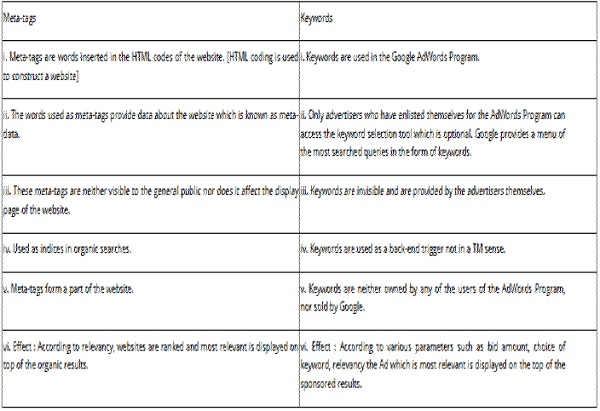
88. It must be stated here that the working of the meta-tags and also the keywords, as contended by Mr. Sethi is governed through the use of algorithms. The use of meta-tags within codes and keywords with respect to the sponsored search produces a desired result which is on the basis of Google’s algorithm. According to the Oxford Reference website, algorithm has been defined as, a “documented series of steps which leads to the transformation of some data. For example, in order to calculate the sum of a series of numbers a possible algorithm would involve repeatedly adding the numbers to be summed to a running total. Computer programs are a manifestation of algorithms which allow them to be executed very quickly”. Whereas the Collins online dictionary defines algorithm as, “a series of mathematical steps, especially in a computer program, which will give you the answer to a particular kind of problem or question”.
89. It is contended by Mr. Sethi, Google’s use of its advertising/sponsored result algorithm is different from that of the algorithm involved in producing organic search result through use of meta-tags. It is the case of Mr. Sethi that it is the use of Google’s algorithm in the AdWord program which triggers a sponsored result i.e., the advertisements, which is different from the use of meta-tags, which produces Google’s organic result. He stated that the sponsored result is triggered, based on many parameters, wherein each ad is given a quality score which is an aggregate of many factors such as relevancy of ad to search query, landing page quality, number of ad extensions, past history of the advertiser, geographical relevance of Ads to the webpage user; which goes to show that the AdWords Program is not driven by monetary consideration alone. No doubt, that meta-tags and keywords may be conceptually different however, both are used to show relevancy and appear on the top of the search engine result page, whether in organic or sponsored result. The question now is whether the use of mark as a keyword, results in diversion of traffic from the website of the original proprietor to that of the advertiser, this aspect has not been disputed/contested by Google, nor it has been argued that the end result from use of meta-tags and keywords is different; inasmuch as both are instrumental for a search result (whether organic or sponsored) to appear on the top of the search engine result page, except that sponsored links to the advertiser’s web page is marked with the symbol denoting Ad which is followed by the URL, displayed in the following manner : Ad. https://www.
90. I must also state that it is Google’s policy that it will only investigate the Ad content and not the keywords, the former includes the ad text and ad title but not the keywords. In order to assess the quality score, Google also sees the quality of the landing page which is primarily the website of the advertiser which may or may not have/display the infringed trademark. In other words, it is not the case of Google that as keywords are not visible to a consumer the use of same shall not amount to an infringement of trademark. However, under the AdWords Program they also see the landing page i.e., website of the advertiser, which in a given case shall have the infringing trademark, which is also used as a keyword, in such a scenario, Google cannot absolve themselves from the liability of ensuring that the keyword is not an infringement of trademark.
91. It is important to note, that had the AdWords Program of Google not existed, the only option available to the infringer/prospective advertiser in order to achieve the same result would have been to change their meta-tags (source coding) which has already been held to be “use” of trademark and as such infringement. This aspect also highlights the fact that the same result is sought to be achieved through different means.
xxx xxx xxx”
(Emphasis Supplied)
89. The aforesaid findings by the learned Single Judge were upheld by the Division Bench of this Court in the case of Google LLC Versus DRS Logistics (P) Limited and Others19, in the following manner:
“xxx xxx xxx
99. We find no infirmity with the reasoning of the learned Single Judge in considering the use of trade marks as keywords analogous to using the same as meta tags, for the limited purposes of examining whether use of a trade mark, which is not visible may infringe the trade mark. Merely because the meta tags may be visible to a person who examines the source code of a website is not material. The use of meta tags and keywords, in one sense, serves similar purpose for displaying advertisement and attracting internet traffic.
100. As noticed above, meta tags serve as a tool for indexing the website by a search engine. Thus, if a trade mark of a third party is used as a meta tag, the same would serve as identifying the website as relevant to the search query that includes the trade mark as a search term. The use of keywords in the Ads programme also serves the same purpose. It, essentially, in a manner of speaking, tags a link of an advertiser (sponsored link) with the keyword(s). The same are used as a device to catalogue the sponsored link. The fact that using a keyword may not necessarily lead to display of the advertiser’s link as a sponsored link on the SERF, pursuant to a search query that includes a keyword as a search term, makes little difference. Admittedly, the use of the keywords enables an advertiser for placing its sponsored link in the short list, which is finally considered for display on the SERF. There may be other parameters that are relevant for determining the final list of sponsored links that are displayed on the SERF pursuant to a search query that includes the keyword as a search term. But that does not dispel the fact that keywords are used to index the sponsored links for the purposes of displaying the same on the SERF.
xxx xxx xxx
103. The learned Single Judge had referred the decision of the Division Bench of this Court in Kapil Wadhwa v. Samsung Electronics Co. Ltd. [Kapil Wadhwa v. Samsung Electronics Co. Ltd., 2012 SCC OnLine Del 5172] . In that case the court found that the use of trade mark in the source code as a meta tag was illegal. Similarly, in Amway India Enterprises (P) Ltd. v. 1MG Technologies (P) Ltd. [Amway India Enterprises (P) Ltd. v. 1MG Technologies (P) Ltd., 2019 SCC OnLine Del 9061] , the court had found the use of the trade mark as a meta tag in advertising would amount to infringement of the proprietor’s trade mark. In People Interactive (I) (P) Ltd. v. Gaurav Jerry [People Interactive (I) (P) Ltd. v. Gaurav Jerry, 2014 SCC OnLine Bom 4607] , the Bombay High Court had held that the defendant had “hijacked internet traffic from the plaintiffs’ site by a thoroughly dishonest and mala fide use of the plaintiffs’ mark and name in the meta tags of his own rival website”. The court also found that the same resulted in infringement of the plaintiffs’ mark and had the effect of compromising and diluting its distinctive character.
xxx xxx xxx
104. As discussed earlier, we are unable to accept that merely because the trade mark is not visible, its use as a keyword in the Ads programme would not amount to use of the trade mark under the TM Act. The advent of internet and e-commerce have added new dimensions to trade and commerce. Thus, the provisions of the TM Act would necessarily have to be read in an expansive manner to address the novel issues thrown up by the advancement of technology.
xxx xxx xxx”
(Emphasis Supplied)
90. Keeping in mind the aforesaid discussion, this Court deems it appropriate to refer to the decision in the case of People Interactive (I) Pvt. Ltd. Versus Gaurav Jerry & Ors.20, wherein, the Bombay High Court while dealing with use of trademark as a meta-tag, held that illicit plugging of the mark and domain name of the plaintiff therein, in the meta-tags by the defendant therein, amounted to hijacking the plaintiff’s reputation and goodwill, and piggyback ride on the plaintiff’s valuable intellectual property. The relevant paragraphs of the aforesaid judgment are reproduced as under:
“xxx xxx xxx
12. Meta-tags are routinely used by the search engines and search engine robots to assess webpage contents and other relevant material relating to a webpage in the building of search engine indices. This is where an illicit use of meta tags can be severely damaging. For, if in the meta tags of one website a person uses the domain name or other unique identifying marks, characters or name of another, a search engine, being robotized, is bound to confuse the two, and to report that the first and the second are the same. A search for the latter (the original, the victim) is very likely to yield results for the former, the one that has pirated the identifying marks or name. Now if any individual was to run up a web site and use this Court’s “keywords” or “description” meta tag contents, a search engine robot would identify that illicit website as being the “official website of the Bombay High Court.”
13. This is precisely what seems to have happened in this case. The Plaintiffs’ analysis showed that by illicitly plugging the Plaintiffs’ mark and domain name into his website’s web pages’ meta-tags, the 1st Defendant succeeded in diverting as much as 10.33% and 4.67% of the Internet traffic away from the Plaintiffs to himself. There could be no better evidence of passing off, confusion and deception. This is, plainly, hijacking the Plaintiffs’ reputation and goodwill and riding piggyback on the Plaintiffs’ valuable intellectual property.
xxx xxx xxx”
(Emphasis Supplied)
91. Thus, this Court categorically holds that use of trademark as a keyword in the Google AdWords Policy to trigger advertisements, amounts to use of the trademark, even if the trademark is not visible or perceptible to the end user.
Use of Trade Mark as a Keyword amounts to ‘Use’ by Google:
92. Google has further sought to contend that use of the trademark as a keyword, only amounts to use by the advertiser, and not use by Google. In support of this contention, Google has sought to place reliance on the decisions in Interflora Inc. and another Versus Marks and Spencer plc21, L’Oreal SA Versus eBay International AG22, as well as Google France SARL and another Versus Louis Vuitton Malletier SA and other23.
93. To determine whether use of trademark as keyword amounts to use by Google, it is imperative to analyse the manner in which the Google AdWords Policy operates. Under the AdWords Programme, Google does not operate as a neutral platform where advertisers can choose any words as a keyword. Rather, Google operates a Keyword Planner Tool, whereby, Google actively suggests those words or phrases to advertisers which are most searched and popular. By doing this, Google actively suggests the advertisers those keywords that are more likely to trigger their advertisements in response to user search queries. In doing so, Google not just suggests ordinary or generic words, but also trademarked terms. Thus, by identifying and actively prompting advertisers to use and purchase the trademarked term as a keyword for display of their advertisement, Google plays an active role in the use of the trademark.
94. Furthermore, when multiple advertisers seek to choose the same word as a keyword, including a trademarked term, Google conducts an auction or bidding on the trademarked term, and earns a Cost-Per-Click amount as revenue, i.e., a charge is levied on the advertiser only when a user clicks on the advertisement and reaches the website of the advertiser. Thus, Google does not earn any revenue from mere display of an advertisement on the SERP, and is therefore not merely selling advertising space on the SERP. Rather, it charges the advertiser when the user actually clicks on the advertisement triggered by the use of another’s trademark term as a keyword, and is diverted to such website. Thus, the bid amount becomes payable to Google when there is diversion of traffic by use of a trademark as a keyword. Such conduct of Google is clearly a use in course of its trade, i.e., the trade of advertising.
95. In light of these findings, the contention of Google that it merely ‘reserves’ the keywords for the purpose of triggering the search-based advertisements has to be necessarily rejected. It is clear that Google actively auctions and sells the use of the trademarked terms, and earns revenue at the point of diversion of traffic.
96. The contention of Google that since the Keyword Planner Tool is optional, and not mandatory, and that advertisers have full discretion to choose their keywords, will not absolve the active role played by Google in promoting and monetising the use of trademarked terms as keywords. Additionally, Google categorically admits that until 2009, Google did not permit the use of trademarks as keywords in India. However, it changed its policy in India, and does not restrict the use of trademarks as keywords. Thus, Google’s commercial policy is clearly designed to promote the use of trademarked terms as keywords, and to reap commercial benefits out of the same.
97. Google has sought to contend that the final display of advertisement is not solely determinant on who bid the highest amount for the keyword, but also on other facts, such as relevancy and the Quality Score of the website. However, this contention does not help the case of Google as it admits that the keywords used continue to be a factor in the display of the advertisement. Presence of other factors does not nullify the impact of the sale of a registered trademark as a keyword by Google.
98. Thus, given the active role played by Google in suggesting and selling trademarks as keywords, and the design of the AdWords Policy and the Keyword Planner Tool, this Court is of the view that use of trademark as keyword amounts to use by Google also.
99. Accordingly, the contention of Google that the keywords suggested by Google is only for internal use and that use, if any, is only by the advertiser and not Google, is totally misplaced and rejected. Clearly, Google suggests, offers and sells words, including, trademark terms, as keywords to advertisers. This active offering and selling of trademark terms to advertisers is not mere internal use of the trademark term, and is clearly a commercial use. Thus, use of trademark as keywords also amounts to use by Google, wherein, Google derives a distinct advantage by use of trademarks as keywords.
100. At this stage, it would be relevant to make reference to the judgment of the Division Bench in the case of Google LLC Versus DRS Logistics (P) Limited and Others24, wherein, the Division Bench held that use of trademark as keywords in the AdWords Policy amounts to use by Google as well, in the following manner:
“xxx xxx xxx
Use of trade marks as keywords, whether “use” by Google
107. Google claims that even if it is held that use of trade marks as keywords amounts to use of the trade marks; the said use is by the advertiser and not use by Google. Google contends that it merely permits the advertisers to use keywords for display of sponsored links; it does not select the keywords. It claims that the keyword selection planner is merely a tool which enables the advertisers to take an informed decision. It is a tool that provides the advertisers information regarding the approximate bid value of the keywords that may be relevant for the purposes of display of the advertiser’s sponsored link.
108. Google places heavy reliance on the decisions in Google France SARL and Google Inc. v. Louis Vuitton Malletier SA [Google France SARL and Google Inc. v. Louis Vuitton Malletier SA, 2011 Bus LR 1 : (2011) All ER 411] , Interflora Inc. v. Marks & Spencer Plc. [Interflora Inc. v. Marks & Spencer Plc., 2015 Bus LR 492 : 2014 EWCA Civ 1403] and L’Oreal SA v. eBay International AG [L’Oreal SA v. eBay International AG, 2012 Bus LR 1369] in support of its aforesaid contention.
109. It is relevant to refer to the decision in Google France SARL and Google Inc. v. Louis Vuitton Malletier SA [Google France SARL and Google Inc. v. Louis Vuitton Malletier SA, 2011 Bus LR 1 : (2011) All ER 411] , to consider the reasons that informed the said decision. The court noted that it was common ground that the service provider carries on commercial activity for economic advantage when it stores keywords, which are similar to a trade mark, for its clients. However, the court did not accept that the same would amount to use by the service provider in the course of trade. The relevant extract of the said judgment indicating the above view is set out below:
“55. Although it is clear from those factors that the referencing service provider operates ‘in the course of trade’ when it permits advertisers to select, as keywords, signs identical with trade marks, stores those signs and displays its clients’ ads on the basis thereof, it does not follow, however, from those factors that that service provider itself ‘uses’ those signs within the terms of Article 5 of Directive 89 of 104 and Article 9 of Regulation No. 40/94.
56. In that regard, suffice it to note that the use, by a third party, of a sign identical with, or similar to, the proprietor’s trade mark implies, at the very least, that that third party uses the sign in its own commercial communication. A referencing service provider allows its clients to use signs which are identical with, or similar to, trade marks, without itself using those signs.
57. That conclusion is not called into question by the fact that that service provider is paid by its clients for the use of those signs. The fact of creating the technical conditions necessary for the use of a sign and being paid for that service does not mean that the party offering the service itself uses the sign. To the extent to which it has permitted its client to make such a use of the sign, its role must, as necessary, be examined from the angle of rules of law other than Article 5 of Directive 89 of 104 and Article 9 of Regulation No. 40/94, such as those referred to in para 107 of the present judgment.
58. It follows from the foregoing that a referencing service provider is not involved in use in the course of trade within the meaning of the abovementioned provisions of Directive 89/104 and of Regulation No. 40/94.
59. Consequently, the conditions relating to use ‘in relation to goods or services’ and to the effect on the functions of the trade mark need to be examined only in relation to the use, by the advertiser, of the sign identical with the mark”.
∗∗∗
104. However, with regard to the question whether a referencing service provider, when it stores those signs, in combination with terms such as ‘imitation’ and ‘copy’, as keywords and permits the display of ads on the basis thereof, itself uses those signs in a way which the proprietor of those marks is entitled to prohibit, it must be borne in mind, as has been pointed out in paras 55 to 57 of the present judgment, that those acts of the service provider do not constitute use for the purposes of Article 5 of Directive 89/104 and Article 9 of Regulation No. 40/94.”
110. We find it difficult to accept that Google is a passive service provider and merely permits the advertisers, the use of keywords without using it itself. A review of the Ads programme clearly indicates that Google’s role is anything but passive. It is an active participant in promoting use of trade marks as keywords for the purpose of its Ads programme. It actively suggests keywords that would result in the display of ads, which are likely to result in higher clicks. The PPC (pay per click) revenue model suggests that the choice of the sponsored link to be displayed is based on the probability to generate the highest revenue, which is a function of the bid amount per click and the number of clicks. Google, by virtue of operating the search engine over a period of time, is in a position to suggest keywords which would result in the higher probability of clicks (visits to the website/webpage of the advertiser). The use of the keyword(s), as suggested, does not automatically guarantee that the advertiser’s sponsored link would be displayed on the SERP when an internet user types the said keywords in the search bar. According to Google, use of a keyword merely results in the sponsored link of the advertiser being shortlisted. The final display is based on the quality of the website and other parameters. This, according to Google, is done by various proprietary algorithms and by use of artificial intelligence. Prima facie, it appears that the exercise is clearly designed to attract maximum revenue. It is possible that an advertiser does not bid the highest amount for particular keywords and yet a sponsored link appears at the top of the SERP because the quality of its website and its relevance to the search query. This would result in attracting a higher number of clicks — that is, a higher number of persons being attracted to visit the website of the advertiser — and the multiple of clicks and the cost per click amount bid may be higher than the multiple of clicks and the cost per click amount bid by the highest bidder for the
111. The Ads programme is nothing but a programme for display of advertisements. It is Google’s commercial venture to raise advertisement revenues by display of sponsored links, which are placed on the result page projected to the internet user who uses Google’s search engine for seeking web pages relevant to their search query. The final decision as to which ad is displayed on a search page is not that of the advertiser but is the qualitative decision that is taken by Google. Merely because the said decision is by automation, driven by artificial intelligence (AI), is of no relevance considering that Google is the architect of its programme and operates the proprietary software. One has little doubt that the said decision is persuaded with the object of maximising its revenue. It is contended that Google merely conducts an auction and the person who bids the higher amount per click for the keyword secures a chance for its ad to be displayed. The fact that Google is a recipient of the bid amount; plays an active role in using its tools to suggest the most relevant keywords with the object and purpose of encouraging its use; is in full control of the decision — although made through the use of its proprietary automated system — as to which ad to display at which page, leaves little room for doubt that Google is an active participant in the use and selection of keywords.
xxx xxx xxx
128. Prima facie, we are unable to accept the view that use of trade marks as keywords in the Ads programme is use only by the advertisers and not Google. We reject the substratal premise that Google’s participation in the Ads programme is limited to merely providing the tools and the technical framework for advertisers to use the keywords. As stated before, Google actively encourages and suggests use of the keywords. It determines, albeit by use of its software and algorithms, the ads that are displayed on the SERP. It auctions use of keywords, including trade marks, as it is not disputed that the advertiser that bids the higher cost per click amount is accorded a higher priority for display of its Ads. It is difficult to accept that whilst Google, in a manner of speaking, sells keywords for use in its proprietary software; it does not use it.
129. As noted above, in Google France SARL and Google Inc. v. Louis Vuitton Malletier SA [Google France SARL and Google Inc. Louis Vuitton Malletier SA, 2011 Bus LR 1 : (2011) All ER 411] , the court was of the view that a referencing service provider (such as Google) allows its clients to use signs, which are identical with or similar to trade marks “without itself using those signs”. We are unable to subscribe to this view.
130. As noted above, the role of Google is not a passive one; Google actively promotes and encourages the use of trade marks identified with the leading goods and service providers — which apparently yield a higher incidence of search queries in respect of a particular category of goods and services — as keywords by suggesting the same and further monetising their value. In our view Google’s PPC model, which actively uses keywords, derives a distinct advantage by use of trade marks as keywords.
xxx xxx xxx”
(Emphasis Supplied)
101. Reading of the aforesaid judgment brings forth the following as regards the AdWords Programme of Google:
i. Indisputably, the AdWords Programme is Google’s commercial venture to monetise the use of the search engine for advertising by displaying the sponsored links of various advertisers, who seek to display their advertisements on the SERP pursuant to search queries initiated by an internet user.
ii. Google actively encourages and suggests the use of the keywords. It determines, albeit by use of its software and algorithms, the advertisements that are displayed on the SERP. It auctions use of keywords, including, trademarks, and it is not disputed that the advertiser that bids the higher ‘Cost-Per-Click’ amount is accorded a higher priority for display of its advertisements.
102. Thus, this Court holds that use of trademarks as keywords amounts to use by Google also.
103. As brought forth by the evidence on record, admittedly and undisputedly, no prior consent/ approval was sought by Google from the plaintiff company for offering/ suggesting/ selling its registered trademark to other entities.
104. As such, there is no permitted use within the meaning of Section 2(1)(r)(ii) of the Trade Marks Act. Defendant no. 1 has acknowledged and admitted during the course of evidence that Google had offered/suggested the plaintiff’s trademarks as keywords. It is trite law that the use of a trademark by a person who is neither a proprietor of the trademark nor permitted to use the same, would result in infringement of the trademark. Use of Keywords as Trademarks amounts to Infringement under the Trade Marks Act:
105. The question that falls for consideration in the present case is whether Google, by permitting the registered trademark “HINDWARE” to be listed as a biddable keyword on its AdWords platform, and thereby, enabling rival entities to purchase that keyword and cause their own sponsored advertisement to appear first when a consumer searches for “HINDWARE”, is guilty of infringement of a registered trademark under the Trade Marks Act.
106. Trade Marks law recognises that a trademark is not a mere label, rather it is a commercial asset in itself, and the value it accumulates represents the sustained hard work, money and efforts extended by the trademark owner in building a goodwill and reputation for the trademark. Thus, beyond the classical function of a trademark serving as a badge of trade origin, the Trade Marks Act also seeks to protect its investment and advertising functions.
107. Section 28 of the Trade Marks Act provides that a registered proprietor of a trademark is entitled to the exclusive right to the use of the trademark in relation to the goods or services in respect of which the trademark is registered. Section 28 of the Trade Marks Act reads as under:
“xxx xxx xxx
28. Rights conferred by registration.—(1) Subject to the other provisions of this Act, the registration of a trade mark shall, if valid, give to the registered proprietor of the trade mark the exclusive right to the use of the trade mark in relation to the goods or services in respect of which the trade mark is registered and to obtain relief in respect of infringement of the trade mark in the manner provided by this Act.
2. The exclusive right to the use of a trade mark given under subsection (1) shall be subject to any conditions and limitations to which the registration is subject.
3. Where two or more persons are registered proprietors of trade marks, which are identical with or nearly resemble each other, the exclusive right to the use of any of those trade marks shall not (except so far as their respective rights are subject to any conditions or limitations entered on the register) be deemed to have been acquired by any one of those persons as against any other of those persons merely by registration of the trade marks but each of those persons has otherwise the same rights as against other persons (not being registered users using by way of permitted use) as he would have if he were the sole registered proprietor.
xxx xxx xxx”
(Emphasis Supplied)
108. It is well established in law that Section 28(1) of the Trade Marks Act confers two independent rights in favour of a registered proprietor, i.e., right to claim exclusivity over the trademark and the right to obtain relief against infringement of the trademark. In this regard, reference may be made to the judgment in the case of Abros Sports International Private Limited Versus Ashish Bansal and Others25, wherein, it has been held as follows:
“xxx xxx xxx
14.6. The “subject to” caveat, with which Section 28(1) commences, for the delivery-up of the infringing labels and marks for destruction or erasure. directly invokes Section 28(1) itself. Section 28(1) confers, on the registered proprietor of a trade mark, not only the right to seek relief against infringement, but also “the exclusive right to the use of the trade mark in relation to the goods or services in respect of which the trade mark is registered”. This latter right is available to the registered proprietor of every trade mark. In other words, it is available as much to the plaintiff as to the defendant, if the allegedly infringing trade mark of the defendant is a registered trade mark. By virtue of Section 28(1), the registration of the impugned trade mark in favour of the defendant would confer, on the defendant, the exclusive right to use the said mark in relation to the goods or services in respect of which the trade mark is registered.
xxx xxx xxx”
(Emphasis Supplied)
109. The question that begs consideration by this Court is as to, “whether exclusive use also includes exclusive use to advertise?”.
110. The commercial rights in a trademark are exclusive in nature. Section 28 of the Trade Marks Act provides that a registered proprietor has the “exclusive right” to use the trademark in relation to goods for which it is registered. This exclusivity to use the mark and enjoy the commercial benefits of the trademark implies that no third party, whether a competitor, a platform, or an intermediary, may trade upon, encash, or exploit the commercial and business value and significance of a registered mark without the authorization of its proprietor, subject to other provisions of the Trade Marks Act.
111. In the present case, Google does not own any proprietary rights in the mark “HINDWARE” nor does it have any license to sell access to the advertising function, i.e., the commercial pulling power of the registered mark to the rivals of the trademark owner. Yet, by listing the trademark as a keyword and auctioning it to rival companies, Google uses the registered trademark as its own commercial inventory. By auctioning the registered trademark to rivals, Google generates revenue from multiple competitors of the trademark owner. Thus, Google profits from the mark’s reputation without having contributed to the creation of that reputation, and most importantly, without the proprietor’s consent.
112. In view of this, Google’s conduct amounts to free-riding as it monetizes on the investments made by the trademark owner, over the years. By actively suggesting, prompting and auctioning trademarks to third parties, Google rides on the goodwill of the trademark’s reputation, sells off the power of the mark in attracting consumer to other rivals, in order to increase enrolment in its own AdWords Policy and earn more profits. In doing so, Google has attempted to sell something that it simply does not own.
113. It is also to be noted that the very fact that a consumer looks for a particular trademark on the Google search engine, evidences the fact that the user was aware of the trademark, and the mark enjoys certain goodwill and reputation in the market. It is this reputation and goodwill that Google seeks to exploit and encash by selling the said trademark as a keyword to the direct competitors of the trademark owner under the AdWords Programme.
114. The ownership over a trademark, like ownership of any other property, is protected under Article 300A of the Constitution of India. Article 300A of the Constitution of India reads as under:
“xxx xxx xxx
300-A. Persons not to be deprived of property save by authority of law.—No person shall be deprived of his property save by authority of law.
xxx xxx xxx”
115. In this regard reference may be made to the judgment in the case of K.T. Plantation Private Limited and Another Versus State of Karnataka26, wherein, it has been held as follows:
“xxx xxx xxx
168. Article 300-A proclaims that no person can be deprived of his property save by authority of law, meaning thereby that a person cannot be deprived of his property merely by an executive fiat, without any specific legal authority or without the support of law made by a competent legislature. The expression “property” in Article 300-A confined not to land alone, it includes intangibles like copyrights and other intellectual property and embraces every possible interest recognised by law.
xxx xxx xxx”
(Emphasis Supplied)
116. Clearly, trademarks are commercial assets and constitute the property of the trademark owner. When Google auctions this keyword and enables a competitor to exploit it, it seizes and sells the trademark owner’s property. Neither any contract, nor any statutory provision has been brought forth by Google before this Court to show that it is authorised to auction the trademark, and the commercial value embedded in it, to a third party, without the trademark owner’s consent. Neither the Trade Marks Act nor the IT Act permits a search engine company to auction a registered trademark belonging to another. Thus, the conduct of Google amounts to undue exploitation of the trademark. It is obvious that such a conduct would not be permissible under law. A trademark owner cannot be deprived of the advertising function of its trademark by selling or bidding of its trademark by Google.
117. The conduct of Google falls foul under Section 29(8) of the Trade Marks Act. Section 29(8) of the Trade Marks Act reads as under:
“xxx xxx xxx
(8) A registered trade mark is infringed by any advertising of that trade mark if such advertising –
a. takes unfair advantage of and is contrary to honest practices in industrial or commercial matters; or
b. is detrimental to its distinctive character; or
c. is against the reputation of the trade mark.
xxx xxx xxx”
(Emphasis Supplied)
118. Section 29(8) of Trade Marks Act provides that a registered trademark is infringed by any advertising of that trademark, if one of the following three conditions are fulfilled:
a. The advertising takes unfair advantage of and is contrary to honest practices in industrial or commercial matters;
b. The advertising is detrimental to the distinctive character of the trademark;
c. The advertising is against the reputation of the trademark.
119. As noted hereinabove, a trademark is not just limited to its primary function of source identification, but also has extended functions, such as investment function and advertising function. The investment function of a trademark seeks to build and preserve the reputation and goodwill of the trademark. The advertising function refers to the ability of the mark to attract and retain consumers. Section 29(8)(a) provides that a trademark proprietor is entitled to protection against any advertising of its mark that enables a third party to take unfair advantage of a mark in a manner contrary to honest practices in industrial or commercial matters.
120. It is important to note that for infringement to be made out under Section 29(8), there is no need to prove likelihood of confusion. Thus, the underlying principle behind Section 29(8) is to protect the investment and advertising functions of a trademark.
121. Further, Section 29(8)(a) provides that a registered trademark would stand infringed if the advertising of that trademark results in firstly, unfair advantage, and secondly, the same is contrary to honest practices in industrial or commercial matters.
122. The contention of Google that Section 29(8) is not applicable to the present case as use of trademark as a keyword does not amount to advertisement of the trademark, has to be rejected. The legislature has deliberately used the word “advertising” of that trademark, and not “advertisement” of that trademark. “Advertising” is a verb, and not a noun, and encapsulates the entire process of advertising, i.e., promoting goods and services. It is wider than the noun “advertisement” which only reflects the end result. Thus, by using the word “advertising”, the parliament has sought to capture the full spectrum of the promotional activity, and not merely the end display visible to the consumers. Use of the trademark as a keyword is the mechanism that causes the advertisement to be displayed. Thus, use of trademark as a keyword is use in the process of advertising, and within the ambit of the terms of Section 29(8) of the Trade Marks Act.
i. Use of Trademark as Keyword amounts to Unfair Advantage:
123. The words “unfair advantage” have not been defined anywhere in the Trade Marks Act, though these words appear at multiple places in the Act, such as in Sections 29(4), 29(8) as well as 30(1) therein.
124. Wharton’s Law Lexicon, 16th Edition, defines “unfair advantage” as “an advantage obtained by unrighteous means”.
125. The New Lexicon Webster’s Dictionary of the English Language, 1989 Edition, defines the word “unfair” as “not just; not according to business ethics; unfair practice”. The word “advantage” has been defined as “a condition or position conferring superiority; something which gives benefit or profit”.
126. Thus, an unfair advantage would mean a benefit or profit earned unjustly, or by unfair practice, or not according to business ethics.
127. While interpreting the meaning of the words “unfair advantage”, as appearing under Section 29(4) the Trade Marks Act, the Court in the case of Bloomberg Finance LP Versus Prafull Saklecha & Ors.27, held that “unfair advantage” refers to free-riding on the goodwill attached to mark which enjoys a reputation, in the following manner:
“xxx xxx xxx
37. Section 29(4) is also distinct from Section 29(1) to (3) of the TM Act in another important aspect. The element of having to demonstrate the likelihood of confusion is absent. Perhaps to balance out this element, the legislature has mandated the necessity of showing that (a) the mark has a reputation in India (b) that the mark has a distinctive character (c) the use by the infringer is without due cause. In other words, the legislative intent is to afford a stronger protection to a mark that has a reputation without the registered proprietor of such mark having to demonstrate the likelihood of confusion arising from the use of an identical or similar mark in relation to dissimilar goods and services. The words ‘detriment’ in the context of the ‘distinctive character’ of the mark brings in the concept of ‘dilution’ and ‘blurring’. In the context of ‘repute’ they are also relatable to the concept of ‘tarnishment’ and ‘degradation’. The words “takes ‘unfair advantage” refers to ‘free-riding’ on the goodwill attached to mark which enjoys a reputation. The disjunctive ‘or’ between the words ‘distinctive character’ and ‘repute’ is designedly inserted to cater to a situation where a mark may not have a distinctive character and yet may have a reputation.
xxx xxx xxx”
(Emphasis Supplied)
128. It would also be useful to refer to the decision of the Bombay High Court in the case of Ultra Tech Cement Limited and Another Versus Dinesh Kothari and Another28, wherein, the Court approvingly cited a passage from the Commentary titled as Dr. S. Venkateswaran on Trade Marks & Passing Off, in the context of unfair advantage, in the following manner:
“xxx xxx xxx
36. Mr. Dhond relied upon paragraphs 14-085 to 14-089 of Kerry’s Law of Trade Marks & Trade Names, Fourteenth Edition. I do not find any support for this submission in these passages. In fact, as rightly pointed out by Mr. Tulzapurkar, paragraph 14-087 indicates that the burden lies on the defendant who wishes to establish that his activities fall within the exception viz. that the mark was used with due cause. In any event, even assuming that the burden is on the plaintiffs, in the present case, the plaintiffs have discharged the same.
(B). The passage from Dr. S. Venkateswaran on Trade Marks & Passing Off appears to support Mr. Tulzapurkar’s submission. It is stated by the learned author at page 1345:—
“The notion of taking unfair advantage in this sense is that the third party is unfairly using the registered mark to enhance his own business. The most comprehensive description of what constitutes unfair advantage is stated in Mango Sport System Srl Socio Univo Mangone Antonia Vmcenzo v. Diknak:
“As to unfair advantage, which is in issue here since that was the condition for the rejection of the mark applied for, that is taken when another undertaking exploits the distinctive character or repute of the earlier mark to the benefit of its own marketing efforts. In that situation that undertaking effectively uses the renowned mark as a vehicle for generating consumer interest in its own products. The advantage for the third party arises in the substantial saving on investment in promotion and publicity for its own goods, since it is able to ‘free ride’ on that undertaking of the earlier reputed mark. It is unfair since the reward for the costs of promoting, maintaining and enhancing a particular trade mark should belong to the owner of the earlier trade mark in question.”
xxx xxx xxx”
(Emphasis Supplied)
129. Reading of the aforesaid manifests that the notion of unfair advantage means a third party unfairly using the registered mark to enhance his own business. When an undertaking exploits the distinctive character or repute of a renowned mark to benefit its own marketing efforts, and uses the same as a vehicle for generating consumer interest in its own products, the same would amount to an unfair advantage.
130. The advantage for the undertaking arises in the substantial saving on investment in promotion and publicity for its own goods, since it is able to ‘free-ride’ on the reputation of the mark in question. This advantage is unfair since the reward for the costs of promoting, maintaining and enhancing a particular trademark should belong to the owner of the trademark in question.
131. In the present case, the trademark “HINDWARE” is a coined word, and does not have any meaning in English or any other language. When such a coined word is used as a trademark, the word acquires meaning, goodwill and reputation solely by the efforts of the registered proprietor. The plaintiff invested money as well efforts to build a reputation in the minds of the consumers qua the coined mark “HINDWARE”. Thus, the user acquires knowledge of this coined term only due to the investments made by the registered proprietor in building a reputation for that mark. When the user types in the coined registered trademark “HINDWARE” in the search query, the user was clearly aware about the plaintiff company and its mark “HINDWARE” and was specifically searching for
“HINDWARE”.
132. The business model of Google reveals that in order to ensure that more and more companies enrol in its AdWords Policy, it operates a Keyword Planner Tool. Google, by virtue of operating the search engine over a period of time, is in a position to suggest keywords which would result in higher probability of the website being displayed and being clicked by the user. Thus, the more efficient the choice of the keyword, the higher would be the chances of the company using the keyword to have visibility of its advertisement, which in turn, is likely to increase the traffic/footfall on its website.
133. In order to increase enrolment in the AdWords Policy, Google as a business concern, has an interest in suggesting efficient keywords. As noted hereinabove, till 2009, Google did not permit use of trademark terms as keywords under its AdWords Policy. However, in 2009, it deliberately changed its policy in India and no longer restricts or investigates use of trademarks as keywords.
134. This Court also notes that Google reserves the right to disapprove the advertisement as well the keywords provided by the advertiser on a reactive basis. In this regard, the Evidence Affidavit of D3W-1, i.e., Gitanjali Duggal is reproduced as under:
“xxx xxx xxx
11. I say that the complete discretion to provide even the keywords vests with the advertiser himself. I say that the advertiser alone decides what words or combination of words to provide as keywords, keeping in mind that the word he provides needs to be relevant to his business. I say that Google does, however, reserve the right to disapprove the ad or the keywords provided by the advertiser on a reactive basis, which is done for various reasons that may include a violation of the Google Ad advertising policies or applicable local laws. I say that in such a case also, the Google Ads program does not edit or modify the advertisement itself but merely disapproves a particular advertisement / keyword as the case may be. I say that this approval system is automated and limited in nature.
xxx xxx xxx”
(Emphasis Supplied)
135. Thus, despite having the means to disapprove the keywords, Google as per its own policy, does not restrict use of trademarks as keywords. In an attempt to increase its own business, Google now actively suggests keywords, including trademarks, to different companies, even though it knows that these companies are neither the owners nor the authorised licensees of the said trademarks. These third-party companies are also often the direct competitors/ rivals of the trademark proprietor.
136. Additionally, Google allows multiple companies to use the same trademark as a keyword, and conducts a real time auction for the use of the trademark as a keyword. Thus, multiple entities, not being the owner of the trademark in question, can participate in the auction and bid on the use of a trademark as a keyword. The entity paying the higher bid amount would have its advertisement listed above other entities, amongst other factors.
137. Google has set up a “Cost-Per-Click” mechanism, under which Google earns money when a user actually clicks on the advertisement displayed by the use of the trademark as a keyword. Thus, Google signals these companies that it would not charge them for using the trademark as a keyword when the advertisement is displayed, but only when the user clicks on the advertisement. Thus, the money earned by Google is not simply for selling a space on it digital platform. Rather, the billing is done when a customer actually clicks on the advertisement and is diverted to the website of the said company.
138. In this regard, the Evidence Affidavit of D4W-1, i.e., Mr. Gavin Chariston, wherein, he deposed that charge is not levied upon the advertiser for mere display of an advertisement, rather it is levied when the user clicks on advertisement and reaches the website of the advertiser, is reproduced as under:
“xxx xxx xxx
23. I state that no charge is levied upon an advertiser for mere display of an advertisement on the Search Results Page under the Google Ads Program, as opposed to the standard model of advertising in the brick and mortar world. I state that a charge is levied on the advertiser only if an internet user, exercising his/her discretion clicks on the advertisement and reaches the website of the advertiser. I state that each such instance is then charged on a ‘cost-per-click’ (CPC) basis from the advertiser.
xxx xxx xxx”
(Emphasis Supplied)
139. Further, as per the evidence on record before this Court, it is an admitted case that Google was never authorised to use the trademark of the plaintiff in any manner. Thus, without any permission of the trademark owner, i.e., the plaintiff, Google actively suggests or prompts competitors to use the mark as a keyword.
140. The manner in which Google operates its AdWords Policy makes it clear that Google sells or auctions the use of the trademark of the plaintiff to third parties, without any authorisation from the proprietor of the trademark or sharing the profits with the proprietor. This practice of Google clearly amounts to an “unfair practice” as it seeks to exploit the distinctive character or repute of the plaintiff’s coined and well-known trademark to benefit its own advertising business by free-riding on the reputation and goodwill built by the plaintiff’s trademark.
141. By actively prompting, inducing and selling the plaintiff’s trademark to direct competitors, Google provides already-made pool of interested users to them. By enabling these direct competitors to intercept users at the precise moment they express an interest in the plaintiff’s mark, Google reduces the uncertainty around consumer targeting, and lowers the cost and efforts that these direct competitors would have incurred had they built independent brand recognition for their goods or services. Thus, Google provides a platform to these companies to further their own marketing efforts and generate consumer interest by free-riding on the reputation of the plaintiff’s trademark, without having to spend on promotion and publicity for their own goods/services. Third parties are more and more likely to enrol in the AdWords Policy as it ensures substantial saving on investment in promotion activities.
142. The consequence is two-fold. First, Google enhances its own business by increasing participation of third-party companies and earning more profits by bidding trademarks. Second, Google creates a platform where direct competitors/rival companies are incentivised to free-ride on the reputation of the plaintiff’s trademark, without investing in building goodwill for their own goods and services. Both of these consequences are achieved by misappropriating the goodwill of the plaintiff’s coined and well-known trademark.
143. Google’s actions amount to unfair advantage as it earns profits from the costs incurred not by it, but by the plaintiff in promoting and enhancing its trademark. It is unfair for both Google and third parties to profit/ free-ride from the goodwill of a mark which has been created by the investments of its owner in product quality and advertising.
144. Even the plaintiff, who is the proprietor of the trademark, would have to bid amongst other competitors to use its own trademark as a keyword, so that its own advertisement appears in the top results when a user searches for “HINDWARE”. Google does not own the trademark of the plaintiff, but it still seeks to earn a higher “Cost-Per-Click” amount so that the plaintiff is allowed to use the advertising function of its own trademark, i.e., use its own trademark to attract customers for itself. The profit earned by Google by auctioning the plaintiff’s trademark as a keyword to third parties, and then requiring the plaintiff to bid for the use of its own trademark as a keyword, would certainly amount to an unfair advantage.
145. The trademark, with its goodwill and reputation, is the plaintiff’s commercial asset, and only the plaintiff has the exclusive right to use it for commercial benefits. Google cannot be allowed to use the plaintiff’s trademark to earn commercial benefits by misappropriating the reputation and goodwill of the plaintiff’s trademark, and reaping rewards therein.
146. Furthermore, by providing a platform where direct competitors of the plaintiff piggy ride on the plaintiff’s trademark and divert potential customers away, Google impairs the advertising function of the plaintiff’s trademark as Google uses the plaintiff’s own trademark to not attract, rather divert consumer attention away from the plaintiff. The trademark, instead of guiding consumers to the plaintiff, is used as a trigger to expose them to competing advertisements. This defeats the very purpose behind the advertising function of the plaintiff’s trademark. The use adversely affects the proprietor’s use of its own mark as part of its sales promotion strategy and future market expansion plans.
147. Merely because the website of the plaintiff may also be reflected in the organic search results would not mean that there is no adverse impact on the advertising function of the plaintiff’s trademark. This is because the AdWords Policy displays the advertisements on the top of the SERP, above the organic results. This is contrary to honest practices in industrial or commercial matters because clearly a user is more likely to click on the results that appear on the top, rather on the bottom of the SERP.
148. Google has contended that the use of trademarks as keywords promotes fair competition and is in consumer interest. It is the case of Google that Google and the advertisers draw certain advantages by using trademarks as keywords, by identifying users who are probably interested in the goods and services covered by the registered trademark. However, every advantage drawn cannot be termed as drawing unfair advantage of the trademark, without cause as identifying customers to offer them alternatives is not unfair. In this regard, Google has placed reliance on the decision of the Division Bench in the case of Google LLC Versus DRS Logistics (P) Limited and Others29, to contend that per se use of trademarks as keywords does not amount to without cause, taking an unfair advantage of the trademark.
149. The contention of Google that use of trademark as keywords leads to fair competition as it provides alternative options to the consumer, does not hold much ground. At the outset, it must be noted that the prima facie findings on unfair advantage in the decision of the Division Bench in the case of Google LLC Versus DRS Logistics (P) Limited and Others30, were with respect to Section 29(4) of the Trade Marks Act in the context of the trademark “Agrawal Packers and Movers”, which is a conjugation of generic words. The same were prima facie findings at the stage of an interim application. On the other hand, the present case deals with infringement under Section 29(8) of the Trade Marks Act with respect to a coined and distinctive trademark, at a post trial stage, where evidence has been led.
150. Section 29(4) of the Trade Marks Act seeks to restrict those uses of a trademark, that in the course of trade, takes unfair advantage of the trademark “without due cause”. Thus, even if a use was to take unfair advantage of the trademark, the same would not amount to infringement if it was done with “due cause”. In juxtaposition, under Section 29(8) of the Trade Marks Act, the advertising of the mark should take unfair advantage of the trademark, and be contrary to honest practices in industrial or commercial matters. The language of Section 29(8) is materially different from Section 29(4), in so far that there is no requirement of the use being “without due cause” under Section 29(8) of the Trade Marks Act. Thus, the test of infringement under Section 29(8) is stricter in comparison to Section 29(4) of the Trade Marks Act.
151. There is no doubt that a fair marketplace requires presence of multiple producers or suppliers. Consumers benefit from increased competition, better quality of the goods and services, and competitive pricing. Thus, there is no objection in rival companies offering alternative goods and customers to the consumer. However, in the present facts and circumstance, the objection lies in the means adopted to achieve this result.
152. During the course of evidence, Google has admitted that it makes available the mark “HINDWARE” as a keyword to rival companies on the Google AdWords Programme. Although in the end result it may lead to more alternatives being offered to the consumer, the same does not legitimise the means used by Google of selling a trademark it does not own, and other rivals misappropriating the goodwill of the plaintiff’s trademark. The fact remains that Google actively sells the trademark of the plaintiff without the permission of the plaintiff, to take unfair advantage of the distinctiveness and reputation of the plaintiff’s trademark to advance its own commercial interests.
153. Section 29(8) of the Trade Marks Act does not make any distinction between permissible and impermissible free riding. The ends of more competition, do not justify the means of auctioning trademarks and misappropriating on their goodwill.
154. Further, Google’s AdWords Policy may not always lead to enhanced competition. The very nature of the AdWords Policy is such that it can distort market competition, and may even lead to reducing competition in the market. Consider a scenario where smaller companies or start-ups register a trademark and wish to increase their market presence. In this digital era, their ability to do so would depend on the searches made for their mark. However, a larger well-established company, having more financial resources, may out-bid these smaller companies for using the smaller companies’ trademark as a keyword. The result would be that the larger company’s advertisement is displayed as a top result even when a user searches for the smaller company. This would divert potential consumers from these smaller companies or start-ups to the larger company. This would over time put the smaller companies at a structural disadvantage, and increase the possibility of creating a monopoly. This result emanates not from the difference in quality of the two companies, but the difference in their bidding powers.
155. Thus, the very design of Google’s AdWords Policy is not premised on fair competition. It is premised on selling or auctioning of the trademark to the highest bidder to ensure best profits for Google, and not the legitimacy of the advertiser’s claim. Such a framework is not aligned with fair competition, which presupposes that traders compete on their own merits. No valid explanation has been given by Google as to why it should be permitted to sell/auction the trademark of the plaintiff as a keyword.
156. The reliance placed by Google on analogies in the brick-and-mortar world, are also not applicable to the present case. The first analogy relied upon by Google is where hypothetically, a customer walks into physical retail computer store and asks the salesperson to show him a Dell laptop. However, the salesperson guides the customer to a computer with Lenovo computers, saying that “Dell laptops are great, but have you looked at the new Lenovo”. The sales person would do this as the competitor Lenovo offers the retailer a higher margin of profit than Dell. Google contends that the actions of the salesperson in offering customers who are looking for a particular product, the products of a rival competitor, would not amount to infringement.
157. No doubt, in the aforesaid analogy there is no infringement.
However, reliance on this brick-and-mortar analogy is misplaced in the present case, because a trademark specific search by the user is equivalent to the user entering the specific exclusive store of the trademark owner, and not a general store, to which the aforesaid analogy applies.
158. To take the analogy given by Google forward, in a brick-and-mortar store, if a customer walks into a store exclusively selling Dell laptops, then the intention of the customer is to specifically check the laptops of the said brand. However, when a customer walks into a general electronics shop selling laptops of various brands, then upon the customer asking for a Dell laptop, the sales person would also show other brands like Lenovo on the basis of various factors like profit margin, incentives etc. being offered to the sales person.
159. Likewise, when a user types and searches a coined trademark term, let us say, ‘Dell’ on the Google search engine, the intention of the user is directed and source specific, as the user is seeking out to reach the website of ‘Dell’. Thus, such a specific search for a trademark is akin to the user seeking to go to the exclusive outlet/store of ‘Dell’. In such an exclusive outlet, only the goods of ‘Dell’ would be offered for sale by the sales person, and not those of rival competitors such as ‘Lenovo’.
160. On the other hand, had the user typed in generic terms, such as “laptops”, then the same would have been akin to the user walking into a multi-brand/general store, which may offer laptops for sale from multiple different companies, including ‘Dell’ and ‘Lenovo’.
161. Thus, in effect, Google’s AdWords Policy seeks to convert a source specific search by the user into a general search, by selling the trademark of the proprietor to its competitors and unjustly exploiting the magnetism of the trademarks’ advertising value. This conduct of Google in auctioning a trademark as a keyword bears no parallel to ordinary competitive practices in the physical marketplace, and is unjust enrichment of the plaintiff’s trademark.
162. Google has also sought to contend that use of trademark as keywords is only a method to seek out customers interested in a product or service covered under a trademark. Google relies on real life examples to argue that there would be nothing illegal if either an entity engaged in commerce puts its advertising bill board next to an exclusive store of its competitor, or, if a competitor buys shelf space next to competing goods of a well-known brand. As per Google, these examples are similar to its AdWords Policy, where advertisements are directed towards customers seeking goods or services of a particular brand, and the same were found to be non-actionable.
163. However, the reliance placed by Google on these analogies is clearly misplaced. In both the scenarios, i.e., setting up of advertisement billboard next to store of a rival or buying shelf space next to competing goods, there is no auctioning, selling or buying of trademarks of an entity to its rivals. Unlike the said scenarios, the advertisements under Google’s AdWords Policy is triggered by selling and buying of the right to use the trademark of an entity as a keyword, without any permission or authorisation. While offering alternative goods to a customer is permissible, in doing so, Google cannot be allowed to infringe the registered trademark of a proprietor by selling the mark, and using the mark as a trigger for display of advertisements. As held hereinabove, the ends do not justify the means.
164. Merely because when a user searches for the plaintiff’s trademark, Google in addition to displaying advertisement of the plaintiff’s competitors, also displays the website of the plaintiff as an organic listing, even if free of cost, in no way amounts to any leeway for Google to sell/auction the plaintiff’s trademark to rival companies. The organic listing of the plaintiff’s website by Google does not repel, undo or set-off against the wrong caused to the plaintiff by Google by selling off the plaintiff’s trademark, without its permission or misappropriating the goodwill of the plaintiff’s trademark.
165. The contention of Google that even if an entity owns a trademark, it cannot claim a monopoly over the SERP is also misplaced in the present facts and circumstances. When a trademark owner seeks to injunct Google from selling or auctioning its trademark, and injunct rival companies from bidding on its trademark, the trademark owner is not claiming a monopoly on the SERP itself. Rather, what it is seeking to injunct is the bidding or auctioning of its trademark as a keyword, without its consent, to prevent both Google and rival companies from unjustly enriching from the reputation of the mark.
166. Google has sought to place reliance on the judgment dated 14th December, 2023, as passed by the Division Bench of this Court in Google LLC Versus Makemytrip (India) Private Limited and Others31, to contend that use of trademark as keyword does not amount to unfair advantage. However, the aforesaid decision dealt with the trademark “MakeMyTrip” being a conjugation of generic words, and not a coined word. Moreover, the decision was an interim order, which did not finally and conclusively decide the issue. The prima facie findings therein are only tentative in nature. However, the present case is a post-trial matter, wherein, there is evidence before this Court on the basis of which it can be fairly be concluded that the registered trademark of the plaintiff has been infringed.
167. In this regard, it would be apposite to refer to the decision of the Supreme Court in the case of State of Assam Versus Barak Upatyaka D.U. Karmachari Sanstha32, wherein, the Supreme Court held that an interim order which does not finally and conclusively decide an issue cannot be a precedent, in the following manner:
“xxx xxx xxx
21. A precedent is a judicial decision containing a principle, which forms an authoritative element termed as ratio decidendi. An interim order which does not finally and conclusively decide an issue cannot be a precedent. Any reasons assigned in support of such non-final interim order containing prima facie findings, are only tentative. Any interim directions issued on the basis of such prima facie findings are temporary arrangements to preserve the status quo till the matter is finally decided, to ensure that the matter does not become either infructuous or a fait accompli before the final hearing.
xxx xxx xxx”
(Emphasis Supplied)
168. Thus, this Court holds that use of trademarks as keywords by Google amounts to unfair advantage under Section 29(8) of the Trade Marks Act.
ii. Google’s conduct does not amount to Honest Practice in Commercial or Industrial Matters:
169. The words “honest practice” has not been defined under the Trade Marks Act.
170. The New Lexicon Webster’s Dictionary of the English Law, 1989 Edition, defines the word “honest” as “never deceiving, stealing, or taking advantage of the trust of others, ……… obtained by fair means”. It further defines the word “dishonest” as “not honest, lacking integrity, insincere”.
171. As per the Black’s Law Dictionary, 7th Edition, the word “dishonest” has been defined as being “fraudulent act”. A fraudulent act has been defined as being “conduct involving bad faith, dishonesty, lack of integrity, or moral turpitude”. Merriam Websters’s dictionary defines the word “honest” as being “free from fraud or deception”.
172. The Madras High Court, in the case of Consim Info Pvt. Ltd. Versus Google India Pvt. Ltd.33, held that honest practices are a duty to act fairly in relation to the legitimate interests of the trademark owner. It seeks to reconcile the fundamental interests of trademark protection with those of free movement of goods and freedom to provide services in the common market, in such a way, that trademark rights are able to fulfil their essential role in the system of undistorted competition. The relevant paragraphs of the said judgment are reproduced as under:
“xxx xxx xxx
178. Despite Section 29(8)(a) and Section 30(1)(a) speaking of “honest practices”, there is no indication anywhere in the Act as to what constitute “honest practices”. It may perhaps be due to the fact that persons who follow honest practices in everyday life do not need a definition from the statute book, while for the others, no amount of definition would be of any use. However, the European Court of Justice in Michael Holterhoff v. Ulrich Freiesleben, (2002) F.S.R. 23, 362, p. 376, expressed the view that, “by its very nature, such a concept must allow of a certain flexibility. Its detailed contours may vary from time to time and according to circumstances, and will be determined in part by various rules of law which may themselves change, as well as by changing perceptions of what is acceptable. However, there is a large and clear shared core concept of what constitutes honest conduct in trade, which may be applied by the Courts without great difficulty and without any excessive danger of greatly diverging interpretations…” The Court further described the concept as “expressing a duty to act fairly in relation to the legitimate interests of the trade mark owner, and the aim as seeking to “reconcile the fundamental interests of a trade-mark protection with those of free movement of goods and freedom to provide services in the common market” in such a way that trade mark rights are able to fulfil their essential role in the system of undistorted competition which the Treaty seeks to establish and maintain”.
xxx xxx xxx”
(Emphasis Supplied)
173. Thus, a practice would be regarded as being an “honest practice” if it is fair with respect to the legitimate interests of the trademark proprietor. Furthermore, the practice must be treated as being honest in industrial or commercial matters. Thus, the practice in question should be regarded as being honest by a substantial and responsible section of that industry. The fact that few members of the industry indulge in an illicit practice would not mean that the majority members of the industry regard the same to be honest. Honest practice in commercial matters must be read as commercial morality to not indulge in unfair practices.
174. Google’s actions of selling or trading off the plaintiff’s trademark to the direct rivals or competitors of the plaintiff, without permission, as well as without sharing the profits with the trademark proprietor, is evidently dishonest. Honesty or fair dealing requires traders to compete with each other on the strength of the reputation of their own goods and services. Google’s conduct is against the principles of commercial morality, as it misappropriates the advertising value of the plaintiff’s trademark and free ride on its goodwill and reputation to assure direct rivals or competitors of the plaintiff of better user interaction on their advertisements. The said practice of Google cannot be regarded as an ‘honest practice’ in industrial and commercial matters. It is to be noted that many players in the industry have challenged actions of Google in conducting auction of their trademarks, and have even initiated litigations against the said practice all over the world.
175. Google contends that the plaintiff is disentitled to challenge the bidding of trademarks as the plaintiff itself bid on the trademark “CERA” to trigger its own advertisement. In this regard, it would be apposite to refer to the order dated 27th February, 2019 passed in CS(COMM) 103/2019, which reads as under:
“xxx xxx xxx
Learned counsel for defendant No.1 assures and undertakes to this Court that defendant No.1 shall not use the term ‘CERA’ or ‘CERA SANTIWARYWARE’ for the purpose of advertisement through the ad word policy of Google or in many manner whatsoever, even if, the same was used inadvertently in the past.
The statement/undertaking given by the learned counsel for
defendant No.1 is accepted by this Court and defendant No.1 is held bound by the same.
xxx xxx xxx”
176. This Court takes notes that plaintiff did bid on and purchased the trademark term “CERA” on the AdWords Policy, however, this conduct forms the subject matter of another case, being CS(COMM) 103/2019 and does not arise for adjudication in the present case. Moreover, the actions of the plaintiff do not nullify the action of Google in selling or bidding the trademarks, without consent or authorisation of the trademark owners. The legality of Google’s Policy must be assessed on its own terms. Clearly, two wrongs do not make a right. Furthermore, there can be no estoppel against law on the ground that the plaintiff had also taken advantage of the AdWords Policy of Google.
177. In view of the detailed discussion hereinabove, it is clear that the conduct of Google in using the trademark of the plaintiff as a keyword, amounts to unfair advantage of the advertising of the plaintiff’s trademark, and is contrary to honest practices in industrial and commercial matters. Thus, the action of Google amounts to infringement of the plaintiff’s trademark “HINDWARE” under Section 29(8) of the Trade Marks Act.
178. Thus, Google has illegally and unauthorisedly used and infringed the registered trademark of the plaintiff, ‘HINDWARE’, being a coined word and having no dictionary meaning. Google being an active proponent for use of the trademark of the plaintiff, by selling the registered trademark of the plaintiff as a keyword to the direct competitors of the plaintiff, has infringed the plaintiff’s registered trademark. By selling trademark as a keyword, the intent of Google is clearly to ride on the coattails of the reputation and goodwill in the registered trademark of the plaintiff.
No defence made out in favour of Google:
179. Google has contended that even if the use of the trademark as a keyword is found to be use by google, the same would not be infringing use, as such use by Google is fair, nominative, descriptive, honest and non-confusing in nature, and is therefore, statutorily exempt under the provisions of Sections 30(1), 30(2)(a) and 35 of the Trade Marks Act. Google has further averred that if a competitor can be permitted to include the trademark of his competitor within his advertisement under the principles of comparative advertising or in a descriptive sense or in a nominative sense in the physical world, the same principles and the same defences ought to apply to the field of internet advertising as well.
180. Section 30 of the Trade Marks Act lays down the limits on effect of a registered mark, and lists down exceptions which do not amount to infringement of a registered trademark. Sections 30(1) and 30(2) of the Trade Marks Act read as under:
“30. Limits on effect of registered trade mark.— (1) Nothing in Section 29 shall be construed as preventing the use of a registered trade mark by any person for the purposes of identifying goods or services as those of the proprietor provided the use—
i. is in accordance with honest practices in industrial or commercial matters, and
ii. is not such as to take unfair advantage of or be detrimental to the distinctive character or repute of the trade mark.
(2) A registered trade mark is not infringed where—
a. the use in relation to goods or services indicates the kind, quality, quantity, intended purpose, value, geographical origin, the time of production of goods or of rendering of services or other characteristics of goods or services;
b. a trade mark is registered subject to any conditions or limitations, the use of the trade mark in any manner in relation to goods to be sold or otherwise traded in, in any place, or in relation to goods to be exported to any market or in relation to services for use or available or acceptance in any place or country outside India or in any other circumstances, to which, having regard to those conditions or limitations, the registration does not extend;
c. the use by a person of a trade mark—
(i) in relation to goods connected in the course of trade with the proprietor or a registered user of the trade mark if, as to those goods or a bulk or which they form part, the registered proprietor or the registered user conforming to the permitted use has applied the trade mark and has not subsequently removed or obliterated it, or has at any time expressly or impliedly consented to the use of the trade mark; or
(ii) in relation to services to which the proprietor of such mark or of a registered user conforming to the permitted use has applied the mark, where the purpose and effect of the use of the mark is to indicate, in accordance with the fact, that those services have been performed by the proprietor or a registered user of the mark;
iii. the use of a trade mark by a person in relation to goods adapted to form part of, or to be accessory to, other goods or services in relation to which the trade mark has been used without infringement of the right given by registration under this Act or might for the time being be so used, if the use of the trade mark is reasonably necessary in order to indicate that the goods or services are so adapted, and neither the purpose nor the effect of the use of the trade mark is to indicate, otherwise than in accordance with the fact, a connection in the course of trade between any person and the goods or services, as the case may be;
iv. the use of a registered trade mark, being one of two or more trade marks registered under this Act which are identical or nearly resemble each other, in exercise of the right to the use of that trade mark given by registration under this Act.
xxx xxx xxx”
(Emphasis Supplied)
181. A reading of Section 30(1) of the Trade Marks Act shows that nothing in Section 29 would prevent any person from using a registered trademark for the purpose of identifying goods or services as “those of the proprietor”. Further, for Section 30(1) to apply, it has to be shown that first, the use is in accordance with honest practices in industrial or commercial matters, and second, the use does not take unfair advantage of or is detrimental to the distinctive character or repute of the trademark.
182. Thus, in terms of Section 30 of the Trade Marks Act, a registered trademark is not infringed only when the use of the registered trademark is in relation to the use as indicated and detailed in the said Section.
183. However, in the present case, the use of the registered trademark of the plaintiff “HINDWARE” as a keyword by Google, is not for the purpose of identifying goods or services as those of the proprietor, i.e., the plaintiff. Rather, Google actively sells the trademark of the plaintiff as a keyword to the competitors of the plaintiff, so that the competitors’ advertisement is triggered.
184. In this regard, it would be apposite to refer to the decision in the case of Skol Breweries Ltd., Mumbai Versus Fortune Alcobrew Pvt. Ltd., Ulhasnagar and Others34, wherein, the Bombay High Court held that Section 30(1) of the Trade Marks Act entitles a person to use a registered mark of another for the purpose of identifying the goods or services of such registered proprietor, and not for the purpose of identifying his goods or services, in the following manner:
“xxx xxx xxx
29. The reliance upon section 30(1) is misplaced. The purpose of section 30(1) is entirely different. Section 30(1) entitles a person to use a registered mark of another for the purpose of identifying the goods or services of such registered proprietor and not for the purpose of identifying his goods or services.
xxx xxx xxx
36. Comparative advertising which clearly falls within the scope of section 30(1), furnishes a useful illustration to demonstrate that the proviso to section 30(1) does not provide a defence to infringement generally and only applies qua such use of a trade mark as is permissible by the opening or principle part of the Section 30(1) is not limited to comparative advertising. It would include the use by any person of the mark of another in any other manner or for any other purpose so long as it is for the purpose of identifying the goods or services as those of the proprietor of the mark and such use is not contrary to section 29(8) and the proviso to section 30. The use of the mark in this manner maintains the trade connection between registered mark of the proprietor thereof and the goods and services sold and offered by him under the mark.
xxx xxx xxx”
(Emphasis Supplied)
185. Additionally, this Court has already discussed in detail that the conduct of Google in selling trademarks as keywords takes unfair advantage of the plaintiff’s trademark, and is contrary to honest practices in industrial and commercial matters. Thus, Section 30(1) of the Trade Marks Act would be of no aid to Google in the present case.
186. It is also to be noted that the defence raised by Google under Section 30(2)(a) of the Trade Marks Act is misplaced. This is because Section 30(2)(a) of the Trade Marks Act provides that where the use of the trademark in relation to goods or services was to indicate the kind, quality, quantity, intended purpose, value, geographical origin, the time of production of goods or of rendering of services or other characteristics of goods or services, such use would not amount to infringement. However, in the present case, the trademark of the plaintiff “HINDWARE” is a coined word and is distinctive in nature. The word “HINDWARE” has no meaning in ordinary language and is neither generic nor descriptive of the goods supplied, i.e., sanitaryware. The use of the plaintiff’s trademark “HINDWARE” as a keyword by Google in no way indicates the kind, quality, quantity, intended purpose, value, geographical origin, the time of production of goods or of rendering of services or other characteristics of goods or services. Thus, the said provision is not applicable to the present facts and circumstances.
187. The reliance placed by Google on Section 35 of the Trade Marks Act to seek exemption is also equally unmerited. Section 35 of the Trade Marks Act provides that nothing in the said Act shall entitle the proprietor of a registered trademark to interfere with any bona fide use by a person of his own name or that of his place of business, or of the name, or the place of business of any of his predecessors in business, or the use by any person of any bona fide description of the character or quality of his goods or services. Section 35 of the Trade Marks Act reads as under:
“xxx xxx xxx
35. Saving for use of name, address or description of goods or services.— Nothing in this Act shall entitle the proprietor or a registered user of a registered trade mark to interfere with any bona fide use by a person of his own name or that of his place of business, or of the name, or of the name of the place of business, of any of his predecessors in business, or the use by any person of any bona fide description of the character or quality of his goods or services.
xxx xxx xxx”
188. The word bona fide as appearing under Section 35 of the Trade Marks Act has been interpreted by the Karnataka High Court, to mean honest use by the person of his own name without any intention to deceive anyone, or without any intention to make use of the goodwill which has been acquired by another trader, in the case of Cothas Coffee Co. Versus Cotha Associates35, in the following manner:
“xxx xxx xxx
12. Section 35 of the Act is as under:
Section 35. Saving for use of name, address or description of goods or services— Nothing in this Act shall entitle the proprietor or a registered user of a registered trade mark to interfere with any bona fide use by a person of his own name or that of his place of business, or of the name, or of the name of the place of business, of any of his predecessors in business, or the use by any person of any bona fide description of the character or quality of his goods or service.
13. A bare perusal of the provisions brings out the following salient features: firstly, it prevents a proprietor or a registered user of a registered trade mark from interfering with the use by another person of “his own name, of that of his place of business, or of the name, or of the name of the place of business, of any of predecessors in business”, provided that the use is “bona fide” one.
Secondly, such a person is permitted to use the “bona fide description of the character or quality of his goods or service.” Thus, if there is either a “bona fide” use of the person’s own name, or a “bona fide description of the character or quality of his goods or service”, then the protection of Section 35 of the Act can be extended to such a person. Hence, “bona fide use” is the essential ingredient of Section 35 of the Act. The protection can be claimed against the proprietor or registered user of registered trade mark, provided bona fide use is established by the person claiming the protection under Section 35 of the Act.
Thirdly, since the provision begins with a non-obstante clause, it is an exception to Sections 27 and 29 of the Act. But nonetheless, the benefit can be given of this exceptional provision, provided the use is a “bona fide” one. “Bona fide use” normally means the honest use by the person of his own name without any intention to deceive anyone, or without any intention to make use of the goodwill which has been acquired by another trader.
xxx xxx xxx”
(Emphasis Supplied)
189. In the present case, it is evident that the use of the trademark of the plaintiff by Google is not bona fide, as such use is driven by the intention to use the goodwill acquired by another trader.
190. Further, Google has been unable to show how use of the plaintiff’s trademark “HINDWARE” as a keyword amounted to use by a person of his own or his predecessor’s name or place of business. Google has not shown how selling of the plaintiff’s coined trademark “HINDWARE” to the direct competitors of the plaintiff, and its use as a keyword, amounted to description of the character or quality of the goods or services offered by the advertisement. Thus, the exemption sought by Google under Section 35 of the Trade Marks Act has to be rejected.
191. This Court also deems it appropriate to note that while Article 19(1)(a) of the Constitution of India guarantees freedom of speech and expression, including commercial speech, this freedom is not absolute and is subject to Article 19(2) of the Constitution of India. Surely, advertising is part of free speech, however, advertising which takes unfair advantage of a trademark, or is detriment to the distinctiveness or repute of the mark, cannot be allowed under free speech.
192. Google has contended that by way of the Settlement Agreement between the plaintiff and defendant no. 1 in CS (COMM) 592/2017, the defendant no. 1 was compelled to depose as a witness, which is not permissible. However, the said contention of the Google is totally fallacious. Defendant no. 1 entered the witness box on its own volition. Even otherwise, nothing precludes a party from summoning another party to a case, to depose as a witness. In this regard, reference may be made to the judgment of Supreme Court in the case of Mohammed Abdul Wahid Versus Nilofer and Another36, wherein, the Supreme Court has held that the Indian Evidence Act, 1872 (“Evidence Act”) does not differentiate between a party to the suit acting as a witness and a witness otherwise called by such a party to testify. A party to a case is not precluded from presenting himself as a witness. Thus, it has been held as follows:
“xxx xxx xxx
25. It may also be observed that nowhere in the Evidence Act has the party been precluded from presenting himself as a witness, and therefore this differentiation based only on the meaning as it appears, cannot be countenanced. A perusal of Sections 137, 138 and 139, in our considered view, does not favour the differences as pointed out in the impugned judgment [Mohd. Abdul Wahid v. Nilofer, 2021 SCC OnLine Bom 170]. Examination-in-chief, cross-examination and re-examination are all facets of a trial which can be availed by a party or the adversary, for both the party to a suit as a witness and also for other witnesses called by the party. Therefore, this negates the interpretation that “the party who calls him” suggests a difference between the party as also the witness called by such party for the purposes of entering evidence before the court.
26. Having arrived at the conclusion as above, that the provisions of the Code as also the Evidence Act do not differentiate between a party to the suit acting as a witness and a witness otherwise called by such a party to testify, we may now consider the next question presented by this lis.
xxx xxx xxx”
(Emphasis Supplied)
PW-1’s authorization to file the present suits:
193. This Court further notes the submission made on behalf of Google that plaintiff’s witness, PW-1 does not have proper authorization to file the present suit by the board of plaintiff, and the new Board Resolution of 2016 to rectify the same is belated and renders the suit not maintainable. In this regard, it is to be noted that the Courts have held that even in the absence of a Board Resolution or Power of Attorney, a person referred to in Order XXIX Rule 1 of CPC, can sign and verify the pleadings on behalf of an organization by virtue of the office such person holds. Such act by the officer of signing the pleadings may be expressly or impliedly ratified.
194. Thus, in the case of United Bank of India Versus Naresh Kumar and Others37, the Supreme Court observed that since the suit had been filed in the name of the company, the court fee was paid by company, and the trial had continued for about two years, the same was sufficient to show implied ratification of the officer’s act by the company. The relevant portion of the judgement reads as under:
“xxx xxx xxx
10. It cannot be disputed that a company like the appellant can sue and be sued in its own name. Under Order 6 Rule 14 of the Code of Civil Procedure a pleading is required to be signed by the party and its pleader, if any. As a company is a juristic entity it is obvious that some person has to sign the pleadings on behalf of the company. Order 29 Rule 1 of the Code of Civil Procedure, therefore, provides that in a suit by or against a corporation the Secretary or any Director or other Principal Officer of the corporation who is able to depose to the facts of the case might sign and verify on behalf of the company. Reading Order 6 Rule 14 together with Order 29 Rule 1 of the Code of Civil Procedure it would appear that even in the absence of any formal letter of authority or power of attorney having been executed a person referred to in Rule 1 of Order 29 can, by virtue of the office which he holds, sign and verify the pleadings on behalf of the corporation. In addition thereto and dehors Order 29 Rule 1 of the Code of Civil Procedure, as a company is a juristic entity, it can duly authorise any person to sign the plaint or the written statement on its behalf and this would be regarded as sufficient compliance with the provisions of Order 6 Rule 14 of the Code of Civil Procedure. A person may be expressly authorised to sign the pleadings on behalf of the company, for example by the Board of Directors passing a resolution to that effect or by a power of attorney being executed in favour of any individual. In absence thereof and in cases where pleadings have been signed by one of its officers a corporation can ratify the said action of its officer in signing the pleadings. Such ratification can be express or implied. The court can, on the basis of the evidence on record, and after taking all the circumstances of the case, specially with regard to the conduct of the trial, come to the conclusion that the corporation had ratified the act of signing of the pleading by its officer.
xxx xxx xxx
12. The courts below having come to a conclusion that money had been taken by Respondent 1 and that Respondent 2 and the husband of Respondent 3 had stood as guarantors and that the claim of the appellant was justified it will be a travesty of justice if the appellant is to be non-suited for a technical reason which does not go to the root of the matter. The suit did not suffer from any jurisdictional infirmity and the only defect which was alleged on behalf of the respondents was one which was curable.
xxx xxx xxx”
(Emphasis Supplied)
195. In the present case, even if we take Google’s argument to be true, the PW-1 was continuously signing affidavits on behalf of plaintiff-company. Thus, the same would even amount to implied ratification by the plaintiff-company. Nevertheless, the plaintiff-company in the year 2016 passed a Board Resolution officially allowing the PW-1 to sign pleadings on behalf of the plaintiff-company. Therefore, the intention of the plaintiff was clear to allow PW-1 to sign the pleadings before this Court. Moreover, said defect was curable in nature and was duly cured by the plaintiff.
196. Further as held in the case of Uday Shankar Triyar Versus Ram Kalewar Prasad Singh and Another38, non-compliance of any procedural requirement relating to a pleading or procedural defects and irregularities which are curable should not be allowed to defeat substantive rights or to cause injustice. Procedure, a handmaiden to justice, should never be made a tool to deny justice or perpetuate injustice, by any oppressive or punitive use.
Defence under Section 79 of The Information Technology Act, 2000, not available to Google in the present case:
197. Google has contended that it is an intermediary in terms of Section 2(1)(w) of the IT Act, as it merely provides an advertising platform for display of the advertisements, and the advertisement as well as the keywords used to trigger the said display, are third-party data. Further, it is the case of Google that as an intermediary, it is protected under the safe harbour under Section 79 of the IT Act.
198. Section 79 of the IT Act, reads as under:
“xxx xxx xxx
79. Exemption from liability of intermediary in certain cases.— (1) Notwithstanding anything contained in any law for the time being in force but subject to the provisions of sub-sections (2) and (3), an intermediary shall not be liable for any third party information, data, or communication link made available or hosted by him.
(2) The provisions of sub-section (1) shall apply if—
(a) the function of the intermediary is limited to providing access to a communication system over which information made available by third parties is transmitted or temporarily stored or hosted; or
(b) the intermediary does not—
i. initiate the transmission,
ii. select the receiver of the transmission, and
iii. select or modify the information contained in the transmission;
(c) the intermediary observes due diligence while discharging his duties under this Act and also observes such other guidelines as the Central Government may prescribe in this behalf.
(3) The provisions of sub-section (1) shall not apply if—
i. the intermediary has conspired or abetted or aided or induced, whether by threats or promise or otherwise in the commission of the unlawful act;
ii. upon receiving actual knowledge, or on being notified by the appropriate Government or its agency that any information, data or communication link residing in or connected to a computer resource controlled by the intermediary is being used to commit the unlawful act, the intermediary fails to expeditiously remove or disable access to that material on that resource without vitiating the evidence in any manner.
Explanation.—For the purposes of this section, the expression “third party information” means any information dealt with by an intermediary in his capacity as an intermediary.
xxx xxx xxx”
(Emphasis Supplied)
199. In this regard, it is to be noted that under Section 79(1) of the IT Act, an intermediary is not liable for any third-party information, data or communication link available or hosted by it, subject to the provisions of sub-sections (2) and (3) of Section 79 of the IT Act. Thus, the protection/exemption envisaged under Section 79(1) of the IT Act for intermediaries is limited to only making available or hosting third-party information, data, or communication link by the intermediary, and does not extend to other actions of the intermediary. Therefore, the action of Google in conducting auction and selling the use of the plaintiff’s trademark as a keyword to direct competitors are not exempted under Section 79(1) of the IT Act.
200. Even otherwise, the exemption under Section 79(1) of the IT Act is subject to Section 79(2) and (3). Section 79(2) provides that when the criteria laid down under Section 79(2)(a) or Section 79(2)(b), and Section 79(2)(c) are fulfilled, the exemption under Section 79(1) would apply. Where the intermediary merely provides access, it has to comply with Section 79(2)(a), whereas, where it provides services in addition to access, it has to comply with Section 79(2)(b) of the IT Act.
201. In this regard, reference is made to the decision in the case of
Amazon Seller Services Pvt. Ltd. Versus Amway India Enterprises Pvt. Ltd. and Others39, wherein, the Division Bench of this Court has held as under:
“xxx xxx xxx
138. In terms of Section 79 of the IT Act, there does not appear to be any distinction between passive and active intermediaries so far as the availability of the safe harbour provisions are concerned. In terms of Section 79, an intermediary shall not be liable for any third-party information, data or communication link made available or posted by it, as long as it complies with Sections 79(2) or (3) of the IT Act.
139. The exemption under Section 79(1) of the IT Act from liability applies when the intermediaries fulfil the criteria laid down in either Section 79(2)(a) or Section 79(2)(b), and Section 79(2)(c) of the IT Act. Where the intermediary merely provides access, it has to comply with Section 79(2)(a), whereas in instances where it provides services in addition to access, it has to comply with Section 79(2)(b) of the IT Act.
140. In Amazon’s case, as indeed in Cloudtail’s and Snapdeal’s, since they provide services in addition to access, they have to show compliance with Section 79(2)(b) of the IT Act. In other words, they have to show that they (i) do not initiate the transmission (ii) do not select the receiver of the transmission and (iii) do not select or modify the information contained in the transmission. The case of these Defendants is as follows. Where there is a potential customer who is accessing the site, so long as it is he who clicks the button, it is the customer who is initiating the transmission. Amazon, Snapdeal or Cloudtail do not ‘select’ the receiver of the transmission, which is the buyer. They do not modify the information contained in the transmission, such as the choice of the product, the number of units, and so forth. For example, if a potential buyer goes to Amazon’s website and selects a book sold by a seller whose name is indicated on the site, as long as this entire transaction is not controlled by Amazon and the choices, of which the transaction consists, are made solely by the customer, such as, say, the decision to purchase three copies of the book, and these choices are not altered by Amazon, the requirements of Section 79(2)(b) of the IT Act would stand fulfilled.
141. Given the disputed questions of fact that emerge from the pleadings in the suit, it is obvious that the issue of whether an entity is an intermediary or not can be decided only after a trial. In this context, it should be noted that the reasoning of the learned Single Judge in Christian Louboutin SAS v. Nakul Bajaj (supra) was disapproved of by a Division Bench of this Court in its judgment dated 4th April, 2019 in RFA (OS) (COMM) 1/2019 (Clues Network Pvt. Ltd. v. L’Oréal), wherein the Court set aside an order of the learned Single Judge, which relied, inter alia, on Christian Louboutin SAS v. Nakul Bajaj (supra). Indeed, the learned Single Judge appears to have erred in distinguishing the decision in Myspace Inc. v. Super Cassettes Industries Ltd. (supra), where the Division Bench held that Section 79 of the IT Act is not an “enforceable provision”, but merely provides “affirmative defence” to entities which fulfil the criteria set forth therein. It was observed by the DB in the said case as under:
“51… The true intent of Section 79 is to ensure that in terms of globally accepted standards of intermediary liabilities and to further digital trade and economy, an intermediary is granted certain protections. Section 79 is neither an enforcement provision nor does it list out any penal consequences for noncompliance. It sets up a scheme where intermediaries have to follow certain minimum standards to avoid liability; it provides for an affirmative defence and not a blanket immunity from liability.”
142. Section 79 of the IT Act is a safe harbour for online market places, limiting their liability for third party information posted on their systems. It is to ensure that the liability for non-compliance and/or violation of law by a third party, i.e. the seller, is not fastened on the online market place. In holding that Amazon is in fact not an intermediary, the learned Single Judge has obviated the need for any evidence to be led in the matter.
143. During the course of arguments before this Court, the Respondents/Plaintiffs were not at all clear as to whether, according to them, Amazon was in fact an intermediary or not. In any event, the alternative arguments, claiming that Amazon is not an intermediary, appear to be riddled with inconsistencies. If, in fact, Amazon is not an intermediary, the question of Amazon having to comply with Section 79(2) of the IT Act would not arise at all. Clearly, the Respondents seem to be unsure as to what their stand ought to be. As a result, the burden of proof has shifted unfairly onto the Defendants to show that they have complied with the requirements of Section 79 of the IT Act, when in fact the Plaintiffs have to first show that there had been a violation of any of their rights due to the Defendants’ activities before the “affirmative defence” of Section 79 could be sought to be invoked. Therefore, Section 79 of the IT Act has been, contrary to the judgment in Myspace Inc. v. Super Cassettes Industries Ltd. (supra), sought to be enforced by the Plaintiffs positively, rather than be deployed as “affirmative defence.”
144. There is prima facie merit in the contention of the Appellants that the value-added services provided by them as online market places, as listed out by the learned Single Judge, do not dilute the safe harbour granted to them under Section 79 of the IT Act. Section 2(1)(w) of the IT Act does envisage that such intermediaries could provide value-added services to third party sellers. This interpretation is sought to be buttressed by Press Note No. 2 issued by the Ministry of Commerce and Industry. In particular, reference is made to para 5.2.15.2.4(vi), which reads as under:
“In marketplace model goods/services made available for sale electronically on website should clearly provide name, address and other contact details of the seller, post sales, delivery of goods to the customers and customer satisfaction will be responsibility of the seller.”
7. There was no occasion for the learned Single Judge to have, at the stage of considering applications for interim injunction, returned a conclusive finding that Amazon is “a massive facilitator” and plays an “active role in the sales process.” These are too sweeping and definitive a set of findings which have to be properly rendered at the conclusion of the trial. Here again there is prima facie merit in Amazon’s contention that merely because it packs and ships the product does not mean that the sale is consummated by Amazon. Amazon contends that such an interpretation runs afoul of both Section 79 of the IT Act and the policy laid down by the Press Note No. 2, a portion of which have been extracted hereinabove. Amazon explains that when the sale of product is “fulfilled by Amazon”, all it means is that Amazon guarantees the quality of the product by rendering logistical support services, which include storage, packaging and delivery. These are again matters that would have to be tested at the trial.
xxx xxx xxx”
(Emphasis Supplied)
202. In the present case, since Google as a search engine provides services in addition to access, it would have to show compliance under Section 79(2)(b) and Section 79(2)(c) of the IT Act. Thus, the onus was on Google to show that it does not initiate the transmission, select the receiver of the transmission and does not select or modify the information contained in the transmission. However, as per the pleadings and the evidence on record, it has been admitted by Google that it allows use of trademarks as keywords in order to seek out users interested in the goods or services covered by the registered trademark. Therefore, the design of the Google AdWords Policy and the Keyword Planner Tool is to ensure that the advertisements generated are transmitted to a particular class of receivers, i.e., users who are searching for the trademark. Thus, it is clear that Google, by way of its Keyword Planner Tool selects the receiver of the transmission, and hence is not in compliance with Section 79(2)(b) of the IT Act.
203. Further, Intermediary Guidelines, mandate the intermediaries to strictly observe the requisite due diligence. In this regard, Rule 3(1)(b)(iv) of the Intermediary Guidelines reads as under:
“xxx xxx xxx
(1) Due diligence by an intermediary: An intermediary, including a social media intermediary, a significant social media intermediary and an online gaming intermediary, shall observe the following due diligence while discharging its duties, namely:—
a……
b. the intermediary shall inform its rules and regulations, privacy policy and user agreement to the user in English or any language specified in the Eighth Schedule to the Constitution in the language of his choice and shall make reasonable efforts [by itself, and to cause the users of its computer resource to not host], display, upload, modify, publish, transmit, store, update or share any information that,—
a……
b. ……
c. …
d. infringes any patent, trademark, copyright or other proprietary rights;
xxx xxx xxx”
(Emphasis Supplied)
204. Thus, Rule 3(1)(b)(iv) provides that the due diligence that intermediaries have to follow, includes that the intermediary shall make reasonable efforts by itself and cause the users not to publish, transmit or share any information that infringes a trademark. The very fact that Google sells the trademark of the plaintiff to its direct competitors, without seeking permission of the plaintiff in this regard, for the purpose of earning revenue is sufficient to show that Google failed to observe due diligence. The AdWords Policy in force in India clearly shows that Google would not restrict or investigate the use of trademarks as keywords by direct competitors, and thus, it cannot be said to have exercised due diligence in terms of Rule 3(1)(b)(iv) of the Intermediary Guidelines.
205. Sub-Section (3) of Section 79 of the IT Act also makes it amply clear that restriction of liability is not available where an intermediary has conspired, abetted, aided or induced the commission of an unlawful act.
206. In the present case, Google is an active participant in use of the trademarks of proprietors. The trademarks are monetised by Google by using the same as keywords for displaying the paid advertisements on the SERP. The Ads Programme of Google encourages the users for using various search terms, including, trademarks as keywords for display of the advertisements to the target audience. Thus, Google cannot seek the benefit of exemption under Section 79 of the IT Act.
207. The contention of the Google that the Keyword Planner Tool is not mandatory, and that the advertisers have the full discretion and complete responsibility of providing the keywords, would not absolve Google of its responsibility. This is because the display of an advertisement on the SERP depends on the Quality Score of the advertisement, which is based on an aggregate of factors, including the keyword chosen. Clearly an advertiser interested in having his advertisement displayed at the top of the SERP, needs a good Quality Score, and would therefore use the Keyword Planner Tool.
208. In this regard, a reference needs to be made to the Evidence Affidavit of D3W-1, wherein, she has deposed as under:
“xxx xxx xxx
21. I state that the Google Ads Program uses a software algorithm to calculate the Ad-Rank of every advertisement based on the ‘Quality Score’ of the website, which informs the Ads Program whether the advertisement should be displayed or not on a search results page. I state that the Quality Score of a website is a combination of, inter-alia, the following three features:
(i) Expected click through rate, i.e., a measure of how likely it is that an advertisement will get clicked when shown for a particular keyword, irrespective of the advertisement’s position, extensions, and other ad formats that may affect the visibility of the advertisement.
(ii) Ad relevance, i.e., a measure of how closely related a particular keyword is to an advertisement.
(iii) Landing page experience, i.e., a measure used to estimate how relevant and useful the advertiser’s website’s landing page be to people who click the advertisement.
xxx xxx xxx”
209. Thus, even though Keyword Planner Tool is not mandatory, the same will be seen as essential by the advertiser. Google cannot be permitted to shrug off responsibility by making available a tool that leads to infringement, and then turning around to claim that the said tool was not mandatory.
210. In this regard, reference is made to the observations made in the judgment rendered by a Single Judge of this Court in the case of DRS Logistics (P) Ltd. and Another Versus GOOGLE India Pvt. Ltd. and Others40, wherein, it has been held as follows:
“xxx xxx xxx
119. Having noted the aforesaid position of law and it is the case of Google as contended by Mr. Sethi that Google is an intermediary is unmerited, surely there is an obligation on part of Google to ascertain that the keyword chosen by the advertiser is not a trademark and even if it is a trademark the same has been licensed/assigned. Not ascertaining this factum by Google, it cannot take/seek the benefit of exemption under Section 79 of the IT Act as it has been held in the above judgment as amounting to legalising the infringing activity. That apart, the conclusion of the Coordinate Bench in paragraphs of 83 and 84 shall apply on all fours to the facts of this case. In view of this conclusion, the plea of Mr. Sethi that Google is not an arbiter of third party disputes and shall not investigate complaints of violation of trademark infringement is unmerited, hence rejected.
xxx xxx xxx”
(Emphasis Supplied)
211. The Division Bench in the case of Google LLC Versus DRS Logistics (P) Limited and Others41, also gave a prima facie finding that Google would not fall within the exemption under Section 79 of the IT Act, in the following manner:
“xxx xxx xxx
182. Whilst it is undisputed that an intermediary is not liable for any third-party information, data or communication link available or hosted by it in terms of Section 79(1) of the IT Act, the said exemption is not available if the function of the intermediary is not limited to merely providing access to the communication system over which information made available by a third party is transmitted or hosted. The safe harbour is also not available to the intermediary if he selects the receiver of the transmission. Further, the exemption is provided if the intermediary observes due diligence while discharging its duties under the IT Act.
183. Sub-section (3) of Section 79 of the IT Act also makes it amply clear that restriction of liability is not available where an intermediary has conspired, abetted, aided or induced the commission of an unlawful act. The limitation of liability under Section 79(1) of the IT Act is lifted if an intermediary fails to expeditiously remove or disable access to the material on receiving actual knowledge that the information controlled by the intermediary is being used to commit an unlawful act.
184. In the facts of the present case, the allegations of infringement are in relation to the Ads programme which is run by Google. Prima facie, Google is an active participant in use of the trade marks of proprietors and was selecting the recipients of the information of the infringing links.
185. Undisputedly, the trade marks are monetised by Google by using the same as keywords for displaying the paid ads on the In one sense, Google effectively sells the use of the trade marks as keywords to advertisers. Prima facie, it encourages users for using search terms, including trade marks, as keywords for display of the ads to the target audience. Given the aforesaid allegations, it is difficult to accept that Google is entitled to exemption under Section 79 of the IT Act from the liability of infringement of trade marks by its use of the trade marks as keywords in the Ads programme. It can hardly be accepted that Google can encourage and permit use of the trade marks as keywords and in effect sell its usage and yet claim the said data as belonging to third parties to avail an exemption under Section 79(1) of the IT Act. Prior to 2004, Google did not permit use of trade marks as keywords. However, Google amended its policy, obviously, for increasing its revenue. Subsequently, it introduced the tool, which actively searches the most effective terms including well-known trade marks as keywords. It is verily believed that in the year 2009 Google estimated that use of trade marks as keywords would result in incremental revenue of at least US dollar 100 million. [ Email by Google’s project manager (Baris Glutekin) produced on record of the case of Rosetta Stone Ltd. v. Google Inc., 676 F 3d 144 (US court of Appeal for the 4th Circuit) and referred in an article by David J. Franklyn & David A. Hyman Trade marks as Search Engine Keywords: Much Ado About Something?, (2013) 26 Harv. JL & Tech 481.] Google is not a passive intermediary but runs an advertisement business, of which it has pervasive control. Merely because the said business is run online and is dovetailed with its service as an intermediary, does not entitle Google to the benefit of Section 79(1) of the IT Act, insofar as the Ads programme is concerned.
186. We concur with the prima facie view of the learned Single Judge that the said benefit would be unavailable to Google if its alleged activities are found to be infringing DRS’s trade marks.
xxx xxx xxx”
(Emphasis Supplied)
212. Thus, this Court is of the view that no defence is made out in favor of Google under Section 79 of the IT Act.
213. Therefore, in view of the detailed discussion hereinabove, the present issues are answered in favour of the plaintiff and against the defendants.
Issue no. 5 in CS (COMM) 591/2017: Whether the plaintiff is entitled to damages of ₹21 lakhs as claimed by it? OFF
Issue no. 4 in CS (COMM) 592/2017: Whether the plaintiff is entitled to damages of ₹21 lakhs as claimed by it? OFF
214. In the present case, the plaintiff has sought damages on the basis of the infringement of its trademark by Google. On the other hand, Google has resisted the said claim on the ground that no evidence has been led by the plaintiff with regard to claim of damages.
215. It is to be noted that nothing has been placed on record to show the actual loss faced by the plaintiff on account of the AdWords Programme of the Google.
216. At this stage, it would be relevant to discuss the manner in which damages, if any, can be granted in the present matter, in light of the finding of this Court with regard to infringement on part of Google. In this regard, reference may be made to the judgment in the case of Kabushiki Kaisha Toshiba Versus Tosiba Appliances Co.42, wherein, it was held that even in the absence of direct proof of damages, the Court is empowered to award nominal damages to the aggrieved party, in the following manner:
“xxx xxx xxx
139. The Plaintiff’s late introduction of a claim for damages totalling Rs. 25,00,000/- along with punitive damages is premised on speculative assumptions rather than tangible evidence. This claim is derived from an extrapolation of the Defendant’s sales data, specifically using sales bills, invoices for “TOSIBA” products, and a Chartered Accountant’s certification of the Defendant’s annual sales. The Plaintiff estimates the Defendant’s profits from the sale of allegedly infringing products by assuming a profit margin of 10%.
Such an approach to assessing damages post-trial, without evidence or proof and opportunity to the Defendant to controvert cannot be accepted. Pertinently, the parties conducted a trial on an entirely different premise and the Defendant was not confronted with this claim any time prior to filing of the written submissions. In absence of direct, tangible evidence linking the Defendant’s actions to quantifiable losses incurred by the Plaintiff, this method of calculation remains conjectural and insufficient to form the basis for a credible claim for damages. Thus, due to lack of evidence put forth by the parties during the trial, the Court is not inclined to award damages as claimed. In the precedents cited by Plaintiff, persuasive material elaborating the foundation of the claimed amount of damages, such as the product-wise price chart, detailed account of profit earned on each sale and seizures made by a Local Commissioner, was presented to the Court. Contrastingly, in the case at hand, the Plaintiff’s claim is entirely dependent on the evidence of sale of “TOSIBA” products of the Defendant, without any breakdown of amounts purportedly due to the Plaintiff. Plaintiff’s claim of intangible losses manifested in the form of loss of consumer confidence and trust also fails to persuade the Court, given the Plaintiff’s inability to establish their reputation in India at the relevant juncture.
140. Nonetheless, the Court is empowered to award nominal damages to the aggrieved party who is able to establish that they have suffered an injury caused by the wrongful conduct of a wrongdoer but cannot offer proof of a loss that can be compensated. This is particularly necessary when the infringement of rights is clear, as in the present case, where the Defendant has used a deceptively similar mark. The rationale behind this is to affirm the rights of the trademark holder and recognize the wrongdoing, albeit the actual damage might not be quantifiable due to the Plaintiff’s lack of express evidence. Given the protracted duration of this lawsuit – spanning three decades – and the continuous use of the infringing mark by the Defendant throughout this period, it is both reasonable and just for the Court to award nominal damages. Therefore, in recognition of these factors and in line with judicial precedents that support the award of nominal damages in cases of clear infringement but insufficient proof of actual damage, the Court finds it appropriate to award nominal damages of Rs. 15,00,000/-. This amount is intended not as a measure of actual loss suffered, but as a minimal compensatory amount reflecting the infringement’s duration and the need to uphold trademark rights.
xxx xxx xxx”
(Emphasis Supplied)
217. From a perusal of the aforesaid judgment, it is apparent that onus is on the plaintiff to prove its case for damages and there has to be a substantive examination for calculation and grant of damages. However, in absence thereof, the Court is empowered to award nominal damages.
218. Reference may also be made to the case of Oxygun Health Pvt. Ltd. and Others Versus Pneumo Care Health Pvt. Ltd. and Another43, wherein, the Division Bench of this Court held as follows:
“xxx xxx xxx
23. Re. quantum of damages
23.1 Mr. Bhadauria further submits that, as the respondents have not suffered any loss, as they have not been using the asserted marks, the damages, if any, would have to be nominal.
23.2 We find, from the impugned judgment, that the learned Commercial Court has in fact awarded nominal damages. Though the respondents sought damages of Rs. 25 lakhs, the learned Commercial Court has held that no evidence having been led to justify the damages of Rs. 25 lakhs, nominal damages of Rs. 3 lakhs had been awarded following the law laid down by this Court in Koninlijke Philips v. Amazestore. This decision follows the principle of “compensatory damages” as against actual damages, where egregious infringement or passing off is found to have taken place. We find no error in the approach of the learned Commercial Court in following the decision in Koninlijke Philips, which was binding on it.
xxx xxx xxx”
(Emphasis Supplied)
219. Accordingly, considering the fact that infringement of the plaintiff’s registered trademark has been proved, though there is insufficient proof of actual damages, this Court considers it appropriate to award nominal damages in favour of the plaintiff as compensation for infringement of its registered trademark.
220. Accordingly, this Court awards nominal damages of Rs. 15,00,000/-(Rupees Fifteen Lacs only) each in the present suits, totalling to Rs. 30,00,000/- (Rupees Thirty Lacs only) in favour of the plaintiff.
221. The aforesaid amount shall be paid by the defendants, i.e., Google LLC/Google India, jointly and severally, within a period of eight weeks. The said amount has been awarded not towards the actual loss or damages suffered by the plaintiff, but as a minimal compensation in the light of the finding of this Court regarding infringement by the defendants.
222. In the facts and circumstances of the present case, the plaintiff is also held entitled to costs. As regards the costs, this Court notes Rule 35 of the Delhi High Court Intellectual Property Rights Division Rules, 2022 (“IPD Rules”), which reads as under:
“xxx xxx xxx
35. Costs
In cases before the IPD, actual costs may be awarded by the Court as already provided for in the Delhi High Court (Original Side) Rules, 2018.
xxx xxx xxx”
(Emphasis Supplied)
223. In this regard, Rule 2 of Chapter XXIII of the Delhi High Court (Original Side) Rules, 2018 (“Original Side Rules”), is relevant which empowers the Court to award actual costs borne by the parties at the time of decreeing of the suit, even if the same has not been qualified by parties. The aforesaid Rule reads as under:
“xxx xxx xxx
2. Imposition of actual costs. – In addition to imposition of costs, as provided in Rule 1 of this Chapter, the Court shall award costs guided by an upto actual costs as borne by the parties, even if the same has not been qualified by parties, at the time of decreeing or dismissing the suit. In this behalf the Court will take into consideration all relevant factors including (but not restricted) the actual fees paid to the Advocates/Senior Advocates; actual expenses for publication, citation, etc.; actual costs incurred in prosecution and conduct of the suit including but not limited to costs and expenses incurred for attending proceedings, procuring attendance of witnesses, experts, etc.; execution of commissions; and all other legitimate expenses incurred by the party; which the Court orders to be paid to any party.
In addition to imposition of costs as above, the Court may also pass a decree for costs as provided in Sections 35-A and 35-B of the Code or any applicable law.
xxx xxx xxx”
(Emphasis Supplied)
224. Reference may also be made to the case of Dharampal Satyapal Foods Limited Versus Mehul Bhai Kachhadiya and Another44, wherein the Court granted actual costs in the following manner:
“xxx xxx xxx
23. The Plaintiff has paid Court fees and incurred legal expenses for instituting the present suit. Thus, in view of the judgment of the Supreme Court in Uflex Ltd. v. Government of Tamil Nadu,6 as well as in terms of the Commercial Courts Act, 2015 and Delhi High Court (Original Side) Rules, 2018 read with Delhi High Court Intellectual Property Division Rules, 2022, Plaintiff is held entitled to actual costs, recoverable jointly and severally from Defendants No. 1 and 2. Plaintiff shall file its bill of costs in terms of Rule 5 of Chapter XXIII of the Delhi High Court (Original Side) Rules, 2018 on or before 30th April, 2023. As-and-when the same is filed, the matter will be listed before the Taxing Officer for computation of costs.
xxx xxx xxx”
(Emphasis Supplied)
225. In the present case, the suits were instituted in the years 2014 and 2013 respectively. The suits involved multiple hearings and recording of evidence for over a period of time. Accordingly, the plaintiff is held entitled to actual costs of litigation in terms of The Commercial Courts Act, 2015 and Delhi High Court (Original Side) Rules, 2018 read with IPD Rules, recoverable from the defendants jointly and severally. The plaintiff shall file its Bill of Costs in terms of Rule 5 of Chapter XXIII of the Delhi High Court (Original Side) Rules, 2018, within a period of two months. As and when the same is filed, the matter will be listed before the Taxing Officer for computation of costs.
226. Accordingly, the present issues are decided in favour of the plaintiff and against the defendants.
Settlement between plaintiff and defendant no. 1 in CS (COMM) 592/2017:
227. It is further to be noted that the plaintiff had entered into Settlement Agreements with Grohe as well as Omkara Infoweb, defendant no. 1 in both the suits respectively. While the suit against Grohe, i.e., CS (COMM) 591/2017, was decreed in favour of the plaintiff on the basis of the settlement, however, as regards Omkara Infoweb, the application being A. No. 13863/2017 in CS (COMM) 592/2017, was kept pending.
228. As per the aforesaid application, A. No. 13863/2017 in CS (COMM) 592/2017, the parties have arrived at Settlement Agreement dated 08th November, 2017, wherein, relevant portions are reproduced as under:
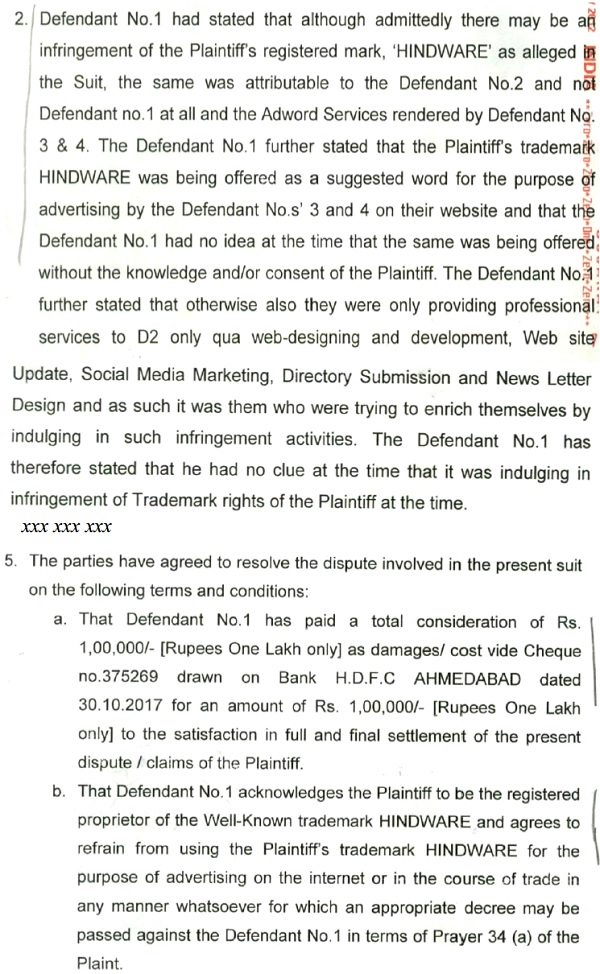
–
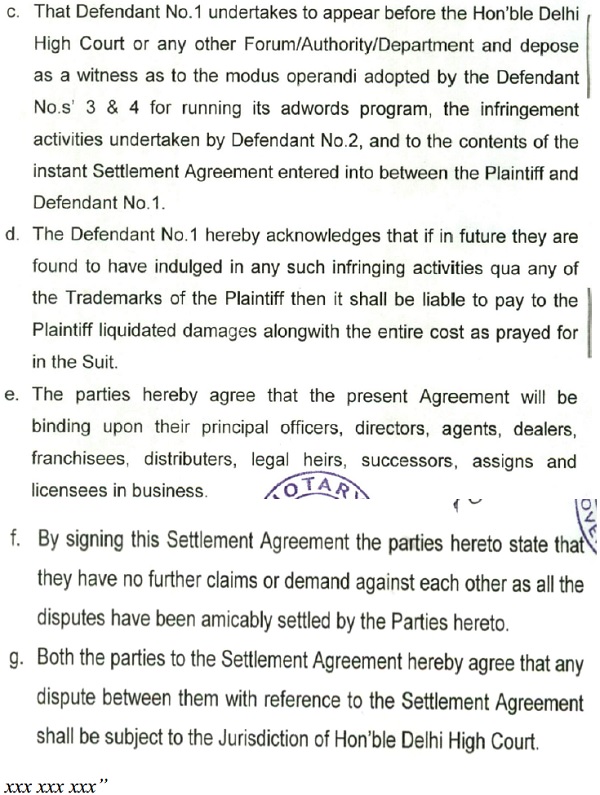
229. This Court has perused the Settlement Agreement between the plaintiff and defendant no. 1 in CS (COMM) 592/2017 and finds no impediment in decreeing the suit, in terms thereof. The parties are held bound by the terms of the Settlement Agreement and shall not raise any further claims or demands against each other qua the dispute, subject matter of the present suit.
RELIEF:
230. A decree is accordingly passed in both the suits in favour of the plaintiff and against the defendants in the following terms:
i. Permanent injunction restraining the defendants, i.e., Google LLC and Google India from using the mark/name ‘HINDWARE’ or ‘HINDWARE SANITARYWARE’, ‘HINDWARE SANITARY’ or ‘HINDWARE SANITARYWARE INDIA’ or any combination thereof, of the plaintiff either as part of advertising keywords, AdWords or in any manner whatsoever, amounting to infringement.
ii. Nominal damages to the extent of Rs. 30,00,000/- (Rupees Thirty Lacs only) payable jointly and severally by Google LLC and Google India, to the plaintiff.
iii. Actual costs payable jointly and severally by Google LLC/Google India.
231. Suit is further decreed in favour of the plaintiff and against defendant no. 1, i.e., Omkara Infoweb in CS (COMM) 592/2017, in terms of Settlement Agreement dated 08th November, 2017 between the plaintiff and Omkara Infoweb, which shall form part of the decree.
232. Let decree sheet be drawn up accordingly.
233. The present suits, along with pending applications, stand disposed of in the aforesaid terms.
Notes:
1 2023 SCC OnLine Del 4809
2 2023 SCC OnLine Del 7965
3 2023 SCC OnLine Del 5523
4 2023 SCC OnLine Del 4809
5 2023 SCC OnLine Del 7965
6 2023 SCC OnLine Del 5523
7 2018 SCC OnLine Del 10881
8 2024 SCC OnLine Mad 8314
9 2023 SCC OnLine Del 4818
10 2026 SCC OnLine Del 893
11 (2008) 1 SCC 618
12 (2005) 7 SCC 791
13 (2011) 11 SCC 786
14 2010 SCC OnLine Del 3806
15 2025 SCC OnLine SC 1701
16 2023 SCC OnLine Del 4809
17 2023 SCC OnLine Del 4809
18 2021 SCC OnLine Del 5767
19 2023 SCC OnLine Del 4809
20 2014 SCC OnLine Bom 4607
21 [2014] EWCA Civ 1403
22 [2012] Bus LR 1369
23 [2011] Bus LR 1
24 2023 SCC OnLine Del 4809
25 2025 SCC OnLine Del 3410
26 (2011) 9 SCC 1
27 2013 SCC OnLine Del 4159
28 2012 SCC OnLine Bom 2335
29 2023 SCC OnLine Del 4809
30 2023 SCC OnLine Del 4809
31 2023 SCC OnLine Del 7965
32 (2009) 5 SCC 694
33 2010 SCC OnLine Mad 4967
34 2012 SCC OnLine Bom 513
35 2017 SCC OnLine Kar 4478
36 (2024) 2 SCC 144
37 (1996) 6 SCC 660
38 (2006) 1 SCC 75
39 2020 SCC OnLine Del 454
40 2021 SCC OnLine Del 5767
41 2023 SCC OnLine Del 4809
42 2024 SCC OnLine Del 5594
43 2025 SCC OnLine Del 4401
44 2023 SCC OnLine Del 2252