Prabhulal Kalji Doshi Vs ITO (ITAT Mumbai)
In Prabhulal Kalji Doshi vs ITO (AY 2017-18), the ITAT Mumbai allowed the assessee’s appeal and quashed reassessment proceedings, holding that reopening under the new regime was legally invalid. The Tribunal first condoned a 79-day delay noting bona-fide reasons such as lack of awareness of proceedings and bank account attachment.
On merits, ITAT observed that income alleged to have escaped assessment was only ₹28.86 lakh and the notice u/s 148 was issued beyond three years from the end of AY 2017-18. Under the amended Sec 151, reassessment after three years is not permissible where escapement is below ₹50 lakh, and even otherwise sanction must be from higher specified authority. Since approval was taken only from the Principal Commissioner instead of the Principal Chief Commissioner/Chief Commissioner, the jurisdictional condition failed.
Accordingly, the reassessment notice and entire proceedings were quashed, and issues relating to Sec 68 cash deposit addition were treated as academic.
FULL TEXT OF THE ORDER OF ITAT MUMBAI
The present appeal filed by the assessee arises out of the order dated 06/06/2025 passed by the NFAC, Delhi [hereinafter the “Ld.CIT(A)”] for A.Y. 2017-18 on following grounds of appeal:-
“1. The Ld CIT(A) failed to consider the fact that original assessment was completed u/s 143(3) of the Act vide order dt. 18.12.2019 wherein the issue of cash deposited during demonetisation was considered, therefore reasons recorded for reopening is factually incorrect and reopened on incorrect facts, therefore reopening is bad in law.
2. The Id CIT (A) failed to appreciate that the JAO have no jurisdiction to issue notice u/s 148 of the Act dated 28/07/2022 and pass order u/s 148A(d) dated 28/07/2022 as after 29/03/2022 same can be done in a faceless manner, therefore the reassessment proceedings is bad in law.
3. The Id CIT(A) failed to appreciate that the AO issued reopening notice u/s 148 on 28/07/2022, approval was required to be taken as per provisions of amended section 151 of the Act from Principal Chief Commissioner or Principal Director General or Chief Commissioner or Director General, however approval is from PCIT. The approval is not in accordance with law, therefore liable to be quashed.
4. The Id CIT (A) failed to appreciate that the reopening of assessment vide notice u/s. 148 of the Act dated 28/07/2022 is after expiry of three years from the end of the Assessment Year: 2017-18 and the income escapement is below 50 lacs, i.e. Rs.28,86,000/-, therefore reopening is bad in law.
II. Addition u/s 68 of Rs. 28,86,000/-:
5. The Id. CIT (A) erred in confirming the addition made by AO of Rs.28,86,000/- in the total income of the assesse as unexplained cash credit u/s 68 of the Act without considering the submission and documents filed by the appellant wherein the assessee had explained the source of deposit along with relevant evidence, therefore the addition of Rs.28,86,000/-u/s 68 of the Act not justified.
6. The Ld. CIT(A) erred in confirming addition of Rs. 28,86,000/- treating the same as unexplained cash credit, without considering zerox copy of pay-in-slips / bank certificate as evidences for cash deposited during demonetisation period especially when no Rs. 500 cash was deposited after 03.12.2016.
7. The Assessee craves leave to add, alter modify or delete one or more ground before or at the time of hearing of Appeal.”
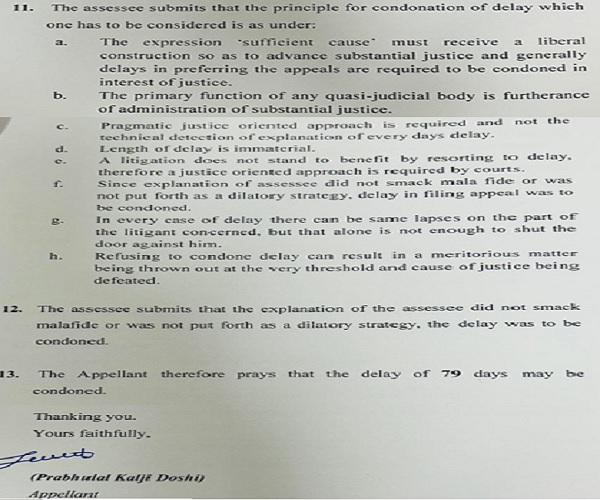
2. At the outset, Ld. AR submitted that, there is a delay of 79 days in filing the present appeal before this Tribunal. Assessee has filed an application dated 17/11/2025 seeking condonation of delay wherein it is stated as under:-
***This space is left blank intentionally. P.t.o.***
PRABHULAL KALJI DOSH1
Room No. 65, 1st PIr.. Moti Mention, 511‘ Khetwadi Lane, Khetwadi, Mumbai 400004
Date: 17/11/2025
To,
The Assistant Registrar,
ITAT, Mumbai
Ref: PRABHULAL KALJI DOSHI
Assessment Year: 2017 – 18
Sub: Prayer for Condonation of delay of 79 days.
Respected Sir,
1. The Appellant wish to file an appeal before ITAT, against the order passed u/s 250 of the Income Tax Act, 1961 for AY: 2017-18 by the National Faceless Appeal Centre (NFAC) dated 06/06/2025.
2. The CIT(A) Order passed and uploaded on portal on 06/06/2025 and accordingly the last day for filing an appeal before CIT(A) was 31/08/2025. However the appeal was delayed and filed on 17/11/2025. Thus there is a delay of 79 days.
3. The Assessee is Individual, having educational qualification upto Class VII and he is completely unaware of the tax legal proceeding. The assessee relied on his Chartered Accountant Mr. Sumit Mishra for the appellate proceeding. The Assessee missed/ overlook the notices sent by the NFAC on email and the Order passed by the NFAC dated 06/06/2025.
4. The Assessee submits that the account maintained with RMGB Bank had been attached by Income Tax Department on 07-10-2025, thereafter Assessee rushed to his CA Shri Sumit Mishra for Release of his Bank Account along with recovery notice obtained from hank. Then, the said CA checked on the Portal the status of appeal and found out that Order had already been passed by NFAC on 06-06-2025.
5. The Assessee was in rush to get his bank account released as it was affecting his business operations. So, he has paid Outstanding demand for AY 2011-12 along with interest (Rs. 11,55,400) and paid 20% amount of Outstanding demand for AY 2017-18 (Rs. 7,75,682).
6. The Assessee further submits that on 16-10-2025, assessee was able to get his bank account released, as it took time to arrange funds for payment of outstanding demands. After that assessee on advice of the CA decided for filing appeal before Hon’ble ITAT. The papers and file were forwarded to the counsel for drafting and filing the appeal before Hon ITAT.
7. It is submitted that there was no malafide intention to delay the filing of the appeal. The assessee further submits that he has good case on merits and if an opportunity is granted to the assessee the correct tax shall be worked out.
8. It is further submitted that the delay was neither deliberate nor with any malicious intention. The default, if any, was due to the bonafide reason and circumstances beyond the control of the Appellant.
9. In view of the above facts, the applicant submits that the delay was due to bonafide reasons. In Collector, Land Acquisition vs. Mst. Katiji & Ors. (1987) 167 ITR 471 (SC) — it was held that “Sufficient cause” for the purpose of condonation of delay should be interpreted with a view to do even-handed justice on merits in preference to approach which scuttles a decision on merits. The expressions ‘Sufficient cause” employed by the legislature is adequately elastic to enable the Courts to apply the law in a meaningful manner which subserves the ends of justice.
10. Your honour’s kind attention is also invited to the following observations of their Lordships of the Supreme Court in the case of State of Haryana vs. Chandra Mani ct Others (1996 (2) SCALE 820):
“•…………….. In Ramanlal Motilal & Chhotelal vs. Rewa Coalfields Ltd. [(1962) 2 SCR 762], it was laid down that in showing sufficient cause to condone the delay, it is not necessary that the applicant / appellant has to explain whole of the period between the date of the judgment till the date of filing the appeal. It is sufficient that the applicant/appellant would explain the delay caused by the period between the last of the dates of limitation and the date on which the appeal/application is actually filed.”
“………………. The expression –sufficient cause” should receive a liberal construction. In Inder Singh vs. Kanshi Ram [AIR 1917 PC 156] it was observed that true guide for a court to exercise the discretion under section 5 is whether the appellant acted with reasonable diligence in prosecuting the appeal. In Shakuntala Devi Jain v. Kuntal Kumari & Ors. [(1969 1 SCR 1006], a Bench of three Judges had held that unless want of bona fides of such inaction or negligence as would deprive a part of the protection of section 5 is proved, the application must not be thrown out or any delay cannot be refused to be condoned.”