In re Goldie Ashokbhai Shah (GST AAR Gujarat)
M/s Goldie Ashokbhai Shah, a GST-registered individual, approached the Gujarat Authority for Advance Ruling (AAR) seeking clarification on the GST applicability for leasing a co-owned property to M/s Ashimara Living Private Limited, an unregistered company. The property, a residential building in Ahmedabad, was proposed to be leased for nine years to be used by the lessee to provide long-term residential accommodation to students and working professionals. The applicant’s query focused on whether the lease service qualifies for exemption under Entry No. 12 of Notification No. 12/2017-CT (R) (Rate), which provides GST exemption for renting services of residential dwellings, subject to conditions including that the dwelling is used as a residence and not rented to a registered person.
The applicant argued that all conditions for exemption were met. They emphasized that the property is rented, constitutes a residential dwelling, and the lessee is unregistered. They contended that the property’s use by students and working professionals qualifies as residential accommodation, citing Service Tax precedents and judicial interpretations, including the Delhi High Court ruling in P.N. Karkhanis, the Karnataka High Court ruling in Taghar Vasudeva Ambrish, and the Madras High Court ruling in Thai Mookambikaa Ladies Hostel. The applicant clarified that the exemption’s exclusion of student residences or hostels does not apply because the applicant is not directly providing accommodation services but only leasing the property.
The Department submitted that the exemption was not applicable. The department noted that the lessee intended to operate commercial accommodation services for students and working professionals, not use the property as a residence for itself. It emphasized that the property was classified as commercial, not residential, and that services provided by the applicant are for commercial purposes. As the leasing activity constitutes renting of immovable property for commercial use, it falls under GST liability at the rate of 18%, and the GST-registered applicant is liable to pay tax under the forward charge mechanism.
The AAR analyzed the issue, considering both the applicant’s and the department’s submissions. It identified two distinct services: (i) the applicant’s provision of the property to the lessee, and (ii) the lessee’s provision of residential accommodation to students and working professionals. The ruling is concerned only with the first service. While the applicant satisfied four of six exemption conditions, the key issues were the classification of the property as a residential dwelling and whether it was rented for use as a residence.
The AAR observed that the property is commercially classified, contrasting with properties in precedents relied upon by the applicant. In P.N. Karkhanis, the property was residential and partially used for office purposes. In Taghar Vasudeva Ambrish, the property was residential under the Revised Master Plan 2015 of Bangalore, and a Supreme Court Special Leave Petition (SLP) had been filed, placing the High Court ruling in jeopardy. In Thai Mookambikaa Ladies Hostel, the petitioners directly provided accommodation, unlike the applicant who is only leasing the property. The AAR noted that legislative amendments to Entry No. 12 of Notification No. 12/2017-CT (R) clarified that exemptions apply only to properties used as residences by the registered person or in personal capacity, not for commercial purposes.
Ruling:
1. The service of renting the residential building to the lessee, an unregistered person, for providing residential accommodation to students and working professionals, is not exempt under Entry No. 12 of Notification No. 12/2017-CT (R)
2. The applicant is liable to pay GST at 18% on the lease service as per Notification No. 11/2017-Central Tax (Rate) since the property is used for commercial purposes by the lessee.
FULL TEXT OF THE ORDER OF AUTHORITY FOR ADVANCE RULING, GUJARAT
M/s. Goldie Ashokbhai Shah, 26, Kalhaar, Shilaj Road, Kalol, Gandhinagar, Gujarat-382721 [for short — ‘applicantl is registered under GST and their GSTIN is 24ACCPS5059D1ZQ.
2. The applicant is one of the seven owners of a residential building located at Final Plot No. 135 of Town Planning Scheme No. 03, Mouje Village Shekhpur-Khanpur, Ashram Road, Navrangpura, Taluka Sabarmati, Ahmedabad-3 (Memnagar), Ahmedabad, Gujarat-380009 (the ‘property’ for short). The applicant along with the owners of the property has agreed to lease its residential building to M/s Ashimara Living Private Limited (hereinafter referred to as the Lessee’), a company incorporated under the Companies Act, 2013, which is not registered under the GST regime, for a term of nine years, where the lessee will used the said property to further provide long-term residential accommodation.
3. The agreed key terms of the lease agreement relevant for the the present application are summarized as under: –
a. The Lessee will use the premise for providing long-term residential accommodation to the students and working professionals (hereinafter referred to as “the Residents”), and it intends to run housing facilities for the Residents from the said property.
b. The Lessee has requested the Applicant to grant on lease the residential building for the purpose of setting up and running of housing facilities for the Residents.
c. The Lease of the said residential building shall remain in force for a term of 9 years unless terminated.
d. In consideration, the Lessee shall pay the lease rent of Rs. 12,00,000/- per month (to be distributed among all seven owners of the property as per their share in the property), which shall be net of applicable direct and indirect taxes, if applicable, i.e., GST and/or any other applicable or increment in such taxes.
e. Use of said premises & amenities: The Lessee shall use the said premises for providing the long-term residential accommodation to the Residents. The Lessee shall use the said premises with adequate care and caution and maintain the same in good condition and shall restore the same to the original condition at its own cost and expense.
4. The applicant has also narrated the legal provisions and their legislative history as under: –
i. The Central Government, vide S. No. 12 of Notification No. 12/2017-CT (R) dtd. 28.06.2017 (hereinafter referred to as “the Exemption Notification”) as amended from time to time, has granted exemption from payment of Goods & Services Tax (GST) to those renting services, which are provided with respect to residential dwelling for use as residence except where the residential dwelling is rented to a registered person.
ii. No. 12 of the Exemption Notification has undergone multiple changes since the inception of GST regime, which are summed up as below aim clear understanding of the law positioning —
W.c.f. 01 July 2017 till 17 July 2022
| Si. No. | Chapter, Section, Heading, Group or Service Code (Tariff) |
Description of Services | Rate (per cent) | Condition |
|---|---|---|---|---|
| (1) | (2) | (3) | (4) | (5) |
| 12 | Heading 9963 or Heading 9972 | Services by way of renting of residential dwelling for use as residence |
Nil | Nil |
W.c.f. 18 July 2022 till 31 December 2022
| SI. No. | Chapter, Section, Heading, Group or Service Code (Tariff) |
Description of Services
(3) |
Rate (per
cent) |
Condition |
| (1) | (2) | (4) | (5) | |
| 12 | Heading 9963 or Heading 9972 | Services by way of renting of residential dwelling for use as residence except where the residential dwelling is rented to a registered person |
Nil | Nil |
W.c.f. 01 January 2023 to 14 July 2024
| SI. No. | Chapter, Section, Heading, Group or Service Code (Tariff) | Description of Services | Rate (per cent) | Condition |
|---|---|---|---|---|
| (1) | (2) | (3) | (4) | – |
| 12 | Heading 9963 or Heading 9972 | Services by way of renting of residential dwelling for use as residence except where the residential dwelling is rented to a registered person Explanation 1 – For the purpose of exemption under this entry, thisentry shall cover services by way of renting of residential dwelling to a registered person where,-i. the registered person is proprietor of a proprietorship concern and rents the residential dwelling in his personal capacity for use as his own residence; andii. such renting is on his own account and not that of the proprietorship concern |
Nil | (5) Nil |
W.e.f. 15 July 2024 till date
| SI. No | Chapter, Section,
Heading, Group or |
Description of Services | Rate (per
cent) |
Condition |
|---|---|---|---|---|
| (1) | (2) | (3) | (4) | (5) |
| 12 | pleading 9972 | Services by way of
renting of residential dwelling for use as Explanation 1 – For the purpose of exemption under this entry, this (i) the registered person is proprietor of aproprietorship concern and rents the residential dwelling in his personal capacity for use as his own residence; and(ii) such renting is on his own account and not that of the proprietorship concern Explanation 2.- Nothing contained in this entry shall apply to- (a)accommodation services for students in student residences; (b) accommodation services provided by Hostels, Camps, Paying Guest accommodations and the like. 12A Heading 9963 Supply of Nil Nil |
Nil | Nil
,…, p:‘,:: –it – |
5. In view of the above backdrop, the applicant has sought an advance ru I i ng on the following question: –
1. Whether the service of renting of Residential building provided by the Applicant to the Lessee, an unregistered person, for use as residential accommodation for the students and working professionals (“the Residents”), is exempt as per S. No. 12 of the Exemption Notification No. 12/2017 Central Tax (Rate) dated 28 June 2017 and corresponding exemption notification issued under the Gujarat State GST Act?
2. If the answer to above question is in negative, who shall be the person liable to pay GST on the impugned service of renting of residential dwelling and what shall be the applicable rate of GST thereupon?
6. The applicant’s interpretation of law is as under: –
(i) On a bare reading of entry No. 12 of Notification No. 12/2017-CT (R) dtd. 28.06.2017 ; it can be inferred that exemption is granted subject to following conditions being cumulatively fulfilled —
a. It must be a service of renting.
b. The property so rented / leased out must be a residential dwelling.
c. Such residential dwelling must be given for use as a residence.
d. Such renting service must not be provided to a registered person under GST law.
(c) The accommodation services are not for students in student residences; and
(f) The accommodation services are not provided by hostels, camps, paying guest accommodation and the like.
(ii) As regards the first condition, it is an undisputable fact that services of renting have been provided by the applicant to the Lessee in relation to property under consideration and are covered under the definition of supply as contained in Section 7 read with Para 5(a) of Schedule II of the CGST Act.
(iii) As regards the second condition that the property so rented must be a residential dwelling, it is to be noted that definition of ‘residential dwelling’ has not been provided in the GST law. Under erstwhile Service tax law, ‘residential dwelling’ was defined in Para 4.13.1 of Taxation of Services: An Education Guide dated 20 June 2012 (hereinafter referred to as “Education Guide”) which was issued by CBIC containing clarification on many aspects. It is provided in Education Guide that in normal trade parlance, ‘residential dwelling’ means any residential accommodatioriliter is different from hotel, motel, inn, guest house, etc. which are meant for temporary stays. It can be deduced from this clarification that any residential accommodation which is used for long term stays can be referred to as ‘residential dwelling’ for the purposes of Service tax. In the absence of any other definition in the GST Law, the same meaning of `residential dwelling” can be adopted under GST also. In addition, as per the judicial ruling of Hon’ble Delhi High Court in the matter of P.N. Karkhanis-MANU/DE/0238/1976, for determining whether a property is residential accommodation, it must have been constructed as a residence.
iv. Reliance is also placed on the judgement of the High Court of Bombay in the case of Bandit Ravji Nikam Vs Acharyaratna Deshbhushan-2003(3) Born CR 210, wherein the High Court has discussed the difference between hotel and hostels providing accommodation and the latter is adequately covered in residential accommodation.
v. Regarding the third condition that the residential dwelling must be given on rent ‘for use as a residence’, the ultimate usage of the property rented out by the applicant in the hands of the lessee must be seen. The meaning of residence as laid down by various Courts is that residence generally means where person resides for a considerable long time; it is an act or fact of abiding or dwelling in a place for some time; it means a place where a person permanently resides and not a place where he casually visits or go for short visits. To sum up, what is important is the person must actually stay at that place and that too for a considerable amount of time depicting permanency and not just casual visits. Applying these inferences to the matter in hand, it is an undisputed fact that the paying guest accommodation run by the Lessee is used for dwelling/staying by individuals (students and/or working professionals). Those individuals actually reside in the property rented out to by the Applicant to Lessee. Legislative intent under Service tax and GST has always been to grant exemption to those individuals/entities who are providing residential accommodation services to other persons in order to promote the renting of premises so that every person gets a house to live in. However, hotels, motels, inn, guest house, etc. have been ketit the ambit of such exemption entry since they provide only umporary accommodation, like overnight stay or stay for a few days.
vi. Further, reliance is also placed upon the judgment passed in Taghar Vasudeva Ambrish v. Appellate Authority for Advance Ruling reported in MANU/KA/0327/2022, wherein, the Hon’ble Division Bench of Karnataka High Court had elaborately discussed a like issue which came up for consideration and held that the benefit of exemption notification cannot be denied. Similar view was taken by the I lon’ble Madras High Court in Thai Mookambikaa Ladies Hostel Vs U0/-2024 (84) GSTL 209 (Mad) while relying on the judgement in Taghar Vasudeva Ambrish.
vii. Regarding the fourth condition that the exemption is not available if the residential dwelling is rented to a registered person, it has already been submitted that the lessee to whom the residential building will be given on rent by the applicant is not registered under the GST regime.
viii. Regarding the last condition, that the exemption is not allowed to (a) accommodation services for students in student residences and (b) accommodation services provided by Hostels, camps, paying guest accommodation and the like, it is to note that the applicant is not providing any kind of accommodation services to the lessee and rather, the applicant is renting the said property to the Lessee and lessee is providing accommodation services to its customers (Students and or working professionals).
ix. The legislative intent to the same effect can be seen from the fact that Explanation 2 containing said condition (Sixth condition) was inserted in Entry No. 12 w.e.f. 15 July 2024 when HSN code for Entry No. 12 was changed from erstwhile “Heading 9963 or Heading 9972” to “Heading 9972” only, thereby, omitting Heading 9963 from Entry No. 12. Parallelly, with effect from the same date, i.e., w.e.f. 15 July 2024, Entry No. 12A was inserted in Exemption Notification and the same is applicable to I leading 9963. Thus, from the series of amendments so carried out, it can be clearly inferred that where earlier services covered under both Chapter Heading 9963 and 9972 were covered under S. No. 12 of Exemption Notification, w.e.f. 15 July 2024, only the services falling under Chapter Heading 9972 are covered under this entry while other services falling under Chapter 9963 were exempted vide a separate exemption entry no. 12A. Heading No. 9963 is for “Accommodation, Food & beverage services” while Heading No. 9972 is for “Rental or leasing services involving own or leased non-residential property”. From the conjoint perusal of chapter heading & facts of the present case, it can be seen that there are two activities involved in present case —
i. Services provided by the Applicant to lessee which is renting of immovable property in nature and is classified under Heading 9972; and,
ii. Services provided by the lessee to its customers (students and/or working professionals) which is accommodation services in student residences and is classified under Heading 9963.
However, since the present ruling is being sought for first leg of service, i.e., from Applicant to the lessee which is covered under I leading 9972, in the Applicant’s interpretation of law, impugned services are not falling under the scope of services listed in Explanation 2 of the Entry No. 12 as those kind of accommodation services are not being provided by the Applicant but are being provided by the lessee where Applicant is providing only renting of immovable property services. Hence, in view of above submissions, the last condition for claiming exemption under S. No. 12 of Exemption Notification also stands fulfilled.
7. Personal hearing was granted on 16.10.2025 wherein Shri Atul Gupta, authorised representative, appeared on behalf of the applicant and the Superintendent, CGST, Kalol appeared on behalf of the Department. Shri Gupta reiterated the facts & grounds as stated in the application. He also relied upon the judgement of Hon’ble Division Bench of Karnataka Fligh Court in Taghar Vasudeva Ambrish v. Appellate Authority for Advance Ruling reported in MANU/KA/0327/2022. He also submitted written submissions wherein they have submitted proof in the form of snapshots of the GST portal to substantiate that M/s Ashimara Living Private Limited, having PAN ABBCA7486K, is not registered with GST. A draft agreement proposed to be entered into by the applicant and M/s Ashimara Living Private Limited was also enclosed.
8. The Jurisdiction Officer has submitted that Entry No. 12 of Notification No. 12/2017 — Central Tax (Rate) dated 28 June 2017, is available only the property rented is a residential dwelling and it is used as a residence by In the present case, the unregistered tenant is taking the property on rent for the purpose of accommodation services/facility to students and working professionals. The Tenant is not using the property as his own residence, but is taking the same on rent for conducting a commercial activity of providing accommodation to others for consideration. Further, in addition to accommodation, the tenant may also provide other facilities such as meals/laundry/wi-fi etc. The tenant, thus, is specifically planning to use the building for commercial activity/business. Therefore, the use of the property is commercial in nature and not as residence. Thus, the exemption under the said entry is not applicable in this case. The service of renting of the said premiss amounts to ‘renting of immovable property for commercial use’, which is a taxable supply under GST, attracting tax at the rate of 18%, as may be amended from time to time. Since the supplier of the service i.e. the landlord, is a registered person, the liability to pay GST arises on him under the forward charge mechanism.
Discussion and findings
9. At the outset, we would like to state that the provisions of both the CGS’I’ Act and the GGST Act are the same, except for certain provisions. Therefore, unless a mention is specifically made to such dissimilar provisions, a reference to the CGST Act would also mean a reference to the same provisions under the GGST Act.
10. We have considered the submissions made by the applicant in their application for advance ruling as well as the submissions made both oral and written during the course of personal hearing. We have also considered the issue involved, the relevant facts & the applicant’s submission/interpretation of law in respect of question on which the advance ruling is sought.
11. We find that applicant has leased a property co-owned by 6 other owners to M/s Ashmira Living Private Limited, which is not registered under GST. As per the agreement, which is to be entered between the applicant and the lessee, the lessee would use the property for providing long-term residential accommodation to the students and working professionals. The applicant wants to know whether the use of the property as residential accommodation to the students and working professionals is exempt as per Entry No. 12 of Notification No. 12/2017-CT (R) dtd. 28.06.2017 and if no, who would be liable to pay GST on the impugned service of renting of residential dwelling and the applicable rate of GST.
12. We find that , that there are two activities involved in present case —
i. Services provided by the Applicant to lessee
ii. Services provided by the lessee to its customers (students and/or working professionals).
The present ruling is being sought for the first leg of service i.e. services provided by the Applicant to lessee. The applicant’s contention is that since they have fulfilled all the conditions of the exemption notification, they are eligible for the benefit of exemption provided by the notification. We find that out of the six conditions which have been mentioned in para 6 (i), supra, we fairly agree with the reasoning given by the applicant for the fulfilment of four conditions. We are mainly concerned with the Applicant’s interpretation of the second condition i.e. the property so rented / leased out must be a residential dwelling, and the third condition i.e such residential dwelling must be given for use as a residence, which we feel is not correct.
13. The applicant’s main focus to interpret their property as a residential dwelling/ residential accommodation is the dictionary meaning as well as some of the case laws. We are not going into each of these case laws but focus on some of the judgements, which we feel have a bearing on this issue. The said judgements are the judgement of the Delhi High Court in the case of P.N.Karkhanis Vs P.N.Chopra-Manu/DE/0238/1976, the Karnataka High Court judgement in the case of Taghar Vasudeva Ambrish v. Appellate Authority for Advance Ruling-MANUIKA/0327 /2022 and the Madras High Court judgement in the case of Thai Mookambikaa Ladies Hostel Vs U0/-2024 (84) GSTL 209 (Mad).
14. We find that in P.N.Karkhanis case, the High Court was dealing with the eviction notice issued under the Delhi Rent Control Act to the petitioner. One of the pleas taken before the High Court was that the premises was let out for residence but was being used for office-cum-residential purpose by the petitioner. The High Court interpreted the “residential accommodation” used in section 14A (1) of the Delhi Rent Control (Amendment)Act, 1976 and held that even if a part of the premises was used as an office, it would not convert a residential accommodation into a nonresidential accommodation. We do not understand as to how this interpretation of residential accommodation is of help to the applicant as we find that the property belonging to the applicant is a commercial property. We find suppck in this by going through the draft lease agreement submitted by the applicant themselves during the course of hearing. The relevant para is reproduced below: –
“WHEREAS:
A. The Lessors is the sole and absolute owner of the Commercial Building, being absolutely seized and possessed, of all that piece or parcel of land and the building more particularly described in the Schedule A hereto referred to as “Said Premises or Premises”. The Lessor represents to the Lessee that the Lessor are sole and absolute owner of the said premises and no one else has any right, title, interest or share therein.
B. *
[Emphasis supplied]
15. From the above, it is clear that the property in question is a Commercial property and must have been registered as such, while the property in question in P .N . Karkhanis case.is a residential property. We now move on to the other two High Court judgements i.e Taghar Vasudeva Ambrish and Thai Mookambikaa Ladies Hostel. We find that though the facts in Taghar Vasudeva Ambrish are almost similar, there is vital fact which is different from the applicant’s case. The relevant para of Taghar Vasudeva Ambrish, is reproduced below: –
“13. It is noteworthy that the accommodation which is used for the purposes of the hostel of students and working women is classified in residential category in the Revised Master Plan 2015 of Bangalore City.
* * * * * *
Thus, while the applicant’s property is classified as a commercial property, the accommodation in Taghar Vasudeva Ambrish was classified in residential category by the Bangalore City. Therefore, one of the factors which influenced the High Court was that accommodation was classified in residential category. Secondly, the Department has filed a Special Leave Petition (SLP Diary No. 29980/2022) before the Hon’ble Supreme Court against the judgement of the High Court and Leave has been granted by the Supreme Court vide order dtd. 24.11.2023. We find that the Supreme Court in Kunhayammed Vs State of Kerala- 2001 (129) E.L.T. 11 (S.C.) has observed that once leave to appeal has been granted, the finality of the judgement, decree or order appealed against is put in jeopardy though it continues to be binding and effective between Ihe parties, unless it is stayed or nullified.
Similarly, in Union of India Vs West Coast Paper Mills Ltd.- 2004 (164) E.L.T. 375 (S.C.)- the Supreme Court observed that
“38. * * once an appeal is filed before this Court and the same is entertained, the judgment of the High Court or the Tribunal is in jeopardy. The subject matter of the lis unless determined by the last Court, cannot be said to have attained finality. Grant of stay of operation of the judgment may not be of much relevance once this Court grants special leave and decides to hear the matter on merit.”
Therefore, the leave to appeal having been granted by the Supreme Court against the judgement of the High Court in Taghar Vasudeva Ambrish, the judgement of the High Court is in jeopardy and cannot be said to have attained finality.
16. In Thai Mookambikaa Ladies Hostel’s case, the High Court of Madras was dealing with the case where the petitioners having obtained licence, were running a private ladies hostel by providing residential accommodation and were seeking exemption under Entry No. 12 of Notification No. 12/2017-CT (R) dtd. 28.06.2017 In the instant case, the applicant is not providing residential accommodation to the students themselves but were leasing out their commercial property to another entity, who in turn were using the same for providing residential accommodation to the students/working professionals. Thus, the facts of both the cases are different. Further, the Court has also relied upon the judgement of Taghar Vasudeva Ambrish, whose precedent value, we have already discussed earlier. It would not be out of place to mention here that a writ appeal has already been filed by the Department against the judgement of the High Court in Thai Mookambikaa Ladies Hostel [Filing No.-WA-72393/2025].
17. We would further like to discuss as to why the judgement of Taghar Vasudeva Ambrish would also not apply, because the High Court was dealing with Entry No. 13 of Notification No. 9/2017-Integrated Tax (Rate), dated 28-6-2017, which existed prior to 17 July 2022 (which is identical to Entry No.12 of Notification No. 12/2017-CT (R) dtd. 28.06.2017 ) and was worded as under: –
| Sl. No. | Chapter, Section,
Heading, Group or |
Description of Services | Rate (per cent) | Condition |
|---|---|---|---|---|
| (1) | (2) | (3) | (4) | (5) |
| 13 | Heading 9963 Heading 9972 or | Services renting dwelling residence by of for way of residential use as | Nil | Nil |
The High Court was only dealing the description of services “Services by way of renting of residential dwelling for use as residence” and therefore held that the ultimate usage of the property rented out by the applicant in the hands of the lessee must be seen. We find that this description of service has undergone amendments a number of times in keeping with the intention of the legislature. The objective of the Government becomes clear with the subsequent amendments made in the Notification. Vide Notification No. 04/2022-CT (Rate) dated 13.07.2022 , the following amendment was made-
(b) against serial number 12, in column (3), after the words “as residence”, the following words “except where the residential dwelling is rented to registered person” shall be inserted.
After this amendment, the relevant ‘Description of Services’ is — “Services by way of renting of residential dwelling for use as residence except where the residential dwelling is rented to registered person “. Thus, when a registered person rents the property to a registered person, the exemption is not available. Further amendments by way of Explanations clarify that the exemption would be available only if the registered person uses it as his own residence and also has not rented in the capacity of a proprietorship firm. These amendments make it clear that the intention of the Government has been to exempt only those supplies of renting of immovable property which are used as residences in the personal capacity and are not used for commercial purposes, be it by a registered person or a non registered person. We find that this is not the case for the applicant, as the lessee was not using the said property for their own residential purpose but were using it for commercial purposes i.e. providing residential accommodation to students/working professionals. Therefore, we hold that the applicant is not eligible for exemption under Entry No. 12 of Notification No. 12/2017-CT (R) dtd. 28.06.2017
18. We now move on to the second question of the applicant i.e. who shall be the
person liable to pay GST on the impugned service of renting of residential dwelling and the applicable rate of GST. We find that the applicant, in Para 53 of Annexure-III of their application has submitted that there are two activities involved in the present case: –
i. Services provided by the Applicant to lessee which is renting of immovable property in nature and is classified under Heading 9972; and,
ii. Services provided by the lessee to its customers (students and/or working professionals) which is accommodation services in student residences and is classified under Heading 9963.
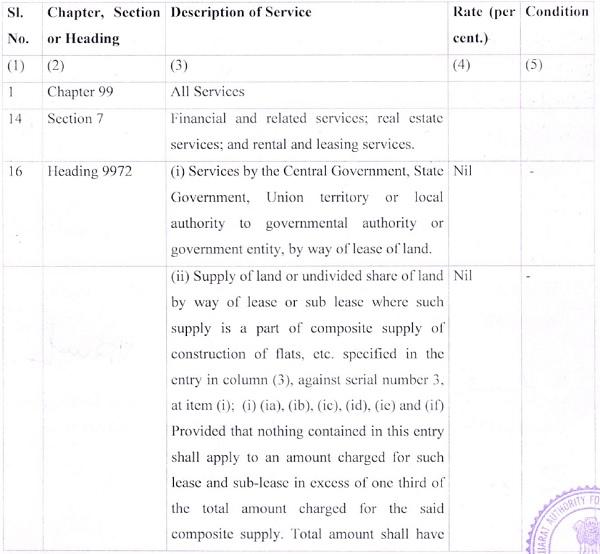
Thus, the applicant has submitted that the services provided by them to the lessee is renting of immovable property and is classified under 9972. We find that Heading 9972 deals with Real Estate Services and SAC 997211 covers Rental or leasing services involving own or leased residential property.Notification No. 11/2017-Central Tax (Rate), as amended prescribes the rate of duty for intra-state supply of services and the relevant entry for real estate services is as under: –
–

We find from the above that the services provided by the applicant would more aptly fall under SI. No. (iii) of Entry No. 16 ofNotification 11/2017-CGST(R) dtd. 28.06.2017and would attract GST @ 18 %. Since, the applicant is registered under GST, they would be liable to pay tax on the supply made by them.
19. In view of the foregoing, we rule as under: –
RULING
Q.1 Whether the service of renting of Residential building provided by the Applicant to the Lessee; an unregistered person, for use as residential accommodation for the students and working professionals (“the Residents ‘), is exempt as per S. No. 12 of the Exemption Notification No. 12/2017-CT (R) dtd. 28.06.2017 and corresponding exemption notification issued under the Gujarat State GST Act?
Ans: No
Q.2 If the answer to above question is in negative, who shall be the person liable to pay GST on the impugned service of renting of residential dwelling and what shall be the applicable rate of GST thereupon?
Ans: The applicant would be liable to pay GST on the on the impugned service of renting of residential dwelling to the lessee and the applicable rate of GST would be 18%, in view of Notification No. 11/2017-CGST(R) dtd. 28.06.2017, as amended.