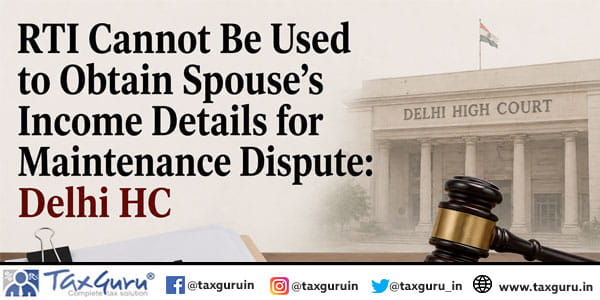
Explore the power of transparency with the RTI Act. Learn how the Right to Information Act empowers citizens to access government information for a more accountable democracy.
Corporate Law : RTI Act transformed governance by allowing citizens to access official records, enhancing transparency, accountability, and public...
Corporate Law : The issue concerns denial of policy documents by invoking Section 8(1)(g) without justification. It is argued that such a non-spea...
Corporate Law : The Commission found prima facie human rights violations where students face dangerous daily travel due to lack of roads and trans...
Corporate Law : The case questions how data protection rules can operate when the parent Act is admittedly unenforced. It underscores that subordi...
Corporate Law : The statutory regulator declined disclosure of a key committee report on foreign lawyers. The decision raises questions on transpa...
Corporate Law : A generalized denial without explanation was contested as contrary to Sections 3 and 7(1) of the RTI Act. The applicant emphasized...
Corporate Law : The appellate authority held that compliance certificates on eligibility and financial capacity contain sensitive commercial infor...
Corporate Law : IBBI denies RTI appeal seeking Resolution Professional's disciplinary reply, citing fiduciary relationship under Section 8(1)(e) o...
Corporate Law : The Insolvency and Bankruptcy Board of India's First Appellate Authority addressed an RTI appeal regarding delayed provision of tr...
Corporate Law : IBBI's First Appellate Authority dismisses Ravinder Aggarwal's RTI appeal seeking details on MSA Developers' resolution plan imple...
Corporate Law : Supreme Court ruled that the Chief Justice’s office falls under the RTI Act, affirming transparency while safeguarding judicial ...
Corporate Law : Madras High Court dismisses R. Vijayan's review petition seeking RTI compensation, finding no apparent error in prior ruling despi...
Corporate Law : The petitioner is a practicing Chartered Accountant, residing in New Delhi. His name was included in a list of “Undesirable Cont...
Corporate Law : Delhi High Court held that order passed by Central Information Commission directed disclosure of information which is entirely per...
Corporate Law : Orissa High Court rules against disclosing tax evasion petition outcome under RTI Act. Detailed judgment highlights legal reasonin...
Corporate Law : The issue was whether IBBI must provide data held by a regulated entity. The Authority held that RTI applies only to information h...
Corporate Law : The appeal found that the RTI response was delayed beyond statutory timelines. The key takeaway is that delay breaches RTI provisi...
Corporate Law : The appellate authority held that RTI applications cannot seek interpretations or clarifications on legal issues like treatment of...
Corporate Law : The issue concerns delayed response to an RTI application beyond the prescribed period. It was held that authorities must adhere t...
Corporate Law : The appellate authority held that public authorities under the RTI Act must only provide information already available in records....
The appellate authority held that information can be disclosed only if it is held or controlled by the public authority. As the requested 1986 committee report was not available with the Board, the RTI appeal was disposed of.
The IBBI First Appellate Authority held that information on admitted claims in a CIRP case was available online and need not be recompiled under RTI.
Information linked to verification of resolution plans was held exempt due to fiduciary relationship, reinforcing limits on RTI disclosures.
The appellate authority held that RTI cannot be used to seek confirmations or opinions. Information already available in the public domain need not be recompiled by the regulator.
The appellate authority held that information could not be disclosed since the subsidiary company was not admitted to insolvency proceedings. RTI access was limited to information held by the regulator.
The appellate authority held that compliance certificates on eligibility and financial capacity contain sensitive commercial information and are exempt from disclosure under the RTI Act.
The issue concerns denial of policy documents by invoking Section 8(1)(g) without justification. It is argued that such a non-speaking reply violates RTI obligations and warrants appellate scrutiny.
The Commission found prima facie human rights violations where students face dangerous daily travel due to lack of roads and transport. Authorities have been directed to inquire and report urgent remedial action within two weeks.
The case questions how data protection rules can operate when the parent Act is admittedly unenforced. It underscores that subordinate legislation cannot survive without statutory commencement.
The Appellate Authority held that the change in corporate status was made to implement a subsisting NCLAT stay. Since the relevant Change Request Form was already disclosed, no further information was required under the RTI Act.