
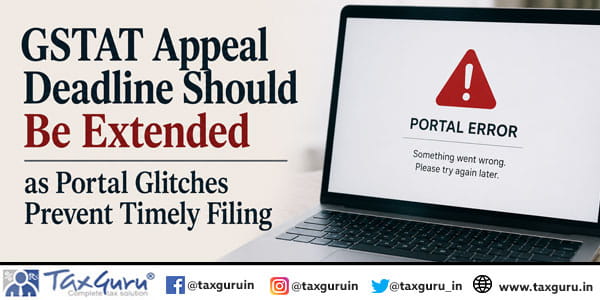
The Central Gujarat Chamber of Tax Consultants has submitted a representation to the Union Finance Minister and GST Council seeking extension of the statutory deadline for filing appeals before the GST Appellate Tribunal (GSTAT) from 30 June 2026 to 31 December 2026. The Chamber contends that widespread technical and operational issues on the GSTAT e-filing portal, including server failures, Aadhaar authentication problems, DSC registration errors, Bharatkosh payment failures, database synchronisation issues, restrictive document upload limits, incorrect fee computation, and unresolved grievances, have prevented taxpayers from filing appeals within the prescribed period. It also highlights procedural complexities in the appeal forms and checklist that increase the compliance burden. The representation states that the low number of appeals filed compared to the expected volume reflects systemic deficiencies rather than taxpayer inaction. It requests extension of the filing deadline, protection from recovery proceedings pending such extension, technical improvements to the portal, simplification of appeal procedures, and clarification of procedural requirements.
CENTRAL GUJARAT CHAMBER OF TAX CONSULTANTS
Together in Profession, Stronger in Service
Ref.: CGCTC/REP/2026-27/01 Date: 24.06.2026
To,
Smt. Nirmala Sitharaman,
Hon’ble Union Minister of Finance &
Chairperson, Goods and Services Tax Council,
Government of India, North Block,
New Delhi – 110 001.
Subject: Representation for extension, from 30.06.2026 to 31.12.2026, of the statutory cut-off date notified under Section 112(1) of the Central Goods and Services Tax Act, 2017 for filing of appeals before the Goods and Services Tax Appellate Tribunal — on account of persistent technical infirmities of the GSTAT e-filing portal and the consequent denial of the statutory right of appeal.
Hon’ble Madam,
At the outset, the Central Gujarat Chamber of Tax Consultants places on record its sincere appreciation of the Government and the GST Council for operationalising the Goods and Services Tax Appellate Tribunal — a long-awaited and significant step towards strengthening the GST dispute-resolution mechanism — and respectfully submits the present representation in the larger interest of the trade, industry and the professional fraternity.
Brief about the Chamber
The Central Gujarat Chamber of Tax Consultants (“the Chamber” / “CGCTC”) is a professional association of tax practitioners — Advocates, Chartered Accountants, Cost Accountants and certified Tax Practitioners — based at Vadodara and serving the Central Gujarat region. Founded on 18th June, 2011 and presently in its fifteenth year, the Chamber has, through its study circles, seminars and national conferences, consistently worked towards the dissemination of tax knowledge and the advancement of sound and accessible tax administration, and has been honoured with five National Awards of the All India Federation of Tax Practitioners for the Best One-Day / Two-Day National Tax Conference. A substantial body of the Chamber’s members regularly advise upon and appear in GST appellate matters and are enrolled, or are in the course of enrolment, to practise before the Goods and Services Tax Appellate Tribunal. It is in this representative capacity, and in furtherance of the collective professional and public interest, that this representation is respectfully submitted.
Statutory Backdrop
Vide Notification F. No. A-50/7/2025-GSTAT-DoR dated 17.09.2025 (S.O. 4220(E)), issued under sub-section (1) of Section 112 of the CGST Act, 2017 and on the recommendation of the GST Council at its 56th meeting held on 03.09.2025, the Central Government notified 30.06.2026 as the outer date up to which appeals in respect of orders communicated before 01.04.2026 may be filed before the GSTAT. That Notification was itself a product of the Government’s recognition — articulated through the Council — that the Tribunal, having remained non-functional for over nine years notwithstanding its constitution under Section 109 of the Act, required a calibrated and staggered window to absorb the very large backlog of second appeals. The Chamber respectfully submits that the very rationale which persuaded the Government to grant this one-time window continues to subsist and has, if anything, been aggravated by the persistent technical infirmities of the GSTAT e-filing portal, none of which lie within the control of the taxpayer or his authorised representative.
The Extent of Under-Filing Speaks for Itself
The most telling and objective measure of the difficulty being faced is the rate of filing itself. As against an anticipated volume of approximately 3 to 3.5 lakh appeals across the country, barely 23,500-odd appeals have been filed nationally as on date. A shortfall of this magnitude, with the cut-off only days away, cannot be ascribed to any want of diligence on the part of taxpayers or professionals. It bears emphasis that every appellant before the GSTAT has, by definition, already filed a first appeal before the Appellate Authority and has thereby demonstrated vigilance in pursuing the available remedies. The gap is, therefore, attributable not to inertia but to systemic and unrectified infirmities of the digital infrastructure through which the right of appeal must be exercised.
A. Technical and Operational Infirmities of the GSTAT e-Filing Portal
The following difficulties, experienced widely by members and the professional fraternity at large, render timely and defect-free filing practically impossible for a substantial class of appellants:
1. Server buffering and gateway time-outs. Pages frequently fail to load and the portal repeatedly returns “504 Gateway Time-out”, forcing users to re-login and re-enter data, with loss of partially completed forms — acutely so during peak filing periods.
2. Repeated Aadhaar-authentication failures. Aadhaar authentication, intended to be a onetime auto-populated step, has to be repeated eight to ten times within a single session with particulars re-entered manually each time; and in several cases the Aadhaar-authenticated signature is not reflected in the appeal form once filed, casting doubt on the validity of an otherwise complete submission.
3. DSC registration errors. A validly registered Class III Digital Signature Certificate, successfully used on the portal earlier, is shown as “not registered”, thereby foreclosing the final and mandatory step of submission.
4. Bharatkosh payment-gateway failures. The integration with the Bharatkosh gateway — through which court fees is remitted — suffers from chronic latency and session time-outs, with the recurring scenario of “Account Debited but Payment Failed”. The portal’s own advisory directs the appellant to wait up to 72 hours for back-end reconciliation, an administrative assurance that carries no enforceable statutory safeguard and leaves a bona fide appellant remediless if reconciliation does not, in fact, materialise.
5. Non-generation of Temporary ID in penalty matters. In matters involving penalty under Section 122 read with Section 125, the portal does not generate a Temporary Identification Number, foreclosing the very gateway for initiating the appeal.
6. Non-synchronisation of GSTN and GSTAT databases. Registration, order and ARN/CRN particulars already available with GSTN must be re-entered manually at the GSTAT portal; and updated e-mail addresses on the GST Portal are not reflected for OTP delivery, with authentication OTPs continuing to be sent to superseded addresses, leaving the appellant unable to access even the Temporary ID.
7. Restrictive document-upload configuration. The 250-page per-file limit, the 300 DPI scanning requirement and the file-size caps (20/50 MB) are unworkable for voluminous paper-books in complex multi-year matters; the per-file limit ought to be enhanced to at least 500 pages.
8. “Demand” tab rendered non-editable. Once particulars in the “Demand” tab of Form GST APL-05 are submitted, they become permanently non-editable, with no provision to correct a bona fide, inadvertent error before final submission.
9. Multiplication of the Authorised Representative’s particulars. At the “Add Representative” stage the AR’s name and enrolment number appear multiple times in the same field, preventing the AR from inducting herself and impairing the statutory right of representation under Section 116.
10. Inability to give effect to partial relief. Where the first appellate authority has granted partial relief, the portal does not permit upload of the manual Order-in-Appeal and generation of Form GST APL-04 reflecting the revised liability, leaving such appellants unable even to commence filing.
11. Errors in fee computation and jurisdiction mapping. The portal computes appeal fees incorrectly in several cases (both in excess of, and short of, the prescribed amount), and the State/Zone and jurisdiction drop-downs are not comprehensive — relevant jurisdictions are missing while duplicate identical entries appear — causing incorrect filing and avoidable defect notices.
12. Grievances pending without redressal. Complaints duly lodged on the portal’s own grievance mechanism — some as far back as 26.05.2026 — have remained unresolved for well over three weeks, with no interim workaround communicated, even as the limitation period runs out.
B. Complexity of the Appeal Form and the Mandatory Checklist
Independently of the technical glitches, the design of the appeal form itself imposes a disproportionate procedural burden:
1. The form requires a continuously drafted appeal to be disaggregated into numerous discrete fields, resulting in duplication and consuming, in many cases, more time than the preparation of the appeal itself; for instance, the chronology of events, conveniently set out in a single document, must be entered event-by-event on the portal.
2. The “Case Summary” tab duplicates the grounds already furnished under “Case Details” and ought to be deleted, or made optional during the initial phase.
3. The “Statement of Facts – Case History” tab (Reference/Acknowledgement No. and Action By) is unworkable where proceedings were conducted manually with no portal-generated acknowledgement; it may be replaced by a single field, “Statement of Facts in Brief / as per attached statement”.
4. The “About Appellant” and respondent particulars should be auto-populated from the GSTIN / registration module, with an edit facility, to avoid repetitive data entry and errors.
5. The number and identity of respondents is uncertain owing to the apparent inconsistency between Rule 33(1) of the GST Appellate Tribunal (Procedure) Rules, 2025 and the guidance in User Manual Version 2.7; a clarification is sought.
6. The 29-point mandatory checklist (which is not part of the statutory form), together with certain fields that find no corresponding requirement in Section 112 or in the Rules, travels beyond the parent enactment and ought to be made optional during the initial phase.
7. A calibrated, phased approach — as was successfully adopted for GSTR-3B and for GSTR-9 / GSTR-9C — may be followed, keeping non-essential fields optional initially, providing tab-wise instructions beneath Forms GST APL-05 to APL-07, and progressively making fields mandatory as users become familiar with the system.
Why the Relief Must Emanate from the Government, on the Council’s Recommendation
It is respectfully submitted that the remedy sought cannot be obtained before the Tribunal itself. Under Section 112(6) of the CGST Act, the Tribunal’s power to condone delay is limited to a further period of three months and, more fundamentally, presupposes that an appeal has first been filed. The Hon’ble Supreme Court has held, in Singh Enterprises v. Commissioner of Central Excise, Jamshedpur, (2008) 3 SCC 70, and Commissioner of Customs & Central Excise v. Hongo India (P) Ltd., (2009) 5 SCC 791, that neither a Tribunal nor a Court can enlarge a period of limitation beyond what the statute itself permits. The appropriate and only efficacious remedy, therefore, is an upstream extension of the cut-off date by the Government on the recommendation of the Council — exactly as the present 30.06.2026 date was itself notified vide the Notification dated 17.09.2025. The power once exercised to grant a staggered window remains equally available, mutatis mutandis, to extend it where the underlying rationale continues to subsist.
It is further submitted that where the failure to exercise a statutory right within time is attributable to the inadequacy of the very mechanism through which that right must be exercised, equity leans firmly in favour of an extension. The Hon’ble Supreme Court in Union of India v. Filco Trade Centre Pvt. Ltd., (2022) SCC OnLine SC 1006, taking judicial notice of technical glitches on the GST Network that prevented taxpayers from availing of a statutory right, directed the reopening of the common portal — holding, in effect, that a genuine technical inability to comply cannot be visited upon the taxpayer. Tribunals, introduced through Articles 323A and 323B and intended, as recognised in the 215th Report of the Law Commission of India, to deliver speedy and inexpensive justice free of technicalities, must remain simple and accessible; access to such a forum is itself part of the guarantee of Articles 14 and 21 of the Constitution. An electronic-only filing regime, beset with the infirmities set out above and offering no physical fallback, converts a procedural choice into a denial of the substantive right of appeal.
Finally, it bears note that the Department has already conceded the existence of system-level hardship: the lenient-scrutiny dispensation has itself been extended from 30.06.2026 to 31.12.2026. That relief, salutary as far as it goes, addresses only the scrutiny of appeals that have already been filed, and does nothing to redress the anterior and more fundamental inability to file at all. Relief at the filing stage is the necessary and logical corollary of the relief already granted at the scrutiny stage.
Prayer
In view of the foregoing, the Chamber most respectfully prays that the Government may be pleased to:
a. recommend to the GST Council, and thereafter notify under sub-section (1) of Section 112 of the CGST Act, 2017, an extension of the statutory cut-off date for filing of appeals before the GST Appellate Tribunal, in respect of orders communicated before 01.04.2026, from 30.06.2026 to 31.12.2026;
b. pending such extension, issue appropriate administrative instructions that no coercive or recovery action under Sections 78 and 79 of the CGST Act be initiated against taxpayers who are unable to file their appeals on or before 30.06.2026 on account of the technical infirmities set out hereinabove;
c. direct a time-bound technical audit and remediation of the pre-deposit, DSC-validation, Aadhaar-authentication, document-upload, payment-gateway and database-synchronisation modules of the GSTAT portal, in consultation with GSTN and the authority administering Bharatkosh;
d. cause the appeal form and the 29-point checklist to be simplified and rationalised — with non-essential fields made optional during the initial phase, auto-population from GSTN, and tab-wise instructions provided beneath Forms GST APL-05 to APL-07;
e. issue a clarification reconciling Rule 33(1) of the GST Appellate Tribunal (Procedure) Rules, 2025 with User Manual Version 2.7 as to the number and identity of respondents to be impleaded; and
f. pass such other order(s) / direction(s) as may be deemed fit and proper in the facts and circumstances of the case.
The Chamber shall remain grateful for the consideration extended to this representation, made bona fide in the larger interest of the trade, industry and professional fraternity, and in furtherance of the object of access to justice that animates the Goods and Services Tax Appellate Tribunal itself.
Thanking you,
Yours faithfully,
For Central Gujarat Chamber of Tax Consultants
Adv. Vijay Shah
President
CA Fayazan Dabhoiwala
Hon. Secretary
Copy, with respect, to:
1. The Chairman, Central Board of Indirect Taxes and Customs, Department of Revenue, Ministry of Finance, North Block, New Delhi – 110 001.
2. The Secretary, Goods and Services Tax Council Secretariat, New Delhi.
3. Hon’ble Finance Minister, Government of Gujarat, Gandhinagar.
4. Hon’ble President, Principal Bench, Goods and Services Tax Appellate Tribunal, New Delhi.
5. Hon’ble Vice-President, State Bench, Goods and Services Tax Appellate Tribunal, Ahmedabad.






Is there is any chance of extension of due date if filing appeal before GST Tribunal?