15 GST Compliance Lapses That Frequently Trigger Departmental Scrutiny
The article explains that GST scrutiny is increasingly driven by comparison of data across GSTR-1, GSTR-3B, GSTR-2B, e-way bills, e-invoices, annual returns, books of account, financial statements and third-party data, and identifies 15 common compliance lapses that frequently trigger departmental scrutiny. These include non-reversal of input tax credit where supplier payments remain unpaid beyond 180 days, incorrect Rule 42/43 reversals, omission of incidental income, failure to examine GST on advances for services, reverse charge mechanism lapses, valuation issues in related-party and branch transactions, errors in GSTR-1, blocked ITC claims under Section 17(5), mismatches between GSTR-1 and GSTR-3B, ITC claims without GSTR-2B reconciliation, e-invoice and e-way bill mismatches, incorrect treatment of GST credit notes, stock, scrap and write-off discrepancies, wrong place of supply and tax type, and inadequate reconciliation between books, GST returns and annual filings. The article also provides preventive controls, reconciliation flows, monthly compliance checklists and documentation practices, and states that correct reporting, reconciliation and record maintenance form the basis of GST compliance and preparedness for departmental scrutiny.
Introduction
GST is a self-assessment law.
Every registered person files returns, claims ITC, pays tax, reports outward supplies and maintains records on his own. But the GST system is now highly data-driven. The Department compares GSTR-1, GSTR-3B, GSTR-2B, e-way bills, e-invoices, annual returns, books of accounts, financial statements and third-party data.
Many GST notices are not issued because the taxpayer intended to evade tax. They are often triggered because of small mistakes, wrong reporting, missing reconciliation or weak documentation.
A business may be compliant in intention, but still face scrutiny if its records do not speak clearly.
This article discusses 15 common GST compliance lapses which frequently invite departmental scrutiny.
- 1. Non-reversal of ITC where supplier payment is pending beyond 180 days
- 2. Incorrect ITC on exempt supplies without Rule 42/43 reversal
- 3. Omission of incidental income from GST reporting
- 4. Failure to pay GST on taxable advances, especially for services
- 5. Ignoring Reverse Charge Mechanism on applicable expenses
- 6. Improper valuation in related-party or branch transactions
- 7. Delay or error in filing GSTR-1
- 8. Claiming blocked ITC under Section 17(5)
- 9. Mismatch between GSTR-1 and GSTR-3B
- 10. Claiming ITC without reconciling GSTR-2B
- 11. E-invoice and e-way bill mismatch
- 12. Incorrect treatment of credit notes and financial credit notes
- 13. Stock differences, scrap, shortages and write-offs
- 14. Wrong place of supply and wrong tax type
- 15. Poor reconciliation between books, returns and annual filings
- Summary Table — 15 GST Lapses and Preventive Action
- Master GST Compliance Flow Chart
- Practical Monthly GST Compliance Checklist
- Conclusion
1. Non-reversal of ITC where supplier payment is pending beyond 180 days
This is one of the most common audit points.
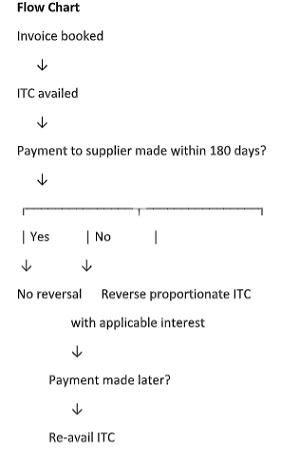
If a recipient has taken ITC on an invoice but has not paid the supplier the value of supply plus GST within 180 days from the invoice date, proportionate ITC is required to be reversed or paid with interest.
Once payment is later made to the supplier, ITC can be re-availed.
| Issue | GST impact | Practical control |
|---|---|---|
| Supplier payment pending beyond 180 days | Proportionate ITC reversal/payment | Maintain vendor ageing invoice-wise |
| Part payment made | Proportionate reversal for unpaid portion | Link payments with invoices |
| Payment made later | ITC can be re-availed | Keep payment proof and reconciliation |
| RCM invoices | 180-day rule does not apply | Separate RCM vendor ledger |
2. Incorrect ITC on exempt supplies without Rule 42/43 reversal
Where inputs, input services or capital goods are used for both taxable and exempt supplies, full ITC cannot be retained.
Common credit has to be reversed proportionately.
Rule 42 applies to inputs and input services. Rule 43 applies to capital goods.
| Type of credit | Relevant rule | Common mistake |
|---|---|---|
| Inputs | Rule 42 | Full ITC claimed despite exempt turnover |
| Input services | Rule 42 | Common office expenses not reversed |
| Capital goods | Rule 43 | Capital asset used for taxable and exempt activity but no reversal |
| Non-business use | Rule 42/43 | No proportionate reversal |
Simple formula
Common ITC attributable to exempt supplies =
Common ITC × Exempt Turnover ÷ Total Turnover
Practical examples
Hospitals, educational institutions, banks, NBFCs, real estate businesses, charitable institutions and mixed-supply businesses should be very careful.
3. Omission of incidental income from GST reporting
Many businesses report only main sales.
But GST scrutiny also examines other income appearing in the profit and loss account.
These may include scrap sales, commission, incentives, recovery from employees, penalty income, cancellation charges, liquidated damages, packing charges, delivery charges, documentation charges and other recoveries.
| Income appearing in books | GST question |
|---|---|
| Scrap sale | Is GST paid on sale of scrap? |
| Commission income | Is it taxable service? |
| Penalty / cancellation charges | Is it linked with supply or contract? |
| Packing / handling charges | Included in value of supply? |
| Recovery from customer | Reimbursement or taxable recovery? |
| Sale of old assets | Is GST paid on disposal? |
| Forex gain | Is it merely exchange fluctuation or linked with taxable supply? |
Professional point
The Department does not look only at sales ledger.
It also looks at:
Profit & Loss Account
↓
Other Income
↓
Ledger Scrutiny
↓
GST Taxability Check
↓
Mismatch with GSTR-1 / GSTR-3B
↓
Notice / Audit Query
4. Failure to pay GST on taxable advances, especially for services
For goods, tax on advances has been largely relaxed for normal registered suppliers.
But for services, advances continue to be sensitive.
If advance is received for taxable services, GST implications must be examined at the time of receipt, unless a specific exception applies.
| Type of advance | GST attention required |
|---|---|
| Advance for goods | Generally relaxed for normal registered suppliers |
| Advance for services | GST may be payable at receipt stage |
| Mobilisation advance | Common in works contracts and service contracts |
| Retention adjustment | Check time of supply and invoice terms |
| Security deposit | Not taxable unless adjusted as consideration |
| Advance later refunded | Proper refund voucher / credit note treatment required |
Common lapse
Businesses record advance in balance sheet but forget to examine GST liability.
5. Ignoring Reverse Charge Mechanism on applicable expenses
RCM is a frequent departmental audit area.
Expenses are checked from the profit and loss account. If the expenditure is of a nature covered under reverse charge, GST has to be paid by the recipient.
| Expense head | Possible RCM exposure |
|---|---|
| GTA freight | Check GTA option, invoice and rate |
| Legal fees from advocate | Generally RCM for business entity |
| Import of services | RCM under IGST |
| Director sitting fees / commission | RCM exposure |
| Security services | Check supplier and recipient category |
| Sponsorship | RCM in specified cases |
| Rent from Government / local authority | Check applicable notification |
| Services from unregistered persons in specified cases | Examine notified categories |
RCM Control Flow
Expense booked
↓
Identify supplier status
↓
Check nature of service
↓
Check RCM notification
↓
Pay GST in cash under RCM
↓
Claim ITC, if otherwise eligible
6. Improper valuation in related-party or branch transactions
Transactions between related persons and distinct persons require careful valuation.
Branches with separate GST registrations are treated as distinct persons. Supply between branches may attract GST even without consideration in specified cases.
| Transaction | GST risk |
|---|---|
| Branch transfer of goods | Taxable supply between distinct persons |
| Cross charge of common expenses | Valuation and documentation issue |
| Head office support to branch | Whether taxable service? |
| Related-party sale | Open market value / valuation rule check |
| Free supply to related person | Schedule I examination |
| Employee recovery from group entity | Taxability and valuation issue |
Practical control
Maintain:
1. tax invoice,
2. valuation basis,
3. agreement / policy,
4. working papers,
5. recipient ITC position, and
6. branch-wise reconciliation.
7. Delay or error in filing GSTR-1
GSTR-1 is not a mere reporting form.
It creates the outward supply data for recipients. It affects their GSTR-2A/2B and ITC eligibility. Delay or wrong reporting in GSTR-1 can create notices for the supplier as well as commercial disputes with customers.
| Lapse | Possible impact |
|---|---|
| GSTR-1 filed late | Late fee, notice, recipient ITC issue |
| Invoice missed | GSTR-1 vs books mismatch |
| Wrong GSTIN | Customer ITC blocked or delayed |
| Wrong place of supply | IGST vs CGST/SGST issue |
| Wrong tax rate | Short payment / excess payment issue |
| Wrong B2B/B2C classification | Data mismatch |
Good practice
Before filing GSTR-1, reconcile it with:
Sales register
E-invoice data
E-way bill data
Debit notes
Credit notes
Books of accounts
8. Claiming blocked ITC under Section 17(5)
Section 17(5) is a favourite area in audits.
The taxpayer may feel that an expense is business-related. But GST law may still block ITC.
| Common blocked ITC area | Typical example |
|---|---|
| Food and beverages | Staff meals, catering |
| Personal consumption | Personal-use expenses booked in business |
| Motor vehicles | Cars used by business, subject to exceptions |
| Club membership | Club / health / fitness membership |
| Works contract | Civil construction of immovable property |
| Goods lost / stolen / destroyed | Stock loss, fire loss, shortage |
| Gifts and free samples | Promotional free distribution |
| CSR and welfare expenses | Needs careful eligibility review |
Simple test
Expense is in books
↓
GST charged by supplier
↓
Business use exists
↓
Still check Section 17(5)
↓
If blocked, do not claim ITC
9. Mismatch between GSTR-1 and GSTR-3B
This is one of the easiest mismatches for the system to detect.
If outward tax liability reported in GSTR-1 is higher than tax paid in GSTR-3B, the system may generate scrutiny.
| Comparison | Departmental concern |
|---|---|
| GSTR-1 tax > GSTR-3B tax | Short payment of tax |
| GSTR-3B tax > GSTR-1 tax | Reporting error or missed invoice |
| Credit notes in GSTR-1 not adjusted properly | Wrong tax reduction |
| Amendments not tracked | Period-wise mismatch |
| Different taxable values | Possible suppression or classification error |
Reconciliation flow
Books sales
↓
GSTR-1 outward supply
↓
GSTR-3B tax payment
↓
E-invoice data
↓
Annual return
↓
Difference explained with documents
10. Claiming ITC without reconciling GSTR-2B
ITC should not be claimed merely because invoice is available in books.
GSTR-2B reconciliation is now a key compliance control.
| ITC issue | Scrutiny trigger |
|---|---|
| Invoice not appearing in GSTR-2B | ITC claimed without supplier reporting |
| Supplier GSTR-3B not filed | Rule 37A issue |
| Supplier registration cancelled | Genuineness verification |
| Wrong GSTIN used by supplier | Credit not appearing correctly |
| Credit note uploaded by supplier | ITC reversal required |
| Ineligible ITC shown in 2B | Wrong claim in 3B |
| Time-barred ITC | Section 16(4) issue |
Minimum documents for ITC defence
| Document | Purpose |
|---|---|
| Tax invoice | Basic ITC document |
| GSTR-2B | Supplier reporting support |
| Goods receipt note | Receipt of goods |
| Service completion proof | Receipt of service |
| E-way bill / transport document | Movement proof |
| Payment proof | Vendor payment trail |
| Ledger confirmation | Reconciliation support |
11. E-invoice and e-way bill mismatch
E-invoicing and e-way bill data are strong audit tools.
Mismatch between invoice, e-invoice, e-way bill and return can create scrutiny.
| Mismatch | Risk |
|---|---|
| E-invoice generated but not reported in GSTR-1 | Outward supply omission |
| E-way bill generated but no invoice in returns | Possible unreported supply |
| Invoice value differs from e-way bill value | Valuation query |
| Wrong HSN / rate | Classification issue |
| Movement without proper e-way bill | Detention / penalty risk |
| Cancelled e-invoice but supply exists | Reporting error |
Control
Every month, reconcile:
E-invoice portal
↓
E-way bill portal
↓
Sales register
↓
GSTR-1
↓
GSTR-3B
12. Incorrect treatment of credit notes and financial credit notes
Credit note under GST is not the same as a commercial adjustment note.
A GST credit note must satisfy Section 34 requirements. If time limit or conditions are not satisfied, tax liability may not reduce even if commercial credit is given to customer.
| Situation | GST treatment |
|---|---|
| Goods returned within time | GST credit note may be issued |
| Rate or value wrongly charged | GST credit note may be issued |
| Post-supply discount as per prior agreement | Credit note possible if conditions are met |
| Pure financial adjustment | Does not automatically reduce GST liability |
| Credit note issued after time limit | Commercial effect may remain, GST adjustment may fail |
| Credit note issued by recipient | Not a GST credit note for supplier’s tax reduction |
Practical warning
Do not reduce GST liability merely because the customer account has been credited.
13. Stock differences, scrap, shortages and write-offs
Stock is not only an accounting item. It is also a GST-sensitive item.
Departmental officers often compare purchase, production, sales, stock records, e-way bills and financial statements.
| Stock issue | GST concern |
|---|---|
| Scrap generated but not sold/reported | Unreported outward supply |
| Stock shortage | Possible unaccounted sale |
| Goods destroyed | ITC reversal issue |
| Free samples | Blocked ITC / reversal |
| Gifts | Blocked ITC |
| Obsolete stock written off | ITC reversal examination |
| Job-work stock not returned | Deemed supply risk |
| Capital goods scrapped | GST on disposal / reversal check |
Stock scrutiny flow
Opening stock
+ Purchases
+ Production
– Sales
– Consumption
– Wastage / scrap
= Closing stock
↓
Compare with books and GST records
14. Wrong place of supply and wrong tax type
Wrong place of supply can convert IGST into CGST/SGST or vice versa.
Even where total tax rate is same, wrong tax type can create litigation, interest, refund blockage and customer ITC issues.
| Error | Impact |
|---|---|
| IGST charged instead of CGST/SGST | Wrong tax payment |
| CGST/SGST charged instead of IGST | Customer ITC dispute |
| Wrong shipping State | Place of supply mismatch |
| Bill-to / ship-to not analysed | Wrong reporting |
| Services classified under wrong POS rule | Tax paid in wrong State |
| Export treated as domestic or vice versa | Refund / liability issue |
Professional control
For every transaction, ask:
What is supplied?
Who is supplier?
Who is recipient?
Where is movement ending?
Which POS rule applies?
Which tax is payable?
15. Poor reconciliation between books, returns and annual filings
GST compliance does not end with monthly returns.
Annual return and reconciliation statement bring together the full financial year. Differences between books, GSTR-1, GSTR-3B, GSTR-2B, e-way bill, e-invoice and financial statements invite scrutiny.
| Reconciliation area | Why important |
|---|---|
| Books turnover vs GSTR-1 | Outward supply reporting |
| GSTR-1 vs GSTR-3B | Tax payment verification |
| Books ITC vs GSTR-2B | ITC eligibility |
| GSTR-3B ITC vs GSTR-9 | Annual consistency |
| Expense ledger vs RCM paid | Reverse charge compliance |
| Fixed asset register vs ITC | Blocked credit / disposal |
| Other income vs GST returns | Hidden supply check |
| Credit notes as per books vs GST returns | Tax adjustment check |
Final audit formula
Books
+ GST returns
+ GSTR-2B
+ E-invoice
+ E-way bill
+ Annual return
+ Financial statements
= Complete GST compliance file
Summary Table — 15 GST Lapses and Preventive Action
| No. | Compliance lapse | Main risk | Preventive action |
|---|---|---|---|
| 1 | 180-day supplier payment not tracked | ITC reversal with interest | Vendor ageing review |
| 2 | No Rule 42/43 reversal | Excess ITC | Monthly exempt turnover working |
| 3 | Incidental income omitted | Short payment of GST | Other income GST review |
| 4 | GST on service advances missed | Tax and interest | Advance ledger review |
| 5 | RCM ignored | Tax, interest, penalty | Expense-wise RCM checklist |
| 6 | Related-party valuation wrong | Short tax payment | Valuation policy |
| 7 | GSTR-1 delayed/wrong | Notices and customer disputes | Pre-filing reconciliation |
| 8 | Blocked ITC claimed | ITC reversal | Section 17(5) checklist |
| 9 | GSTR-1 vs GSTR-3B mismatch | System scrutiny | Monthly liability reconciliation |
| 10 | ITC claimed without GSTR-2B match | ITC dispute | 2B reconciliation |
| 11 | E-invoice/e-way bill mismatch | Reporting and movement risk | Portal-to-return matching |
| 12 | Wrong credit note treatment | Wrong tax reduction | Section 34 control |
| 13 | Stock/scrap/write-off issues | Unreported supply / ITC reversal | Stock GST review |
| 14 | Wrong place of supply | Wrong tax type | POS checklist |
| 15 | Poor annual reconciliation | Audit exposure | GSTR-9/9C working file |
Master GST Compliance Flow Chart
Books of Accounts
↓
Identify outward supplies
↓
Check valuation, rate and place of supply
↓
Report correctly in GSTR-1
↓
Pay tax correctly in GSTR-3B
↓
Check ITC with GSTR-2B
↓
Reverse ineligible / common / 180-day ITC
↓
Pay RCM wherever applicable
↓
Reconcile with e-invoice and e-way bill
↓
Review annual return and financial statements
↓
Maintain documentation file
Practical Monthly GST Compliance Checklist
| Area | Monthly question |
|---|---|
| Sales | Is every invoice reported in GSTR-1? |
| Tax payment | Does GSTR-3B match GSTR-1 and books? |
| ITC | Is ITC supported by GSTR-2B? |
| 180-day condition | Are old unpaid vendors reviewed? |
| Exempt supplies | Is Rule 42/43 reversal done? |
| RCM | Are all RCM expenses identified? |
| Credit notes | Are GST credit notes within law and time? |
| E-invoice | Is e-invoice data matching returns? |
| E-way bill | Is goods movement matching sales? |
| Other income | Is GST impact examined? |
| Stock | Is scrap / shortage / write-off reviewed? |
| Branches | Are inter-branch supplies reported? |
| POS | Is correct tax type charged? |
| Blocked ITC | Is Section 17(5) reviewed? |
| Records | Are documents ready for audit? |
Conclusion
GST scrutiny is increasingly based on data comparison.
The Department may not start with the allegation of tax evasion. It may start with a simple mismatch. But once a mismatch is noticed, the taxpayer must explain it with documents.
The best defence is not created after receiving a notice. It is created every month through correct reporting, proper reconciliation and strong documentation.
In GST, compliance is not merely return filing.
It is a complete discipline of:
- Correct classification
- Correct valuation
- Correct tax payment
- Correct ITC claim
- Correct reversal
- Correct reporting
- Correct records
A taxpayer who maintains this discipline can handle departmental scrutiny with confidence.
*****
Disclaimer: This article is meant for professional education and general awareness. GST law is subject to amendments, notifications, circulars, portal changes and factual interpretation. Readers should verify the applicable legal position before taking any business or litigation decision. The views expressed are personal and should not be treated as a legal opinion for any specific case without examining complete facts and documents.