Summary: Overseas listing enables Indian companies to access international capital markets, attract foreign investors, enhance global visibility and potentially reduce their cost of capital. Traditionally, Indian companies raised overseas equity through American Depositary Receipts (ADRs) and Global Depositary Receipts (GDRs), involving foreign depositaries and domestic custodians. The introduction of India’s direct listing framework in 2024 created an alternative route for eligible Indian public companies to list securities on recognised international exchanges in GIFT IFSC, including India INX and NSE IX. This article examines the evolution of overseas listing, the working of depositary receipts, primary and secondary market transactions, benefits for issuers, and challenges involving financial reporting, shareholder rights and regulatory compliance. It also explains the emerging direct listing framework and its significance for Indian companies seeking international capital. The regulatory framework has subsequently evolved, including amendments notified in November 2026 expanding the permissible instruments.
- Introduction
- Why Do Companies List Overseas?
- Access to a Larger Pool of Capital
- Global Visibility and Reputation
- Better Valuation
- Low Cost of Capital
- Overseas Listing Process Through Depositary Receipts (DR) Mechanism
- Procedural Aspects of Setting Up a DR Programme
- Secondary Market Transactions of DRs
- Challenges and Difficulties Faced by Issuers (Indian Companies)
- Dual Financial Reporting
- Vulnerability to Class-Action Lawsuits
- Challenges and Difficulties Faced by Overseas Investors
- Muted Voting Rights
- Additional Administrative and Conversion Costs
- Direct Overseas Listing Framework
- International Financial Services Centre (IFSC) Exchanges
- Conclusion
Introduction
Overseas listing refers to the practice of a company listing its financial instruments on a stock exchange located outside its home country. For instance, an Indian company listing its shares on the New York Stock Exchange (NYSE).
Overseas listing provides Indian companies with access to international capital markets and a broader base of investors beyond the domestic market. Historically, such access was primarily achieved through Depositary Receipt (DR) mechanisms, including ADRs and GDRs.
The introduction of direct listing through IFSC exchanges marks a significant development in India’s overseas listing framework. This paper examines the evolution from the traditional DR mechanism to the emerging framework for direct overseas listing.
Why Do Companies List Overseas?
Access to a Larger Pool of Capital
Listing on foreign exchange provides access to more institutional investors and specialised investors than the domestic market.
Global Visibility and Reputation
Listing on a recognised international exchange can enhance a company’s global visibility, credibility and reputation.
Better Valuation
Companies listed overseas are likely to be valued higher. To substantiate this, Doidge, Karolyi and Stulz, in their article published in the Journal of Financial Economics, used Tobin’s Q as a measure of firm valuation. Tobin’s Q measures how highly the market values a company relative to its assets.
Tobin’s Q = Market value of the firm ÷ Replacement cost of its assets.
It was found by the study that foreign companies that were cross listed in the US had a 16.5% higher Tobin’s Q than companies that were not listed in the US.
Low Cost of Capital
Overseas listing can reduce the cost of capital by giving companies access to a wider pool of investors, thereby diversifying risk.
Apart from these reasons companies also opt for overseas listing as it facilitates access to foreign currency, which can be useful for the companies’ foreign operations and also helps in strategic expansion of business.
Overseas Listing Process Through Depositary Receipts (DR) Mechanism
Prior to 1993, Indian corporates were not permitted to access international capital markets. However, in 1993, the Ministry of Finance, Department of Economic Affairs, introduced a framework allowing Indian corporates to access global capital markets through the Depository Receipt (DR) mechanism.
A Depositary Receipt (DR) is a financial instrument that represents shares of a company and allows those shares to be traded in a foreign market. There are two major types of Depositary Receipts (DRs):
1. Global Depositary Receipts (GDRs)
2. American Depositary Receipts (ADRs)
Let us understand the mechanism of DR through the example of an ADR.
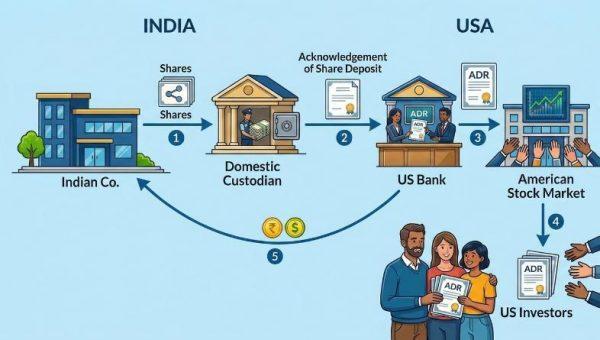
- Let us say that an Indian company wants to raise money from the US by issuing shares to investors in the US. Indian companies are prohibited from directly issuing rupee denominated securities on the international stock exchanges. This can be done only through intermediaries.
- The first intermediary in this process is the “Foreign custodian or foreign depository” which is an overseas depositary bank (US) and it is typically a bank acting as a custodian in this process. Eg. JP Morgan Chase, Citibank.
The Indian company issues its shares to the overseas depositary. Against these underlying shares, the depositary issues certificates or instruments in the foreign country. These certificates represent the shares of the Indian company and are known as American Depositary Receipts (ADRs).
- The second intermediary in this process is called the Domestic custodian, which is a bank in India acting as an agent to the US depository bank. The domestic custodian bank takes custody of the shares issued by the Indian company and would issue an acknowledgement of share deposit to the foreign depository.
- Once this acknowledgement is received, the US Depository bank issues ADRs representing the shares deposited.
- These ADRs will be denominated in US dollars and once issued, they can be traded on stock exchanges in the US, such as the NYSE, just like other securities. Since the ADRs represent the shares of the Indian company, it derives its value from the underlying shares of Indian company and their price fluctuates based on the price movements of the underlying Indian company’s shares.
- Further, the amount received by the US depositary bank from the issue of ADRs is then remitted to the Indian company after deducting the applicable fees and expenses.
The following image illustrates the working of ADRs:
The concept of GDRs is similar to that of ADRs. However, the principal difference between ADRs and GDRs lies in the market in which they are issued and the stock exchange on which they are listed. ADRs are traded on stock exchanges in the United States, whereas GDRs are traded on stock exchanges outside the United States.
Procedural Aspects of Setting Up a DR Programme
Regarding the procedural aspects of setting up a DR program, the issuer company (Indian company) selects and appoints a foreign depositary and a domestic custodian and enters into a depositary agreement setting forth the rights, responsibilities, and obligations of the various parties involved.
The depositary establishes the ratio between the DRs and the equity shares (for example, a 1:5 ratio means 1 DR represents 5 equity shares). The primary role of the depositary and custodian is to issue the DRs and manage the program on an ongoing basis.
It is worthwhile noting that the depository is the registered owner of the shares and its name appears in the ‘Register of Members’ of the issuer company.
Once the DR program is established, the DRs representing the equity shares of the Indian issuer are listed on the relevant international stock exchange and become available for trading by investors in the secondary market, similar to other listed securities.
Secondary Market Transactions of DRs
Secondary market transactions in DRs can be of 2 types, namely, Intra-market transactions and Cross-border transactions.
1. Intra-Market Transactions: When a foreign investor holding a DR sells it via an intra-market transaction, the DRs are simply transferred from the seller’s account to the buyer’s account, similar to trading regular shares through a demat/trading account. Both the buying and selling parties are located within the same foreign market. (e.g., a transaction occurring entirely between two investors in the US)
2. Cross-border transaction: In a cross-border transaction, a foreign investor holding a DR wishes to sell the underlying shares to a buyer in the home country (India). Here, the seller would approach a broker in that country and instruct to deliver the shares underlying the DR to the buyer in the home country (India).
The Foreign depository will cancel the DR that is being sold and instruct the domestic custodian (having the custody of the underlying shares) to release the underlying shares and deliver them to the broker of the buyer in the home country.
The section so far illustrates how a typical overseas listing through the DR mechanism operates in both the primary and secondary international capital markets.

Post introduction of this DR scheme for overseas listing, until 2001, 72 Indian companies raised foreign equity capital by issuing and listing their 85 DR programs on the foreign capital markets.
Infosys became the first Indian company to list on National Association of Securities Dealers Automated Quotations (NASDAQ) through an ADR in March 1999, raising approximately $70 million.
Reliance Industries Limited, Tata Motors, Dr. Reddy’s Laboratories, Hindalco, and Mahanagar Telephone Nigam Limited listed through GDR offerings in London and Luxembourg. According to the RBI, in 2004-05 Indian companies raised $613 million via ADRs/GDRs.
Challenges and Difficulties Faced by Issuers (Indian Companies)
Dual Financial Reporting
Listing an ADR on US exchanges (NYSE/NASDAQ) required Indian firms to convert their financial statements from Indian GAAP (or Ind AS) to US GAAP or IFRS.
Vulnerability to Class-Action Lawsuits
In foreign jurisdictions, particularly the US, shareholder litigation is aggressive. Indian issuers faced expensive shareholder class-action lawsuits in US federal courts due to disclosure disputes and governance issues. For eg., Post 2009 corporate accounting scandal, Satyam Computer Services paid a $125 million settlement to resolve a class-action lawsuit filed by US ADR holders along with a $10 million fine to the SEC.
Challenges and Difficulties Faced by Overseas Investors
Muted Voting Rights
DR holders do not hold underlying shares directly; ownership is registered in the name of the Depositary Bank. Consequently, DR holders generally lack direct voting rights at Annual General Meetings (AGMs).
Additional Administrative and Conversion Costs
Holding and converting DRs involves ongoing service fees charged by Depositary Banks. Investors are subject to annual issuance, custody, and dividend processing fees.
Direct Overseas Listing Framework
Although these limitations of the DR program led to a decline in Depositary Receipt (DR) issuances, the Government of India introduced the Direct Overseas Listing Scheme as an initiative to enable Indian companies to raise foreign capital directly.
On July 28, 2023, the Government of India announced the Direct Listing Scheme to allow eligible listed and unlisted Indian public companies to list their equity shares directly on exchanges within an International Financial Services Centre (IFSC), bypassing the indirect DR route.
The regulatory framework was subsequently established through the Companies (Listing of Equity Shares in Permissible Jurisdictions) Rules, 2024, and the applicable foreign exchange and securities regulations.
International Financial Services Centre (IFSC) Exchanges
An International Financial Services Centre (IFSC) is a specially designated jurisdiction within India that is legally treated as an offshore territory for financial and foreign exchange regulatory purposes. Currently, GIFT City (Gujarat International Finance Tec-City) in Gujarat, is India’s first and only operational IFSC.
While financial markets in mainland India are regulated by SEBI and the RBI, activities within the IFSC fall under a single unified regulator, the International Financial Services Centres Authority (IFSCA). Currently, two stock exchanges operate within GIFT IFSC:
- India International Exchange (IFSC) Limited (India INX of BSE)
- NSE International Exchange Limited (NSE IX of NSE)

These exchanges are recognized as “International exchanges” under India’s Direct Listing Scheme. Consequently, listing the equity shares of an eligible Indian public company on either exchange qualifies as an overseas listing under the framework.
To cater to global institutional investors and facilitate seamless cross-border transactions, trading on these IFSC exchanges is conducted in US Dollars across extended 22-hour market operating windows.
For further details on direct listing regulations, refer to the IFSCA circular on direct listing of Indian companies, the Securities Contracts (Regulation) Amendment Rules, 2024, and the 2025 amendments to the listing rules.
Conclusion
India’s overseas listing journey has evolved from the traditional DR-based model towards a framework that permits eligible Indian public companies to directly list their equity shares on IFSC exchanges. While the DR mechanism provided Indian companies with access to international capital markets, the involvement of multiple intermediaries and associated regulatory and administrative requirements highlighted the need for alternative avenues. The introduction of the Direct Overseas Listing framework through GIFT IFSC has consequently broadened the options available to Indian companies seeking access to international capital markets, contributing to the continuing evolution of India’s overseas listing framework.