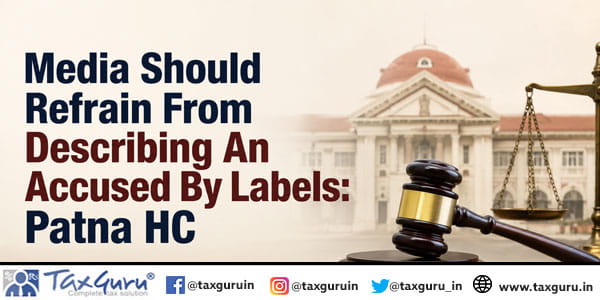
It is entirely in the fitness of things and so also perfectly in order that the Patna High Court in a most learned, laudable, landmark, logical and latest oral judgment titled Rishu Shree vs State of Bihar in Criminal Miscellaneous No.32409 of 2026 (Arising Out of PS. Case No.-5 Year-2025 Thana- Vigilance District- Patna) that was pronounced just recently on 24.06.2026 has minced absolutely just no words to hold in no uncertain terms that while the media is free to report factual developments concerning criminal cases, it should refrain from describing an accused as “mastermind”, “scamster”, “kingpin” or using other labels which imply that the accused is guilty even before a trial. We thus see that the Court has made it indubitably clear that an accused’s right to a fair trial must be protected while directing the media to refrain from using labels that imply that an accused in an alleged tender scam case was guilty even before a trial. It must be noted that the Single Judge Bench comprising of Hon’ble Mr Justice Ansul sent a very loud and clear message that news outlets cannot conduct a media trial that undermines an individual’s right to a fair trial.
It was underscored by the Patna High Court most emphatically that a person’s reputation cannot be prejudiced before a court determines whether the accused is guilty or not. We need to note that the Court passed the pragmatic judgment while hearing a petition that had been filed by Rishu Shree who sought the quashing of an first information report (FIR) that had been registered by the Bihar Special Vigilance Unit (SVU) in connection with an alleged tender scam. This leading case is scheduled for further hearing on July 10.
At the very outset, this brief, brilliant, bold and balanced oral judgment authored by the Single Judge Bench comprising of Hon’ble Mr Justice Ansul of Patna High Court sets the ball in motion by first and foremost putting forth in para 2 that, “The instant application has been filed for quashing of the entire criminal proceedings pertaining to Special Vigilance Unit Case No. 05 of 2025 dated 30.04.2025.”
As we see, the Bench then discloses in para 3 that, “Counsel for the ED, Mr. Zohaib Hossain appeared and he stated that in the round of litigation in connection with same FIR, the petitioner has filed Cr.WJC No. 1046 of 2025 in which they added as a party but here they have not been added as a party.”
As things stands, the Bench then directs in para 4 that, “Counsel for the petitioner is directed to add Enforcement Directorate as party respondent.”
As it turned out, the Bench enunciates in para 5 that, “Mr. Zohaib Hossain, counsel for the ED seeks time to file counter affidavit to bring the materials available on record.”
Quite naturally, the Bench points out in para 6 that, “Counsel for the SVU also seeks time to file counter affidavit. The counter affidavit must explain the reasons for delay of one year in conducting the raid after registration of FIR.”
To put things in perspective, the Bench envisages in para 7 that, “Counsel for the petitioner Ms. Nandita Roy, Sr. Adv. Has stated that one more thing is very relevant in this case that an FIR was registered and after more than a year of registration of FIR raid was conducted in the residential premises on 27.05.2026 and he was arrested on the same date. She states that in the raid nothing incriminating was found against him still after arrest various television channels, newspapers, online news portal and social media handles commenced extensive and lurid coverage of the case, broadcasting one sided narratives, unverified allegations and prejudicial content that portrays the petitioner as guilty even before commencement of trial. Several prime time news debates were conducted by prominent TV anchors wherein the petitioner was condemned, vilified and subjected to public humiliation without any opportunity to present his side. Such coverage has direct effect of influencing public opinion against the petitioner, prejudicing the minds of potential witnesses and creating an atmosphere inimical to fair trial.”
While citing the relevant case law, the Bench observes in para 8 that, “She further states that in the case of State of Maharashtra v. Rajendra Jawanmal Gandhi, reported in (1997) 8 SCC 386, unequivocally stated that “ A trial by press, electronic media or public agitation is the very antithesis of rule of law.””
While citing yet another relevant case law, the Bench states in para 9 that, “In M.P. Lohia v. State of West Bengal reported in (2005) 2 SCC 686 the Hon’ble Supreme Court held that it is not proper for the press or the electronic media to project a one-sided picture of events before the public in matters which are sub-judice.”
While striking the right chord, the Bench while dwelling on yet another case law mentions in para 10 that, “In Sahara India real Estate Corporation Ltd. & Ors. v. Securities and Exchange Board of India & Anr. Reported in (2012) 10 SCC 603, the Hon’ble Supreme Court held that the courts have the power to impose prior restraints on publications in exceptional cases where there exists a real and substantial risk.”
Do note, the Bench notes in para 11 that, “This court has gone through the annexures in the Interlocutory Applications No. 01 of 2026.”
Simply put, the Bench states in para 12 that, “There is a report where the heading is Bihar’s Curious Case of an indispensable engineer: What an ED probe found. Another report says Bihar Police searches houses of two IAS officers over tender scam. In another news, the photograph of the petitioner is there and it says: Tender scam accused Rishu avoids direct answers, denies wrongdoing. One news writes: “As the Bihar government’s focus is on development and infrastructure projects worth thousands of crores, Rishu Sinha created a network to pay a decent commission to government officials for securing tenders”. One newspaper states that: ED raids 7 places in Patna and kept counting cash for 8 hours using 4 machines.”
More worryingly, the Bench observes in para 13 that, “It is to be seen that these news items are not only in the mainline press or Television channels but the social media platforms are flooded with news declaring the petitioner a guilty person without even initiation of the trial.”
Be it noted, the Bench notes in para 14 that, “The petitioner may be accused of a serious case his rights to get a fair trial would not be ousted by the magnitude of the allegation i.e. levelled against him there are freedom of the press guaranteed under Article 19(1)(A) of the Constitution is subject to reasonable restriction under Article 19(2) in the interest state security, public order, decency, morality, defamation and incitement to an offence.”
Most forthrightly and most rationally, the Bench underscores in para 15 holding unequivocally that, “Maligning the image of a person who is yet to be held guilty may come within the ambit of defamatory act, immoral act or even an indecent act. This is pre-judging the issue when the matter is sub-judice.”
While citing a recent and relevant case law, the Bench observes in para 16 that, “In the case of Mahua Moitra decided on 23.02.2024 in W.P. (c) 2676/2024 an Office Memorandum dated 01.04.2010 issued by Government of India which is an advisory on Media Policy of Police. It stated while sharing information to the public through the media appropriate information as is professionally necessary is shared without hampering the process of investigation or issues of legal/privacy rights of the accused/victims and matters of strategic and national interest.”
Do also note, the Bench then notes in para 17 that, “Apart from that Senior Counsel for the petitioner, counsel for the ED also expressed his ex-pleasure over the type of reporting that is going on with regard to the case and with regard to the recent trend of media trial.”
Most explicitly, the Bench while citing relevant case laws concedes in para 18 that, “This Court is clearly aware of the judgments passed in the case of Indian Express Newspaper Pvt. Ltd. v. Union of India reported in (1985) 1 SCC 641 which established the idea of free press. In LIC v. Manubhai D. Shah (Prof.) reported in (1992) SCC 637 where the court held that in any set-up more so in a democratic set-up like ours dissemination of news and views for popular consumption is a must and any attempt to deny the same must be frowned upon.”
Most commendably, it is worth noting that the Bench notes in para 19 that, “Having seen both sides of the coin, this court is clearly not in a view of media gag over the issue. However, the court would certainly direct for control over irresponsible reporting and imputation of guilt upon the petitioner without any initiation trial at all.”
As a corollary and far most significantly, the Bench encapsulates in para 20 what constitutes the cornerstone of this notable judgment postulating precisely that, “In that view of the matter the court issues following directions: Pending consideration of the present petition all print, electronic, digital and social media platforms shall be at liberty to report the factual developments concerning the case and proceedings before competent courts. However, none of the above would:
(a) Describe the petitioner as guilty of the offences alleged.
(b) Portray the petitioner as having committed the offences alleged.
(c) Publish or broadcast material pertaining to determine criminal liability.
(d) Use expressions imputing guilt like mastermind, scamster, kingpin or equivalent description conveying criminal responsibility.
(e) Conduct media trials based upon alleged confessions, investigation material, unproved document whose evidentiary value is yet to be determined.
(f) However, nothing in this order shall prevent fair, accurate and objective reporting of the proceedings pending before the court or publication of the facts.”
It would be instructive to note that the Bench for clarity hastens to add in para 21 clarifying that, “The above restraint shall extend to digital publications, online portals, video streaming services, podcast, social media accounts, channels and other internet based platforms.”
Finally, the Division Bench then concludes by directing and holding in para 22 that, “Put up this case on 10.07.2026 for further hearing.”
In a nutshell, we thus see that the Patna High Court has sent a very loud and unequivocal message that media should strictly refrain from describing an accused by labels. To put it differently, the Court has made it indubitably clear that media can’t label an accused as mastermind, scamster or kingpin before trial takes place. It is high time and media must most strictly abide by what the Patna High Court has directed so explicitly, elegantly and eruditely in this leading case! No denying or disputing it!