Summary: The Insurance Regulatory and Development Authority of India (IRDAI) released on 23 September 2026 a Public Consultation Paper titled “Recalibrating Economics of Insurance Distribution”, proposing comprehensive reforms to insurance distribution structures, expenses, commissions, market conduct, transparency and digital infrastructure. The proposals seek to establish a customer-centric, competitive, efficient and transparent distribution ecosystem, while improving sustainable outcomes for policyholders, insurers and distributors. The proposed architecture would consolidate distribution entities into three broad categories—Insurance Distribution Entities (IDEs), Insurance Distribution Persons (IDPs) and Market Infrastructure Institutions (MIIs)—with simpler registration, lower entry and capital requirements, reduced fees and greater flexibility for insurance and other financial and non-financial activities. The Expense of Management (EoM) framework is proposed to be recalibrated through a phased reduction, including company-level limits linked to Gross Direct Premium Income. The commission framework would be aligned with the segment, line of business, distribution channel, product complexity and effort involved, with possible additional rewards for distribution in underserved areas. The proposals also seek greater disclosure of commission structures and distribution costs, safeguards against compulsory bundling and mis-selling, identification of individuals involved in sales, commission claw-back for mis-selling and restrictions on volume-linked or reward-linked incentives for bank and NBFC staff. Digital infrastructure, including Bima Sugam and the Public Insurance Registry (PIR), is proposed to support comparison, portability, transparency and wider access. Stakeholders have been invited to submit comments and feedback by 25 October 2026.
Insurance Regulatory and Development Authority of India
Press Release | 23rd September 2026
Recalibrating Economics of Insurance Distribution
IRDAI issues consultation paper on Distribution Reforms
Proposed reforms seek to simplify the distribution architecture, improve cost efficiency and transparency, align incentives with policyholder value and enable a more efficient and inclusive insurance sector
The Insurance Regulatory and Development Authority of India (IRDAI), on Wednesday, 23rd September 2026, released a Public Consultation Paper on “Recalibrating Economics of Insurance Distribution”, setting out a comprehensive framework of reforms covering insurance distribution, its structure, expenses, commissions, market conduct, transparency and digital infrastructure.
The primary aim is to foster a customer-centric, competitive, efficient and transparent distribution ecosystem, while enabling better and sustainable outcomes for policyholders, insurers and distributors.
The proposed reforms are anchored in the expectations of the Sabka Bima Sabki Raksha (Amendment of Insurance Laws) Act, 2025, which seeks to accelerate the growth and development of the insurance sector, strengthen policyholder protection, improve ease of doing business and enhance transparency in regulation making and regulatory oversight. The Act received Presidential assent on 20 December 2025.
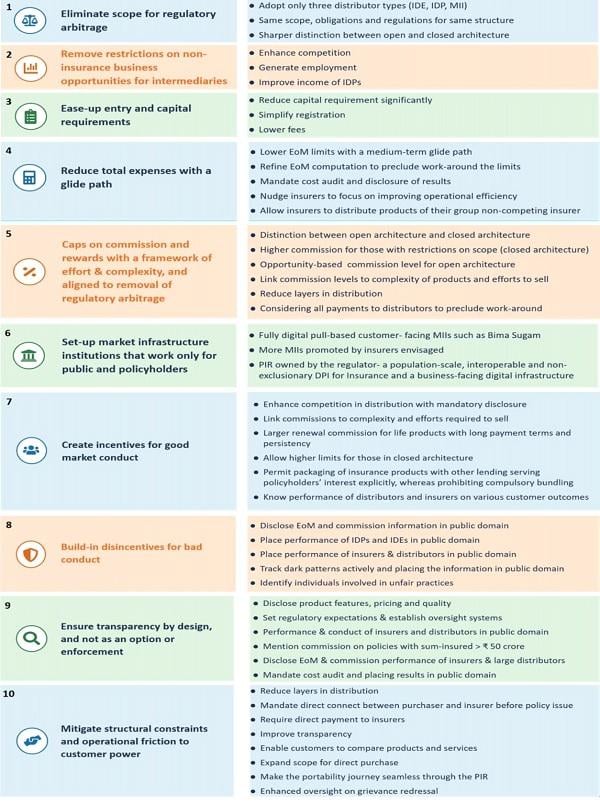
In furtherance of these objectives, the proposed distribution reforms seek to create a simpler, more open and competitive ecosystem by easing entry, expanding business and income opportunities, enabling non-insurance financial and non-financial activities, facilitating employment, removing operational constraints, strengthening skills through cost-efficient training, and setting clear regulatory expectations.
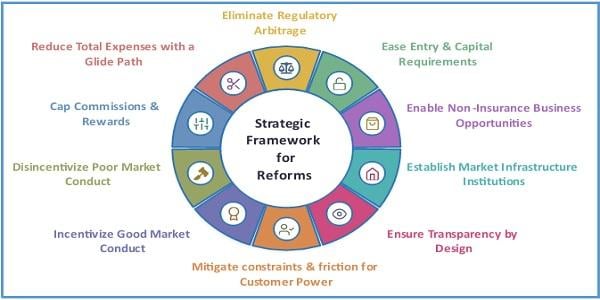
The proposed distribution architecture is guided by the principle of “same structure, same functions, same norms.”
It seeks to replace the existing complex and fragmented architecture with three broad categories of distribution entities, namely Insurance Distribution Entities (IDEs), Insurance Distribution Persons (IDPs) and Market Infrastructure Institutions (MIIs).
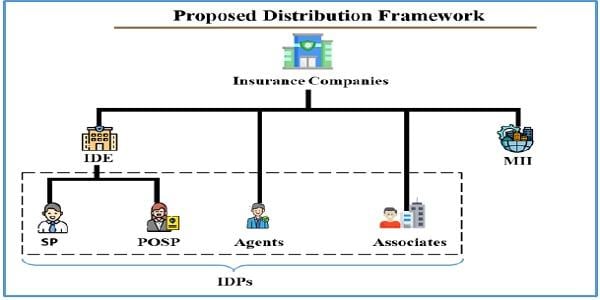
It proposes simpler registration, significantly lower entry and capital requirements, reduced regulatory fees and greater flexibility for distributors to undertake insurance as well as other financial and non-financial activities, thereby expanding avenues for business diversification and revenue generation and allowing people in relatively small markets to also venture into insurance business.
Entities with the same structure would have the same scope of business, obligations and regulatory framework. A clearer distinction between open and closed distribution architectures would promote competition and reduce regulatory arbitrage and operational constraints. The reforms are intended to simplify the distribution architecture, making it more customer facing, where customers easily understand who they are buying through, along with expanding opportunities for IDPs, supporting employment generation and improving their income potential. The reforms aim to enable entrepreneurs across the country, including in smaller markets, to participate in insurance distribution.
Alongside this, the Expense of Management (EoM) framework is proposed to be recalibrated through lower limits with a phased glide path.
For life insurers, the EoM limit would move to a company-level basis linked to Gross Direct Premium Income (GDPI), with the limit proposed at 15% within two years and 12.5% within five years. [Box 2 of Part 1 of the Consultation Paper]
For general insurers, the basis would shift from Gross Written Premium (GWP) to domestic Gross Direct Premium Income (GDPI), with the EoM limit reducing from 30% of GWP to 20% of GDPI within five years, also through progressive annual reductions. [Box 2 of Part 1 of the Consultation Paper]
The regulatory fee on insurers is also proposed to be reduced.
The proposed reduction in EoM is intended to lower the overall cost of insurance, thereby expanding the risk pool available in general insurance and enhancing returns to policyholders in life savings products. The phased approach seeks to balance improved value and affordability for policyholders with the financial sustainability of insurers, while progressively improving cost efficiency across the sector.
The commission framework is proposed to be recalibrated in parallel.
Instead of a uniform approach, commission limits would take into account the segment, line of business, distribution channel, product complexity and the effort involved in selling and servicing the product. [Boxes 4A and 4B of Part 1 of the Consultation Paper] The sale of products in underserved areas (small towns with a population of up to 50,000 and rural areas, and smaller cities with a population of up to 10 lakh) may have rewards over and above the normal commission limits.
The proposals also include cost audits and safeguards against indirect payments with the objective of ensuring greater accountability for the actual cost of distribution.
Greater transparency and stronger accountability are proposed to strengthen the ability of policyholders to make informed choices.
Insurers and large distribution entities would be required to disclose commission policies and structures in a simple and accessible manner, while specified commercial policies would carry commission disclosures. This would enable customers to be aware of the distribution costs built into the pricing.
The reforms also seek to strengthen safeguards against compulsory bundling of insurance with other financial products and services and address mis-selling through greater accountability. This includes documenting customer needs and suitability, explicitly including all forms of remuneration, direct or indirect, monetary or non-monetary, within the definition of commission for regulatory purposes, and prohibiting volume-linked or reward-linked incentives for bank and NBFC staff selling insurance. It also includes linking the identity of the individual with the policy sold, placing information on mis-selling incidents in the public domain, and providing for commission claw-back in cases of mis-selling. The consultation paper also proposes tracking dark patterns and making relevant performance information available to strengthen market discipline. Greater transparency in product information, remuneration and distribution practices, along with appropriate safeguards against mis-selling and unfair practices, will give much greater confidence to customers.
Digital infrastructure is an important part of this transition.
The consultation paper proposes Market Infrastructure Institutions (MIIs) for insurance as digital, pull-based alternatives for insurance distribution, with Bima Sugam identified as one such infrastructure. The paper also envisages greater use of the Public Insurance Registry (PIR) to support transparency, comparison, portability and operational efficiency. Together, these digital and technology-enabled channels are intended to improve ease of purchase and servicing, expand consumer choice and facilitate wider access to insurance, including among currently underserved segments.
The proposed reforms are intended to work together to support a distribution ecosystem capable of reaching a larger and more diverse customer base, bringing uninsured citizens into the insurance fold:
A simpler architecture can facilitate competition, innovation and wider participation; lower structural costs can support affordability; better-aligned remuneration can strengthen incentives for quality advice and service; greater transparency can improve customer choice; and digital infrastructure can reduce transaction costs and enable more direct access to insurance.
Consultation with stakeholders
IRDAI has invited comments and suggestions from the public and all stakeholders on the proposed reforms on “Recalibrating Economics of Insurance Distribution.” The consultation paper seeks views on the problems identified, the proposed strategic objectives, reform measures and their implementation. The consultation paper can be accessed from https://iib.gov.in/dr.
Comments/feedback may be submitted through the web consultation process, through the prescribed Excel template uploaded on the consultation portal, or by email. The last date for submission of comments and feedback is 25 October 2026.
IRDAI remains committed to fostering a responsive, competitive and policyholder-centric insurance ecosystem, and will continue to engage with stakeholders and monitor the implementation of the reforms to ensure that policyholder interests remain central to the development of the insurance sector. IRDAI looks forward to the active participation of all stakeholders in shaping these reforms.
Annexure A: Regulatory objectives and corresponding Reforms