The content is General News. The article highlights work in progress (WIP) as the inventory category that presents the greatest challenge during physical verification. Unlike raw materials or finished goods, WIP lacks a natural unit of count, continues to move during verification, and requires assessment of the stage of completion and valuation based on absorbed material, labour and overhead. It notes that under CARO 2020, auditors report on physical verification of inventory and discrepancies of ten percent or more in any class of inventory, but WIP verification often relies on book values with limited physical assessment. The article identifies common issues such as scrapped items carried at full value, rejected components remaining in rework, jobs closed in the system but physically incomplete, and finished goods still recorded as WIP due to unposted ERP transactions. It states that effective WIP verification includes an agreed cut-off, joint assessment of stage of completion with production personnel, identification of stagnant WIP, reconciliation with open ERP job orders, and documentation of completion estimates. It concludes that inventory verification should focus on explaining the value of work still in progress, not only on counting finished goods.
Why Work in Progress Is the Most Challenging Inventory Class to Verify During Physical Verification
Ask any auditor which part of inventory causes the most concern during physical verification, and the answer is rarely raw materials or finished goods. It is almost always work in progress.
Raw materials sit in a store with bin cards. Finished goods sit in a warehouse with labels and dispatch records. WIP sits on the shop floor — half-assembled, spread across machines, sometimes inside the machines themselves — and no single department has complete ownership of it. The stores team says it has left the store. The dispatch team says it has not arrived. In between lies a value that appears on the balance sheet but is genuinely difficult to see, count, or verify.
Why WIP resists verification
First, WIP has no natural unit of count. A raw material is counted in kilograms or units. A finished product is counted in pieces. But what is a gearbox that is sixty percent assembled? Counting it as one unit overstates it; ignoring it understates it. Verification requires an assessment of the stage of completion, which needs production knowledge, not just counting skills. This is where many verification teams struggle.
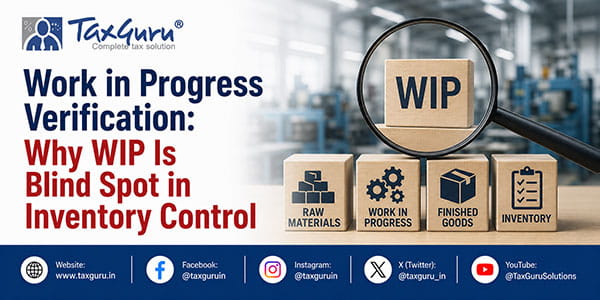
Second, WIP moves while you count it. Conducting verification in a running plant is difficult because material keeps entering and leaving processes throughout the counting itself. Unless cut-off procedures are agreed with production teams in advance — which shift, which lot, which stage — two counters can arrive at two different numbers on the same day, both honestly.
Third, WIP quantity and valuation are both estimates. Even where the quantity is right, the value depends on how much material, labour and overhead has been absorbed at each stage of completion. A quantity error and an absorption error can offset or compound each other, and neither is visible from the books alone.
Why this matters for audit
Under CARO 2020, the auditor reports on whether physical verification of inventory has been conducted at reasonable intervals and whether discrepancies of ten percent or more in any class of inventory were properly dealt with. WIP is a class of inventory. In practice, however, many verification exercises quietly concentrate on raw materials and finished goods — the countable classes — and carry WIP at book values with minimal physical assessment. On paper, the verification looks complete. In practice, the blind spot remains.
The discrepancies that eventually surface in WIP tend to be structural rather than accidental: scrapped items still carried at full value, rejected components lying in rework bins for months, jobs closed in the system but physically incomplete, or the reverse — physically finished goods still shown as WIP because a routing step was never closed in the ERP.
It is not unusual to find jobs that are complete on the shop floor but still appear as WIP simply because the final production transaction has not been posted. Nobody intended to misstate anything. The system and the floor just stopped talking to each other.
What a meaningful WIP verification looks like
A WIP verification that actually reduces risk usually involves a few discipline points:
- A clear cut-off, agreed with production before the count begins
- Stage-of-completion assessment done jointly with someone who knows the process, not by counters alone
- Identification of stagnant WIP — anything that has not moved between two verification dates deserves a question, because genuine WIP moves
- Reconciliation with open job orders in the ERP, not merely with the WIP ledger balance
- Documentation of the basis of completion estimates, because that basis is what an auditor will ask for
None of this is complicated. It is simply work that falls between departments, which is exactly why it gets missed.
A closing thought
Companies spend considerable effort verifying what is easy to count and comparatively little on what is hard to count — while the hard-to-count portion is often where the estimates, the judgement, and therefore the risk actually sit. A well-executed inventory verification is not measured by how accurately it counts finished goods. It is measured by how confidently it explains the value that is still in progress.