In re Finster Black Private Limited (CAAR Mumbai)
The Customs Authority for Advance Rulings, Mumbai, recently deliberated on the classification of Tyre Pyrolysis Oil and Tyre Pyrolysis Recovered Carbon Black, shedding light on their categorization under the Customs Tariff Act, 1975. The ruling by CAAR Mumbai addresses the classification of Tyre Pyrolysis Oil (also known as Depolymerisation Oil) and Tyre Pyrolysis Recovered Carbon Black. The applicant, Finster Black Private Limited, sought clarity on the classification of these products and their eligibility for import/export.
Tyre Pyrolysis Oil, obtained through the pyrolysis process of end-of-life tires, presents unique challenges in classification due to its diverse physical and chemical properties. The ruling considered various aspects, including the source material, manufacturing process, and utility of the product. Despite similarities with biodiesel in some aspects, TPO was classified under heading 27101990 as an industrial liquid fuel oil, distinct from standard petroleum oils or biodiesel.
Recovered Carbon Black, a by-product of the tyre pyrolysis process, underwent similar scrutiny. Despite being chemically defined and obtained through pyrolysis, it was distinct from natural carbons and solid fuels, leading to its classification under subheading 28030010.
FULL TEXT OF THE ORDER OF CUSTOMS AUTHORITY OF ADVANCE RULING, MUMBAI
M/s. FINSTER BLACK PRIVATE LIMITED (having IEC No. AADCF8884D and hereinafter referred to as ‘the applicant’, in short) filed an application (CAAR-1) for advance ruling before the Customs Authority for Advance Rulings, Mumbai (CAAR in short). The said application was received in the secretariat of the CAAR, Mumbai on 27.09.2023 along with its enclosures in terms of Section 281-1(1) of the Customs Act, 1962 (hereinafter referred to as the ‘Act’ also). The applicant is seeking advance ruling on the classification of “Tyre Pyrolysis Oil (Depolymerisation Oil) and Tyre Pyrolysis Recovered Carbon black”. The applicant has also sought advance ruling as to the question “If Tyre Pyrolysis Oil under negative List or require any additional NOC/licenses for export”.
2. Applicant has stated as follows in their statement of relevant facts having a bearing on the question(s) raised enclosed with the CAAR-1 application:
That as per study of committee comprising CPCB-Delhi, IIT-Delhi and NEERI-Nagpur (Study on Tyre Pyrolysis Plant’s adequacy Pg 7), Pyrolysis technically is defined as follows:
“Pyrolysis is chemical reaction that involves molecular breakdown of larger molecules to smaller molecules by heating in absence of air. Pyrolysis is also known as Reverse cracking, thermolysis, depolymerisation etc”. Further, manufacturing flow process of Pyrolysis technically is defined as follows:
Typically, the process of Tyre pyrolysis includes feeding of scrap tyres, into reactor where they are heated in absence oxygen for breakdown of long chain hydrocarbons (polymers). The reactors are generally 2.1M to 2.8M of diameter and 6M to 6.5M length. Heating of the reactor is carried out through burners which uses liquid, gas or wood for initial heating. The reactor is slowly rotated during the heating process. Tyre Pyro gas starts generating at around 120°C -150°C. Top of Outer Jacket of the reactor is connected to air pollution control devices, 1D fans and stack height of 30M from ground for flue gas emissions. The reactor is maintained at 200°C for 1.5-2.0 hours and then increased to 250°C to 300°C where it is maintained for 3 to 4 hours. The operating temperature varies from unit to unit and in some cases it goes even up to 500°C. Reactor is further connected with series of condensers where condensation of gases produces Tyre Pyrolysis Oil. The lighter fraction of the gases (uncondensed pyro gas) produced in the process are used as fuel for heating of reactor. The excess uncondensed Pyro Gas is either flared up or re circulated for reactor heating or in some cases stored for subsequent usage. After the completion of process, the Tyre pyrolysis carbon black and Tyre pyrolysis steel wire-scrap inside the reactor are taken out. These products are unloaded from the reactor after purging the reactor with nitrogen Gas.
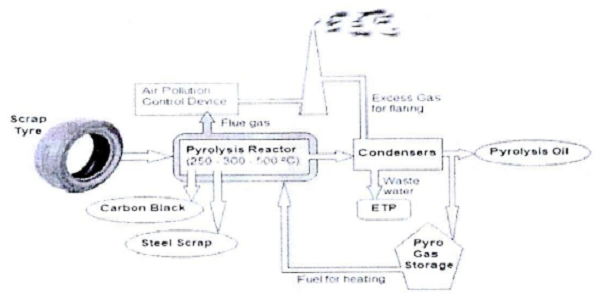
The Flow process chart of Tyre pyrolysis along with Material Mass Balance also along with their intended utilizations / end use were as follows:
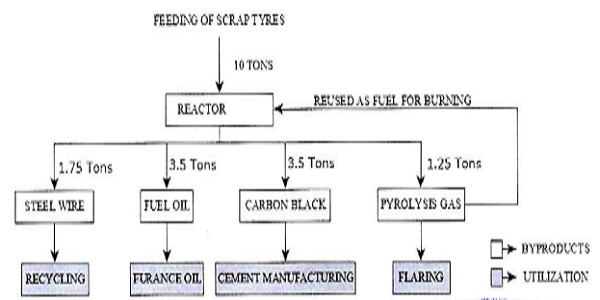
Tyre pyrolysis is the process of converting waste tyres into like Tyre Pyrolysis Oil (Main product), Tyre Pyrolysis recovered Carbon Black (By product -1), Tyre pyrolysis recovered Steel Wire scrap (By product -2) and Hydrocarbon Gas (Intermediate Product). In simple words, Latex which arc milk of rubber trees are nothing but “Carbo-Hydrates”. This long chain of “Carbo-Hydrates” arc reverse cracked i.e. pyrolysed in to medium and short chains of “Hydro — Carbon”. Medium chain of Hydrocarbon arc condensable liquids which are commercially known as Tyre Pyrolysis Oil (Main Product) and shorter chain of Hydrocarbon are non – condensable Gas which are commercially known as Tyre Pyrolysis Gas (Intermediate Product). Carbon Black which are used as filler in Tyre manufacturing is recovered as Recovered carbon Black (By product # 1). Steel used as reinforce for strength during Tyre manufacturing is recovered as Pyrolysed Tyre wire steel Scrap (By product #2).
The scrap tyres are being processed in batches, with duration of each batch about 2428 hours in Reactors. It takes 4 hours to mechanically load the tyres into the reactor. Initially, to attain the favourable temperature, Tyre pyrolysis oil is being used for burning in duel fuel burner. Once the reactor attains the temperature (360°C to 380°C), to breakdown the molecules, the vapours are generated. The vapour is liquefied to obtain pyrolysis oil by using condenser. The non-liquefied vapor is combustible gas, which is utilized to further increase the temperature of the reactor for completion of process. The reactors are set to maintain at a controlled temperature and pressure for about 7-9 hours. After which the reactors are set to cool for about 10-12 hours. Once the batch process is completed, Carbon black, the intermediate product of the process is recovered from the reactor mechanically through screw. Duration to unload the fractions from the reactor takes about 2-4 hours. Tyre wire Steel Scraps are removed mechanically after opening of reactor door.
As per study report of committee comprising CPCI3-Delhi, IIT-Delhi and NEERI-Nagpur (Study on Tyre Pyrolysis Plant’s adequacy — p. g. 18), in conclusions of the study, Tyre pyrolysis oil’s parameter is observed as follows:
“Tyre Pyrolysis Oil (TPO) has high calorific value in the range of 6300kcal/kg to 10200kcal/kg and low sulphur content in range of 0.87% to 1.28% wt. Ash content 0.087% wt., total halogen in the range of 146.27 ppm to 287.4 ppm. The carbon number varies from C4-C30, flashpoint is Class B i.e. 42°C to 54°C, boiling range from 66.4°C to 312°C. Sediment ranges from 0.002% to 0.0063% wt., PONA ranges from 69.53% to 70.87% v/v pour point varies from -30°C to -6°C. Conrad son carbon residue ranges from 0.62% to 3.41% and kinematic viscosity at 40°C ranges from 3.67 to 6.12. The value of Sulphur content, calorific value, Sediments, Lead, arsenic, Cadmium + Chromium + Nickel, PAI I, Total Halogens, PCB’s and water content in TPO is well within specified for fuel oil”.
As per independent test done by Applicant with Tyre pyrolysis recovered Carbon Black, the same has high calorific value from range of 6000Kcal/kg to 6500 Kcal/Kg, Ash & VM to 23% by wt. max, 2% by wt. of moisture content and 70 to 80% fixed carbon. The process of manufacturing recovered carbon black from the chor or raw carbon received from the reactor requires sieing, magnetic separation, grinding operation to be done.
Technical Sheet/Product Sheet submitted by the applicant is follows: Depolymerisation Oil (Pyrolysis oil) has been product of end of life rubber recycling. Middle molecular hydrocarbons condensed during the process of rubber pyrolysis is Depolymerisation Oil (Pyrolysis oil). Initial processing was limited to mass condensation of hydrocarbon gas.
Physical & chemical properties: