In re NMDC Limited (GST AAAR Madhya Pradesh)
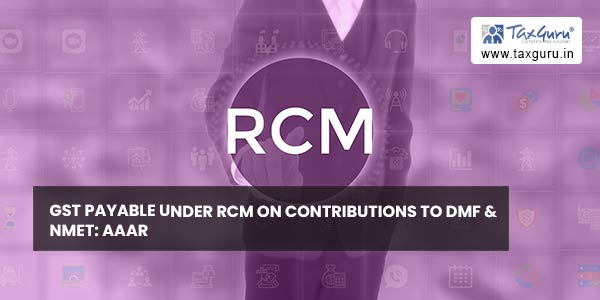
AAAR held that The Appellant is liable to pay GST under reverse charge on the contributions made to District Mineral Foundation (DMF) and National Mineral Exploration Trust (NMET) as per Mines and Minerals (Development and Regulation) Act, 1957.
Read Also AAR: Classification of service of granting of license by Govt to extract minerals
FULL TEXT OF THE ORDER OF APPELLATE AUTHORITY FOR ADVANCE RULING, MADHYA PRADESH
PROCEEDINGS
(Under section 101 of the Central Goods and Services Tax Act, 2017 and the Madhya Pradesh Goods and Services Tax Act, 2017)
At the outset, we would like to make it clear that the provisions of both the CGST Act and the MPGST Act are mirror image of each other except for certain specific provisions. Therefore, unless a specific mention is made to such dissimilar provisions, a reference to the CGST Act would mean a reference to the similar provisions under the MPGST Act and vice-versa. At places we may refer it as GST Act.
The present appeal has been filed under section 100 of the Central Goods and Service Tax Act, 2017 and the Madhya Pradesh Goods and Services Tax Act, 2017 [hereinafter also referred to as “the CGST Act and MPGST Act”] by M/s. NMDC Limited (hereinafter also referred to as the “appellant”) against the order of Authority for Advance Ruling No. 09/2019 dated 18.07.2019
BRIEF FACTS OF THE CASE
1. NMDC limited is a state-controlled mineral producer of the Government of India. It is owned by the Government of India and is under administrative control of the Ministry of Steel.
2. It is iron ore producer and exporter producing about 30 million tons of iron ore from 3 fully mechanised mines in Chhattisgarh and Karnataka.
3 NMDC Ltd. also has Diamond Mining Project at Majhgawan, Panna (M.P.) (hereinafter referred to as “NMDC” or “the company” or “the Appellant”) which is engaged in mining and sale of “rough diamonds” falling under chapter heading 7102 attracting GST rate of 0.25% .
Operating mines of NMDC includes the following-
Bailadila Iron Ore Mine, Kirandul Complex, Disst. South Bastar, Dantweada (Chhattisgarh)
Bailadila Iron Ore Mine, Bacheli Complex Distt. South Bastar, Dantewada (Chhattisgarh)
Donimalai Iron Ore Mine, Donimalai, Distt. Bellary (Karnataka)
Diamond Mining Project, Majhgawan, Panna (Madhya Pradesh)
QUESTIONS RAISED BEFORE AUTHORITY FOR ADVANCE RULING (AAR)
Questions as were raised before AAR are as under: –
1. Whether royalty paid in respect of Mining Lease can be classified under “Licensing services for the right to use minerals including its exploration and evaluation falling under the heading 9973 attracting GST at the same rate of tax as applicable on supply of like goods involving transfer of title in goods”?
2. Determination of the liability to pay tax on contributions made to District Mineral foundation (DMF) and National mineral Exploration trust (NMET) as per MMDR Act, 1957.
RULLING PRONOUNCED BY AUTHORITY FOR ADVANCE RULING (AAR)
1. In respect of the first question raised by the Applicant regarding the classification of service by way of granting of license to extract minerals, we rule that the said service shall be classified under Tariff Heading 99733.
2. In respect of the second question raised by the Applicant regarding the taxability or otherwise of the additional contributions made to DMF and NMET, we rule that the said contributions are nothing but additions to the royalty payable for the original supply itself, and is therefore liable to be added to the value of the original supply and treated accordingly for the purposes of GST.
QUESTIONS RAISED BEFORE THE APPELLATE AUTHORITY FOR ADVANCE RULING (AAAR)
The following question has been posed before the Appellate Authority with reference to the activity undertaken by the Appellant: –
Appellant’s liability to pay tax on contributions made to District Mineral Foundation (DMF) and National Mineral Exploration Trust (NMET) as per Mines and Minerals (Development and Regulation) Act, 1957 (MMDR Act, 1957) ?
GROUNDS OF APPEAL
The Appellant has given grounds of appeal in pdf format which are as under: –
Contribution made to District Mineral Foundation (DMF) and Natural Mineral Exploration Trust (NMET) are not for any taxable supply and hence, no GST should be on applicable on the contribution made by the Appellant.
12. Under the GST Law, all supplies of goods and services should attract GST (unless specifically exempted) Section 9 of the Central Goods and Services Tax act, 2017, (CGST Act) is the charging section which provides that there will be a levy of a tax called the Central Goods and Services Tax on all intra-state supplies of goods or services or both on the value determined under section 15 of the CGST Act, 2017 at such rates not exceeding twenty percent as may be notified by the Government. As is clear from the aforesaid section, the key pre condition for the levy of GST is presence of a supply”.
13. Section 7 of the CGST Act, 2017 defines the term supply and the relevant portion of the same is reproduced hereunder as follows:-
“7. (1) For the purposes of this Act, the expression “supply” includes-
(a) all forms of supply of goods or services or both such as sale, transfer, barter, exchange, license, rental, lease or disposal made or agreed to be made for a consideration by a person in the course or furtherance of business;
(b) import of services for a consideration whether or not in the course or furtherance of business; and
(c) the activities specified in Schedule I, made or agreed to be made without a consideration;
(d) the activities to be treated as supply of goods or supply of services as referred to Schedule II
…………………….
14 Section 7 of the CGST Act, 2017 defines the term “supply” to include all forms of supply of goods or services or both. Also, it expressly seeks to include all activities treated as supply of goods or supply of services as referred to Schedule II of the CGST Act, 2017- In this regard, Clause 5 of Schedule II provides for the list of activities that shall be treated as supply of services. Inter alia, Clause 5(e) provides that agreeing to the obligation to refrain from an act, or to tolerate an act or a situation, or to an act shall be treated as a supply of services. The relevant portion of the Schedule II is extracted hereunder for your ready reference:-
SCHEDULE II
(Section 7)
5. Supply of services
The following shall be treated as supply of services, namely:-
(a)……………..
……………………….
(c) agreeing to the obligation to refrain from an act, or to tolerate an act or a situation, or to do an act; and……”
15. Further, although there is no comprehensive definition of the term “service” (as it existed under the erstwhile service tax regime), the term “service” is defined as follows under section 2(102) of the CGST Act, 2017:-
” services means anything other than goods, money and securities but includes activities relating to the use of money or conversion by cash or by any other mode, from one form, currency or denomination, to another form currency or denomination for which a separate consideration is charged.”
16. A plain reading of the aforesaid provisions indicate that for a transaction to qualify as a ‘supply of service’, it is necessary there is an underlying ‘activity’ performed by one person for another for consideration.
17. In order to qualify as a ‘supply of service for a consideration there has to be a service provider and a service recipient who have agreed to perform/ receive specified services. The contract/agreement should involve contractual reciprocity.
18. For an activity to qualify as a ‘service’, the same has to be performed at the behest of the service, recipient. An act done without corresponding desire, or without reciprocate contractual obligation of the service recipient cannot be considered as an activity for a consideration.
19. Further, under the GST law, for a supply be taxable, the same has to be for a ‘consideration. Section 2(31) of the. CGST Act, 2017 defines the term ‘consideration’ as follows:
“(31) ”consideration” in relation to the supply of goods or services or both includes-
(a) any payment made or to be made, whether in money or otherwise, in respect of, in response to, or for the inducement of, the supply of goods or services or both, whether by the recipient or by any other person but shall not include any subsidy given by the Central Government or a State Government;
(b) the monetary value of any act or forbearance, in respect of, in response to, or for the inducement of, the supply of goods or services or both, whether by the recipient or by any other person but shall not include any subsidy given by the Central Government or a State Government:
Provided that a deposit given in respect of the supply of goods or services or both shall not be considered as payment made for such supply unless the supplier applies such deposit as consideration for the said supply;
20. from the definition of the term ‘consideration’, it is apparent that consideration can be monetary or non-monetary and that same should be ‘in respect of, ‘in response to’, ‘or for the inducement of the supply’ of goods or services or both, meaning thereby that it should be identified with a supply of service and have nexus with the said supply of service.
21. Basis the above, it is understandable the levy of GST is attracted only when there is i) an activity undertaken at the behest of the service recipient and ii) the same is in response to/ for consideration (as contemplated under section 2(31) of the CGST Act, 2017). In the Appellant’s case, there is no activity undertaken by the DMF Trusts and NMET at the behest of the Appellant for a consideration. The Appellant is mandated under law to contribute to the trusts set up and law and there is no voluntary contribution made by the Appellant in return for an activity. In fact, there is no agreement entered into for a specific service by the Appellant and the trusts in question for a pre-defined consideration.
22. In any event, since the trusts in question do not qualify as ‘government’ or ‘local authority’, there can no obligation on the Appellant to discharge GST under the reverse charge mechanism. Payment of GST, if any, shall be the liability of the trusts in question.
23. In short, it is submitted that there can no levy of GST on the contributions made by the Appellant:
– There is no activity/supply of service undertaken by the Trusts in question (DMF Trusts and NMET Trusts) for the Appellant;
– Further, even assuming that there is an activity undertaken by the Trusts, the same cannot be said to be in the course of furtherance of any business.
– Even assuming that the Trusts undertake a supply of service to the Appellant, the same cannot be subject to be GST since the same is not for a consideration;
Alternatively, since the trusts in question qualify neither as ‘government’ nor as ‘local authority’, there can no liability on the Appellant to pay tax under the reverse charge.
There is no activity/supply of service undertaken by the Trysts in question for the Appellant
24. The holder of mining lease shall, in addition to the royalty, pay to the District Mineral Foundation of the district in which the mining operations are carried an amount of 30% of royalty. Also, a certain portion of the royalty (at 2% is payable to NMET) by a mining lease holder.
25. District Mineral Foundation (DMF) is a trust set up as a non-profit body in districts where mining operations are carried out. The objective of a DMF is to work for the interest and benefit of persons, and areas affected by mining related operations in such manner as may be prescribed by the State Government. It is funded through the contributions from miners like the Appellant.
26. As per Rule 3 of District Mineral Foundation Rules. 2016 (” DMF Rules”) in the state of Madhya Pradesh, District Mineral Foundation (DMF) is set up in the form of trust. The objective of the, foundation as per Rule 4 of the said rules is as under
The Trust shall prepare schemes and plans as per guidelines of the Pradhan Mantri Khanij Kshetra Kalyan Yojna (PMKKKY) and instructions issued by the State Government from, time to time to ensure their implementation for the development of mining affected areas
27. The terms “affected people” and “affected areas” are also defined under the DMF Rules under rule 12. Under rule 12, the term ‘affected area’ shall include:
(i) Affected Areas.
(i) villages and Gram Panchayats within which the mines are situated and are operational. Such mining areas may extend to neighboring village, block or district of state.
(ii) An area within such radius from a mine or cluster of mines as may be. specified by the State Government, irrespective of whether this falls within the district concerned or adjacent district.
(iii) villages in which families displaced by mines have been re settled/rehabilitated by the project authorities.
(iv) Villages that significantly depend on the mining areas of meeting their economic needs and have usufruct and traditional rights over the project areas, for instance, for grazing, collection of minor forest produce etc.
(2) Indirectly affected areas- Those areas which are not directly affected but where local population is adversely affected on account of economic, social and environmental consequences due to mining related operations, even though the major negative impacts of mining could be, by way of deterioration of water, soil or air quality, reduction in stream flows sand depletion of ground water, congestion and pollution due to mining operations, transportation of minerals, increased burden on existing infrastructure and resources.
(3) The Foundation shall prepare and maintain and updated list of such directly and indirectly affected areas
28. Further, under Rule 12(4) of the DMF Rules, the the term “affected people” is defined to include the following:-
“Affected people -shall include:-
(a) Affected Family as defined under clause (c) of Section 3 of the Right to Fair Compensation and Transparency in Land Acquisition, Rehabilitation and Settlement Act, 2013 ((30 of 2013)
(b) Displaced Family as defined under clause (k) of Section 3 of the Right to Fair Compensation and Transparency in Land Acquisition, Rehabilitation and Resettlement Act, 2013 (No. 30 of 2013)
(c) Any other person or family appropriately identified by the concerned Gram sabha;
(d) people who have legal and occupational rights over the land, being mined, and also those with usufruct and traditional rights;
(e) the Foundation shall prepare and maintain an updated list of such affected persons/local communities.
29. In particular, rule 13 deals with expenditure from the Trust fund and according to the said rule, the funds available with the Trust shah be used for:-
– High priority areas – At least 60% of the funds shall be utilized under following heads:-
Drinking water supply