Mumbai Fabrics P. Ltd. Vs Union of India and Ors. (Bombay High Court)
Question for consideration is whether the seized goods imported by the petitioner are old and used rubber tyres reusable as tyres or are old and used rubber tyres scrap being in pressed baled form?
Evidently there is a dispute between the petitioner and the respondents regarding classification of the goods imported. While according to the petitioner the goods imported are old and used scrap tyres in pressed baled form which being a restricted item is covered by the import license, it is the stand of the respondents that 25% to 40% of the imported goods were found to be tyres in good shape and in reusable condition. Difering from the petitioner, it is contended that old and used tyres without any bead cut would fall under CTH 4012 which deals with retreaded or used pneumatic tyres of rubber, solid or cushion tyres, tyre treads and tyre flaps of rubber retreaded tyres. However, petitioner has contended and which has not been denied by the respondents that respondent No.4 had carried out 100% examination of the goods on arrival and thereafter levied duty following which petitioner paid the assessed duty. Thereafter out of charge was issued by respondent No.4.
Respondents have placed heavy reliance on the report of the Chartered Engineer which has been severely criticized by Mr. Nankani by pointing out what he termed as grave flaws in the report rendering it unft for any reliance. However, we are of the view that when the matter is at a very preliminary stage with investigation still on going, it would not be proper to make any comment on the report of the Chartered Engineer one way or the other. On the other hand, it has been the consistent prayer of the petitioner that samples should be drawn from the seized goods which should thereafter be sent for testing to the IRMRA which is a laboratory accredited to the Ministry of Commerce and Industry, Government of India.
Section 110A deals with provisional release of goods, documents and things seized (or bank account provisionally attached) pending adjudication on taking a bond with such security and conditions as the adjudicating authority may require.
Confiscation of improperly imported goods etc. is dealt with in section 111 and as per clause (d) any goods which are imported or attempted to be imported or are brought within the Indian customs waters for the purpose of being imported, contrary to any prohibition imposed by or under the Customs Act or any other law for the time being in force shall be liable to confiscation.
However, section 124 mandates that there can be no confiscation or imposition of penalty without issuance of show-cause notice and without giving a reasonable opportunity of hearing to the owner of the goods or to the person concerned.
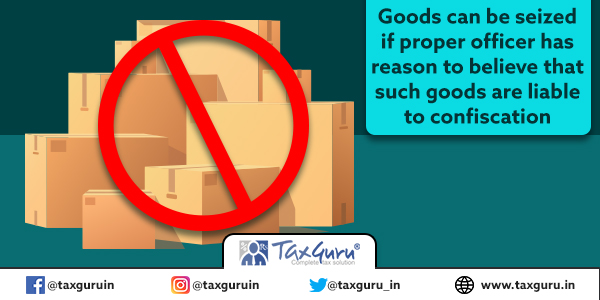
From a conjoint reading of the aforesaid provisions it is evident that seizure of goods is not an end in itself. Goods can only be seized if the proper officer has reason to believe that such goods are liable to confiscation. Further more, seizure cannot also be for an indefinite period. Timeline is provided in sub section (2) of section 110. In case of confiscation, the statute has provided for the requisite procedural safeguards in section 124. As a pragmatic measure, provisional release of seized goods pending adjudication is provided in section 110A.
Thus having regard to the dispute raised and the statutory framework in place, we feel that it may not be proper for the writ court to step in at this stage to render a finding as to whether the seized goods are old and used rubber tyres scrap in pressed baled form or rubber tyre in reusable form; in other words, whether the imported goods fall under the customs tarif heading of 4004000 or under the heading of 4012, which will basically be a finding of fact. Therefore, we are of the view that this aspect should be best left to the adjudicating authority to decide, if it requires adjudication. Preempting an adjudication on this issue by the writ court by taking a view one way or the other may not be justified. Moreover, having regard to the provisions of section 110, it may also not be proper for the writ court to fix a timeline for winding up of the investigation and for commencement and completion of adjudication at a stage when notice under section 124(a) of the Customs Act has not yet been issued.
Having said so, it needs no reiteration that the writ court is primarily concerned with the decision making process and not with the correctness of the decision per se. The decision making process and by extension the investigation process has to be fair and reasonable, adhering to the due process consistent with the principles of natural justice.
While respondents may place reliance on the report of the Chartered Engineer, petitioner would have the right to question the said report. Further more, request of the petitioner to draw samples from the seized containers and thereafter to send the samples for testing before an accredited laboratory, in this case IRMRA, cannot be brushed aside as being of no consequence. As a matter of fact, respondents themselves have allowed the same vide panchnama dated 9th September, 2020 though with the rider that customs department would have nothing to do with the testing; and that the drawing of samples for the purpose of testing has been facilitated on the request of the petitioner.
We fail to understand the rationale behind such a stand taken by the respondents. While respondents have stated that getting the goods examined by a Chartered Engineer is a well established departmental procedure, it is also a well established departmental procedure that in the case of seizure samples are drawn and then sent for testing in accredited laboratory/laboratories. We see no harm in acceding to such a request of the petitioner. Rather it will only facilitate a fair investigation and consequently fair adjudication. Test report from a laboratory which is accredited to the Ministry of Commerce and Industry, Government of India would certainly merit consideration being a relevant document and should be considered alongwith all other relevant documents including the report of the Chartered Engineer by the investigating/adjudicating authority. After all the procedure, be it investigation or adjudication, must not only be fair but must also be seen to be fair.
That being the position, we are of the view that the following directions will meet the ends of justice :-
I) Petitioner shall submit the samples in terms of panchnama dated 9th September, 2020 to an accredited laboratory, if not already submitted, for testing and report of such testing should be placed before the respondents.
(II) Such report in terms of direction (I) shall be considered by the respondents and authorities of the customs department alongwith other relevant materials while deciding the claim of the petitioner.
(III) In view of directions (I) and (II) above, petitioner may avail the offer of provisional release of the seized goods under section 110A of the Customs Act as per offer letter dated 26th August, 2020, which shall be without prejudice to the claim of the petitioner.
(IV) Investigation and consequential steps, including adjudication, if necessary, shall be expedited.
FULL TEXT OF THE HIGH COURT ORDER /JUDGEMENT
1. Heard Mr. Vikram Nankani, learned senior counsel alongwith Dr. Sujay Kantawala, learned counsel for the petitioner; and Mr. Anil C. Singh, learned Additional Solicitor General alongwith Mr. Pradeep Jetly, learned senior counsel for the respondents.
2. By fling this petition under Article 226 of the Constitution of India petitioner seeks quashing of the seizure memos dated 26th August, 2020 and further seeks a direction to the respondents for release of the seized goods.
3. Question for consideration is whether the seized goods imported by the petitioner are old and used rubber tyres reusable as tyres or are old and used rubber tyres scrap being in pressed baled form?
4. Case of the petitioner is that it is a company incorporated under the Companies Act, 1956 and is engaged in recycling of “waste tyres scrap” into “rubber crumbs granulation” at its factory. The process is a green category industry and is environmentally friendly for which petitioner has been granted consent by the Maharashtra Pollution Control Board, Navi Mumbai on 11th February, 2019. Petitioner has also been granted permission/no objection certificate dated 29th November, 2019 by the Ministry of Environment, Forest and Climate Change, Government of India for import of old and used rubber tyres scrap (multiple cuts/pressed baled/ shredded) for manufacture of crumb rubber.
5. Petitioner has been granted import license dated 27th December, 2019 by the Directorate of Foreign Trade, Government of India for the import of old and used rubber tyres scrap (multiple cuts/pressed baled/shredded). As per the import license such imported goods have been classified under the customs tarif heading 4004000 which covers waste, parings and scrap of rubber (other than hard rubber) and powders and granules obtained therefrom.
7. On the basis of the consent of the Maharashtra Pollution Control Board, permission/ no objection certificate of the Ministry of Environment, Forest and Climate Change, Government of India and import license issued by the Directorate of Foreign Trade, Government of India, petitioner imported seven consignments of old and used scrap tyres in pressed baled form at Nhava Sheva Port during the period July – August, 2020 whereafter clearance of the consignments were sought for by fling the following bills of entry:-