In re INA Bearing India Private Limited (GST AAR Maharashtra)
Whether the sale of goods, which are located outside India, would be liable to tax in India under section 7(5) (a) of Integrated Goods and Services Tax Act, 2017?
There is no doubt that the goods of the applicant would be imported goods if they are brought from outside the country into India and it is clear that when the location of the supplier is in India and the said goods are delivered/supplied from a place outside India to a place outside India, these goods have not crossed the customs frontiers of India, thus clearly the transaction in these goods are in the nature of inter-state supply as per Section 7(2) and 7(5) (a) of the IGST Act.
We find that proviso to Section 5(1) of the IGST Act states that “Provided that the integrated tax on goods imported into India shall be levied and collected in accordance with the provisions of section 3 of the Customs Tariff Act, 1975 on the value as determined under the said Act at the point when duties of customs are levied on the said goods under section 12 of the Customs Act, 1962”.
Thus from the above it is clear that integrated tax on goods imported into India is to be levied and collected in accordance with Section 3 of the Customs Tariff Act, 1975 and Section 12 of the Customs Act, 1962 and the same is to be levied and collected at the time of import into India. The goods are considered to be imported into India only after they clear the customs frontier after compliance of applicable procedures and payment of duty as applicable.
Thus as per Section 7(2) and 7(5) (a) of the IGST Act and proviso to Section 5(1) of the IGST Act it is very clear that in respect of imported goods into the territory of India there is no levy and collection except in accordance with the provisions of Section 12 of the Customs Act, 1962 and Section 3 of the Customs Tariff Act, 1975. Section 12 of the Customs Act, 1962 provides that custom duties which includes Integrated tax in respect of imported goods would be levied only at the time of import or export of goods.
Thus in case of goods supplied on an out an out basis as is in the present case, there is no levy till the time of their customs clearance in compliance with Section 12 of the Customs Act and Section 3 of the Customs Tariff Act. In view of this the imported goods sold from and to a non-taxable territory, though they are clearly in the nature of inter-state supply would come in the category of “exempt supply” as no duty is leviable on them except in accordance with proviso to Section 5(1) of the IGST Act.
We find that in the definition of exempt supply as given in Section 2(47) of the CGST Act is as under:-
Section 2(47) of the Central Goods and Services Tax (CGST) Act, 2017, “exempt supply” means supply of any goods or services or both which attracts nil rate of tax or which may be “wholly exempt from tax under section 11, or under section 6 of the Integrated Goods and Services Tax Act, and includes non-taxable supply”.
Further we find that Section 2(78) of the CGST Act defines non-taxable supply which is as under:-
” As per Section 2(78) of the Central Goods and Services Tax (CGST) Act, 2017, “non-taxable supply” means a supply of goods or services or both which is not leviable to tax under this Act or under the Integrated Goods and Services Tax Act”.
Thus it is very clear that the goods sold in the subject transaction are non-taxable supply as no tax is leviable on them till the time of customs clearance in accordance with and compliance of Section 12 of the Customs Act, 1962 and Section 3 of the Customs Tariff act, 1975.
FULL TEXT OF ORDER OF AUTHORITY OF ADVANCE RULING MAHARASHTRA
(under section 98 of the Central Goods and Services Tax Act, 2017 and the Maharashtra Goods and Services Tax Act, 2017)
The present application has been filed under section 97 of the Central Goods and Services Tax Act, 2017 and the Maharashtra Goods and Services Tax Act, 2017 [hereinafter referred to as “the CGST Act and MGST Act”] by INA Bearing India Private Limited, the applicant, seeking an advance ruling in respect of the following question.
a) Whether the sale of goods, which are located outside India, would be liable to tax in India under section 7(5)(a) of Integrated Goods and Services Tax Act, 2017?
b) If answer to (a) is yes, then whether the recipient, to whom such goods are sold, be eligible to avail the input tax credit of such goods ?
At the outset, we would like to make it clear that the provisions of both the CGST Act and the GST Act are the same except for certain provisions. Therefore, unless a mention is specifically made to such dissimilar provisions, a reference to the CGST Act would also mean a reference to the same provision under the MGST Act. Further to the earlier, henceforth for the purposes of this Advance Ruling, a reference to such a similar provision under the CGST Act / MGST Act would be mentioned as being under the “GST Act”.
02. FACTS AND CONTENTION – AS PER THE APPLICANT
The submission (Brief facts of the case), as reproduced verbatim, could be seen thus –
STATEMENT OF THE RELEVANT FACTS HAVING A BEARING ON THE QUESTIONS AS PROVIDED IN ANNEXURE1
Brief Background of the Transaction:
> INA Bearings India Private Limited (hereinafter referred to as ‘Applicant’) is engaged in supply of bearings and tools. The Applicant supplies bearings to a wide range of customers which inter-alia include Original Equipment Manufacturers (OEM).
> It is pertinent to note that for manufacture of bearings for specific customer, a specific type of tool is required. These tools are developed basis the requirements of the customers. Using these specially designed tools, child parts are manufactured and supplied to our customer. Typically, while entering into a contract for supply of bearings, the customer issued two purchase orders viz:
> PO No. RNAIPL/2013/B4A/PTVT/230 dated 13.09.2013 for supply of tools and
> PO No. RN15-MP-113W-K316 dated 28.05.2015 for supply of tappets.
> The Applicant in-turn raised a purchase order on Scaheffler Technologies AG & Co. KG (for the purpose of brevity herein after referred as “Scaheffler Germany”) for supply of tools. The tools which are required for manufacturing is developed outside India by Scaheffler Germany. Once the tool was developed, Scaheffler Germany had raised an invoice bearing number 130213462 dated 16.03.2018 on the Applicant for the tools and the ownership of the said tools got transferred to the Applicant, however, there was no physical movement of tools i.e. the tools continue to remain in the possession of Scaheffler Germany.
> The Applicant had in turn raised an invoice bearing number 1045197 dated 16.03.2018 on its customer in India and thereby the ownership of the tools got transferred to the customer, however, the tools physically continue to remain under the possession of Scaheffler Germany.
> The diagrammatic representation of the transactions executed is as below:
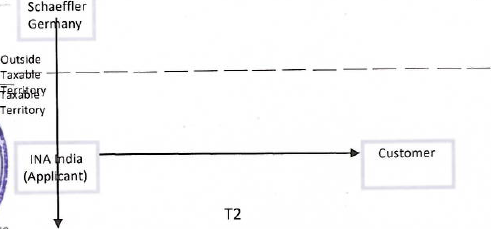
Where,
T1 = Transfer of ownership of Tools from Schaeffler Germany to INA India without movement of tools
T2 = Transfer of ownership of Tools from INA India to Customer without movement of tools and where the tools are situated in Germany
> The issue under consideration is
> whether transfer of ownership to customer without physically moving goods from Germany would make the transaction liable to GST in light of provisions of section 7(5)(a) of Integrated Goods and Services Tax Act, 2017 (IGST Act, 2017) and will the Applicant be required to charge IGST on the tools sold to its customer in India.
> If IGST is applicable on the transaction under consideration, then whether Applicant’s customer would be eligible to avail the input tax credit of IGST charged by the Applicant.
The Applicant is making detailed submission herein below to demonstrate why IGST should not be applicable on the transaction under consideration.
Statement containing the applicant’s interpretation of law and/or facts, as the case may be, in respect of the questions(s) on which advance ruling is required
A. Levy of IGST cannot be extended beyond territorial jurisdiction of the said legislation.
Evaluating IGST provisions to understand possibility of levying IGST
A1. With reference to facts of the applicant summarized in Annexure 2, the transaction of supply of tool to customer in India by Applicant needs to be evaluated in terms of IGST Act to understand nature of transaction and to evaluate applicability of IGST.
A2. Section 7 of IGST Act, 2017, lays down the principles to determine nature of transaction as inter-state transaction. In this regard, attention is invited to provision of section 7(5) which reads as under:
‘(5) Supply of goods or services or both,-
(a) when the supplier is located in India and the place of supply is outside India;
(b) to or by a Special Economic Zone developer or a Special Economic Zone unit; or
(c) in the taxable territory, not being an intra-State supply and not covered elsewhere in this section, shall be treated to be a supply of goods or services or both in the course of inter-State trade or commerce.’
(Emphasis provided)
A3. In order to evaluate applicability of section 7(5)(a), it is pertinent to evaluate following aspects of transaction in question –