Summary: NVIDIA announced the reinstatement of founder Jensen Huang as President, CEO and director on 23 November 2026, following a unanimous board decision taken on 22 November. The announcement reversed a leadership transition disclosed on 12 November, when CFO Colette Kress became interim CEO. NVIDIA shares closed at $165.05, rising 31.48% and restoring approximately $952 billion in market capitalisation. The recovery extended to broader technology markets. However, independent investigations remain ongoing, and the company has introduced additional national security and export-control oversight. Strong data centre revenue and AI infrastructure demand support its business outlook, but customer concentration, competition, export restrictions and corporate governance remain important risks. For investors, the episode illustrates the distinction between a recovery in market sentiment and sustainable earnings growth.
What Happened to Jensen Huang?
NVIDIA’s board accepted Huang’s resignation on 11 November 2026 and publicly announced the leadership transition on 12 November. Colette Kress was appointed interim CEO while retaining her finance responsibilities, and Harvey C. Jones became board chair. The departure followed controversy over Huang’s personal conduct and reports of possible foreign intelligence targeting. These reports must be distinguished from established findings of misconduct or breaches of national security.
Timeline of NVIDIA’s Leadership Crisis
| Date | Development |
|---|---|
| 8 November 2026 | Huang issued a personal apology. |
| 10 November 2026 | Independent directors announced the appointment of outside counsel for an investigation. |
| 11–12 November 2026 | Board accepted resignation and publicly announced the CEO transition. |
| 17 November 2026 | NVIDIA announced third-quarter financial results. |
| 22 November 2026 | Board reinstated Huang, effective immediately, according to the SEC filing. |
| 23 November 2026 | Reinstatement publicly announced; shares surged. |
NVIDIA Share Price Recovery
| Particulars | Value |
|---|---|
| Previous closing price (approximately, calculated) | $125.53 |
| 23 November closing price | $165.05 |
| Single-day gain | 31.48% |
| Market capitalisation restored | Approximately $952 billion |
| Market capitalisation after rally | Approximately $3.98 trillion |
The previous close is derived by dividing $165.05 by 1.3148. This implies an increase of approximately $39.52 per share. Despite the extraordinary recovery, reporting indicates that the stock remained below its pre-resignation level. The rebound does not represent cash received by NVIDIA: market capitalisation measures the market value of outstanding shares, not operating cash flow or corporate profit.
Why Did NVIDIA Reinstate Jensen Huang?
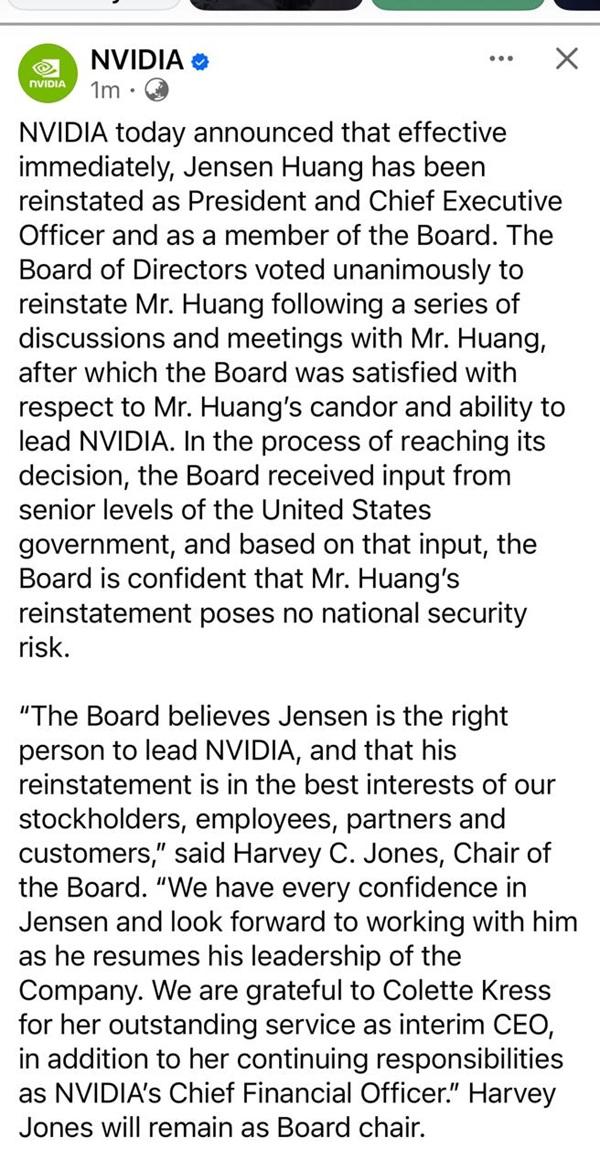
The board stated that discussions with Huang restored its confidence in his leadership and candour. Following input from senior US government officials, it concluded that reinstatement did not pose a national security risk. President Donald Trump welcomed the decision. Huang’s familiarity with NVIDIA’s technology roadmap, customers and supply chain may help restore strategic continuity, although these commercial considerations are editorial analysis rather than independently established reasons for each director’s vote.
Corporate Governance and Regulatory Risks
The company confirmed that its independent investigation into reports of foreign intelligence targeting would continue. Huang pledged cooperation. NVIDIA also established an independent National Security and Export Control Committee and initiated a search for a Chief Compliance Officer. Reinstatement is not equivalent to the closure of investigations or an independent legal finding that no violations occurred.
The rapid reversal highlights key-person risk, the importance of succession planning and the need for independent board oversight. Investors should assess whether the new compliance arrangements operate effectively and whether subsequent disclosures resolve outstanding concerns.
NVIDIA Financial Performance and AI Growth
NVIDIA’s third-quarter FY2027 announcement reported revenue of approximately $115.8 billion, up 103% year on year, and data centre revenue of $107.6 billion, up 110%. Data centres accounted for approximately 92.9% of total quarterly revenue. This demonstrates the commercial importance of AI infrastructure but also exposes NVIDIA to any slowdown in spending by major cloud and AI customers.
Future growth will depend on accelerated computing, AI inference, enterprise deployments, networking and the successful introduction of new processor architectures. Investors should examine free cash flow, gross margins, receivables, customer financing and capital commitments alongside reported revenue growth.
Impact on Global and Indian Stock Markets
US technology shares rallied on 23 November, with the Nasdaq Composite gaining around 6.5% and the S&P 500 approximately 4.7%. The Dow rose approximately 3%. The response reflects a broader improvement in risk sentiment, although other market factors may also have contributed.
Semiconductor manufacturers, memory suppliers, AI server makers and data centre infrastructure businesses may benefit from sustained AI expenditure. In India, technology services, electronics manufacturing, data centres and power infrastructure could see indirect opportunities. Indian IT companies could benefit from AI implementation and cloud migration, but automation may also pressure traditional service revenues. Indian investors holding international funds or US equities should additionally consider currency exposure and applicable tax obligations.
Key Factors to Monitor
- Independent investigation findings and regulatory disclosures.
- Export controls and access to international markets.
- Quarterly revenue, profitability and free cash flow.
- Customer concentration and the returns customers earn on AI infrastructure.
- Competitive processors and semiconductor supply constraints.
- Board independence, succession planning and compliance oversight.
Conclusion
Jensen Huang’s return reduces immediate leadership uncertainty but does not eliminate NVIDIA’s governance and regulatory risks. The extraordinary stock market reaction demonstrates how closely AI investment sentiment is tied to the company’s prospects. Sustainable shareholder value will ultimately depend on profitable growth, cash generation, competitive strength and effective governance rather than leadership sentiment alone.
***
Disclaimer: This article is prepared for general educational and informational purposes and reflects information available as of 24 November 2026. It is not an offer, solicitation or personalised recommendation to purchase, sell or hold any security, mutual fund, exchange-traded fund or other financial instrument. The valuation scenarios are hypothetical illustrations using assumed earnings and valuation multiples, and do not constitute independent earnings forecasts, assured returns or investment targets. Actual performance may differ materially because of market volatility, changes in interest rates, currency fluctuations, competition, technological developments, trade restrictions, legal proceedings, operational performance and other factors. Historical share price movements are not reliable indicators of future performance. Company announcements represent the company’s stated position and do not necessarily establish the outcome of independent investigations or government inquiries. Allegations and pending proceedings should not be construed as findings of wrongdoing. Market capitalisation figures may be rounded and may vary according to the data provider and share count used. Investors should independently verify current financial statements, regulatory filings, market prices and applicable taxation before making decisions. Individual investment suitability depends on financial circumstances, investment objectives, time horizon, portfolio diversification and risk tolerance. Readers should seek guidance from an appropriately qualified and registered investment adviser where necessary. No assurance is given that any illustrative scenario will occur. Investments in equity securities, including foreign securities, involve the risk of partial or complete loss of capital.