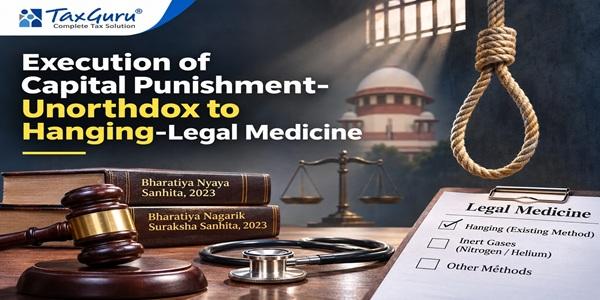
Execution of Capital Punishment-Unorthdox to Hanging-Legal Medicine
Summary: The method of executing capital punishment in India raises important constitutional, legal and medical questions concerning human dignity, physical suffering and the limits of permissible punishment. The Supreme Court considered these issues in Rishi Malhotra v. Union of India, 2026 SCC OnLine SC 1602, where the petitioners challenged the constitutionality of execution by hanging and sought consideration of alternative methods. The Court declined to invalidate the existing statutory method, finding insufficient grounds to reconsider the earlier ruling upholding hanging, while leaving open the possibility of legislative or expert review. The article examines the statutory framework governing the death penalty under the Bharatiya Nyaya Sanhita, 2023, and Bharatiya Nagarik Suraksha Sanhita, 2023, alongside the constitutional principles established in Jagmohan Singh, Bachan Singh and Machhi Singh. These judgments address the validity of capital punishment, sentencing safeguards, aggravating and mitigating circumstances, and the rarest-of-rare doctrine. From the perspective of legal medicine, the authors discuss alternative execution methods involving inert gases and examine international litigation concerning nitrogen-based executions, including Smith v. Hamm and Jeffery Lee v. Greg Lovelace. The discussion also considers helium-related oxygen deprivation and the serious medical consequences of paraquat poisoning, with reference to the Sharon Raj murder case in Kerala. The central concern is whether any method of execution can reliably eliminate pain, suffering and uncertainty while satisfying the constitutional protection of human dignity. The authors ultimately question the assumption that an alternative method would necessarily constitute a painless execution and emphasise the need for careful examination of legal, medical and ethical considerations before changing the existing method.
- Capital Punishment in India: Hanging, Human Dignity and Constitutional Questions
- Alternate methods that can be adopted to execute Death Sentence:
- One of the alternate methods is of NITROGEN GAS:
- Helium Gas
- Paraquat-Posion:
- Conclusion: Medical Jurisprudence and the Question of Painless Execution
- References and Footnotes
Capital Punishment in India: Hanging, Human Dignity and Constitutional Questions
In India, one among of the major punishments is Death Penalty, to execute the same; the culprit will be hanged by the neck until death. Hanging a person until death is not an easy task per se, provided that hanged person should die at that point of time, if he takes breathe though hanged he/she released free and cannot be hanged twice. On top of the above, the offender should not feel pain while executing death penalty. Thus, hanging a person till death and incorporating alternative mode to execute death penalty involves medical jurisprudence. As in the case of Rishi Malhotra vs Union of India[1], challenged the method of hanging a person until death violates right to live with human dignity up to the end of the natural life and not satiate the Hon’ble Apex Court of India with regard to alternative mode of executing capital punishment. Hence, the Summit Court of India upheld the hanging a person by the neck until death. In this piece of write up, the authors tend to hones on alternative to execute death penalty in painless manner.
As stated supra, the Capital Punishment or Death Penalty or Death Sentence as it called prescribed under Section 4 of Bhartiya Nyaya Sanhita, 2023[2] as one of the major punishments in India. The Death Sentence imposed to offenders of heinous crime such as Gang Rape(Section 70(2) of BNS), Murder(Section 103(1) of BNS), Mob Lyching resulting to death(Section 103(2), Organizing Crime resulting to death Section 111(2)(a) BNS, Terrorism acts resulting to death-(Section113(2)(a)BNS), etc., and Section 453 of BNSS states that confirmation of death sentence by the High Court, passed by the Court of Session. The Judicial pronucements with regard to death sentence as held by the Apex Court of India. In first, Jagmohan Singh vs The State of U.P.[3], the Summit Court of India validated death penalty and went ahead to uphold to state that it should not violate Article 21 of the Constituion of India, Bachan Singh vs State of Punjab[4], the Apex Court of India whilst imposing death sentence, mitigating and aggravating factors shall be taken into account, the concept of “Rarest of Rare Cases” prompted, Machhi Singh vs State of Punjab[5], the Supreme Court of India, outlined the parameters to apply rarest of rare cases so as to award Death sentence.
Alternate methods that can be adopted to execute Death Sentence:
It’s not easy to get into a life as the same applies to while leaving a life. What’s the alternative method of hanging to execute succinctly laid as follows:
One of the alternate methods is of NITROGEN GAS:
Death penalty by inert gas i.e., nitrogen hypoxia where pure nitrogen is administered through a face mask to replace breathable oxygen, causing fatal oxygen deprivation. In the year 2024, the United States of America in Smith vs Hamm[6], 144.S.Ct.414(2024), offender Kenneth Eugene Smith was executed to death by availing Nitrogen Gas though while petition to stay for execution of death sentence through Nitrogen Gas. The said execution first of its kind in the United States of America. On contrary, executing through Nitrogen Gas was stayed in the case of Jeffery Lee vs Greg Lovelace[7], presented on September 11,2026 and the write up authored by Caroline E.Penfield on Nitrogen execution in which extensively aired out regarding execution by way of lethal Injection and Nitrogen Gas[8].The authors intended that Inert gases like that of Nitrogen gas are generally free of odor and taste, after within 2 to 6 minutes of breathing pure nitrogen, the brain and heart are starved of oxygen, leading to loss of consciousness and cardiac arrest .Sensors in your neck detect the dropping oxygen and trigger intense air hunger, severe distress, panic, and gasping before consciousness fades.
Helium Gas
Another gas is of Helium is a colorless, odorless, non-flammable, chemically inert gas and also chemically inert gas present in atmospheric air that is used in various branches of industry and in medicine. It is not a conventional chemical poison, but inhaling it can cause severe oxygen deprivation (hypoxia) and death and inhalation acts primarily by displacing oxygen in the lungs and alveoli, creating a steep diffusion gradient that rapidly washes out oxygen from the bloodstream helium allows normal exhalation of CO2, brain fails to activate allowing hypoxia to progress hence no urge to breath and sensation of suffocation . Rapid cerebral hypoxia directly impairs central nervous system function, leading to lightheadedness, loss of balance, syncope, and coma and it does not leave characteristic macro- and microscopic post-mortem changes and It dissipates fairly quickly in the ambient air, and usually its presence cannot be detected either in the blood or in the tissues. From the side of forensic perspective, deaths associated with oxygen deprivation may present difficulties in determining the precise circumstances and mechanism of death.
Paraquat-Posion:
In an intriguing case that had happen in the State of Kerala, where Greeshma murdered her boyfriend Sharon Raj by using Herbicide Paraquat posion, both were in good lovingly relationship, subsequently Greeshma happen to marry another person, for that moment of time Greeshma not interested to marry apart from his boyfriend Sharon Raj, finally they both Greeshma and Sharon Raj tied knot as marriage and then had sexual intercourse with free consent of both after marriage. The day is coming forward for marriage of Greeshma with another person, by then Greeshma intended to leave Sharon raj, but the said Sharon Raj denied the same, this Greeshma scrolled out in Online how to kill by way of poisoning, first she tried through over dose of paracemtoal (Dolo) tablets in “Slice” juice and it has not consumed by Sharon raj because of distaste, Greeshma’s plan failed and atlast she poisoned him by Paraquat poison and accomplished, hence this is the case of prosecution in S.C.764 of 2023-ADDITIONAL DISTRICT & SESSIONS JUDGE, NEYYATTINKARA sentenced to death but it should be subject to Top Court of the State i.e., Kerala High Court.
Paraquat dichloride is an incredibly potent, cheap weed killer used extensively across global agriculture, but it poses an extreme public health hazard. Absorbed by inhalation, ingestion, cutaneous , injection, Paraquat generates reactive oxygen species which cause cellular damage via lipid peroxidation, activation of NF-KB, mitochondrial damage and apoptosis in many organs. Paraquat also causes renal and liver injury. Ingestion of large amounts of liquid concentrate (>50–100 ml of 20% ion w/v) results in fulminant organ failure and death. Therefore , poisoning is not an acceptable alternative methods . It may involve substantial suffering, complications, severe prolonged medical deterioration.
Conclusion: Medical Jurisprudence and the Question of Painless Execution
Whilst begetting from the mother’s womb either of the mode C-Section or Normal, the pain that baby suffers will not hunch or speak out in public but the mother’s pain can be out spoken, as the same while executing the death sentence, the pain that Soul suffers will not be assume or sound off. Listing alternative method of executing death sentence is high time to bring forth, the authors had through this write up would like to state that there is no such method which is painless for execution of death.
References and Footnotes
[1] Rishi Malhotra vs Union of India, 2026 SCC Online SC 1602
[2] https://devgan.in/bns/section/4/
[3] Jagmohan Singh vs The State of U.P., 1973 SCC(Cri) 169
[4] Bachan Singh vs State of Punjab, (1982) 3 SCC 24
[5] Machhi Singh vs State of Punjab, 1983(3) SCC 470
[6] Smith vs Hamm, 144.S.Ct.414(2024)
[7] Jeffery Lee vs Greg Lovelace, on 11th of September 2026
[8] Caroline E.Penfield, Washington and Lee University School of Law, Before the Last Breath: How Alabama’s Nitrogen Execution Adoption Created a Procedural Crisis on Death Row, Volume.32, Issue 2, Spring 2026, Washington and Lee Journal of Civil Rights and Social Justice.
Cases Discussed
- Rishi Malhotra & Anr. v. Union of India, W.P. (Criminal) No. 145 of 2017; 2026 SCC OnLine SC 1602; decided on 18.08.2026 (Supreme Court). The Supreme Court declined to invalidate hanging as the prescribed execution method or refer its earlier constitutional validity ruling to a larger Bench, while leaving open government examination of alternative methods.
- Jeffery Lee v. Greg Lovelace and Others, Case No. 2:25-cv-680-ECM; order dated 09.06.2026 (United States District Court, Middle District of Alabama). The district court found Alabama’s nitrogen execution protocol unconstitutional and issued an injunction against its use for Lee; subsequent proceedings affected that relief.
- Smith v. Hamm, 144 S. Ct. 414 (2024) (United States Supreme Court). The litigation concerned an application for relief against execution using nitrogen hypoxia.
- Machhi Singh v. State of Punjab, (1983) 3 SCC 470 (Supreme Court). The Court elaborated factors for applying the rarest-of-rare doctrine.
- Bachan Singh v. State of Punjab, (1980) 2 SCC 684 (Supreme Court). The Constitution Bench upheld the constitutional validity of capital punishment subject to exceptionally stringent sentencing standards.
- Jagmohan Singh v. State of Uttar Pradesh, (1973) 1 SCC 20; 1973 SCC (Cri) 169 (Supreme Court). The Supreme Court considered the constitutional validity of the death penalty under the then-prevailing statutory scheme.
Author:
Pasapala Syed Mustaq, BA. LLB (Hon’s) (LLM) | Advocate, High Court of Andhra Pradesh & Dist.Court, Allagadda.
(Dr). Mulla Shirina, MBBS (Intern) | Siddhartha Medical College, Vijayawada.