Lokesh Kumar Goyal Vs ITO (ITAT Jodhpur)
Summary : The Income Tax Appellate Tribunal, Jodhpur Bench, allowed the appeal of Lokesh Kumar Goyal for assessment year 2015-16 and quashed reassessment proceedings initiated under Sections 147 and 148 of the Income-tax Act, 1961. The dispute concerned the date on which a reassessment notice was issued: although the notice bore the date 31 March 2021, the assessee maintained that the ITBA portal and email records established dispatch only on 1 April 2021.
The assessee had declared income of Rs. 3,87,400. Following information about alleged reversal trades in illiquid BSE stock options and an alleged bogus loss of Rs. 2,24,69,000, the Assessing Officer reopened the case and computed income at Rs. 2,29,60,672. The first appellate authority dismissed the assessee’s appeal.
Before the Tribunal, the assessee argued that digital signing or generation of a notice did not constitute its issuance. Reliance was placed on judicial decisions distinguishing electronic preparation from actual dispatch, including Navyug Eduventure Private Ltd., Sumanjeet Agarwal, Sharad Garg, Daujee Abhushan Bhandar (P.) Ltd. and Kalyan Chillara. The Department relied on the lower authorities’ orders.
The Tribunal accepted the assessee’s jurisdictional objection, holding that the notice was barred by limitation and lacked jurisdiction. It quashed all proceedings arising from that notice, allowed the appeal and did not adjudicate the remaining grounds.
Cases Discussed
- M/s Navyug Eduventure Private Ltd., ITA No. 3524/Del/2025 and C.O. No. 271/Del/2025, order dated 15 April 2026 — relied upon regarding the date of electronic issuance and procedural requirements.
- Union of India Vs Ashish Agarwal, [2022] 444 ITR 1 (SC) — discussed in the submissions concerning the Finance Act, 2021 transition.
- Sumanjeet Agarwal Vs ITO (Delhi High Court) — cited for the distinction between digital signing and dispatch.
- Sharad Garg Vs ITO, [2022] 136 taxmann.com 360 (Delhi) — electronic dispatch determines issuance.
- Daujee Abhushan Bhandar (P.) Ltd. Vs Union of India (Allahabad High Court; citation incomplete in source) — signing without dispatch is insufficient.
- Kalyan Chillara Vs Dy. CIT, (2024) 465 ITR 729 (Telangana HC) — notices dispatched on or after 1 April 2021 discussed.
FULL TEXT OF THE ORDER OF ITAT JODHPUR
The aforetitled appeal has been preferred by the appellant against the order dated 23.03.2026 u/s 147 of the Income Tax Act, 1961 (in short referred as ‘the Act’) passed by National Faceless Appeal Centre, Delhi [for the sake of convenience, hereinafter referred to as NFAC] by which appeal filed by the assessee was dismissed.
2. Facts of the case are that, the appellant filed return of income for AY 2015-16 on 22/09/2015 declaring total income of Rs. 3,87,400/-. It was widely reported in media and specific information was received regarding rampant tax evasion through coordinated and premeditated trading in illiquid stocks and on ‘options’ in the Bombay Stock Exchange. On receiving above information, it is noticed that the appellant indulged in trading in reversal trades in BSE stock options as per SEBI to book bogus loss of Rs. 2,24,69,000/- for FY 2014-15, relevant to AY 2015-16. The case was reopened, as there was suspicion, that income had escaped assessment. Thereafter, notices u/s 142(1),143(2) and 148 of the Act were issued time to time and after completion of proceedings total income of the appellant computed by the Learned AO as Rs.2,29,60,672/-, which was assailed by way of appeal and the Learned CIT(A) dismissed the same and aggrieving from the impugned order, appellant before us by present appeal.
3. Heard rival submissions and carefully perused the material available on record.
4. Reiterating the grounds of appeal, the Learned AR submitted that the Learned CIT(A) erroneously upheld reassessment proceedings initiated u/s 147/148 of the Act, without appreciated that the notice dated 31-03-2021 was served on 01-04-2021 i.e. after amendment by Finance Act, 2021, which is beyond the prescribed legal framework and only on this point, unsustainable in law.
5. Per Contra, the Learned DR relied upon orders passed by both lower authorities.
6. In the course of hearings, the Learned AR relied upon the order of coordinate bench, in the case of M/s Navyug Eduventure Private Ltd. ITA No.3524/Del/2025 & C.O.271/Del/2025, dated 15.04.2026, in which held that the notice under Section 148 of the Act and the proof of email issued to the assessee and sending time stamp is 1st April, 2021 as per ITBA document, which reflects that the notice has been issued on 1st April, 2021. The learned CIT-DR could not controvert or place any document to demonstrate that the requirement of issuing notice under Section 148 of the Act on 31st March, 2021 i.e., the same date as it was digitally signed, was fulfilled. Since the date of issuance of notice under Section 148 of the Act is 1st April, 2021, the notice under Section 148 of the Act can be construed as having been issued under Section 148A(b) of the Act under the provisions of Section 148 of the Act as inserted by the Finance Act, 2021 with effect from 1st April, 2021, as held by Hon’ble Supreme Court in the case of Union of India Vs. Ashish Agarwal – [2022] 444 ITR 1 (SC). But, the Learned AO has to follow necessary process laid down in the amended provisions u/s 148A of the Act. The amended provisions of Section 148 and 148A of the Act mandate conducting of an enquiry if required u/s 148A(a) of the Act and providing an opportunity of being heard to the assessee u/s 148A(b) of the Act and passing of an order under Section 148A(d) of the Act after taking due approval from specified authority before issuing notice under Section 148 of the Act is necessary, which is missing in the present case. Hence, notice u/s 148 of the Act issued on 1st April, 2021 is barred by limitation and without following Section 148 is invalid and bad in law.
7. The Learned AR further relied upon the order passed by the Hon’ble Delhi High Court in Suman jeet Agarwal versus ITO, in which held that the mere generation of a notice on the ITBA portal or its digital signing does not amount to issuance of the notice. The Court specifically examined the manner in which the ITBA system operates and distinguished between generation/digital signing of the notice and the subsequent triggering/dispatch of the e-mail. It was held that dispatch is a sine qua non for issuance of an electronic notice for the purposes of Section 149. Consequently, where the notice was dispatched on or after 01.04.2021, it could not be treated as having been issued on 31.03.2021.
8. Also submitted that similarly, in Sharad Garg v. ITO, [2022] 136 com 360 (Delhi), the Hon’ble Delhi High Court followed the aforesaid principle and held, in the context of electronic notices dated 31.03.2021, that mere digital signing does not amount to issuance; the notice is regarded as issued when it is actually e- mailed/dispatched to the assessee.
9. Further submitted that the principle was also considered by the Hon’ble Allahabad High Court in Daujee Abhushan Bhandar (P.) Ltd. v. Union of India, [2022] taxmann.com 246 (Allahabad), wherein it was held that merely drawing up and digitally signing a notice on 31.03.2021, in the absence of its dispatch, would not amount to issuance of the notice within the meaning of Section 149 and the date on which the electronically signed notice is transmitted/dispatched assumes significance for determining the date of issuance.
10. The Learned AR submitted that, In the case of Kalyan Chillara v. Dy. CIT (2024)465 ITR 729 (Telangana) (HC), on identical issue, it was observed that the last date for service of notice and initiating proceedings under section 148 of the Act was coming to an end on March 31, 2021 and in the majority of the cases, the notice was dated March 31, 2021 but had been issued from the office of the Department either on April 1, 2021 or on subsequent dates, on writ petitions contending that the notices were barred by limitation, allowing the petitions, that all the notices u/s 148, had been issued (not served) on April 1st, 2021 or on a later date. The question of service of these notices and the date of service of notices upon the assessees was of no relevance or consequence since the notices had been dispatched from the Department on or after April 1, 2021 which itself was beyond the period of limitation. It was held that all the notices issued under section 148, dated March 31, 2021, were barred by limitation under sections 148 and 149, since these notices had left the Income-tax Business Application portal on or after April 1, 2021 and therefore, were unsustainable.
11. Learned AR further submitted that the present matter pertains to assessment year 2015-16, in which notice u/s 148 bears the date 31.03.2021 and respondent on ITBA/E-mail record establishes that the notice was dispatched only on 01.04.2021 and appellant has sufficient documentary evidence in the Form of ITBA Portal Screenshot and E-mail record which specifically records on 01.04.2021 as the date of dispatch and as the notice was not issued/dispatched within the limitation prescribed under the law applicable upto 31.03.2021. The subsequent receipt of the notice by the appellant cannot cure the fundamental effect that the notice itself was dispatched only on 01.04.2021 and respondent cannot take advantage all these fact that the notice was generated or digitally signed on 21.03.2021 when its own record establishes that the notice was actually dispatched only on 01.04.2021 and as mentioned above, the notice u/s 148 is barred by limitation and without jurisdiction and all proceedings initiated pursuant thereto including the reassessment order liable to be quashed. For ready reference, view notices for E-proceedings as under:
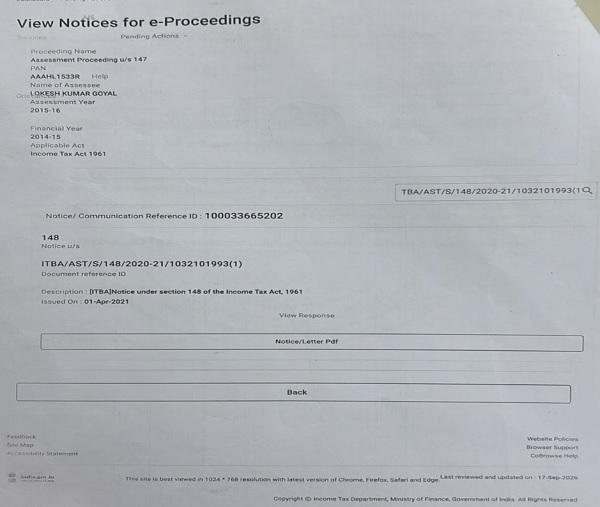
–
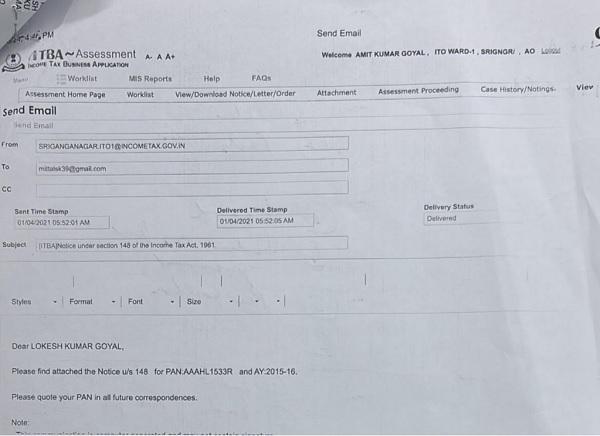
12. On the basis of discussions and submissions advanced on behalf of the appellant and fact situation as mentioned hereinbefore, we find material substance therein and we have no hesitation to conclude and hold that the notice in question u/s 148 barred by limitation and lacks jurisdiction, so all proceedings initiated pursuant thereto liable to be quashed and appeal is deserves to be allowed. As we dispose off appeal as above, other grounds does not required specific adjudication.
13. Consequently, this appeal is hereby allowed as above.
Order pronounced on 27/10/2026 in Open Court