Cent Bank Home Finance Ltd. Vs Commissioner (GSTAT Raipur)
Summary: GSTAT Raipur set aside the appellate order dated 24.03.2025 and remanded the matter to the Appellate Authority for consideration of documentary evidence concerning recovery from a written-off housing loan account. The appeal by Cent Bank Home Finance Ltd. arose from a GST demand of Rs. 4,18,440 for the period July 2017 to March 2018. The dispute originated from scrutiny of returns under Section 61 of the GST Act, followed by proceedings under Section 73.
The appellant contended that the disputed amount represented recovery of a written-off housing loan and was therefore not liable to GST. It relied upon Notification No. 12/2017-Central Tax (Rate) dated 28.06.2017. Entry No. 27 of the Notification covers services by way of extending deposits, loans or advances insofar as the consideration is represented by interest or discount, subject to the stated exception. The Department objected that this exemption plea had been raised for the first time before the Tribunal and that sufficient evidence establishing the nature of the disputed receipts had not been produced.
The Tribunal rejected the objection to consideration of the Notification. Referring to State of M.P. vs. Ramcharan, AIR 1957 MP 68, it observed that statutory notifications issued under delegated legislative power have the force of law. It further relied upon State of Madras vs. Rajagopalan, AIR 1955 SC 817 for the principle that a pure question of law may be raised at any stage of the proceedings. The Tribunal accordingly examined Notification No. 12/2017 and answered the first question of law in favour of the appellant, holding that the transaction relating to recovery of a loan amount was covered by the exemption.
On the factual issue, however, the Tribunal held that the appellant was required to establish through cogent and reliable documentary evidence that the amount actually related to a written-off loan account of its Raipur branch and was recovered during the relevant financial year. The record contained a document relating to housing loan account No. 01102060001944 showing a cheque deposit of Rs. 11,50,000 by Mr. Vinoj Kumar Jadhav on 01.01.2018. Expenses aggregating Rs. 43,218 were reflected under different heads, leaving Rs. 11,06,782 according to the computation recorded in the order. The account also contained a SARFAESI charge receivable of Rs. 40,157.
The Tribunal observed that the document was a record of a recognised bank and referred to Section 4 of the Banker’s Book Evidence Act, 1891, under which a certified copy of an entry in a banker’s book is admissible as prima facie evidence of the matters, transactions and accounts recorded therein. It found that the Appellate Authority had failed to consider the document in accordance with law.
Referring to Rule 112(4) of the CGST Rules, 2017, the Tribunal noted its power to direct production of documents or witnesses necessary for disposal of an appeal. It therefore held that a just decision required production and consideration of Annexure A6 and the record concerning the written-off housing loan. The order-in-appeal dated 24.03.2025 was consequently set aside and the matter remanded with directions to the appellant to produce certified copies of the relevant records and to the Appellate Authority to reconsider the matter according to law.
Cases Discussed
- State of M.P. vs. Ramcharan, AIR 1957 MP 68 — Relied upon for the proposition that law is not confined to legislative enactments and that statutory orders and notifications legislative in character constitute law.
- State of Madras vs. Rajagopalan, AIR 1955 SC 817 — Relied upon for the principle that a pure question of law can be raised at any stage of the proceeding.
FULL TEXT OF THE ORDER OF GSTAT
1. This appeal has been preferred under Section 112(1) of the Central Goods and Services Tax Act, 2017 and the Chhattisgarh Goods and Services Tax Act, 2017 (hereinafter referred to as the “GST Acts, 2017”) against the order dated 24.03.2025 passed by the Appellate Authority and Joint Commissioner (Appeal), State Tax, Raipur, in First Appeal No. 1010/GST/2024, in the case of M/s Cent Bank Home Finance Ltd., Raipur (C.G.). By the said order, the learned Appellate Authority dismissed the appeal and upheld the assessment order.
2. There are legal issues involved in this appeal therefore, this appeal is decided by Division Bench.
3. The brief facts of the case are that the Proper Officer, in exercise of the powers conferred under Section 61 of the GST Act read with Rule 142(1A) of the GST Rules, 2017, scrutinized the returns filed by the appellant and, upon noticing certain discrepancies therein, issued a notice in Form GST ASMT-10 dated 13.07.2023. However, the appellant failed to submit any reply to the said notice within the prescribed period. Consequently, a show-cause notice in Form GST DRC-01 dated 29.09.2023 was issued to the appellant under Section 73(1) of the GST Act, which proposed demand as under:
| Act | Tax | Interest | Penalty | Other | Total |
|---|---|---|---|---|---|
| IGST | 0 | 0 | 0 | 0 | 0 |
| CGST | 99,610 | 96,182 | 10,000 | 0 | 2,05,792 |
| SGST | 99,610 | 96,182 | 10,000 | 0 | 2,05,792 |
| CESS | 0 | 0 | 0 | 0 | 0 |
| TOTAL | 1,99,220 | 1,92,364 | 20,000 | 0 | 4,11,584 |
Even after expiry of the period of 30 days prescribed period under Section 73(8), CGST Act, the dealer neither paid the amount demanded in accordance with the provisions of the Act nor submitted any reply. Accordingly, an order was passed under Section 73(9) of the GST Act, 2017, creating the following additional demand:
| Act | Tax | Interest | Penalty | Other | Total |
|---|---|---|---|---|---|
| IGST | 0 | 0 | 0 | 0 | 0 |
| CGST | 99,610 | 96,610 | 10,000 | 0 | 2,09,220 |
| SGST | 99,610 | 96,610 | 10,000 | 0 | 2,09,220 |
| CESS | 0 | 0 | 0 | 0 | 0 |
| TOTAL | 1,99,220 | 1,93,220 | 20,000 | 0 | 4,18,440 |
Aggrieved by the aforesaid order, the appellant preferred a first appeal, which was dismissed as stated above.
4. The main grounds of appeal are that the order passed by the State Tax Officer is unsustainable in law and on facts, having regard to the facts and circumstances of the case. The assessment order is arbitrary, unreasonable, and contrary to the provisions of law, particularly as no notice in Form GST DRC-01A was issued to the appellant prior to initiation of the proceedings. It is further contended that the learned Appellate Authority erred in observing that, despite issuance of notice, no one appeared on behalf of the appellant. In fact, the appellant was duly represented by its Chartered Accountant, Shri Yashwant Sharma, who appeared physically before the authority on 08.08.2024 and participated in the proceedings. A letter was also uploaded on the GST portal on 29.10.2024, specifically stating that the appellant had appeared physically before the authority on 08.08.2024. The said material was not properly considered by the learned Appellate Authority. It is further submitted that the learned Appellate Authority erred in confirming the demand towards tax, interest, and penalty amounting to Rs. 4,18,440/-, despite the appellant’s specific contention that the amount in question pertained to the “Write-off of Housing Loan Account”, which, according to the appellant, constitutes an exempt/non-GST transaction under Notification No. 12/2017 dated 28.06.2017. It was contended that the transaction merely involved the recovery/write-off of a housing loan and constituted a transaction in money, relating to a loan, and therefore did not attract levy of GST. The appellant further contends that the documentary evidence and other material placed on record in support of its claim were not duly considered by the authorities below. The impugned order, therefore, suffers from non-consideration of material evidence and is liable to be set aside. Accordingly, the appeal deserves to be allowed.
5. The respondent, in his detailed reply, denied almost all the facts and grounds raised by the appellant and also raised a preliminary objection that the appellant had not furnished any details or documentary evidence in support of the exempted, nil-rated or non-GST supplies in Table 5 of its annual return in Form GSTR-9 or in the reconciliation statement in Form GSTR-9C at the stage of scrutiny. It was further submitted that the appellant had claimed the benefit of Notification No. 12/2017 dated 28.06.2017 for the first time before this Tribunal and that such a claim was an afterthought. According to the respondent, this factual plea had never been disclosed in the appellant’s returns and was not supported by any documentary evidence, such as ledger accounts, borrower-wise recovery statements, resolutions relating to write-off of loans, or any other corroborative evidence, either before the Proper Officer or before the First Appellate Authority. The respondent further submitted that all statutory pre-conditions, opportunities of hearing and procedural safeguards prescribed under Sections 61, 73 and 107 of the GST Act, 2017, had been duly complied with. The appellant was specifically called upon, through the notice issued under Section 61 of the GST Act, to furnish a list of and documentary evidence in support of the exempted, nil-rated and non-GST supplies reported in Form GSTR-9. However, the appellant failed to submit any reply or supporting documentary evidence within the prescribed period. The respondent also contended that the appellant’s claim that the amounts recovered in respect of written-off housing loan accounts were exempt under Notification No. 12/2017 dated 28.06.2017 had not been substantiated by any cogent or reliable evidence. The appellant failed to produce borrower-wise reconciliation statements, the Board’s resolutions relating to the write-off of the loans or receivables, relevant ledger extracts, or any other documentary evidence establishing that the disputed amounts represented recovery of written-off housing loans. Accordingly, the respondent submitted that the appellant had failed to establish its entitlement to the exemption claimed under Notification No. 12/2017 dated 28.06.2017 at any stage of the proceedings. In the absence of supporting documentary evidence, the claim of exemption was, therefore, liable to be rejected.
6. Appellant’s Rejoinder: The appellant, in his rejoinder, has contended that the cross-objection filed by the Department is barred by limitation, having been filed beyond the prescribed period, and is, therefore, not maintainable. The appellant has further submitted that the observation that he did not appear for the personal hearing is factually incorrect. It has been stated that the appellant’s authorised representative duly appeared before the authority on 08.08.2024 and that a synopsis in support of the appellant’s submissions was also uploaded on 14.08. 2024.With regard to the disputed amount, the appellant has contended that the same is outside the purview of GST, as it represents the recovery/return of the loan amount advanced by the appellant and, therefore, does not constitute a “supply” within the meaning of the GST law. According to the appellant, irrespective of whether such transaction is described as a non-GST supply or an exempt supply, the amount is not liable to GST, as it merely represents the return or recovery of the principal amount of the loan advanced.
7. The argument of the learned C.A. appearing on behalf of the appellant is that the cross objection is time barred therefore not maintainable. It is filed on 24.08.26.but the period of limitation was already expired on 04.05.26. Appellant was given loan to his consumers. It is not supply, therefore, not taxable in GST Act. Charted Account on behalf of appellant was appeared before Assessing Officer on 08.08.24 and filed reply with annexures but CA’s presence was wrongly not mentioned in the order. CA filed a representation on 29.10.24 in this regard. According to him, he uploaded his reply along with annexures on portal also on 06.08.24 but reply was not considered by Assessing Officer.
8. The argument of the learned authorized representative appearing on behalf of the respondent is that the appellant has taken new stand of notification no.12 dated 28.06.2017 for the first time in the Tribunal. The case of appellant is also not covered in non-GST supply. The cross Objection is well within time after receiving notice of Tribunal. There are no documents on record which prove the transaction related to write off loan. Even after calling of documents by Proper Officer appellant did not submit, it.
9. Questions of Law and Fact Involved in the Appeal
1. Whether the recovery of write-off amount of a housing loan account is exempt from the levy of GST under Notification No. 12/2017 dated 28.06.2017?
2. Whether the transaction in question undertaken by the appellant pertains to the recovery of the amount relating to the write-off of the housing loan account?
REASONS OF CONCLUSION
On question of law no-1
10. Learned Authorised representative of respondent took the plea that appellant first time raise the objection regarding non consideration of Notification number 12 dated 28.06,2017 before Tribunal which is not maintainable. We considered this plea. This notification was issued under power given under section 11 of GST Act, to Central Government so, it keeps force as a law and also applied as a law. In this regard State of M.P. vs. Ramcharan AIR 1957 MP 68 Para 8 laid down as following: –
8. As a result of the above discussion, it is clear that under our legal order and jurisprudence based on the Constitution, “Law” is not limited to Legislative enactments. All forms of delegated Legislation and conditional Legislation amount to law. All orders and notifications made and issued under statutory powers and which are legislative in nature amount to Law. A statutory order or notification will be in legislative in nature if in substance it adds to, supplements, modifies or amends a statue or exempts certain matters from its operation.
11. It is settled law that a pure question of law can be raised at any stage of proceeding, as per State of Madras vs. Rajagopalan AIR 1955 SC 817. The plea of respondent is not tenable.
12. The extract of the notification no-12 dt. 28.06.2017 as under: –
(TO BE PUBLISHED IN THE GAZZTE OF INDIA EXTRAORDENARY, PART II,
SECTION 3 SUB- SECTION (i))
Government of India
Ministry Of Finance
(Department of Revenue)
Notification No. 12/2017 -Central Tax (Rate)
New Delhi, the 28th June 2017
G.S.R……. (E). – In exercise of the powers conferred by sub section(1) of section 11 of the Central Goods and Service Tax Act, 2017 (12 of 2017), the Central Government, on being satisfied that it is necessary in the public interest so to do, on the recommendations of the council, hereby exempt the intra- state supply of service of description as specified in column (3) of the Table below from so much of the central tax leviable thereon under sub-section(1) of section-9 of the said Act, as is in excess of the said tax calculated at the rate as specified in the corresponding entry in column (4) of the said Table, unless specified otherwise, subject to the relevant conditions as specified in the corresponding entry in column (5) of the said Table, namely:-
| 27 | Heading 9971 | Service by way of-
(a) Extending deposits, loans or advances in so for as the consideration is represented by way of interest or discount (other than interest involved in credit card services): (b) Inter se sale or purchase of foreign currency amongst banks or authorised dealers of foreign exchange or amongst banks and such dealers. |
4. This notification shall come into force on the 1st day of July. 2017.
[F.No.334/1/2017-TRU]
(Ruchi Bisht)
Under Secretary of the Government of India
13. According to Entry No. 27 of the aforesaid Notification No. 12/2017, services by way of extending deposits, loans, and advances are exempt from the levy of GST. Therefore, it is evident that the transaction relating to the recovery of a loan amount is covered by the aforesaid exemption. Accordingly, the first question of law is answered in favour of the appellant.
On question of fact no-2
14. So far as the non-maintainability of cross objection due to its time barred is concern, in our considered opinion it is not a cross objection but reply /Counter Statement of appeal. Filing of Cross Objection is only necessary where some relief was not granted to respondent but in this case Order in Appeal is completely in favour of respondent, therefore, it is not necessary to him to file a Cross Objection. If we assume that it is Cross Objection it will be maintainable because it is produced after notice of appeal to respondent within time, therefore, this objection is not acceptable.
15. In order to claim the benefit of the aforesaid Notification No. 12/2017, the appellant is required to establish, by producing cogent and reliable documentary evidence, that the amount in question pertains to a written-off loan account of Raipur branch and that the said amount was recovered during the relevant financial year, i.e.`, from 01.04.2017 to 31.03.2018.
16. A notice dated 30.06.2023 has been filed by the appellant, which is issued by the State Tax Officer circle 4 Raipur. He also pleaded fact of receiving this notice in his statement of facts. The notice is as under: –
कार्यालय सहायक आयुक्त राज्य कर वृत्त – चार रायपुर
Reference No.
date 30-06-2023
GSTIN – 22AAACC6380N2ZJ,
LEGAL Name: – CENT BANK HOME FINANCE LIMITED,
TRADE NAME: – CENT BANK HOME FINANCE LIMITED,
Address: – RDA Building 1 2nd floor GE road Bombay Market 492001
E-Mail: – [email protected]
Mobile 9770385779
Subject: – Notice of intimating discrepancies in the return after scrutiny u/s 61 Tax period July 2017 to March 2018.
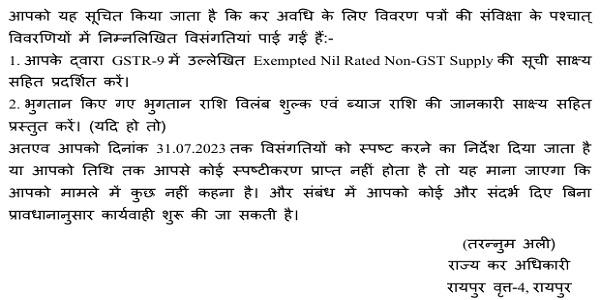
Appellant asked for producing list of Exempted Nil Rated Non-GST supply with evidence which has been mentioned in GSTR-9 by him by above notice. He was also asked for producing information related to late fees and interest paid with evidence (If available) by above notice.
17. Appellate Authority has mentioned in his order dated 24.03.25 para number 1 that the appellant has not produced the evidence of Non-GST Supply therefore the proceeding under section 73 was initiated against him.
18. Learned C.A. appeared on behalf of appellant argued that he uploaded reply with annexures on GST portal on 6.08.2024 and appeared before Appellate Authority on 8.08.2024 but his presence did not get mentioned and produced documents did not get considered.
19. We perused the record of learned Appellate Authority. In the record there is document related to write off loan account no. 01102060001944 in which a cheque of Rs. 11,50,000/- cheque number 174854 was deposited by one Mr. Vinoj Kumar Jadhav on1.1.2018. In this account there are some expenses Total 43,218/- are entered in various head like Account closure of 01102060001944 Rs. 100, Being amt trf to sarfaesi charge receivable of Mr Jadhav Rs. 40,157, sus bal recovered from Mr Jadhav Rs, 2961. If we deduct 43,218/- from 11,50,000/- the remining amount is 11,06,782/-. According to appellant, this has been considered as a taxable supply by the Assessing Officer and imposed tax.
20. In this account it is entered that Rs. 40,157 SARFAESI charge receivable of Mr. Jadhav. It shows that appellant Bank also attempted to recover loan by taking procedure of SARFAESI Act,2002.
21. Above-mentioned document is a document of a recognized Bank (A Central Bank of India subsidiary) which has not been considered by the learned Appellate Authority. Appellate Authority could, if desired necessary, verify this document by sending a letter to concern branch of the appellant’s bank or call a copy certified by the Branch Manager of appellant’s Bank. A copy certified by Branch Manager of Bank is admissible as a proof of facts mentioned in the document in any Court, Tribunal or Quasi-Judicial Authority in light of section 4 of Banker’s Book Evidence Act, 1891 and no other formal proof is required for this type of document. The learned Appellate Authority has failed to consider above document as per law.
22. Section 4 of Banker’s Book Evidence Act,1891 is as follow; –
4. Mode of proof of entries in banker’s books
Subject to provisions of this Act, a certified copy of any entry in a banker’s book shall in all legal proceedings be received as prima facie evidence of the existence of such entry, and shall be admitted as evidence of the matters, transactions and accounts therein recorded in every case where, and to the same extent as, the original entry itself is now by law admissible, but not further or otherwise.
23. Where a deposit of Rs. 11,50,000 is made by Mr. Vinoj Kumar Jadhav in a written-off housing loan account there must be some record of write off housing loan in appellant possession otherwise why a person deposit this much amount by cheque to appellant.
24. Rule 112 (4) of CGST Rules,2017 as under; –
(4) Nothing contained in this rule shall affect the power of the Appellate Authority or the Appellate Tribunal to direct the production of any document, or any witness, to enable it to dispose of the appeal.
25. In our considered opinion for just decision of this litigation this appeal should be remanded for production and consideration of above two documents namely; Annexure A6 and record of written-off housing loan.
26. Consequently, we set aside the Order in Appeal dated 24.03 25 and remand the appeal to Appellate Authority with the direction that Appellant shall produce the certified copy of Annexure 6 and record of written-off housing loan of account number 01102060001944 of Mr. Vinoj Kumar Jadhav. Authority shall consider above record and decide this appeal according to Law.