#AD
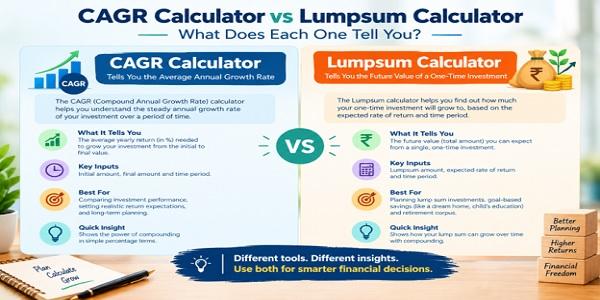
Investment calculators can simplify calculations that would otherwise require several mathematical steps. But different calculators answer different financial questions. A Lumpsum Calculator is primarily used to estimate the potential future value of a one-time investment based on an assumed return and investment horizon. A CAGR Calculator works in the opposite direction, using the starting value, ending value and holding period to determine the annualised rate of growth.
What a Lumpsum Calculator Tells You
A Lumpsum Calculator estimates the potential value of a one-time investment based on the investment amount, assumed annual return and holding period. For example, an investment of ₹5 lakh with an assumed annual return of 10% over 10 years can be used to estimate the potential value at the end of the period. The return rate is an assumption, not a prediction. Since market linked investments can fluctuate, the actual outcome may differ from the calculated value. The calculator is therefore useful for scenario analysis and future value estimation, rather than predicting actual investment returns.
What a CAGR Calculator Tells You
A CAGR Calculator works with an investment’s known starting value, ending value and holding period. It calculates the annualised compounded rate at which the investment would have grown between the two points. For example, if ₹5 lakh grows to ₹10 lakh over eight years, CAGR expresses that growth as an annualised rate.
CAGR = (Final Value / Initial Value)^(1 / Number of Years) − 1
Unlike absolute return, CAGR accounts for the investment period. However, it does not capture the fluctuations or interim gains and losses during that period.
The Two Calculators Work in Opposite Directions
Although both calculators deal with investment growth, they start with different information and produce different outputs.
| Parameter | Lumpsum Calculator | CAGR Calculator |
|---|---|---|
| Starting information | Investment amount | Initial value |
| Return | Assumed | Calculated |
| Ending value | Estimated | Given |
| Time period | Given | Given |
| Primary output | Potential future value | Annualised growth rate |
| Typical use | Future-value estimation | Measuring investment growth |
CAGR Makes Different Time Periods Easier to Compare
One of the main uses of CAGR is to put investment growth over different holding periods into an annualised framework. An investment that rises 50% over three years and another that rises 50% over seven years have the same absolute gain but not the same annualised growth rate. CAGR accounts for the time involved in generating that growth.
This makes it useful when reviewing the historical performance of investments, businesses or other assets. However, CAGR is a measure of the beginning and ending values. It does not describe what happened between those two points.
When CAGR May Not Be the Right Measure
CAGR is most appropriate when there is a single initial investment and a single final value. Its usefulness is limited when money enters or leaves the investment at different points in time. Regular investments, additional purchases and withdrawals all affect the timing of cash flows and, consequently, the return experienced by the investor.
In such cases, XIRR can be more appropriate because it accounts for the timing of individual cash flows.
What CAGR Does Not Show
CAGR can make an investment’s growth appear smoother than the actual journey.
An investment may have risen sharply in one year, declined substantially the next and recovered later. If its beginning and ending values remain unchanged, its CAGR will also remain unchanged.
In other words, CAGR does not capture
- Year to year volatility
- The sequence of returns
- Interim declines or recoveries
- The timing of additional investments or withdrawals
It is therefore best viewed as an annualised representation of growth between two points, rather than a description of the investment’s actual year by year performance.
This distinction becomes particularly relevant when comparing market linked investments, where the path of returns can be as important as the final outcome.
Why the Lumpsum Estimate Can Differ From Actual Returns
A Lumpsum Calculator is based on the return assumption entered by the investor. A higher assumed rate results in a higher projected value, while a lower rate produces a lower estimate. However, market-linked investments do not deliver a fixed return every year. An equity mutual fund, for instance, may gain in one year and decline in another. The actual return over the investment period can therefore differ from the assumed rate.
Consequently, the final value may be higher or lower than the calculator’s estimate. A Lumpsum Calculator should therefore be viewed as a projection based on an assumed rate of return, not a prediction of the actual outcome.
Using CAGR and Lumpsum Calculators Together
The two calculators can be useful at different stages of an investment assessment. A CAGR Calculator can show the annualised growth achieved between two known values. That rate can then be used as a hypothetical input in a Lumpsum Calculator to illustrate how a one-time investment might grow over a specified period. However, this does not make historical CAGR a forecast. If an investment delivered a 12% CAGR in the past, using 12% as an input for a future value calculation only creates a scenario. It does not imply that the investment will deliver the same rate going forward.
Conclusion
CAGR and Lumpsum Calculators answer different investment questions. A CAGR Calculator measures the annualised growth achieved between a known starting value and ending value, while a Lumpsum Calculator estimates a potential future value using an assumed return, investment amount and holding period. Using them together can help investors assess past growth and model different future scenarios. However, neither calculator can predict actual market returns and the results should be considered alongside investment horizon, risk, cash flow timing and market conditions.
Disclaimers
Investors may consult their Financial Advisors and/or Tax advisors before making any investment decision. These materials are not intended for distribution to or use by any person in any jurisdiction where such distribution would be contrary to local law or regulation. The distribution of this document in certain jurisdictions may be restricted or totally prohibited and accordingly, persons who come into possession of this document are required to inform themselves about, and to observe, any such restrictions.
MUTUAL FUND INVESTMENTS ARE SUBJECT TO MARKET RISKS, READ ALL SCHEME RELATED DOCUMENTS CAREFULLY.