In re Santosh Devi Daga (AAR Rajasthan)
Summary: The Rajasthan Authority for Advance Ruling considered the GST classification and exemption claimed for Psyllium Seeds (Isabgol) traded through the APMC at Nokha. The applicant, M/s Santosh Devi Daga, a proprietorship acting as a licensed commission agent and trader, stated that cultivators bring Psyllium Seeds to the APMC after harvesting and threshing and that no drying, dehydration, freezing, grading, polishing, crushing, milling, roasting, chemical treatment or other processing is undertaken by the applicant. The applicant sought a ruling on whether the goods are classifiable under Tariff Item 12119013 and exempt under Entry No. 87 of Notification No. 10/2025-Central Tax (Rate) dated 17.09.2025, and whether threshing by cultivators is merely a harvesting activity rather than processing or manufacture.
The Authority accepted the classification of Psyllium Seeds (Isabgol) under Tariff Item 12119013. It examined Heading 1211, the HSN notes, Notification No. 09/2025-Central Tax (Rate), Notification No. 10/2025-Central Tax (Rate), CBIC FAQ F.No. 332/2/2017-TRU and Circular No. 163/19/2021-GST dated 06.10.2021. The Authority focused on the condition that Entry No. 87 of Notification No. 10/2025 exempts specified plants and parts of plants, including seeds and fruits, only when they are “fresh or chilled”. It observed that the exemption notification must be construed strictly and that the burden of establishing fulfilment of the exemption conditions rests on the person claiming the exemption.
On the facts, the Authority did not accept the applicant’s contention that Psyllium Seeds supplied through the APMC remained “fresh”. It reasoned that after harvesting the crop undergoes post-harvest handling, including threshing and a period during which moisture is reduced before the goods reach the APMC, and therefore the seeds supplied by the applicant could not be treated as “fresh” for Entry No. 87. The Authority accordingly held that, although the goods remain classifiable under Tariff Item 12119013, the applicant’s Psyllium Seeds are not exempt under Entry No. 87 of Notification No. 10/2025-Central Tax (Rate). Instead, they are liable to GST at 5% under Entry No. 71 of Schedule I to Notification No. 09/2025-Central Tax (Rate) dated 17.09.2025.
The applicant relied on Gujarat AAR Advance Ruling No. GUJ/GAAR/R/2026/21 dated 29.05.2026, concerning Psyllium Seeds supplied in natural, raw and unprocessed form. The Rajasthan AAR declined to rely on that ruling because it did not have access to the facts of that case and noted that, under section 103 of the CGST Act, the Gujarat ruling did not bind the Rajasthan Authority. On the second question concerning threshing by cultivators, the Authority held that it was not fit for a separate advance ruling because it did not fall within section 97(2); it also observed that the applicant’s contention regarding threshing had already been examined while deciding the first question.
Cases Discussed
- Commissioner of Customs v. Dilip Kumar & Co. (2018) 9 SCC 1
- In re Jigneshkumar Narayandas Patel, Advance Ruling No. GUJ/GAAR/R/2026/21 dated 29.05.2026 — not relied upon; held non-binding under section 103 of the CGST Act.
FULL TEXT OF THE ORDER OF RAJASTHAN AUTHORITY FOR ADVANCE RULING
The issue raised by M/s SANTOSH DEVI DAGA, KANKARIA KATLA, BIKANER ROAD, NOKHA, Bikaner, Rajasthan-334803, (hereinafter “the applicant”) is fit to pronounce advance ruling as they have deposited prescribed Fee under CGST Act and it falls under the ambit of the Section 97(2) given as under:
(a) classification of goods and/or services or both
(b) Applicability of a notification issued under the provisions of this Act
A. SUBMISSION OF THE APPLICANT (in brief):-
Brief facts of the case:
The Applicant, M/s SANTOSH DEVI DAGA, is a proprietorship concern duly registered under the Central Goods and Services Tax Act, 2017 (hereinafter referred to as the “CGST Act”) bearing GSTIN: 08BCYPD3008G1ZL.
The Applicant acts as a licensed commission agent & trader and facilitates auction transactions of agricultural produce at the Agricultural Produce Market Committee (hereinafter referred to as the “APMC”), Nokha, Rajasthan.
The Applicant is engaged solely in the activity of commission agency and does not carry out any manufacturing, processing or transformation activity on any commodity whatsoever.
The commodity in relation to which the present application has been filed is Psyllium Seed, commonly known as Isabgol. Psyllium (Plantago Ovata) is an agricultural crop widely cultivated by farmers in the State of Rajasthan and adjoining regions. Upon harvesting of the crop, threshing operations are carried out by the cultivators themselves for the purpose of separating the Psyllium Seeds from the crop. This activity is an integral part of the harvesting process performed at the farm level. Thereafter, such Psyllium Seeds are brought by the cultivators/farmers to the APMC, Nokha, for sale through the established auction mechanism.
B. INTERPRETATION AND UNDERSTANDING OF APPLICANT ON QUESTION RAISED (IN BRIEF)
The Applicant respectfully submits that it does not undertake any of the following activities or processes upon the commodity, either at the APMC premises or at any other location:
(i) Drying or dehydration of any nature;
(ii) Freezing or cold-storage treatment;
(iii) Crushing or milling;
(iv) Grading or sorting;
(v) Polishing;
(vi) Husk extraction (conversion of Psyllium Seed to Isabgol Husk / Psyllium Husk);
(vii) Chemical treatment of any nature;
(viii) Any other process that alters the identity, nature, character or composition of the goods.
The commodity remains Psyllium Seed (Isabgol) in the same natural condition in which it is brought by the cultivators to the APMC market. No process is undertaken that changes its essential character or brings into existence a new and commercially distinct commodity. The Applicant merely facilitates the auction proceedings and enables the sale transactions between the farmers/cultivators and the buyers. The Applicant’s role is limited entirely to that of a commission agent & trader.
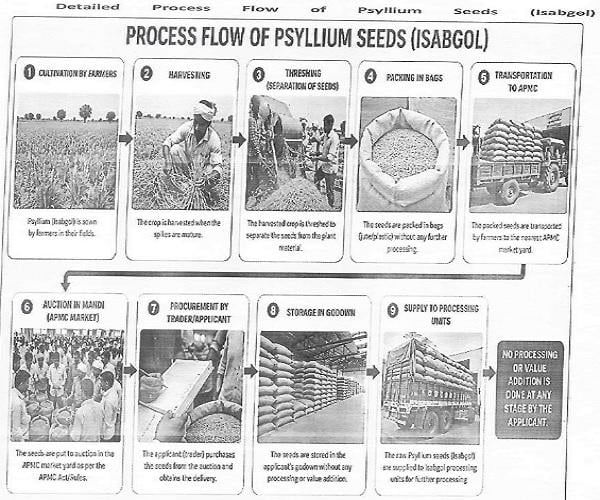
The process flow of Psyllium Seeds (Isabgol) commences with cultivation by farmers, followed by harvesting and threshing at the farm level. The seeds are thereafter packed in bags and transported to the APMC market where they are sold through the auction mechanism. The Applicant, acting merely as a commission agent & trader, facilitates the auction process. No drying, dehydration, grading, polishing, husk extraction or any processing activity is undertaken at any stage. The commodity remains Psyllium Seed (Isabgol) in its natural and unprocessed form throughout the transaction chain.
Threshing is Part of Harvesting and Not Processing
Threshing merely separates Psyllium Seeds from the harvested crop and does not alter the identity, composition, character or essential nature of the goods.
Threshing is an agricultural operation ordinarily undertaken by cultivators immediately after harvesting for separating the seeds from the harvested crop. Such activity does not result in any transformation of the commodity nor does it alter its identity, character or composition. No new product emerges as a result of threshing. Accordingly, threshing constitutes merely a harvesting-related activity and cannot be regarded as processing or manufacture for GST purposes.
Natural Moisture Content Does Not Amount to Drying
Natural reduction in moisture content occurring after harvesting is an inherent agricultural phenomenon resulting from exposure to ordinary climatic conditions. Such natural reduction cannot be equated with intentional drying, dehydration, curing or any processing activity. No artificial heat, mechanical drying equipment or dehydration process is employed by the cultivators or the Applicant. Accordingly, the commodity continues to remain fresh and unprocessed for the purpose of GST classification and exemption.
Need for the Present Application
Rajasthan is among the largest producing States of Psyllium Seeds (Isabgol) in the country. Large volumes of Psyllium Seeds are traded through APMC markets situated across the State on a regular basis. Divergent interpretations regarding the applicable GST treatment on such transactions continue to prevail among cultivators, commission agent & traders, traders and purchasers operating in the trade.
The Gujarat Authority for Advance Ruling has already examined an identical issue concerning the classification and GST exemption of Psyllium Seeds (Isabgol) vide Advance Ruling Order No. GUJ/GAAR/R/2026/21 dated 29.05.2026. However, no corresponding ruling has been pronounced by the Hon’ble Rajasthan Authority for Advance Ruling on facts which are substantially similar.
An authoritative determination by this Hon’ble Authority is, therefore, necessary to ensure certainty, uniformity and consistency in the tax treatment applicable to Psyllium Seeds traded through the APMC mechanism in the State of Rajasthan.
Classification of the Commodity under the Customs Tariff Act, 1975
Heading 1211 specifically covers Psyllium Seed (Isabgol) under Tariff Item 12119013. HSN Notes also specifically refer to Plantago Psyllium (herbs and seeds).
It is a well-settled principle of customs tariff classification — equally applicable to GST classification — that where a commodity is specifically covered under a particular tariff entry, its classification is required to be determined under that specific entry. The said principle has been consistently affirmed by the Hon’ble Supreme Court of India and various High Courts.
The aforesaid principle has also been recognised by the Hon’ble Supreme Court in Commissioner of Customs v. Dilip Kumar & Co. (2018) 9 SCC 1.
Since Psyllium Seed (Isabgol) is specifically and unambiguously mentioned at Tariff Item 12119013, there remains no scope for doubt or ambiguity regarding its proper classification. The commodity involved in the present application is accordingly classifiable under Tariff Item 12119013.
Applicability of the Exemption — Entry No. 87 of Notification No. 10/2025-Central Tax (Rate)
Entry No. 87 of Notification No. 10/2025-Central Tax (Rate) dated 28.06.2017 provides an exemption in respect of the following category of goods:
“Plants and parts of plants (including seeds and fruits), of a kind used primarily in perfumery, in pharmacy or for insecticidal, fungicidal or similar purposes, fresh or chilled.”
It is the Applicant’s respectful submission that Psyllium Seed (Isabgol) is a plant seed of a kind used primarily in the pharmaceutical and nutraceutical industries. Psyllium Husk, which is derived from Psyllium Seeds, is extensively employed in the preparation of medicinal formulations and dietary supplement products.
Consequently, Psyllium Seeds, being seeds of a plant used primarily in pharmacy, fall squarely within the description set out in Entry No. 87 of the said Exemption Notification. The commodity in the present application is supplied in its natural and unprocessed form. It is neither dried nor dehydrated, neither frozen nor chemically treated. All conditions specified under Entry No. 87 are accordingly satisfied.
It is therefore respectfully submitted that the commodity is entitled to exemption from levy of GST in terms of Entry No. 87 of Notification No. 10/2025-Central Tax (Rate) dated 28.06.2017.
Psyllium Seeds Continue to Remain Fresh Agricultural Produce
- No artificial drying
- No dehydration
- No freezing
- No roasting
- No polishing
Accordingly, the commodity retains its character as fresh agricultural produce and remains eligible for exemption.
Support from CBIC FAQ — F.No. 332/2/2017-TRU
The Central Board of Indirect Taxes and Customs (CBIC) issued Frequently Asked Questions bearing reference F.No. 332/2/2017-TRU, which specifically addresses the GST treatment applicable to Isabgol products. The clarification distinguishes fresh Isabgol Seeds, dried Isabgol Seeds and Isabgol Husk.
| Category of Good | GST Rate | Remarks |
|---|---|---|
| Fresh Isabgol Seeds (Psyllium Seeds) | NIL | Exempt from GST |
| Dried Isabgol Seeds | Taxable | GST applicable |
| Isabgol Husk (Psyllium Husk) | Taxable | GST applicable |
The commodity involved in the present application — being natural and unprocessed Psyllium Seeds — falls squarely within the category of Fresh lsabgol Seeds.(N IL GST), as enumerated in the said CBIC clarification. The CBIC FAQ thus directly and unequivocally supports the Applicant’s claim for exemption.
Mere manual removal of visible foreign matter such as straw, dust or chaff does not alter the essential character of the commodity.
Circular No. 169/19/2021-GST dated 06.10.2021
Circular No. 169/19/2021-GST dated 06.10.2021 issued by CBIC provides guidance on the distinction between fresh products and dried/processed products for the purpose of GST exemption notifications.
The said Circular clarifies that goods continue to be regarded as “fresh” where they are supplied substantially in the same condition as harvested and have not been intentionally dried, dehydrated, or frozen.
The Psyllium Seeds involved in the present application fully satisfy the said test. The seeds are brought to the APMC in their natural condition as harvested, without any intentional drying, dehydration, or freezing process being applied to them. Accordingly, the commodity qualifies as “fresh” for the purpose of Entry No. 87 of the Exemption Notification, and the benefit of the exemption is squarely applicable.
Essential Character of the Goods Remains Unchanged
The commodity originates from cultivation of land, is harvested by the farmers, and is brought to the APMC market in its natural, raw and unprocessed state. No manufacturing activity of any kind is involved at any stage of the transaction.
Mere manual removal of visible foreign matter such as straw, dust or chaff does not alter the essential character of the commodity.
No process is undertaken — either by the cultivators or by the Applicant — that changes the essential character, identity, or nature of the commodity. The commodity is, at all relevant points in the transaction chain, Psyllium Seed (Isabgol) and nothing else. No new commercially distinct commodity emerges as a result of any treatment or process. Therefore, the identity, essential character and composition of the commodity remain entirely unchanged from harvest to sale through the APMC auction mechanism.
Reliance on the Gujarat Advance Ruling Order No. GUJ/GAAR/R/2026/21 dated 29.05.2026
We respectfully place our reliance upon the Advance Ruling Order No. GUJ/GAAR/R/2026/21 dated 29.05.2026 pronounced by the Gujarat Authority for Advance Ruling. In the said ruling, the Gujarat Authority for Advance Ruling comprehensively examined the following aspects:
i. Classification of Psyllium Seed (Isabgol) under Tariff Item 12119013 of the Customs Tariff Act, 1975;
ii. Applicability of Entry No. 87 of Notification No. 10/2025-Central Tax (Rate) dated 28.06.2017;
iii. CBIC FAQ bearing reference F.No. 332/2/2017-TRU and its implications;
iv. CBIC Circular No. 169/19/2021-GST dated 06.10.2021;
v. The nature, characteristics and condition of Psyllium Seeds as traded through the APMC auction mechanism.
The Gujarat Authority considered the factual position that the commodity_remained in its natural and unprocessed form throughout the transaction chain and examined the applicability of the GST exemption notification on that basis.
The Applicant is conscious that the said Advance Ruling is binding only in respect of the applicant before the Gujarat Authority and does not operate as a binding precedent upon this Hon’ble Authority. Nevertheless, the ruling carries significant persuasive value inasmuch as the facts and legal questions involved are substantially identical to those arising in the present application.
The Applicant respectfully urges that the legal principles and reasoning adopted in the aforesaid Gujarat Ruling deserve due consideration while adjudicating the present application.
Relevant Findings of Gujarat AAR
The Hon’ble Gujarat Authority for Advance Ruling, after examining the tariff classification, HSN Notes, CBIC FAQ and Circular No.169/19/2021-GST, inter alia held as follows:
i. Psyllium Seeds are classifiable under Tariff Item 12119013.
ii. Plantago Psyllium is specifically recognised under the HSN Explanatory Notes.
iii. Threshing undertaken for separating seeds from the harvested crop does not amount to processing.
iv. Fresh and unprocessed Psyllium Seeds supplied in the condition in which they are harvested are eligible for exemption under Entry No.87 of Notification No.10/2025-CT(R).
The factual matrix involved in the present application is substantially identical to the facts examined by the Gujarat Authority for Advance Ruling. Accordingly, the reasoning adopted therein deserves due persuasive consideration by this Hon’ble Authority.
Summary of Submission-
- Psyllium Seed (Isabgol) is specifically classified under Tariff Item 12119013 of the Customs Tariff Act, 1975. No ambiguity exists regarding its tariff classification.
- Psyllium Seed (lsabgol) is a plant seed of a kind used primarily in pharmacy, squarely falling within the scope of Entry No. 87 of Notification No. 10/2025-Central Tax (Rate) dated 28.06.2017.
- The commodity in the present case is supplied in its natural, .raw and unprocessed form — without any drying, dehydration, freezing, crushing, milling, grading, polishing, husk extraction or chemical treatment. It accordingly satisfies all conditions stipulated under the said Exemption Entry.
- CBIC FAQ F.No. 332/2/2017-TRU specifically recognises Fresh lsabgol Seeds as falling in the NIL GST category, which directly supports the Applicant’s position.
- CBIC Circular No. 169/19/2021-GST dated 06.10.2021 further reinforces the position that goods supplied substantially in their harvested condition, without intentional processing, continue to be treated as “fresh” for exemption purposes.
- The essential character and identity of the commodity remain wholly unchanged throughout the transaction chain. No new commercially distinct commodity emerges.
- The Gujarat Authority for Advance Ruling has, on substantially identical facts, examined the said questions and rendered a ruling that has strong persuasive value before this Hon’ble Authority.
C. QUESTIONS ON WHICH THE ADVANCE RULING IS SOUGHT:
01) Whether Psyllium Seeds (Isabgol) 12119013 brought by cultivators/farmers to an Agricultural Produce Market Committee (APMC) and sold through the auction mechanism in their natural, raw and unprocessed form — without undergoing drying, dehydration, freezing, grading, polishing, crushing, milling, roasting, .chemical treatment or any other processing activity — are classifiable under Tariff Item 12119013 and are accordingly exempt from levy of GST under Entry No. 87 of Notification No. 10/2025 -Central Tax (Rate) dated 17.09.2025, as amended from time to time?
Q2) Whether threshing undertaken by cultivators for separating Psyllium Seeds (Isabgol) from the harvested crop constitutes merely a harvesting activity and not processing or manufacture for the purpose of classification and exemption under GST?
D. COMMENTS OF THE JURISDICTIONAL OFFICER: –
Comments received from the Office of Assistant Commissioner, Central Tax, CGST Division- BIKANER RURAL, In front of Chetan Mahadev Temple, Jaipur Road, BIKANER, Rajasthan vide letter F.No. V(Misc)03/Div-BKN (Rural)/Tech/2025/379, dated 20.07.2026, are as under:
In this context, it is submitted that as per application filed by M/s Bikaner Trading
Company (Legal Name-Santosh Devi Daga) with their annexures have been examined.
The following comments are submitted –
1. Questions Raised by the Applicant
The applicant has sought Advance Ruling on the following issues:
i. by Whether Psyllium Seeds (Isabgol) 12119013 brought cultivators/farmers to Agricultural Produce Market Committee (APMC) and sold through the auction mechanism in their natural, raw and unprocessed form without undergoing drying, dehydration, freezing, grading, policing, crushing, milling, roasting, chemical treatment or any other processing activity are classifiable under Tariff Item No.12119013 and eligible for exemption under Entry No.87 of NOtification No.10/2025- Central Tax (Rate) dated 17.09.2025.
ii. Whether threshing undertaken by cultivators merely for separating Psyllium Seeds from harvested crop constitutes merely a harvesting activity and not processing or manufacture for the purpose of classification and exemption under GST.
2. Nature of Commodity
The commodity under consideration is Psyllium Seeds (Isabgol) obtained from Plantago ovata. The material indicates that the crop is cultivated by farmers in Rajasthan and adjoining areas. After maturity, the crop is harvested and threshing is carried out for separating seeds from the spikes and straw.
3. Examination of Agricultural Practice:-
In general practice of spikes and straw plants require about 2 to 4 days of sun-drying to completely crisp. If humidity is high or there is recent moisture, it may take up to 5 to 7 days. The spikes and straw must be thoroughly dried so the seed shells and husks can easily separate during winnowing, which is similarly applicable in the instant case. Whereas, the applicant in their application did not mentioned the same. However, on the basis of general practice this office has following view:-
a. Harvesting and threshing are agronomically recognized as distinct operations. Harvesting consists of cutting or uprooting the mature crop from the field. Threshing is a subsequent mechanical operation undertaken after harvesting to separate the seeds from the spikes, straw and other plant material.
b. The agricultural literature itself describes threshing under the separate heading
“Post Harvest Technology,” stating that harvested plants are spread for few days and thereafter threshed by tractor or bullocks. This clearly identifies threshing as a postharvest activity rather than harvesting itself.
c. Threshing is a critical mechanical process that separates the marketable psyllium seeds from the non-marketable straw, spikes and other crop residues. Without threshing, the harvested crop cannot yield the commercial seed intended for sale.
d. The fact that threshing does not amount to manufacture does not necessarily mean that it is part of harvesting. An activity may fall short of manufacture yet still constitute a post- harvest processing operation.
e. Therefore, the proposition that threshing is merely harvesting activity is not supported by the agricultural process itself. Rather, threshing is a distinct post-harvest mechanical operation performed after the crop has been harvested and, in the case of psyllium, after deliberate drying of the harvested plants.
f. Further, Harvested psyllium seeds are not supplied in the same condition as naturally plucked from the plant. After harvesting the crop plucked from the plant is deliberately spread in the field for about few days before threshing. This is not incidental handling but a conscious post-harvest practice intended to ensure adequate drying and facilitate seed separation.
g. The CBIC Circular draws a clear distinction between agricultural produce supplied in its natural fresh condition and produce that has been “intentionally dried to dehydrate including through sun drying.” Although the circular is issued in the context of Chapter 8 fruits and nuts, it lays down the broader interpretative principle that deliberate drying undertaken after harvest changes the character from fresh produce to dried produce.
h. In the case of psyllium, agricultural recommendations themselves state that:
-
- harvesting should take place only when the atmosphere is dry;
- there should be no moisture on the plants; and
- harvested plants are spread for few days before threshing.
These operations indicate a deliberate post-harvest drying process rather than mere transportation or temporary storage.
i. Therefore, the psyllium seeds arriving at the APMC cannot readily be regarded as being supplied in their natural, raw and completely unprocessed state, because they have already undergone intentional drying and post-harvest handling before marketing.
The applicant has further relied upon Circular No.169/19/2021-GST dated 06.10.2021, particularly paragraphs 3.2 and 3.3, wherein CBIC has clarified the distinction between fresh, frozen and dried agricultural produce.
The Circular explains that:
- Fresh agricultural produce continues to remain fresh when- supplied substantially in the condition in which it is harvested.
- Goods lose the character of “fresh” only where they are intentionally subjected to drying, dehydration, freeze-drying, freezing or similar preservation processes for marketing as dried or frozen goods.
- Mere natural reduction of moisture content or ordinary storage for preservation does not, by itself, amount to intentional drying.
However, as per Para No. 3.2 as cited below:-
3.2 At present, fresh nuts (almond, walnut, hazelnut, pistachio etc) falling under heading 0801 and 0802 are exempt from GST, while dried nuts under these headings attract GST at the rate of 5%/ 12%. The general Explanatory Notes to chapter OS mentions that this chapter covers fruit, nuts intended for hum consumption. They may be fresh (including chilled), frozen (whether or not previously cooked by steaming or boiling in water or containing added sweetening matter) or dried (including dehydrated, evaporated or freeze dried). Thus, HS chapter differentiates between fresh, frozen and dried fruits and nuts. Fresh fruit and nuts would thus cover fruit and nuts which are meant to be supplied in the state as plucked. They continue to be fresh even if chilled. However, fruit and nuts do not qualify as fresh, once frozen (cooked or otherwise), or intentionally dried to dehydrate including through sun drying, evaporation or freezing, for supply as dried fruits or nuts. It may be noted that in terms of note 3 to Chapter 8, dried fruits, even if partially re-hydrated, or subject to preservation say by moderate heal treatment, retain the character of dried fruits or dried nuts.
It is clear that crops do not qualify as fresh if, they are intentionally dried to dehydrate including through sun drying. In this case, in the view of above Psyllium seeds do not qualify as fresh.
5. Examination of Notification No.09/2025-Central Tax (Rate) dated 17.09.2025
In order to determine the taxability of the commodity under consideration, it is necessary to examine the provisions of Notification No.09/2025-Central Tax (Rate) dated 17.09.2025, issued under Section 9(1) of the CGST Act, 2017.
Entry No.71 of Schedule-1 of the said Notification covers goods falling under Heading 1211 described as:
“Plants and parts of plants (including seeds and fruits), of a kind used primarily in perfumery, in pharmacy or for insecticidal, fungicidal or similar purpose, frozen or dried, whether or not cut, crushed or powdered.”
The aforesaid entry specifically applies only where the goods supplied are frozen or dried. Thus, the levy of GST under Entry No.71 is attracted only if the commodity answers the description of “frozen” or “dried” goods. Accordingly, the applicability of Entry No.71 depends upon the factual determination of the condition in which the Psyllium Seeds are supplied.
6. Examination of Notification No.10/2025-Central Tax (Rate) dated 17.09.2025 Entry No. 87 of Notification No. 10/2025-Central Tax (Rate) dated 17.09.2025 exempts:
Here is the text converted from the image:
| S. No. | Chapter/Leading/Subheading/Tariff Item | Description of Goods |
|---|---|---|
| 87 | 1211 | Plants and parts of plants (including seeds and fruits), of a kind used primarily in perfumery, in pharmacy or for insecticidal, fungicidal or similar purpose, fresh or chilled. |
A plain reading of the entry makes it evident that the exemption is not available to all goods falling under Heading 1211. As per the notification the description of which is specified in column (3) of the Schedule appended to this notification, falling, under the tariff item, sub-heading, heading or Chapter, as the case may be, as specified in the corresponding entry in column (2) of the said Schedule, from the whole of the central las leviable thereon under section 9 of the Central Goods and Services Tax Act, 2017 (12 of 2017). Therefore, exemption is specifically restricted to such goods as are supplied in “fresh or chilled” condition. Therefore, satisfaction of this condition is a prerequisite for claiming the benefit of the exemption.
7. Applicability of Entry No.87 of Notification No. 10/2025-Central Tax (Rate) dated 17.09.2025
In the case of psyllium, agricultural recommendations themselves state that:
- harvesting should take place only when the atmosphere is dry;
- there should be no moisture on the plants; and
- harvested plants are spread for approximately two days before threshing.
These operations indicate a deliberate post-harvest drying process rather than mere transportation or temporary storage.
As per Circular No. 163/19/2021-GST dated 06.10.2021, fruit and nuts do not qualify as fresh, once frozen (cooked or otherwise), or intentionally dried to dehydrate including through sun drying, evaporation or freezing, for supply as dried fruits or nuts. It may be noted that in terms of note 3 to Chapter 3, dried fruits, even if partially re-hydrated, or subject to preservation say by moderate heat treatment, retain the character of dried fruits or dried nuts. It is clear that crops do not qualify as fresh if they are intentionally dried to dehydrate including through sun drying. In this case, in the view of above Psylium seeds do not qualify as fresh and will not fall under Entry 87 of Notification No.10/2025-Central Tax (Rate) dated 17.09.2025.
8. Overall Conclusion
In view of the discussion made hereinabove, the following conclusions appear to emerge:
a. The commodity involved in the present application is correctly classifiable under Tariff Item 12119013 of the First Schedule to the Customs Tariff Act, 1975.
b. The activity of threshing undertaken by cultivators is a distinct post-harvest mechanical operation performed after the crop has been harvested and, in the case of psyllium, after deliberate drying of the harvested plants.
c. As per Circular No. 163/19/2021-GST dated 06.10.2021 It is clear that crops do not qualify as fresh if, they are intentionally dried to dehydrate including through sun drying. In this case, in the view of above Psylium seeds do not qualify as fresh. Further, it is subject to verification that the goods are supplied without intentional drying, dehydration, freezing or any other processing, the commodity appears to answer the description of fresh Psyllium Seeds.
d. It is well settled in law that exemption notifications must be construed strictly. A person seeking the benefit of an exemption bears the burden of clearly establishing that the goods satisfy each and every condition prescribed tinder the relevant notification. Where the language of an exemption notification is clear, specific, and unambiguous, its scope cannot be expanded by implication, intendment, or equitable considerations.
In the view of above, this office is in opinion that Psyllium seeds does not qualify conditions of exemptions mentioned in above mentioned Notification, hence attracts
5% GST.
E. PERSONAL HEARING:
Personal hearing in the matter was granted to the applicant on 13.07.2026. Mr. Lalit Goalchha (C.A.) Authorized Representative appeared for personal hearing. He reiterated the submission already made by them.
F. DISCUSSIONS AND FINDINGS
1. At the outset, we would like to make it clear that the provisions of both the CGST Act and the RGST Act are the same except for certain provisions. Therefore, unless a mention is specifically made to such dissimilar provisions, a reference to the CGST Act would also mean a reference to the same provision under the RGST Act. Further to the earlier, henceforth for the purposes of this Advance Ruling, a reference to such a similar provision under the CGST Act / RGST Act would be mentioned as being under the “GST Act”.
2. We have considered the submissions made by the applicant in their application for advance ruling as well as the submissions made both oral and written during the course of personal hearing. We have also considered the issue involved, the relevant facts & the applicant’s submission/views in respect of question on which the advance ruling is sought and the comments of the jurisdictional officer.
3. The applicant has submitted that they act as a licensed Commission agent & Trader and facilitates auction transactions of agricultural produce at the Agricultural Produce Market Committee, Nokha, Rajasthan and are engaged solely in the activity of commission agency and does not carry out any manufacturing, processing or transformation activity on any commodity whatsoever; that the commodity in relation to which the present application has been filed is Psyllium Seed, commonly known as lsabgol. Psyllium (Plantago Ovata) is an agricultural crop widely cultivated by farmers in the State of Rajasthan and adjoining regions. The applicant has further submitted that upon harvesting of the crop, threshing operations are carried out by the cultivators themselves for the purpose of separating the Psyllium Seeds from the crop; that this activity is an integral part of the harvesting process performed at the farm level and thereafter, such Psyllium Seeds are brought by the cultivators/farmers to the APMC, Nokha for sale through the established auction mechanism.
4. The applicant has asked the following question before the Advance Ruling Authority:
Q1. Whether Psyllium Seeds (Isabgo1)12119013 brought by cultivators/farmers to an Agricultural Produce Market Committee (APMC) and sold through the auction mechanism in their natural, raw and unprocessed form — without undergoing drying, dehydration, freezing, grading, polishing, crushing, milling, roasting, chemical treatment or any other processing activity — are classifiable under Tariff Item 12119013 and are accordingly exempt from levy of GST under Entry No. 87 of Notification No. 10/2025 -Central Tax (Rate) dated 17.09.2025, as amended from time to time?
Q2. Whether threshing undertaken by cultivators for separating Psyllium Seeds (lsabgol) from the harvested crop constitutes merely a harvesting activity and not processing or manufacture for the purpose of classification and exemption under GST?
5. Since the applicant is of the opinion that the product supplied by him falls under heading 1211 of the First Schedule to the Customs I ariff Act, 1975 (51 of 1975), a reference will be required to be made to the Chapter Notes of Chapter 12, headings 1211 of the First Schedule to the Customs Tariff Act, 1975 (51 of 1975) as well as the HSN notes to heading 1211. The same are reproduced hereunder:
Chapter Notes to Chapter 12 of the First Schedule to the Customs Tariff Act, 1975 (51 of 1975):
CHAPTER 12 Oil seeds and oleaginous fruits, miscellaneous grains, seeds and fruit; industrial or medicinal plants; straw and fodder
1. Heading 1207 applies, inter alia, to palm nuts and kernels, cotton seeds, castor oil seeds, sesamum seeds, mustard seeds, safflower seeds, poppy seeds and shea nuts (karite nuts). It does not apply to products of heading 0801 or 0802 or to olives (Chapter 7 or Chapter 20).
2. Heading 1208 applies not only to non-defatted flours and meals but also to flours and meals which have been partially defatted or defatted and wholly or partially refatted with their original oils. It does not, however, apply to residues of headings 2304 to 2306.
3. For the purposes of heading 1209, beet seeds, grass and other herbage seeds, seeds of ornamental flowers, vegetable seeds, seeds of forest trees, seeds of fruit trees, seeds of vetches (other than those of the species Vicia faba) or of lupines are to be regarded as ‘seeds of a kind used for sowing’. Heading 1209 does not, however, apply to the following even if for sowing: (a) leguminous vegetables or sweet corn (Chapter 7); (b) spices or other products of Chapter 9; (c) cereals (Chapter 10); or (d) products of headings 1201 to 1207 or 1211.
4. Heading 1211 applies, inter alia, to the following plants or parts thereof: basil, borage, ginseng, hyssop, liquorice, all species of mint, rosemary, rue, sage and wormwood. Heading 1211 does not, however, apply to: (a) medicaments of Chapter 30; (b) perfumery, cosmetic or toilet preparations of Chapter 33; or (c) insecticides, fungicides, herbicides, disinfectants or similar products of heading 3808.
5. For the purposes of heading 1212, the term ‘seaweeds and other algae’ does not include: (a) dead single-cell microorganisms of heading 2102; (b) cultures of microorganisms of heading 3002; or (c) fertilizers of heading 3101 or 3105. SUB-HEADING NOTE: For the purposes of sub-heading 1205 10, the expression ‘low erucic acid rape or colza seeds’ means rape or colza seeds yielding a fixed oil which has an erucic acid content of less than 2% by weight and yielding a solid component which contains less than 30 micromoles of glucosinolates per gram.
Heading 1211 as per the First Schedule to the Customs Tariff Act, 1975 (51 of 1975)
1211 PLANTS AND PARTS OF PLANTS (INCLUDING SEEDS AND FRUITS), OF A KIND USED PRIMARILY IN PERFUMERY, IN PHARMACY OR FOR INSECTICIDAL, FUNGICIDAL OR SIMILAR PURPOSE, FRESH, CHILLED, FROZEN OR DRIED, WHETHER OR NOT CUT, CRUSHED OR POWDERED
| Tariff Item | Description |
|---|---|
| 1211 20 00 | Ginseng roots |
| 1211 30 00 | Coca leaf |
| 1211 40 00 | Poppy straw |
| 1211 50 00 | Ephedra |
| 1211 60 00 | Bark of African cherry (Prunus africana) |
| 1211 90 | Other: |
| — | — Seeds, Kernel, Aril, Fruit, Pericarp, Fruit rind, Endosperm, Mesocarp, Endocarp: |
| 1211 90 11 | Ambrette seeds |
| 1211 90 12 | Nuxvomica, dried ripe seeds |
| 1211 90 13 | Psyllium seed (isobgul) |
| 1211 90 14 | Neem seed |
| 1211 90 15 | Jojoba seed |
| 1211 90 16 | Garcinia |
| 1211 90 19 | Other |
| — | — Leaves, Leaf bud, Galls, flowers, Inflorescence, Spadix, Flower bud, Style and Stigma, Stamen and pods |
| 1211 90 21 | Belladona leaves |
| 1211 90 22 | Senna leaves and pods |
| 1211 90 23 | Neem leaves |
| 1211 90 24 | Gymnema |
| 1211 90 25 | Cubeb |
| 1211 90 26 | Pyrethrum |
| 1211 90 29 | Other |
| — | — Bark, husk and rind |
| 1211 90 31 | Cascara sagrada bark |
| 1211 90 32 | Psyllium husk (isobghul husk) |
| 1211 90 33 | Gamboge fruit rind |
| 1211 90 34 | Ashoka (Saraca asoca) |
| 1211 90 35 | Arjuna (Terminalia arjuna) |
| 1211 90 39 | Other |
| — | — Roots, Root stalk, Bulb, Corn, Tuber, Stolon and rhizome: |
| 1211 90 41 | Belladona roots |
| 1211 20 00 | Ginseng roots |
| 1211 30 00 | Coca leaf |
| 1211 40 00 | Poppy straw |
| 1211 50 00 | Ephedra |
| 1211 60 00 | Bark of African cherry (Prunus africana) |
| 1211 90 | Other: |
| — | — Seeds, Kernel, Aril, Fruit, Pericarp, Fruit rind, Endosperm, Mesocarp, Endocarp: |
| 1211 90 11 | Ambrette seeds |
| 1211 90 12 | Nuxvomica, dried ripe seeds |
| 1211 90 13 | Psyllium seed (isobgul) |
| 1211 90 14 | Neem seed |
| 1211 90 15 | Jojoba seed |
| 1211 90 16 | Garcinia |
| 1211 90 19 | Other |
| — | — Leaves, Leaf bud, Galls, flowers, Inflorescence, Spadix, Flower bud, Style and Stigma, Stamen and pods |
| 1211 90 21 | Belladona leaves |
| 1211 90 22 | Senna leaves and pods |
| 1211 90 23 | Neem leaves |
| 1211 90 24 | Gymnema |
| 1211 90 25 | Cubeb |
| 1211 90 26 | Pyrethrum |
| 1211 90 29 | Other |
| — | — Bark, husk and rind |
| 1211 90 31 | Cascara sagrada bark |
| 1211 90 32 | Psyllium husk (isobghul husk) |
| 1211 90 33 | Gamboge fruit rind |
| 1211 90 34 | Ashoka (Saraca asoca) |
| 1211 90 35 | Arjuna (Terminalia arjuna) |
| 1211 90 39 | Other |
| — | — Roots, Root stalk, Bulb, Corn, Tuber, Stolon and rhizome: |
| 1211 90 41 | Belladona roots |
HSN Notes to Heading 1211
12.11 – Plants and parts of plants (including seeds and fruits), of a kind used primarily in perfumery, in pharmacy or for insecticidal, fungicidal or similar purposes, fresh, chilled, frozen or dried, whether or not cut, crushed or powdered.
1211.20 – Ginseng roots; 1211.30 – Coca leaf; 1211.40 – Poppy straw; 1211.50 – Ephedra; 1211.90 – Other
This heading covers vegetable products of a kind used primarily in perfumery, in pharmacy or medicine, or for insecticidal, fungicidal, parasiticidal or similar purposes. They may be in the form of whole plants, mosses or lichens, or of parts (such as wood, bark, roots, stems, leaves, flowers, petals, fruits and seeds (other than oleaginous fruits and oil seeds classified in headings 12.01 to 12.07), or in the form of waste resulting, in the main, from mechanical treatment. They remain in the heading whether fresh, chilled, frozen or dried, whole, cut, crushed, ground or powdered or (where appropriate) grated or hulled. Products of this heading impregnated with alcohol remain classified here.
Plants and parts (including seeds and fruits) of trees, bushes, shrubs or other plants are classified here if of a kind used directly for the purposes specified above or if used for the production of extracts, alkaloids or essential oils suitable for those purposes. On the other hand, the heading excludes seeds and fruits of a kind used for the extraction of fixed oils; these fall in headings 12.01 to 12.07 even if the oils are to be used for the purposes mentioned in this heading.
It should also be noted that vegetable products more specifically described in other headings of the nomenclature are excluded from this heading, even if they are suitable for use in perfumery, pharmacy, etc., e.g.: citrus fruit peel (heading 08.14); vanilla, cloves, aniseed, badian and other products of Chapter 9; hop cones (heading 12.10); chicory roots of heading 12.12; natural gums, resins, gum-resins and oleoresins (heading 13.01).
Live chicory plants and roots and other live seedling plants, bulbs, rhizomes, etc., clearly intended for planting, and flowers, foliage, etc., for ornamental purposes, fall in Chapter 6.
A representative (non-exhaustive) list of plants and parts covered by the heading includes, among others: Aconite (roots and leaves), Ambrette/musk (seeds), Angelica (roots and seeds), Belladonna (herbs, roots, berries, leaves and flowers), Cinchona (bark), Ephedra (Mahuang) (stems and branches), Ginseng (roots), Liquorice (roots), Mint (all species), and Plantago psyllium (herbs and seeds) — among many other listed botanicals. The botanical names given are illustrative only, for identification purposes, and mention of a particular species does not indicate that other species of the same plant family are excluded from the heading.
Certain products of this heading, which are regarded as narcotic drugs under international instruments, are indicated in the list which appears al the end of Chapter 29.
6. We have gone through the Chapter Notes of Chapter 12, products/articles mentioned under tariff heading 1211 as well as the HSN Notes to heading 1211. We find that the product “Psyllium seeds” appears at sub-heading 1211 9013. The name against the sub-heading is mentioned as Psyllium seed (lsobgul). Further, the name Plantago psyllium : herbs and seeds also finds mention under the HSN notes of heading 1211. We therefore, find that Psyllium seeds are correctly classifiable under Subheading 1211 9013 of the First Schedule to the Customs Tariff Act, 1975(51 of 1975).
7. When it comes to decide the rate of tax on Psyllium Seeds, we find that there are three entries relevant for the present application which are as under:
1. As per Notification No.10/2025-Central Tax (Rate) dated 17.09.2025, Entry No.87 (covering HSN 1211) which reads as ‘Plants and parts of plants (Including seeds and fruits), of a kind used primarily in perfumery, in pharmacy or for insecticidal, fungicidal or similar purpose, fresh or chilled, exempts the product from GST.
2. As per Notification No.10/2025-Central Tax (Rate) dated 17.09.2025, Entry No.77 (covering HSN 12) reads as ‘All goods of seed quality’ exempts the product from GST.
3. As per Notification No.09/2025-Central Tax (Rate) dated 17.09.2025, Entry No.71 (covering HSN 1211) reads as ‘Plants and parts of plants (Including seeds and fruits), of a kind used primarily in perfumery, in pharmacy or for insecticidal, fungicidal or similar purpose, frozen or dried, whether or not cut, crushed or powdered.’ GST rate here is 5%.
8. We find that in order to decide whether rate of tax is “exempted” or “5%”, the test of eligibility hinges on whether the goods supplied by applicant (not purchased by applicant) are “fresh or chilled” or “of seed quality” or “frozen or dried”. We find that the applicant has detailed the entire process through a flow Chart followed for obtaining Psyllium seeds in their submission starting with:
- cultivation by farmers,
- harvesting of the plants,
- threshing of the plants in a thresher through which psyllium seeds are separated from the Plants,
- packing of seeds in (Jute/Plastic) bags,
- transport of seeds to APMC mandis through tractors, carts or trucks,
- put for auction in the APMC Market yards as per APMC Act/Rules,
- procurement of psyllium seeds by Trader/Applicant and obtains the delivery,
- Stored the seeds in Applicant’s Godown without any processing or value addition.
- Supply of seeds to the processing units. No processing or value addition is done at any stage by the applicant.
8.1 We find that the process mentioned by applicant is not relevant for the purpose of deciding the condition in which goods are supplied by applicant. The above referred processes are relevant only upto the stage of supply of goods by farmers to applicant (purchase of applicant) through APMC. Hence whether the above mentioned process involves drying or freezing etc., is of no significance after purchase of the goods by applicant because the question to be decided in this application is whether goods supplied by applicant at a later stage after purchase from farmers through APMC qualify as “fresh or chilled” or “frozen or dried” so as to apply rate of tax.
9. The applicant has further submitted that the commodity remains Psyllium Seed (lsabgol) in the same natural condition in which it is brought by the cultivators to the APMC market; that no process is undertaken that changes its essential character or brings into existence a new and commercially distinct commodity; that the Applicant merely facilitates the auction proceedings and enables the sale transactions between the farmers/cultivators and the buyers; that the Applicant’s role is limited entirely to that of a commission agent & trader; that no drying, dehydration, grading, polishing, husk extraction or any processing activity is undertaken at any stage; that the commodity remains Psyllium Seed (Isabgol) in its natural and unprocessed form throughout the transaction chain.
The applicant has also submitted that Natural reduction in moisture content occurring after harvesting is an inherent agricultural phenomenon resulting from exposure to ordinary climatic conditions; that such natural reduction cannot be equated with intentional drying, dehydration, curing or any processing activity. No artificial heat, mechanical drying equipment or dehydration process is employed by the cultivators or the Applicant. Accordingly, as per the applicant, the commodity continues to remain fresh and unprocessed for the purpose of GST classification and exemption.
9.1 We find that applicant has emphasized that subject goods will be traded in the same form as procured by them from farmers. It is important to note that to be eligible for exemption from tax, the goods should be “fresh or chilled” at the time of supply by applicant. I he applicant has shown in the flow chart that the Psyllium seeds are stored in their Godown after obtaining delivery of seeds through auction process. We find that there is no information on record about the period of storage and in fact it can not be predicted, secondly when the goods will be stored in godowns, undoubtedly the purpose is to dry them and so it amounts to “drying”. By the time the goods are supplied by applicant, they are “dried”.
10. The applicant has also made a reference to FAQ F.No.332/2/2017-TRU dated December, 2017, wherein it is mentioned that lsabgol seeds are classifiable under heading 1211, fresh Isabgol seeds attract NIL rate of GST, dried Isabgol seeds attract 5% GST & lsabgol husk falls under heading 1211 attract GST rate of 5%. The applicant has also referred to Circular No.163/19/2021-GST dated 06.10.2021 (We note that the applicant has, at places, referred to this clarification as “Circular No. 169/19/2021-GST”; the clarification bearing upon the fresh/dried distinction is, in fact, Circular No. 163/19/2021-GST dated 06.10.2021, and we proceed on that footing.) wherein clarification regarding GST rates and classification (goods) (based on the recommendation of the GST Council in its 45th meeting held on 17.09.2021 at Lucknow) has been provided. They have also referred to para 3.2 of the said Circular stating that the process of drying is discussed in para 3.2. of Circular No.163/19/2021-GST dated 06.10.2021.
11. Since the rate of GST and the Notifications applicable to the Psyllium seeds supplied by the applicant is mainly based on whether the product is “fresh OR chilled” OR “frozen OR dried”, we find it prudent to refer to Circular No.163/19/2021-GST dated 06.10.2021 wherein it has been discussed threadbare as to what a fresh product OR dried product OR frozen product means. We find that para-3 of the said Circular covers “applicability of GST on fresh and dried fruits and nuts.” Para 3.2 and 3.3 of the said Circular reads as under:
“3.2 At present, fresh nuts (almond, walnut, hazelnut, pistachio etc.) falling under heading 0801 and 0802 are exempt from GST, while dried nuts under these headings attract GST at the rate of 5%/12%. The general Explanatory Notes to chapter 08 mentions that this chapter covers fruit, nuts intended for human consumption. They may be fresh (including chilled), frozen (whether or not previously cooked by steaming or boiling in water or containing added sweetening matter) or dried (including dehydrated, evaporated or freeze-dried). Thus, HS chapter differentiates between fresh, frozen and dried fruits and nuts. Fresh fruit and nuts would thus cover fruit and nuts which are meant to be supplied in the state as plucked and would continue to be fresh even if chilled. However, fruit and nuts do not qualify as fresh, once frozen (cooked or otherwise), or intentionally dried to dehydrate including through sun Lirying, evaporation or freezing, for supply as dried fruits or nuts. It is further mentioned that exemption from GST to fresh fruits and nuts covers only such products which are not frozen or dried in any manner as stated above or otherwise processed. Supply of dried fruits and nuts, falling under heading u801 and 0802 attract GST at the rate of 5%/12% as specified in the respective rate Schedules. Since the rate of GST and the Notification in which the Psyllium seeds supplied by the applicant is mainly based on whether the product is fresh OR chilled OR frozen OR dried, we find that the aforementioned analogy would be applicable in toto in the present case.
3.3. Therefore, exemption from GST to fresh fruits and nuts covers only such products which are not frozen or dried in any manner as stated above or otherwise processed. Supply of dried fruits and nuts, falling under heading 0801 and 0802 attract GST at the rate of 5%/12% as specified in the respective rate Schedules.”
12. We find that the above para refers to fresh nuts falling under headings 0801 and 0802 and explains that fresh fruit and nuts would cover fruit and nuts which are meant to be supplied in the state as plucked and would continue to be fresh even if chilled. It is further mentioned therein that fruit and nuts do not qualify as fresh, once frozen (cooked or otherwise), or intentionally dried to dehydrate including through sun Lirying, evaporation or freezing, for supply as dried fruits or nuts. It is further mentioned that exemption from GST to fresh fruits and nuts covers only such products which are not frozen or dried in any manner as stated above or otherwise processed. Supply of dried fruits and nuts, falling under heading u801 and 0802 attract GST at the rate of 5%/12% as specified in the respective rate Schedules. Since the rate of GST and the Notification in which the Psyllium seeds supplied by the applicant is mainly based on whether the product is fresh OR chilled OR frozen OR dried, we find that the aforementioned analogy would be applicable in toto in the present case.
13. From the submission of the applicant, we find that there is no justification supported by documentary evidences as to how long does it take during the period the goods are harvested by the farmer till the same are supplied by the applicant. It is universal fact that shelf life of agricultural produce is enhanced by drying and other processing and in the absence of evidence about the time duration as discussed above, it can not he accepted that the produce remains fresh and in the same condition in which they are brought by farmers to the APMC.
14. Since the product namely Psyllium seeds is an agricultural produce and the applicant is firmly of the view that their product is ‘Fresh’, it becomes pertinent to ascertain the meaning of ‘fresh agricultural produce’ in common parlance. In common parlance, ‘fresh agricultural produce’ refers to raw, unprocessed food items derived from farming, primarily including fresh fruits, vegetables, and root crops that have not been dried, frozen, or heavily processed. As per Oxford Learner’s dictionary, ‘fresh produce’ refers to farm-grown food items that are recently picked or produced and have not been preserved, such as through freezing or canning. We find that there is nothing on record to establish that the subject goods reach the APMC immediately after plucked or harvested and for how much time they are stored by the applicant. It is a common practice that plant products are dried to increase their shelf life so that they can be consumed for a longer time as their life cycle in the market before consumption is not definite and certain. We further find that the applicant has relied on the clarification given in para 3.2 of the Circular 163/19/2021-GST dated 06.10.2021 to the present case, however, para 3.3 of the said circular clarifies that “Therefore, exemption from GST to fresh fruits and nuts covers only such products which are not frozen or dried in any manner as stated above or otherwise processed”. Emphasis is applied on the phrase “dried in any manner” and we find that the psyllium seeds are stored in a dry ventilated place which renders them a dried character. Hence we do not agree that the subject goods can be considered as ‘fresh’ at the time of supply by applicant.
15. Now, since the applicant wants to know whether the Psyllium seeds are exempted or taxable, we will be required to refer to Notification No.09/2025-Central Tax (Rate) dated 17.09.2025 as well as Notification No.10/2025-Central Tax (Rate) dated 17.09.2025 to ascertain the aspect of GST liability. Notification No.09/2025-Central Tax (Rate) dated 17.09.2025 reads as under:
GOVERNMENT OF INDIA
MINISTRY OF FINANCE
(DEPARTMENT OF REVENUE)
NOTIFICATION NO 9/2025-Central Tax (Rate)
New Delhi, the 17th September, 2025
In exercise of the powers conferred by sub-section (1) of section 9 and sub-section (5) of section 15 of the Central Goods and Services Tax Act, 2017 (12 of 2017), and in supersession of the notification of the Government of India in the Ministry of Finance (Department of Revenue), No. 01/2017-Central Tax (Rate), dated the 28th June, 2017 published in the Gazette of India, Extraordinary, Part II, Section 3, Sub-section (i), vide number G.S.R. 673(E), dated the 28th June, 2017, except as respects things done or omitted to be done before such supersession, the Central Government, on the recommendations of the Council, hereby notifies the rate of central tax of-(i) 2.5 per cent. in respect of goods specified in Schedule I; (ii) 9 per cent. in respect of goods specified in Schedule II; (iii) 20 per cent. in respect of goods specified in Schedule III; (iv) 1.5 per cent. in respect of goods specified in Schedule IV; (v) 0.125 per cent. in respect of goods specified in Schedule V; (vi) 0.75 per cent. in respect of goods specified in Schedule VI, and (vii) 14 per cent. in respect of goods specified in Schedule VII, appended to this notification (hereinafter referred to as the said Schedules), that shall be levied on intra-State supplies of goods, the description of which is specified in the corresponding entry in column (3) of the said Schedules, falling under the tariff item, sub-heading, heading or Chapter, as the case may be, as specified in the corresponding entry in column (2) of the said Schedules.
Schedule I – 2.5%
| S. No. | Chapter/Heading/Subheading/Tariff Item | Description of Goods |
|---|---|---|
| 71 | 1211 | Plants and parts of plants (including seeds and fruits), of a kind used primarily in perfumery, in pharmacy or for insecticidal, fungicidal or similar purposes, fresh, frozen or dried, whether or not cut, crushed or powdered. |
16. On going through the aforementioned Notification, we find that there is only one entry in the said Notification i.e. Entry No.71 falling under Schedule I of Notification No.09/2025-Central Tax (Rate) covering heading 1211 which reads as “Plants and parts of plants (including seeds and fruits), of a kind used primarily in perfumery, in pharmacy or for insecticidal, fungicidal or similar purpose, frozen or dried, whether or not cut, crushed or powdered,” wherein GST rate is 5% (2.5% CGST + 2.5% SGST). The Psyllium seeds are parts of plants (seeds) of a kind used in pharmacy i.e. manufacture of isabgol, the same is dried, hence the same is squarely covered under the ambit of Entry No.71 of the Schedule-I of Notification No.09/2025- Central Tax (Rate) dated 17.09.2025.
17. Next, we need to refer to Notification No.10/2025-Central Tax (Rate) dated 17.09.2025 which reads as under:
GOVERNMENT OF INDIA
MINISTRY OF FINANCE
(DEPARTMENT OF REVENUE)
NOTIFICATION No. 10/2025-Central Tax (Rate)
New Delhi, the 17th September, 2025
G.S.R…-(E). – In exercise of the powers conferred by sub-section (1) of section 11 of the Central Goods and Services Tax Act, 2017 (12 of 2017), and in supersession of the notification of the Government of India in the Ministry of Finance (Department of Revenue), No. 02/2017-Central Tax (Rate), dated the 28th June, 2017 published in the Gazette of India, Extraordinary, Part II, Section 3, Sub-section (i), vide number G.S.R. 674(E), dated the 28th June, 2017, except as respects things done or omitted to be done before such supersession, the Central Government, being satisfied that it is necessary in the public interest so to do, on the recommendations of the Council, hereby exempts intra-State supplies of goods, the description of which is specified in column (3) of the Schedule appended to this notification, falling under the tariff item, sub-heading, heading or Chapter, as the case may be, as specified in the corresponding entry in column (2) of the said Schedule, from the whole of the central tax leviable thereon under section 9 of the Central Goods and Services Tax Act, 2017 (12 of 2017).
SCHEDULE
| S. No | Chapter/Heading/Subheading/Tariff Item | Description of Goods |
|---|---|---|
| 77 | 12 | All goods of seed quality |
| 87 | 1211 | Plants and parts of plants (including seeds and fruits), of a kind used primarily in perfumery, in pharmacy or for insecticidal, fungicidal or similar purposes, fresh or chilled
|
18. We find that the aforementioned Notification covers a comprehensive list of products/items which are exempt from GST. On going through the aforementioned Notification, we find that there are two entries i.e. Entry No.77 which reads as “All goods of seed quality” covering Chapter 12 and the other is Entry No.87 covering heading 1211 and reads as “Plants and parts of plants (including seeds and fruits), of a kind used primarily in perfumery, in pharmacy or for insecticidal, fungicidal or similar purpose, fresh or chilled”. As discussed earlier, the product ‘Psyllium seeds’ is part of plant (seed) and is used in pharmacy for the production of ‘Isabgol’. Moreover, the said seeds can not be termed as ‘fresh’ at the time of supply by applicant, as discussed in paras supra. Entry No.87 is a specific entry covering products of heading 1211 only and aptly covers ‘Psyllium seeds’ which are “fresh or chilled” only. Hence, we find and conclude that “Psyllium seeds” being dried as discussed above, are not covered under Entry No.87 of Notification No.10/2025-Central Tax (Rate) dated 17.09.2025 under NIL GST.
19. We also note, that the Advance Ruling No. GUJ/GAAR/R/2026/21 dated 29.05.2026 of the Gujarat Authority for Advance Ruling in the case of M/s Jigneshkumar Narayandas Patel (Trade Name: Akshar Traders), which has been referred by applicant said to be based on similar material facts, holding that Psyllium Seeds (Isabgol) supplied in natural, raw and unprocessed form, as procured through APMC auctions directly from farmers, without undergoing drying, freezing, crushing or other processing, qualify as ‘fresh’ lsabgol seeds exempt to tax under Entry 87 (HSN 1211) of Notification No. 10/2025-Central Tax (Rate) dated 17.09.2025, can not be relied upon to form an opinion in this case as we do not have access to the facts of that case. As per section 103 of the CGST Act 2017, the above referred ruling does not have a binding effect.
20. In respect of the Second question raised by the applicant, before proceeding to the merits, we find it necessary to deal with the maintainability of the question under Section 9 /(z) of the GS I Act. As per the said Section the question on which the advance ruling is sought under this Act, shall be in respect of,-
a. classification of any goods or services or both;
b. applicability of a notification issued under the provisions of this Act;
c. determination of time and value of supply of goods or services or both;
d. admissibility of input tax credit of tax paid or deemed to have been paid;
e. determination of the liability to pay tax on any goods or services or both;
f. whether applicant is required to be registered;
g. whether any particular thing done by the applicant with respect to any goods or services or both amounts to or results in a supply of goods or services or both, within the meaning of that term.
21. Clause (a) of Section 95 of the GST Act defines an “advance ruling” to mean a decision on the matters or questions specified in Section 97(2) “in relation to the supply of goods or services or both being undertaken or proposed to be undertaken by the applicant”, and Section 103(1) confines the binding effect of such a ruling to the applicant who has sought it and to the concerned officer or the jurisdictional officer in respect of that applicant. A ruling upon the character of an operation performed by cultivators – who are neither before us nor bound by anythinc, that we may say —would bind no person in respect of that operation and would serve no purpose envisaged in the GST Act.
22. We further observe that the question is in substance not an independent question at all but a plea advanced in aid of the First. The applicant’s contention that the Psyllium Seeds retain their natural, raw and unprocessed character, and that threshing works no change in their identity, has been examined by us on merits while answering the First question, and we have recorded our findings in the paragraphs supra. The applicant is, therefore, in no manner prejudiced by our declining to answer the Second question separately. For the reasons aforesaid, we find that the Second question raised by the applicant does not fall under any of the categories mentioned under Section 97(2) of the GST Act, and we accordingly do not find the second question fit for pronouncement of ruling.
23. In view of the foregoing facts, circumstances and provisions of the GST law, we pass the following ruling: –
RULING
Q1) Whether Psyllium Seeds (Isabgol) 12119013 brought by cultivators/farmers to an Agricultural Produce Market Committee (APMC) and sold through the auction mechanism in their natural, raw and unprocessed form — without undergoing drying, dehydration, freezing, grading, polishing, crushing, milling, roasting, chemical treatment or any other processing activity — are classifiable under Tariff Item 12119013 and are accordingly exempt from levy of GST under Entry No. 87 of Notification No. 10/2025 -Central Tax (Rate) dated 17.09.2025, as amended from time to time?
Ans.- Yes, the Psyllium Seeds (Isabgol) brought by cultivators/farmers to an Agricultural Produce Market Committee (APMC) and sold through the auction mechanism in their natural, raw and unprocessed form — without undergoing drying, dehydration, freezing, grading, polishing, crushing, milling, roasting, chemical treatment or any other processing activity — are classifiable under Tariff Item 12119013. However, the Psyllium Seeds (lsabgol) supplied by the applicant can not be said to qualify as “fresh” lsabgol seeds and are not exempted under Entry 87 (HSN 1211) of Notification No.10/2025-Central Tax (Rate) dated 17.09.2025 as “Plants and parts of plants (including seeds and fruits) of a kind used primarily in perfumery, in pharmacy or for insecticidal, fungicidal or similar purpose, fresh or “chilled.” The same are liable to tax @ 5% under Notification No. 09/2025-CT dt 17.09.2025.
Q2. Whether threshing undertaken by cultivators for separating Psyllium Seeds (Isabgol) from the harvested crop constitutes merely a harvesting activity and not processing or manufacture for the purpose of classification and exemption under GST?
Ans.- We do not find this question fit for pronouncement of ruling as it do not fall within the ambit of Section 97(2) of the GST Act.