Summary: The Insurance Regulatory and Development Authority of India (IRDAI), on 1st September 2026, released a Consultation Paper on the proposed Public Insurance Registry (PIR), envisaged as a Digital Public Infrastructure (DPI) for the insurance sector. The proposal is stated to be in furtherance of the objectives of the Sabka Bima Sabki Raksha (Amendment of Insurance Laws) Act, 2025.
The proposed PIR is described as a population-scale, interoperable and non-exclusionary digital public infrastructure intended to support growth and inclusion, build trust and transparency, and promote affordability and financial sustainability in insurance. The framework seeks to address information and interoperability gaps by establishing a consistent and authoritative view of insurance records while allowing appropriate information to remain with relevant source institutions.
The proposed infrastructure is intended to facilitate easier product discovery and comparison, provide a consolidated view of policies across insurers, reduce documentation, improve servicing and claims experiences, and assist in identifying unclaimed amounts. IRDAI envisages PIR not merely as a data repository but as an innovation platform and strategic investment in national economic infrastructure that could strengthen consumer protection, market efficiency and insurance coverage. The consultation paper adopts a user-centric approach and identifies use cases across eight stakeholder groups: the public, policyholders and prospects; insurers; reinsurers; intermediaries; regulators; financial institutions; government departments and agencies; and researchers and think tanks. The proposed use cases include product comparison, insurer and intermediary verification, policy and claims access, identification of protection gaps, improved underwriting and pricing, standardized exposure and loss information, faster onboarding and servicing, regulatory monitoring, verification of policy ownership and collateral cover, public policy analysis, and access to approved anonymised datasets.
The consultation also covers the proposed data architecture, identity framework, data standards, privacy and consent safeguards, commercial confidentiality, governance, implementation readiness and transition arrangements. The identified use cases remain at a conceptual stage and are intended to be developed into detailed functional and technical specifications as PIR progresses towards implementation.
Comments and suggestions have been invited from the public and stakeholders, particularly on the user stories in Section 8 and consultation questions in Section 15. The consultation process is intended to facilitate informed and wide-ranging stakeholder participation in determining the scope, design and implementation of PIR. The supplied material states that comments and feedback may be submitted through the designated portal or by email using the prescribed Excel template. The last date for submission of comments and feedback is 30th September 2026. The proposal therefore presently represents a consultation framework rather than a statement that the proposed PIR has already become an operational or binding regulatory requirement.
The supplied regulatory material does not state a specific implementation date for PIR. It instead indicates that the identified use cases are conceptual and will be further developed into functional and technical specifications as the proposed infrastructure progresses towards implementation.
Also Read: IRDAI Extends Public Insurance Registry Consultation Feedback Deadline to 17 October 2026
Insurance Regulatory and Development Authority of India
Press Release | 1st September 2026
IRDAI proposes ‘Public Insurance Registry’ as Digital Public Infrastructure for Insurance
The Insurance Regulatory and Development Authority of India (IRDAI), on Tuesday, 1st September 2026, released a Consultation Paper on the proposed Public Insurance Registry (PIR), envisaged as a Digital Public Infrastructure (DPI) for Insurance. This is in furtherance to the objectives of the Sabka Bima Sabki Raksha Act,2025.
The proposed PIR represents a significant step towards building a more connected, transparent, efficient and resilient insurance ecosystem, with trusted information serving as a foundation for better protection, innovation and public value.
It draws encouragement from the success and lessons from DPIs in other sectors of Indian economy.

PIR is a population-scale, interoperable and non-exclusionary digital public infrastructure for the insurance sector, with the objectives of facilitating growth and inclusion, building trust and transparency, and promoting affordability and financial sustainability. The proposed infrastructure is intended to enable technology, governance and market participation to work together towards wider and deeper financial resilience.
PIR seeks to address information and interoperability gaps by establishing a consistent and authoritative view of insurance records, while enabling appropriate information to remain with the relevant source institutions. The PIR would enable easier product discovery and comparison, a consolidated view of policies across insurers, reduced documentation, improved servicing and claims experiences, and easier identification of unclaimed amounts.
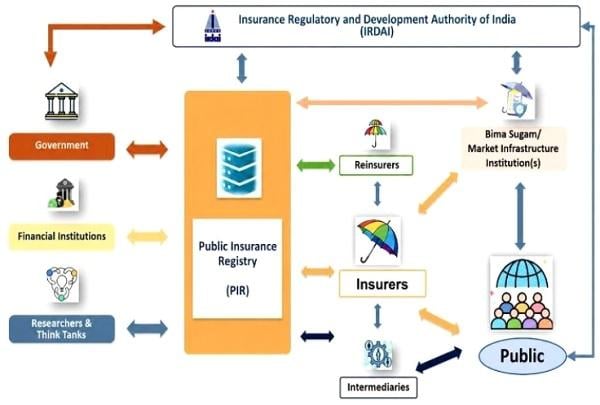
Envisaged not merely as a data repository, but as an innovation platform and a strategic investment in national economic infrastructure, the PIR will strengthen consumer protection, market efficiency, insurance coverage and supporting the next generation of insurance reforms. It has the potential to lower information barriers, promote competition and enable market participants to differentiate through product innovation, pricing, service quality and customer experience.
The consultation paper on PIR has been conceived through a user-centric approach, anchored in the needs and challenges of diverse stakeholders across the insurance ecosystem. It seeks to translate these needs into tangible outcomes by enabling more seamless, transparent and data-driven insurance journeys and decision-making. These use cases are presently at a conceptual stage and will be further developed into detailed functional and technical specifications as PIR progresses towards implementation.
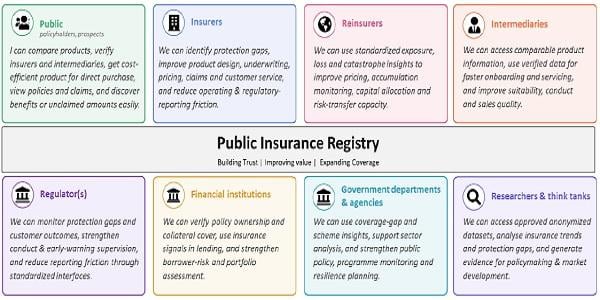
The envisioned use cases span across 8 stakeholders including:
1. Public, Policyholders, Prospects can compare products, verify insurers and intermediaries, get cost-efficient product for direct purchase, view policies and claims, and discover benefits or unclaimed amounts easily.
2. Insurers can identify protection gaps, improve product design, underwriting, pricing, claims and customer service, and reduce operating & regulatory-reporting friction.
3. Reinsurers can use standardized exposure, loss and catastrophe insights to improve pricing, accumulation monitoring, capital allocation and risk-transfer capacity.
4. Intermediaries can access comparable product information, use verified data for faster onboarding and servicing, and improve suitability, conduct and sales quality.
5. Regulator(s) can monitor protection gaps and customer outcomes, strengthen conduct & early-warning supervision, and reduce reporting friction through standardised interfaces.
6. Financial Institutions can verify policy ownership and collateral cover, use insurance signals in lending, and strengthen borrower-risk and portfolio assessment.
7. Government departments & agencies can use coverage-gap and scheme insights, support sector analysis, and strengthen public policy, programme monitoring and resilience planning.
8. Researchers & think tanks can access approved anonymised datasets, analyse insurance trends and protection gaps, and generate evidence for policymaking & market development.
Comments and suggestions have been invited from the public and stakeholders on the proposed framework, including its objectives, use cases, data architecture, identity framework, data standards, privacy and consent safeguards, commercial confidentiality, governance, implementation readiness and transition arrangements. The consultation is intended to ensure that the scope, design and implementation of PIR evolve through informed and wide-ranging stakeholder participation. The consultation paper can be accessed from link and https://iib.gov.in/pir .
Comments / feedback on this Consultation Paper, particularly on the user stories in Section 8 and the consultation questions in Section 15, may be submitted through the designated web portal https://iib.gov.in/pir or by email to [email protected] using the prescribed excel template.
The last date for submission of comments and feedback is 30th September 2026.