Keshav Bhardwaj Vs DCIT (ITAT Delhi)
Delhi ITAT Deletes Penalty as AO Failed to Specify Charge in Section 271(1)(c) Notice
The Delhi ITAT deleted the penalty of ₹29.90 lakh levied under section 271(1)(c), holding that the penalty notice issued under section 274 was invalid as the Assessing Officer failed to specify whether the penalty was for concealment of income or furnishing inaccurate particulars of income. The assessee had revised the return to offer long-term capital gains from sale of shares, which was accepted in the assessment.
The Tribunal observed that the Assessing Officer had used a standard printed notice without striking off the irrelevant limb and had also recorded inconsistent satisfaction in the assessment and penalty orders, reflecting complete non-application of mind. Such a vague notice deprived the assessee of a proper opportunity to defend the specific charge.
Relying on the decisions of the Karnataka High Court in CIT v. Manjunatha Cotton & Ginning Factory and the Supreme Court in SSA’s Emerald Meadows and Dilip N. Shroff, the Tribunal held that a valid penalty notice must clearly specify the exact limb of section 271(1)(c) invoked. Since this mandatory requirement was not fulfilled, the penalty was held to be unsustainable and was deleted. The assessee’s appeal was accordingly allowed.
FULL TEXT OF THE ORDER OF ITAT DELHI
The present appeal is filed by assessee against the order dated 28.11.2025 passed by Ld. Commissioner of Income Tax (Appeal), National Faceless Appeal Centre (“NFAC”), Delhi [in short “ld. CIT(A)”] in Appeal No. NFAC/2013-14/10040174 u/s 250 of the Income Tax Act, 1961 [“the Act”] arising out of assessment order dated 21.09.2016 passed u/s 143(3) of the Act pertaining to Assessment Year 2014-15.
2. Brief facts of the case are that the assessee is an individual, filed his return of income on 30.07.2014, declaring total income of INR 4,34,370/- which was revised on 30.12.2015 at an income of INR 1,01,12,310/-. The assessment was completed u/s 143(3) in terms of order dated 21.09.2016 wherein the AO observed that the assessee has revised the return of income only after receiving the summons u/s 131(1A) of the Act from Joint Director of Income Tax, Investigation, Gurgaon and therefore, penalty proceedings u/s 271(1)(c) of the Act were initiated for concealment of income or furnishing the inaccurate particulars of income. Thereafter, in terms of the order dated 21.03.2017 passed u/s 271(1)(c) of the Act, the AO has levied the penalty of INR 29,90,480/- on account of furnishing inaccurate particulars of income/concealment of income being 100% of the tax sought to be evaded.
3. Aggrieved by the said order, assessee is in appeal before ld. CIT(A) who vide impugned order dated 28.11.2025, dismissed the appeal of the assessee.
4. Aggrieved by the order of Ld. CIT(A), the assessee is in appeal before the Tribunal challenging the confirmation of penalty levied at Rs. 29,90,480/- u/s 271(1)(c) of the Act.
5. Before us, ld. AR for the assessee submits that assessee has revised the return of income to include Long Term Capital gain (“LTCG”) from the sale of shares of HPC Bioscience (“HPCB”) and Esteem Bio Organic (“EBO”) which were claimed exempt in the return filed u/s 139(1) of the Act. Ld. AR submits that return was revised suo motto without any inquiry or investigation and the allegation of the AO that it was revised after receiving the summons u/s 131 of the Act has no relevance as the assessee under the professional advice has offered the said income to tax. He further submits that notice issued for initiation of penalty proceedings is vague where the assessee was show caused to reply on both the limbs. Ld. AR further drew our attention to para 2 of the assessment order where the AO while initiating the penalty proceedings, has recorded the satisfaction for both the limbs i.e. concealment of income or furnishing inaccurate particulars of income and has not specified as to which limb was invoked for initiation of penalty proceedings. Ld.AR further submits that in the penalty order passed in para 3 of the order, AO has recorded the satisfaction that the assessee has concealed the particulars of income and in para 6, has levied the penalty for furnishing inaccurate particulars of income. Ld.AR submits that AO was not certain about the charge on which penalty u/s 271(1)(c) of the Act is going to be levied in the instant case.
6. Ld. AR further submits that the allegation of the Revenue that LTCG declared from the sale of share of HPC Bioscience and Esteem Bio Organic as bogus is also baseless as in many of the cases, the Co-ordinate Bench of Delhi Tribunal has held the LTCG from the sale of shares of these two companies as genuine and if the assessee had not revised the return, no additions would finally be sustained on this issue. Thus there was no attempt made by the assessee to conceal any income or furnished any inaccurate particulars of income.
7. In the last, Ld.AR for the assessee submits that the income declared in the revised return was accepted as such and therefore, there was no occasion for the Revenue to hold that the assessee has concealed any income more particularly, when the revised return superseded the original return of income filed and therefore, he humbly requested for the deletion of the penalty levied by the AO u/s 271(1)(c) of the Act.
8. On the other hand, ld. Sr. DR for the Revenue vehemently supported the orders of the lower authorities and submits that if the case of the assessee was not taken up for scrutiny and no summons were issued by ld. JCIT, the assessee never offered the Long term capital gain earned from these two companies for tax which was bogus LTCG. He, therefore, requested for the confirmation of the penalty levied.
9. Heard the contentions of both the parties and perused the material available on record. From the perusal of the notice issued on 21.09.2016 for initiation of the penalty proceedings, it is observed that AO has not specified the limb on which the satisfaction is recorded for initiation of penalty proceedings. The assessee was not show caused to explain whether the penalty proceedings were initiated for furnishing inaccurate particulars of income or for concealment of income. The same is reproduced herein below:
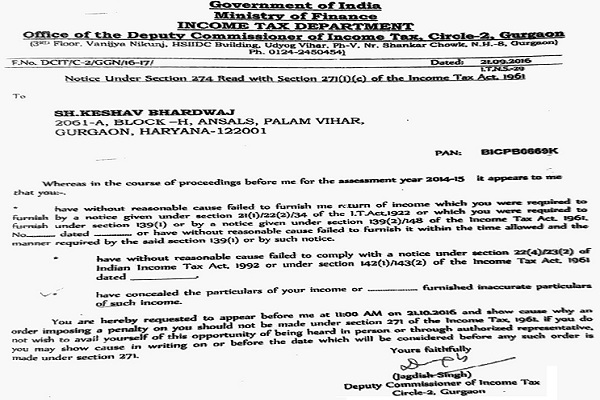
10. As per Section 271(1)(c) of the Act, the AO should record his satisfaction that the assessee has either concealed the income or furnished inaccurate particulars of his income. From the perusal of the notice issued u/s.274(1) r.w.s.271(1)(c) of the Act, as reproduced above, it is clear that it was not specifically pointed out as to whether the assessee has concealed the particulars of income or furnished the inaccurate particulars of income. In this regard, reliance can be placed on the decision of the Hon’ble Apex Court in case of M/s. SSA’s Emerald Meadows reported in (2016) 73 taxmann.com 248 (SC) wherein the Hon’ble Supreme Court has dismissed the Special Leave Petition filed by the Revenue against the judgment rendered by Hon’ble High Court of Karnataka whereby identical issue was decided in favour of the assessee. Operative part of the judgment in case of M/s. SSA’s Emerald Meadows (supra) decided by Hon’ble High Court of Karnataka is reproduced below:-
“2. This appeal has been filed raising the following substantial questions of law:
(1) Whether, omission if assessing officer to explicitly mention that penalty proceedings are being initiated for furnishing of inaccurate particulars or that for concealment of income makes the penalty order liable for cancellation even when it has been proved beyond reasonable doubt that the assessee had concealed income in the facts and circumstances of the case?
(2) Whether, on the facts and in the circumstances of the case, the Tribunal was justified in law in. holding that the penalty notice under Section 274 r.w.s. 271(1)(c) is had in law and. invalid in spite the amendment of Section 271(1 B) with retrospective effect and by virtue of the amendment, the assessing officer has initiated the penalty by properly recording the satisfaction for the same?
(3) Whether on the facts and in the circumstances of the case, the Tribunal was justified in deciding the appeals against the Revenue on the basis of notice issued, under Section 274 without taking into consideration the assessment order when the assessing officer has specified that the assessee has concealed particulars of income?
3. The Tribunal has allowed the appeal filed by the assessee holding the notice issued by the Assessing Officer under Section 274 read with Section 271(1)(c) of the Income Tax Act, 1961 (for short ‘the Act) to be bad in law as it did not sped which limb of Section 271(1)(c) of the Act, the penalty proceedings had been initiated i.e, whether for concealment of particulars of income or furnishing of inaccurate particulars of income. The Tribunal, while allowing the appeal of the assessee, has relied on the derision of the Division Bench of this Court rendered in the case of COMMISSIONER INCOME TAX VS- MANJUNATHA COTTON AND GINNING FACTORY (2013) 359 ITR 565.
4. In our view, since the matter is covered by judgment of the Division Bench of this Court, we are of the opinion, no substantial question of law arises in this appeal for determination by this Court, the appeal is accordingly dismissed.”
11. As observed above, the Assessing Officer initiated the penalty proceedings by issuing the notice u/s 274/271(1)(c) of the Act without specifying whether the assessee has ‘concealed the particulars of income’ or assessee has ‘furnished inaccurate particulars of income’, so as to provide adequate opportunity to the assessee to explain its case. Rather notices in this case have been issued in a stereotyped manner without applying mind which is bad in law, hence is not a valid notice sufficient to impose penalty u/s 271(1)(c) of the Act.
12. The penalty provisions of section 271(1)(c) of the Act are attracted where the assessee has concealed the particulars of income or furnished inaccurate particulars of such income. It is also a well-accepted proposition that the aforesaid two limbs of section 271(1)(c) of the Act carry different meanings. Therefore, it was imperative for the Assessing Officer to strike- off the irrelevant limb so as to make the assessee aware as to what is the charge made against him so that he can respond accordingly. The Hon’ble Karnataka High Court in the case of CIT Vs Manjunatha Cotton and Ginning Factory reported in (2012) 359 ITR 565 observed that the levy of penalty has to be clear as to the limb under which it is being levied. As per Hon’ble High Court, where the Assessing Officer proposed to invoke first limb being concealment, then the notice has to be appropriately marked. The Hon’ble High Court held that the standard proforma of notice under section 274 of the Act without striking of the irrelevant clauses would lead to an inference of non-application of mind by the Assessing Officer. The Hon’ble Supreme Court in the case of Dilip N. Shroff vs. JCIT reported in 291 ITR 519 (SC) has also noticed that where the Assessing Officer issues notice under section 274 of the Act in the standard proforma and the inappropriate words are not deleted, the same would postulate that the Assessing Officer was not sure as to whether he was to proceed on the basis that the assessee had concealed the particulars of his income or furnished inaccurate particulars of income. According to the Hon’ble Supreme Court, in such a situation, levy of penalty suffers from non-application of mind. In the background of the aforesaid legal position and having regard to the manner in which the Assessing Officer has issued notices under section 274 r.w.s. 271(1)(c) of the Act without striking off the irrelevant words, as reproduced above, the penalty proceedings shows the non-application of mind by the Assessing Officer and is, thus, unsustainable.
13. In view of the facts and circumstances of the case, particularly looking to the fact that the AO has failed to record the satisfaction about any limb at the time of initiation of penalty proceedings u/s.271(1)(c) of the Act, therefore, the penalty levied u/s.271(1)(c) of the Act is hereby deleted.
14. In the result, appeal filed by the assessee is allowed.
Order pronounced in the open court on 31.07.2026.