TDS Deducted, Yet Tax Still Payable?; The hidden ITR shock every salaried taxpayer must avoid; Form 16 Alone May Not Prevent Additional Tax & Interest for Salaried Taxpayers; FD interest, stock-market gains, job changes and other income can create tax—and interest—even when Form 16 appears complete.
Article explains that Form 16 and salary TDS do not necessarily discharge a salaried taxpayer’s final income-tax liability because TDS is only a mode of tax collection based on information available to the employer. It highlights that additional income such as fixed deposit interest, dividends, savings-bank interest, rental income, capital gains, salary from multiple employers, freelancing, ESOPs, RSUs, overseas investments, virtual digital assets, online winnings, and other taxable receipts must be aggregated while filing the income-tax return. It clarifies that for AY 2026–27, ₹12 lakh is not the basic exemption limit under the default new tax regime and that the Section 87A rebate is subject to specified conditions. The article discusses how advance tax provisions and interest under Sections 234A, 234B, and 234C may apply where tax remains unpaid, provides illustrative computations, outlines advance tax instalments, and recommends quarterly reviews, reconciliation of Form 16, Forms 16A, Form 26AS, AIS/TIS, bank and broker records, timely reporting of multiple salaries and other income, and payment of advance tax to reduce year-end tax liability and interest.
In professional practice, one misconception appears repeatedly: a salaried employee sees tax deducted every month, receives Form 16 and assumes that the year’s tax liability has been fully discharged. That assumption is understandable—but often incorrect.
Salary TDS is only an estimate made by the employer on the basis of salary and the information furnished by the employee. The employer does not automatically know about every fixed deposit, share transaction, dividend, second employer, rental receipt, overseas investment or side income. At the time of filing the income-tax return (ITR), all taxable income is aggregated, the final tax is recomputed and TDS is merely allowed as credit. If some tax was still payable and should have been paid earlier as advance tax, then interest under sections 234B and 234C may also be charged.
The central message: TDS is a mode of collecting tax; it is not a certificate that the taxpayer’s final liability is nil.
First, correct the ₹12 lakh misconception
For AY 2026–27, ₹12 lakh is not the basic exemption limit. Under the default new tax regime, the basic slab begins with nil tax up to ₹4 lakh. A resident individual whose total income does not exceed ₹12 lakh may receive a rebate under section 87A, subject to a maximum of ₹60,000. However, the rebate does not absorb tax on income chargeable at special rates, such as specified capital gains under sections 111A and 112.
Therefore, a person can have total income within ₹12 lakh and still have tax payable. This distinction is particularly important for employees investing in listed shares and equity-oriented mutual funds.
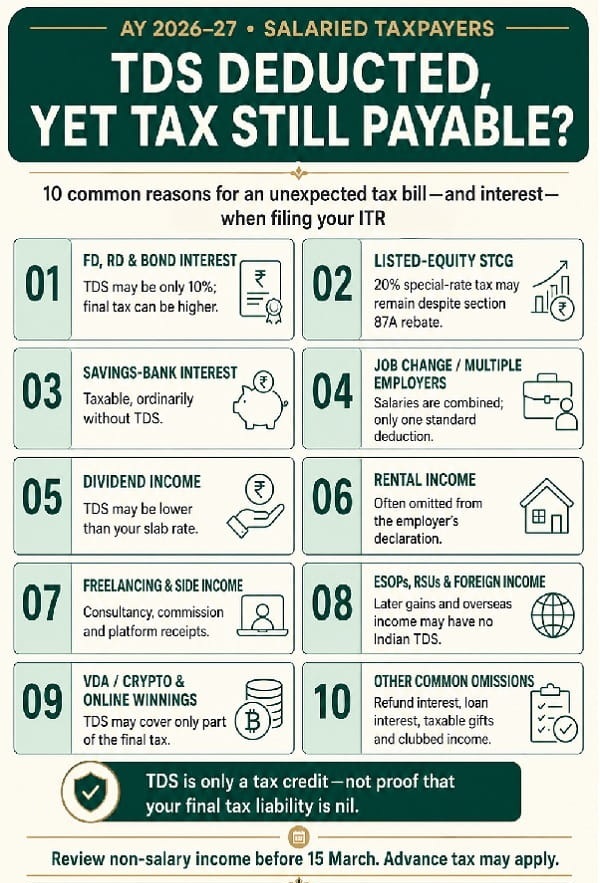
Where does the surprise tax bill arise?
1. Fixed-deposit, recurring-deposit and bond interest
Employees frequently report investment deductions to the employer but omit the income generated by those investments. Bank TDS on interest is generally 10% where applicable, while the taxpayer’s marginal rate may be 20% or 30%, apart from cess. TDS may therefore cover only a fraction of the actual tax.
Illustration 1: ₹5 lakh FD interest for a taxpayer in the 30% slab
Assumptions: FY 2025–26/AY 2026–27; the employee’s existing taxable income is already above ₹24 lakh under the new regime, so the entire additional interest falls in the 30% slab; no surcharge applies; the taxpayer is not a senior citizen; the bank deducts TDS at 10%; no advance tax is paid; and self-assessment tax is paid while filing the return in July 2026.
| Particulars | Amount (₹) |
|---|---|
| Interest income | 5,00,000 |
| Income tax at 30% | 1,50,000 |
| Health and Education Cess at 4% | 6,000 |
| Total tax attributable to interest | 1,56,000 |
| Less: TDS by bank at 10% | (50,000) |
| Balance tax payable | 1,06,000 |
| Interest under section 234C | 5,353 |
| Interest under section 234B (April–July: 4 months) | 4,240 |
| Interest under section 234A (return filed within due date) | Nil |
| Approximate amount payable with return | 1,15,590 |
Thus, despite ₹50,000 having already been deducted by the bank, the employee may still pay approximately ₹1.16 lakh at the return-filing stage—₹1.06 lakh as balance tax and about ₹9,590 as interest. If no TDS was deducted, the shortfall and related interest would be still higher.
2. Listed-equity short-term capital gains and the ₹12 lakh trap
Short-term capital gain covered by section 111A—generally, gain on listed equity shares, equity-oriented mutual-fund units or business-trust units where the prescribed STT condition is satisfied—is taxable at 20% for transfers on or after 23 July 2024. Not every short-term gain is taxable at 20%; gains outside section 111A may be taxable at normal rates.
Illustration 2: Salary income of ₹10 lakh and section 111A STCG of ₹2 lakh
Assumptions: the employee is a resident individual under the new regime; ₹10 lakh is taxable salary income after the standard deduction and other permissible adjustments; the ₹2 lakh gain is fully covered by section 111A; no TDS or advance tax has been paid; the entire gain arose on or before 15 June 2025; and tax is paid while filing the return in July 2026.
| Computation | Amount (₹) |
|---|---|
| Taxable salary income | 10,00,000 |
| Section 111A short-term capital gain | 2,00,000 |
| Total income | 12,00,000 |
| Tax on salary at normal slab rates | 40,000 |
| Tax on STCG at 20% | 40,000 |
| Gross income tax | 80,000 |
| Less: section 87A rebate—restricted to normal-rate tax | (40,000) |
| Tax after rebate | 40,000 |
| Health and Education Cess at 4% | 1,600 |
| Net tax payable | 41,600 |
| Approx. section 234C interest | 2,099 |
| Section 234B interest (April–July: 4 months) | 1,664 |
| Approximate amount payable with return | 45,360 |
What happened to the rebate? The normal slab tax of ₹40,000 is neutralised by section 87A, but the ₹40,000 tax on special-rate STCG survives. After cess and assumed interest, the return-stage outflow is approximately ₹45,360.
The section 234C figure depends on the quarter in which the capital gain actually arose. The law gives relief where a capital gain could not be estimated, provided the tax relating to it is paid in the remaining advance-tax instalment(s), or by 31 March where no instalment remains. If the taxpayer waits until return filing, the benefit may be lost and the notified ITR asks for a quarter-wise breakup of capital gains.
3. Savings-bank interest
Savings-account interest is taxable, but ordinarily no TDS is deducted from it. The exact figure may not be known at the beginning of the year, particularly where several accounts are maintained. Under the old regime, eligible taxpayers may claim deduction under section 80TTA (and eligible senior citizens under section 80TTB); these deductions are generally unavailable under the new regime. A reasonable estimate should therefore be built into the annual tax computation and updated near year-end.
4. Job change or salary from more than one employer
Each employer may compute TDS as if its salary were the employee’s only income. This can result in lower slab rates being applied twice, rebate being considered separately and the standard deduction effectively being allowed more than once at the TDS stage. In the ITR, however, salary from all employers is aggregated and only one overall standard deduction is available.
Illustration 3: Both employers deduct nil tax, but the ITR shows a liability
Suppose Employer A pays gross salary of ₹6 lakh and Employer B pays gross salary of ₹8 lakh. If each considers only its own payment, both may arrive at nil TDS after the new-regime rebate. In the final return, gross salary is ₹14 lakh, and after a single standard deduction of ₹75,000, taxable salary is ₹13.25 lakh. The resulting tax including cess is approximately ₹81,900. If no advance tax was paid and the amount is discharged in July, interest under sections 234B and 234C may take the total outflow to roughly ₹89,310, based on the stated assumptions.
Section 192 permits an employee receiving salary from more than one employer to furnish the earlier salary and TDS details to the chosen/current employer so that tax can be deducted on aggregate salary. This is the simplest way to avoid a large year-end shortfall.
5. Dividends
Dividend is ordinarily taxable at slab rates. Even where TDS is deducted at 10%, a taxpayer in a higher slab may face a substantial gap. Dividend income also receives a limited section 234C timing relief if the related tax is paid in the remaining advance-tax instalments or, where none remains, by 31 March.
6. Rental income
An employee may own a let-out house but leave the rent out of the employer’s tax declaration. TDS by a tenant, if applicable, may still be lower than the final tax. Annual rent, municipal taxes, the statutory deduction under section 24(a), eligible interest and any house-property loss restrictions must be considered in the overall estimate.
7. Freelancing, consultancy, commission and digital-platform income
Salary earners increasingly receive side income from consulting, teaching, content creation, referral arrangements and online platforms. TDS may be nil or may be deducted at a rate lower than the final slab rate. Such receipts can also change the applicable ITR form and may constitute business or professional income rather than ‘other sources’.
8. ESOPs, RSUs and overseas investments
Employer TDS on an ESOP or RSU perquisite does not automatically settle the capital gain arising on a later sale. Foreign dividends, overseas bank interest and gains on foreign shares may have no Indian TDS. Foreign tax credit also requires proper reporting and supporting compliance. These items deserve a separate quarterly review rather than a year-end estimate based only on Form 16.
9. Virtual digital assets and online winnings
Tax deducted on virtual digital asset transactions can be only a small fraction of the final special-rate tax. Online winnings may also leave cess or other reconciliation differences. Employees participating in crypto or gaming platforms should compute the tax immediately after a taxable event and not wait for AIS or the return utility to reveal the liability.
10. Small but frequently omitted items
Interest on an income-tax refund, interest on loans given to relatives or others, taxable gifts and income required to be clubbed from investments made in the name of a spouse or minor child are commonly missed. Individually small amounts can become material when combined, particularly for a taxpayer already in a higher slab.
How salaried taxpayers can avoid excess tax and interest
1. Give the employer a complete income estimate. Include projected FD/RD interest, savings interest, dividends, rental income and TDS already deducted. Section 192(2B) enables an employee to furnish eligible other-income particulars to the employer for TDS computation.
2. Report earlier salary immediately after changing jobs. Furnish previous-employer salary and TDS details to the current/chosen employer and ask for tax to be recomputed on aggregate salary.
3. Download a broker tax P&L every quarter. Separate section 111A gains, other capital gains, intraday activity and futures-and-options results. These categories do not necessarily share the same head of income or tax rate.
4. Pay advance tax on time. The normal cumulative targets are 15% by 15 June, 45% by 15 September, 75% by 15 December and 100% by 15 March. For an unexpected capital gain or dividend, pay the related tax in the next applicable instalment.
5. Do not confuse 15 March with 31 March. Payment by 15 March protects against the final section 234C instalment. Tax paid by 31 March is still treated as advance tax and can prevent section 234B exposure, but a payment after 15 March may not erase the one-month section 234C charge unless the statutory exception applies—for example, a qualifying capital gain arising after 15 March.
6. Use a prudent estimate for savings interest. Start with the previous year’s figure, adjust for current balances and rates, and keep a modest buffer. Replace the estimate with bank interest certificates before filing.
7. Reconcile, do not merely copy, information statements. Compare Form 16, all Forms 16A, Form 26AS, AIS/TIS, bank interest certificates, broker statements, mutual-fund capital-gain statements and foreign-income records. AIS is an important cross-check, but it is not a substitute for the taxpayer’s own complete records.
8. Run a final tax review before 15 March. A simple year-end computation can often convert an unexpected July demand into a planned March payment and materially reduce interest.
Advance tax and sections 234A, 234B and 234C—in brief
Advance tax generally becomes payable when the estimated tax liability for the year, after TDS/TCS and eligible credits, is ₹10,000 or more. A salaried status does not create an exemption from advance tax.
| Provision | When it applies | Rate and period | Practical point |
|---|---|---|---|
| Advance tax | Estimated net tax liability is ₹10,000 or more | Cumulative 15%, 45%, 75% and 100% by 15 Jun, 15 Sep, 15 Dec and 15 Mar | Review all non-salary income each quarter |
| Section 234A | Return is filed after the applicable due date and tax remains payable | 1% per month or part thereof for the period of delay | Nil where the return is timely filed; late-filing fee may separately apply |
| Section 234B | Advance tax is not paid or is less than 90% of assessed tax | 1% per month or part thereof from 1 April until payment/assessment, on the shortfall | Tax paid by 31 March can avoid or reduce exposure |
| Section 234C | Advance-tax instalments are deferred or short-paid | 1% per month; generally 3 months for the first three shortfalls and 1 month for the last | Quarter of capital gain/dividend and prompt payment are crucial |
Conclusion
For salaried taxpayers, Form 16 is the starting point of return preparation—not the final tax computation. The employer can deduct the correct amount only when the employee supplies complete information. A quarterly review of bank interest, investments, capital gains and secondary income is therefore not merely good record-keeping; it is an effective way to prevent an unexpected self-assessment tax bill and avoidable interest.
The safest rule is simple: whenever income arises outside payroll, ask two questions immediately—how will it be taxed, and has enough tax already been paid?