Income Tax Return (ITR) filing for senior citizens becomes much easier with proper preparation and understanding of the applicable rules. A person aged 60 to below 80 years is treated as a Senior Citizen, while 80 years or above is a Super Senior Citizen, and those turning 60 during the financial year are eligible for senior citizen benefits for that year. ITR filing is generally mandatory, except for certain resident senior citizens aged 75 years or above whose income is limited to pension and interest from the same specified bank, subject to prescribed conditions and submission of Form 125. Merely attaining 75 years does not automatically exempt ITR filing. Before filing, taxpayers should collect PAN, Form 16, interest certificates, AIS, Form 26AS, and deduction proofs, verify income details, select the correct tax regime and ITR form, and reconcile records. Simple returns can often be filed without professional assistance, while complex cases involving capital gains, inherited property, or foreign assets require expert advice.
Senior Citizen Tax Clinic – Part 1: ITR filing Simplified
A Practical Series on Income Tax for Senior Citizens
Simple explanations – Real-life examples – Step-by-step guidance
As the Income Tax Return (ITR) filing season approaches, many senior citizens are unsure whether they are required to file a return, which ITR form applies, how pension and bank interest are taxed, and whether they can claim a refund of TDS deducted by banks.
The confusion is understandable. Frequent changes in income tax rules and the fear of making mistakes often make ITR filing seem complicated.
Most senior citizens have a relatively simple source of income, such as a pension, family pension, interest on bank deposits, rental income, or capital gains from the sale of property or investments. With a basic understanding of the applicable provisions, ITR filing can be much easier than it appears.
In this article, we shall answer the following practical questions:
- Who is treated as a Senior Citizen?
- Is ITR filing compulsory?
- Who is eligible for an exemption after the age of 75 years?
- What documents should be kept ready?
- Which ITR form is applicable?
- Can a senior citizen file the return without professional help?
Who Is a Senior Citizen Under Income Tax Rules?
Under the Income Tax Act, a person aged 60 years or above but below 80 years is considered a Senior Citizen, whereas a person aged 80 years or above is considered a Super Senior Citizen.
When is a Person Considered to Have Attained the Age of 60 years?
For income-tax purposes, age eligibility is not determined merely by the date of birth falling within a financial year. A person who attains the age of 60 years at any time during a financial year is treated as a Senior Citizen for the entire financial year.
Furthermore, the Income Tax law follows a technical rule for determining age. A person is deemed to have attained a particular age on the day immediately preceding their birthday.
Illustration 1:
Mr Sharma’s 60th birthday falls on 01 April 2026. He is deemed to have attained the age of 60 years on 31 March 2026, i.e., the day immediately preceding his birthday.
Accordingly, Ar. Sharma will be treated as a Senior Citizen for Financial Year 2025-26 (Assessment Year 2026-27) and will be eligible for the higher basic exemption limit applicable to senior citizens under the old regime for FY 2025-26.
Are all senior citizens required to file an Income Tax Return?
The answer is generally “Yes”. However, a limited exemption from return filing has been provided for certain resident senior citizens aged 75 and above, as discussed in the following paragraphs.
Special Relief for Certain Senior Citizens Aged 75 years and above:
Senior citizens aged 75 years or above, with income only from pension and interest, are not required to file an ITR, provided the interest income is earned from the same bank that receives the pension. In addition, the specified banks should deduct the applicable tax after considering the eligible deductions and the rebate available to the senior citizen.
If a senior citizen has any other source of income, such as rental income, capital gains, business income, or interest from another bank, the exemption may not be available, and ITR filing requirements will need to be examined separately.
Important point to remember:
Merely attaining the age of 75 years does not automatically exempt a person from filing an Income Tax Return. Where there is any doubt about eligibility or a TDS refund is expected, filing an Income Tax Return may be a safer approach
Illustration 2:
Mr Sharma retired from a PSU two years ago. He receives a pension from his former employer, holds fixed deposits in a bank and earns interest on them. He has no other income and submits the prescribed declaration in Form 125 (earlier known as Form 12BBA) to the bank. In such a case, he may not be required to file an Income Tax Return.
What is Form 125? Form 125 in Indian income tax is a declaration form that allows “Specified Senior Citizens” (aged 75 and older) to claim an exemption from filing annual Income Tax Returns (ITR). By submitting this form, the senior citizen authorises the specific banks to compute their total income and deduct tax at source
Form No 125 can be submitted in paper form or E-filed through net banking using the facility provided by the specified bank. This Form only provides exemption from filing of an ITR to a specified Senior Citizen and does not offer any exemption from the deduction of tax at source on pension and interest income
What documents should I keep ready before filing my ITR?
Now that we know who is required to file an ITR, let us move to the next practical aspect. A little preparation before starting the filing process can save considerable time and help avoid errors, mismatches and unnecessary notices.
It is advisable to have all relevant documents ready before starting the ITR filing process. This not only makes filing the return easier but also helps avoid omissions and future notices. Important documents include PAN Card, Bank Interest Certificate, Form 26AS, Annual Information Statement (AIS), Form 16, etc. A few minutes spent collecting and verifying these documents can save considerable time and effort.
Senior Citizens’ Checklist for ITR Filing
- Download AIS
- Download Form 26AS
- Collect interest certificates from all banks
- Verify pension amount
- Verify TDS deducted
- Keep deduction proof ready
- Select the correct tax regime
- Select the correct ITR Form
Having all items on the above checklist ready before starting the filing process means that nearly 80% of the preparation for ITR filing is already complete.
However, collecting documents alone is not sufficient. It is equally important to ensure that the income reflected in personal records matches the information available with the Income Tax Department. A quick review of the Annual Information Statement (AIS) and Form 26AS before filing the return helps identify any mismatch at an early stage.
How to Download AIS & Form 26AS?
Downloading the Annual Information Statement (AIS) and Form 26AS is a straightforward process through the official Income Tax e-filing portal.
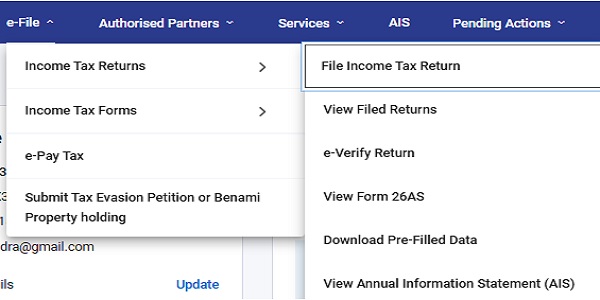
Step 1: Log In: Go to the Income Tax e-Filing Portal>click on the e-File menu, select Income Tax Returns, and click on View AIS.
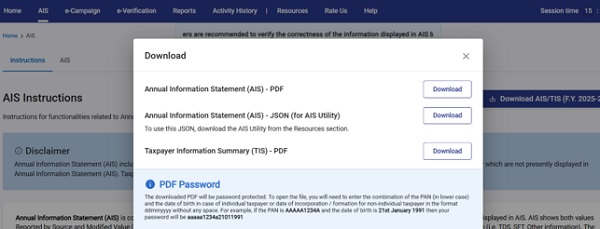
Step 2: Click on the AIS Tile. On the redirected Compliance Portal, click the AIS tile. Select the relevant Financial Year from the drop-down menu. Click the Download icon on the tile. Select either PDF or JSON format, enter the CAPTCHA if prompted, and click Proceed to download.
Note: The downloaded PDF is password-protected. The password format is lowercase PAN + Date of Birth in ddmmyyyy format
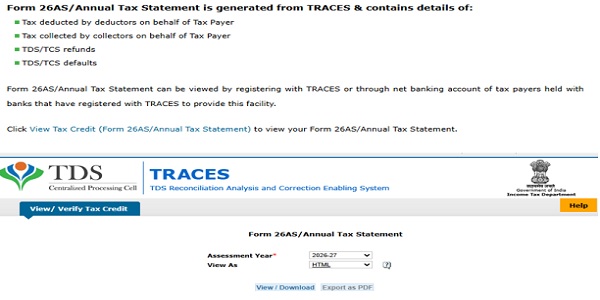
Step 3: Click on View Form 26AS:
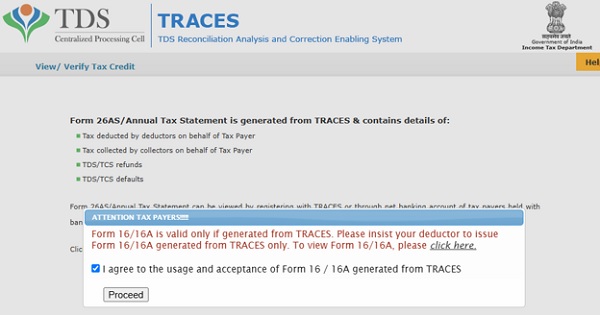
Step 4: Click on Proceed:
Which ITR Form should I file?
Everything is now in place, the documents are ready, and the income details have been verified with the Income Tax Department’s records. But before clicking “Proceed” on the e-Filing portal, there is one important question to answer: Which ITR form should be filed?
Choosing the correct ITR form is just as important as reporting the correct income. The following section explains how to identify the appropriate form based on the nature of income and other eligibility conditions:
If income consists of pension, one house property, bank interest, etc. – ITR – 1
Capital Gains, more than one house property, foreign assets, etc. – ITR – 2
This is only a broad guide. The correct form depends upon the nature of income and other reporting requirements.
Can a Senior Citizen File ITR Without Professional Help?
Yes, in many cases. If the income consists only of a pension, one house property and bank interest, many senior citizens can comfortably file the return themselves by following the instructions available on the e-Filing portal. However, where the return involves capital gains, inherited property, foreign assets or other complex transactions, professional assistance is advisable.
Conclusion:
Filing an Income Tax Return need not be a stressful exercise for senior citizens. With a basic understanding of the applicable provisions, a few key documents kept ready, and careful verification of the information reflected in AIS and Form 26AS, most senior citizens can complete the process smoothly and with confidence.
Whenever there is any doubt regarding the applicable ITR form, reporting of income, or tax implications of a particular transaction, it is always advisable to seek professional guidance rather than making assumptions.
A correctly filed return not only ensures compliance with the Income Tax Act but also helps claim legitimate refunds, maintain a clean financial record, and provides peace of mind. After all, informed taxpayers make confident taxpayers.
Key Takeaways:
The objective of this article is not merely to explain the filing process but to help taxpayers approach it with confidence and proper preparation. A quick recap of the most important points discussed:-
- Being a Senior Citizen does not automatically exempt a person from filing an ITR.
- The exemption available after the age of 75 years is subject to several conditions.
- Keep all documents ready before starting return filing.
- Verify AIS and Form 26AS before submitting the return.
- When in doubt, seek professional advice rather than making assumptions.
Frequently Asked Questions by Senior Citizens
Q1. Is filing an Income Tax Return compulsory if the total income is below the basic exemption limit?
Answer: Generally, filing an ITR is not mandatory if the total income before deductions does not exceed the applicable basic exemption limit and none of the specified conditions requiring compulsory filing applies. However, filing a return is advisable when a TDS refund is to be claimed, losses are to be carried forward, or proof of income is required for loans, visas, or other financial purposes.
Q2. Is checking Form 26AS alone sufficient before filing the return?
Answer: No. Form 26AS primarily reflects tax deducted at source and tax collected at source, as well as certain specified transactions. The Annual Information Statement (AIS) provides a much broader picture of financial transactions and income reported to the Income Tax Department. Reviewing both helps identify omissions or mismatches before filing the return.
Q3. What should be done if the income shown in AIS does not match personal records?
Answer: The discrepancy should first be verified using supporting documents, such as bank interest certificates, Form 16, or other income records. If the AIS contains incorrect information, appropriate feedback can be submitted through the AIS portal. The return should be filed based on the verified income.
Q4. Can an Income Tax Return be revised if a mistake is noticed after filing?
Answer: Yes. If an error or omission is discovered after filing, a Revised Return can generally be filed within the time permitted under the Income Tax Act, subject to the applicable provisions for the relevant assessment year.
Q5. Is professional assistance necessary for every senior citizen?
Answer: Not necessarily. Where the income consists only of pension, one house property and bank interest, many senior citizens can file the return themselves with proper preparation. However, professional guidance is advisable when the return involves capital gains, inherited property, foreign assets, business income or any complex tax issues.
The next part of this series will answer many practical questions relating to pensions, TDS, Form 15H and bank deductions
Coming up in Senior Citizen Tax Clinic – Part 2: Pension, Family Pension & TDS – What Every Senior Citizen Should Know
The next article in this series will explain the taxability of pensions and family pensions, TDS deductions by banks, submission of Form 15H, claiming refunds, and other practical issues commonly faced by senior citizens.
*****
Disclaimer: The article is for educational purposes only.
The author can be approached at [email protected]