Summary: The Food Safety and Standards Authority of India (FSSAI) has sanctioned prosecution against Bisleri International Pvt. Ltd. under the Food Safety and Standards Act, 2006, after a regulatory sample of its packaged drinking water was declared unsafe. According to an official announcement issued by FSSAI on 22 November 2026, the sample failed to comply with the prescribed bromate limits. Following an appeal by the company, the sample was examined by a Referral Food Laboratory, which also declared it unsafe due to the detection of polynuclear aromatic hydrocarbons (PAHs).
FSSAI stated that the laboratory findings established violations relating to unsafe food under the Food Safety and Standards Act, 2006, and consequently granted sanction to launch prosecution against the company.
The regulatory action has attracted attention because Bisleri is one of India’s most recognised packaged drinking water brands. The findings raise concerns regarding chemical contamination, manufacturing quality controls, laboratory testing and compliance with food safety standards.
However, sanctioning prosecution does not amount to a judicial finding of guilt. The findings relate to the tested sample and should not be interpreted as establishing that all Bisleri products or batches are unsafe.
- FSSAI's Official Announcement Against Bisleri International
- 1. Collection of Regulatory Sample
- 2. Non-Compliance With Bromate Limits
- 3. Referral Laboratory Confirms Unsafe Sample
- 4. Violations Under the Food Safety and Standards Act
- 5. Sanction Granted for Prosecution
- Bisleri's Response to FSSAI's Findings
- What Is Bromate and Why Is It Harmful?
- What Are Polynuclear Aromatic Hydrocarbons (PAHs)?
- Legal Consequences Under the Food Safety and Standards Act, 2006
- Punishment Under Section 59
- Does Sanction for Prosecution Mean Bisleri Has Been Convicted?
- Implications for Packaged Drinking Water Manufacturers
- What Should Consumers Know About Bisleri Drinking Water?
- Conclusion
FSSAI’s Official Announcement Against Bisleri International
In its official social media announcement titled “Sanction of Prosecution Against M/s Bisleri International Pvt. Ltd.”, FSSAI recorded five key observations concerning the packaged drinking water sample.
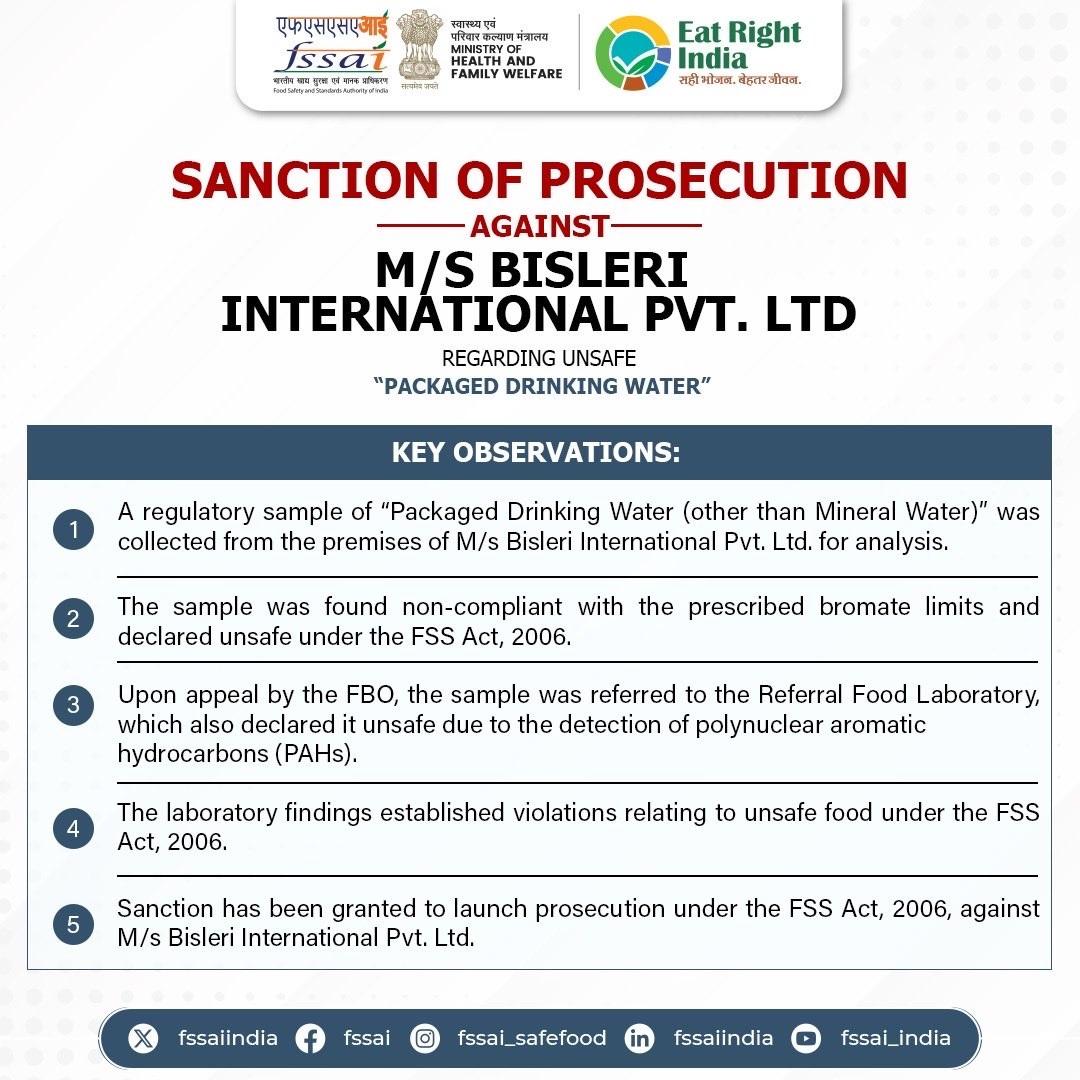
1. Collection of Regulatory Sample
A regulatory sample of “Packaged Drinking Water (other than Mineral Water)” was collected from the premises of M/s Bisleri International Pvt. Ltd. for laboratory analysis.
2. Non-Compliance With Bromate Limits
The sample was found non-compliant with the prescribed bromate limits and was declared unsafe under the Food Safety and Standards Act, 2006.
3. Referral Laboratory Confirms Unsafe Sample
Following an appeal by the food business operator, the sample was referred to the Referral Food Laboratory for further examination.
The referral laboratory also declared the sample unsafe due to the detection of polynuclear aromatic hydrocarbons (PAHs).
4. Violations Under the Food Safety and Standards Act
FSSAI stated that the laboratory findings established violations relating to unsafe food under the Food Safety and Standards Act, 2006.
5. Sanction Granted for Prosecution
Based on the laboratory findings, sanction was granted to launch prosecution against M/s Bisleri International Pvt. Ltd. under the Food Safety and Standards Act, 2006.
The official announcement does not disclose the complete laboratory reports, batch number, individual PAH concentrations or precise charges proposed in the prosecution.
Bisleri’s Response to FSSAI’s Findings
According to a Reuters report dated 22 November 2026, Bisleri stated that the sample concerned its Goa facility and had been collected in 2025.
The company reportedly stated that the bromate concentration was 12 micrograms per litre, compared with the prescribed limit of 10 micrograms per litre.
This represents an exceedance of 20% over the stated permissible limit.
Bisleri also maintained that subsequent independent testing arranged by the company showed bromate concentrations within permissible limits. The company reiterated its commitment to product safety and indicated that it would cooperate with the regulatory authorities.
These statements represent Bisleri’s reported position and should be distinguished from the laboratory findings announced by FSSAI. The regulator’s announcement also refers to the detection of PAHs by the Referral Food Laboratory.
Source: Bisleri International’s statement, as reported by Reuters on 22–23 November 2026.
What Is Bromate and Why Is It Harmful?
Bromate is a chemical compound that can form as a by-product during drinking water treatment, particularly when ozone reacts with bromide ions naturally present in source water.
Ozonation is commonly used for water disinfection. However, improper control of treatment conditions may result in the formation of bromate.
Potassium bromate has been classified by the International Agency for Research on Cancer (IARC) as possibly carcinogenic to humans (Group 2B).
Excessive bromate exposure is a health concern because of its potential toxicological effects, including kidney toxicity and possible carcinogenic risks.
In the present case, the reported bromate concentration exceeded the stated permissible limit. Such non-compliance is relevant for regulatory purposes, although the reported concentration alone does not establish that consumption of an individual bottle would necessarily cause immediate illness.
What Are Polynuclear Aromatic Hydrocarbons (PAHs)?
Polynuclear aromatic hydrocarbons, also commonly known as polycyclic aromatic hydrocarbons, are a group of organic chemical compounds containing multiple aromatic rings.
They are generally associated with incomplete combustion of carbon-containing materials, petroleum-related contamination, industrial activities and other environmental sources.
Certain PAHs are recognised as carcinogenic, while others have different toxicological characteristics. Their health significance depends on the specific compound, concentration and duration of exposure.
In the Bisleri matter, FSSAI stated that the Referral Food Laboratory detected PAHs and declared the packaged drinking water sample unsafe.
However, the official announcement does not identify the particular PAHs detected or disclose their concentrations.
It would therefore be inappropriate to conclude from the available announcement alone that the contamination originated from plastic bottles, manufacturing equipment, source water or any other particular source.
Legal Consequences Under the Food Safety and Standards Act, 2006
The Food Safety and Standards Act, 2006, establishes the statutory framework for regulating the manufacture, storage, distribution, sale and import of food products, including packaged drinking water.
The following provisions are particularly relevant to proceedings involving unsafe food:
- Section 3(1)(zz): Defines unsafe food.
- Section 26: Prescribes responsibilities of food business operators.
- Section 27: Addresses liability of manufacturers, packers, wholesalers, distributors and sellers.
- Section 42: Prescribes the procedure for launching prosecution.
- Section 46: Deals with Food Analysts and related procedures.
- Section 47: Governs sampling and analysis.
- Section 59: Prescribes punishment for unsafe food.
Punishment Under Section 59
Section 59 provides different punishments depending on whether the unsafe food results in injury or death.
- Where no injury results: Imprisonment for up to six months and fine up to Rs. 1 lakh.
- Where non-grievous injury results: Imprisonment for up to one year and fine up to Rs. 3 lakh.
- Where grievous injury results: Imprisonment for up to six years and fine up to Rs. 5 lakh.
- Where death results: Imprisonment for a minimum of seven years, which may extend to life imprisonment, and a minimum fine of Rs. 10 lakh.
These are statutory punishment categories and not penalties already imposed on Bisleri.
The precise charges, liability and consequences will depend on the allegations in the prosecution, evidence presented and findings of the competent court.
Does Sanction for Prosecution Mean Bisleri Has Been Convicted?
No. Sanctioning prosecution is a regulatory step that permits the initiation of legal proceedings.
It does not establish criminal guilt or constitute a conviction.
The prosecution must establish the relevant statutory ingredients before the competent court. The company retains its right to contest the allegations, challenge the evidence and raise available legal defences.
Implications for Packaged Drinking Water Manufacturers
The FSSAI action highlights the importance of robust quality assurance and regulatory compliance in the packaged drinking water industry.
Manufacturers should maintain effective monitoring of source water quality, treatment processes, chemical contaminants and finished products.
Where ozonation is used, adequate controls should be implemented to minimise bromate formation and ensure compliance with prescribed limits.
Manufacturers should also maintain proper laboratory records, batch traceability, documented corrective actions and verification of testing results.
For companies operating multiple manufacturing facilities, consistent implementation of quality control procedures is particularly important.
What Should Consumers Know About Bisleri Drinking Water?
The FSSAI announcement concerns a regulatory sample collected from Bisleri International’s premises.
The available announcement does not establish that every bottle or production batch sold under the Bisleri brand is unsafe.
It also does not identify a nationwide product recall arising from this particular finding.
Consumers should check packaging integrity, batch details, manufacturing information and applicable FSSAI licence particulars when purchasing packaged drinking water.
However, chemical contaminants such as bromate and PAHs cannot reliably be identified through ordinary visual inspection, smell or taste.
Consumers should follow subsequent official FSSAI advisories or product-specific recall notices, if any, rather than assuming that all products of a particular brand are affected.
Conclusion
FSSAI’s decision to sanction prosecution against Bisleri International Pvt. Ltd. represents a significant food safety enforcement development.
The regulator’s official announcement confirms that a packaged drinking water sample failed the prescribed bromate requirements and was subsequently declared unsafe by a Referral Food Laboratory following the detection of PAHs.
The case underscores the importance of effective chemical contamination controls, independent laboratory testing and compliance with statutory food safety standards.
At the same time, the distinction between regulatory findings, prosecution and judicial determination of liability must be maintained. The ultimate legal consequences will depend on the evidence and outcome of the proceedings.