In re G.C. Chemie Pharmie Limited (CAAR Mumbai)
Summary: The Customs Authority for Advance Rulings (CAAR), Mumbai, in the matter of G.C. Chemie Pharmie Limited, ruled that the proposed imports of Fructo-Oligosaccharides (FOS), described as FOS-95 Powder (Dry) and FOS-95 Syrup, are classifiable under Customs Tariff Item 2940 00 00 of the First Schedule to the Customs Tariff Act, 1975, rather than Heading 1702. The ruling was issued on 29 October 2026 by Shri Rajesh Fattesing Dhabre, Customs Authority for Advance Rulings, Mumbai, in CAAR/Mum/ARC/124/2026-27. The Authority examined whether the products, containing fructo-oligosaccharides of different degrees of polymerisation, qualified for classification under Heading 2940 dealing with chemically pure sugars, notwithstanding their molecular diversity and residual sugar content. The ruling followed an examination of the applicant’s submissions, technical specifications, manufacturer’s documentation, laboratory reports, the Harmonized System Explanatory Notes and the relevant provisions governing customs tariff classification.
The applicant, G.C. Chemie Pharmie Limited, was engaged in the import, manufacture and trading of pharmaceutical and nutraceutical products. It proposed to import FOS-95 Powder and FOS-95 Syrup from Shandong Starlight So True Biological Technology Co., Ltd., China, through Nhava Sheva, Mumbai. The imported products were described as prebiotic carbohydrates manufactured from sucrose through enzymatic transformation using fructosyltransferases, followed by purification. The applicant explained that FOS generally comprises chains of fructose molecules with a terminal glucose unit and is recognised for its ability to support beneficial intestinal microbiota. The principal commercial products under consideration were a dry powder with declared total FOS content exceeding 95% and a syrup with total FOS content exceeding 95% on a dry-solids basis.
The applicant submitted that the product consisted predominantly of fructo-oligosaccharides, including GF2 (kestose), GF3 (nystose), GF4 and higher oligomers, with reducing sugars representing a relatively small proportion. It argued that the products satisfied the requirements of Chapter 29, particularly Heading 2940, because the HSN Explanatory Notes expressly recognised oligosaccharides within the expression “sugars” covered by that heading. According to the applicant, the presence of residual glucose, fructose and sucrose arising during the manufacturing process should be regarded as permissible impurities rather than ingredients intentionally added to alter the character of the products. Alternatively, if classification under Heading 2940 was rejected, the products could fall under Heading 1702 covering other sugars and sugar preparations.
The applicant relied upon the classification principles under the General Rules for Interpretation of the Customs Tariff, especially Rule 1 and Rule 3(a), together with Chapter Note 1(a) to Chapter 29 and Note 1(b) to Chapter 17. It also cited the earlier CAAR ruling in In re Nutricia International Private Limited, involving classification of a mixture of human milk oligosaccharides under Heading 2940. The applicant contended that the precedent supported classification of its FOS products under the same heading despite the presence of multiple oligosaccharide constituents and process-related impurities.
During the proceedings, the Authority sought extensive clarification concerning the chemical identity of the individual FOS constituents, their molecular formulae, molecular weights, degrees of polymerisation, the actual composition of the imported goods and the chromatographic separation undertaken during manufacturing. Particular attention was given to whether the declared FOS purity above 95% represented a single chemically defined compound or the aggregate concentration of several distinct oligosaccharide species. The Authority also examined whether glucose, fructose and sucrose were unavoidable manufacturing residues, independently identifiable constituents or components whose presence affected classification under Chapter 29. The applicant furnished additional submissions through its authorised representative, including supporting technical documents and explanations concerning the analytical methods adopted.
The Authority observed that the expression “chemically pure” under Heading 2940 must be understood in the context of the Chapter Notes and HSN Explanatory Notes. It examined whether the imported product satisfied the requirements of separate chemically defined organic compounds and whether the presence of different oligosaccharide constituents constituted a mixture rather than permissible impurities. It also considered the distinction between the manufacturing process employed for the FOS products and the process considered in Nutricia International Private Limited. The Authority noted that the reported purity exceeded 95% on a dry-solids basis, but that this figure represented an aggregate of different FOS components rather than the purity of a single molecular species. These considerations formed an important part of the classification analysis.
In its final determination, the Authority concluded that the proposed FOS products were classifiable under CTH 2940 00 00 and not under CTH 1702. In the case of FOS-95 Powder, the conclusion was based on the product specifications and supporting analytical reports indicating predominant fructo-oligosaccharide content. In the case of FOS-95 Syrup, the conclusion relied upon the applicant’s declaration that it contained the same FOS ingredient in aqueous form, with solids content of approximately 68%–72%, subject to the supporting technical evidence. The Authority nevertheless emphasised that the ruling was based on the information, product descriptions and documents furnished by the applicant. Actual imports would remain subject to verification by the jurisdictional Customs authorities, particularly if the composition or characteristics of the imported goods differed materially from those examined.
Cases Discussed
1. In re Nutricia International Private Limited (CAAR Mumbai); CAAR/Mum/ARC/197, 198/2024-25; 09/01/2025 — Relied upon by the applicant for classifying oligosaccharide mixtures under Heading 2940. The Authority examined and distinguished the precedent in relation to the different composition, manufacturing process and purity characteristics of the FOS products.
2. Commissioner of Central Excise Vs Wockhardt Life Sciences Ltd. (Supreme Court); 2012 (277) E.L.T. 299 (S.C.) — Cited by the applicant concerning the principle that a specific tariff description should prevail over a general or residuary classification.
FULL TEXT OF THE ORDER OF CUSTOMS AUTHORITY FOR ADVANCE RULINGS, MUMBAI
1. M/s. G. C. Chemie Pharmie Limited (IEC No.: 0395065895) (hereinafter referred to as ‘the Applicant’) filed an application (CAAR-1) for advance ruling in the Office of Secretary, Customs Authority for Advance Ruling (CAAR) Mumbai. The said application was received in the secretariat of the CAAR, Mumbai on 06.02.2026 along with its enclosures in terms of Section 28H (1) of the Customs Act, 1962 (hereinafter referred to as the ‘Act’ also). The applicant is seeking advance ruling on the issue of classification of “Fructo Oligosaccharides”. The applicant intends to import the said goods from the ports of Nhava Sheva, Uran, Distt. Raigad.
2. Applicant’s eligibility for Advance Ruling
2.1 I observe that the applicant holds a valid Importer-Exporter Code (IEC) No. 0395065895 and, therefore, qualifies as an “applicant” within the meaning of Section 28E(c)(i) of the Customs Act, 1962.
2.2 The question on which the advance ruling is sought pertains to the classification of goods described as “Fructo Oligosaccharides”, which is a permissible subject matter for an advance ruling under Section 28H(2)(a) of the Customs Act, 1962. The relevant statutory provisions are reproduced below:
Section 28E. Definitions. –
(c) “applicant” means any person, –
(i) holding a valid Importer-Exporter Code Number granted under section 7 of the Foreign Trade (Development and Regulation) Act, 1992; or
Section 28H. Application for advance ruling. –
(1) An applicant desirous of obtaining an advance ruling under this Chapter may make an application in such form and in such manner and accompanied by such fee as may be prescribed, stating the question on which the advance ruling is sought.
(2) The question on which the advance ruling is sought shall be in respect of, –
(a) classification of goods under the Customs Tariff Act, 1975 (51 of 1975);
2.3 Further, the applicant has declared that no proceedings involving the same issue are pending before any Customs authority, the Appellate Tribunal or any Court of Law. In view of the foregoing, and subject to verification of the other statutory requirements, the applicant appears to fulfil the eligibility criteria for seeking an advance ruling under Section 28E(c) of the Customs Act, 1962. The admissibility of the application is accordingly examined under Section 28-I of the said Act.
3. Applicant’s Submissions:
3.1 The applicant is inter-alia engaged in the import, manufacturing and trading of Pharmaceutical and nutraceutical products. The applicant intends to import the abovesaid product in powder or yellowish syrup form from China through the Seaports / ICD’s at Nhava Sheva, Mumbai. The product is widely recognized for its prebiotic properties, supporting the growth of beneficial gut microbiota.
3.2 About Fructo-Oligosaccharides: –
Fructo-oligosaccharides are produced from sucrose through enzymatic transformation using fructosyltransferases, followed by purification. They are prebiotic ingredients which are not digested and absorbed in the human body and reach the large intestine, where they support the growth of beneficial gut microbiota. Fructo-oligosaccharides have been described as natural ingredients having prebiotic properties and functioning as water-soluble dietary fibre. The composition and description of the product are set out below.
Table-1
| Product Names | (a) FOS-95 Powder (Dry) (b) FOS-95 Syrup (dry solids FOS ≥ 95%) |
| Definition | FOS is a mixture of oligosaccharides with β-(2→1) fructosyl linkages, typically GF2 Kestose (Glucose linked to two fructose units), GF3 Nystose (Glucose linked to three fructose units), GF 4+. |
| FOS-95 Powder (Dry) | |
| Product Description (Powder) | White to off-white free flowing powder, highly soluble in water. |
| Total FOS (Dry basis) | ≥95% (HPAEC-PAD) |
| DP Distribution (of total FOS) | GF2 (Kestose): 30-55%; GF3 (nystose): 25-40%; GF4+: 5-20% |
| Reducing Sugars (G+ F+ Sucrose, db.) | ≤ 3.0% |
| Appearance | White/off-white powder |
| FOS-95 Syrup | |
| Product Description (Syrup) | Clear to slightly opalescent viscous syrup. Typical solids 68-72% |
| Total FOS (Dry basis) | ≥95% (HPAEC-PAD) |
| DP Distribution (of total FOS) | GF2 (Kestose): 30-55%; GF3 (nystose): 25-40%; GF4+: 5-20% |
| Reducing Sugars db.) | ≤ 3.0% |
| As-is FOS (calculated) | 70.0% X 95.0% = 66.5% (w/w) |
3.3 From the perusal of above table, it is evident that FOS, whether in a powder or syrup form, is a mixture of oligosaccharides with β-(2→1) fructosyl linkages, typically GF2 Kestose (Glucose linked to two fructose units), GF3 Nystose (Glucose linked to three fructose units), GF 4+.
3.4 The Applicant has submitted copies of the Product Specification Statement, Ingredient Statement, and Technical Literature (COA) issued by Shandong Starlight So True Biological Technology Co.,Ltd., which are reproduced as follows:
ANNEXURE – V
Shandong Starlight So True Biological Technology Co., Ltd
Fructo-Oligosaccharide Specification
Product Introduction:
Fructo-Oligosaccharides are produced from sucrose, though transformation by fructosyltransferases and refinement. It is a prebiotic proliferating agent which is not digested and absorbed by human body and reaches the large intestine directly. Fructo-Oligosaccharides had been proved to be safely natural ingredient with both super bifidus factor and water soluble dietary fiber. It has been approved by governments of more than 200 countries and regions worldwide.
| Product Name | Fructo-Oligosaccharide 95 Syrup | Executive Standard | GB/T 23528-2009 |
Item & Specs
| Category | Item | Specification | Standard | Result |
|---|---|---|---|---|
| Appearance | Appearance | Clear or Yellowish Syrup | GB/T 23528 | Pass |
| Foreign Taste & Odor | Slightly Sweet Taste Odor Free | GB/T 23528 | Pass | |
| Shape | Thick Syrup | GB/T 23528 | Pass | |
| Indexes | FOS Content (on dry basis) | 95 Min | GB/T 23528 | Pass |
| Dry Solid | More than 75 | GB/T 23528 | Pass | |
| Moisture | Less than 5.0 | GB/T 20884 | Pass | |
| pH | 4.5-7.0 | GB/T 20885 | Pass | |
| Ash % | Less than 0.4 | GB/T 317 | Pass | |
| Transparency % | More than 85 | GB/T 23528 | Pass | |
| As (mg/kg) | Less than 0.5 | GB 5009.11 | Pass | |
| Pb (mg/kg) | Less than 0.5 | GB 5009.12 | Pass | |
| Microbiological Specification | Total Plate Count (CFU/g) | Less than 1000 | GB 4789.2 | Pass |
| Coliforms (MPN/g) | Less than 3.0 | GB 4789.3 | Pass | |
| Salmonella (CFU/g) | Negative | GB 4789.4 | Pass | |
| Yeast & Mold (CFU/g) | Less than 20 | GB 4789.15 | Pass | |
| Shigella | Negative | GB 4789.5 | Pass | |
| Staphylococcus | Negative | GB 4789.10 | Pass | |
| Result | The samples all the tested parameter pass GB/T 23528-2009 requirements. | |||
Shandong Starlight So True Biological Technology Co., Ltd.
Fructo-Oligosaccharide Specification
Product Introduction:
Fructo-Oligosaccharides are produced from sucrose, though transformation by fructosyltransferases and refinement. It is a prebiotic proliferating agent which is not digested and absorbed by human body and reaches the large intestine directly. Fructo-Oligosaccharides had been proved to be the only natural ingredient with both super bifidus factor and water soluble dietary fiber. It has been approved by governments of more than 200 countries and regions worldwide.
| Product Name | FOS 95 Powder | Executive Standard | GB/T 23528-2009 |
| Item & Specs | |||
–
| Category | Item | Specification | Standard | Result |
|---|---|---|---|---|
| Appearance | Appearance | White or Yellowish Powder | GB/T 23528 | Pass |
| Foreign Taste & Odor | Slightly Sweet Taste Odor Free | GB/T 23528 | Pass | |
| Shape | Amorphous Powder | GB/T 23528 | Pass | |
| Particle Mesh | 40-100 Mesh | More than 90% | ||
| Indexes | FOS Content (on dry basis) % | 95 Min | GB/T 23528 | Pass |
| Dry Matter % | 97 ± 1.5 Min | GB/T 23528 | Pass | |
| Moisture % | Less than 5.0 | GB/T 20884 | Pass | |
| Carbohydrates % | 99.5 Min | GB/T 20884 | Pass | |
| pH | 4.5-7.0 | GB/T 20885 | Pass | |
| Ash % | Less than 0.4 | GB/T 23528 | Pass | |
| Transparency % | More than 85 | GB/T 23528 | Pass | |
| As (mg/kg) | Less than 0.5 | GB 5009.11 | Pass | |
| Pb (mg/kg) | Less than 0.5 | GB 5009.12 | Pass | |
| Microbiological Specification | Total Plate Count (CFU/g) | Less than 1000 | GB 4789.2 | Pass |
| Coliforms (MPN/g) | Less than 3.0 | GB 4789.3 | Pass | |
| E. Coli | Not Detected | GB 4789.3 | Pass | |
| Salmonella (CFU/g) | Negative | GB 4789.4 | Pass | |
| Yeast & Mold (CFU/g) | Less than 20 | GB 4789.15 | Pass | |
| Shigella | Negative | GB 4789.5 | Pass | |
| Staphylococcus | Negative | GB 4789.10 | Pass | |
| Result | The samples all the tested parameter pass GB/T 23528-2009 requirements. | |||
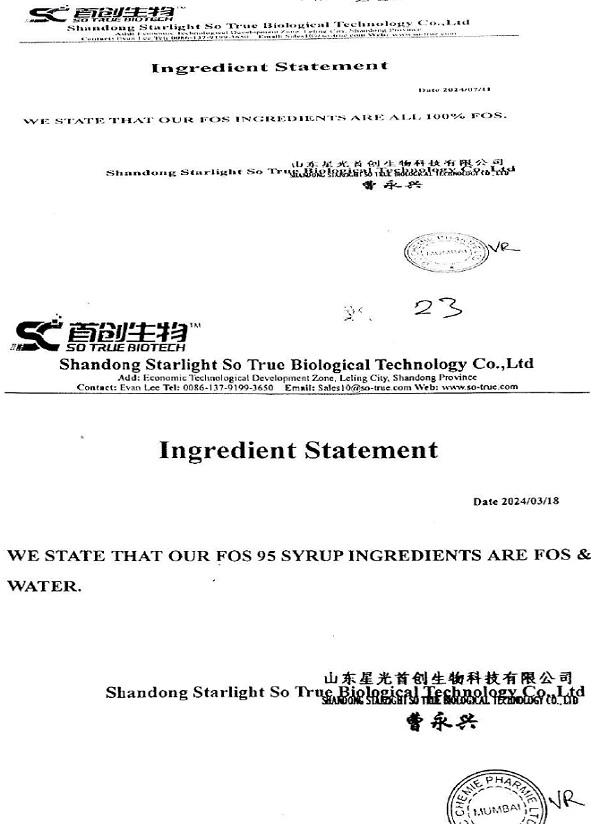
Shandong Starlight So True Biological Technology Co., Ltd.
Ingredient Statement
Date: 2024/07/11
WE STATE THAT OUR FOS INGREDIENTS ARE ALL 100% FOS.
Shandong Starlight So True Biological Technology Co., Ltd.
Shandong Starlight So True Biological Technology Co., Ltd.
Ingredient Statement
Date: 2024/03/18
WE STATE THAT OUR FOS 95 SYRUP INGREDIENTS ARE FOS & WATER.
Shandong Starlight So True Biological Technology Co., Ltd.
Shandong Starlight So True Biological Technology Co., Ltd.
Product names: FOS-95 Powder (dry) • FOS-95 Syrup (dry solids FOS ≥95%)
A. Identification
- Product description (powder): White to off-white free-flowing powder, highly soluble in water.
- Product description (syrup): Clear to slightly opalescent viscous syrup. Typical solids 68–72% (specimen value shown below).
- Definition: Fructo-oligosaccharides (FOS) — mixture of oligosaccharides with β-(2→1) fructosyl linkages, typically GF2 (kestose), GF3 (nystose), GF4+.
B. Certificate of Analysis (specification ranges)
FOS-95 Powder (COA)
- Total FOS (dry basis): ≥ 95.0% (HPAEC-PAD)
- DP distribution (of total FOS): GF2 (kestose): 30–55%; GF3 (nystose): 25–40%; GF4+: 5–20%
- Reducing sugars (G+F+Sucrose, d.b.): ≤ 3.0%
- Moisture (LOD): ≤ 4.0%
- Ash: ≤ 0.5%
- pH (10% w/v, 25 °C): 5.0–7.0
- Appearance: White/off-white powder
- Bulk density (typ.): 0.45–0.65 g/mL
- Microbiology (limits): TPC ≤ 1,000 cfu/g; Yeast & Mold ≤ 100 cfu/g; E. coli: absent (10 g); Salmonella: absent (25 g)
- Heavy metals: Pb ≤ 1.0 mg/kg; As ≤ 1.0 mg/kg
FOS-95 Syrup (COA) — example values (adjust to production batch)
- Solids (°Brix): 70.0% (refractometer)
- FOS (dry basis): ≥ 95.0% (HPAEC-PAD)
- As-is FOS (calculated): 70.0% × 95.0% = 66.5% (w/w)
- DP distribution (d.b. of FOS): GF2: 30–55%; GF3: 25–40%; GF4+: 5–20%
- Reducing sugars (d.b.): ≤ 3.0%
- pH (as-is): 4.5–6.5
- Viscosity (25 °C): report with spindle/rpm (batch dependent)
- Microbiology (limits): TPC ≤ 5,000 cfu/g; Yeast & Mold ≤ 500 cfu/g; pathogens absent
C. Example Batch Results (illustrative)
Powder (batch #PF12345): Total FOS (d.b.) 95.6% (HPAEC-PAD); GF2 42.1%; GF3 37.2%; GF4+ 20.7%; Reducing sugars 1.8%; Moisture 3.2%; Ash 0.28%.
Syrup (batch #SY12345, solids 70.0%): Solids 70.0%; FOS (d.b.) 95.2% → As-is FOS 66.64%; GF2 40.5%; GF3 38.0%; GF4+ 21.5%; Reducing sugars 1.6%; pH 5.8.
D. Analytical methods (recommended)
- Total FOS & DP distribution: HPAEC-PAD using a CarboPac PA200 (or equivalent) column; calibration with authentic standards for GF2/GF3/GF4 where available. Report area% converted to mass% via calibration curves. Typical gradient: 100 mM NaOH / sodium acetate gradient — laboratory should validate exact gradient, column temp, and flow.
- Mono & disaccharides (glucose, fructose, sucrose): HPLC-RID with Aminex HPX-87C/87P or equivalent, or enzymatic assays.
- Moisture: Karl Fischer titration (preferred) or Loss on Drying at 105 °C (specify method).
- Ash: Muffle furnace at 525 ± 25 °C to constant weight.
- pH: pH meter in 10% w/v solution for powder; direct for syrup.
- Solids (syrup): Refractometer (°Brix) calibrated with standard.
- Viscosity: Rotational viscometer (report spindle and rpm, temperature 25 °C).
- Microbiology: USP/ISO methods for TPC, yeast & molds, absence tests for pathogens.
- Heavy metals: ICP-MS or ICP-OES after appropriate digestion.
E. HPAEC-PAD METHOD SUMMARY (Suggested starting method for DP profiling)
Column: Carbopac PA200 (3 × 250 mm) or equivalent anion-exchange column capable of resolving oligosaccharides.
Mobile phases: A = 100 mM NaOH; B = 100 mM NaOH + 500 mM sodium acetate (NaOAc).
Flow: 0.5–0.8 mL/min (lab to validate)
Column temp: 30 °C
Gradient (example):
- 0–5 min: 0% B (equilibration)
- 5–30 min: linear 0 → 20% B (separates GF2–GF6)
- 30–45 min: linear 20 → 50% B (higher oligomers)
- 45–55 min: 50% B (wash)
- 55–65 min: re-equilibrate to 0% B
Injection: 10–25 µL (depending on detector sensitivity)
Detection: PAD (pulsed amperometric detection);
Quantitation: calibrate GF2/GF3/GF4 using standards where available; express higher oligomers as equivalent GF4 if standards absent. Use external standard curves and perform recovery checks (spike/recoveries).
Notes: Adjust NaOH concentration, acetate strength, and gradient to your column/instrument. Validate method for linearity, LOD/LOQ, accuracy, precision, specificity, and robustness per ICH/ICH-like guidance.
F. Storage & Handling
- Powder: store in cool, dry place (<25 °C), sealed packaging, avoid moisture. Shelf life 12–24 months depending on packaging.
- Syrup: store sealed, protected from heat and direct sunlight. Shelf life 12 months refrigerated or ambient depending on preservatives and packaging.
G. Notes & Customization
- If your production recipe is enzyme- or process-specific (e.g. whether residual sucrose or FOS distribution will shift), provide process route and I will tailor the DP ranges and analytical calibration suggestions.
- If you want this COA exported as a printable PDF or a vendor-branded COA template, say the file format and I will generate it.
Shandong Starlight So True Biological Technology Co., Ltd.
3.5 The applicant stated that the product is obtained from sucrose and is recognized as a prebiotic ingredient that promotes the growth of beneficial gut microbiota, particularly bifidobacteria.
3.6 It is also evident that FOS is composed of Fructo-Oligosaccharides (>95%), & Reducing Sugars (Glucose + Fructose + Sucrose (< 3%) and are widely recognized for their prebiotic properties, supporting the growth of beneficial gut microbiota. The Fructo-Oligosaccharides content clearly constitutes the predominant component of the product. The limited presence of reducing sugars (<3%) is merely incidental and does not alter the fundamental character of the substance as a chemically pure sugar derivative.
3.7 The applicant also informed that the Product is supplied either in syrup or powder form, generally appearing as a clear to yellowish liquid or white to yellowish powder, with a mildly sweet taste and odourless characteristics. It is highly soluble in water and exhibits excellent stability under acidic and heat conditions, making it suitable for incorporation into a wide range of nutraceutical, pharmaceutical, and food applications.
4. The Applicant, upon perusal of the aforesaid facts and modus operandi, has submitted that the following points are noteworthy:
(a) The product Fructo-Oligosaccharides (FOS) is a well-defined chemical substance comprising a mixture of oligosaccharides linked through β-(2→1) fructosyl bonds. The composition is chemically consistent and does not constitute a formulation or a blend with any other active or inactive ingredients;
(b) The Product contains not less than 95% pure oligosaccharides, with defined proportions of GF2 (Kestose), GF3 (Nystose), and GF4+ oligomers. The limited presence of reducing sugars (<3%) is merely incidental and does not alter the fundamental character of the substance as a chemically pure sugar derivative.;
(c) The Product exhibits prebiotic properties by selectively promoting the growth of beneficial gut bacteria. Its functional use in nutraceutical and pharmaceutical preparations stems from its inherent chemical composition, and not from any admixture or formulation process.
(d) The Product is supplied either in syrup or powder form, generally appearing as a clear to yellowish liquid or white to yellowish powder, with a mildly sweet taste and odourless characteristics.
5. The applicant has sought Advance Ruling on the following question:
Whether the product (Fructo-Oligosaccharides) is classifiable under Tariff Heading 2940 or Tariff Heading 1702 of the Customs Tariff Act 1975?
6. Applicant’s interpretation of Law: –
6.1 At the outset, the applicant submitted that the Tariff is aligned, up to the 6-digit level, with the Harmonized System of Nomenclature (‘HSN’) issued by the World Customs Organization (‘WCO’). It has been held by the Hon’ble Supreme Court in the case of Collector of Customs, Bombay Vs. Business Forms – 2002 (142) ELT 18 that the HSN Explanatory Notes aid in the interpretation of the Headings of the Tariff and may be used as a safe guide for the same.
6.2 The classification of the goods imported into India is to be determined based on the General Rules of Interpretation (hereinafter referred to as the “GRI”) set out in the Tariff. As per Rule 1 of the GRI, classification of the imported products shall be determined according to the terms of the headings and any relative Section or Chapter Notes.
6.3 The product in question i.e., FOS is a mixture of oligosaccharides with β-(2→1) fructosyl linkages, typically GF2 Kestose (Glucose linked to two fructose units), GF3 Nystose (Glucose linked to three fructose units), GF 4+. Oligosaccharides are specifically covered under Heading 2940. Thus, at the outset classification under Heading 2940 should be examined.
6.4. Classification under Tariff Heading 2940:
6.4.1 That Tariff heading 2940 of the Customs Tariff Act covers Sugars, chemically pure, other than sucrose, lactose, maltose, glucose and fructose; sugar ethers, sugar acetals and sugar esters, and their salts, other than products of headings 2937, 2938 or 2939. Relevant extracts of HSN Explanatory Notes to Heading 2940 are set out below:
| HSN Explanatory Notes to Chapter Heading 29.40: –
Other Organic Compounds 29.40 – Sugars, chemically pure, other than sucrose, lactose, maltose, glucose and fructose; sugar ethers, sugar acetals and sugar esters, and their salts, other than products of headings 2937, 2938 or 2939. A) SUGARS, CHEMICALLY PURE This heading covers only chemically pure sugars. The term “sugars” covers monosaccharides, disaccharides and oligosaccharides. Each saccharide unit must consist of at least four, but not more than eight, carbon atoms and, as a minimum, must contain a potential reducing carbonyl group (aldehydic or ketonic) and at least one asymmetric carbon atom bearing a hydroxyl group and a hydrogen atom. The heading excludes: a) Sucrose, this, even when chemically pure, falls in heading 17.01. b) Glucose and lactose; these, even when chemically pure, fall in heading 17.02. c) Maltose which, even when chemically pure, falls in heading 17.02. Isomeric with sucrose. Crystalline mass. Used in medicine. d) Fructose (laevulose) which, even when chemically pure, falls in heading 17.02. Isomeric with glucose. Yellowish crystals in the pure state. Used in medicine (for diabetic diets). e) Aldol (heading 29.12) and acetoin (3-hydroxy-2-butanone) (heading 29.14), which, though they meet the criteria for being saccharide units, are not sugars. The following are included among the chemically pure sugars falling under this heading: (1) Galactose. Isomeric with glucose. Obtained by hydrolysing lactose. Found in pectin substances and mucilages. Crystalline when pure. (2) Sorbose (sorbenose). Isomeric with glucose. White crystalline powder, very soluble in water. Used in the synthesis of of ascorbic acid (vitamin C), and in the preparation of culture media. (3) Xylose (wood sugar) (C5H10O5). White crystals. Used in pharmacy. (4) Trehalose, isomeric with sucrose. Ribose and arabinose, isomeric with xylose. Raffinose (C18H32O16). Fucose, rhamnose (C6H12O5), digitoxose (C6H12O4) and other deoxy sugars. These sugars are all essentially laboratory products. The sugars of this heading may be in the form of aqueous solutions. |
6.4.2 In view of the above, it is clear that Tariff Heading 2940 only includes Chemically Pure Sugars. The term “sugars” referred to in Tariff Heading 2940 specifically covers monosaccharides, disaccharides, and oligosaccharides.
6.4.3 Based on the literature provided, it is evident that FOS is composed of Fructo-Oligosaccharides (>95%), & Reducing Sugars (Glucose + Fructose + Sucrose (< 3%) and are widely recognized for their prebiotic properties, supporting the growth of beneficial gut microbiota. The Fructo-Oligosaccharides content clearly constitutes the predominant component of the product. The limited presence of reducing sugars (<3%) is merely incidental and does not alter the fundamental character of the substance as a chemically pure sugar derivative. The presence of reducing sugars in the product is attributable to impurities arising during the manufacturing process and permissible in terms of Note 1(a) of Chapter 29 read with HSN Explanatory Notes to Chapter 29. Therefore, in view of HSN Explanatory Notes to Tariff Heading 2940 which clearly states that the term “Sugars” in the heading 2940 covers Oligosaccharides, FOS (having more than 95% Fructo-Oligosaccharides) is correctly classifiable under Customs Heading 2940 of the Customs Tariff Act.
6.4.4. The applicant stated that even applying Rule 3(a) of the General Rules of Interpretation (GRI) which provides that the heading which provides the most specific description shall be preferred to headings providing a more general description, the product in question classifiable under Tariff Heading 2940.
6.4.5. The Hon’ble Supreme Court in a catena of judgment has held that the specific entry should prevail over general entry. Reliance is placed in this regard on the case of Commissioner of Central Excise Vs. Wockhardt life Sciences Ltd. [2012 (277) E.L.T. 299 (S.C.)], wherein the Apex Court held that classification of goods cannot be under residuary entry in presence of specific entry, even if it requires product to be understood in technical sense. It was further held that the residuary entry can be taken refuge of only in absence of specific entry.
6.4.6. Further, in terms of Chapter Note 1(a) of Chapter 29, the headings of this chapter are restricted to separate chemically defined compounds, whether or not containing impurities. The relevant extract of the Note 1(a) of Chapter is reproduced herein below for ready reference:
| Note 1 | Except where the context otherwise requires, the headings of this Chapter apply only to:
(a) separate chemically defined organic compounds, whether or not containing impurities; |
6.4.7 The phrase ‘separate chemically defined compounds’ has been defined in HSN Explanatory Notes to Chapter 29 as under:
| HSN Explanatory Notes to Chapter 29
“A separate chemically defined compound is a substance which consists of one molecular species (e.g., covalent or ionic) whose composition is defined by constant ratio of elements and can be represented by a definitive structural diagram. In a crystal lattice, the molecular species corresponds to the repeating unit cell. Separate chemically defined compounds containing other substances deliberately added during or after their manufacture (including purification) are excluded from this Chapter. Accordingly, a product consisting of saccharin mixed with lactose, for example, to render the product suitable for use as a sweetening agent is excluded.” The separate chemically defined compounds of this Chapter may contain impurities (Note 1 (a)). An exception to this rule is created by the wording of heading 29.40 which, with regard to sugars, restricts the scope of the heading to chemically pure sugars. |
–
| The term “impurities” applies exclusively to substances whose presence in the single chemical compound results solely and directly from the manufacturing process (including purification). These substances may result from any of the factors involved in the process and are principally the following:
(a) Unconverted starting materials. (b) Impurities present in the starting materials. (c) Reagents used in the manufacturing process (including purification). (d) By-products It should be noted, however, that such substances are not in all cases regarded as “impurities” permitted under Note 1 (a). When such substances are deliberately left in the product with a view to rendering it particularly suitable for specific use rather than for general use, they are not regarded as permissible impurities. For example, a product consisting of methyl acetate with methanol deliberately left in with a view to improving its suitability as a solvent is excluded (heading 38.14) For certain compounds (e.g., ethane, benzene, phenol, pyridine), there are specific purity criteria, indicated in Explanatory Notes to heading 29.01, 79.02, 29.07 and 29.33. |
6.4.8. Further, on a careful perusal of the HSN Notes, it is evident that a separate chemically defined compound refers to a substance consisting of a single molecular species, the composition of which is defined by a constant ratio of elements and which can be represented by a definitive structural formula.
6.4.9. That Separate chemically defined compounds to which other substances have been deliberately added during or after manufacture (including during purification) are excluded from this Chapter.
6.4.10. However, the presence of certain impurities in such products is permissible, provided that these impurities arise solely and directly from the manufacturing process (including purification). Such impurities may result from various factors inherent in the process and principally include the following:
(a) Unconverted starting materials.
(b) Impurities present in the starting materials.
(c) Reagents used in the manufacturing process (including purification).
(d) By-products
6.4.11. As per the technical literature, FOS is composed of Fructo-Oligosaccharides (>95%), & Reducing Sugars (Glucose + Fructose + Sucrose (< 3%) and are widely recognized for their prebiotic properties, supporting the growth of beneficial gut microbiota.
6.4.12. The product Fructo-Oligosaccharides content clearly constitutes the predominant component of the product. The limited presence of reducing sugars (<3%) is merely incidental and does not alter the fundamental character of the substance as a chemically pure sugar derivative.
6.4.13 In terms of the HSN Explanatory Notes to Chapter 29, a separately chemically defined compound may contain certain impurities, provided such impurities arise solely and directly from the manufacturing process (including purification) and are not deliberately added. These permissible impurities expressly include unconverted starting materials and by-products.
6.4.14. Applying the above legal provisions to the present facts, the minimal quantity of reducing sugars present in the product qualify as permissible impurities under the HSN Notes. Their presence does not detract from the essential character of the product as Fructo-Oligosaccharides, nor does it alter its classification as a separately chemically defined compound.
6.4.15. Accordingly, the product satisfies the requirements of Clause (a) of Chapter Note 1 of Chapter 29 of the Tariff Act and merits classification as a pure chemical compound under the said Chapter.
6.4.16. Furthermore, in light of the foregoing analysis, it is evident that FOS satisfy the statutory and explanatory requirements of Chapter 29, particularly Chapter Note 1(a), and are squarely covered under Customs Tariff Heading 2940, which expressly covers oligosaccharides as per the HSN Explanatory Notes. The presence of residual reducing sugars is merely incidental, arising from the manufacturing process, and does not alter the essential character of FOS as a separately chemically defined compound. Even by applying Rule 3(a) of the GRI, the more specific classification under Heading 2940 must prevail over the general Heading 1702. Therefore, in light of the relevant Chapter Notes, Explanatory Notes, and interpretative rules, FOS is correctly classifiable under Tariff Heading 2940 of the Customs Tariff Act.
6.4.17. Reliance is placed on the following relevant ruling pronounced by this Hon’ble Advance Ruling Authority for supporting the claim of above said classification:
| S. No. | Citation | Relevant Para and Ratio Decidendi |
|---|---|---|
| 1. | Re: Nutricia International Private Limited CAAR/Mum/ARC/197,198/2024-25 dated 09-01-2025 | “7.11 From the above, I find that the constituent oligosaccharides of 5-HMO mix individually can be classified under CTH 2940 and the wet-blending process used to mix these 5 constituent Oligosaccharides does not chemically alter them. Now the question before me is whether the mixture of these oligosaccharides containing some miniscule amount of impurity can also be classified under heading 2940 or not.”
“7.12 I find that the Heading 2940 under the Harmonized System (HSN) refers to “chemically pure sugars,” and the term “chemically pure” generally means that the substance should have a high level of purity, typically without significant impurities. I further find that Chapter note 1(a) of Chapter 29 allows for the presence of a small amount of impurities (such as residual solvents, starting materials, or by-products) and therefore, although the heading mentions Chemically Pure sugars, the presence of small amount of impurities might not disqualify the product from being considered “chemically pure” as long as the primary substance is clearly identifiable and predominant and the impurities are not altering the characteristics of the compound.” “7.13 I further find that the mixture i.e. ‘5-HMO Mix’ predominantly consists of these 5 oligosaccharides (more than 90%) with only trace amount of impurities. the mixture can be classified and under Heading 2940 as Chemically Pure Sugar.” “7.14 The Heading 1702 covers common sugars, such as glucose, lactose, fructose, sucrose, and other sugars in solid form, including refined sugars or crude sugars whereas the constituent oligosaccharide present in 5-HMO Mix are synthesized from a carbon source (e.g. Sucrose, Glucose or Glycerol) and Lactose as precursor by production strains. Further, the explanatory notes of Heading 2940 clearly states that the term “Sugars” in the heading 2940 covers Oligosaccharides. Since, Oligosaccharides are specifically mentioned in heading 2940, they cannot be classified under Heading 1702.” |
6.4.18. The above-cited ruling squarely applies to the present case, as the product in question is composed of oligosaccharides. Therefore, the product clearly merits classification under CTH 2940 of the Customs Tariff Act.
7. Classification under CTH 1702:
7.1. That Tariff Heading 1702 covers common sugars, such as glucose, lactose, fructose, sucrose and other sugars in solid form; sugar syrups not containing added flavouring or colouring matter; artificial honey, whether or not mixed with natural honey; caramel. Thus, alternatively, the product may be classifiable under Tariff Heading 1702. However, Chapter Note 1(b) to Chapter 17 reveals that Chapter 17 does not cover Chemically Pure Sugar (other than Sucrose, lactose, maltose Glucose and fructose) falling under Tariff Heading 29.40. Relevant portion of Chapter Notes to Chapter 17 is extracted below:
| Chapter 17 | |
|---|---|
| Sugars and sugar confectionery | |
| Notes | |
| 1 | This Chapter does not cover:
(a) sugar confectionery containing cocoa (heading 1806); (b) chemically pure sugars (other than sucrose, lactose, maltose, glucose and fructose) or other products of heading 2940; or (c) medicaments or other products of Chapter 30. |
7.2. From the perusal of the above, it appears that Chapter 17 does not covers chemically pure sugars other than sucrose, lactose, maltose, glucose and fructose or other products of heading 2940. Therefore, it is clear that the products falling under Tariff Heading 2940 are specifically excluded from the Tariff Heading 1702.
7.3. Further, FOS is composed of Fructo-Oligosaccharides (>95%), & Reducing Sugars (Glucose + Fructose + Sucrose (< 3%) and are widely recognized for their prebiotic properties, supporting the growth of beneficial gut microbiota. The Fructo-Oligosaccharides content clearly constitutes the predominant component of the product. The limited presence of reducing sugars (<3%) is merely incidental and does not alter the fundamental character of the substance as a chemically pure sugar derivative. Further, the HSN Explanatory notes to Heading 2940 clearly states that the term “Sugars” in the heading 2940 covers Oligosaccharides. Since Oligosaccharides are specifically mentioned in heading 2940, they cannot be classified under Heading 1702. Thus, FOS being an oligosaccharide is excluded from Tariff Heading 1702 in view of Chapter Note 1(b) of Chapter 17 and correctly classifiable under CTH 2940 of the Customs Tariff.
7.4. The applicant has further submitted, vide e-mail dated 02.06.2026, the following process flow chart:
Process Flow Chart
Fructooligosaccharide (FOS)
| Raw Material Acceptance Inspection |
| ↓ |
| Dosing ← Sugar, Water |
| ↓ |
| Sterilization |
| ↓ |
| Saccharification |
| ↓ |
| Decolorization |
| ↓ |
| Closed-system Filtration |
| ↓ |
| Primary Ion Exchange |
| ↓ |
| Primary Concentration |
| ↓ |
| Adjustment pH |
| ↓ |
| Chromatographic Separation |
| ↓ |
| Secondary Ion Exchange |
| ↓ |
| Secondary Concentration |
Powder manufacturing branch:
| Secondary Concentration |
| ↓ |
| UHT Sterilization |
| ↓ |
| Drying |
| ↓ |
| Smashing |
| ↓ |
| Packaging |
| ↓ |
| Metal Detection CCP |
Syrup manufacturing branch:
| Adjustment pH |
| ↓ |
| UHT Sterilization |
| ↓ |
| Precision Filtration CCP |
| ↓ |
| Filling |
| ↓ |
| Labeling |
| ↓ |
| Storage |
| ↓ |
| Delivery |
Additional process controls shown in the manufacturing flowchart: Packing Acceptance Inspection and Packing Cleaning and Disinfection CCP feed into the packaging/filling stages.
8. Port of Import and reply from jurisdictional Commissionerate,
The applicant in their CAAR-I indicated that they intend to import the subject goods from the jurisdiction of Office of the Commissioner of Customs, NS-I, Nhava Sheva, JNCH, Uran, Distt. Raigad. The application was forwarded to the Office of the Commissioner of Customs, NS-I, Nhava Sheva, JNCH, Uran for their comments on 19.02.2026, 13.03.2026, 02.04.2026 and 23.04.2026, however, no reply has been received in this regard.
9. Details of Personal Hearing: –
A personal hearing was granted to the applicant on 26.05.2026. The applicant’s representative appeared on the scheduled date and reiterated the submissions made in the written application and the documents/enclosures submitted therewith. They argued that Fructo-Oligosaccharides being mixture of more than one unit and Fructose shall fall in CTH 2940. Their purity total FOS (Dry basis) is more than 95%, there is processing and remnant 3% impurity.
Comments from Jurisdictional Authority are not received even after 4 letters. No rebuttal is required.
Nobody appeared for Personal Hearing from the department side.
10. Additional submissions:
In view of the aforesaid submissions and documents, particularly the description of FOS as a mixture of oligosaccharides and the declaration of “Total FOS ≥95%”, further clarification is considered necessary regarding the chemical identity of the individual FOS constituents, their actual quantitative composition, the basis on which the declared FOS purity is determined, and the precise function and outcome of the chromatographic separation process, Vide mail dated 21.09.2026, the Applicant has requested to furnish the following information/documents:
10.1 Composition of “Total FOS ≥95%”
10.1.1 Please clarify whether the declared “Total FOS ≥95%” represents:
(a) the purity of one single chemically defined FOS compound; or
(b) the aggregate concentration of two or more chemically distinct FOS compounds/oligosaccharides, such as GF2, GF3, GF4, GF5, GF6 and higher oligomers.
10.1.2 Please furnish the individual percentage by weight on dry basis of each FOS constituent present in the subject goods, including GF2, GF3, GF4, GF5, GF6 and higher FOS, wherever separately identifiable and quantifiable.
10.1.3 Where the product specification refers to “GF4+” or higher FOS, please furnish the detailed analytical break-up thereof, indicating, to the extent analytically determinable, the respective percentages of GF4, GF5, GF6 and higher-degree-of-polymerization FOS.
10.1.4 Please reconcile the individual composition so furnished with the supplier’s specification of “Total FOS (dry basis) ≥95%” and the stated DP distribution of GF2, GF3 and GF4+.
10.2. Chemical identity of individual FOS constituents
10.2.1 For each of the principal FOS constituents, including GF2, GF3, GF4, GF5 and higher FOS, as applicable, please furnish:
(i) chemical name;
(ii) molecular formula;
(iii) molecular weight;
(iv) structural formula/structural representation; and
(v) degree of polymerization (DP).
10.2.2 Please clarify whether GF2, GF3, GF4, GF5 and higher FOS represent different molecular species having different molecular formulae and/or molecular weights, and whether each such species is separately identifiable and quantifiable by the analytical method employed.
10.2.3 Please furnish the actual DP distribution of the FOS present in the subject goods, based on representative batch-wise analytical data.
10.3. Chromatographic separation
10.3.1 In respect of the chromatographic separation step appearing in the manufacturing process, please explain its precise purpose and outcome.
10.3.2 Please clarify whether the chromatographic separation:
(i) separates the individual FOS constituents, such as GF2, GF3, GF4 and higher oligomers, into separate fractions; or
(ii) primarily separates/removes non-FOS components while the different FOS constituents remain together as a mixture.
10.3.3 In case the chromatographic process results in separation of individual FOS constituents into different fractions, please furnish details of:
(i) the fractions obtained;
(ii) the composition of each fraction;
(iii) the FOS constituents present in each fraction; and
(iv) the stage, if any, at which such fractions are recombined to obtain the final product.
10.3.4 Please furnish representative analytical data showing the composition of the product before and after the chromatographic separation, particularly with respect to GF2, GF3, GF4, GF5 and higher FOS.
10.4. Basis of declaration of “Total FOS ≥95%”
10.4.1 Please furnish the Certificate of Analysis (COA)/test report and the corresponding analytical method used for determining the declared “Total FOS ≥95%”.
10.4.2 Please clarify whether the declared “Total FOS ≥95%” is arrived at by summing the concentrations of individual FOS constituents, such as GF2 + GF3 + GF4 + GF5 + higher FOS. If so, furnish the detailed calculation and analytical basis thereof.
10.4.3 Please furnish representative batch-wise analytical results demonstrating the actual composition and purity of the subject goods.
10.5. Clarification regarding the expression “100% FOS”
10.5.1 It is noted that the documents furnished in support of the application include statements describing the product/ingredients as “100% FOS”. Please clarify the precise technical meaning of the said expression.
In particular, please clarify whether “100% FOS” means:
(i) that the product consists exclusively of substances falling within the broad class of FOS, while containing multiple chemically distinct FOS molecular species; or
(ii) that the product consists of one particular chemically defined FOS compound at 100% chemical purity.
Please support the clarification with relevant technical specifications/analytical data.
10.6. Glucose, fructose, sucrose and other constituents
10.6.1 Please furnish the individual percentage by weight of glucose, fructose and sucrose in the final product on dry basis.
10.6.2 Please indicate whether glucose, fructose and sucrose arise solely from the starting material/process and identify the relevant stage(s) of manufacture at which these substances remain present or are generated.
10.6.3. Please furnish the identity and percentage of any other mono-saccharides, di-saccharides, oligosaccharides or other substances/impurities present in the final product, apart from the FOS constituents and glucose, fructose and sucrose.
10.7. Clarification regarding “chemical purity” and classification under CTH 2940
10.7.1 In view of the description of FOS as a mixture of oligosaccharides, please clarify what is meant by the applicant’s characterization of the subject goods as “chemically pure”.
In particular, please state whether, according to the applicant, “chemically pure” in the present case refers to:
(i) a product consisting of one single chemically defined molecular species; or
(ii) a product containing more than 95% in aggregate of multiple chemically distinct FOS molecular species.
10.7.2 If the declared FOS content of more than/at least 95% represents the aggregate concentration of multiple chemically distinct FOS molecular species, please furnish the technical basis and supporting technical literature/standards relied upon by the applicant for treating such aggregate composition as a chemically pure sugar for the purpose of classification under CTH 2940.
10.7.3 Please further clarify whether the individual FOS constituents such as GF2, GF3, GF4 and higher FOS are considered by the applicant to be:
(i) impurities associated with one principal FOS compound; or
(ii) intended and integral constituents of the FOS product, collectively constituting the declared FOS content.
10.8 Complete composition of the final product
10.8.1 Please furnish a complete quantitative composition of the final imported/proposed-to-be-imported product in the following format, based on actual representative batch-wise analytical data:
| Sr. No. | Constituent | Percentage by weight (dry basis) |
|---|---|---|
| 1. | GF2 (Kestose) | |
| 2. | GF3 (Nystose) | |
| 3. | GF4 | |
| 4. | GF5 | |
| 5. | GF6 and higher FOS | |
| 6. | Glucose | |
| 7. | Fructose | |
| 8. | Sucrose | |
| 9. | Other oligosaccharides, if any | |
| 10. | Other substances/impurities, if any | |
| Total | 100% |
10.9 The above information is required as the subject goods have been described as containing FOS of more than 95%, whereas the technical documents furnished by the applicant/supplier describe FOS as a mixture of oligosaccharides, including GF2, GF3 and GF4+, and declare Total FOS (dry basis) ≥95%. The actual individual composition and the analytical basis of such declaration are therefore required to be clearly established.
10.10. The applicant is, therefore, requested to specifically establish, on the basis of analytical data and the final composition of the goods, whether the declared FOS purity represents the purity of one chemically defined compound or the aggregate content of multiple chemically distinct FOS molecular species, and to explain the role and outcome of the chromatographic separation process in determining such composition.
10.11. The above information/documents may be furnished separately for FOS-95 Powder (Dry) and FOS-95 Syrup (Dry Solids FOS ≥95%), wherever the composition, manufacturing process, analytical characteristics or basis of purity differs between the two products
11. In response to the aforesaid email, the Applicant, vide email dated 19.10.2026, submitted its reply as under:
Lexport
Date: 19.10.2026
To,
Customs Authority for Advance Rulings
(CAAR), 2nd Floor, New Custom House,
Ballard Estate, Wilson Road,
Mumbai- 400001.
Subject: Clarifications/additional Information sought by the Customs Authority for Advance Rulings (CAAR), Mumbai via email dated 21.09.2026 in respect of Advance Ruling Application filed by M/s G.C. Chemie Pharmie Ltd. (Company)
Dear Sir/ Madam,
1. Please refer to the email dated 21.09.2026, whereby additional information and clarifications were sought from the above-mentioned company in respect of its Advance Ruling Application seeking a ruling on the classification of the product Fructo-Oligosaccharides (FOS) under CTH 2940 or CTH 1702 of the First Schedule to the Customs Tariff Act, 1975.
2. We, M/s Lexport, Advocates & Consultants, being the authorised representatives of M/s G.C. Chemie Pharmie Ltd. (Company), hereby submit the following clarifications and additional information in response to the queries raised by your Goodself’s office vide email dated 21.09.2026.
3. From the email dated 21.09.2026, it is understood that your Goodself’s office has sought clarification and additional information from the company on the following aspects:
(a) Composition of the subject product, particularly the declaration that the FOS content is greater than 95%;
(b) Chemical identity of the individual FOS constituents present in the product;
(c) Details of the chromatographic separation and the analytical method employed for identifying and quantifying the individual constituents;
(d) Basis and supporting evidence for the declaration that the total FOS content is greater than 95%;
(e) Complete qualitative and quantitative composition of the subject product;
(f) Presence and quantities of glucose, fructose, sucrose and other constituents, if any; and
(g) Any other relevant technical or compositional information required for determining the appropriate tariff classification of the product.
4. The clarifications and justifications in response to the queries raised by your good office are set out in the tabular form below for your kind consideration.
| Particular | Queries Raised by the Department | Clarification and justification submitted by the Company |
|---|---|---|
| Composition of the product | Please clarify whether the declared “Total FOS ≥95%” represents:
(a) the purity of one single chemically defined FOS compound; or (b) the aggregate concentration of two or more chemically distinct FOS compounds/oligosaccharides, such as GF2, GF3, GF4, GF5, GF6 and higher oligomers. |
As regards whether the subject goods are composed of one single chemically defined FOS compound or the mixture of two or more chemically distinct FOS compounds, we have already submitted in paragraphs no. 3.3 of Annexure-I and Para number 4 of the Annexure-III to the Application for Advance Ruling that the product in question, i.e., Fructo-Oligosaccharides (FOS), is a mixture of oligosaccharides, including GF2, GF3, GF4, and other related constituents. |
| Please furnish the individual percentage by weight on dry basis of each FOS constituent present in the subject goods, including GF2, GF3, GF4, GF5, GF6 and higher FOS, wherever separately identifiable and quantifiable. | With regard to the requirement to furnish the individual percentage by weight, on a dry basis, of each FOS constituent present in the subject goods, it is respectfully submitted that the available theoretical reports indicate the presence of GF2 (30-55%), GF3 (30-55%) and GF4 (up to 26%). However, no reference standards are available for GF5 and GF6. Further, the samples have not been tested for the individual FOS constituents, as such individual testing is not mandatory under the applicable testing requirements. Accordingly, the individual weight percentages of the respective FOS constituents have not been separately determined. | |
| Where the product specification refers to “GF4+” or higher FOS, please furnish the detailed analytical break-up thereof, indicating, to the extent analytically determinable, the respective percentages of GF4, GF5, GF6 and higher-degree-of-polymerization FOS. | As mentioned above, GF4 percentage is low being in the range of 2-56% while no reference standard is available for GF5 and GF6 etc. The analytical report is based on theoretical data as the samples are not tested batchwise for individual constituents, the same not being mandatory. | |
| Please reconcile the individual composition so furnished with the supplier’s specification of “Total FOS (dry basis) ≥95%” and the stated DP distribution of GF2, GF3 and GF4+. | As mentioned above, the distribution of various oligosaccharides, namely GF2, GF3 and GF4+ is in a range which totals to >95%. The exact percentage of each individual oligosaccharide in each sample could vary but the overall percentage remains >95%. Copies of some of the test reports of different samples are annexed and marked as Annexure-A. | |
| Chemical identity of individual FOS constituents | For each of the principal FOS constituents, including GF2, GF3, GF4, GF5 and higher FOS, as applicable, please furnish:
(i) chemical name; (ii) molecular formula; (iii) molecular weight; (iv) structural formula/structural representation; and (v) degree of polymerization (DP). |
GF2, GF3, GF4 etc. are characterized by fructosyl linkages. β-(2→1) Linkages where the fructosyl units connect through the second and first carbon atoms (C-2 of one fructose to C-1 of the next). In GF2 known as Kestose, one Glucose unit is linked to two Fructose units, in GF3 known as Nystose, one Glucose is linked to three Fructose units. Depending upon its constituent units, molecular formula and weight of each of these oligosaccharides would be different and can be worked out. |
| Please clarify whether GF2, GF3, GF4, GF5 and higher FOS represent different molecular species having different molecular formulae and/or molecular weights, and whether each such species is separately identifiable and quantifiable by the analytical method employed. | As mentioned above, GF2, GF3, GF4 etc. have different molecular formula and different molecular weight. The analytical method specified in GB/T 23528.2 for fructo-oligosaccharides can identify and quantify these components. However, it is not analyzed as it is not required. | |
| Please furnish the actual DP distribution of the FOS present in the subject goods, based on representative batch-wise analytical data. | Copies of some of the sample test reports are annexed as Annexure A in reply above, to confirm the presence of oligosaccharides as ≥95%. | |
| Chromatographic separation | In respect of the chromatographic separation step appearing in the manufacturing process, please explain its precise purpose and outcome. | This operation serves only as a purification process. Some FOS fractions will also be removed during processing and various FOS fractions remain mixed in the final product. |
| Please clarify whether the chromatographic separation:
(i) separates the individual FOS constituents, such as GF2, GF3, GF4 and higher oligomers, into separate fractions; or (ii) primarily separates/removes non-FOS components while the different FOS constituents remain together as a mixture. |
As mentioned above, the primary purpose is purification and not the separation of each individual FOS fraction. Thus, it primarily separates/removes non-FOS components (though some FOS fractions will also get removed during the process) while the different FOS constituents remain together as a mixture. | |
| In case the chromatographic process results in separation of individual FOS constituents into different fractions, please furnish details of:
|
Not applicable, in view of reply above. |
–
| Chromatographic separation (continued) | In case the chromatographic process results in separation of individual FOS constituents into different fractions, please furnish details of:
(i) the fractions obtained; (ii) the composition of each fraction; (iii) the FOS constituents present in each fraction; and (iv) the stage, if any, at which such fractions are recombined to obtain the final product. |
Not applicable, in view of reply above. |
| Please furnish representative analytical data showing the composition of the product before and after the chromatographic separation, particularly with respect to GF2, GF3, GF4, GF5 and higher FOS. | As mentioned above, test for individual FOS fraction is not carried out, the same being not mandatory. | |
| Basis of declaration of “Total FOS ≥95%” | Please furnish the Certificate of Analysis (COA)/test report and the corresponding analytical method used for determining the declared “Total FOS ≥95%”. | Please refer to the test reports annexed and marked as Annexure-A. |
| Please clarify whether the declared “Total FOS ≥95%” is arrived at by summing the concentrations of individual FOS constituents, such as GF2 + GF3 + GF4 + GF5 + higher FOS. If so, furnish the detailed calculation and analytical basis thereof. | As stated above, the individual concentrations of the respective FOS constituents are not tested, as such testing is not mandatory under the applicable testing requirements. However, the total FOS content of the subject product is tested and determined. | |
| Please furnish representative batch-wise analytical results demonstrating the actual composition and purity of the subject goods. | Please refer to the test reports annexed and marked as Annexure-A. | |
| Clarification regarding the expression “100% FOS” | It is noted that the documents furnished in support of the application include statements describing the product/ingredients as “100% FOS”. Please clarify the precise technical meaning of the said expression. | As mentioned in Ingredient Statement at Page 22 of the Application, it is confirmed that the FOS ingredients are 100% FOS. However, as mentioned above, total FOS concentration is ≥95% containing multiple chemically distinct FOS molecular species. |
| Glucose, fructose, sucrose and other constituents | Please furnish the individual percentage by weight of glucose, fructose and sucrose in the final product on dry basis. | Reducing Sugars (Glucose + Fructose + Sucrose) are less than 3% in final product. |
| Please indicate whether glucose, fructose and sucrose arise solely from the starting material/process and identify the relevant stage(s) of manufacture at which these substances remain present or are generated. | Glucose, fructose and sucrose originate from the starting raw material, namely white granulated sugar and may also be generated during the saccharification stage of the manufacturing process. Partial Glucose, Fructose and Sucrose are removed in the chromatographic process. | |
| Please furnish the identity and percentage of any other mono-saccharides, di-saccharides, oligosaccharides or other substances/impurities present in the final product, apart from the FOS constituents and glucose, fructose and sucrose. | Small amount of moisture and ash are occasionally present, as can be seen from test reports. | |
| Clarification regarding “chemical purity” and classification under CTH 2940 | In view of the description of FOS as a mixture of oligosaccharides, please clarify what is meant by the applicant’s characterization of the subject goods as “chemically pure”.
In particular, please state whether, according to the applicant, “chemically pure” in the present case refers to: (i) a product consisting of one single chemically defined molecular species; or (ii) a product containing more than 95% in aggregate of multiple chemically distinct FOS molecular species. |
The product here contains more than 95% in aggregate of multiple chemically distinct FOS molecular species. |
| If the declared FOS content of more than/at least 95% represents the aggregate concentration of multiple chemically distinct FOS molecular species, please furnish the technical basis and supporting technical literature/standards relied upon by the applicant for treating such aggregate composition as a chemically pure sugar for the purpose of classification under CTH 2940. | While Chapter 29 covers separate chemically defined organic compounds, this does not apply for sugars as per Chapter Note 1(c) which reads, as under:
“(c) the products of headings 2936 to 2939 or the sugar ethers, sugar acetals and sugar esters, and their salts, of heading 2940, or the products of heading 2941, whether or not chemically defined” Thus, Oligosaccharides being sugar (as per HSN Explanatory Note, page 33, Annexure VI of Application) and excluded from Chapter 17, can be grouped together as Sugar and it is not essential that individual chemically defined FOS constituent should only be present in the product for it to be classified under CTH 2940. This reasoning is also adopted in the Advance Ruling in the case of M/s Nutricia International Private Limited (Para 7.11 at Page 46, Annexure VIII of Application). The composition of FOS Syrup merely includes water with FOS powder and in terms of HSN Explanatory Note the sugars under CTH 2940 may be in the form of aqueous solutions. (page 33, Annexure VI of Application). |
|
| Please further clarify whether the individual FOS constituents such as GF2, GF3, GF4 and higher FOS are considered by the applicant to be:
(i) impurities associated with one principal FOS compound; or (ii) intended and integral constituents of the FOS product, collectively constituting the declared FOS content. |
Since total FOS concentration is of relevance, individual FOS constituent is not considered as impurity associated with any individual FOS. | |
| Complete composition of the final product | Please furnish a complete quantitative composition of the final imported/proposed-to-be-imported product in the following format, based on actual representative batch-wise analytical data: | Please refer to Annexure-A of this letter. |
5. In view of the foregoing facts, technical explanations and submissions, it is respectfully submitted that the subject product, namely Fructo-Oligosaccharides (FOS), comprises a mixture of oligosaccharides, including GF2, GF3, GF4 and higher-degree-of-polymerisation FOS, which collectively constitute the declared total FOS content of 95% or more on a dry basis. The individual FOS constituents are integral components of the product and are not impurities associated with any single principal FOS compound.
6. It is respectfully submitted that the mere presence of multiple chemically distinct oligosaccharide species does not, by itself, preclude classification of the subject product under CTH 2940, particularly when the product predominantly comprises Fructo-Oligosaccharides (FOS), constituting more than 95% of its total composition on a dry basis.
7. Reliance is placed on advance ruling passed by Customs Authority for Advance Rulings New Custom House, Ballard estate, Mumbai – 400 001 in the case of M/s Nutricia International Private Limited, CAAR/Mum/ARC/197,198/2024-25 dated 09.01.2025 annexed as Annexure VIII to the Application (Annexure-B).
8. In Paragraph 7.11 and 7.13 of the said ruling, the Authority observed that the mixture known as “5-HMO Mix” predominantly consisted of five oligosaccharides, constituting more than 90% of the mixture, with only trace amounts of impurities, and held that the mixture was classifiable under Heading 2940 as chemically pure sugar. The relevant extracts are reproduced herein below for ease of reference:
“7.11 From the above, I find that the constituent oligosaccharides of 5-HMO mix individually can be classified under CTH 2940 and the wet-blending process used to mix these 5 constituent Oligosaccharides does not chemically alter them. Now the question before me is whether the mixture of these oligosaccharides containing some miniscule amount of impurity can also be classified under heading 2940 or not.”
“7.13 I further find that the mixture i.e. ‘5-HMO Mix’ predominantly consists of these 5 oligosaccharides (more than 90%) with only trace amount of impurities, the mixture can be classified and under Heading 2940 as Chemically Pure Sugar.”
9. In the said case, the product comprised a mixture of five identified human milk oligosaccharides, which collectively constituted more than 90% of the mixture, with only trace amounts of impurities. The Authority considered the composition of the product and concluded that the mixture was classifiable under Heading 2940 as chemically pure sugar.
10. Accordingly, the said ruling thus provides a basis for examining whether a product comprising multiple oligosaccharide species may fall under Heading 2940, notwithstanding that it does not consist of only one molecular species.
11. Furthermore, without prejudice to above submissions, in terms of Chapter Note 1(c) to Chapter 29 is not necessarily contingent upon the product being chemically defined, provided the product satisfies the conditions prescribed under the said Note. Relevant extract is reproduced herein below:
Note 1. Except where the context otherwise requires, the headings of this Chapter apply only to:
“(c) the products of headings 2936 to 2939 or the sugar ethers, sugar acetals and sugar esters, and their salts, of heading 2940, or the products of heading 2941, whether or not chemically defined”
12. In the present case, the product satisfies the prescribed conditions for CTH 2940 as mentioned in HSN Explanatory Notes to Tariff Heading 2940 which clearly states that the term “Sugars” in the heading 2940 covers Oligosaccharides. Accordingly, FOS (having more than 95% Fructo-Oligosaccharides) is correctly classifiable under Customs Heading 2940 of the Customs Tariff Act.
13. Accordingly, the absence of a separate chemical definition, by itself, cannot be a valid basis for rejecting classification under CTH 2940, provided the subject product otherwise meets the requirements of the said tariff heading.
14. Furthermore, Chapter Note 1(a) to Chapter 29 and HSN Explanatory Notes to Chapter 29 of the Tariff Act states that the presence of certain impurities (Glucose + Fructose + Sucrose <3%) in the subject products is permissible, provided that these impurities arise solely and directly from the manufacturing process (including purification). In support of the submission Reliance is also placed on advance ruling passed by Customs Authority for Advance Rulings New Custom House, Ballard Estate, Mumbai – 400 001 in the case of M/s Nutricia International Private Limited, CAAR/Mum/ARC/197,198/2024-25 dated 09.01.2025 annexed as Annexure VIII to the Application.
7.12 I find that the Heading 2940 under the Harmonized System (HSN) refers to “chemically pure sugars,” and the term “chemically pure” generally means that the substance should have a high level of purity, typically without significant impurities. I further find that Chapter note 1(a) of Chapter 29 allows for the presence of a small amount of impurities (such as residual solvents, starting materials, or by-products) and therefore, although the heading mentions Chemically Pure sugars, the presence of small amount of impurities might not disqualify the product from being considered “chemically pure” as long as the primary substance is clearly identifiable and predominant and the impurities are not altering the characteristics of the compound.
15. In view of the foregoing submissions, Chapter Note 1(c) to Chapter 29, the HSN Explanatory Notes to CTH 2940 and the advance ruling in M/s Nutricia International Private Limited (CAAR/Mum/ARC/197,198/2024-25 dated 09.01.2025), it is respectfully submitted that the subject product, comprising more than 95% FOS on a dry basis, is classifiable under CTH 2940 notwithstanding that it comprises multiple oligosaccharide species.
16. We trust that the foregoing clarifications and additional information adequately address all the queries raised by your Goodself’s office.
17. We respectfully request that the submissions be taken on record and that an opportunity of personal hearing be granted to the Applicant to make further submissions, if required, in support of its application for advance ruling.
Yours sincerely,
12. Discussion and findings: –
12.1 I have carefully considered the application filed by the Applicant, the facts and documents placed on record, the product specifications, technical literature, manufacturing process, the written submissions made by the Applicant, the submissions made during the personal hearing held on 13.10.2026, and the additional submissions dated 19.10.2026 furnished in response to the queries raised by this Authority vide email dated 21.09.2026. I have also examined the relevant provisions of the Customs Act, 1962, the Customs Tariff Act, 1975, the General Rules for the Interpretation of the Import Tariff and the relevant Harmonized System of Nomenclature (HSN) Explanatory Notes.
12. Discussion and findings: –
12.1 I have carefully considered the application filed by the Applicant, the facts and documents placed on record, the product specifications, technical literature, manufacturing process, the written submissions made by the Applicant, the submissions made during the personal hearing held on 13.10.2026, and the additional submissions dated 19.10.2026 furnished in response to the queries raised by this Authority vide email dated 21.09.2026. I have also examined the relevant provisions of the Customs Act, 1962, the Customs Tariff Act, 1975, the General Rules for the Interpretation of the Import Tariff and the relevant Harmonized System of Nomenclature (HSN) Explanatory Notes.
12.2 The issue for determination in the present application is the classification of the subject goods, namely, “FOS-95 Powder (Dry)” and “FOS-95 Syrup”, proposed to be imported by the Applicant. The Applicant has claimed classification under Customs Tariff Heading (CTH) 2940 00 00, whereas the applicability of CTH 1702 is also required to be examined in view of the composition, characteristics and form of presentation of the subject goods.
12.3 I observe that the question raised by the Applicant falls within the scope of Section 28H(2)(a) of the Customs Act, 1962, as it relates to the classification of goods under the Customs Tariff Act, 1975.
Nature and composition of the subject goods
12.4 I observe that the subject goods are Fructo-Oligosaccharides (FOS), manufactured from sucrose through enzymatic conversion using fructosyltransferases, followed by purification and concentration operations. The product specifications furnished by the Applicant describe FOS as a mixture of oligosaccharides having β-(2→1) fructosyl linkages, comprising principally GF2 (Kestose), GF3 (Nystose) and higher-degree-of-polymerisation fructo-oligosaccharides, collectively referred to as GF4+.
12.5 I have examined Annexure-A submitted vide letter dated 19.10.2026 in response to this office’s email dated 21.09.2026 seeking clarification/additional information. Annexure-A comprises three test reports issued by Centre Testing International (Qingdao) Co., Ltd. in respect of samples described as “Fructo oligosaccharides, Specification FOS95”, manufactured by Baolingbao Biology Co., Ltd. The reports relate to samples from lot No. 24122113, received on 03.01.2025. Report No. A2250000953101001E records total fructooligosaccharides at 95.8% on a dry basis and moisture at 2.18%. The report also records pH at 6.7 and ash as not detected, against the stated limits. These results provide analytical support for the declared high aggregate FOS content of the tested FOS95 powder sample.
12.6 Report No. A2250000953101002E, relating to a sample of the same specification and lot, reports total sugars (sum of glucose, fructose, sucrose, maltose and lactose) at 3.4 g/100 g; fructose at 0.68 g/100 g; sucrose at 2.7 g/100 g; and glucose, maltose and lactose as not detected at the stated limits of quantification. Conductivity ash is reported at 0.013%, and solubility at 99.4%. The reported total-sugar result is therefore 3.4 g/100 g and does not support an unqualified finding that all residual simple sugars are below 3%. The report is to be read according to the analytes and units actually reported; it does not separately quantify every individual FOS species.
12.7 I further observe that the Applicant, vide its additional submissions dated 19.10.2026, has expressly clarified that the declared total FOS content exceeding 95% represents the aggregate concentration of multiple chemically distinct FOS molecular species and does not represent the purity of a single chemically defined FOS compound. The Applicant has acknowledged that GF2, GF3, GF4 and higher FOS constituents possess different molecular formulae and molecular weights.
12.8 The reports in Annexure-A do not provide a quantitative distribution of GF2, GF3, GF4, GF5 and higher FOS constituents. Accordingly, the declared aggregate FOS value of 95.8% on a dry basis cannot be treated as proof of the precise percentage of each individual oligosaccharide. The report establishes the aggregate FOS content of the tested FOS95 sample, subject to the report’s own statement that the results relate only to the sample tested.
12.9 Report No. A2250000953101003E concerns 191 pesticide/residue parameters and records the results of those tests for the sample identified as FOS95. That report is relevant to the quality characteristics tested, but does not independently determine tariff classification or establish the molecular distribution of the FOS constituents. I have therefore relied on the first report for the aggregate FOS result and the second report for the reported sugar profile, without attributing to either report findings that it does not contain.
12.10 In this regard, I find it necessary to distinguish between the declared aggregate FOS content and the individual molecular composition of the product. The declaration of total FOS exceeding 95% may establish the predominance of the FOS fraction, subject to the reliability of the supporting analytical evidence. However, such declaration does not, by itself, establish the precise percentage of each individual oligosaccharide or establish that the product consists of a single molecular species.
12.11 The Applicant has also clarified that the chromatographic separation undertaken during manufacture is primarily intended for purification and removal of non-FOS components, and not for isolating each individual FOS constituent into separate fractions. According to the Applicant, some FOS fractions may also be removed during the process, while the remaining FOS constituents continue to be present together in the final product.
12.12 I find that the manufacturing process and the chromatographic separation described by the Applicant are relevant to understanding the nature of the product. However, the fact that the process is directed towards purification does not, by itself, establish that the final product is a single chemically defined compound. The classification must be determined with reference to the goods as presented for importation, their actual composition and the applicable tariff provisions.
Examination of CTH 2940
12.13 Heading 29.40 of the First Schedule to the Customs Tariff Act, 1975, covers:
“Sugars, chemically pure, other than sucrose, lactose, maltose, glucose and fructose; sugar ethers, sugar acetals and sugar esters, and their salts, other than products of headings 2937, 2938 or 2939.”
12.14 The HSN Explanatory Notes to Heading 29.40 state that the heading covers only chemically pure sugars and that the expression “sugars” includes monosaccharides, disaccharides and oligosaccharides. Accordingly, oligosaccharides are expressly contemplated within the scope of Heading 29.40, subject to the applicable conditions and limitations governing the heading.
12.15 Note 1(a) to Chapter 29 provides that, except where the context otherwise requires, the headings of the Chapter apply only to separate chemically defined organic compounds, whether or not containing impurities. The HSN Explanatory Notes explain that a separate chemically defined compound ordinarily consists of one molecular species whose composition is defined by a constant ratio of its constituent elements and which can be represented by a definitive structural diagram.
12.16 The HSN Explanatory Notes further explain that impurities permitted under Note 1(a) may include unconverted starting materials, impurities present in the starting materials, reagents used during manufacture or purification, and by-products, provided their presence results solely and directly from the manufacturing process, including purification. Substances deliberately retained in a product for a particular functional purpose are not necessarily regarded as permissible impurities.
12.17 In the present case, the Applicant’s own clarification establishes that FOS-95 is a mixture of different molecular species, namely GF2, GF3 and higher FOS constituents. These constituents collectively constitute the intended FOS fraction of the product and cannot be treated as impurities associated with a single principal FOS compound. I therefore find that the product cannot be regarded as a single separate chemically defined molecular species merely on the ground that its aggregate FOS content exceeds 95%.
12.18 However, the above finding does not, by itself, conclude the classification issue. It is necessary to examine the scope of Heading 29.40 in conjunction with the applicable Chapter Notes and the General Rules for the Interpretation of the Import Tariff, particularly where the goods consist predominantly of a mixture of oligosaccharides.
12.19 In this regard, Rule 1 of the General Rules for the Interpretation of the Import Tariff provides that classification shall be determined according to the terms of the headings and any relative Section or Chapter Notes. Rule 2(b) provides that a reference in a heading to a material or substance shall be taken to include mixtures or combinations of that material or substance with other materials or substances, and that the classification of goods consisting of more than one material or substance shall be determined according to the principles of Rule 3.
12.20 Accordingly, the fact that FOS-95 contains several molecular species does not, by itself, preclude consideration of Heading 29.40. The applicability of the heading must be assessed having regard to the express inclusion of oligosaccharides in the HSN Explanatory Notes, the nature of the mixture and the relevant interpretative rules. At the same time, the mere presence of oligosaccharides in a product cannot automatically establish classification under Heading 29.40 without examining the conditions governing the heading.
12.21 I have also examined the Applicant’s reliance on Note 1(c) to Chapter 29. The said Note refers to specified products of headings 29.36 to 29.39, sugar ethers, sugar acetals and sugar esters and their salts of Heading 29.40, and products of Heading 29.41, whether or not chemically defined.
12.22 I find that Note 1(c) to Chapter 29 cannot be interpreted in isolation or as dispensing with the requirement of chemical purity applicable to the category of sugars covered by Heading 29.40. The said Note specifically identifies the categories of products to which the expression “whether or not chemically defined” applies. It does not, merely by virtue of its reference to Heading 29.40, establish that every mixture of sugars or oligosaccharides is classifiable under that heading irrespective of its composition and characteristics.
12.23 I therefore find that the Applicant’s reliance on Note 1(c) is relevant only to the extent of its actual scope. The classification of the subject goods must independently satisfy the terms of Heading 29.40, read with the applicable Chapter Notes, HSN Explanatory Notes and General Rules for the Interpretation of the Import Tariff.
Examination of the decision in Nutricia International Private Limited
12.24 I have also considered the decision of this Authority in Nutricia International Private Limited, CAAR/Mum/ARC/197,198/2024-25 dated 09.01.2025, particularly paragraphs 7.11 to 7.14 thereof, relied upon by the Applicant in its original application as well as its additional submissions.
12.25 In the said ruling, the Authority examined a product described as “5-HMO Mix”, comprising five identified human milk oligosaccharides. The ruling considered whether the mixture, predominantly comprising the identified oligosaccharides with a small quantity of impurities, could be classified under Heading 29.40. The Authority observed that the constituent oligosaccharides were individually classifiable under the said heading and that the wet-blending process did not chemically alter those constituents. The mixture was ultimately held classifiable under Heading 29.40 in the facts and circumstances of that case.
12.26 I find that the aforesaid ruling is relevant to the extent that it recognises the possibility of classifying a product comprising multiple oligosaccharide constituents under Heading 29.40, subject to examination of the nature of the constituents, the composition of the product and the applicable tariff provisions. However, the said ruling cannot be treated as laying down an unconditional proposition that every product containing a high proportion of oligosaccharides necessarily falls under Heading 29.40.
12.27 An important factual distinction in the present case is that FOS-95 is obtained through enzymatic conversion of sucrose, followed by purification and concentration, and the individual molecular species in the final product have not been separately quantified in the samples under consideration. The Applicant has also clarified that the chromatographic step does not isolate each FOS constituent into separate fractions, but principally removes non-FOS components while the remaining FOS constituents continue to be present together.
12.28 Consequently, the decision in Nutricia International Private Limited has to be considered as a relevant precedent in the context of the tariff provisions and the facts of the present case, rather than as a substitute for examining the composition and characteristics of FOS-95 independently.
Examination of CTH 1702 and Chapter 17 Note 1(b)
12.29 Heading 17.02 covers:
“Other sugars, including chemically pure lactose, maltose, glucose and fructose, in solid form; sugar syrups not containing added flavouring or colouring matter; artificial honey, whether or not mixed with natural honey; caramel.”
12.30 Note 1(b) to Chapter 17 provides that Chapter 17 does not cover “chemically pure sugars (other than sucrose, lactose, maltose, glucose and fructose) or other products of heading 2940”.
12.31 I find that the relationship between Headings 29.40 and 17.02 must be determined by applying the terms of the respective headings and the relevant Chapter Notes. Where goods are properly covered by Heading 29.40, Chapter 17 Note 1(b) excludes them from Chapter 17. Conversely, the exclusion in Chapter 17 cannot, by itself, establish that goods which do not satisfy the requirements of Heading 29.40 must necessarily be classified under that heading.
12.32 The form in which the subject goods are presented, namely powder or syrup, is a relevant characteristic but is not conclusive of classification. In particular, the fact that the syrup contains water and has a solids content of approximately 68-72% does not, by itself, determine whether the product falls under Heading 29.40 or Heading 17.02. The classification must be based on the composition of the goods and the applicable tariff provisions.
Consideration of the additional submissions and supporting evidence
12.33 I have specifically considered the additional submissions dated 19.10.2026, wherein the Applicant has clarified that the individual FOS constituents are integral components of the product and are not impurities associated with any single principal FOS compound. I find that this clarification is consistent with the Applicant’s description of FOS-95 as a mixture of oligosaccharides.
12.34 The Applicant has stated that the reducing sugars, namely glucose, fructose and sucrose, collectively constitute less than 3% of the product on a dry basis and originate from the starting raw material or may be generated during the manufacturing process. It has further stated that some of these sugars are removed during chromatographic purification. However, the individual percentages of glucose, fructose and sucrose have not been separately furnished in the additional submissions.
12.35 I find that the presence of residual reducing sugars cannot be treated as permissible impurities solely on the basis of their aggregate concentration being below 3%. For the purpose of applying the relevant HSN provisions concerning impurities, the circumstances in which such substances are present, their origin in the manufacturing process and whether they arise solely and directly from the process must be considered. The Applicant’s explanation regarding their origin is relevant to this examination, but it does not dispense with the need for supporting technical evidence where required.
12.36 I have considered Annexure-A specifically. Report No. A2250000953101001E records total FOS of 95.8% on a dry basis for the tested FOS95 sample. Report No. A2250000953101002E records total sugars of 3.4 g/100 g, comprising reported fructose of 0.68 g/100 g and sucrose of 2.7 g/100 g, with glucose, maltose and lactose not detected at the stated quantification limits. These results must be stated as reported; in particular, the record does not support describing total sugars as below 3% without qualification. The reports do not quantify the individual GF2, GF3, GF4 and higher FOS constituents separately.
12.37 The Applicant has also clarified that the expression “100% FOS” used in certain documents refers to the FOS ingredient, while the technical specification declares the total FOS concentration to be greater than 95% and acknowledges the presence of multiple chemically distinct FOS molecular species. I find that, for the purpose of classification, the actual composition declared in the product specifications and established by the supporting technical records is material. The expression “100% FOS” cannot be interpreted as establishing that the product consists of only one chemically defined molecular species.
12.38 I find that Annexure-A supports the conclusion that the tested FOS95 powder sample is predominantly composed of fructo-oligosaccharides, with a reported aggregate FOS content of 95.8% on a dry basis. It does not establish the precise distribution of individual FOS molecular species, nor does it contain a separate test report for the syrup form. The Applicant’s explanation is that the syrup is the same FOS ingredient presented with water and has solids content of approximately 68-72%. I have considered that explanation alongside the product specifications and manufacturing description; the classification of the syrup is accordingly based on the declared identity and composition of the goods as proposed to be imported, rather than on a syrup-specific result in Annexure-A.
Conclusion on classification
12.39 On a cumulative consideration of the product specifications, manufacturing process, additional submissions dated 19.10.2026, the relevant Chapter Notes, the HSN Explanatory Notes and the decision in Nutricia International Private Limited, I find that the subject goods are represented as a product predominantly comprising fructo-oligosaccharides, with a declared aggregate FOS content exceeding 95% on a dry basis. The individual FOS constituents are intended components of the product and are not merely incidental impurities. The classification question must therefore be determined with reference to the product as a whole and the applicable interpretative rules.
12.40 I further find that the HSN Explanatory Notes to Heading 29.40 expressly include oligosaccharides within the expression “sugars”. The fact that the subject goods comprise multiple oligosaccharide molecular species does not, by itself, conclude the matter against Heading 29.40. At the same time, the declaration of a high aggregate FOS content and the Applicant’s reliance on Chapter Note 1(c) cannot independently dispense with the requirements of the heading. The applicability of Heading 29.40 must rest on the nature and composition of the product, considered in conjunction with the relevant tariff provisions and the General Rules for the Interpretation of the Import Tariff.
12.41 Applying the relevant interpretative rules to the product as described and supported by the records, I find that the powder sample tested under Annexure-A is predominantly composed of fructo-oligosaccharides, with aggregate FOS reported at 95.8% on a dry basis. The separate sugar-profile report records total sugars at 3.4 g/100 g; therefore, I do not rely on the assertion that residual sugars are below 3% as an established fact. Nevertheless, the reported FOS content and the product specifications indicate that the FOS fraction imparts the essential character of the powder. In respect of the syrup, the conclusion is based on the Applicant’s declaration that it is the same FOS ingredient in aqueous form, with solids content of approximately 68-72%, and is subject to the goods being imported in conformity with that description.
12.42 Having regard to the terms of Heading 29.40, the relevant Chapter Notes and HSN Explanatory Notes, the product specifications and manufacturing process, the analytical evidence in Annexure-A, and the ruling in Nutricia International Private Limited considered above, I hold that “FOS-95 Powder (Dry)” and “FOS-95 Syrup”, when imported in conformity with the product description and composition examined in these proceedings, are classifiable under CTH 2940 00 00 of the First Schedule to the Customs Tariff Act, 1975, and not under CTH 1702. This conclusion is confined to the goods as described in the application and supported by the record; any material variation in composition or characteristics would require classification to be determined on its own facts.
12.43 The foregoing findings and determination have been arrived at on the basis of the application, the documents and submissions placed on record, the arguments advanced and information furnished during the personal hearing, and the additional clarifications and analytical reports submitted by the Applicant. The jurisdictional Customs authorities shall remain at liberty, at the time of import and in accordance with law, to call for the Certificate(s) of Analysis, test reports, technical literature or such other relevant evidence as may be considered necessary to verify the identity, composition and characteristics of the goods actually imported and their conformity with the product description examined in this ruling. The classification determined herein is subject to the goods being imported in conformity with the facts and material placed before this Authority.
13. I rule accordingly.