Summary: Workplace culture takes shape through everyday interactions, habits and unwritten rules, rather than through stated values alone. Although organisations may sincerely promote respect, trust, teamwork and care, employees experience these values through responses to their requests, concerns, ideas, mistakes and differences. Over time, routine responses become habits and unwritten expectations that can be difficult to question because they have no clear owner. This creates a distance between an organisation’s intentions and an individual’s experience. Continuing the Critique → Care series, the article introduces a three-part communication cartoon series examining how working practices influence whether care is felt. Its focus is on familiar workplace moments and the lasting effect of timely kindness, attention and support. The article presents culture as a shared responsibility shaped by leaders, colleagues, teams and individuals, regardless of role or experience. It suggests that greater attention to another person’s perspective can help change everyday habits without requiring restructuring or a new policy. Communication cartoons offer a simple mirror through recognisable characters and situations, encouraging readers to consider what they could do differently. The central message is that consistent attention, appropriate timing and a willingness to notice unspoken needs can make care customary, help people feel valued and encourage them to extend that care to others.
Introduction
Culture is rarely written in a policy. It is felt in small, everyday moments: in what we notice, what we assume, and what we leave unsaid. No one person designs these moments, yet everyone shapes them.
Ask any organisation about its culture and you will hear the values on the wall: respect, trust, teamwork and care. These words are sincere. But people rarely learn culture from the wall. They learn it from what happens when they need something, when they have something to say, or when they do things differently from the rest. Over time, these moments turn into habits, and habits turn into unwritten rules that nobody remembers agreeing to.
The difficulty is that unwritten rules are hard to question. A policy can be reviewed, amended and circulated. A habit is simply “the way things are done here”. It has no owner, so it rarely has a critic. People adjust, and nobody notices the gap between what an organisation intends and what a person experiences.
Therefore, the Critique → Care series continues, this time with the workplace itself, where habits and unwritten norms decide whether care shows up. These relatable stories are tagged #CritiqueToCare.
Think of an ordinary week at work. Nothing dramatic happens, yet small tests keep arriving: a request, a worry, an idea, a mistake. Nobody announces them as tests. But how the people around us respond is what we remember long after the task itself is forgotten. A kind word at the right time, or a missing one, often outlasts the project it was said in.
Most workplaces mean well. The real question is whether that good intent is felt by the person on the other side, at the moment it matters. Between what a workplace provides and what a person experiences lies a distance, and that distance is where this series lives.
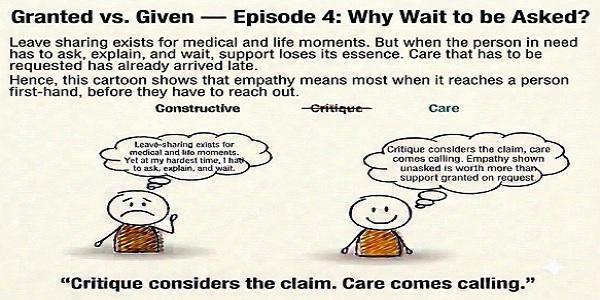
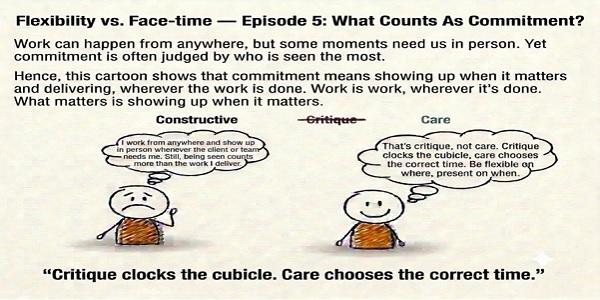
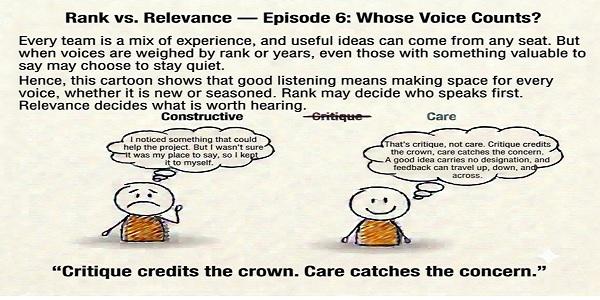
Hence, I have described a three-part communication cartoon series from scratch on this topic. Intension of the sketch is to show how the way we work quietly shapes whether care is felt.
–
–
Conclusion
Culture is not built through a single announcement or a yearly engagement programme. It is built in routine moments, repeated often enough to become normal. Each time someone is heard, trusted or supported without having to push for it, a small piece of culture is laid. Each time they are not, a different piece is laid, just as surely.
The encouraging part is that habits change far more easily than structures. There is no need for a restructuring or a new policy, only a little more attention to how things feel from the other side of the table. Leaders can do this, but so can colleagues, teams and every individual, because culture belongs to everyone who works in it, whatever their role or years of experience.
Communication cartoons are a light way to hold up a mirror: simple characters, short conversations and situations most of us will recognise. If a reader smiles, pauses or thinks “I have seen this”, the sketch has done its job. These are universal workplace moments, not specific to any organisation, meant to leave the reader with one question: what could I do differently tomorrow?
A culture of care does not ask for grand gestures. It asks for attention, timing and a willingness to notice what has not yet been said. When that becomes routine, people no longer wonder whether they are valued, because they already feel it. And people who feel valued tend to extend the same care to others.
I hope Animation Ink inspires us to build cultures where care is a custom, not a coincidence.
Thank You