Summary: The UK’s Unassessed Transfer Pricing Profits (UTPP) regime applies to accounting periods beginning on or after 1 January 2026 and replaces Diverted Profits Tax for those periods. UTPP operates within the corporation tax system as an extension of the UK’s transfer pricing rules and can result in profits being taxed at an effective 31% rate for a large company otherwise subject to the 25% main corporation tax rate. However, UTPP is not a six-percentage-point surcharge on every transfer pricing adjustment. Three cumulative conditions are required: there must be unassessed transfer pricing profits, the arrangements must produce an Effective Tax Mismatch Outcome (ETMO), and the Tax Design Condition (TDC) must be satisfied. Broadly, the mismatch test considers whether tax payable by the other party on corresponding profits is less than 80% of the UK corporation tax that would otherwise arise, while the TDC examines whether arrangements were designed to reduce, eliminate or delay UK tax in connection with the unassessed profits. For multinational groups, particularly those involving low-tax jurisdictions, UTPP makes the commercial substance, economic functions, transfer pricing methodology and actual taxation of related-party income increasingly important.
- Introduction
- What Exactly Is an "Unassessed Transfer Pricing Profit"?
- Three Conditions Must Come Together
- The 80% Tax-Mismatch Test
- Low Tax Alone Still Does Not Trigger UTPP
- Why 31% Is Only Part of the Story
- DPT Has Gone, But the Policy Has Not
- Why India-UAE-UK Structures Deserve Particular Attention
- Documentation Is More Important, But Substance Is More Important Still
- Closing Perspective
- Research Basis
Introduction
A transfer pricing error in the UK has always carried a potential tax cost.
From 2026, some errors can carry a materially higher one.
The UK’s new Unassessed Transfer Pricing Profits (UTPP) regime applies to accounting periods beginning on or after 1 January 2026. It replaces Diverted Profits Tax (DPT) for those periods and sits inside the corporation tax system as an extension of the UK’s transfer pricing rules. HMRC substantially refreshed its detailed UTPP guidance on 29 September 2026, including practical examples covering royalties, commissionaires, intangibles, hedging and intra-group arrangements.
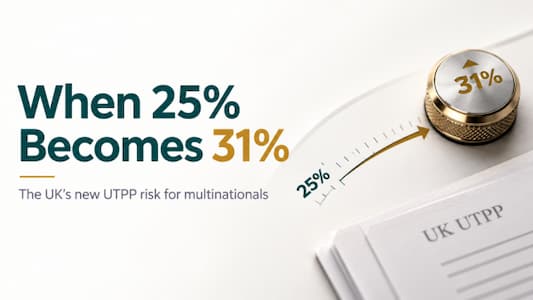
For a large UK company otherwise taxed at the current 25% corporation tax rate, profits assessed under UTPP can effectively face 31%, because the statutory UTPP rate is the underlying corporation tax rate plus six percentage points.
But the important point is equally what UTPP does not do.
It is not a 6% surcharge on every transfer pricing adjustment.
That distinction should shape how multinational groups assess the new risk.
What Exactly Is an “Unassessed Transfer Pricing Profit”?
The starting point remains ordinary transfer pricing.
Under the UK’s TIOPA 2010 rules, related-party arrangements must reflect the arm’s-length principle. UK legislation is expressly interpreted by reference to OECD transfer pricing principles, and HMRC describes comparability between controlled and independent transactions as central to the analysis.
The OECD and UN frameworks point in the same fundamental direction: associated enterprises should transact under conditions consistent with those that independent enterprises would have agreed.
UTPP enters only after that ordinary TP question.
A company has unassessed transfer pricing profits where a transfer pricing requirement should have increased taxable profits or removed losses, but that position was not fully reflected in the company’s corporation tax self-assessment.
So an under-remunerated UK distributor, excessive royalty, inadequately priced service charge or another non-arm’s-length provision can potentially create the first ingredient.
But that alone is still not enough.
Three Conditions Must Come Together
HMRC identifies three cumulative requirements:
- there must be unassessed transfer pricing profits;
- the arrangement must produce an Effective Tax Mismatch Outcome (ETMO); and
- the Tax Design Condition (TDC) must be met.
This is what separates UTPP from an ordinary TP adjustment.
The 80% Tax-Mismatch Test
The ETMO is a relatively mechanical gateway.
Broadly, tax due and payable by the other party on the corresponding profit must be less than 80% of the UK corporation tax that would otherwise have arisen on the unassessed UK profit. With a 25% UK corporation tax rate, that broadly points toward a foreign tax burden below 20% on the corresponding amount, although the statutory calculation must be applied rather than relying simply on headline rates.
That distinction matters.
Suppose a UK company pays an excessive royalty to a group entity in a jurisdiction where the corresponding income is taxed at 25%. There may still be a UK transfer pricing issue, but the ETMO gateway may not be satisfied.
Now suppose the recipient is subject to 0%, 5% or 9% tax on that income. The mismatch question becomes much more significant.
This is one reason UK groups dealing with entities in preferential regimes or low-tax jurisdictions should review their TP position particularly carefully.
Low Tax Alone Still Does Not Trigger UTPP
The second gateway is more qualitative.
The Tax Design Condition is met where it is reasonable to assume that the structure of the transaction, series of transactions or wider arrangements was designed to reduce, eliminate or delay UK tax, and that design is connected to the unassessed TP profits. HMRC says some degree of contrivance will normally be expected.
This is critical.
A multinational can legitimately locate real business functions in a lower-tax jurisdiction. HMRC’s guidance expressly says UTPP is not intended to apply merely because a group genuinely moves the economic activity needed to generate income to a country with a lower tax rate.
Consider two examples.
A UK group centralises genuine technical support in another European country. The foreign entity employs the people, performs the work, delivers synergies and charges arm’s-length fees. The lower foreign tax rate does not automatically create UTPP.
Contrast that with valuable income being shifted to an affiliate with very limited employees or economic activity while key functions continue in the UK. If the pricing does not reflect the UK contribution and the arrangement was designed to disconnect UK activity from the associated income, the UTPP analysis becomes much more serious.
Low tax creates the mismatch. Artificial profit separation creates the real UTPP risk.
Why 31% Is Only Part of the Story
For a large company subject to the UK’s 25% main corporation tax rate, the UTPP rate would ordinarily be 31% on the assessed profits. The legislation defines the UTPP rate as the applicable underlying corporation tax rate plus six percentage points.
The financial exposure can extend further.
Interest runs from the date the corporation tax should originally have been paid. HMRC also states that reliefs, deductions and set-offs generally cannot be used against profits assessed at the UTPP rate or the associated tax charge.
And UTPP is deliberately designed to create payment pressure. Once HMRC assesses UTPP, the charge becomes a formal corporation tax liability, with tightly controlled postponement provisions.
This means a weak TP position can become materially more expensive than simply paying the original corporation tax difference several years later.
DPT Has Gone, But the Policy Has Not
UTPP supersedes the UK’s Diverted Profits Tax for accounting periods beginning from 1 January 2026. DPT continues to apply to the earlier periods falling within its regime.
The architectural change is significant.
DPT was deliberately a separate tax outside corporation tax and, historically, outside the scope of the UK’s tax treaties. UTPP is now part of the corporation tax regime, which HMRC says simplifies its interaction with transfer pricing and facilitates a more consistent treaty approach.
This makes UTPP more closely connected to the international framework under Article 9 of tax treaties, corresponding adjustments and the Mutual Agreement Procedure.
Where a UK adjustment creates economic double taxation, treaty mechanisms may allow the counterparty jurisdiction to consider corresponding relief. OECD Article 9 and the UN Model both recognise this general principle, although the exact outcome depends on the applicable bilateral treaty and competent-authority process.
Why India-UAE-UK Structures Deserve Particular Attention
Imagine an Indian multinational with a UK sales company and a UAE regional or IP entity.
The UK company pays substantial management, technology or royalty charges to the UAE entity. The UAE entity benefits from a low effective rate, while significant commercial decision-making or intangible-related functions remain in the UK.
The first question remains entirely conventional:
Is the UK company’s charge arm’s length?
If the answer is no, UTPP adds two further questions:
Does the recipient’s tax position create the required effective tax mismatch?
And were the arrangements designed in a way that sought to separate UK economic activity from the related income?
The presence of an Indian parent does not itself change those UK tests.
But it adds another cross-border layer. India may have its own TP position regarding services, IP, cost allocations or group arrangements. The UK-India treaty remains in force, including its associated-enterprises and dispute-resolution framework, while a UAE counterparty would require separate analysis under the relevant UK-UAE arrangements.
One global operating model can therefore generate TP consequences in three jurisdictions.
That is why multinational transfer pricing should not be designed one country at a time.
Documentation Is More Important, But Substance Is More Important Still
A polished benchmarking report will not solve a UTPP problem if the underlying facts tell a different story.
HMRC says evidence relevant to the Tax Design Condition can include tax-planning documents, the commercial benefits of the arrangement, the location and number of staff, and whether the actual functions attributed to entities correspond with their economic activity.
For 2026 onward, I would therefore review high-value UK related-party arrangements through three lenses:
Pricing: Does the arm’s-length analysis remain defensible?
Tax mismatch: Where is the corresponding income taxed, and what tax is actually due and payable?
Design and substance: Do the people, functions, assets and risks support the legal allocation of profit?
HMRC also makes clear that there is no separate UTPP notification requirement, unlike DPT. Companies are expected to get the TP position right in their original corporation tax self-assessment. HMRC’s Profit Diversion Compliance Facility remains available for multinational groups seeking to review and correct arrangements that may be within scope.
Closing Perspective
The UK’s UTPP regime should not lead businesses to conclude that every disputed TP position is suddenly taxed at 31%.
That would overstate the rules.
The more important change is behavioural.
Where a group has unassessed TP profits, a material cross-border tax mismatch and evidence of tax-driven design, leaving an aggressive position inside the corporation tax return has become more expensive.
The principle I would take into every 2026 UK TP review is therefore:
The cost of a weak transfer pricing position is no longer determined only by the amount of the adjustment. The structure around that adjustment now matters too.
For multinational groups, particularly those operating through UK entities alongside low-tax regional hubs, this is the right time to revisit not only benchmarking, but the underlying commercial narrative supporting where profit sits.
Research Basis
This article is based on Finance Act 2026, section 46 and Schedule 5, the resulting Part 4A of TIOPA 2010, HMRC’s UTPP guidance updated through 29 September 2026, current UK corporation tax rates, HMRC guidance on treaty and transfer pricing principles, the OECD Transfer Pricing Guidelines, the UN Practical Manual on Transfer Pricing, and the current UK-India treaty materials. Research cut-off: 3 October 2026.