Planetcast Media Services Private Limited Vs Sathyadhara Communications Private Limited (NCLT Kochi)
Summary: NCLT, Kochi Bench admitted the Section 9 application filed by Planetcast Media Services Private Limited against Sathyadhara Communications Private Limited and initiated Corporate Insolvency Resolution Process (CIRP). The Operational Creditor claimed default of Rs.3,41,13,009, comprising principal outstanding of Rs.2,04,77,784 and delayed interest of Rs.1,36,35,225 arising from playout, satellite bandwidth, teleport/uplinking and related services supplied for the Corporate Debtor’s Darshana TV channel.
The parties’ commercial relationship originated in 2014 under an Uplinking Service Agreement and Space Segment Service Contract dated 19.07.2014. These arrangements were subsequently renewed, including on 20.11.2020 for a term extending until 31.12.2023. The Tribunal found that the renewal agreement was in continuation of the original agreement and contained an automatic renewal mechanism. It noted that monthly invoices continued to be raised and received and that the Corporate Debtor continued to use the services without contemporaneous objection. Consequently, non-execution of a fresh formal agreement after 31.12.2023 did not, by itself, invalidate the continuing contractual relationship.
The Corporate Debtor opposed admission principally on the grounds of a pre-existing dispute regarding service quality and invoices, substantial payments allegedly not properly accounted for, proceedings under Section 138 of the Negotiable Instruments Act, the existence of an arbitration clause, incorrect date of default, and lack of proper authority for institution of the petition. It contended that the IBC could not be used as a substitute for debt recovery.
On the alleged pre-existing dispute, the Tribunal examined the communications relied upon by the Corporate Debtor. Complaints dated 26.10.2016, 27.08.2018, 06.07.2023 and 14.11.2023 concerning signal or service quality were considered. The Tribunal held that the first two communications pre-dated the last renewal agreement dated 20.11.2020 and were therefore irrelevant for determining a dispute concerning the later claim. As regards the 2023 emails, the Tribunal found them to be routine business communications rather than evidence of a genuine dispute regarding the Operational Creditor’s entitlement to payment. Services continued thereafter without agitation of those complaints.
Applying the principle in Mobilox Innovations Private Limited v. Kirusa Software Private Limited, the Tribunal held that an Adjudicating Authority must examine whether an alleged dispute is genuine and serious and whether it has a material bearing on the claimed debt. On the facts, the Tribunal found no plausible contention requiring further investigation sufficient to constitute a genuine pre-existing dispute.
The Tribunal also rejected the argument based on pending cheque-dishonour proceedings under Section 138 of the Negotiable Instruments Act, 1881. It held that the mere pendency of such proceedings could not by itself establish a pre-existing dispute under Section 8(2)(a) of the IBC. The cheques had been issued towards discharge of outstanding dues and subsequently dishonoured, and the Corporate Debtor had not shown that a genuine dispute concerning the underlying operational debt had been raised before issuance of the Section 8 demand notice.
The Tribunal noted that between 31.10.2022 and 30.06.2025 the Corporate Debtor had paid Rs.2,24,66,840. The Operational Creditor had reflected those payments in the account statements produced with its rejoinder. Since the amount claimed remained above Rs.1 crore, the Tribunal considered any exact adjustment or quantification to be a matter capable of being dealt with by the Resolution Professional at the relevant stage.
The arbitration clause was also held not to bar proceedings under Section 9. The Tribunal observed that an arbitration clause, in the absence of a genuine pre-existing dispute raised before the Section 8 demand notice, did not oust the jurisdiction of the Adjudicating Authority.
The objection regarding authority to institute the proceedings was rejected after the Tribunal verified the Board Resolution dated 13.08.2024 and the subsequent Verified Affidavit dated 24.07.2026. The Board Resolution authorised the Senior General Manager (Legal) to represent the Operational Creditor before courts and tribunals. Referring to Palogix Infrastructure Pvt. Ltd. v. ICICI Bank Ltd. and Rajendra Narottamdas Sheth & Anr. v. Chandra Prakash Jain & Anr., the Tribunal held that the authorisation was sufficient and that any procedural ambiguity had also been cured and ratified.
The petition was filed on 14.07.2026 and the stated date of default was 31.10.2025. The Tribunal found that the outstanding operational debt exceeded the statutory threshold under Section 4 and that the petition was within limitation. It consequently admitted CP(IB)/18/KOB/2026 under Section 9, imposed moratorium under Section 14, directed public announcement of CIRP, appointed Mr. Jossy Steephen Kattur as Interim Resolution Professional and directed the Operational Creditor to deposit Rs.2,00,000 towards initial CIRP expenses. The Tribunal expressly clarified that its order would not affect the Resolution Professional’s discretion concerning admission of the amount claimed by the Operational Creditor.
Cases Discussed
- Mobilox Innovations Private Limited v. Kirusa Software Private Limited, (2018) 1 SCC 353 — relied upon for determining whether the Corporate Debtor had shown a genuine pre-existing dispute requiring further investigation.
- A.D. Electro Steel Co. Pvt. Ltd. & Anr. v. Anil Steels — considered while examining whether a dispute concerning goods/services and the underlying contractual liability was genuine and plausible.
- Sudhi Sachdev v. APPL Industries Ltd., (2018) ibclaw.in 98 NCLAT — relied upon concerning the effect of dishonoured cheques and Section 138 proceedings on the existence of a pre-existing dispute.
- Palogix Infrastructure Pvt. Ltd. v. ICICI Bank Ltd., (2017) ibclaw.in 16 NCLAT — considered on authority of an authorised corporate officer to institute IBC proceedings.
- Rajendra Narottamdas Sheth & Anr. v. Chandra Prakash Jain & Anr., (2021) ibclaw.in 155 SC — relied upon concerning corporate authorisation to institute insolvency proceedings.
- Shahi Md. Karim v. Kabay India LLP, (2023 SCC OnLine NCLAT 180) — referred to while considering whether an arbitration clause bars proceedings under Section 9 of the IBC.
- Innoventive Industries Limited v. ICICI Bank, (2018) 1 SCC 407 — referred to regarding satisfaction as to debt and default and admission subject to statutory requirements.
FULL TEXT OF THE JUDGMENT/ORDER OF NCLT, KOCHI BENCH
1. The present petition has been filed on 14.07.2026 by the Petitioner/Operational Creditor, M/s. Planetcast Media Services Private Limited (hereinafter referred to as the “Operational Creditor”), against the Corporate Debtor, M/s. Sathyadhara Communications Private Limited (hereinafter referred to as the “Corporate Debtor”), under Section 9 of the Insolvency and Bankruptcy Code, 2016 (hereinafter referred to as the “Code”), read with Rule 6 of the Insolvency and Bankruptcy (Application to Adjudicating Authorities) Rules, 2016, seeking initiation of the Corporate Insolvency Resolution Process (“CIRP”), on account of the Corporate Debtor’s default in payment of the operational debt.
2. Part I of the petition reveals that the Petitioner/Operational Creditor is M/s. Planetcast Media Services Private Limited. The Corporate Identification Number (CIN) of the Operational Creditor is U64200DL1996PLC078558, and its registered office is situated at 1121, 11th Floor, Hemkunt Chambers, 89, Nehru Place, New Delhi – 110 019.
3. Part II of the petition reveals that the Corporate Debtor is M/s. Sathyadhara Communications Private Limited, having CIN U92130KL2009PTC023839. The registered office of the Corporate Debtor is situated at 2nd Floor, IC Complex, Railway Station Link Road, Kozhikode, Kerala-673 002. Therefore, this Bench has jurisdiction to deal with this Petition. The Respondent/Corporate Debtor was incorporated on 18.02.2009, with authorised Share Capital of Rs.3,50,00,000/- and Paid-up Share Capital of Rs.3,28,62,000/-.
4. Part III of the petition reveals that the Operational Creditor has not proposed the name of an Interim Resolution Professional. The total amount claimed to be in default, as set out in Part IV of the Petition, as on 30.10.2025, is Rs.3,41,13,009/- (Rupees Three Crore Forty-One Lakhs Thirteen Thousand and Nine Only), which comprises Rs.2,04,77,784/- towards the principal outstanding amount and Rs.1,36,35,225/- towards delayed interest as per contracts executed.
5. The averments made by the Petitioner/Operational Creditor are summarized as under:
a) M/s. Planetcast Media Services Private Limited (formerly Planetcast Media Services Limited), incorporated on 13.04.1996 and converted into a private company on 18.02.2026, is engaged in providing playout, satellite bandwidth, and teleport (uplinking) services under a licence issued by the Ministry of Information & Broadcasting, Government of India.
b) In 2014, M/s. Sathyadhara Communications Private Limited (the Corporate Debtor) engaged the Operational Creditor for uplinking, satellite bandwidth, and related services for its TV channel, Darshana TV, by executing the Uplinking Service Agreement and the Space Segment Service Contract dated 19.07.2014. The parties subsequently amended the service charges on 04.10.2014 and renewed the agreements on 05.12.2017 (extending the term until 31.12.2020) and again on 20.11.2020 (extending the term until 31.12.2023). The Corporate Debtor also issued a Purchase Order dated 31.12.2020 for cloud playout services. Copies of the agreements, amendments, renewals, and the purchase order have been annexed with the petition as Annexures D to I.
c) The Operational Creditor and the Corporate Debtor have maintained a business relationship for over 11 years. Upon rendering services to the satisfaction of the Corporate Debtor, the Operational Creditor raised invoices for the services provided. Copies of the outstanding invoices have been annexed with the petition as Annexure K (Series).
d) Despite receiving the services, the Corporate Debtor has failed to pay the outstanding dues. As per the ledger account maintained by the Operational Creditor for the period from 01.04.2022 to 08.12.2025, the Corporate Debtor is liable to pay Rs.2,04,77,784/- towards the principal outstanding amount and Rs.1,36,35,225/- towards contractual delay interest. A copy of the ledger account statement has been annexed with the petition as Annexure L.
e) As of 30.09.2023, the Corporate Debtor admitted an outstanding amount of Rs.1,88,02,832/-, excluding foreign exchange fluctuations for September 2023. Thereafter, in a meeting held on 28.09.2023, confirmed by email dated 03.10.2023, the parties agreed to a One-Time Settlement (OTS). Copy of the email dated 03.10.2023 has been annexed with the petition as Annexure N.
f) The Corporate Debtor admitted its inability to pay the first OTS instalment of Rs.1 Crore and sought extensions of time through emails dated 14.11.2023 and 09.01.2024. Despite repeated extensions, no payment has been made till date. Copies of the emails have been annexed with the petition as Annexures O and P, respectively.
g) The Corporate Debtor issued cheques aggregating Rs.1,50,00,000/- towards partial discharge of its liability. All the cheques were dishonoured upon presentation. Consequently, the Operational Creditor initiated proceedings under Section 138 of the Negotiable Instruments Act, 1881, and issued a statutory demand notice dated 13.05.2025. The Corporate Debtor replied to the notice on 20.06.2025, raising baseless and untenable allegations. A copy of the reply has been annexed with the petition as Annexure Q.
h) On 06.03.2025, the Operational Creditor issued a suspension notice due to the Corporate Debtor’s failure to clear its outstanding dues. In response, by email dated 13.03.2025, the Corporate Debtor acknowledged the outstanding debt, apologized for the delay, and undertook to settle the entire amount in a lump sum by 10.04.2025. Copies of the emails are annexed with the petition as Annexures R and S, respectively. The Corporate Debtor continued to unequivocally acknowledge its liability through a series of subsequent emails, forming part of the petition as Annexure T series, while repeatedly seeking extensions of time to defer payment. The details thereof are as under:
“a. Email dated 10.04.2025: The Corporate Debtor deferred the scheduled settlement meeting, requesting an extension until the end of April 2025 due to the unavailable travel schedule of its new Chairman.
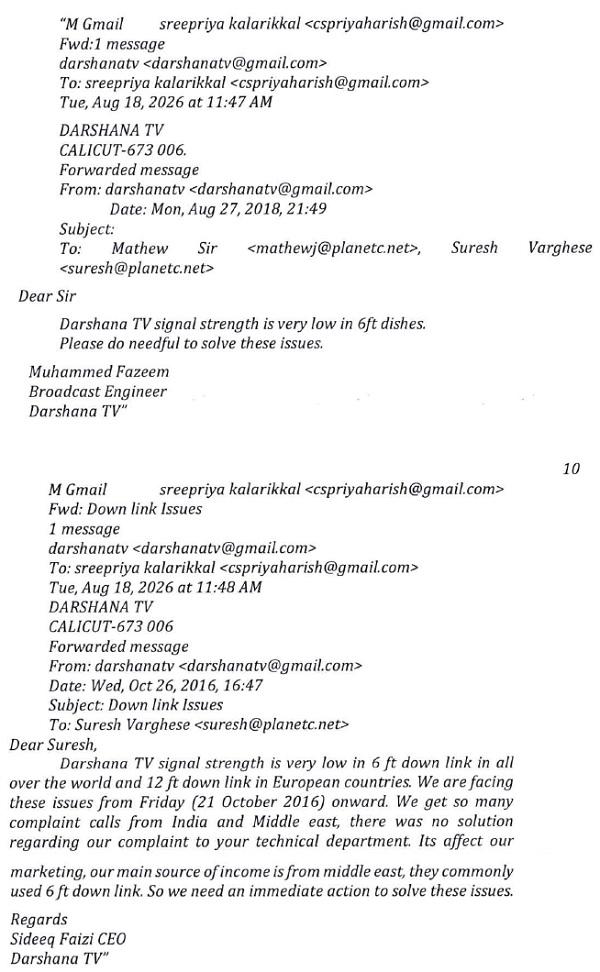
b. Email dated 02.05.2025: The Corporate Debtor provided a fresh assurance to clear the entire outstanding balance within fifteen (15) days and requested the immediate resumption of the suspended channel audio.
c. Email dated 28.05.2025: Following direct discussions involving its investor and Chairman, the Corporate Debtor gave a “final word” assurance to unconditionally settle all outstanding dues on or before June 30, 2025.”
i) Despite repeated reminders and sufficient time being granted, the Corporate Debtor failed to make payment towards the outstanding liability. Accordingly, the Operational Creditor issued a Demand Notice in Form 3 under the IBC, 2016, dated 09/01/2026, calling upon the Corporate Debtor to pay the outstanding operational debt within 10 days of receipt thereof, failing which appropriate proceedings under Section 9 of the IBC, 2016 would be initiated. The Demand Notice was duly served by registered post and through email. A copy of the Demand Notice, along with proof of email service, is annexed with the petition as Annexure U (Colly).
j) The Corporate Debtor, vide its Reply-cum-Notice of Dispute dated 27.01.2026, sent through registered post, denied the existence, quantum, and default of the alleged operational debt. A true copy of the reply is annexed with the petition as Annexure V.
k) The petitioner submitted that a total sum of Rs.3,41,13,009/- (Rupees Three Crore Forty-One Lakh Thirteen Thousand and Nine Only) is due and payable by the Corporate Debtor, comprising Rs.2,04,77,784/- towards principal outstanding and Rs.1,36,35,225/- towards delay interest as stipulated under the contracts.
l) It is further submitted that the documents on record establish that the Corporate Debtor has failed to discharge the outstanding liability despite the debt having fallen due and payable. The continued non-payment constitutes a clear case of debt and default. Accordingly, the present petition has been filed under Section 9 of the IBC, 2016, seeking initiation of the Corporate Insolvency Resolution Process (“CIRP”) against the Corporate Debtor.
m) The unpaid operational debt exceeds the threshold prescribed under Section 4 of the IBC, 2016. The amount claimed constitutes an “operational debt” within the meaning of Section 5(21) of the IBC, 2016 arising from the provision of services. The Petitioner, being an Operational Creditor within the meaning of the Code, is entitled to maintain the present petition under Section 9 of the IBC for initiation of CIRP against the Corporate Debtor.
Submissions on behalf of the Respondent/Corporate Debtor: –
6. The Respondent, in its reply affidavit, has submitted that the petition filed by the Operational Creditor under Section 9 of the Insolvency and Bankruptcy Code, 2016 is not maintainable and has denied all allegations made in the Company Petition, except to the extent of statements specifically admitted.
7. The Section 9 petition is misconceived, legally untenable, and constitutes an abuse of the insolvency process. There are genuine disputes concerning the alleged operational debt, including substantial payments made by the Corporate Debtor that have not been properly reflected in the Operational Creditor’s ledger. The petition has been filed as a coercive measure to exert undue commercial pressure, whereas the IBC is not a substitute for debt recovery proceedings. Accordingly, the petition is liable to be dismissed.
8. The Corporate Debtor submitted that the Operational Creditor has alleged a continuous default in payment for teleport and cloud playout services. However, the Operational Creditor has approached this Adjudicating Authority with unclean hands by suppressing substantial payments made by the Corporate Debtor. Between 31.10.2022 and 30.06.2025, the Corporate Debtor made regular payments aggregating to Rs.2,24,66,840/- through RTGS/NEFT, which have not been properly credited in the Operational Creditor’s statement of accounts. Consequently, the alleged operational debt has been artificially inflated and remains disputed and unadjudicated.
9. It is submitted that the Operational Creditor has also failed to disclose the correct and legally sustainable date of default, as required under the IBC, 2016. The alleged date of default, i.e., 31.10.2025, is inconsistent with its own pleadings, invoices, contractual documents, and prior proceedings under the Negotiable Instruments Act, 1881. There is no material establishing how the alleged default arose on the said date, thereby rendering the petition legally defective.
10. It is further submitted that genuine and pre-existing commercial disputes existed between the parties prior to the filing of the Section 9 Petition. The Corporate Debtor had specifically disputed the correctness and quantum of the invoices, the continuation of services beyond the contractual period, the quality of services rendered, and the misuse of security cheques. These disputes were formally communicated through legal notices, including the Reply Notice dated 20.06.2025, and were also reflected in prior balance confirmations and settlement proposals annexed by the Operational Creditor itself.
11. The pendency of multiple criminal proceedings arising from the same invoices, coupled with the Corporate Debtor’s categorical denial of liability, further demonstrates the existence of a pre-existing dispute. The Operational Creditor cannot seek to convert a disputed contractual claim into insolvency proceedings merely because criminal complaints have been filed.
12. The Corporate Debtor submitted that in view of the aforesaid pre-existing disputes, the Section 9 proceedings are not maintainable. The IBC, 2016 is intended for the resolution of insolvency and not to serve as a substitute for recovery proceedings. The Operational Creditor has improperly invoked Section 9 as a recovery mechanism to exert commercial pressure upon the Corporate Debtor.
13. It is also submitted that the agreements executed between the parties also contain an arbitration clause providing for resolution of contractual disputes. Despite the existence of such a mechanism and the admitted disputes between the parties, the Operational Creditor neither invoked arbitration nor sought adjudication of the disputed claims through the agreed contractual mechanism. Instead, it has approached the insolvency jurisdiction for recovery of a seriously disputed claim, which is impermissible in law.
Submissions on behalf of the petitioner in the rejoinder state as follows:
14. The Operational Creditor denies the allegations of the Corporate Debtor and submitted that the outstanding operational debt is genuine, duly supported by the invoices, ledger, balance confirmations, correspondence, and payment records. All payments totalling Rs.2,24,66,840/- have been duly accounted for and adjusted on a FIFO basis, leaving Rs.2,04,77,784/- as principal outstanding, besides contractual interest. Only four invoices, being S. Nos. 1, 2, 29 and 53, are part-paid; fully paid invoices have been excluded.
15. It is submitted that the Corporate Debtor repeatedly acknowledged its liability, including through the Balance Confirmation dated 07.07.2023, OTS proposal dated 03.10.2023, and email dated 14.11.2023. It also admitted an outstanding liability of Rs.1,86,71,422/- on 28.05.2025, after which only Rs.7,25,000/- was paid. These documents constitute clear acknowledgement of the subsisting debt. The alleged pre-existing dispute, raised only after the Section 8 Demand Notice, is therefore a belated and unsupported defence. There has been no suppression of payments or material documents.
16. It is further submitted that the agreements provided for automatic month-to-month renewal, and the Corporate Debtor continued to avail the satellite, teleport, and cloud playout services after 31.12.2023. The MIB permission dated 30.07.2025 further corroborates that ‘Darshana TV’ continued using the relevant teleport and satellite infrastructure until July 2025. The invoices raised thereafter, including the FEF charges for April-July 2025, relate to services and bandwidth actually provided and consumed and do not constitute double billing. The foreign-exchange fluctuation component was calculated in accordance with the contractual formula and is supported by the relevant records, including bank remittance documents.
17. The Petitioner submitted that the Corporate Debtor has produced no contemporaneous notice, email, complaint, or other material alleging deficiency in services or seeking termination before issuance of the Section 8 Demand Notice. The communication dated 06.03.2025 was only a conditional warning and did not terminate or suspend the services. The continued use of the services without contemporaneous objection further negates the alleged pre-existing dispute.
18. It is submitted that the cheques issued by the Corporate Debtor were not merely security cheques. The pendency of proceedings under Section 138 of the Negotiable Instruments Act, 1881 does not constitute a pre-existing dispute or bar proceedings under Section 9 of the IBC, 2016; rather, dishonour of the cheques supports the existence of the underlying legally enforceable debt.
19. It is submitted that the objection concerning authorization is equally untenable. The Board Resolution dated 13.08.2024 validly authorised Shri Navodaya Gaur, Sr. General Manager (Legal), to institute and prosecute proceedings under the IBC, 2016. The position is supported by Palogix Infrastructure Pvt. Ltd. v. ICICI Bank Ltd. (Company Appeal (AT) (Insol.) No.30 of 2017), as affirmed by the Hon’ble Supreme Court in Rajendra Narottamdas Sheth and Ors. v. Chandra Prakash Jain and Ors. [(2022) 5 SCC 600]. Any procedural defect, if alleged, is curable and was duly rectified pursuant to the Adjudicating Authority’s directions dated 15.07.2026, as evidenced by the Verified Affidavit dated 24.07.2026, ratifying and confirming the authorisation.
20. The Petitioner submitted that the objection based on the arbitration clause is also misconceived. An arbitration agreement does not bar proceedings under Section 9 of the IBC, 2016 where no genuine pre-existing dispute was raised before the Section 8 Demand Notice. As held in Shahi Md. Karim v. Kabay India LLP (2023 SCC Online NCLAT 180), the existence of an arbitration clause does not oust the jurisdiction of the Adjudicating Authority. No dispute was raised or arbitration invoked prior to the Demand Notice.
21. It is submitted that the default of Rs.3,41,13,009/- is established. Since the invoices were contractually payable within seven days and the last invoice was issued on 24.10.2025, the date of default was 31.10.2025, as supported by Annexure W and the email dated 24.10.2025 (Annexure AA). The alleged inflated or fabricated invoices are unsupported by the record, which establishes the contractual basis and actual provision of the services.
22. The Petition is neither frivolous nor a mere debt-recovery proceeding. It satisfies the requirements of Section 9 of the IBC, 2016, including the existence of an operational debt above the prescribed threshold, a valid Demand Notice, and a clear default. The alleged pre-existing dispute is a post-facto defence unsupported by any contemporaneous record. The Petition therefore deserves to be admitted, and CIRP initiated against the Corporate Debtor.
ANALYSIS AND FINDINGS:
23. We have heard Ld. Counsels for the Petitioner/Operational Creditor and Corporate Debtor and have gone through the pleadings and documents.
24. This Petition has been filed under Section 9 of the IBC, 2016, seeking initiation of the Corporate Insolvency Resolution Process against the Respondent. The Operational Creditor is a service provider, whereas the Corporate Debtor is engaged in the business of television broadcasting and distribution, and it has availed teleport and allied broadcasting services from the Operational Creditor from time to time since 2014. The initial agreement was executed on 19/07/2014, which was subsequently extended from time to time and lastly executed on 20/11/2020 with its expiry date on 31/12/2023.
25. The Petitioner is claiming default in payment, and the Respondent has categorised the entire default into 2 periods, i.e., the period prior to the settlement agreement and the period after the expiry of the alleged service contract. The following few dates and events would be relevant to arrive at the right conclusion.
| Sl. No. | Events | Date |
|---|---|---|
| 1. | Date of 1st Uplinking Service Agreement and Space Segment Service Contract between Corporate Debtor and Operational Creditor | 19/07/2014 |
| 2. | Date of Renewal-cum-Amendment Contract to Space Segment Service Contract and to the Uplinking Service Agreement | 05.12.2017 |
| 3. | Date of Renewal-cum-Amendment Agreement No.2 to Uplinking Service Agreement and to Space Segment Service Contract | 20.11.2020 |
| 4. | One-Time Settlement (OTS) proposal in respect of the outstanding invoices amounting to Rs.1,88,02,832/- as on 30.09.2023 | 03.10.2023 |
26. The Petitioner has sent the demand notice dated 09/01/2026 and has filed this petition under Section 9 of the IBC for initiation of the resolution process, whereas the Respondent is alleging pre-existing disputes on account of deficient services and disputes raised regarding service charges, continuation of service invoices, and alleged outstanding liabilities.
27. The Respondent, though, has come with the plea that after expiry of the agreement on 31/12/2023, there was no subsisting agreement between the Operational Creditor and the Corporate Debtor and, consequently, there would be no contractual authority for the invoices issued after 31/12/2023. By taking such defence, the Respondent has acknowledged the validity and execution of the agreement dated 20/11/2020, the Renewal-cum-Amendment Agreement, which is/was in continuation of the “Uplinking Service Agreement” dated 19/07/2014. So, the agreement dated 20/11/2020 has no independent existence, and it is to be seen in terms of the earlier executed agreement.
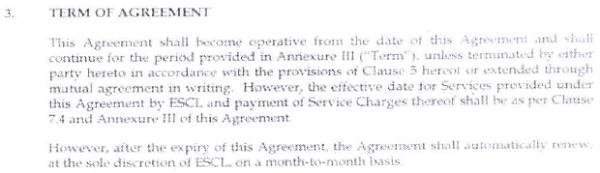
28. Apart from this, the parties, Renewal-cum-Amendment Contract No.2 dated 20/11/2020 to the Up-linking Service Agreement, added the following new clauses about termination and foreclosure charges, which are read as under:

29. In the Renewal-cum-Amendment Contract No.2 dated 20/11/2020, the parties to the contract specifically agreed as under:

30. It is clear from the above that, Clause 3 of the Space Segment Service Contract dated 19/07/2014, as reproduced supra, remains unchanged in the initial agreement, and that is binding between the parties. Therefore, after expiry, in terms of the agreement dated 20/11/2020, the agreement stood automatically renewed at the sole discretion of the Operational Creditor on a month-to-month basis.
31. It can be evidenced from the facts that the Operational Creditor issued monthly invoices, and the Respondent/Corporate Debtor received the said invoices without any agitation or objection and also utilized the services. There is no material on record to exhibit that the Respondent ever showed its intention to terminate the services of the petitioner or objected to the monthly invoices. Therefore, it would not be appropriate to take the defence that the invoices issued after 31/12/2023 were beyond the terms of the contract. Non-execution of any formal agreement by the parties would not have any material impact on their obligations, rights, responsibilities, and liabilities in terms of the original contract. So, as per the original contract, the parties agreed that 2% interest in case of default would be a material clause for adjudication of this case. The relevant clauses are read as under:
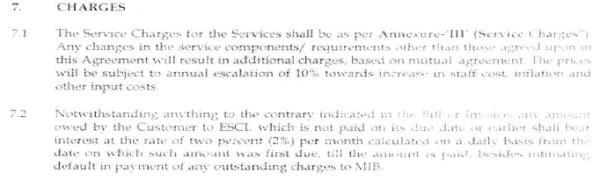
Though the Respondent is agitating about the expiry of the contract and its impact on invoices issued after 31/12/2023, there is no denial of continuation of services even after expiry of the original contract till 31/07/2025.
32. The Respondent has taken the defence of a pre-existing dispute on account of issues raised in the reply to the notice issued under Section 138 of the Negotiable Instruments Act, 1881, and the pendency of complaints under Section 138 of the Negotiable Instruments Act, before the Chief Metropolitan Magistrate, Patiala House Courts, New Delhi.
33. The defence made available to the Corporate Debtor by the legislature on account of pre-existing disputes has its own significance in these summary proceedings. This Adjudicating Authority is not required to go into the merits of such agitated disputes to discard the petition filed under Section 9 of the IBC, 2016. The existence of a genuine pre-existing dispute is the only requirement. So, while assessing the existence of a pre-existing dispute, it has become obligatory upon this Adjudicating Authority to satisfy itself that the alleged dispute so claimed should be clear, genuine, and serious, which may impact the foundation of the claim itself or have considerable bearing on the quality and quantity of the services or goods about which the petition under Section 9 of the IBC, 2016 has been filed.
34. The Respondent has referred to certain communications made on 26/10/2016, 27/08/2018, 06/07/2023, and 14/11/2023, in respect of its complaints about the quality of signals and services rendered by the Operational Creditor. The complaints raised prior to 20/11/2020 would be irrelevant for the purposes of the Section 9 Application. As the first two complaints/emails were made before the last renewal dated 20/11/2020 would not be relevant to agitate at this stage, and the other complaints, though the Respondent has referred to pages 9 and 10 of the additional Memo, which read as under:
35. We have carefully considered the material on record, and we are of the considered view that the said complaints are routine business communications or complaints which would not be construed as any pre-existing dispute as contemplated under Section 9 of the IBC, 2016. Even otherwise, except for these two emails, there is no serious agitation from the Respondent/Corporate Debtor to bring the said dispute to its logical end. Even the reply given in response to the notice issued under Section 138 of the Negotiable Instruments Act, 1881 is more or less defensive in nature, and there is no material on record that the Respondent ever agitated such issues seriously to dispute the quality or quantity of the services or to question the entitlement of the Operational Creditor to raise demand for services so provided. Each case has its own distinct facts and circumstances. The nature and manner of alleged disputes reflects a routine operational issue, which stood addressed at the relevant time, and Respondent/Corporate Debtor thereafter continued the services without any agitation.
36. The disputes so raised in the emails dated 06/07/2023 and 14/11/2023 were not carried forward by the Corporate Debtor or subsequently agitated in any manner, which would lead to a communication that those stray complaints had been duly addressed by the petitioner at the relevant time. So, that cannot be treated as a pre-existing dispute on the basis of the said communication.
37. The Respondent has also relied upon the pendency of proceedings under Section 138 of the Negotiable Instruments Act, 1881, arising out of the dishonour of the cheques issued towards the outstanding dues, to contend that there exists a dispute between the parties and, therefore, the present proceedings under Section 9 of the Code are not maintainable. The Respondent has relied upon the decisions in Mobilox Innovations Private Limited v. Kirusa Software Private Limited, (2018) 1 SCC 353, and A.D. Electro Steel Co. Pvt. Ltd. & Anr. v. Anil Steels to contend that the disputes raised by it constitute a pre-existing dispute. The principle laid down in Mobilox Innovations Private Limited is that this Adjudicating Authority is required to examine whether the defence raises a plausible contention requiring further investigation and whether the dispute is genuine and not spurious, hypothetical or illusory. However, the said test has to be applied to the facts of each case. In A.D. Electro Steel, the Corporate Debtor had specifically disputed the quantity of goods supplied and alleged violation of the terms of the agreement in its reply to the Section 138 notice, which directly went to the foundation of the claim. In the present case, however, the Respondent has not demonstrated any such specific serious and substantial dispute regarding the services actually availed or the invoices raised prior to the issuance of the Section 8 Demand Notice. On the contrary, the record contains repeated acknowledgements of the outstanding liability and requests for time to make payment. Therefore, applying the test laid down in Mobilox, the defence raised by the Respondent does not appear to be a plausible contention requiring further investigation so as to constitute a genuine pre-existing dispute.
38. However, the mere pendency of proceedings under Section 138 of the Negotiable Instruments Act, 1881, by itself, cannot be treated as a pre-existing dispute within the meaning of Section 8(2)(a) of the Code. The proceedings under Section 9 of the Code are concerned with the existence of an operational debt and default, and, at the stage of admission, the Adjudicating Authority is required to examine whether a genuine pre-existing dispute existed prior to the issuance of the notice under Section 8. The pendency of proceedings for dishonour of cheques does not, in itself, establish such a dispute; rather, where the cheques were issued towards discharge of the outstanding liability, their dishonour may lend support to the existence of the underlying debt. In this regard, the Hon’ble NCLAT in Sudhi Sachdev v. APPL Industries Ltd., (2018) ibclaw.in 98 NCLAT, has held as under:
“6. In the present case, it is not in dispute that there is a debt payable to the Operational Creditor and default on the part of the Corporate Debtor. The pendency of the case under Section 138/141 of the Negotiable Instruments Act, 1881, even if accepted as a recovery proceeding, it cannot be held to be a dispute pending before a court of law. Thereby we hold that the pendency of the case under Section 138/141 of Negotiable Instruments Act, 1881 actually amounts to admission of debt and not an existence of dispute. We find no merit in this appeal. It is accordingly dismissed. No Costs.”
39. The ratio of the aforesaid decision is that the pendency of proceedings under Section 138 of the Negotiable Instruments Act, 1881, cannot by itself be equated with the existence of a pre-existing dispute for the purposes of Section 9 of the Code. In the present case also, the cheques relied upon by the Operational Creditor were issued towards discharge of the outstanding dues and were subsequently dishonoured. The Respondent has not demonstrated that, prior to the issuance of the notice under Section 8 of the Code, any genuine and substantial dispute regarding the underlying debt had been raised and pursued to an extent sufficient to cast doubt upon the existence of the operational debt itself. Accordingly, the mere pendency of the proceedings under Section 138 of the Negotiable Instruments Act, 1881, cannot constitute a bar to the present proceedings under Section 9 of the Code.
40. The pendency of complaint under Section 138 of the Negotiable Instruments Act, 1881, would not have any bearing on the rights of the Operational Creditor to seek insolvency under the IBC, 2016. The fact remains that no effective proceedings have been initiated by the Respondents to agitate such issues before the issuance of notice under Section 8 of the IBC, 2016, to bring its case within the ambit of a pre-existing dispute. As such, the defence as taken by the Respondent would not be tenable.
41. It is the case of the Respondent that between 31/10/2022 and 30/06/2025, the Respondent/Corporate Debtor has paid an amount of Rs.2,24,66,840/- and the Petitioner has not given credit for the said amount, whereas in its Rejoinder, the Petitioner has placed on record the account statements reflecting such payments. Further, the amount due is more than 1 Crore, and at this stage, if the amount due is more than one crore, this Adjudicating Authority need not go into the exact quantum due; it would be taken care of by the Resolution Professional, and the Respondent would have every right to agitate such quantum at the relevant time.
42. It is further alleged that the amount is not crystallised. We find no merit in the defence as taken, whereas the amount claimed is on the basis of One Time Settlement (OTS) and subsequent invoices issued by the Operational Creditor on a month-to-month basis. It is further agitated that in the agreement there exists an Arbitration Clause. In our opinion, the existence of an arbitration clause would not have any bearing on the rights of the Operational Creditor to opt for the insolvency process, and it is the commercial wisdom and prerogative of the Operational Creditor to opt for the remedies available to it, in accordance with law.
43. The Respondent has disputed the date of default stated as 31.10.2025, contending that the same is inconsistent with the invoices and other documents on record. However, the date of default has been specifically stated by the Operational Creditor with reference to the last invoice dated 24.10.2025. As per the agreed terms, the invoice was payable within seven days, and on failure to make payment within the said period, the amount became due and payable on 31.10.2025. The earlier payments, settlement discussions, or proceedings under Section 138 of the Negotiable Instruments Act, 1881, do not by themselves invalidate the date of default so pleaded. The records placed before us support the existence of the outstanding operational debt and the failure of the Corporate Debtor to discharge the same. Therefore, the objection raised by the Respondent regarding the date of default is not sustainable.
44. The Respondent has also raised an objection regarding the authority of the person who instituted the present proceedings on behalf of the Operational Creditor. The said question was put forward by this Adjudicating Authority at the initial stage of the proceedings to clarify and establish the authority under which the present Petition had been instituted. Pursuant thereto, the Operational Creditor filed a Memo/Affidavit placing the relevant record before this Adjudicating Authority. Upon verification of the original physical and digital records, it was found that the Certified True Copy of the Board Resolution dated 13.08.2024 had already been filed at the inception of the proceedings and is available at Page Nos. 403 and 404 of the original Company Petition. The said Resolution authorises Sr. General Manager (Legal) to represent and act on behalf of the Operational Creditor in legal proceedings before courts and tribunals. Though the Resolution does not specifically mention the NCLT or the present Corporate Debtor, it generally authorises the said officer to represent the company before courts and tribunals, which is sufficient to institute the present proceedings under the Code. Further, pursuant to the directions of this Adjudicating Authority dated 15.07.2026, the Operational Creditor was granted an opportunity to cure the procedural ambiguity and has filed the Verified Affidavit dated 24.07.2026, clarifying and confirming the authority and ratifying the institution of the present proceedings. It is submitted that the legal position that a duly authorised officer, acting under a general corporate authorisation to represent the company before courts and tribunals, can institute proceedings under the IBC has been recognised in Palogix Infrastructure Pvt. Ltd. v. ICICI Bank Ltd., (2017) ibclaw.in 16 NCLAT and affirmed by the Hon’ble Supreme Court in Rajendra Narottamdas Sheth & Anr. v. Chandra Prakash Jain & Anr., (2021) ibclaw.in 155 SC. In the facts of the present case, therefore, the objection regarding want of authority does not survive and cannot be a ground to non-suit the Operational Creditor.
45. Relying upon the judgment in Innovative Industries Limited V. ICICI Bank (2018) 1 SCC 407, it was held that once the Adjudicating Authority is satisfied about the existence of a financial debt and default, the petition is required to be admitted, subject to the statutory requirements.
46. In view of the above, it is seen that this petition is filed on 14/07/2026 and the date of default is stated to be 31/10/2025 for a sum of Rs.3,41,13,009/-. The outstanding operational debt is of more than Rupees One Crore, which meets the threshold limit as per Section 4 of the Code and is well within the limitation for filing the present petition. Accordingly, the petition filed under Section 9 of the Insolvency and Bankruptcy Code, 2016 for initiation of the Corporate Insolvency Resolution Process against the Respondent/Corporate Debtor deserves to be admitted.
47. The very existence of such a threshold demonstrates that, where a Corporate Debtor fails to make payment within the stipulated terms, the Financial Creditor or the Operational Creditor is entitled to invoke Section 7 or Section 9 of the IBC, 2016, as the case may be.
48. In the present case, the Corporate Debtor, despite repeated assurances, failed to remit the outstanding debt, which is contrary to commercial virtuousness. In the considered opinion of this Adjudicating Authority, such a default, by itself, confers a right and discretion upon the Operational Creditor to approach this Adjudicating Authority under Section 9 of the IBC, 2016, after following the due procedure prescribed under law.
49. Once the Operational Creditor chooses to exercise its statutory right under Section 9 of the IBC, 2016, this Adjudicating Authority has very limited scope to interfere, provided that all statutory requirements are duly complied with and the application is not vitiated by fraud, collusion, or misrepresentation. In the present matter, the petition is not affected by any such vices. Accordingly, the defence raised by the Corporate Debtor is devoid of merit and is not sufficient to stall the insolvency process.
50. Given the above, this Adjudicating Authority finds that this petition filed by the Operational Creditor for initiation of the Corporate Insolvency Resolution Process (CIRP) against the Corporate Debtor is a fit case to be admitted under Section 9 of the Code. The Operational Creditor did not suggest the name for appointment of Insolvency Resolution Professional (IRP) to conduct the CIRP of the Corporate Debtor. Hence, we appoint the IRP from the list provided to us by IBBI.
51. Hence, this Adjudicating Authority orders the Corporate Insolvency Resolution Process of M/s. Sathyadhara Communications Private Limited, and accordingly admit the petition and passes the following orders:
i. This petition bearing CP(IB)/18/KOB/2026, filed by the Operational Creditor, M/s. Planetcast Media Services Private Limited, under Section 9 of the Code, for initiating CIRP against M/s. Sathyadhara Communications Private Limited (the Corporate Debtor) is hereby admitted.
ii. There will be a Moratorium under Section 14 of the Code. The moratorium shall have effect from the date of this order till the completion of the CIRP or until the Adjudicating Authority approves the resolution plan under sub-section (1) of Section 31 of the Code or passes an order for liquidation of the Corporate Debtor under Section 33 of the Code, as the case may be.
iii. Public announcement of the CIRP shall be made immediately as specified under Section 13 of the Code read with Regulation 6 of the Insolvency and Bankruptcy Board of India (Insolvency Resolution Process for Corporate Person) Regulations, 2016.
iv. We hereby appoint Mr. Jossy Steephen Kattur, Reg. No. IBBI/IPA-002/IP-N01056/2021-2022/13627, address: Barons 16 C, Skyline Imperial Gardens, Next to Ima House, Behind Jin Stadium, Kaloor, Stadium Link Road, Ernakulam 682 025, E-mail: [email protected] to act as an Interim Resolution Professional under Section 13(1)(C) of the Code. He shall conduct the Corporate Insolvency Resolution Process as per the provisions of the IBC, 2016 read with the Regulations made thereunder.
v. Although there is no substantial merit in the defence taken by the Respondent Company regarding the amount referred to in the application filed under Section 9 of the Insolvency and Bankruptcy Code, 2016, nevertheless, any decision rendered under the present order shall not have any bearing on the discretion or wisdom of the Resolution Professional in admitting the amount claimed by the Operational Creditor.
vi. The designated IRP shall perform all its functions as contemplated under the Code and must take any additional actions in this regard that are mandated by the law, more specifically Sections 15, 17, and 18 of the Code. The powers of the Board of Directors of the Corporate Debtor shall stand superseded as a consequence of the initiation of the CIRP in relation to the Corporate Debtor in terms of the provisions of the Code. The fee payable to IRP or as the case may be, the IRP shall comply with such Regulations, Circulars and Directions as may be issued by the Insolvency and Bankruptcy Board of India (IBBI). The IRP shall carry out all the functions as contemplated under the Code.
vii. During the CIRP period, the management of the Corporate Debtor shall vest with the IRP or, as the case may be, the RP in terms of section 17 of the IBC. The officers and managers of the Corporate Debtor shall provide all documents in their possession and furnish all information in their knowledge to the IRP within one week from the date of receipt of this order, in default of which coercive steps will follow.
viii. The IRP/RP shall submit to this Adjudicating Authority periodical reports concerning the progress of the CIRP in respect of the Corporate Debtor.
ix. The Operational Creditor shall deposit a sum of Rs.2,00,000/- (Rupees Two Lakhs Only) within two weeks from the date of receipt of this order, in order to meet out the initial expenses to perform the duties assigned to the IRP in accordance with Regulation 6 of Insolvency and Bankruptcy Board of India (Insolvency Resolution Process for Corporate Person) Regulations, 2016 and IRP is to file proof of receipt of such amount to this Adjudicating Authority along with First Progress Report. This amount may not be construed as the fee paid to the IRP. Subsequently, IRP may raise further demands for Interim funds, which shall be provided as per the Rules.
x. Additionally, the Operational Creditor shall serve a copy of this Order on the IRP and on the Registrar of Companies, Kerala, by all available means for updating the Master Data of the Corporate Debtor. The Registrar of Companies shall send a compliance report in this regard to the Registry of this Tribunal within seven days from the date of receipt of a copy of this Order.
52. The present Company Petition bearing No. CP(IB)/18/KOB/2026 is admitted accordingly.
53. The Registry is hereby directed to send e-mail copies of this order forthwith to all the parties and their counsel for information and to take necessary steps.
54. Let the certified copy of this order be issued upon compliance with the requisite formalities.
55. File be consigned to records.