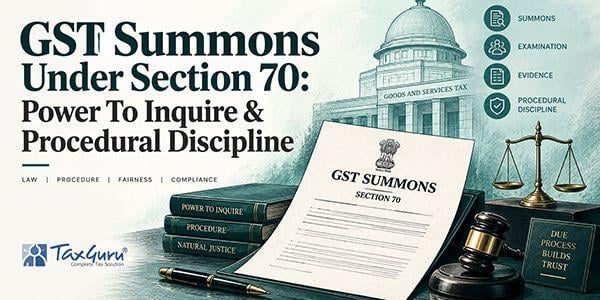
GST Summons Under Section 70 of CGST Act, 2017: Power To Inquire, Procedural Discipline & Civil Court Connection
Summary: Section 70 of the CGST Act, 2017 empowers the proper officer to summon a person whose attendance is considered necessary to give evidence or produce documents or other things during an inquiry, in the same manner as a civil court under the Code of Civil Procedure, 1908. The provision combines significant investigative authority with safeguards relating to necessity, relevance, proper jurisdiction and procedural discipline. Following insertion of Section 70(1A) with effect from 1 November 2024, a summoned person may be required to attend personally or through an authorised representative, as directed by the officer. The article examines the relationship between Section 70 and Sections 30, 32, 132 and 133 CPC and Order XVI, CBIC’s summons guidelines, DIN/RFN requirements, consequences of non-appearance, evidentiary value of statements and the meaning of a “judicial proceeding”. It also analyses Supreme Court rulings including Radhika Agarwal v. Union of India, M/s Armour Security (India) Ltd. v. Commissioner, CGST and Union of India v. Sunil Biyani, emphasising that summons constitute an investigative mechanism rather than adjudication and do not, by themselves, make the summoned person an accused.
- 1. Introduction
- 2. Background: Why Does a Tax Officer Need a Summons Power?
- 3. Section 70, Phrase by Phrase
- “The proper officer under this Act”
- “shall have power”
- “to summon any person”
- “whose attendance he considers necessary”
- “either to give evidence”
- “or to produce a document”
- “or any other thing”
- “in any inquiry”
- “in the same manner, as provided in the case of a civil court”
- 4. Section 70(1A): Personal Appearance Versus Authorised Representative
- 5. The CPC Connection—What Exactly Does Section 70 Borrow?
- Section 30 CPC — Discovery and Summons
- Order XVI Rule 5 — What Should the Summons Tell the Recipient?
- Order XVI Rule 6 — Must a Person Personally Attend Merely to Produce Documents?
- Order XVI Rules 8 and 9 — Service and Reasonable Time
- Order XVI Rules 10 to 12 — Failure to Attend
- Sections 132 and 133 CPC — Statutory Exemptions
- 6. Important CPC Questions in GST Practice
- Can a person refuse personal appearance and simply send a CA or advocate?
- Can the department summon a CFO merely because he is the CFO?
- Can GSTR-1, GSTR-3B or other portal data be repeatedly demanded through summons?
- Can a summons simply ask for “all records”?
- Can repeated summons be issued?
- Does a defective summons automatically become void?
- 7. CBIC's Administrative Discipline: Summons Are Not Routine Letters
- 8. DIN, RFN and Authenticity of Summons
- 9. “Judicial Proceeding” — What Does Section 70(2) Really Mean?
- 10. Non-Appearance: Civil, GST and Penal Consequences
- 11. Statements Under Section 70: Important, But Not Automatically Conclusive
- 12. Constitutional Position: Is a Person Summoned an “Accused”?
- 13. Parallel Central and State Investigations After Armour Security
- 14. When Should a Summons Be Judicially Challenged?
- 15. A Few Principles That Should Govern Section 70
- 16. Conclusion
1. Introduction
Among the investigative provisions of the Central Goods and Services Tax Act, 2017, few provisions have generated as much anxiety in practice as section 70. A summons may consist of barely a page, yet its legal consequences extend far beyond an ordinary departmental letter. The recipient may be required to personally attend, make a statement, produce books, electronic records or other material; non-compliance may attract statutory consequences; and, significantly, Parliament declares the inquiry itself to be a “judicial proceeding”.
At the same time, section 70 is not a charter for unrestricted interrogation. Every important expression used by Parliament carries a limitation: the summons must be by the proper officer; attendance must be considered necessary; the purpose must be to give evidence or produce a document or other thing; it must relate to an inquiry; and the power is exercisable in the same manner as a civil court under the Code of Civil Procedure, 1908.
The provision, therefore, has two sides. It confers an important investigative power upon the tax administration, but simultaneously imports concepts of necessity, relevance, procedure and judicial responsibility.
The law has also undergone an important change. With effect from 1 November 2024, sub-section (1A) has been inserted in section 70. It expressly provides that a person summoned may be required to attend either personally or through an authorised representative, “as such officer may direct”, and that the person appearing must state the truth, make statements and produce documents or things as required. The present statutory text also treats the inquiry as a judicial proceeding for sections 229 and 267 of the Bharatiya Nyaya Sanhita, 2023.
A proper understanding of section 70 consequently requires us to read not merely the CGST Act, but also the CPC, section 116 relating to authorised representatives, the provisions dealing with penalty and evidentiary use of statements, CBIC’s administrative instructions and, above all, the growing body of constitutional and GST jurisprudence.
2. Background: Why Does a Tax Officer Need a Summons Power?
GST is founded substantially upon self-assessment. Returns, invoices, e-way bills, input tax credit trails, banking information and electronic records disclose much, but investigations frequently require facts which are within the personal knowledge of taxpayers, employees, vendors, accountants, directors or third parties.
Section 70 fills this evidentiary gap. It is situated in Chapter XIV, dealing with inspection, search, seizure and arrest. Its real function is investigative: to enable the officer to collect oral and documentary evidence so that the correct factual position can emerge before further statutory action is considered.
This distinction between an “inquiry” and subsequent “proceedings” has become important in the context of section 6(2)(b), which restricts parallel proceedings by Central and State authorities on the same subject matter.
In G.K. Trading v. Union of India, the Allahabad High Court distinguished an inquiry under section 70 from adjudicatory proceedings. The Madras High Court in Kuppan Gounder P.G. Natarajan v. DGGI similarly held that section 6(2)(b) and section 70 operate in different fields: one concerns proceedings on the same subject matter, while section 70 concerns an inquiry and the collection of evidence.
The Supreme Court has now substantially settled this controversy in M/s Armour Security (India) Ltd. v. Commissioner, CGST, 2025 INSC 982. A summons, the Court explained, is a step in an inquiry and is not by itself the commencement of adjudicatory “proceedings” for purposes of section 6(2)(b).
Thus, a summons is neither a show cause notice nor a finding of guilt. It is essentially an instrument for discovery of facts.
3. Section 70, Phrase by Phrase
The best method of understanding section 70 is to give independent meaning to every important expression employed by Parliament.
“The proper officer under this Act”
Not every GST officer automatically possesses every power under the Act. Section 2(91) defines “proper officer” by reference to assignment of functions. Circular No. 3/3/2017-GST dated 5 July 2017 assigned functions to specified Central Tax officers.
The authority underlying that Circular itself was challenged recently in Lovelesh Singhal v. CBIC, [2026] 183 taxmann.com 493 (Delhi). The Delhi High Court rejected the challenge and upheld the statutory assignment underlying the section 70 summons.
Jurisdiction must, therefore, be tested not merely by designation printed below a signature, but by statutory assignment of the particular function.
“shall have power”
This confers power; it does not compel an officer to issue summons whenever information is desired. Administrative power remains subject to relevance, reasonableness and the Board’s own instructions.
CBIC itself has expressly directed that officers should examine whether a simple requisition letter would suffice instead of invoking section 70. Summons should be used judiciously and with due consideration.
“to summon any person”
The expression is intentionally wider than “registered person”, “taxable person” or “assessee”. A director, employee, accountant, supplier, purchaser, transporter, banker, consultant or other third party may be summoned if his attendance satisfies the statutory test.
But “any person” does not mean “every person connected in some manner”. The next words provide the controlling limitation.
“whose attendance he considers necessary”
These are perhaps the most important words in section 70.
The statute does not say “whose attendance the officer desires”. Parliament uses necessary. There must be a rational nexus between the proposed attendance and the inquiry.
CBIC’s own instruction recognises this principle. Senior management officials such as CMD, MD, CEO and CFO should not generally be summoned in the first instance merely because of their designation. They should ordinarily be summoned only where investigation indicates their involvement in the relevant decision-making process. Likewise, documents already available electronically on the GST portal should not normally be demanded through summons.
Necessity is thus both a jurisdictional idea and an administrative safeguard.
“either to give evidence”
This permits examination of a person concerning facts within his knowledge. Evidence is different from obtaining a predetermined admission.
An investigating officer may legitimately test transactions, documents, accounting treatment, movement of goods, commercial relationships and the knowledge of persons involved. What section 70 does not contemplate is using summons as a substitute for adjudication or compelling a particular legal conclusion from the person examined.
After insertion of sub-section (1A), the person appearing is expressly required to state the truth during examination. The reciprocal expectation must surely be that questions relate fairly to the inquiry and the statement records what was actually stated.
“or to produce a document”
This expression includes physical as well as electronic records, subject to the broad statutory concept of “document”.
However, relevance remains essential. A summons seeking “all documents since inception” without identifying the relationship of those documents to the inquiry may raise proportionality concerns.
The CPC, discussed later, provides useful guidance: a summons for production ordinarily identifies documents with reasonable accuracy.
“or any other thing”
Parliament deliberately goes beyond “documents”. Depending upon the inquiry, the expression may include electronic devices, storage media or other evidentiary material capable of assisting fact-finding.
Yet the words “other thing” cannot be detached from the statutory purpose. Section 70 is an evidence-gathering provision; it is not an independent confiscation or recovery provision. Where coercive possession is intended, the Act separately provides search and seizure powers under section 67.
“in any inquiry”
The expression is broad as regards the stage of investigation but specific as regards its character.
The Supreme Court in Armour Security has clarified that an inquiry under section 70 is conceptually distinct from later adjudicatory proceedings. Evidence gathering may precede a notice and determination.
This distinction is particularly important when objections are taken that a summons itself amounts to initiation of a tax demand proceeding.
“in the same manner, as provided in the case of a civil court”
These words are frequently quoted and insufficiently examined.
Section 70 does not declare the proper officer to be a civil court for all purposes. It borrows the manner in which a civil court summons persons for evidence and production.
That necessarily takes us to the CPC, particularly section 30, section 32 and Order XVI. But incorporation must remain confined to what is compatible with section 70 and the CGST Act. A tax officer cannot assume every judicial coercive power vested in a civil court merely because the words “same manner” appear in section 70.
This distinction becomes clearer when one notices that the GST Appellate Tribunal Rules expressly provide that Orders XVI and XXVI CPC shall apply mutatis mutandis to summoning witnesses and issuing commissions. Where a wider procedural adoption is intended, the law says so expressly.
4. Section 70(1A): Personal Appearance Versus Authorised Representative
The insertion of sub-section (1A) from 1 November 2024 deserves separate treatment.
It provides that all persons summoned shall be bound to attend “either in person or by an authorised representative, as such officer may direct”.
Three conclusions follow.
First, attendance is mandatory once a valid summons requiring attendance has been issued.
Secondly, representation is now statutorily recognised within section 70 itself. Section 116 permits specified authorised representatives including advocates, practising chartered accountants, cost accountants, company secretaries, eligible employees/relatives and GST practitioners, subject to its conditions. The statutory material itself recognises the role of a practising chartered accountant as an authorised representative.
Thirdly—and importantly—the choice is not entirely with the summoned person. Parliament says “as such officer may direct”. If personal examination of a director or employee possessing first-hand knowledge is genuinely necessary, sending a chartered accountant or advocate cannot automatically substitute the witness. Conversely, where only reconciliation or production of records is required and the officer permits representation, compelling repeated attendance of senior personnel would defeat both the 2024 amendment and CBIC’s own discipline.
The distinction should also be maintained between representation before the officer and a claimed right to have counsel physically present throughout personal interrogation. The older decision in Poolpandi v. Superintendent, Central Excise, (1992) 3 SCC 259, rejected an absolute right to counsel during such investigative interrogation. The 2024 amendment permits authorised representation where directed; it does not transform a personal examination into an adversarial courtroom hearing.
5. The CPC Connection—What Exactly Does Section 70 Borrow?
The reference to the Code of Civil Procedure is not ornamental. It provides the procedural DNA of a proper summons.
Section 30 CPC — Discovery and Summons
Section 30 empowers a civil court, inter alia, to order production of documents and issue summons to persons whose attendance is required either to give evidence or to produce documents or objects.
Section 70 substantially borrows this evidentiary concept. The GST officer is collecting facts and records, not determining liability at the summons stage.
Order XVI Rule 5 — What Should the Summons Tell the Recipient?
Order XVI Rule 5 requires the summons to state the time and place at which attendance is required and whether the person is required to give evidence, produce a document, or both. Where production is required, the document should be described with reasonable accuracy.
Applied to GST, this is a valuable procedural benchmark. A summons should ordinarily enable the recipient to understand:
the inquiry concerned, the purpose of attendance, the date and place, and the documents or things required.
A completely vague demand increases the risk of a roving inquiry and prevents meaningful compliance.
Order XVI Rule 6 — Must a Person Personally Attend Merely to Produce Documents?
This is one of the most important practical questions.
Under Order XVI Rule 6, a person may be summoned merely to produce a document without being summoned to give evidence; such a person may comply by causing the document to be produced instead of personally attending.
But GST now contains its own express sub-section (1A). Therefore, Rule 6 cannot be read in isolation. If the summons is confined to production and the officer has not directed personal attendance, production through an authorised representative or permitted mode may satisfy the object. If the proper officer expressly directs personal appearance under section 70(1A) for a legitimate evidentiary reason, Rule 6 cannot override that statutory direction.
The answer therefore depends upon what the summons requires and why.
Order XVI Rules 8 and 9 — Service and Reasonable Time
Order XVI links service of witness summons with the procedural rules governing service and requires sufficient time for the witness to prepare and travel.
GST itself contains section 169 prescribing modes of service. Accordingly, section 169 is the controlling statutory provision for GST service, but the CPC reinforces an elementary principle: a summons must actually reach the person with reasonable opportunity to comply.
CBIC’s Instruction No. 03/2022-23 specifically warns against repeated summons without first ensuring proper service.
Order XVI Rules 10 to 12 — Failure to Attend
The CPC empowers a court, after satisfying itself regarding service and absence of lawful excuse, to adopt coercive measures against defaulting witnesses.
This raises an important question: does section 70 allow a GST officer himself to exercise every such power of the civil court?
In our view, the safer construction is no.
Parliament borrows the “manner” of summons; it does not confer upon the GST officer the entire execution machinery of a civil court. This is also reflected in CBIC’s own Instruction. In cases of persistent non-compliance, after reasonable opportunity—ordinarily three summons at reasonable intervals—the Instruction contemplates filing a complaint before the jurisdictional Magistrate rather than the officer directly exercising the CPC’s judicial powers.
That administrative interpretation strongly supports a distinction between power to summon in the manner of a court and being a court possessing every CPC sanction.
Sections 132 and 133 CPC — Statutory Exemptions
CBIC has expressly instructed officers to keep sections 132 and 133 CPC in view.
Section 132 provides exemption from personal appearance to women who, according to the customs and manners of the country, ought not to be compelled to appear in public.
Section 133 deals with exemption of specified constitutional and high public functionaries from personal appearance, including categories such as the President, Vice-President, Governors, Ministers and Judges specified therein.
These provisions demonstrate why the CPC reference in section 70 cannot be dismissed as merely procedural decoration. The Board itself recognises that CPC protections accompany the summons power.
6. Important CPC Questions in GST Practice
Can a person refuse personal appearance and simply send a CA or advocate?
Not as an absolute right. Section 70(1A) permits attendance personally or by authorised representative as the officer may direct. If the officer legitimately requires evidence within the personal knowledge of the summoned individual, personal attendance can be directed.
Can the department summon a CFO merely because he is the CFO?
CBIC says senior management officials should not generally be summoned in the first instance. There should be clear indication of their involvement in the decision-making process relevant to revenue loss.
Can GSTR-1, GSTR-3B or other portal data be repeatedly demanded through summons?
Ordinarily no necessity exists to summon records already digitally available to the department. The 2022 Instruction expressly advises against this.
Can a summons simply ask for “all records”?
The statute does not prescribe a detailed schedule, but CPC principles strongly favour reasonable identification of documents. A proper summons should permit intelligible compliance rather than embark upon an unrestricted fishing exercise.
Can repeated summons be issued?
Yes, where justified, but repetition is not itself proof of legality. The officer should first ensure service, consider the response and avoid mechanical repetition. The CBIC framework envisages reasonable intervals and escalation only after reasonable opportunity.
Does a defective summons automatically become void?
Not necessarily. Section 160 of the CGST Act contains a statutory saving for proceedings which are in substance and effect in conformity with the Act despite mistake, defect or omission. A distinction must therefore be drawn between a curable procedural defect and a fundamental defect of jurisdiction, authority or statutory purpose.
7. CBIC’s Administrative Discipline: Summons Are Not Routine Letters
Instruction No. 03/2022-23 (GST-Investigation) dated 17 August 2022 is perhaps the single most important administrative document on section 70. It arose because the Board noticed routine summons to senior officials and demands for records already available on the portal.
Its important safeguards may be summarised as follows:
- summons should be issued judiciously and a requisition letter should be considered where sufficient; a Superintendent should ordinarily obtain prior written permission from an officer not below Deputy/Assistant Commissioner, with reasons recorded; summons should normally disclose the person/offender being investigated unless disclosure would prejudice investigation; portal-available statutory documents should ordinarily not be summoned; senior management should not routinely be called in the first instance; the summoning officer should remain available at the appointed time; CPC exemptions under sections 132 and 133 must be respected; repeated summons should not be issued without ensuring service; and persistent default should be addressed through the statutory/penal process after reasonable opportunity rather than by administrative harassment.
The Instruction deserves to be treated as a working code of summons administration.
8. DIN, RFN and Authenticity of Summons
Circular No. 122/41/2019-GST introduced mandatory Document Identification Number requirements for specified departmental communications, including investigation communications, while Circular No. 128/47/2019-GST prescribed a standard summons format.
The objective was obvious: traceability, accountability and protection against unauthorised communications.
The position has subsequently evolved. Circular No. 249/06/2025-GST dated 9 June 2025 modified the earlier DIN framework in relation to communications generated through the GST common portal carrying a verifiable Reference Number. Thus, DIN objections must now be examined under the current circular regime rather than by mechanically applying the 2019 position to every electronic communication.
For practitioners, authenticity should always be verified, but the presence or absence of one identifier cannot be examined without regard to the mode through which the summons was generated.
9. “Judicial Proceeding” — What Does Section 70(2) Really Mean?
Section 70(2), in its current form, provides that every such inquiry shall be deemed to be a judicial proceeding within the meaning of sections 229 and 267 of the Bharatiya Nyaya Sanhita, 2023.
Section 229 BNS concerns punishment for intentionally giving or fabricating false evidence in a judicial proceeding. Section 267 deals with intentional insult or interruption to a public servant sitting in a judicial proceeding.
The expression “judicial proceeding”, however, must not be misunderstood. It does not convert the proper officer into a court deciding civil rights. The statutory fiction has a particular consequence: truthfulness and orderly conduct during evidence gathering receive penal protection.
The seriousness runs both ways. If the person summoned is legally expected to state the truth, statements must be properly recorded, read over where appropriate and should reflect the actual answers given.
10. Non-Appearance: Civil, GST and Penal Consequences
Section 122(3)(d) provides for penalty where a person fails to appear before a Central Tax officer when issued a summons for appearance to give evidence or produce documents in an inquiry.
Administrative instructions further contemplate recourse to the criminal process where a person deliberately avoids service or intentionally disobeys a duly served summons after reasonable opportunity.
The point is important: a summons should neither be ignored casually nor treated as a demand notice which can simply be answered by legal submissions. Where genuine difficulty exists—illness, travel, short notice, non-availability of records or other reasonable cause—the proper course is to communicate promptly, seek a reasonable adjournment and demonstrate willingness to comply.
11. Statements Under Section 70: Important, But Not Automatically Conclusive
A recurring misconception is that because section 70 proceedings are “judicial proceedings”, every statement recorded becomes conclusive evidence of tax liability.
That proposition goes too far.
Section 136 of the CGST Act separately deals with relevancy of statements made and signed in response to summons during an inquiry or proceedings under the Act for purposes of prosecution, subject to specified conditions. This itself shows that Parliament has carefully regulated evidentiary use.
A section 70 statement may unquestionably be important evidence. But determination of tax liability still requires application of the charging, valuation, input tax credit, demand and adjudication provisions. Admissions must be read in context, documents must be examined, and legal liability cannot be created merely because an investigating officer has obtained an answer to a legal proposition.
Section 70 is a provision for fact finding; sections 73, 74 or 74A, as applicable, govern determination of tax liability.
12. Constitutional Position: Is a Person Summoned an “Accused”?
This question has recently received authoritative consideration.
In Radhika Agarwal v. Union of India, (2025) 6 SCC 545, the Supreme Court upheld the constitutional validity of the GST arrest and summons framework and clarified that a person summoned under section 70 is not per se an accused protected by Article 20(3) merely because he has been called for questioning. At the same time, the Court cautioned that investigation must proceed in accordance with law and that there should be no misuse of power.
The principle has now been reaffirmed in Union of India v. Sunil Biyani, 2026 INSC 849, decided on 12 August 2026. The Supreme Court expressly reiterated that mere issuance of summons under section 70 does not convert the summoned person into an accused.
This proposition must, however, be understood carefully. It does not mean constitutional protection disappears forever. The legal character of a person’s position may change as investigation progresses. What the Court rejects is the proposition that summons itself equals accusation.
The same judgment also emphasises the distinction between summons under section 70 and an order authorising arrest under section 69. The two provisions serve different statutory purposes.
13. Parallel Central and State Investigations After Armour Security
One of the biggest recent controversies has concerned simultaneous involvement of Central and State GST authorities.
The Supreme Court in Armour Security has clarified that an inquiry through summons is not equivalent to commencement of adjudicatory proceedings under section 6(2)(b). Therefore, mere issuance of summons by one authority does not automatically bar an inquiry by another on that reasoning alone.
This does not mean duplication should be encouraged. Administrative fairness demands coordination, particularly where identical documents and witnesses are repeatedly called for. But the legal objection must now be framed with precision: one cannot simply say, “a State authority issued summons first, therefore the Central authority has no jurisdiction to inquire.”
The jurisprudence reflected earlier in G.K. Trading and Kuppan Gounder has, in substance, received Supreme Court approval.
14. When Should a Summons Be Judicially Challenged?
Courts ordinarily discourage writ petitions against every investigative summons. Investigation should normally be allowed to proceed.
But this does not place summons beyond judicial review. Intervention may still be justified where the challenge concerns fundamental jurisdiction, patent lack of authority, manifest abuse, or a clear infringement of statutory or constitutional protection.
The recent decision in Lovelesh Singhal demonstrates the other side: where the officer’s statutory assignment was valid, the Court declined to interfere and required compliance with the summons.
Therefore, before advising a challenge, a practitioner should distinguish between inconvenience and illegality. A summons requiring production of inconvenient records is not for that reason void; equally, statutory power does not legitimise a summons issued by an incompetent authority or for an alien purpose.
15. A Few Principles That Should Govern Section 70
After reading the statute, CPC, Board instructions and recent judgments together, a coherent legal philosophy emerges.
A summons is a means of investigation, not a punishment.
“Any person” is broad, but “whose attendance he considers necessary” restrains that breadth.
“Same manner as a civil court” imports procedural discipline; it does not transform a tax officer into a civil court possessing every CPC power.
The 2024 amendment now expressly accommodates authorised representation but preserves the proper officer’s authority to require personal attendance where genuinely necessary.
The judicial proceeding fiction imposes seriousness upon evidence; it does not transform investigation into adjudication.
Non-attendance cannot be treated casually, but coercive escalation should follow proper service, reasonable opportunity and the procedure recognised by law.
And perhaps most importantly, a summons must remain connected to evidence. The moment it becomes an instrument merely to demand tax payment, dictate a legal admission or subject senior officials to routine attendance, it departs from the object for which Parliament enacted section 70.
16. Conclusion
Section 70 is one of the strongest investigative provisions in the CGST Act, but its strength lies in its carefully drafted limits.
Parliament could have simply authorised tax officers to compel attendance and documents. Instead, it required the officer to be the proper officer, required him to consider attendance necessary, confined the purpose to evidence and production in an inquiry, incorporated the procedural manner of a civil court, prescribed how summoned persons are to attend, required truthfulness, and conferred the special character of a judicial proceeding.
The reference to the CPC is therefore not accidental. Sections 30, 32, 132 and 133 CPC and, more particularly, Order XVI illuminate questions of purpose, service, production, personal attendance, exemptions and consequences of default. At the same time, care must be taken not to import judicial powers which Parliament has not conferred upon the GST officer.
The Supreme Court’s decisions in Radhika Agarwal, Armour Security and, most recently, Sunil Biyani bring welcome clarity. A summons is an inquiry tool; it does not by itself make the recipient an accused, nor does it constitute adjudication. But investigative latitude is coupled with the constitutional requirement that power must not be misused.
In a mature tax system, effectiveness of investigation and protection of taxpayer rights are not competing objectives. Properly administered, section 70 serves both.
The officer must be able to obtain the truth. The citizen must know why his attendance is necessary. The professional must advise compliance without surrendering statutory safeguards. And the summons must remain what the Legislature intended it to be: a disciplined process for obtaining evidence—not an instrument of intimidation or recovery.