Summary: The Press Information Bureau (PIB), Ministry of Information and Broadcasting, has published a backgrounder titled “UPI: Transforming India’s Payment Landscape” on August 24, 2026, highlighting the evolution, scale, technological development and international expansion of the Unified Payments Interface (UPI). UPI was developed by the National Payments Corporation of India (NPCI) and has emerged as a cornerstone of India’s digital payments ecosystem. According to the supplied PIB material, UPI is now accepted in 11 countries, with Greece and the Maldives among the latest countries to adopt the platform.
The backgrounder traces UPI’s development from its pilot launch in April 2016 with 21 member banks and its public rollout in August 2016. The BHIM application was launched in December 2016, followed by Dynamic QR in 2017 and UPI 2.0 in 2018. The 2018 version introduced features including Invoice in the Inbox, Signed Intent and QR, UPI Mandates and overdraft account linking. In 2019, UPI was permitted as an alternative payment mechanism for retail individual investors applying for IPOs through designated intermediaries, and monthly transactions crossed one billion in October 2019. The supplied material’s reference to IPO applications is supported by TaxGuru’s publication on SEBI’s implementation of Phase II of UPI with ASBA.
Between 2020 and 2022, UPI AutoPay, UPI 123PAY, UPI Lite and credit-card integration expanded the system’s use cases. During FY 2021-22, UPI processed transactions worth more than US$1 trillion and crossed five billion monthly transactions in March 2022. Bhutan became the first cross-border deployment identified in the backgrounder. In 2023, Credit Line on UPI was introduced and UPI accounted for approximately 70% of India’s digital payment transactions during FY 2023-24. TaxGuru has separately reported on the introduction and subsequent regulatory treatment of credit facilities linked to UPI.
The 2024 developments highlighted by PIB include UPI Circle, higher transaction limits for tax payments, enhancement of the UPI 123PAY per-transaction limit to ₹10,000 and enhancement of the UPI Lite wallet limit to ₹5,000 with the per-transaction limit raised to ₹1,000. The Reserve Bank of India announced the increase in the UPI limit for tax payments from ₹1 lakh to ₹5 lakh per transaction in August 2024, and NPCI subsequently issued implementation instructions for verified merchants in the tax-payment category. :contentReference[oaicite:3]{index=3} TaxGuru has also published the NPCI circular introducing UPI Circle and delegated payments.
For 2025, the backgrounder records the introduction of on-device authentication for UPI, allowing smartphone fingerprint or face-unlock based payments, and Aadhaar-based Face Authentication for UPI PIN onboarding. The stated objective was to simplify onboarding, particularly for first-time users, senior citizens and people without easy access to cards.
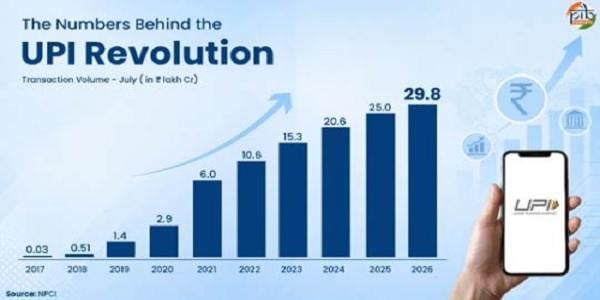
The supplied data demonstrates the scale achieved by UPI over the decade. From FY 2016-17 to FY 2025-26, annual transaction volume increased from 2 crore transactions to over 24,162 crore transactions, described as an approximately 12,000-fold increase. Annual transaction value increased from ₹0.07 lakh crore to approximately ₹314 lakh crore, representing more than a 4,000-fold increase. In July 2026 alone, the UPI ecosystem comprised 741 live banks, processed 2,365.8 crore transactions and recorded transaction value of ₹29.87 lakh crore. :contentReference.
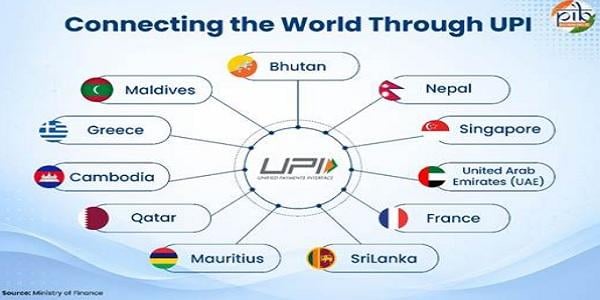
The backgrounder also highlights UPI’s international significance. It states that, as of 2024, UPI accounted for approximately 49% of global real-time payment transaction volume, citing the International Monetary Fund’s June 2025 report titled “Growing Retail Digital Payments: The Value of Interoperability”. The supplied material states that UPI is operational in Bhutan, Nepal, Singapore, the UAE, France, Sri Lanka, Mauritius and Qatar. It further records developments in Cambodia, Greece and the Maldives during 2026, taking the stated number of foreign countries where UPI is live for acceptance and/or cross-border remittances to 11.
The backgrounder concludes that UPI has transformed the way India transacts by making digital payments simple, secure and interoperable. Its rapid adoption, continued innovation and expanding international footprint have positioned UPI as a key component of India’s Digital Public Infrastructure. The supplied material is primarily descriptive and does not itself create a new statutory obligation or amend an existing law; its principal purpose is to present the evolution, milestones, adoption figures and global footprint of UPI.
PIB Backgrounder
UPI: Transforming India’s Payment Landscape
Posted On: 24 AUG 2026 2:19PM by PIB Delhi
Towards a Unified Payment Ecosystem
India’s digital payments ecosystem has undergone a remarkable transformation over the past decade. It is driven by the vision of creating a simple and secure payment system accessible to every citizen. The Unified Payments Interface (UPI), developed by the National Payments Corporation of India (NPCI), has emerged as a cornerstone of India’s digital payments revolution. Today, UPI is accepted in 11 countries, with Greece and the Maldives being the latest to adopt India’s real-time payment platform.
UPI and its Evolution
With interoperable design and ease of use, UPI has fundamentally changed the way individuals, businesses and government entities transact.
- Real-time payment system that powers multiple bank accounts through a single mobile application of any participating bank or payment service provider.
- Integrates multiple banking services, fund transfers and merchant payments on a single platform.
- Enables round-the-clock digital payments.
- Uses two-factor authentication and end-to-end encryption to enhance transaction security.
Over the past decade, UPI has evolved into the backbone of India’s digital payments ecosystem. Following are some of the key milestones in the evolution of UPI:
2016
- UPI was launched on a pilot basis in April 2016 with 21 member banks.
- In August 2016, it was rolled out to the public as participating banks made their UPI-enabled mobile applications available on the Google Play Store.
- The BHIM application was launched in December 2016 to enable digital payments using UPI. It allows users to make direct bank-to-bank transactions through mobile devices.
2017
- Dynamic QR, a retail merchant platform enabling UPI payments via dynamic QR codes was launched, which dynamically included transaction specifics like payee info and exact totals, removing manual amount entry.
2018
- UPI 2.0 was introduced with enhanced features to make digital payments simpler, more secure and seamless.
- Invoice in the Inbox allows users to view bills or invoices before authorising payments.
- Signed Intent and QR enables simplifies payment authorisation while maintaining security.
- UPI Mandates enables recurring payments through pre-authorised instructions.
- Overdraft account linking allows users to make UPI transactions using their overdraft accounts.
2019
- SEBI allowed retail individual investors to use UPI as an alternative payment mechanism when applying for IPOs through designated intermediaries. SEBI/HO/CFD/DIL2/CIR/P/2019/76 dated June 28, 2019 records the implementation of Phase II of UPI with ASBA for retail individual investors.
- UPI crossed the milestone of one billion transactions in a month in October 2019, reflecting rapid nationwide adoption.
2020-2022
- UPI AutoPay was launched to support recurring e-mandates for subscriptions, utility bills, insurance premiums, SIPs and EMIs.
- Feature phone users were brought into the digital payments’ ecosystem through the launch of UPI 123PAY. It allows transactions through interactive voice response (IVR) number, app-based functionality, missed calls-based approach and proximity sound-based payments.
- UPI Lite was introduced to enable low-value transactions in a faster and PIN-less manner.
- The integration of credit cards with UPI further expanded digital payment options for users.
- During FY 2021-22, UPI processed transactions worth over US$1 trillion and crossed 5 billion monthly transactions in March 2022.
- It also expanded internationally with its launch in Bhutan, marking its first cross-border deployment.
2023
- Credit Line on UPI was introduced, allowing pre-sanctioned bank credit lines to be linked as a funding account.
- UPI accounted for ~70% of India’s digital payment transactions during FY 2023–24.
2024
- UPI Circle was introduced, enabling primary users to authorise secondary users with predefined transaction limits on the primary user’s bank account. NPCI/UPI/OC No.201/2024-25 dated 13th August 2024 covers the introduction of UPI Circle.
- RBI enhanced the UPI transaction limit for tax payments from ₹1 lakh to ₹5 lakh per transaction. Higher limits also apply to select categories, including capital markets, IPO subscriptions, loan collections, insurance, healthcare and education. NPCI/UPI/2024-25/OC-185A dated 24th August 2024 implemented the enhanced limit for the tax-payment category.
- The per-transaction limit for UPI 123Pay was raised to ₹10,000, expanding its range of use cases.
- The UPI Lite wallet limit was increased to ₹5,000, with the per-transaction limit raised to ₹1,000.
2025
- On-device authentication for UPI was introduced, enabling payments through smartphone fingerprint or face unlock.
- Aadhaar-based Face Authentication simplified UPI PIN onboarding, especially for first-time users, senior citizens and those without easy access to cards.
UPI Today
UPI has witnessed unprecedented growth in both transaction volume and value, reflecting its widespread adoption by individuals, businesses and financial institutions.
From FY 2016-17 to FY 2025-26:
- Annual transaction volume increased from 2 crore transactions to over 24,162 crore transactions. It represents ~12,000-fold increase.
- Annual transaction value grew from ₹0.07 lakh crore to ~₹314 lakh crore, recording more than 4,000-fold increase.
UPI has transformed the scale and reach of digital payments in India. In July 2026:
- The UPI ecosystem comprises 741 live banks, reflecting its widespread adoption across India’s banking sector.
- UPI processed 2,365.8 crore transactions; and
- Total transaction value stood at ₹29.87 lakh crore.
UPI’s Global Footprint
UPI has emerged as a leading real-time payment system globally. As of 2024, UPI accounted for ~49% of global real-time payment transaction volume. This achievement was highlighted by the International Monetary Fund (IMF) in its “Growing Retail Digital Payments: The Value of Interoperability” report, published in June 2025.
UPI’s Global Footprint Continues to Expand
- UPI is operational in Bhutan, Nepal, Singapore, the UAE, France, Sri Lanka, Mauritius and Qatar, enabling seamless cross-border digital payments.
- In June 2026, NPCI International Payments Limited partnered with ACLEDA Bank Plc. to launch UPI acceptance in Cambodia, further strengthening India’s cross-border digital payment connectivity
- In June 2026, UPI went Live in Greece for Cross Border Remittances, where eligible customers can transfer money instantly, securely, and seamlessly between Greece – India (through Eurobank).
- On 30th July 2026, Cross Border Remittances between the Maldives Instant Payment System, ‘Favara’, and India’s UPI went live, marking a transformative milestone in cross-border digital financial connectivity and bilateral economic cooperation between the Maldives and India.
- As on date, UPI is live in 11 foreign countries for UPI Acceptance and/or Cross Border Remittances.
A Decade of Digital Transformation.
UPI has transformed the way India transacts by making digital payments simple, secure and interoperable. Its rapid adoption, continuous innovation and expanding global presence have made UPI a key component of India’s Digital Public Infrastructure.
Source: PIB