Income Tax : Faceless Income-tax proceedings and e-assessments under Section 144B simplify taxpayer compliance. Use the e-filing portal for ele...
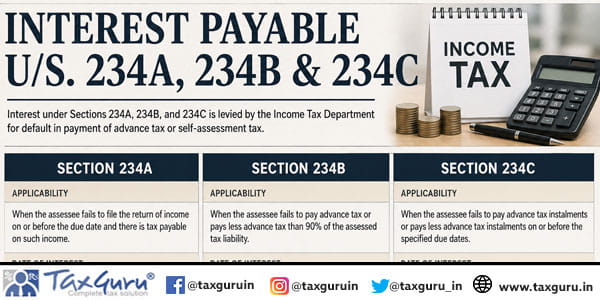
Income Tax : Understand Sections 234A, 234B, 234C, and 234D of the Income Tax Act covering interest on late filing, short payment, delayed adva...
Income Tax : A summary of key penalties under the Income Tax Act for AY 2026-27, covering defaults from late filing and non-payment to misrepor...
Income Tax : Understand how interest under the Income Tax Act is calculated, including Sections 234A–234D, 244A, and Rule 119A mechanics for ...
Income Tax : A look into why taxpayers face interest charges under Sections 234B and 234C, exploring how Section 210, a provision for official ...
Income Tax : Request to CBDT to permit filing of Form 10IC after expiration of time limit by condoning delay Issuance of Order under Section ...
Income Tax : All Odisha Tax Advocates Association has filed an PIl before Orissa High Court with following Prayers- (i) Admit the Writ Petition...
Income Tax : Recommendation For Amendment To Section 234C To Provide Relief Where A New Business Is Started During The Financial Year Section 2...
Income Tax : The issue involved taxing capital gains from a development agreement in multiple years. The court held the same income cannot be t...
Income Tax : Reassessment quashed by ITAT Bangalore as failure to pass a speaking order on objections violated mandatory procedure under Sectio...
Income Tax : The Tribunal held that reopening under Section 147 was invalid where it was based on third-party search material. It ruled that Se...
Income Tax : The Tribunal held that purchases cannot be treated as bogus when supported by invoices, bank payments, and GST records. It ruled t...
Income Tax : The issue was incorrect computation of interest without reducing foreign tax relief. ITAT held that relief under sections 90/90A m...
ITAT held that Section 69 cannot apply when the assessee is not proved to own the cash. Unrebutted affidavits established the source, and mere suspicion cannot justify an addition.
The Tribunal held that the reassessment was issued 45 days beyond the maximum permissible period under Rajeev Bansal (SC), making the 148 notice invalid. Applying the deemed-notice framework of Ashish Agarwal, it ruled that the AO had “zero surviving days” to act. The reassessment was quashed for being issued after the statutory outer limit.
ITAT Mumbai held that transaction of sale of shares is not business income since assessee was never involved in the business affairs of the company. Further, consideration is treated as capital gain inspite of non-compete fee since no specific amount assigned towards non-compete fee in share purchase agreement.
The ITAT held that without a condonation petition, a 300-day delay cannot be excused. The ruling underscores that delay must be justified before merits—including Section 80P—can be considered.
The ITAT ruled that a vague, copy-paste satisfaction note cannot confer valid jurisdiction under Section 153C. Since no specific seized documents were identified, the entire assessment was struck down.
ITAT held that discretionary trusts with unknown beneficiary shares must be taxed at the maximum marginal rate unless statutory exceptions apply, restoring the matter for verification.
ITAT Delhi held that reopening of assessment under section 147 of the Income Tax Act, solely on the basis of information received, without application of mind is bad-in-law and liable to be quashed. Accordingly, appeal of revenue dismissed.
ITAT Jaipur held that addition made on the basis of documents found from the third party without providing any opportunity of cross-examination is liable to be deleted on the ground of violation of principles of natural justice.
The decision highlights that additions under Section 153C cannot stand when based only on third-party statements without seized material linking the assessee. The ruling stresses the need for concrete evidence before treating purchases as non-genuine.
The Tribunal held that several comparables selected by the tax authorities failed the RPT filter and were functionally dissimilar, warranting exclusion. It ordered verification, directed inclusion of suitable event-management comparables, and remanded the interest-on-receivables and ICDS issues for fresh review.