Income Tax : The article explains how multinational digital companies generate substantial revenue from Indian users while shifting profits to ...
Income Tax : The article explains how the coexistence of GloBE and GILTI leads to different tax outcomes for similarly structured multinational...
Income Tax : The Supreme Court's ruling on Permanent Establishment (PE) expands taxability for MNEs, holding that "effective control and contin...
Corporate Law : Global tax system is struggling with digital economy's value creation. OECD's Pillars 1 & 2 introduce new taxing rights and a 15% ...
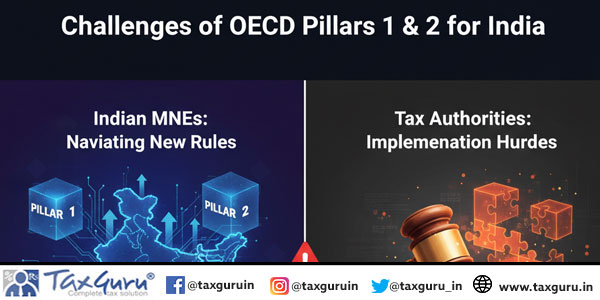
Income Tax : An overview of the compliance challenges Indian MNEs and tax authorities face due to OECD Pillars 1 and 2, covering profit allocat...
Income Tax : Eight years ago, you mandated the OECD to address corporate tax avoidance by multinationals, which cost countries at least $240 bi...
Income Tax : Tax Inspectors Without Borders (TIWB), a joint initiative of the United Nations Development Programme (UNDP) and the Organisation ...
Income Tax : Majority of the members OECD/G20 Inclusive Framework on Base Erosion and Profit Shifting(including India)adoptedyesterday ahigh-le...
Income Tax : CBDT has released the synthesised text for India-Slovak Republic tax treaty. It represents their shared understanding of the modif...
Income Tax : CBDT has released the synthesised text for India-Poland tax treaty. It represents their shared understanding of the modifications ...
Income Tax : It is not at the whim or fancy of a tax authority to decide as to what constitutes 'beneficial ownership'; it is absolutely fundam...
Income Tax : A reader should be able to come to his / her own conclusion by applying the legislative enactments and judicial pronouncements to ...
Income Tax : High Court held that to say that the person being prosecuted or proceeded against can only be 'shown' such documents, but not prov...
Company Law : The MCA amended AS 22 to incorporate provisions related to OECD Pillar Two global minimum tax rules. The amendment exempts compani...
SEBI : PR No. 297/2015 Sixth Meeting of the International Advisory Board of SEBI The Sixth meeting of the International Advisory Board (I...
Income Tax : To combat the problem of offshore tax evasion and avoidance and stashing of unaccounted money abroad requiring cooperation amongst...
The article explains how multinational digital companies generate substantial revenue from Indian users while shifting profits to low-tax jurisdictions. Existing transfer pricing rules struggle to capture value created through digital presence and data monetisation.
The article explains how the coexistence of GloBE and GILTI leads to different tax outcomes for similarly structured multinational groups. Non-US companies face higher top-up taxes due to jurisdictional rules, while US groups benefit from global blending.
The MCA amended AS 22 to incorporate provisions related to OECD Pillar Two global minimum tax rules. The amendment exempts companies from recognising deferred tax assets or liabilities linked to Pillar Two income taxes.
The Supreme Court’s ruling on Permanent Establishment (PE) expands taxability for MNEs, holding that “effective control and continuous direction” through operational continuity, even without a traditional fixed office, constitutes a fixed-place PE under Article 5.
Global tax system is struggling with digital economy’s value creation. OECD’s Pillars 1 & 2 introduce new taxing rights and a 15% minimum tax to combat profit shifting.
An overview of the compliance challenges Indian MNEs and tax authorities face due to OECD Pillars 1 and 2, covering profit allocation, minimum tax, and incentive impacts.
Learn how DTAAs affect capital gains tax on Indian mutual funds for non-residents. Judicial precedents clarify that gains are often only taxable in your country of residence.
Explore the clash between India’s GAAR and DTAAs, examining how domestic anti-avoidance provisions interact with international tax commitments and the impact on taxpayers.
Learn about income tax exemptions for universities, hospitals, and educational institutions under Section 10 of the Income Tax Act, including Rule 2BBB provisions.
This blog will examine the causes of tax evasion in India, the effects it has on society, and possible remedies to guarantee a more equitable taxation system.