Rajesh Shaw Vs Eden Realty Ventures Pvt. Ltd. (NAA)
The Applicant No.1 Rajesh Shaw alleged that the Respondent No. 1 Eden Realty Ventures Pvt. Ltd. had not passed on the benefit of ITC to him by way of commensurate reduction in prices and charged GST @12% on the amount due to him against payments made for project Siddha Eden Lakeville, situated at Lake View Park Road, Banhooghly, Kolkata, West Bengal-700108 on 17.09.2016.
It is observed from the Report of the DGAP that the ITC, as a percentage of the turnover, that was available to the Respondent during the pre-GST period (April-2016 to June-2017) was 1.16%, whereas, during the post-GST period (July-2017 to September-2019), it was 6.85% for the project ‘Siddha Eden Lakeview’. This confirms that, post-GST, the Respondent No. 1 & 2 have been benefited from additional ITC to the tune of 5.69% (6.85% – 1.16%) of their turnover for the project ‘Siddha Eden Lakeview’ and the same was required to be passed on to the customers/flat buyers/recipients. Therefore, the Respondent No. 1 had benefit by an additional amount of ITC amounting to Rs. 4,11,40,502/- (which includes GST @12%), similarly, the Respondent No. 2 had benefited by an additional amount of ITC amounting to Rs. 2,50,94,164/- (which includes GST @12%). The DGAP has calculated the total amount of ITC benefit to be passed on to all the customers/flat buyers/recipients as Rs. 6,62,34,666/- for the project ‘Siddha Eden Lakeview’. The Respondent No. 1 is required to pass on Rs. 96,857/- as the additional benefit of ITC to the Applicant No. 1 and Rs. 4,10,43,645/- to other 264 recipients. Further, the Respondent No. 2 is required to pass on Rs. 2,50,94,164/- to 270 other flat buyers/recipients in the project ‘Siddha Eden Lakeview’ for the period from 1.07.2017 to 30.09.2019.
Authority finds no reason to differ from the above-detailed computation of profiteering in the DGAP’s Report or the methodology adopted. The Authority finds that the Respondent No. 1 has profiteered by an amount of Rs. 4,11,40,502/- and the Respondent No. 2 has profiteered by an amount of Rs. 2,50,94,164/- during the period of investigation i.e. 01.07.2017 to 30.09.2019. The Authority determines an amount of Rs. 4,11,40,502/- (including 12% GST) under section 133(1) as the profiteered amount by the Respondent No. 1 and an amount of Rs. 2,50,94,164/-(including 12% GST) as the profiteered amount by the Respondent No. 2 under section 133(1) from their 265 (including Applicant No. 1) and 270 homebuyers/customers/recipients of supply, respectively (as per Annexure ‘A’ to this Order), which shall be refunded/returned/passed on by the Respondents to the respective homebuyers/customers/recipients of supply along with interest @18% thereon, from the date when the amounts were profiteered by them till the date of such return/refund/payment, in accordance with the provisions of Rule 133 (3) (b) of the GCST Rules 2017. The amount profiteered is Rs. 96,857/- (including GST) in respect of the Applicant No.1. Since the Respondent No. 2 had availed the entire CENVAT/ITC for the project (including units pertaining to the Respondent No. 1), therefore the aforesaid profiteered amount of Rs. 4,11,40,502/- (inclusive of GST) has to be passed on/refunded/returned by the Respondent No. 2 to the Respondent No. 1, who in turn is required to pass on/return/refund the benefit to his recipients including the Applicant No. 1.
This Authority under Rule 133 (3) (a) of the CGST Rules, 2017 orders that The Respondent No. 1 & 2 shall reduce the prices to be realized from the homebuyers/customers/recipients of supply commensurate with the benefit of ITC received as per the Methodology as has been detailed above.
The Respondent No. 1 & 2 are also liable to pay interest as applicable on the entire amount profiteered, i.e. Rs. 4,11,40,502/-(in respect of the Respondent No. 1) and Rs. 2,50,94,164/- (in respect of the Respondent No. 2), for the project ‘Siddha Eden Lakeview’. Hence the Respondent No. 1 & 2 are directed to also pass on interest @18% to the homebuyers/customers/recipients of supply on the entire amount profiteered, starting from the date from which the amount was profiteered till the date of passing on/ payment/return, as per provisions of Rule 133 (3) (b) of the CGST Rules, 2017.
FULL TEXT OF ORDER OF NATIONAL ANTI-PROFITEERING AUTHORITY
1. The Present Report dated 31.12.2020 has been received to this Authority from the Applicant No. 2 i.e. the Director-General of Anti-Profiteering (DGAP) after a detailed investigation under Rule 128 of the Central Goods & Service Tax (CGST) Rules, 2017. The brief facts of the case are that the Standing Committee on Anti-Profiteering had made a reference to the DGAP to conduct a detailed investigation in respect of an application filed by the Applicant No. 1 alleging profiteering by the Respondent No. 1 in respect of purchase of flat no. HR/II/505 (3BHK + 2T) in the Respondent No. l’s project “Siddha Eden Lakeville”, situated at Lake View Park Road, Banhooghly, Kolkata, West Bengal-700108 on 17.09.2016. The Applicant No.1 alleged that the Respondent No. 1 had not passed on the benefit of ITC to him by way of commensurate reduction in prices and charged GST @12% on the amount due to him against payments.
2. The DGAP vide his Report dated 31.12.2020 has inter-alia submitted the following points :-
a. The Applicant No. 1 submitted the following documents along with the application:
i. E-mails of correspondence with Respondent No. 1 requesting to pass on the benefit of ITC.
ii. Copies of Demand Letters and Allotment letter.
b. On receipt of the aforesaid reference from the Standing Committee on Anti- profiteering on 09.10.2019, a Notice under Rule 129 of the Rules was issued by the DGAP on 22.10.2019, calling upon the Respondent No. 1 to reply as to whether he admitted whether the benefit of ITC had not been passed on to the recipients by way of commensurate reduction in prices and if so, to suo moto determine the quantum thereof and indicate the same in his reply to the Notice as well as to furnish all documents in support of his reply. Further, the Respondent No. 1 was also afforded an opportunity to inspect the non-confidential evidences/information which formed the basis of the said Notice, during the period 30.10.2019 to 31.10.2019.
However, the Respondent No. 1 did not avail of the said opportunity.
c. Vide e-mail dated 13.11.2020, the Applicant No. 1 was also given an opportunity to inspect the non-confidential documents/reply furnished by the Respondent on 23.11.2020 or 24.11.2020. However, vide e-mail dated 25.11.2020, the Applicant No. 1 expressed his inability to visit the office and avail the said opportunity.
d. The period covered by the current investigation was from 01.07.2017 to 30.09.2019.
e. The statutory time limit to complete the investigation was 08.04.2020 which was extended up to 31.03.2021 by virtue of Notification No. 35/2020-Central Tax dated 03.04.2020, Notification No. 55/2020-Central Tax dated 27.06.2020, Notification No. 65/2020-Central Tax dated 01.09.2020 and Notification No. 91/2020-Central Tax dated 14.12.2020 issued by Central Government under Section 168A of the CGST Act, 2017 where it was provided that, “any time limit for completion or compliance of any action, by any authority, had been specified in, or prescribed or notified under section 171 of the said Act, which falls during the period from the 20th day of March, 2020 to the 30th day of March, 2021, and where completion or compliance of such action had not been made within such time, then, the time-limit for completion or compliance of such action, shall be extended up to the 31st day of March, 2021”.
f. The Respondent No. 1 replied to the said Notice vide various letters/ e-mails but did not furnish the complete and the relevant documents required for investigation. Hence, Summons under Section 70 of the CGST Act, 2017 read with Rule 132 of the Rules, were issued on 13.03.2020 to the Respondent No. 1 asking him to submit the remaining documents via Speed Post/Courier or through E-mail on the DGAP E-mail ID on or before 19.03.2020. In response to the Summons, the Respondent No. 1 submitted the documents vide e-mail dated 19.03.2020.
g. In response to the Notice dated 22.10.2019 and subsequent reminders and summons, the Respondent No. 1 replied vide letters/emails dated 05.11.2019, 06.11.2019, 13.11.2019, 25.11.2019, 06.12.2019, 28.02.2020, 13.03.2020, 18.03.2020, 19.03.2020, 05.05.2020, 25.05.2020, 08.06.2020, 05.11.2020, 06.11.2020, 10.11.2020, 18.11.2020 and 24.11.2020. The Reply of the Respondent No. 1 was summed up as follows:-
i. In the subject project i.e. “Siddha Eden Lakeville, he was engaged as Landowner whereas, the Developer was M/s. Siddha Real Estate Private Limited. Further, all expenses in relation to construction activities of the project were borne out exclusively by Respondent No. 2. The Respondent No. 1 was neither incurring any expenditure nor claiming any GST ITC in respect of the impugned project.
ii. The Respondent No. 1 submitted that Section 171 of the CGST Act, 2017 provides that any reduction in rate of tax on any supply of goods or services or the benefit of ITC shall be passed on to the recipient by way of commensurate reduction in prices. However, he was not providing the Construction Service directly and the same was provided by the Developer. He was acting as the seller for his area allocation only in accordance with the Joint Development Agreement entered into by him with the developer. Hence, in his opinion, there was no question of profiteering in his hands. If at all any benefit had to be passed, the same was the responsibility of the developer.
h. Vide Notice dated 21.10.2019, the Respondent No. 1 was asked whether any information/documents were provided on confidential basis, in terms of Rule 130 of the Rules, and if so, a non-confidential summary of such information/ documents was required to be furnished. However, the Respondent No. 1 had not classified his information/documents as confidential in terms of Rule 130 of the Rules.
Since, the Respondent No. 1 had submitted that in the impugned project he was engaged as landowner whereas, the Developer was M/s. Siddha Real Estate Private Limited and all expenses in relation to construction activities of the project were borne out exclusively by the Respondent No. 2 and if at all any benefit had to be passed, the same was the responsibility of the developer.
Accordingly, it was decided to implead the Respondent No. 2 in the on-going proceedings as an interested party and Addendum to Notice of Initiation of Investigation was issued to him on 19.11.2019, calling upon him to reply as to whether he admitted that the benefit of ITC available to him had not been passed on to the recipients by way of commensurate reduction in prices and if so, to suo moto determine the quantum thereof and indicate the same in his reply to the Addendum to Notice as well as to furnish all documents in support of his reply. Further, the Respondent No. 2 was afforded an opportunity to inspect the non-confidential evidences/information submitted by the Applicant No. 1, during the period 25.11.2019 to 26.11.2019. However, the Respondent No. 2 did not avail of the said opportunity.
j. In response to the Addendum to the Notice dated 19.11.2019 and subsequent reminders and Summons, the Respondent No. 2 replied vide letters/emails dated 13.01.2020, 27.01.2020, 11.02.2020, 19.02.2020, 28.02.2020, 11.03.2020, 13.03.2020, 09.11.2020, 20.11.2020, 11.12.2020, 15.12.2020 and 16.12.2020 and has interalia submitted that:-
i. He was a real estate developer primarily engaged in the business of real estate construction, development and other related activities. The Respondent No. 2 was undertaking construction of various projects and also providing various other services such as work contract services, business support services to associated enterprises, maintenance services etc.
ii. The Respondent No. 2 had furnished the block wise details of the impugned project “Siddha Eden Lake Ville” in table —’A’ below:-
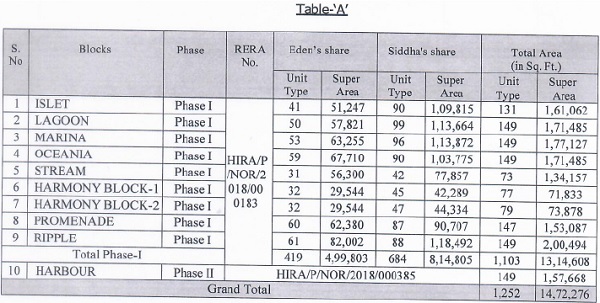
The Respondent No. 2 had submitted that the Block-Harbour was covered under Phase-II which was completely a new block launched on 31-03-2019 i.e. under GST regime and he had not availed any CENVAT/ITC till 30.09.2019 in the said phase-II.
k. The reference received from the Standing Committee on Anti-profiteering, various replies of the Respondent No. 1 & 2 and the documents/evidences on record had been carefully scrutinized. The main issues for determination are:-
i. Whether there was benefit of reduction in the rate of tax or ITC on the supply of Construction Service by the Respondent No. 1 & 2, on implementation of GST w.e.f. 01.07.2017 and if so,
ii. Whether such benefit was passed on by Respondent No. 1 & 2 to the recipients, in terms of Section 171 of the CGST Act, 2017.
l. The Respondent No. 1, vide e-mail dated 05.11.2020, submitted payment plan (part of Builder Buyer agreement), demand letters and payment receipts for the sale of flat no. HR/II/505 in Tower Harmony Block-2 to the Applicant No. 1, measuring 1090 square feet (super area), at total basic sale price of Rs. 50,66,150/-.
m. At the outset, it was observed that the contention of the Respondent No. 1 that he would, compute the benefit on account of ITC of GST in respect of the project, at the end of the project and pass on the benefits that had accrued on account of GST, might have merit but the profiteering, if any, had to be determined at a given point of time, in terms of Rule 129(6) of the Rules. Therefore, the additional ITC available to the Respondent No. 1 & 2 and the amounts received by them from the Applicant No. 1 and other recipients post implementation of GST, had to be taken into account to determine the benefit of ITC that was required to be passed on.
n. Regarding the Respondent No. 2’s contention that the application filed by the Applicant No. 1 was not against him, it was observed from the Sale Agreement entered with the Applicant No. 1 that the Respondent No. 1 was a party and signed the said agreement in the capacity of Developer. Further, as per clause 14.3 of the Joint Development Agreement dated 08.05.2015 requires that “Siddha shall join the deed of transfer in favour of Eden’s Transferees and shall execute and register the same in his capacity as a confirming party”
Therefore, the Agreement was a Tripartite agreement where the Respondent No. 2 was a necessary party and thus, participation of the Respondent No. 2 in the said transactions was undeniable and the Respondent No. 2’s submission that he was not a party to documents entered with the Applicant No. 1 was incorrect. Further, in the impugned project, the CENVAT/ITC on the purchase of inputs, input services and capital goods was availed by the Respondent No. 2 for the whole project including the purchases made towards the unit allotted to the Applicant No. 1. Therefore, the Respondent No. 2 being a GST registered person was also statutory required to comply with the provisions of Section 171 of the CGST Act, 2017 and cannot deny passing on the benefit pertaining to Landowner’s share in the project.
Further, profiteering, if any, had to be computed considering the whole project as a whole irrespective of allocation of Developer or Landowner in order to remove any discrimination among the buyers only because of his purchase of the unit from one party rather than other party. Further, the agreement with the buyers was also signed by both the Respondent No. 1 & 2 jointly.
Moreover, DGAP was empowered to issue Notice to such other persons as deemed fit for a fair enquiry into the matter in terms of Rule 129(4) of the Rules. Therefore, the submission of the Respondent No. 2 in this regard was untenable.
0. Para 5 of Schedule-III of the CGST Act, 2017 (Activities or Transactions which shall be treated neither as a supply of goods nor a supply of services) reads as ‘Sale of land and, subject to clause (b) of paragraph 5 of Schedule II, sale of building’: Further, clause (b) of Paragraph 5 of Schedule II of the CGST Act, 2017 reads as “(b) construction of a complex, building, civil structure or a part thereof, including a complex or building intended for sale to a buyer, wholly or partly, except where the entire consideration had been received after issuance of completion certificate, where required, by the competent authority or after his first occupation, whichever was earlier’: Thus, the ITC pertaining to the residential units and commercial shops which was under construction but not sold was provisional ITC which might be required to be reversed by the Respondent No. 2, if such units remain unsold at the time of issue of the completion certificate, in terms of Section 17(2) & Section 17(3) of the CGST Act, 2017, which read as under:
Section 17 (2) “Where the goods or services or both was used by the registered person partly for effecting taxable supplies including zero-rated supplies under this Act or under the Integrated Goods and Services Tax Act and partly for effecting exempted supplies under the said Acts, the amount of credit shall be restricted to so much of the input tax as was attributable to the said taxable supplies including zero-rated supplies’:
Section 17 (3) “The value of exempted supply under subsection (2) shall be such as might be prescribed and shall include supplies on which the recipient was liable to pay tax on reverse charge basis, transactions in securities, sale of land and, subject to clause (b) of paragraph 5 of Schedule II, sale of building’:
Therefore, the ITC pertaining to the unsold units might not fall within the ambit of this investigation and the Respondent No. 2 was required to recalibrate the selling price of such units to be sold to the prospective buyers by considering the net benefit of additional ITC available to him post-GST.
P. With respect to the allegation of profiteering, on the basis of information and documents submitted by the Respondent No. 2, it was observed that prior to 01.07.2017, i.e. before the GST was introduced, the Respondent No. 2 was eligible to avail CENVAT credit of Service Tax paid on Services but no credit was available in respect of Central Excise Duty and VAT paid on the inputs. However, post-GST, the Respondent No. 2 could avail ITC of GST paid on all the inputs and the input services including the sub-contracts. From the information submitted by the Respondent No. 2 for the period April, 2016 to September, 2019, the details of the ITC availed by him, his turnover from the project “Siddha Eden Lake Ville Phase-I” , and the ratios of ITC’s to turnovers, during the pre-GST (April, 2016 to June, 2017) and post-GST (July, 2017 to September, 2019) periods, have been furnished by the DGAP in Table-T’ below:-

* Note: Since the Respondent No. 2 had availed the entire CENVAT/ITC for the project (including units pertaining to the Respondent No. 1), therefore CENVAT/ITC availed in Respondent No. 2’s books was considered in above table. However, turnover of the Respondent No. 1 was also included at S. No, 5 as well area in S. No. 7 as the Respondent No. 1 was also required to pass on the benefit to his recipients (including the Applicant No. 1),
q. It was clear from the above Table- ‘B’ that the ITC as a percentage of the turnover that was available to the Respondent No. 1 & 2 during the pre-GST period (April, 2016 to June, 2017) was 1.16% whereas during the post- GST period (July, 2017 to September, 2019), the percentage was 6.85%. This clearly confirmed that post-GST, the Respondent No. 1 & 2 had been benefited from additional ITC to the tune of 5.69% [6.85% (-) 1.16%] of the turnover. Accordingly, the profiteering had been examined by comparing the applicable tax rate and ITC available in the pre- GST period (April, 2016 to June, 2017) when Service Tax @4.5% was payable with the post-GST period (July, 2017 to September, 2019) when the effective GST rate was 12% (GST @18% along with 1/3rd abatement for land value) on Construction Service, vide Notification No.11/2017-Central Tax (Rate), dated 28.06.2017. Accordingly, on the basis the figures contained in table-’13’ above, the comparative figures of the ratio of ITC availed/available to the turnover in the pre-GST and post-GST periods as well as the turnover, the recalibrated base price and the excess realization (profiteering) during the post-GST period, has been furnished by the DGAP in Table- ‘C’ below:

r. It was clear from Table-‘C’ above that the additional ITC of 5.69% of the turnover should have resulted in the commensurate reduction in the base prices as well as cum-tax prices. Therefore, in terms of Section 171 of the CGST Act, 2017, the benefit of such additional ITC was required to be passed on by the Respondent No. 1 & 2 to the respective recipients.
s. Accordingly, from the above calculation, it was evident that on the basis of the aforesaid CENVAT/ITC availability in the pre and post-GST periods and the details of the amount raised/collected by the Respondent No. 1 from the Applicant No. 1 and other home buyers during the period 01.07.2017 to 30.09.2019, the Respondent No. 1 had benefited by an additional amount of ITC, by an amount of Rs. 4,11,40,502/- which included GST @12% on the base amount of Rs. 3,67,32,591/-. The buyers and unit no. wise break-up of this amount has been provided by the DGAP in Annexure-40 of his Report. This amount was inclusive of Rs. 96,857/- (including GST) on the base amount of Rs. 86,479/- which was the benefit of ITC required to be passed on to the Applicant No. 1. Similarly, on the basis of the aforesaid CENVAT/ITC availability in the pre and post-GST periods and the details of the amount raised/collected by the Respondent No. 2 from the home buyers during the period 01.07.2017 to 30.09.2019, the Respondent No. 2 had benefited by an additional amount of ITC, by an amount of Rs. 2,50,94,164/- which included GST @12% on the base amount of Rs. 2,24,05,504/-. The buyers and unit no. wise break-up of this amount has been provided by the DGAP in Annexure-41 of his Report.
t. On the basis of the details of outward supplies of the construction service submitted by the Respondent No. 1 & 2, it was observed that the said service had been supplied in the State of West Bengal only.
u. The above computation of profiteering was with respect to 535 home buyers from whom consideration value had been raised/received by the Respondent No. 1 & 2 during the period 01.07.2017 to 30.09.2019 (excluding the flats sold by the Respondent No. 2 post 01.07.2017). Whereas the Respondent No. 1 & 2 had booked total of 723 units in the whole project as on 30.09.2019, however no demands were raised from 44 home buyers, during the post-GST period from 01.07.2017 to 30.09.2019. Therefore, if the ITC in respect of these 44 units was considered to calculate profiteering in respect of 535 units where demands had been raised after GST, the ITC as a percentage of turnover might be erroneous. Furthermore, the Respondent No. 1 & 2 had submitted that effective from 01.07.2017, they had sold 144 flats at the rates agreed by the customers and the consideration for such units had already factored benefit of ITC. The Respondent No. 2 claimed that Section 171 of the CGST could be applied only on the units the prices of which had been agreed before 01.07.2017 i.e. pre-GST customers since due to introduction of GST, the benefit of ITC had been accrued which should be computed and passed. In other words, the consideration of bookings made in GST regime were determined based on various factors including benefit of ITC and the same shall be outside the scope of calculation.
Clause 8.3 of the Agreement to Sell also confirms the same which reads as “Clarification on GST input Tax Credit: The Transferees/ Allottees understand, confirm and accept that the consideration of the said Apartment And Appurtenances had been arrived at after adjusting the full GST ITC to be passed on to the Transferees/Allottees and the Transferees/Allottees consequently shall not be entitled to and covenant not to raise any manner of dispute, claim and/or damage against the Transferor and/or Promoter in this regard’:
This argument of the Respondent No. 2 had merit and therefore, ITC pertaining to the above 144 units was outside the scope of this investigation as the selling price of such units was negotiated between the home buyers and the Respondent No. 2 taking into consideration the benefit of ITC or change in GST.
v. Hence, the benefit of additional ITC to the tune of 5.69% of the turnover has accrued to the Respondent No. 1 & 2 post- GST and the same was required to be passed on by them to the respective recipients. On this account, the Respondent No. 2 was required to pass on the additional benefit of ITC amounting to Rs. 96,857/- to the Applicant No. 1. Further, the investigation reveals that the Respondent No. 1 was required to pass on the additional benefit of ITC amounting to Rs. 4,10,43,645/- to 264 other recipients who were not Applicants in the present proceedings. These recipients were identifiable as per the documents provided by the Respondent No. 1, giving the names and addresses along with Unit No. allotted to such recipients. Therefore, this additional amount of Rs. 4,10,43,645/- was required to be returned to such eligible recipients. Further, the Respondent No. 2 was required to pass on the benefit of ITC amounting to Rs. 2,50,94,164/- in respect of 270 other recipients who were not Applicants in the present proceedings. These recipients were identifiable as per the documents provided by the Respondent No. 2, giving the names and addresses along with Unit No. allotted to such recipients. Therefore, this amount of Rs. 2,50,94,164/- was required to be returned to such eligible recipients.
w. The present investigation covered the period from 01.07.2017 to 30.09.2019. Profiteering, if any, for the period post September, 2019, had not been examined as the exact quantum of ITC that would be available to the Respondent No. 1 & 2 in future could not be determined at this stage, when the Respondent No. 2 was continuing to avail ITC in respect of the present project.
x. The DGAP has concluded that the provisions of Section 171(1) of the CGST Act, 2017, requiring that “any reduction in rate of tax on any supply of goods or services or the benefit of ITC shall be passed on to the recipient by way of commensurate reduction in prices”, had been contravened by the Respondent No. 1 the Respondent No. 2 in the present case.
3. The above Report was carefully considered by this Authority and a Notice dated 05.01.2021 was issued to the Respondent No. 1 & No. 2 to explain why the Report dated 31.12.2020 furnished by the DGAP should not be accepted and there liability for profiteering in violation of the provisions of Section 171 should not be fixed. The Respondent No. 1 was directed to file written submissions which had been filed on 19.01.2021 wherein the Respondent No. 1 had submitted:-
a. He and the Respondent No. 2 (the Developer) had entered into a Joint Development Agreement (JDA) on 8th May, 2015 for development of a project namely ‘Siddha Eden Lakeville’. As per the terms of the agreement, he transferred his development rights to the Respondent No. 2 who was responsible to construct the project at his own cost and resources at agreed terms and conditions. He would not incur any construction cost and would get constructed and completed units.
b. That the Project was under ‘Area Sharing’ model wherein the Respondent No. 2 would receive 38.5% of the allocated units and remaining 61.5% belonged to the Developers. Six Blocks were proposed to be constructed by Developer in the First Phase of construction, namely, “Harbour, Islet, Lagoon, Marina, Oceania and Stream”. A Deed of Declaration was also entered on 15th of January, 2018 identifying second phase of construction in the blocks namely ‘Ripple, Promenade, Harmony-I and Harmony-II’. A copy of Development Agreement had been submitted by the Respondent No. 1.
c. In the present case, the project was developed by the Respondent No. 2 and no ITC of GST paid on input services or inputs has been availed by him. He had also not incurred any cost of construction, therefore there was no ITC on construction expenses and benefit of ITC to be passed on by him to the flat buyers/customers.
The construction expenses were incurred by the Respondent No. 2 even in respect of his share. Therefore benefit, if any shall accrue to the Respondent No. 2 and not to him.
d. As per the Development Agreement, he agreed to grant the license to the Respondent No. 2 for the purposes of development of the said premises against consideration of 38.5% of the constructed units. And the Developer agreed to incur all the development costs including all costs, fees and expenses wholly incurred for the purpose of construction of the complex against a consideration of 61.5% (approx.) of the total constructed area.
e. As per Clause 8.4 of the Development Agreement, ‘Construction as per Specifications’:
“Siddha shall at his own costs and expenses construct, erect and complete the Said complex in accordance with the Revised Building Plan ..”
It had been further emphasized in Clause 18.6 of the Development Agreement that:-
“Siddha shall construct the Said Complex at his own cost, risk and responsibility, by adhering to the Revised Building Plan and applicable laws and attending to all notices issued by concerned authorities”
f. That he was not incurring any cost related to construction and therefore no ITC related to construction had been availed for the said Project, no question of benefit in lieu of excess ITC availment should ensue. Further, any such Benefit enjoyed by the Respondent No. 2 had not been passed on to him neither in cash nor in kind i.e. by means of revision of percentage of allocated flats. Therefore, landowner could only pass on the benefit if the Respondent No. 2 passes on commensurate benefit to him.
g. A similar case of Sattva Developers Pvt. Ltd. vs DGAP dated 14/06/2019, the Authority upheld the mechanism of DGAP to compute the amount of benefit as per the above referred mechanism i.e. availment of ITC to Turnover ratio in pre and post regime. Further, since it was an Allocation agreement between the landowner and the developer, the authority also ordered to pass on the benefit of the profiteered amount to the land owner who would in turn pass on the benefit to his buyers.
4. Copy of the above submissions dated 19.01.2021 filed by the Respondent No. 1 were supplied to the DGAP for supplementary Report under Rule 133(2A) of the CGST Rules, 2017. The DGAP filed his clarification dated 12.02.2021 and has stated that:-
a) Vide the aforesaid letter dated 19.01.2021, the Respondent No. 1 had not disputed the DGAP’s Report.
b) Vide para-30 of the Report dated 31.12.2020, the additional amount of ITC or the profiteering amount required to be passed on by the Respondent No. 1 was determined to be Rs. 4,11,40,502/- which included GST @12% on the base amount of Rs. 3,67,32,591/-. Since the Respondent No. 2 i.e. the developer had availed the entire CENVAT/Input Tax Credit for the project (including units pertaining to the Respondent No. 1), therefore the aforesaid amount of profiteering had to be passed on by the Respondent No. 2 to the Respondent No. 1 who in turn was required to pass on the benefit to his recipients (including the Applicant No.1 ) as per buyers and unit no. wise break-up given in Annex-40 of this office’s Report dated 31.12.2020.
5. The Respondent No. 2 has also filed his consolidated submissions vide letter dated 16.02.2021 and has interalia stated that:-
a. The details of the saleable area and number of units in the ‘Siddha Eden Lake’ project undertaken by Respondent No. 2 have been provided in the Table below: