Smt. Krishana Kumari Devi Vs Harihar Chandra Bhanjdeo (Chhattisgarh High Court)
It is, indisputably and fairly well settled that private was to remain with him under the covenant/agreement executed with the GOI and the said property has to pass on from one Ruler to another in terms of Article 5 of the agreement. It would pass on to the next Ruler under the principle of Lineal Male Primogeniture and the private properties would not be treated as the joint family property or HUF property of the Ruler. It is also settled that by virtue of Section 5(ii) of the Act, 1956, the provisions of the said Act would not apply to the suit property as under the covenant, it would descend to a single heir under the terms of the agreement executed between the Ruler of Bastar and the GOI. It is also settled that the Gaddi and the property would pass on to the next Ruler and would thereafter pass on to the legal heirs of the last Ruler.
The private property of the Ruler shall not be treated as HUF property nor the Act, 1956 would apply to the said property for yet another reason inasmuch as vide Ex.P/74, which is a letter issued by the Government of the Central Provinces and Berar dated 19.07.1948, it was specifically provided that the Muafi Rights created by the Ruler i.e. Maharaja Parvir Chandra Bhanjdeo for the maintenance of his brother in 27 villages are allowed. It is, thus, apparent that if the other family members had any right over the private property by birth or by survivorship there was absolutely no necessity to create Muafi Rights for the maintenance of the Ruler’s brother in 27 villages. It is clearly discernible that the brothers of the Ruler were treated as a separate entity at the time of merger and they had no claim to the private property of the Ruler as they were separated by granting them Muafi Rights in the lands for their maintenance. The brothers of the Ruler have, thus, no right over the properties of the Ruler which would pass on to the next Ruler under law of Primogeniture.
FULL TEXT OF THE HIGH COURT ORDER / JUDGMENT
The following judgment of the Court was passed by Prashant Kumar Mishra, J.
1. This appeal has been preferred by the plaintiffs to assail the legality, validity and correctness of the trial Court’s judgment and decree whereby their suit for declaration of title and ownership over lands and properties in schedule ‘A’, ‘B’, ‘C’, ‘D’, ‘E’ & ‘G’ as also for setting aside the sale deeds shown in schedule ‘B’, ‘E’ & ‘G’ of the plaint has been dismissed. Plaintiffs’ prayer for possession of the properties in schedule ‘A’ (including schedule ‘B’), ‘E’ & ‘G’ and for a decree to set aside the judgment and decree dated 17-2-1978 in civil suit No.2-A of 1978 of the Court of District Judge, Bastar at Jagdalpur has also been dismissed by the trial Court.
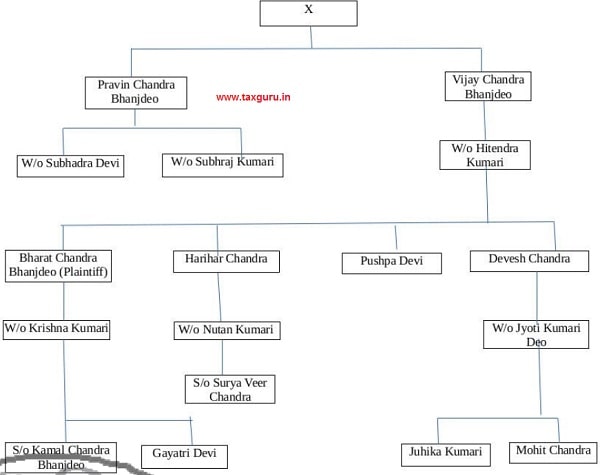
2. The main contesting parties i.e. original plaintiff Bharat Chandra Bhanjdeo now represented by his legal heirs/appellants namely; (1) Smt. Krishna Kumari Devi, (2) Kamal Chandra Bhanjdeo & (3) Ku. Gayatri Devi and the original defendants namely; (1) Smt. Hintendra Kumari Devi, (2) Harihar Chandra Bhanjdeo, (3) Devesh Chandra Bhanjdeo & (4) Smt. Subhraj Kumari alias Vedvati now represented by the respondents No.1 to 4 namely; (1) Harihar Chandra Bhanjdeo, (2) Jyoti Kumari Bhanjdeo, (3) Mohit Chandra Bhanjdeo & (4) Kumari Juhika Bhanjdeo are related to each other as they represent different branches of the Royal family of erstwhile Bastar State. Their relationship and status before the trial Court can be better understood through the following genealogical tree (as mentioned in the memo of appeal) :
Plaintiffs’ case:
(as projected in the plaint)
3. The suit land/properties belonged to Bastar State. The Late Maharaja & Ruler of Bastar State Shri Pravir Chandra Bhanjdeo signed the merger agreement with the Government of India (for brevity ‘the GOI’) on 15-12-1947 through an article of agreement merging the Bastar State with the GOI on or about 1-1-1948. Under Article 3 of the agreement Late Maharaja & Ruler was entitled to full ownership and enjoyment of private properties as distinct from State properties belonging to the Maharaja on the date of agreement.
4. On 31-3-1948 an agreement of private properties of Maharaja & Ruler of Bastar State was arrived at between the Maharaja and the Chief Minister of Madhya Pradesh on behalf of the GOI and all those properties were eventually handed over to Maharaja Pravir Chandra Bhanjdeo.
5. According to the plaintiffs, the private properties were saved from being merged in the GOI, therefore, Shri Pravir Chandra Bhanjdeo became owner thereof in the sense that the properties were attached to his position as Maharaja & Ruler and, as such, these private properties was capable of devolution on the next Maharaja. The private properties were not the personal or self acquired properties of an individual Ruler and for the purposes of inheritance and succession are not governed by Hindu Law.
6. Owing to Maharaja Pravir Chandra Bhanjdeo Kaktiya’s mental infirmity the Government of Madhya Pradesh issued an order on 20-6-1953, under the approval of the GOI, declaring him to be incapable of managing his estate and the Court of Wards (MP) took charge of all the private properties attached to Maharaja of Bastar. The plaintiffs further pleaded that due to said Maharaja’s involvement in subversive activities against the GOI by inciting disorder and rebellion amongst the Tribals of Bastar, an order dated 12-2-1961 was passed by the GOI forfeiting all claims to the continued enjoyment of his position as Maharaja & Ruler of former Bastar State and was deposed by the GOI.
7. On 12-2-1961 Shri Vijay Chandra Bhanjdeo, father of the original plaintiff was recognized by the GOI as Maharaja & Ruler of Bastar in place of Pravir Chandra Bhanjdeo and by the said recognition obtained all the privileges, rights and enjoyment to the ownership of all the private properties belonging to the deposed Maharaja, which were saved in favour of Ruler at the time of merger.
8. Vijay Chandra Bhanjdeo died on 12-4-1970, therefore, after his death the original plaintiff Bharat Chandra Bhanjdeo was recognized as Maharaja & Ruler of Bastar vide GOI notification dated 11-7-1970 w.e.f. 12-4-1970. The original plaintiff, thus, obtained and became entitled to all the privileges, rights and enjoyments and ownership of all the private properties of the preceding Ex-Ruler.
9. At that point of time i.e. as on 12-4-1970 the plaintiff being the minor, the defendant No.1 Smt. Hintendra Kumari Devi, W/o Late Shri Vijay Chandra Bhanjdeo, was working as his natural guardian.
10. It is original plaintiff’s specific case that the properties belonging to the Bastar State, which were saved and attached to Maharaja Pravir Chandra Bhanjdeo, passed on to the next Ruler in accordance with the Gaddi custom and no other person is entitled to receive any property, which were saved to the Maharaja of Bastar State, therefore, upon forfeiture of the rights of Maharaja Pravir Chandra Bhanjdeo as a Ruler and after he was deposed, he lost all his rights over the properties and it came to be owned and enjoyed by the next Ruler Vijay Chandra Bhanjdeo upon his recognition as Maharaja & Ruler of Bastar by a notification issued by the GOI. Vide notification dated 3-5-1972 the office of Maharaja or Ruler of Princely States were derecognized or denotified by the GOI notification issued on the said date. Plaintiff was a Government Ward under the provisions of Court of Wards Act from 29-7-1972 up to 1-7-1981.
11. It was further pleaded that in 1977-78 the original defendants No.1 to 4 conspired to deprive the plaintiff from his lawfully acquired properties and forged a WILL purported to be executed by Late Pravir Chandra Bhanjdeo in favour of the original defendants No.2 & 3 on 27-2-1964. The original defendant No.4 filed a civil suit No.2-A of 1978 against the original defendants No.2 & 3 in the Court of District Judge, Bastar for declaration that the alleged WILL dated 27-2-1964 is null & void in respect of properties shown in schedule ‘A’. The suit was filed on 2-2-1978 and on 16-2-1978 the original defendant No.1 Smt. Hintendra Kumari Devi was appointed as guardian ad litem of the original minor defendants No.2 & 3.
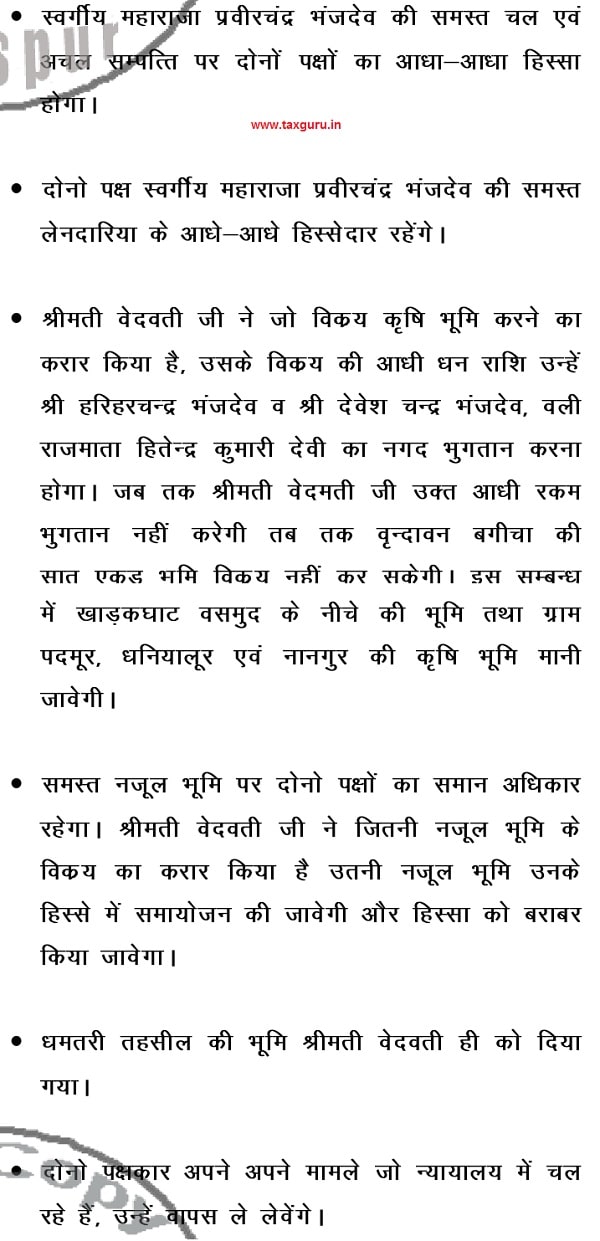
12. The plaintiff and the defendants of the said suit moved applications under Order 32 Rule 7 and Order 23 Rule 3 read with Section 151 of the Code of Civil Procedure, 1908 (for brevity ‘the CPC’) on 17-2-1978 along with a compromise petition and a compromise decree was passed on the same day in the following terms :
13. According to the original plaintiff, the private properties saved in favour of Ruler & Maharaja of Bastar were not his personal or self acquired property, therefore, devolution of the said property would not be governed under the provisions of Hindu Law or Hindu Succession Act. It is for this reason all the private properties of Ruler & Maharaja of Bastar State were devolved and succeeded by the subsequent Rulers namely; Vijay Chandra Bhanjdeo and Bharat Chandra Bhanjdeo (original plaintiff) w.e.f. 12-4-1970. Thus, after derecognition of Maharaja & Rulers in the entire country w.e.f. 3-5-1972 the last Ruler namely Bharat Chandra Bhanjdeo succeeded the entire suit property and it devolved on him as his absolute personal properties. It is also pleaded in para 13 (b) of the plaint that late Maharaja Vijay Chandra Bhanjdeo was holding Vijay Bhawan situated at sheet No.81, plot No.2/1 area 117653 sq.ft. with structures as his personal property in his private capacity which was distinct from private properties held by him by virtue of his being Ruler.
14. The original plaintiff challenged the compromise decree dated 17-2-1978 passed in civil suit No.2-A of 1978 on the ground that the said decree was obtained by playing fraud as also without impleading the original plaintiff herein, therefore, it is not binding on him/them. The decree was obtained without consent of the original plaintiff herein while it dealt with the properties belonging to the Bastar State, therefore, the decree is null &
15. It was specifically pleaded that the judgment obtained by fraud is null & void ab initio. It was also pleaded that the existence of WILL dated 27-2-1964 was never informed or brought to the notice of the plaintiff albeit it dealt with properties possessed by the next Rulers Vijay Chandra Bhanjdeo & Bharat Chandra Bhanjdeo (original plaintiff) and similarly despite pendency of several litigations before the different forums during the life time and after the demise of Vijay Chandra Bhanjdeo the WILL purportedly executed in 1964 was never disclosed or produced before any Court or to the other members of the Royal family of Bastar. It was also not known as to in whose custody the WILL was lying and how and when the present defendants or the parties to the civil suit No.2-A of 1978 came in possession of the same. The attesting witnesses of the WILL belong to Dhamtari & Raipur and no reason has been shown as to why Late Pravir Chandra Bhanjdeo was constrained to take attesting witnesses from Dhamtari and Raipur. It was further pleaded that Late Pravir Chandra Bhanjdeo later on bequeathed all his properties to his wife Late Subhdra Devi.
16. Plaintiff also set up a case of execution of WILL by Late Pravir Chandra Bhanjdeo in favour of his wife Subhdra Devi on 3-11-1964 & 15-3-1966. Pravir Chandra Bhanjdeo died on or about 26-3-1966 and after his death Subhdra Devi became full owner of all the moveable and immoveable properties of Late Pravir Chandra Bhanjdeo including all the suit properties, inclusive of properties shown in schedule ‘A’ by virtue of the WILL. It is also pleaded that alternatively Pravir Chandra Bhanjdeo having no issues, after his death the entire suit property was inherited by his widow Subhdra Devi. Plaintiff further pleaded that Subhdra Devi bequeathed all her properties to the plaintiff by WILL dated 13-11-1968 registered on 14-11-1968. After death of Subhdra Devi in 1969 the plaintiff inherited all the properties on the strength of the WILL as also by succession.
17. According to the plaintiff, the original defendant No.4 was a concubine of Late Pravir Chandra Bhanjdeo as she was not legally married with him. Alternatively, even if the original defendant No.4 was married to Pravir Chandra Bhanjdeo the said marriage having taken place during the life time of his first wife Subhdra Devi, the second marriage was illegal & void.
18. Plaintiff further pleaded that on 12-10-1984 he learnt that the original defendants No.2 to 4 with the connivance of original defendants1 & 5 have succeeded in getting their name recorded in the Government records on the strength of compromise decree dated 17-2-1978 and some of the properties mentioned in schedule ‘B’ have been sold by the defendants No.2 to 4 without they having any valid title over the properties. The original defendants No.8 to 493 who had purchased the properties from the original defendants No.2 to 4 are not bona fide purchasers as they have purchased the properties for a song and throwaway price knowing fully well that the defendants No.2 to 4 had no right, title or interest.
19. It was also pleaded that old and new palace of Maharaja of Bastar described in schedule ‘F’ are in exclusive possession of the plaintiff. The palace premises also consist of houses, buildings, garages and vacant plots. The defendants No.2 to 4 are in occupation of new palace as licencees of the plaintiff who is in actual physical possession of old palace with all the superstructures, out houses, garages, buildings and premises adverse to and to the exclusion of the defendants No.1 to 4.
20. In respect of property called Mundi Dongari, khasra No.148, area 33.36 acres, it was pleaded that the same was allotted by the Government of Madhya Pradesh to Late Maharaja Pravir Chandra Bhanjdeo at the time of merger agreement between him, Government of Madhya Pradesh and the GOI. The defendants No.1, 3 & 4 have also got recorded their names stealthily without consent, knowledge or notice to the plaintiff. There are movables like rifles, 12 bore guns, pistols, revolvers, swords, etc. described in schedule ‘C’, which are kept in Jagdalpur Treasury under the custody of the State Government. Ornaments and Jewelers belonging to the Maharaja & Ruler of Bastar described in schedule ‘D’ are also kept in Jagdalpur Treasury in the custody of the State Government. Plaintiff is entitled to receive the moveables described in schedule ‘C’ & ‘D’. The plaintiff had applied for delivery of these articles on 30-10-1986 before the Collector, Bastar. The Government of Madhya Pradesh (now Chhattisgarh) is also ready and prepared to deliver the same to the original owner, but the defendants have raised unnecessary dispute.
21. Similarly, agricultural lands situated at villages Dhainaloor, Ghat Padmoor, Nangoor, Jagdalpur, Sumund and Sihawa Nagri, Panchgaon in Dhamtari Tashil also belong to the plaintiff and they have been illegally and unlawfully included in the compromise decree passed in civil suit No.2-A of 1978. The plaintiff is also entitled to the said lands.
22. The plaintiff further averred that the defendants No.2 to 4 have sold the properties shown in Schedule ‘E’ to one Trilochan Singh and the defendant No.2 executed the gift deed on 24-3-1982 gifting 1/5th of Vijay Bhawan to defendant No.313 Vidhiya Sagar Tiwari in an unlawful and illegal manner, therefore, the said deeds are void and not binding on the plaintiff. It is also pleaded that property named Rani Gadia is in the exclusive possession of the plaintiff, therefore, he is entitled to the said property. Similarly, the defendant No.4 has illegally gifted away vacant plot No.1/1 sheet No.98 to the defendant No.3 vide gift deed dated 7-3-1980, which is void and not binding on the plaintiff. Sale deeds executed by the defendants No.2 to 4 for the property mentioned in schedule ‘G’ to Maharani Dhyan Vidhiya Peeth, defendant No.395, is also void and not binding on the plaintiff.
23. In the alternative, plaintiff also pleaded that if the properties are found to be private properties of Late Maharaja Pravir Chandra Bhanjdeo then the same having devolved on his widow Smt. Subhadra Devi and the defendant No.4 by succession or inheritance then the plaintiff is entitled to half share by virtue of WILL executed by Subhadra Devi.
24. According to the plaintiff he had no knowledge of the sale deeds shown in schedule ‘B’, ‘E’ & ‘G’ by the defendants No.2 to 4, which came to his notice on 12-10-1984 when he became aware of the judgment and decree dated 17-2-1978 in civil suit No.2-A of 1978. The plaintiff also learnt about various alienations by the defendants No.2 to 4 from time to time from January, 1985. The plaintiff, therefore, prayed for declaration of title and ownership of the properties shown in schedule ‘A’ (including schedule ‘B’), ‘C’, ‘D”, ‘E’ & ‘G’ and in the alternative declaration and possession as prayed in paras 34 & 35 of the plaint and for setting aside the sales shown in schedule ‘B’, ‘E’ & ‘G’. Specific prayer has been made by the plaintiff for setting aside the judgment and decree dated 17-2-1978 in civil suit No.2-A of 1978 of the Court of District Judge, Bastar at Jagdalpur.
Defendants’ case :
25. The original defendants No.1 to 3 namely; Smt. Hitendra Kumari Devi, Harihar Chandra Bhanjdeo and Devesh Chandra Bhanjdeo did not file any written statement. It was only the original defendant No.4 Smt. Subhraj Kumari alias Vedvati who filed her written statement admitting the list of private properties prepared at the time of vesting of the state properties in the dominion of India. She also admitted that Maharaja Pravir Chandra Bhanjdeo was entitled to full ownership and exclusive enjoyment of the private properties, which, according to her, had the characteristic of separate or self acquired property under the Hindu Law. Defendant No.4 denied that the private properties were in the nature of properties held by a ruler and would devolve on the next Ruler on the death of the recognised Ruler. According to her, Maharaja Pravir Chandra Bhanjdeo was entitled to lawful transfer of the private properties and on his death the said properties were heritable by his legal heirs.
26. It was specifically pleaded by the defendant No.4 that in lieu of vesting with the dominion of India the Central Government had sanctioned a privy purse. The privy purse was to be granted to the succeeding Ruler on the death of his former recognised Ruler. She denied that Maharaja Pravir Chandra Bhanjdeo took possession of his private properties in his capacity as Maharaja with further pleading that the private properties were his personal and absolute properties.
27. The defendant No.4 further denied that Maharaja Pravir Chandra Bhanjdeo was incapable or that he had mental infirmity or incapacity. According to this defendant the erstwhile Madhya Pradesh Government’s decision to take the properties of Maharaja Pravir Chandra Bhanjdeo for management by Court of Ward was politically motivated. However, the private properties were later released from the Superintendence of the Court of Ward.
28. Defendant No.4 admitted that Maharaja Pravir Chandra Bhanjdeo’s recognition as a Ruler was withdrawn and Vijay Chandra was recognised as a Ruler, however, she denied that on being recognised as Ruler Vijay Chandra got any right or interest over the private properties of Maharaja Pravir Chandra Bhanjdeo. Vijay Chandra was entitled to privy purse of Rs.1,50,000/- per year. It is further denied by this defendant No.4 that consequent to recognition of Vijay Chandra as a Ruler all properties saved from the merger agreement belonged to him. She would specifically plead that properties vested in Maharaja Pravir Chandra Bhanjdeo could not be divested for vesting in Vijay Chandra.
29. Plea of limitation was raised by the defendant No.4 saying that the cause of action arose on 12-2-1961 for which civil suit No.3-A of 1964 was filed, which was dismissed for want of prosecution on 16-7-1975, however, before that Vijay Chandra died on 12-4-1970. It was further pleaded that the plaintiff not being the recognised Ruler at the time of institution of suit, he would destroy his own right to sue based on the principle that the property belongs to and is succeeded by the next Ruler. Forgery of WILL was also denied. She would specifically state that Maharaja Pravir Chandra Bhanjdeo died issueless. The Defendant No.4 being his widow was the only nearest legal heir to inherit the estate of Maharaja Pravir Chandra Bhanjdeo, therefore, she applied for mutation. However, the defendants No.1, 2 & 3 published a notice in the daily newspaper on 2-1-1978 that deceased Maharaja Pravir Chandra Bhanjdeo has executed a WILL dated 27-2-1964 in their favour bequeathing all his personal properties. On 7-1-1978 Smt. Hitendra Kumari submitted a copy of the said WILL before the Nazul Officer and objected to mutation application filed by the defendant No.4.
30. The defendant No.4 further pleaded that the WILL relied by the defendants No.1, 2 & 3 being forged she preferred civil suit No.2-A of 1978 to declare the above said WILL dated 27-2-1964 to be a forged document. Since the civil suit would have taken long time for adjudication and considering the close relation between the parties, the defendant No.4 and Harihar Chandra with Devesh Chandra represented by their legal guardian (as they were minor) compromised the suit with the permission of the Court. It was denied that the plaintiff has any claim, right or entitlement in the private property of Maharaja Pravir Chandra Bhanjdeo. The defendant No.4 would aver that compromise decree petition was absolutely honest and lawful not being collusive neither with an intention to deprive the plaintiff of his right over the properties. She also denied that Maharaja Pravir Chandra Bhanjdeo executed any WILL in favour of Subhadra Devi. She even denied that Subhadra Devi was the wife of Maharaja Pravir Chandra Bhanjdeo. Execution of WILL dated 3-11-1964 and 15-3-1966 by Maharaja Pravir Chandra Bhanjdeo in favour of Subhadra Devi was denied being forged document. Consequently, Subhadra Devi became the owner of the properties of Maharaja Pravir Chandra Bhanjdeo was also illegal.
31. Defendant No.4 also denied execution and existence of WILL dated 13-11-1968 allegedly executed by Subhadra Devi with alternative submission that otherwise also Subhadra Devi had no title or possession of any of the suit property to transfer in favour of any other person and further that before her death on 27-11-1968, she was seriously ill for about a month. This defendant denied that she was the concubine of Maharaja Pravir Chandra Bhanjdeo. According to her she was married with Maharaja Pravir Chandra Bhanjdeo on 4-7-1961 at New Delhi according to Hindu religious rites. On the request of Maharaja Pravir Chandra Bhanjdeo the Court of Ward was paying this defendant a monthly allowance of Rs.1,000/- and after death of Maharaja Pravir Chandra Bhanjdeo the said allowance was continued by the Union Government. She denied that there exists judicial separation between Maharaja Pravir Chandra Bhanjdeo and the defendant No.4 with pleading that it was a decree for maintenance under the Hindu Adoptions and Maintenance Act and not for judicial separation and hence marital status of the defendant No.4 with Maharaja Pravir Chandra Bhanjdeo cannot be questioned.
32. The defendant No.4 denied that the defendants No.8 to 493 are not bona fide purchasers for value. These defendants have purchased the property after verifying and satisfying with the revenue records. It was specifically contended that the palace was the personal property of Maharaja Pravir Chandra Bhanjdeo and had gifted the bungalow to Vijay Chandra for his residence, therefore, even after his recognition as Ruler Vijay Chandra Bhanjdeo continued to reside in the same bungalow and not in the Palace. The list of private properties of Maharaja Pravir Chandra Bhanjdeo includes the palace and also the neighbouring building Rani Gadia. When Maharaja Pravir Chandra Bhanjdeo was killed in police firing in 1966 Justice Pande Enquiry Commission locked and sealed the palace which was later on opened by the Collector and allowed the entry of Vijay Chandra. Thus, the defendant admits the possession of Vijay Chandra Bhanjdeo in the palace and Rani Gadia.
33. The defendant No.4 further admitted that Mundi Dongri area of 33.36 acres was allotted to Maharaja Pravir Chandra Bhanjdeo as per the merger agreement, however, according to this defendant, after death of Maharaja Pravir Chandra Bhanjdeo her name was mutated over the revenue record concerning Mundi Dongri. Similarly for the properties described in schedule ‘C and the jewelery, plaintiff’s title was denied. The defendant No.4 along with the defendants No.2 & 3 have made joint claim before the Government in respect of jewelery and arms on which the Government has passed an order in their favour and the plaintiff signed the indemnity bond before the Collector, Bastar, agreeing with the said order, therefore, this defendant claimed joint ownership of the arms and jewelery along with the defendants No.2 & 3.
34. The claim of the plaintiff about the agricultural land, as pleaded in para 27 of the plaint, has been denied by the defendant No.4. She also denied execution of sale deeds by the defendants No.1 to 4 at different point of time. She specially admits in para 31 that she was in possession of Rani Gadia. Sale deed executed in favour of Maharshi Dhyan Vidya Peeth was also pleaded to be a bona fide sale. Claim for setting aside the compromise decree has been denied saying that the said decree is valid and lawful.
35. She would also plead that a recognised Ruler has no right to claim separate property of the predecessor Ruler. Maharaja Pravir Chandra Bhanjdeo was in exclusive possession and enjoyment of properties allotted to him by the Government in 1948. The plaintiff did not continue the suit preferred by Maharaja Pravir Chandra Bhanjdeo after his death, therefore, the plaintiff has no locus standi to claim the properties of Maharaja Pravir Chandra Bhanjdeo. Defendant No.4 further stated that in so far as the lands involved in the sale deeds are concerned the suit for mere declaration is not maintainable and further that the plaintiff is required to pay ad valorem Court fees for the lands for which possession is sought. By way of special pleadings the defendant No.4 pleaded that the suit concerning the compromise decree dated 17-2-1978 rendered in civil suit No.2-A/1978 is barred by limitation as also the claim for possession of the properties described in schedule ‘A’ (including schedule ‘B’), ‘E’ & ‘G’ is barred by limitation.
36. Other defendants filed the written statements in groups or individually. The sum and substance of the defence raised by the aforesaid defendants, in addition to the defence raised by main contesting defendant No.4, is that they are bona fide purchasers for value paid and the purchases made by them were after due enquiry from the Government records, which contained the name of the defendant No.1 or the defendants No.2 to 4 as owner. Thus, according to them, even if the defendants No.2 to 4 be ostensible owner they could pass valid title by sale to the purchaser defendants.
Issues :
37. On the basis of pleadings of the parties the trial Court framed as many as 42 issues for adjudication and after trial recorded the following findings on material issues :